
The Room Where No One Comes
You are sitting at a desk that has not been dusted in weeks because no one else enters this room. The lamp throws a cone of yellow light onto papers covered in notation systems that do not yet have a name, because you invented them this morning and will refine them tonight and abandon a third of them by Thursday. Outside, the city is doing what cities do — moving, consuming, performing its own importance — and none of it has anything to do with what is happening in here, which is the construction of something that will outlast the city itself. You do not know that yet. You suspect it, the way a person suspects a fever before the thermometer confirms it, but suspicion is not knowledge, and knowledge is not recognition, and recognition is not coming, not tonight, not this decade.

The pages accumulate. Some of them are extraordinary by any standard that will exist in seventy years, but the standards that exist right now find them illegible, premature, written in a grammar the culture has not yet developed the musculature to read. This is not metaphor. When Gregor Mendel submitted the work that would become the founding document of modern genetics to the Natural History Society of Brünn in 1865, the paper was received with what the historical record describes as polite silence. It was printed. It was filed. It was sent to roughly 120 scientific institutions across Europe. Not one of them followed up. Mendel died in 1884 without a single major contemporary scientist having understood what he had produced. The rediscovery came in 1900, sixteen years after his death, when three separate researchers working independently stumbled onto the same conclusions and found, buried in the archive, that someone had already been there and already been ignored.
What the room contains, in other words, is not simply work. It contains time — future time, borrowed without consent from a world that has not yet arrived. The person at the desk is not ahead of their era in the inspirational sense that gets printed on motivational materials. They are structurally displaced from the apparatus that would allow their work to be processed. Recognition requires infrastructure: critics who have developed the vocabulary, institutions that have built the categories, audiences who have accumulated enough exposure to adjacent ideas to feel the click of something falling into place. None of that infrastructure is built on individual merit. It is built on cultural accumulation, on the slow sedimentation of shared reference, and it operates on its own schedule, indifferent to the schedule of the person producing the work.
This is what gets systematically misread in the retrospective mythology. When a culture discovers a dead genius, it constructs a story in which the genius was always somehow present, always on the verge of being found, heroically persisting in the face of temporary misunderstanding. The loneliness gets aestheticized. The silence gets framed as noble. What disappears in that framing is the material reality of the room: the financial precarity, the self-doubt that cannot be resolved by external feedback because no external feedback arrives, the particular psychological violence of producing something real into a void that does not echo. Vincent van Gogh sold one painting during his lifetime, a single canvas, to a buyer who was essentially a family acquaintance, while his brother Theo subsidized his existence through a decade of letters that read, in places, like dispatches from someone watching a person drown in slow motion. The mythology that came after transformed that drowning into a kind of romantic turbulence, as though the suffering were proof of the genius rather than a contingent and brutal fact about the relationship between a specific nervous system and a specific historical moment.
The room where no one comes is not a symbol. It is a room. It has a temperature. It has a smell. The lamp runs out of oil at the worst possible moment, and there is no one to notice.
What Recognition Actually Is
You already have a shortlist of names ready — Van Gogh, Kafka, Melville — a kind of cultural rosary you reach for when you need to believe that genius survives indifference, that the world eventually corrects its errors, that talent is a promissory note the future will honor. The comfort in that list is not accidental. It is manufactured.
Recognition is not perception delayed. It is a social process that requires very specific conditions to activate, and the death of the recognized subject is not incidental to those conditions — it is constitutive of them. Pierre Bourdieu spent much of his career documenting how cultural fields produce value not by identifying intrinsic qualities in works but by positioning them within networks of legitimation: institutions, critics, collectors, academic syllabi, anniversary editions. What he observed in “The Rules of Art” in 1992 was that the field of cultural production operates on a logic of consecration, and consecration demands a corpse. Not metaphorically. Literally. The living artist is a negotiating party, a rival, a person who can disagree with your reading of their work, who can embarrass the institution by making new and inconvenient things. The dead artist is a property that can be administered.
The nineteen-sixties rehabilitation of Herman Melville, whose “Moby-Dick” had sold fewer than four thousand copies in his lifetime and whose death in 1891 merited a single short obituary in a New York newspaper, did not happen because the twentieth century suddenly developed superior aesthetic judgment. It happened because a particular academic and nationalist apparatus needed a founding mythology for American literature, and Melville’s failure during his lifetime was precisely the feature that made him useful — it proved that America had produced a genuine visionary, someone too vast for his contemporaries to contain. His failure became evidence of his greatness. The social machine did not correct a past error; it processed a historical artifact into ideological fuel.
What makes this mechanism invisible is that it mimics justice. It has the structure of a trial that ends in acquittal, of a reputation restored, of a wrong made right. But no wrong is made right when the injured party cannot receive the verdict. Kafka died of tuberculosis in 1924 having published very little and explicitly instructing Max Brod to burn his manuscripts. The recognition that followed was not vindication. It was appropriation. The man who had asked for silence was given the loudest possible posthumous noise, and nobody who participates in the global Kafka industry stops to ask what it means that the entire edifice was built against the explicit wishes of the person being honored.
Distance in time performs the same function as death in space: it defangs. The further a thinker recedes from the present, the safer their ideas become, because those ideas can be taught without requiring action, quoted without requiring change, framed and mounted without requiring the frame to hold anything structurally threatening. Friedrich Nietzsche writing in the 1880s was destabilizing enough that his sister could hijack his archive and bend his legacy toward ideologies he had explicitly ridiculed. A century and a half later, Nietzsche is a philosophy course, a citation in a self-improvement book, a tattoo. The danger has been metabolized into decoration.
This is why recognition almost never arrives for the ideas that are still sharp. The work that gets consecrated posthumously is almost always work that threatened something which no longer exists, challenged a power that has since dissolved, or addressed a wound that the culture has already decided was not its fault. The timing of recognition is diagnostic: it tells you not when a society became wise enough to see what it had missed, but when the original threat became safe enough to display.
A society that celebrates its unrecognized geniuses after their deaths is not confessing a failure of perception.

The Mechanics of Institutional Rejection
You submit your findings to the journal. The editor does not reject your argument — he rejects your vocabulary, because your vocabulary implies that everything he has published for the last decade needs revisiting.
This is the mechanism that buried Gregor Mendel’s work on hereditary transmission for thirty-five years. When Mendel presented his paper “Versuche über Pflanzenhybriden” to the Natural History Society of Brünn in 1865, the problem was not that his audience lacked intelligence. The problem was that his mathematical framework — ratios, probabilities, discrete units of inheritance — belonged to a conceptual universe that the dominant naturalist tradition had no scaffolding to receive. His paper was reprinted in forty libraries across Europe. It was cited precisely once before his death in 1884. The idea did not disappear because it was hidden. It disappeared because the institutional grammar of biology at that moment was built around continuous variation and blending inheritance, and Mendel’s particles of heredity were not just a new answer — they were a demolition of the existing question.
Peer review, in its modern form, presents itself as a filter for quality, but it functions structurally as a filter for legibility within an existing paradigm. The sociologist Robert Merton described in 1968 what he called the Matthew Effect: recognition in science accumulates disproportionately among those already recognized, while unknown researchers producing equivalent or superior work receive systematically less credit and visibility. This is not a flaw in the system. It is the system’s equilibrium state. A journal editor is not a neutral arbiter of truth — he is a node in a network of citations, grants, reputations, and academic positions, and his survival inside that network depends on the coherence of the network itself. To publish work that invalidates foundational assumptions is to saw the branch on which every member of the editorial board is seated.
Ignaz Semmelweis produced mortality data in 1847 that should have ended the debate immediately. In the First Obstetrical Clinic of the Vienna General Hospital, the puerperal fever death rate among women attended by physicians who had come directly from performing autopsies ran above ten percent in some months. In the midwife-run Second Clinic, it stayed below four percent. When Semmelweis introduced mandatory chlorinated lime handwashing, the mortality in his ward collapsed to below two percent. These were not ambiguous statistics. They were a controlled comparison running across years, with thousands of cases. The medical establishment did not examine the data and find it wanting. They found it threatening — because it implied that physicians, the trained elite, were the vectors of death, and that the women who had died in previous decades had been killed not by miasma or fate but by the unwashed hands of the profession itself. Accepting Semmelweis meant accepting institutional guilt, and no professional body has ever voted enthusiastically for its own indictment.
What makes these cases structurally identical is not the genius of the individuals involved but the nature of what their evidence demanded. It demanded not an addition to existing knowledge but a reorganization of the hierarchy that produced and validated knowledge. Thomas Kuhn’s observation in “The Structure of Scientific Revolutions” in 1962 was precise on this point: normal science does not progress by accumulation alone, it progresses through crises, and crises are resisted with extraordinary energy precisely because the practitioners most invested in the current paradigm are also those with the greatest institutional power to suppress the anomaly. The gatekeepers are not villains. They are people who have spent careers building something coherent, and coherence, once achieved, becomes its own form of blindness.
The archive is full of manuscripts that were returned, data sets that were dismissed, voices that were told to revise and resubmit until they no longer said anything dangerous.
The Scene That Never Gets Told
Picture a room full of people applauding a name on a wall. The year is 1888, Vincent van Gogh is still alive, and not one person in that room would have purchased a canvas from him for the price of a meal. By 1890, he is dead. By 1901, the retrospective in Paris draws crowds who speak of him in the hushed tones reserved for saints. The same cultural machinery that starved the work of oxygen while the maker was breathing now pumps the bellows furiously, generating heat from ashes it helped produce.
What never gets told is what those celebrants would have actually done had they encountered the man himself, not the legend, not the posthumous mythology carefully assembled by his brother’s widow Johanna van Gogh-Bonger, who spent decades editing letters and curating the narrative with the precision of someone who understood that a martyr is far more commercially potent than a difficult, impoverished, mentally destabilized artist who argues with you about color theory at dinner. The crowd applauding the name on the wall would have found him exhausting. They would have called him obsessive. They would have recommended he pursue something more stable. This is not speculation — it is the precise behavior his contemporaries documented and then quietly forgot once the market validated what they had dismissed.
There is a violence in celebration that arrives too late, and it is distinct from simple neglect. Neglect is passive. Posthumous lionization is active — it requires effort, it requires the deliberate construction of a figure who can no longer contradict the version being built. Roland Barthes understood something adjacent to this in 1967 when he declared the death of the author as a theoretical necessity, but the culture had been practicing the literal version of that maneuver for centuries before he named it. You silence the voice, then you amplify the echo, and the echo says exactly what you need it to say.
The dynamic shifts something fundamental in how societies process dissent. A living thinker or artist is a problem — they revise, contradict, evolve, sometimes embarrass the work you praised, sometimes align themselves with politics you find inconvenient. Antonin Artaud spent nine years in psychiatric institutions while French intellectual culture produced manifestos about radical theater; after his death in 1948, those same circles made him a prophet. But Artaud alive was someone who showed up, who made demands, who wrote letters that were impossible to file away cleanly. The version of Artaud that gets taught, the crystallized icon of cruelty and rupture, is a version that cannot show up anymore. That is not coincidence. That is preference.
What the applauding room never confronts is its own role in the structure it is celebrating against. Every retrospective implies a before, and the before always contains people who are, statistically and historically, very similar to the people now filling the gallery. The comfortable liberal consensus that attends these exhibitions, the educated professional class that purchases the biography and the tote bag, is not a separate population from the one that enforced the original silence. It is the same population, one generation removed, performing absolution through admiration. Pierre Bourdieu spent decades documenting how cultural capital operates as a mechanism of class reproduction, and one of its subtler functions is exactly this — the ability to claim proximity to transgression without having ever been present for the actual cost of transgressing.
The scene that never gets told is not the artist dying in obscurity. That scene gets told constantly, with considerable appetite. The scene that never gets told is the moment in the gallery when someone standing beneath the celebrated name realizes, if they are honest, that they would have been in the other room.
Martyrdom as Retroactive Currency
You already know the story before anyone tells it. The painter dies in poverty, the composer is buried in a pauper’s grave, the poet swallows her own silence for years — and then, decades later, the same culture that ignored them builds a museum, prints a stamp, names a street. What looks like justice is actually something far more precise and far more cynical: the dead cannot negotiate.
Pierre Bourdieu spent much of his intellectual career mapping the invisible architecture of cultural legitimacy, and in “The Field of Cultural Production” (1993) he made visible something that most people who love art prefer not to examine. Symbolic capital — the accumulated prestige, recognition, and consecration that determines whose work counts as significant — does not flow freely toward quality. It flows toward safety. And nothing is safer than a corpse. The dead artist has stopped producing, which means the body of work is now finite, controllable, interpretable. There is no risk of a new painting that contradicts the narrative, no interview that unsettles the myth, no political position that embarrasses the institution now championing the legacy. Canonization is not recognition — it is annexation.
What gets called martyrdom is actually a credential transfer. The suffering that the culture imposed on the artist during their lifetime — the poverty, the rejection, the institutional silence — becomes, posthumously, the very proof of their transcendence. The logic runs like this: only someone of extraordinary vision would have been so misunderstood. The misunderstanding, which was a crime when it was happening, becomes a certificate of authenticity once the artist is no longer present to dispute its meaning. Suffering is laundered into genius, and the institutions that administered the suffering are nowhere to be found in that transaction.
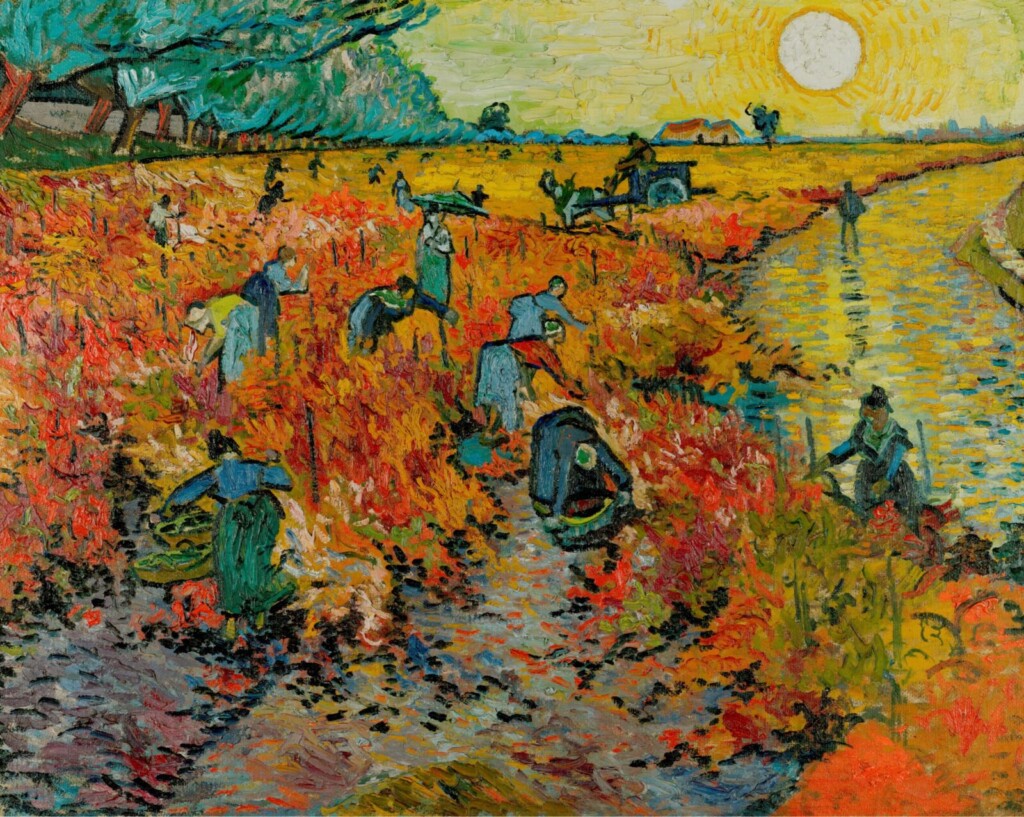
Consider what happened to Vincent van Gogh’s market value. During his lifetime, between 1881 and 1890, he sold exactly one painting — “The Red Vineyard” — for 400 Belgian francs. By 1990, a single canvas fetched 82.5 million dollars at Christie’s. The gap between those two numbers is not explained by artistic evolution — his work was largely complete and largely ignored. It is explained by the mechanics of posthumous consecration: the biography of suffering, the romanticized breakdown, the severed ear transformed into a symbol of radical artistic commitment. The myth produced the market. Not the other way.
What Bourdieu’s framework forces into view is that this process is never innocent. When a major museum retrospectively honors a figure it would have never funded, platformed, or defended during their actual life, it is performing a kind of symbolic debt repayment that costs nothing and gains everything. The institution absorbs the prestige of having been adjacent to greatness while bearing zero responsibility for having obstructed it. The martyrdom narrative is, in this sense, the perfect alibi — it positions the culture as a tragic backdrop against which genius burned alone, rather than as an active system that applied economic and social pressure designed to silence voices that did not fit.
There is a particular kind of person who finds this arrangement deeply satisfying. They require the tragedy to be permanent, the misunderstanding to be total, because anything less would complicate the purity of the story they are consuming. A genius recognized in their own time is a professional. A genius recognized only in death is a saint. Sainthood is useful precisely because it removes the work from the domain of argument and places it in the domain of reverence — which is another way of saying it removes it from genuine engagement. You do not argue with a relic. You display it.
The retroactive currency of martyrdom buys something specific for the living: the feeling of superior perception, the pleasure of recognizing what earlier generations failed to see, without the discomfort of asking what you yourself are failing to see right now, in someone still breathing, still difficult, still refusing to be convenient.
A vision curated by a filmmaker, not an algorithm
In this video I explain our vision
The Genius Was Never Misunderstood
You sit across from someone who has just told you, with unmistakable pride, that Van Gogh’s contemporaries simply didn’t understand him. There is warmth in their voice, a kind of retroactive loyalty, as though recognizing the tragedy makes them exempt from it. But the story they are rehearsing is not an act of historical honesty — it is an act of historical absolution, and the distinction matters more than almost anything else we say about art, power, or the people who hold it.
The contemporaries understood. This is the fact that the myth of misunderstanding exists precisely to bury. When the Academic jury rejected Courbet’s work from the 1855 Paris Exposition Universelle, they did not fail to comprehend it. They comprehended it completely. They saw a painter who had relocated dignity from the aristocratic body to the laboring one, who had made the stone-breaker and the peasant woman into subjects of grandeur, and they recognized with absolute clarity what that gesture would cost the existing hierarchy of taste if it were legitimized. Rejection was not a failure of reading. It was a successful one.
Émile Zola, writing in defense of Manet in 1867, was not operating under the illusion that the critics who dismissed Olympia lacked the sophistication to decode it. He understood that they decoded it perfectly and reacted to exactly what they found: a naked woman who returned the gaze of the viewer without shame, without mythology to cloak her, without the allegorical distance that made female nudity acceptable to the bourgeois eye. The painting did not confuse its audience. It refused to protect them, and they punished it for that refusal with the vocabulary of incomprehension, which is always more socially available than the vocabulary of fear.
What makes the misunderstanding narrative so durable is that it transforms an act of judgment into an accident of circumstance. If the jury, the critic, the patron, the public simply didn’t understand, then no one is guilty of anything except being historically located. The violence of exclusion becomes the innocence of confusion. Society writes itself a pardon in the language of epistemological limitation rather than confronting the simpler and more damning truth: the work was seen, weighed, and found threatening to something specific — a market, a theology, a social arrangement, a definition of the human that someone needed to remain intact.
Spinoza was not excommunicated from Amsterdam’s Jewish community in 1656 because the elders of the Talmud Torah congregation couldn’t follow his arguments. The cherem issued against him was one of the harshest ever recorded, and its language — speaking of abominable heresies and monstrous deeds without elaborating them — is precisely the language of an institution that understands what it is suppressing. Vagueness in the indictment is not evidence of confusion. It is evidence of strategy. You do not name the dangerous idea in the document that officially condemns it, because naming it gives it a second life.
The myth also performs a secondary function that is almost more insidious than its first: it allows the living to perform a solidarity with the dead that costs nothing. To say that Schubert died unrecognized, that Melville was ignored, that Dickinson published almost nothing in her lifetime, is to position oneself on the right side of a history that is already closed. The risk has been removed. The genius is safely dead, the judgment safely reversed, and the mourner can grieve the injustice without ever asking what it is they themselves refuse to see right now, today, in the work that is being produced in their own present tense, in the exhibitions they don’t attend, the manuscripts they don’t finish reading, the musicians playing to empty rooms while alive.
The question that the misunderstanding myth forecloses is the only question worth asking: not what did they fail to see, but what did they see, and choose.
What We Do to the Living
You are sitting in a meeting where someone younger than you, less credentialed than you, proposes something that does not fit the existing framework. Watch what happens to the room. Not hostility, not exactly — something more refined than that. A kind of collective cooling, a slight withdrawal of attention, the conversation moving forward as if the idea had been a minor interruption in the weather.
This is not a historical pattern. It is a Tuesday.
The machinery that destroyed Ignaz Semmelweis — the Hungarian physician who in 1847 demonstrated that handwashing by doctors reduced puerperal fever deaths from roughly ten percent to under two percent, and who was institutionalized and beaten to death in an asylum at fifty-seven, likely from the very infection he had spent his life trying to prevent — that machinery did not dismantle itself when the germ theory of disease was confirmed. It modernized. Peer review, introduced in its current form largely after World War II and systematized throughout the 1970s and 1980s, was designed to filter error from scientific discourse. What it also filters, with remarkable consistency, is anything that does not speak the language the committee already understands. A 2014 study published in the journal Research Policy found that truly novel scientific papers — those making unexpected connections across distant fields — were statistically less likely to be cited for years after publication and more likely to have been initially rejected. The gatekeeping had simply become procedural, anonymous, and therefore invisible to those exercising it.
Social media did not dissolve this dynamic. It accelerated it. The consensus mechanism on any large platform operates by rewarding what already resonates — what already fits the pattern the audience has internalized — and penalizing the unfamiliar through the quiet brutality of non-engagement. A post that challenges a deeply held belief does not get argued with; it gets ignored, which is a more efficient form of erasure. Pierre Bourdieu, writing in Distinction in 1979, mapped how cultural capital functions not as a neutral measure of quality but as a self-replicating system in which those who already hold the currency decide what counts as valuable. What he described in terms of French class structure in the mid-twentieth century now runs on servers, expressed in metrics, but the underlying logic — that legitimacy flows downward from those who already possess it — remains untouched.
Tastemaking culture has absorbed this into its own mythology. The language of disruption, of discovering the next overlooked voice, performs the gesture of openness while reproducing the same filters in new clothing. What gets discovered is almost always legible within an existing aesthetic grammar. The genuinely strange, the genuinely premature, the work that requires its audience to build new categories before they can even perceive it — that work does not get discovered. It gets filed away, often by its own creator, who eventually learns to speak in the dialect that moves through rooms without cooling them.
The cost is not only borne by the individuals erased. Every field carries the weight of what it refused. Nikola Tesla’s work on alternating current and wireless energy transmission was systematically marginalized by an industrial infrastructure that had already committed its capital elsewhere, and what followed was not simply one man’s suffering but decades of delayed development in electrical systems that would eventually arrive anyway, later, more expensively, built on top of structures designed to resist them. The loss is always collective, but it is distributed so diffusely that no one has to hold it. No one signs the document that says: we have decided that this person’s contribution to the world is not worth the discomfort of receiving it.
What makes the present moment particularly resistant to recognizing this is the genuine belief — sincere, widespread, reinforced daily — that the tools we now have for surfacing overlooked work have solved the problem that silenced previous centuries.
The Trap Inside the Myth
You have probably, at some point, held your own silence like a secret treasure — told yourself that the world’s indifference to what you carry inside is simply proof of how far ahead you are running.
That feeling is not harmless. It is the exact mechanism by which the myth of the misunderstood genius stops being a historical observation and becomes a personal sedative, a narrative you administer to yourself in small doses every time external reality fails to confirm your self-image. The danger is not that the myth is false — it contains genuine historical cases, real figures crushed by institutional blindness, actual ideas that arrived decades before the conceptual infrastructure needed to receive them. The danger is structural: the myth is indifferent to the quality of what you are carrying. It offers identical emotional comfort to the person sitting on something genuinely disruptive and to the person sitting on nothing at all, and it cannot tell them apart, because it was never designed to.
This is what makes it categorically different from other consoling narratives. Most illusions at least require some minimal alignment with reality to sustain themselves. The misunderstood genius myth requires only the experience of not being recognized — which is, statistically, the universal condition of almost every human being who has ever tried to produce something. In 1962, Decca Records rejected the Beatles on the grounds that guitar groups were on their way out. That fact circulates endlessly because it seems to validate every rejected creator. What it actually demonstrates is far narrower and far colder: that occasionally, very rarely, institutional judgment is catastrophically wrong. It says nothing about the probability that your rejection belongs to the same category.
The sociologist Everett Hughes, writing in the 1950s on the sociology of work and deviance, identified what he called the “master status” — the single identity characteristic that overrides all others in social perception. The misunderstood genius narrative functions as a master status applied retroactively and prospectively at once: it reframes every past failure as evidence of superiority and pre-empts every future failure with the same logic. It is a closed epistemological loop. No external data can enter it and survive. Rejection confirms the thesis. Silence confirms the thesis. Even occasional recognition can be absorbed and neutralized — you were recognized partially, superficially, by people who still did not grasp the full depth of it.
What makes this particularly insidious is that the myth actively colonizes the people who would most need to break out of it. The genuinely threatening thinker, the one actually carrying something the culture is not ready for, has no reliable way to distinguish their situation from the person manufacturing protective self-mythology. Both feel the same friction. Both experience the same institutional resistance. The myth does not provide a diagnostic tool; it provides a shared vocabulary that flattens the difference between them into irrelevance. Genuine disruption and elaborate self-deception wear the same face from the inside, and the myth ensures they are given the same name.
There is a specific cruelty in how the narrative gets transmitted. It is always told from the future looking back, always narrated from the position of confirmed vindication — Van Gogh now worth hundreds of millions, Semmelweis now in every hospital protocol, Moby-Dick now on every canonical list. The retrospective gaze makes the suffering legible as meaningful, the isolation readable as necessary, the death almost aesthetically fitting. But that gaze is only available to the people who were, in fact, eventually vindicated. The ones who were simply wrong, or simply not good enough, or simply unlucky in a way that carried no hidden greatness — they do not get narrated at all, and their silence is the actual statistical weight of the myth, the vast dark matter that the story requires in order to keep shining.
🕯️ Unrecognized Brilliance: Genius Beyond Its Time
History is full of minds whose depth the world could not absorb while they still lived. These articles explore the painful distance between creative vision and social recognition, tracing the paths of those who worked in solitude, obscurity, or outright hostility — only to be vindicated by posterity.
La Bohème: History and Myth of the Poor Artist
The myth of the poor artist living in garrets and dying unknown is not merely romantic legend — it is a structural condition that has shaped entire cultural movements. This article traces the history of the Bohemian ideal, from Henri Murger’s Parisian circles to its lasting influence on how society imagines artistic sacrifice. Understanding La Bohème means understanding why so many geniuses were buried before they were celebrated.
GO TO THE SELECTION: La Bohème: History and Myth of the Poor Artist
Nikola Tesla: the Genius That Power Could Not Afford
Nikola Tesla is perhaps the most emblematic case of a visionary whose discoveries were suppressed, stolen, and systematically marginalized by the very powers that stood to benefit from them. This article examines the life of a man whose imagination outpaced the industrial age while his material existence crumbled around him. Tesla died in poverty and relative obscurity, leaving a legacy that only the following century would begin to fully appreciate.
GO TO THE SELECTION: Nikola Tesla: the Genius That Power Could Not Afford
The Cursed Poet: History and Figures
The figure of the cursed poet — Rimbaud, Verlaine, Nerval, Lautréamont — crystallizes the archetype of the genius punished by society for refusing its norms. This article explores how the label ‘maudit’ became both a sociological diagnosis and a romantic myth, binding together madness, poverty, and visionary power. Many of these poets were recognized only after death, their manuscripts salvaged from oblivion by the few who understood what had been lost.
GO TO THE SELECTION: The Cursed Poet: History and Figures
Shelley and the Defence of Poetry: Poets as Legislators
Shelley’s Defence of Poetry is a foundational text in understanding why societies resist their greatest minds until it is too late to thank them. He argued that poets are the unacknowledged legislators of the world — a claim that resonates painfully when read alongside the biographies of those who died unseen. This article unpacks Shelley’s vision of the poet as prophet and outcast, whose truth only ripples outward long after the voice has gone silent.
GO TO THE SELECTION: Shelley and the Defence of Poetry: Poets as Legislators
Discover Cinema That Refuses to Be Forgotten
On Indiecinema you will find films that share this same spirit of defiance — stories about artists, dreamers, and thinkers whose work the world was not yet ready to receive. Explore our independent streaming catalog and encounter the cinematic voices that, like so many misunderstood geniuses, are simply waiting for their moment to be truly seen.
👉 EXPLORE THE CATALOG: Watch Indie Films in Streaming
A vision curated by a filmmaker, not an algorithm
In this video I explain our vision

