
The Paintbrush Left on the Table
You stand in the kitchen at seven in the morning, and the light comes through the window at an angle that makes everything look like it belongs to someone else’s life. The coffee is brewing for him. The lunches are already made. On the counter, half-hidden behind a stack of permission slips and a ceramic fruit bowl you chose because it matched something, there is a paintbrush. The bristles have stiffened slightly. You notice this the way you notice a bruise you don’t remember getting.

There is a particular kind of erasure that does not announce itself. It arrives dressed as reasonableness. It speaks in the language of practicality, of timing, of not being selfish, of waiting for the right moment, which is always approximately six months from now, which has been six months from now for eleven years. Simone de Beauvoir wrote in 1949 that women are not born into their condition but made into it, shaped by a thousand small acquiescences that feel like choices because no single one of them is violent enough to be called a theft. What makes her argument still unbearable to sit with is not its radicalism but its precision. The theft is dispersed so thoroughly across daily life that the woman doing the losing often becomes its most efficient administrator.
The sociologist Arlie Hochschild spent years documenting what she called the second shift in her 1989 study of that name, the invisible labor that persists after the paid workday ends, the mental load of remembering, anticipating, coordinating, soothing. But the third shift nobody names is the creative one, the hours that were never stolen because they were never formally claimed. You cannot mourn time you never officially owned. You cannot grieve a self you only ever described in the future tense.
What is astonishing, and what almost no cultural narrative prepares women for, is the physical sensation of that recognition when it finally arrives. It is not dramatic. It does not arrive as a breakdown or a revelation. It arrives as a stiffened paintbrush on a kitchen counter. It arrives as the sudden awareness that you have been fluent in everyone else’s needs and have not spoken your own language in so long that you are no longer certain you remember the grammar. Psychologist Mary Ainsworth’s work on attachment, developed through the 1960s and 1970s, showed how children learn to suppress their own distress to maintain proximity to caregivers. What was never followed rigorously enough was the question of what happens when those children become women in their thirties and forties who have been so thoroughly trained in the suppression of self-signal that they can no longer distinguish their own hunger from the ambient noise of other people’s comfort.
The cultural story about female creativity has always carried a caveat. The woman artist, the woman writer, the woman composer has historically been permitted to exist only in brackets, after the children are grown, before the demands resume, during a window, always during a window. Virginia Woolf put the number at five hundred pounds a year and a room of one’s own in 1929, and the world treated it as a metaphor when she meant it as a material fact. The room was not symbolic. The money was not a philosophical gesture. She was describing a structural precondition that most women in 1929 did not have and that a quietly alarming number of women in the present do not have either, not in the sense that matters, not a room where they are not also on call.
The paintbrush on the counter is not waiting for inspiration. It is waiting for a woman to stop managing the conditions of everyone else’s flourishing long enough to ask a question she already knows the answer to but has not yet allowed herself to finish asking.
Thirsty
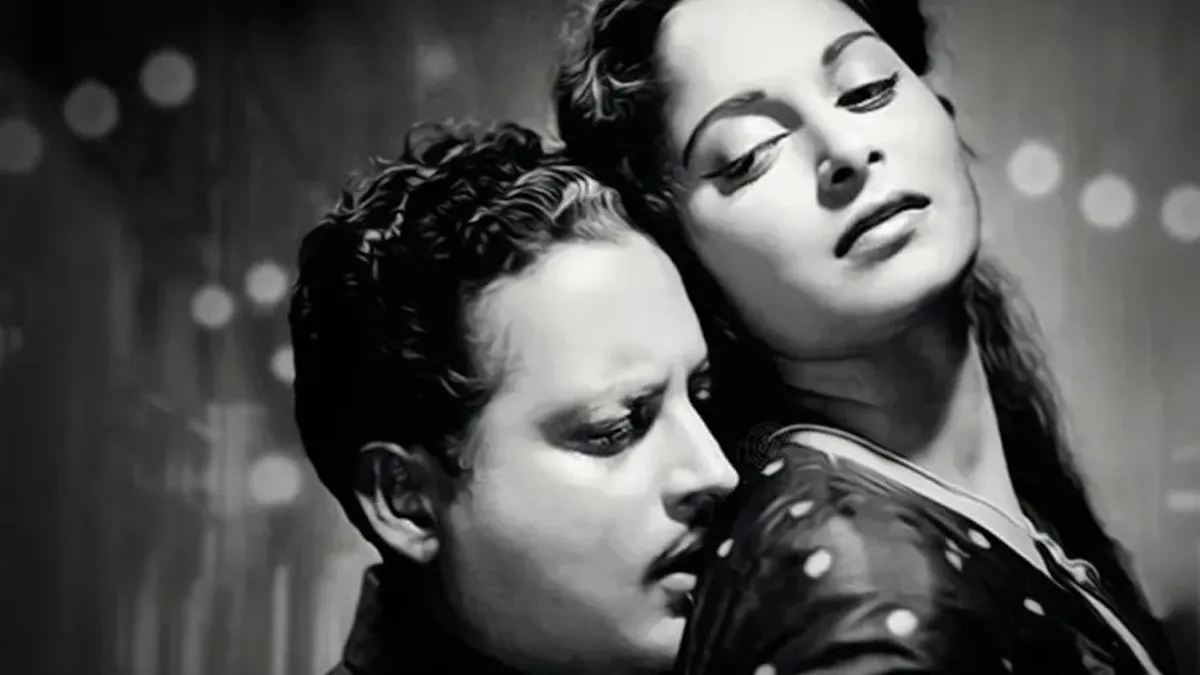
Drama, musical, by Guru Dutt, India, 1957
Thirsty is the heartbreaking story of Vijay, a young poet living in Calcutta who dreams of giving voice to the suffering and injustice of the world through his verses. Idealistic and sensitive, Vijay clashes with a society that despises his art because it is not profitable and does not cater to the tastes of the public. His brothers consider him a failure, the woman he loves leaves him for a marriage of convenience, and his poems are ignored by publishers. Only Gulabo, a prostitute with a pure heart, recognizes the beauty and truth of his words. When a misunderstanding leads everyone to believe Vijay is dead, his name and poetry suddenly become famous, exposing the hypocrisy of those who had previously rejected him.
Watching Thirsty means immersing oneself in a work that goes beyond melodrama, blending poetry, music, and imagery into a profound reflection on the human soul and the value of art. Guru Dutt, director and protagonist, creates one of the most intense and poetic films in world cinema, where black-and-white cinematography, expressive framing, and evocative lyrics produce an atmosphere of poignant melancholy. It is a film about the misunderstanding of the artist, pure love, and society’s hypocrisy, but also a universal critique of materialism and opportunism. Even today, Thirsty moves and provokes thought because it sincerely tells the story of the need to remain true to oneself in a world that measures people’s worth solely by their success.
LANGUAGE: Hindi
SUBTITLES: English, Spanish, French, German, Portuguese
The Architecture of Deferral
You are forty-three years old and you are standing in a kitchen that is not metaphorical — it has a cracked tile near the stove you have been meaning to fix for two years, a child’s drawing held to the refrigerator by a magnet shaped like a pineapple, and a half-finished canvas rolled under the bed in the room upstairs that you pass every morning without opening the door.
The canvas is not a symbol of neglect. It is evidence of a structure.
Simone de Beauvoir argued in 1949 that the deepest injury done to women was not the prohibition of action but the assignment of a metaphysical role: immanence rather than transcendence. Transcendence, in her framework borrowed from existentialist philosophy, means the project of going beyond oneself, of making something in the world that did not exist before. Immanence means the maintenance of what already is — the repetition of life’s conditions, the sustaining of others’ survival, the preservation of the household as a closed system. Her insight was not that women were forbidden to create. It was that they were recruited, at the level of culture and daily expectation, into a function that structurally consumes the energy transcendence requires. The woman who feeds, organizes, soothes, and coordinates is not lazy. She is metabolized by a system designed to extract exactly that labor and leave nothing residual.
What is rarely acknowledged is how willingly this extraction is accepted, even pursued, because the cultural script frames it as love. Erik Erikson’s concept of generativity — the adult stage concerned with nurturing the next generation — was constructed almost entirely from male biographical data, published in his 1950 work Childhood and Society, and yet it was applied universally as though women’s generativity were identical in cost to men’s. For men in his model, generativity coexisted with professional achievement and creative legacy. The data he drew on included figures like Luther and Gandhi, men whose inner lives were tended by women so thoroughly that their solitude was structurally guaranteed. The woman in Erikson’s world was the condition for someone else’s generativity, not its equal subject.
This is where deferral becomes architectural rather than personal. It is not a choice made on a specific afternoon. It is a posture that accumulates across thousands of micro-decisions, each of which appears rational in isolation: this is not the right moment, the children are young, the finances are precarious, there will be time later. Psychologist Ruthellen Josselson, in her longitudinal study published in 1987 as Finding Herself, tracked the identity development of women over decades and found that many of the women who had most thoroughly subordinated their own projects to relational and caregiving demands did not experience this as suppression at the time it was happening. They experienced it as virtue. The sensation of self-abnegation and the sensation of moral correctness were indistinguishable, which is precisely what makes the structure so durable.
Deferral is also transmitted. A daughter watches her mother redirect conversations away from her own desires, smooth over her own exhaustion, perform enthusiasm for other people’s projects with a consistency she never directs toward her own. This is not instruction. It is demonstration. Pierre Bourdieu called this kind of learning doxa — the pre-reflective absorption of the social order as natural — and in The Logic of Practice, published in 1980, he described how the most effective forms of social reproduction happen below the threshold of consciousness, before the question of consent can even arise. The girl does not decide to inherit her mother’s self-suspension. She simply grows into a body that already knows how to perform it.
The canvas under the bed does not represent a dream deferred in the sense of something explosively potential, waiting. It represents a habit of mind that has learned to treat its own urgency as negotiable.

What the Renaissance Actually Was
You have probably stood in front of a painting in a museum and felt something close to reverence, a quiet certainty that what you were looking at had emerged from a singular, almost divine interior — one man, one vision, one uninterrupted act of genius. That feeling is not accidental. It was manufactured over centuries with considerable institutional effort, and you absorbed it the way you absorbed grammar: before you had any choice in the matter.
The Renaissance did not produce genius. It produced conditions. Workshops, patronage networks, guild memberships, access to live models, years of supervised technical apprenticeship — these were the actual infrastructure of what we retrospectively call creative greatness. When Giorgio Vasari assembled his Lives of the Artists in 1550, he was not documenting natural phenomena. He was building a mythology that served specific interests, encoding a particular kind of subject — male, guild-trained, Church-adjacent — as the only possible vessel for artistic transcendence. The story he told was so seductive and so structurally embedded that five centuries later it still shapes which names appear on museum walls and which do not.
Linda Nochlin arrived at that wall in 1971, in the pages of ARTnews, and asked a question so blunt it functioned like a slap. Why have there been no great women artists? The power of the essay was not in its answer but in its refusal to accept the premise hiding inside the question — the assumption that absence of achievement implied absence of capacity. What Nochlin demonstrated, with a precision that made her contemporaries visibly uncomfortable, was that the question itself was the trap. Women had been systematically excluded from the very institutions that produced the conditions for greatness: the Academy in France barred women from life drawing classes using nude models until 1897, nearly three full centuries after such training had become the non-negotiable foundation of canonical Western painting. You cannot produce the work the culture will later call great if you are legally and institutionally prohibited from acquiring the skills that work requires. This is not a subtle point. It is an architectural one.
What made Nochlin’s intervention so destabilizing was not just the historical record she exposed but the psychological mechanism she named. The exclusion had not been maintained through overt cruelty alone — it had been laundered through the language of natural law. Women were absent from the canon because women lacked the inner fire, the rational discipline, the sublime restlessness that genius required. The institutional barrier was invisible because it had been translated into biology. And once something is biology, it stops being a grievance and becomes a fact of nature, as uncontestable as the tides. The cruelty of this move is that it doesn’t just block women from institutions — it colonizes the interior, training women to experience the results of structural exclusion as personal deficiency.
This is the mechanism that persists long after the formal barriers dissolve. The Academy doors open, the life drawing classes become available, the grant applications are technically gender-neutral — and still something calcifies inside the woman who sits down to make work, a voice that sounds nothing like an external prohibition and everything like self-knowledge. She does not think: I was kept out. She thinks: I am not the kind of person who. The historical lie has completed its transformation into autobiography.
What the Renaissance actually was, then, is a set of arrangements that made certain people’s interiority visible and legible as art while rendering others structurally mute — and then told the mute ones they had nothing to say. The woman who reinvents herself creatively in middle age, or after a marriage, or after years of being the one who made everyone else’s conditions possible, is not discovering a talent that suddenly appeared. She is excavating something that was always there but was never given the infrastructure to become visible, not even to herself.
The Productivity of Interruption
You are sitting at the table with something almost finished — a canvas, a manuscript page, a half-built argument — when the domestic world reasserts its claim on you. Not violently. Just persistently, the way water finds the lowest surface. Someone needs feeding, or finding, or reassuring. The unfinished thing waits. Later, it no longer quite belongs to you the same way it did before the interruption, and you tell yourself the problem is discipline, focus, a personal deficiency of will.
That story — the one where the interrupted woman is the cause of her own incompleteness — is one of the more elegant pieces of social engineering ever produced. Arlie Hochschild, in her 1989 study that tracked the daily labor of dual-income couples across a decade, documented something the participants themselves struggled to name: women in those households were working what she calculated as an extra month of twenty-four-hour days per year compared to their male partners, an average of fifteen additional hours each week devoted to the invisible architecture of domestic life. The data did not describe exceptional households. It described the norm. And the norm, when you live inside it, does not announce itself as a political arrangement. It announces itself as Tuesday.
What Hochschild exposed was not simply a quantity of labor but a quality of cognitive drain that no time-use diary can fully capture. The management of a household is not merely the execution of tasks — it is the continuous mental labor of anticipating, scheduling, remembering, and worrying about tasks that have not yet become visible to anyone else in the room. Sociologists later named this phenomenon “cognitive load” or the “mental load,” but the naming arrived decades after the condition had already structured an entire generation of women’s creative lives around gaps, pauses, and the discipline of abandoning things mid-thought.
To call this a “second shift” was already to frame it in the language of industrial labor, which is precise in one direction and insufficient in another. Industrial shifts end. They have whistles. The particular taxation on a woman’s attention that Hochschild was describing has no whistle, because it operates not on the body’s schedule but on the household’s emotional temperature — and emotional temperature has no closing time. Virginia Woolf understood this before the sociology existed to confirm it. In 1929 she calculated that a woman needed five hundred pounds a year and a room of her own not as luxury but as structural precondition — not for genius, but for the uninterrupted continuity of thought that genius, like any cognitive work, requires.
The cruelty of the arrangement is that interruption, experienced repeatedly, trains a woman to interrupt herself. After enough years of abandoning things mid-sentence, mid-stroke, mid-idea, the brain learns to preemptively abandon. It begins to discount its own sustained attention before anyone arrives to claim it. What looks from the outside like a lack of ambition or creative confidence is often this — an internalized efficiency, a learned anticipation of the next intrusion, the creative psyche reorganizing itself around the shape of its own recurring disappearance.
There is a particular kind of creativity that emerges from this condition, though, and it is not the creativity of abundance or uninterrupted flow. It is a creativity of compression, of working in seams and margins, of learning to think in the grammar of interruption itself. Some of the most structurally innovative work made by women in the twentieth century carries this signature — not in spite of the fractured conditions of its making but because those conditions demanded a different relationship to form, to linearity, to the idea that a completed arc requires continuous time. The interrupted mind, when it refuses to accept interruption as failure, sometimes discovers that discontinuity is itself a structure, that the gaps are load-bearing, that what was taken from the work has already become part of the work’s architecture.
When the Self Becomes Contraband
You wake at three in the morning with something urgent in your chest, a sentence, an image, a color you have no name for yet, and before your hand reaches the notebook on the nightstand, a voice arrives first. Not loud. Almost tender. It says: who do you think you are?
That voice has excellent manners. It knows your history, your failures, your approximate position in every room you have ever entered. It speaks in the first person, which is how you learned to trust it. It feels like conscience, like realism, like the reasonable adult in the room. It is none of those things.
Clarissa Pinkola Estés spent decades collecting folk stories from the oral traditions of Central European and Mexican communities before publishing “Women Who Run With the Wolves” in 1992, a book that sold millions of copies not because it flattered its readers but because it named something they recognized and feared. The name she gave it was the predator — not a monster from outside, but a psychic structure installed so early and so quietly that most women never locate it as foreign tissue. It mimics the self. It uses the self’s own vocabulary. Its primary function is not violence but interruption: it arrives the moment a woman begins to reach toward something that belongs only to her, and it redirects that energy into doubt, shame, exhaustion, the sudden urgent need to clean something.
What makes this architecture so difficult to dismantle is precisely its intimacy. External censorship is legible — a door closed, a permission denied, a name struck from a list. Societies have built elaborate systems to keep women out of academies, guilds, publishing houses, and performance halls, and those systems are documented, litigated, measurable. But a woman standing at her own desk at three in the morning, choosing not to write, generates no record. The suppression is invisible because she herself is both its agent and its object. She has absorbed the warden so completely that the cell no longer requires walls.
The psychologist Eugene Gendlin, developing his concept of the felt sense across decades of research culminating in his 1978 work “Focusing,” argued that the body carries knowledge that language has not yet organized, and that genuine creative or emotional movement begins precisely in that pre-verbal register. What he observed in therapeutic settings was that clients who had been taught to distrust their own interior signals — to override the vague, the uncertain, the not-yet-formed — lost access not just to emotion but to the generative function itself. They became competent. They became appropriate. They stopped surprising themselves.
A woman who has internalized the predator does not experience herself as suppressed. She experiences herself as lucid. She edits before she generates. She asks whether it is good before she asks whether it is real. She measures the distance between what she is making and what has already been praised, and she uses that distance not as information but as verdict. The creative act, which requires a tolerance for formlessness that feels dangerously close to failure, becomes something she approaches only after the outcome has been partially guaranteed — which means she rarely approaches it at all.
There is a particular grief that belongs to this condition, and it is not the grief of something stolen. It is the grief of something surrendered so long ago that the surrendering feels like a personality trait. Women describe it not as loss but as absence — the sense that there is a room inside them they have never entered, not because the door is locked but because they long ago convinced themselves it was not there. The voice that achieved this was quiet and consistent and called itself practicality, and it began speaking before they were old enough to know that a voice living inside you is not automatically yours.
A vision curated by a filmmaker, not an algorithm
In this video I explain our vision
A Woman Enters a Room She Was Not Supposed to Survive

She stands at the front of the room with her work projected behind her, and the silence that greets her first slide is not the silence of attention. It is the silence of recalibration — the room adjusting its expectations downward, or sideways, or into a category it had not prepared for her. The people seated before her are not hostile. That would be easier. They are politely uncertain, which is a different kind of erasure, the kind that requires her to perform her own legitimacy in real time while simultaneously defending ideas that a man in the same position would have been allowed to simply present.
What that room is enacting has a name, though the name is rarely spoken inside the room itself. In 1974, the psychologist Pauline Clance began documenting what she would eventually call impostor phenomenon — the internal experience of intellectual fraudulence despite evidence of competence — after noticing it with disproportionate frequency in high-achieving women at Georgia State University. The research she published with Suzanne Imes in 1978 was precise: the phenomenon did not emerge from a lack of ability but from a structural mismatch between external validation and internal permission to receive it. What rarely gets said about this finding is that the mismatch is not purely psychological. It is also architectural. The room itself produces it.
Erving Goffman spent the better part of his career mapping the rituals through which social groups signal who belongs and who is on probation. In “The Presentation of Self in Everyday Life,” published in 1959, he described how physical and institutional spaces function as stages, and how the audience’s response shapes what the performer can actually do within them. The woman standing at the front of that room is not paranoid. She is reading a script the room wrote before she entered it, one in which her presence is framed as exceptional in the diminishing sense of the word — tolerated as an exception rather than recognized as a fact.
There is a specific quality to what happens to creative work when it is made by someone the institution was not designed to house. The work gets read as personal when it should be read as structural, as emotional when it should be read as analytical, as marginal when the margin is in fact the place where the most destabilizing intelligence lives. Virginia Woolf understood this in 1929 when she wrote that a woman must have money and a room of her own to write fiction — but the sharper point, the one that slips past people who quote the sentence casually, is that she was not talking only about physical space. She was talking about the internal architecture that physical space either builds or destroys.
The institution does not need to refuse a woman entry to prevent her from being seen. It only needs to receive her work with that particular lateral silence — the kind that does not say “no” but says “interesting” in a tone that means “irrelevant.” Thousands of women have navigated this room, and the evidence of their navigation is written into the shape of the work they produced: the doubling, the indirection, the formal strategies that encode what could not be stated frontally without triggering the room’s instinct to dismiss. Sandra Gilbert and Susan Gubar documented this in “The Madwoman in the Attic” in 1979 — the ways nineteenth-century women writers developed a literature of concealment and subversion precisely because the alternative was silence enforced from outside rather than chosen from within.
What the woman at the front of the room is doing, whether she names it or not, is refusing to perform the apology the silence is requesting. She continues speaking. The work remains on the screen behind her. And the room’s discomfort — the way certain people shift, the way the questions that follow address everything except the work’s central claim — is not a failure of her presentation.
Reinvention as Epistemological Violence
You have been told, at some point, that your creative awakening was brave. Someone said it warmly, probably someone who meant well, and you received it as a compliment because the architecture of the sentence left no room to refuse it. Brave implies that the danger was yours to navigate. It implies the obstacle was weather — impersonal, unfortunate, no one’s fault.
Miranda Fricker, in her 2007 work Epistemic Injustice, names something most people have felt but never had the vocabulary to resist: the harm done not through violence or exclusion alone, but through the systematic distortion of whose knowledge counts, whose testimony is credible, whose interpretation of their own experience is permitted to stand. She calls one form of this testimonial injustice — the deflation of a speaker’s credibility based on identity — and another hermeneutical injustice, which occurs when the very concepts needed to articulate an experience simply do not exist yet, because the people who needed them were never allowed to build them. A woman who could not name her own creative suffocation was not confused. She was living inside a language designed to make that suffocation invisible.
What the reinvention narrative does, with its warmth and its Instagram captions and its magazine profiles, is hand that woman a new vocabulary and call it liberation while leaving the architecture of suppression entirely untouched. She gets to tell her story now. She is encouraged to tell it as a story of interior transformation — seeds that finally found water, a self that finally broke through. The political question of who withheld the water, and why, and whether they will do it again to the next woman, dissolves into a celebration of personal resilience that the culture can consume without discomfort.
This is not accidental. Individualization is one of the most efficient tools available for neutralizing collective grievance. When the Harvard Business Review studied women’s career interruptions across multiple industries between 2004 and 2010, it found that the dominant institutional framing consistently located the cause of absence in personal choice, family preference, or biological timing — never in organizational cultures that punished visibility, demanded impossible availability, or made creative authority structurally inaccessible to anyone who was also expected to be the primary caregiver, the emotional regulator, the invisible infrastructure of a household. The data was consistent. The language used to describe it was not.
There is a particular cruelty in being asked to perform gratitude for arriving somewhere you were kept from. It forecloses the anger that would be the honest response. Gratitude requires you to receive the present moment as a gift, which means accepting the implicit framing that the giver had the right to decide when to offer it. A woman who publishes her first novel at fifty-three after two decades of writing in margins and early mornings is celebrated for her persistence. What persisted, though, is the question no profile asks: what precise combination of gendered expectations, economic dependency, and cultural contempt for women’s creative interiority required that persistence in the first place.
George Eliot, born Mary Ann Evans in 1819, published her novels under a male name not because she lacked confidence but because she understood with complete clarity that the critical apparatus of her era would read her work differently depending on the name attached to it. She was right. When her identity became known, a significant portion of the critical response shifted — not to engage more seriously with the work, but to process the revelation of her gender as itself the story. The novels did not change. The hermeneutical frame around them did, and it contracted. What she had accomplished did not grow with the disclosure. It became more easily dismissible, more easily domesticated into the register of exception, of pleasant surprise.
To call what a woman overcomes a personal reinvention is to locate the rupture inside her body, inside her psychology, inside some story of private becoming — which means the wall she broke through gets to remain standing for the next woman behind her, completely intact.
The Unfinished Gesture
You finish the painting at two in the morning because that is the only hour the apartment belongs entirely to you, and when you set down the brush you do not photograph it, do not show anyone, do not even stand back to look at it properly, because looking would require a kind of permission you have not yet been granted by the world and are no longer certain you need.
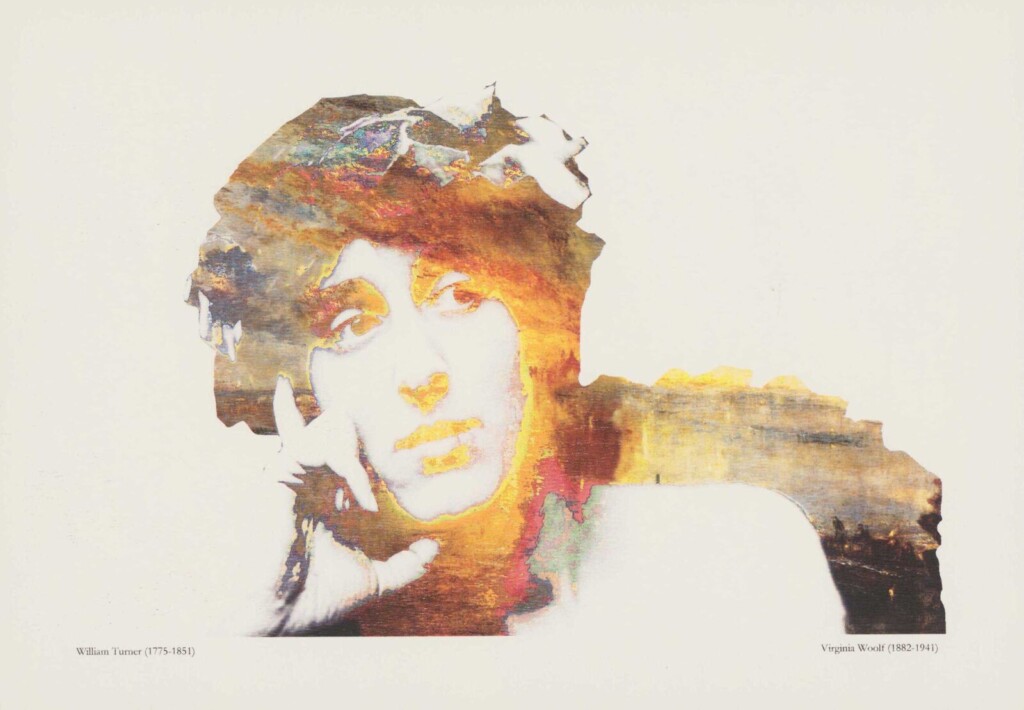
Virginia Woolf calculated in 1929 that a woman required five hundred pounds a year and a room with a lock on the door in order to write fiction — not inspiration, not talent, not a sympathetic audience, but money and physical autonomy, the two things most systematically withheld from women across the preceding centuries. The argument was precise and almost clinical in its materialism, which is why it unsettled so many readers who wanted creativity to be a matter of spirit rather than economics. Woolf was mapping the structural conditions that determined whether a woman’s thought could survive long enough to become a sentence, a paragraph, a completed work. She was not writing about genius. She was writing about infrastructure.
What Woolf could not fully account for, writing in 1929, was the particular psychological residue left by centuries of interrupted work — the internal censor that persists even after the external conditions have nominally improved. Contemporary data on unpaid domestic labor shows that women in dual-income households still absorb between sixty and seventy percent of caregiving and household management, a number that has shifted only marginally since second-wave feminism restructured the public conversation about equality in the early 1970s. The room may now exist. The lock may sometimes be on the door. But the brain trained by decades of interrupted attention does not suddenly produce unbroken thought simply because the structural permission has arrived.
There is a specific form of creative courage that receives almost no cultural recognition, and it belongs to the woman who makes work she is not certain anyone will ever see, not because she is hiding it but because she has stopped organizing her creative life around the axis of reception. The art world, the literary world, the music industry — all of them evolved around an implicit model of the creating subject as someone whose work moves outward toward an audience and is validated by that movement. The woman who paints at two in the morning and does not photograph it is operating outside that economy entirely, and the culture has no ready language for what she is doing, which means it tends either to romanticize her as a secret genius or to dismiss her as someone who lacks ambition.
Sylvia Townsend Warner published her first novel, Lolly Willowes, in 1926, three years before Woolf’s essay, and inside it is a woman who chooses a form of autonomous existence — rural, uncelebrated, illegible to her family — that the novel presents not as failure but as a peculiar kind of sovereignty. What Warner understood, and what the novel enacts rather than argues, is that the refusal to organize one’s life around external legibility is not a withdrawal from the world but an advance into a different relationship with one’s own interiority. That distinction is still not well understood.
The woman who creates without the guarantee of reception is not creating in a vacuum. She is creating in a specific historical pressure, against a specific set of inherited expectations about what female productivity is supposed to look like and whom it is supposed to serve. Every finished canvas, every completed manuscript, every song recorded in a phone’s voice memo at midnight carries inside it the weight of all the work that was interrupted before it, all the half-finished things that were set aside not because the maker lost interest but because someone needed something, and she was the one who was trained, from very early on, to be the one who stopped.
🌸 Voices That Broke the Mold: Women, Art & Rebirth
The story of women who reinvent themselves creatively is never told in isolation — it echoes through literature, philosophy, and the arts across centuries and cultures. These related articles explore the deeper currents of female expression, resistance, and the courage to claim one’s own voice against every expectation.
Woolf’s A Room of One’s Own: Feminism and Writing
Virginia Woolf’s landmark essay remains one of the most powerful manifestos on the conditions women need to create freely — a room, an income, and above all, the right to exist as a full subject. Woolf dismantles centuries of cultural silence not with anger alone, but with devastating clarity and irony. Her argument still resonates for every woman who has had to fight for the space to become herself.
GO TO THE SELECTION: Woolf’s A Room of One’s Own: Feminism and Writing
Ismat Chughtai: The Writer Who Challenged India’s Modesty
Ismat Chughtai wrote stories that colonial and patriarchal India desperately wanted to suppress, placing female desire, domestic rebellion, and social hypocrisy at the very center of her fiction. She faced obscenity trials and public condemnation, yet never retreated from the truth of women’s inner lives. Her work is a testament to how reinvention begins when a woman refuses to write what she is told.
GO TO THE SELECTION: Ismat Chughtai: The Writer Who Challenged India’s Modesty
Frida Kahlo: Life and Works
Frida Kahlo transformed chronic pain, a shattered body, and a turbulent identity into one of the most fiercely personal bodies of work in twentieth-century art. Her self-portraits are not vanity but excavation — a relentless reimagining of who she was beneath every wound and cultural label imposed upon her. Kahlo remains the archetype of the woman who does not survive her circumstances but creates through them.
GO TO THE SELECTION: Frida Kahlo: Life and Works
Virginia Woolf: Life and Works
Virginia Woolf’s life and literary output represent one of the most radical experiments in consciousness and female selfhood that modernism produced. From Mrs Dalloway to The Waves, she built entirely new narrative forms to capture how women think, feel, and remake themselves from the inside out. Her biography is inseparable from her art — both are acts of perpetual, courageous reinvention.
GO TO THE SELECTION: Virginia Woolf: Life and Works
Discover More on Indiecinema
If these stories of creative awakening have moved you, Indiecinema streaming is where the journey continues — with independent films that dare to put women’s inner transformations at the heart of the screen. Explore a curated world of cinema that refuses easy answers and celebrates the courage to begin again.
👉 EXPLORE THE CATALOG: Watch Indie Films in Streaming
A vision curated by a filmmaker, not an algorithm
In this video I explain our vision

