
The Ticket Stub in Your Hand
You paid a dime. That is what it cost — ten cents, the price of a glass of beer — to step through the canvas flap into a space that smelled of sawdust and lamp oil and something else underneath, something animal and close, the smell of bodies held too long in one place. The crowd pressed around you, strangers whose elbows found your ribs without apology, and everyone was looking forward at the low wooden stage where a man in a frock coat was speaking with the velocity of someone who understood that your attention, once given, could be just as quickly withdrawn. You had not come here by accident. You had seen the lithograph posted on the barbershop wall, the one with the illustration that made your pulse do something involuntary, and you had made a series of small decisions — the route you walked, the coins you selected from your pocket — that brought you to exactly this spot, in exactly this complicity, at exactly this hour.

What happened next is the part that does not appear in the historical record with any honesty. Not the performer on the stage, not the frock coat, not the words being spoken into the yellow light — but the sensation that moved through you when you looked. Something that was not quite pity and not quite fascination and not quite relief, though relief was the most accurate of the three, the relief of a body that has been silently negotiating its own normalcy all day and has finally found an external reference point. The freak show did not sell you a curiosity. It sold you a measurement. You left knowing something about where you stood.
P.T. Barnum understood this transaction with the clarity of a man who had studied human appetite without embarrassment. When he opened his American Museum on Broadway in 1841, running it for twenty-four years before it burned in 1865, he was not in the exhibition business in any straightforward sense. He was in the business of manufacturing categories. The people he placed on display — Charles Stratton, whom he renamed General Tom Thumb and exhibited across two continents; Joice Heth, the elderly Black woman he claimed was George Washington‘s 161-year-old nurse; conjoined twins Chang and Eng Bunker, whose very name entered the language — were not simply anomalies. They were instruments of social calibration, bodies that made the audience’s own bodies feel located, classified, verified.
What made this possible was a cultural infrastructure already primed to receive it. The nineteenth century was the great age of taxonomy — of Linnaeus’s hierarchies being extended beyond botany into human populations, of Samuel Morton filling 900 skulls with mustard seed in the 1830s and 1840s to measure cranial capacity and rank the races of man, of the emerging medical establishment drawing borders around the normal body with the precision of surveyors staking property lines. The freak show did not invent the idea that some bodies were aberrant. It simply monetized a consensus that science, medicine, and colonial ideology had already constructed in respectable language. Barnum was not ahead of his time. He was exquisitely of it.
The crowd in that tent was also something more specific than a crowd. It was a cross-section of a young republic that was furiously, anxiously assembling a definition of itself. Immigration was reshaping Eastern cities. The question of who counted as fully human was being debated in legislatures and fought in streets. The category of the normal American body was not a given — it was a project, contested and incomplete, and the freak show was one of the sites where that project was conducted in public, at a profit, with your voluntary participation recorded in the stub the man tore and handed back to you at the entrance, the small paper rectangle you probably dropped in the sawdust without thinking, the one that proved you had chosen to be there.
Spider Baby
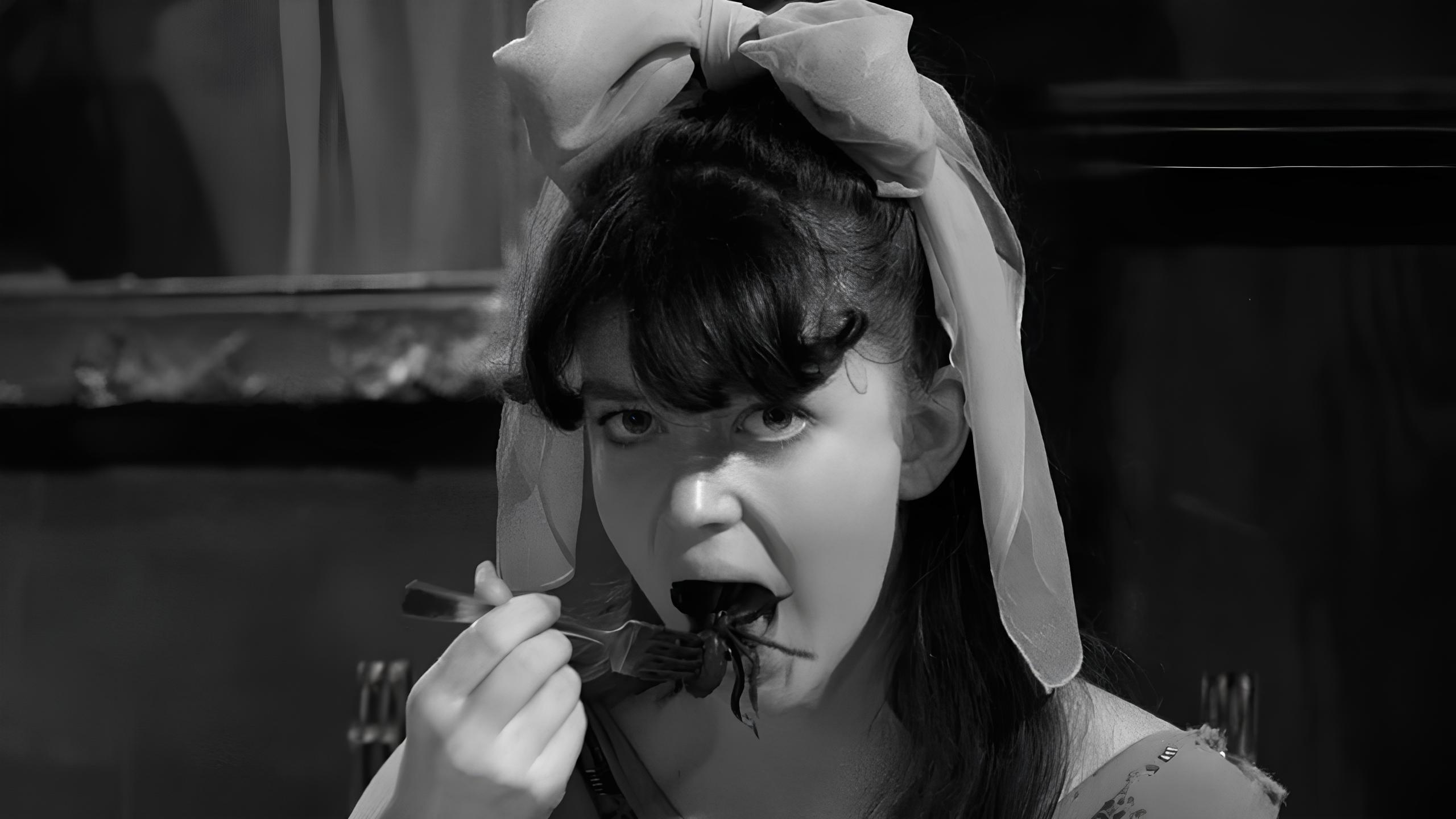
Horror, comedy, by Jack Hill, United States, 1967.
Spider Baby is a grotesque cult horror film that tells the story of the Merrye family, affected by a genetic disease that causes mental regression and feral behavior as they grow older. In an isolated house live Baby, her sisters, and the affectionate caretaker Bruno (Lon Chaney Jr.), who tries to contain their madness when unsuspecting guests arrive. The film mixes a gothic atmosphere, dark humor, and surreal tones, creating a disturbing yet almost fairy-tale world, a bizarre blend between classic horror and morbid comedy. Chaney delivers a surprisingly touching performance, and the direction manages to turn a tiny budget into a unique experience.
Spider Baby is an important cornerstone of American independent cinema: ironic, macabre, melancholic, and unconventional. Spider Baby is an experience that does not rely solely on fear, but plays with the theme of the “monstrous family” to talk about isolation, diversity, and decay, becoming over time a beloved cult title for those who seek a different kind of horror — deformed, grotesque, and unsettling at the same time.
LANGUAGE: English
SUBTITLES: Spanish, French, German, Portuguese
The Architecture of the Abnormal
You have stood in front of a mirror at some point in your life and felt, without being able to name it, that something was off — not broken, not monstrous, just slightly misaligned with some invisible standard you could not locate but somehow believed in absolutely. That standard was not discovered. It was manufactured, with considerable precision, by a Belgian astronomer named Adolphe Quetelet in the 1830s and 1840s, a man who had no interest in human bodies per se but was fascinated by the behavior of data. Quetelet noticed that physical measurements of human populations followed the same bell curve that governed errors in astronomical observation — the same mathematical pattern astronomers used to identify mistakes now appeared when you charted chest circumferences of Scottish soldiers or heights of French conscripts. He called the midpoint of this curve l’homme moyen, the average man, and in doing so committed what would become one of the most consequential category errors in modern history: he treated a statistical artifact as a human ideal.
The average, in any genuine mathematical sense, is a description of distribution, not a prescription for existence. A bell curve tells you where most measurements cluster; it says nothing about where they should cluster. Quetelet understood this at some level, yet his language kept sliding toward aspiration. The average man became, in his 1835 work Sur l’homme et le développement de ses facultés, a figure of physical and moral perfection, the center toward which all human variation was merely error or deviation. The word deviation here is not accidental — it carried its full gravitational weight. To deviate from the mean was not simply to differ; it was to fail, statistically and morally at once.
What Quetelet constructed as a tool for understanding populations, Francis Galton weaponized as a tool for sorting individuals. Working in London in the 1860s through the 1880s, Galton took the bell curve and asked a question Quetelet had left dormant: if the average was good, what would it mean to be better? His 1869 book Hereditary Genius argued that intellectual and physical superiority were heritable traits distributed across populations in predictable ways, and that society could, in principle, accelerate their concentration. He coined the term eugenics in 1883. The logic required, as its structural foundation, the prior existence of a defined normal — because you cannot select for the superior without first establishing what counts as merely adequate, and you cannot establish the adequate without naming what falls below it. The freak, as a social category, was not a discovery of the traveling exhibition circuit. It was a logical necessity produced by a statistical worldview that needed its lower tail as badly as it needed its upper one.
By the time P.T. Barnum was filling his American Museum on Broadway in the 1840s and 1850s, the conceptual architecture was already in place. The audiences who paid twenty-five cents to observe Charles Stratton or Josephine Myrtle Corbin were not responding to some raw, prehistoric instinct toward the monstrous. They were enacting a ritual of measurement, confirming through visible contrast where the boundaries of the normal had been drawn. The exhibition worked not because the performers were alien but because the audience needed them to be slightly more alien than their own secret fears about themselves. Every person who walked through Barnum’s doors carried some private deviation they had not confessed — a body that did not match the diagram, a desire that fell outside the mean — and the stage offered temporary relief through displacement.
What this means is that the history of the freak show is inseparable from the history of normality as an enforced social fiction, and that the enforcer was never the showman with his posters and his tickets but the scientist with his measuring tape and his charts, who convinced an entire civilization that the middle of a distribution curve was the proper destination of a human life.

Barnum's Mirror
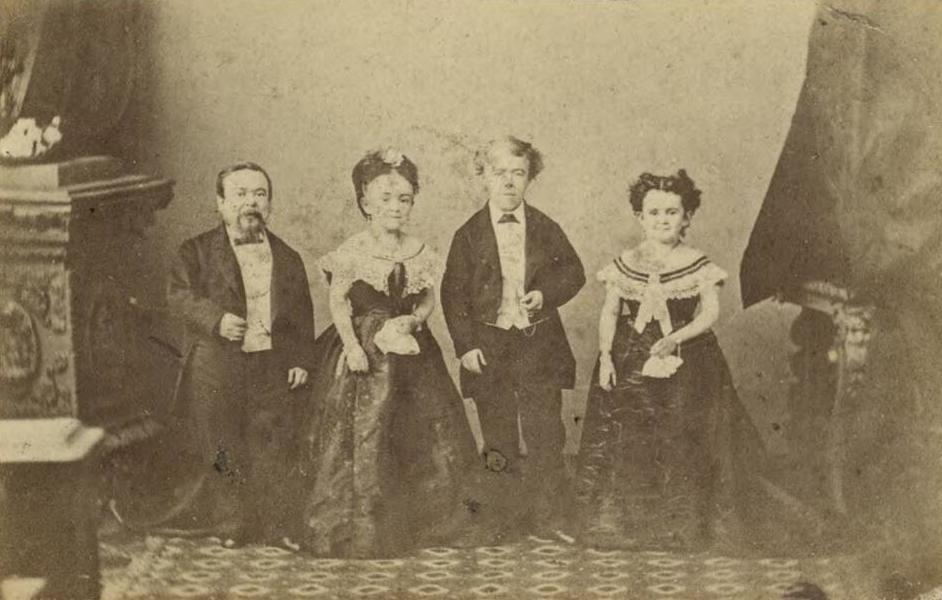
You paid your quarter at the door and received something you could not have named but desperately needed: proof. Not entertainment in any innocent sense, not curiosity satisfied, but a specific and transactional confirmation that the body you carried through the world was the correct kind of body. P.T. Barnum understood this before he had language for it, before anyone did. When he opened his American Museum on Broadway in 1841, filling its five floors with albinos and giants and conjoined twins and microcephalic men billed as “the last of an ancient race,” he was not trafficking in cruelty so much as in a sacrament — the ritual production of the normal self through sustained encounter with its designated opposite.
The theological structure of this is worth pressing on. Every religion requires its congregation to locate itself on a cosmic map, to know where it stands in relation to the divine and the damned. Barnum’s genius was to flatten that vertical axis into a horizontal one — not heaven above and hell below, but normal here and deviant there, separated by a velvet rope and an admission fee. The audience did not come to feel superior in any reflective way. They came to feel real. Michel Foucault‘s excavation of the clinical gaze in The Birth of the Clinic published in 1963 describes how the medical eye of the nineteenth century constituted the normal body precisely through its obsessive documentation of the abnormal one — but Barnum had already industrialized this process for mass consumption thirty years earlier, charging twenty-five cents for what the hospital charged nothing for and the church charged a soul.
By 1860 the American Museum was drawing roughly four hundred thousand visitors per year, numbers that dwarfed the attendance of any church, concert hall, or political rally in the city. This was not coincidence. The decades between 1840 and 1870 were precisely the period in which industrial capitalism was reorganizing the American body into a unit of labor, demanding standardization of physical capacity, punishing deviation from the productive norm with poverty or institutionalization. The freak show did not oppose this reorganization — it blessed it. To stand before Charles Stratton, the man Barnum marketed as “General Tom Thumb,” a man of twenty-five inches who earned more per week than most of his audience earned per month, was to watch the system perform a strange mercy: here is a body that cannot labor as yours can, and look, we have found a use for it anyway, behind glass, for your edification.
What Erving Goffman would later theorize in Stigma in 1963 — the mechanics by which a marked body becomes legible as a social category rather than a person — Barnum had already monetized into a coherent aesthetic. The exhibited person was stripped not of dignity in any simple sense but of ambiguity. They were rendered total, made to mean only one thing, which is the precondition for any object of ritual contemplation. The audience’s own ambiguities — their economic anxieties, their racial uncertainties in an era of massive immigration, their bodily shame in a culture newly obsessed with physiognomy and phrenology — could be temporarily suspended in the presence of a body that had been officially designated as the thing they were not.
Joice Heth, whom Barnum exhibited beginning in 1835 as a 161-year-old enslaved woman who had allegedly nursed George Washington in his infancy, offers the sharpest possible edge of this logic. She was neither a curiosity nor a fraud in the simple sense — she was a demonstration of what the American audience most needed to consume: a body that collapsed race, age, myth, and national origin into a single spectacle, allowing the predominantly white Northern crowd to stand before slavery’s most extreme human product and feel, for twenty-five cents, that they were merely witnesses.
The Consent Trap
You sign the contract yourself, and that is precisely where the trap closes. The ink is yours, the hand is yours, the name — however clumsily written — belongs to you, and yet the terms were drawn up by someone who understood compounding interest, booking fees, and the economics of spectacle before you understood that your body was a commodity with a shelf life.
Charles Stratton was four years old when Phineas Taylor Barnum arrived at his door in Bridgeport, Connecticut, in 1842. Whatever agreement was struck that first winter was not struck with Charles. It was struck with his father, Sherwood Stratton, a carpenter of modest circumstances who recognized in Barnum’s offer something that carpentry could never provide. By the time Charles — rechristened General Tom Thumb, dressed in the uniform of European aristocracy, schooled in jokes and jigs and Napoleonic poses — was performing before Queen Victoria, he was already the product of a negotiation he had never entered. And yet, as he aged into adolescence and then into a surprisingly prosperous adulthood, he renegotiated. He demanded percentages. He toured independently. He married Lavinia Warren in 1863 in a ceremony that drew two thousand guests to Grace Episcopal Church in New York and was covered by papers from Boston to San Francisco. The wedding was, itself, a performance — but it was one he chose, or at least chose within the narrow corridor of choices available to a man whose fame was inseparable from his body’s dimensions. The question of whether that constitutes freedom is one that most people would rather not sit with for too long.
What makes the contractual architecture of the freak show philosophically uncomfortable is that it collapses the clean opposition between coercion and consent that modern liberal societies depend on as a moral sorting mechanism. Michel Foucault, in Discipline and Punish published in 1975, described how power operates not primarily through force but through the organization of space, time, visibility, and knowledge — conditions that determine what choices even appear possible to a subject. Barnum did not need chains. He needed the platform, the lighting, the broadside, and the audience’s hunger. The performer who steps into that arrangement is exercising agency inside a structure that was built entirely to extract value from the thing that makes them different. Consent given inside that architecture is real, and it is also something else simultaneously, and there is no clean word for that.
William Henry Johnson — exhibited for decades as Zip the Pinhead, billed variously as the missing link, the what-is-it, as a creature allegedly captured in Africa despite being born in Liberty Corner, New Jersey, around 1857 — performed a version of animal bewilderment so convincingly that crowds left genuinely uncertain whether they had seen a man or something prior to one. He earned wages. He reportedly enjoyed his work. He outlived most of his contemporaries in the business, dying in 1926 at an estimated age of eighty-four, which suggests that whatever arrangement he maintained with Barnum and later with Ringling Brothers was not simply one of destruction. But he also spent the better part of sixty years allowing white audiences to rehearse a fantasy of racial hierarchy through his body, a fantasy with consequences that extended far beyond the tent. The enjoyment and the harm were not separate events happening in sequence. They occupied the same moment, the same sawdust floor, the same transaction.
What the showmen understood, and what their era had little framework for articulating, is that economic desperation and genuine performance talent can coexist inside a single person without canceling each other out. The sociologist Erving Goffman, writing in Stigma in 1963, argued that stigmatized individuals are not passive recipients of their social condition — they actively manage information, performance, and identity in ways that constitute a form of labor almost never recognized as such. What the freak show demanded was exactly that labor, priced accordingly, which is to say, not nearly enough.
Pathology as Performance
You are sitting in a wooden seat that slopes upward in a semicircle, one of perhaps two hundred students packed into a surgical amphitheater in Philadelphia or Vienna, and a man in a white coat leads a woman onto the floor below you as though presenting an exhibit. She is asked to undress partially. She is asked to turn. She is asked to describe her symptoms aloud, to a room full of strangers who are taking notes. Nobody has asked whether she consents to the theater of it.
Michel Foucault argued in The Birth of the Clinic, published in 1963, that the emergence of modern medicine in the late eighteenth and early nineteenth centuries produced what he called the “clinical gaze” — a mode of looking that transformed the suffering human body into a legible text, something to be read, interpreted, and classified by an authorized observer. The patient was no longer a person reporting an experience; they became a case, a specimen of a category, a surface upon which pathology inscribed its signs for trained eyes to decode. What Foucault identified was not merely a shift in medical epistemology but a redistribution of power so total that it naturalized itself almost immediately, making the subordination of the sick body to the observing institution feel like simple rationality, like science, like care.
The great medical amphitheaters of the 1870s and 1880s were not metaphorically similar to sideshows — they were structurally identical to them. At the Pennsylvania Hospital, at the Salpêtrière in Paris under Jean-Martin Charcot, at the Vienna General Hospital, patients diagnosed with hysteria, epilepsy, congenital anomalies, or simply poverty-adjacent illness were brought before audiences of students, physicians, and invited guests. Charcot’s Tuesday lectures, which drew writers, artists, and socialites alongside medical professionals, became genuine public spectacles. Women classified as hysterics were photographed, staged into postures of suffering, and their convulsions timed and catalogued in a project called the Iconographie Photographique de la Salpêtrière, published in three volumes between 1876 and 1880. The camera did not document their condition; it constructed a performance of it, selecting the most dramatic moments, instructing the women in postures that would read as authentically pathological to an audience trained to desire exactly that image.
What separated the amphitheater from the tent was not dignity or rigor but authorization. The physician’s gaze carried institutional legitimacy; the showman’s carried commercial admission. But both required a body that could not refuse, an audience that was permitted to look without reciprocity, and a narrative that converted the person in front of them into a category. The woman with acromegaly on Charcot’s floor and the woman billed as the “Elephant-Skinned Girl” on the Barnum circuit were subjected to the same fundamental transaction: their physical difference was surrendered to a public that paid — in money or in professional advancement — for the right to witness it. The medical framing did not protect the patient; it simply laundered the looking.
What this means for the history of American spectacle is that the freak show did not exist in opposition to respectable medical culture — it existed in continuous dialogue with it, borrowing its taxonomic language, its appetite for classification, its hierarchy of the normal and the aberrant. Many of the “exhibits” on the sideshow circuit were themselves examined, written about, and displayed in medical journals before they appeared under canvas. The Siamese twins Chang and Eng Bunker, born in 1811 and exhibited for decades, were subjected to repeated physical examinations published in the Boston Medical and Surgical Journal in 1829, their bodies measured, prodded, and described in the same clinical prose that would later appear on their promotional broadsides. The distance between the journal and the broadside was a matter of typeface, not ethics, not intention, not the nature of the transaction being conducted on the body of another person who had very little power to refuse it.
A vision curated by a filmmaker, not an algorithm
In this video I explain our vision
The Audience That Cannot Leave

You are watching a video you did not ask to watch. It appeared in your feed the way things always appear now — through the logic of adjacency, the algorithm’s quiet suggestion that what you paused on thirty seconds ago implies an appetite for this. A heavyset woman is walking through a parking lot. Someone filmed her from a moving car. The caption reads something like “wait for it.” You watch. She trips. The comments underneath are a chorus that has been rehearsing this performance for two centuries.
The transaction is structurally identical to what P.T. Barnum understood when he opened the American Museum in New York in 1841 — not just a place to see unusual bodies, but a place to see them framed as exhibitions. Barnum’s genius was not cruelty, at least not cruelty alone. It was the architecture of permission: the ticket, the marquee, the stage. These objects told the audience that looking was not only acceptable but invited. The woman in the parking lot has no ticket to refuse. She generated no marquee. The stage was built around her in her absence, and the audience arrived before she knew she had performed.
What has shifted in the digital era is not the appetite but the elimination of threshold. Susan Sontag argued in Regarding the Pain of Others, published in 2003, that photographs of suffering do not necessarily generate compassion — they generate familiarity, which is a different thing entirely. Familiarity is what allows a person to scroll past an image of genuine distress while laughing, not because they are monstrous, but because the medium has trained them to receive all content at the same emotional altitude. The freak show required you to travel to it. The internet delivers the body to you at the exact moment of your maximum passivity, which is also the moment of your minimum moral resistance.
There is a particular violence in virality that has no equivalent in the nineteenth-century exhibition circuit: scale without witness. When approximately 72 hours separate an uploaded video from ten million views, the subject of that video has not been seen by ten million people in any meaningful sense. They have been processed. The philosopher Byung-Chul Han, in The Transparency Society published in 2012, describes the contemporary culture of exposure as one that mistakes visibility for truth, that conflates being seen with being known. The woman in the parking lot becomes, through this logic, a symbol before she becomes a person — a symbol of clumsiness, of a body type the audience has already categorized, of a story they finished writing before the video ended.
What the historical freak show required institutional infrastructure to accomplish — the dime, the velvet rope, the professional barker translating a human being into a commodity — the smartphone accomplished by distributing that infrastructure into the hands of approximately 4.9 billion people as of 2023. The barker’s voice is now the caption. The velvet rope is the share button, which creates a secondary audience and a tertiary one, each further removed from any imaginable accountability. Barnum had to answer, at least symbolically, to the people who walked through his door. The person who filmed from the car owes no one anything, has already thrown the phone into a cupholder, has already forgotten the woman’s face.
What remains constant is the specific pleasure of the crowd that believes it is not a crowd. Every individual viewer of that video experiences themselves as a private person making a private choice in a private moment — which is exactly how the man at the freak show in 1885 understood his own attendance. He came alone, or with his wife, or on a Tuesday afternoon when the tent was half-empty. He did not think of himself as a mob. The mob is always composed entirely of people who are certain they are not in it.
Disability, Desire, and the Souvenir
You are holding a small rectangle of cardboard, slightly larger than a playing card, and on its face is a man with no arms who is nonetheless smiling directly at you. He has signed it. This is not a metaphor — between roughly 1860 and 1890, Americans purchased these photographs by the millions, collecting them in parlor albums alongside portraits of presidents and Civil War generals, as though the armless man and Abraham Lincoln occupied the same taxonomy of the remarkable. The cartes-de-visite were sold at the exits of dime museums, mailed through catalogs, traded between neighbors. Charles Eisenmann’s studio on the Bowery became the premier commercial photographer of disabled performers, producing images of Zip the Pinhead, of conjoined siblings, of individuals whose bodies deviated from every norm the era claimed to hold sacred — and the public could not purchase them fast enough.
What the purchasing public believed it was doing and what it was actually doing are two entirely different transactions. The official story was admiration, the collection of the extraordinary, a democratic appetite for human variety. But Rosemarie Garland-Thomson, in her 2009 work Staring: How We Look, argues that the stare is not a passive reception of an unusual sight — it is a productive act, one that generates the identity of the person doing the staring far more than it reveals anything true about the person being stared at. To stare is to consolidate yourself. You know what you are because you have fixed your gaze on what you are not, and the fixation itself does the work of self-definition. The parlor album full of cartes-de-visite was therefore a kind of domestic mirror, each image reflecting the collector’s own silhouette in negative.
This is where Victorian moral culture becomes genuinely strange. The same decades that produced frantic legislation around public decency, that built elaborate systems of bodily shame and sexual concealment, also produced an insatiable market for images of bodies that could not be hidden. The disabled body in the carte-de-visite occupied a loophole in the entire apparatus of Victorian propriety — it was permissible to look because the looking was framed as wonder rather than desire, as education rather than appetite. But desire and wonder have never been clinically separable, and the commercial machinery understood this perfectly even if the customer did not. Promoters coached performers to smile, to appear content, to signal their own consent to being observed — because consent, even performed consent, transformed the transaction from something troubling into something consumable.
The souvenir is a specific object with a specific psychological function. Susan Stewart, in her 1984 study On Longing, describes the souvenir as an object that narrates the collector’s experience rather than the experience of its origin — it domesticates the foreign, miniaturizes the overwhelming, makes the unreachable feel possessed. A carte-de-visite of a bearded woman does not tell you anything reliable about her inner life. It tells you that you were there, that you looked, that you survived the looking intact. The collection itself becomes autobiography — proof that the collector moved through the world and was not destabilized by what they encountered. Except that this is precisely the anxiety the collection is designed to manage: the fear that the encountered body does destabilize, that it does ask something the viewer cannot answer.
By 1880, Eisenmann had photographed hundreds of performers, and the market for their images showed no sign of contraction. The financial logic was straightforward — performers received a percentage of sales, a genuine source of income in an economy that offered them almost no other dignified entry points. This practical reality sits uncomfortably alongside everything else, because it means the transaction was not simply exploitation operating on a single vector.
What the Tent Never Closed
You are scrolling at two in the morning, and the face that stops your thumb is wrong in some way you cannot immediately name — too much of something, too little of something else, the proportions slightly off from whatever template your nervous system has learned to call ordinary. You do not look away. You look harder, and you feel the small electric charge that looking produces, and you do not ask yourself why.
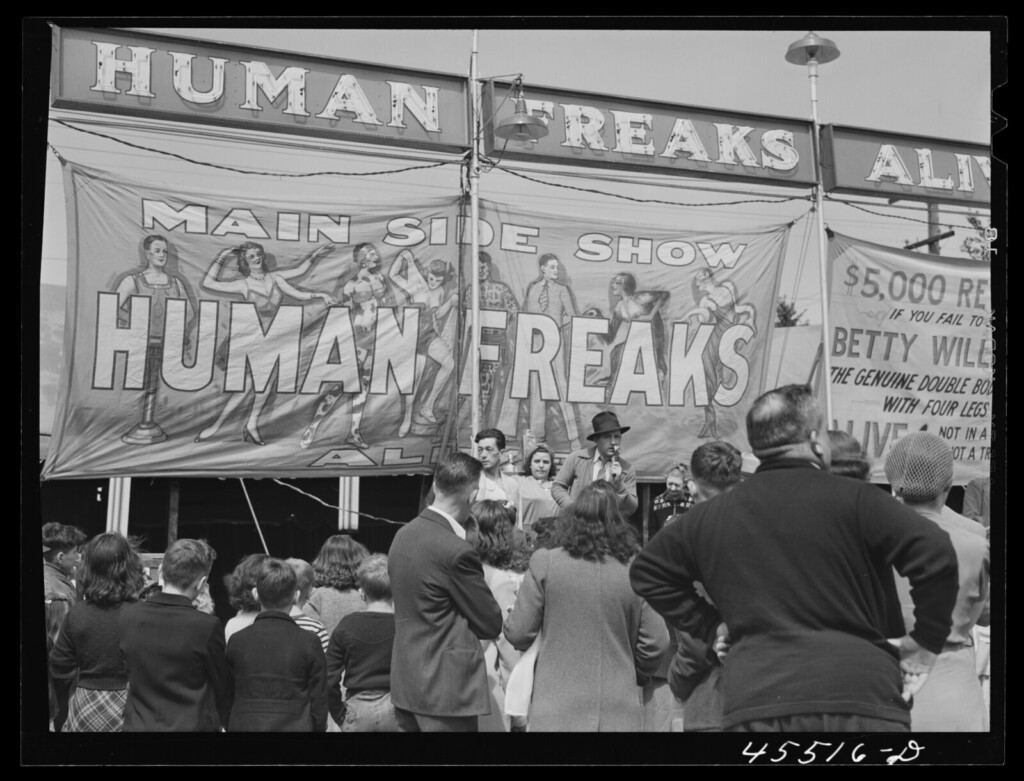
The physical freak show did not die because American culture grew too compassionate to sustain it. It died because the tent was inefficient. The last great dime museum circuits collapsed in the late 1930s and through the 1940s under a combination of forces: zoning pressures, insurance costs, the competition from cinema, and the slow migration of working-class leisure indoors. P.T. Barnum’s institutional logic did not disappear when the canvas came down — it was simply absorbed into distribution systems with national reach and no admission charge.
Susan Stewart, in her 1984 work On Longing, identified something precise and uncomfortable about how the grotesque body functions in Western representation: it operates as a boundary marker, a living demonstration of where the normative ends. The freak is not simply different — the freak is the edge-case that defines the center. Every exhibition of an anomalous body produces, as its actual product, the reassurance of the viewer’s own legibility. The tent was never primarily about the person inside it. The tent was a mirror with distortion built in to make the person holding it feel correctly shaped.
Television inherited this mechanism without inheriting its stigma. By 1956, daytime talk formats were already trafficking in spectacularized deviance — people whose domestic arrangements, bodies, beliefs, or appetites diverged enough from consensus to generate what producers called “good television,” meaning the reliable production of discomfort in the viewer that masquerades as fascination. The clinical term “exploitation” requires a victim who is unwilling, and broadcasters became expert at manufacturing willing participants, people so hungry for visibility in a culture that systematically renders them invisible that they accepted the terms of exhibition without reading the contract.
The pathology that Stewart identifies is not cruelty — cruelty would be too simple, too locatable. The pathology is the structural need to produce the grotesque as a category in the first place, because without it the normative cannot know itself. A culture that stopped marking certain bodies as spectacular would have to confront the arbitrariness of its own aesthetic standards, the historical contingency of what it calls healthy, beautiful, functional, whole. That confrontation has never been culturally affordable.
What social media accomplished after roughly 2010 was the removal of the intermediary. No broadcaster, no producer, no network standards department now stands between the anomalous body and the audience that will pay for it in the only currency the platform accepts: attention. The freak show at its nineteenth-century peak required a physical journey, a ticket, a shared crowd. The new architecture requires nothing except the willingness to keep your thumb still for an additional two seconds, and the algorithm — trained on precisely the electrical charge your nervous system produces when it encounters the body that stops it — will serve you another one immediately. The tent had a flap you walked through. The platform has no entrance because it has no exit.
What has not changed across this entire arc — from Charles Stratton standing on Barnum’s stage in 1842, to the cable networks of the 1990s building franchises around bodies deemed clinically or behaviorally extreme, to the current ecosystem of monetized self-display — is the transaction at the center of it. Someone is seen in a way they cannot fully control, by an audience that derives something from the seeing that it will not name, and the profit flows not to the person on display but to whoever built and owns the stage.
🎪 The Outsider Body: Margins, Power, and Identity
The American freak show did not simply display difference — it codified it, monetized it, and reflected society’s deepest anxieties about the body, normality, and control. These articles explore the cultural and philosophical landscapes that give meaning to marginalization, spectacle, and the politics of visibility.
Art Brut: History and Meaning
Art Brut emerged precisely from the same cultural margins that produced the freak show: a refusal to accept that only sanitized, institutionally validated bodies and minds could produce meaning. Jean Dubuffet championed works created by the mad, the imprisoned, and the socially excluded as the most authentic expressions of human experience. Understanding Art Brut helps illuminate why American society simultaneously feared and fetishized those it deemed abnormal.
GO TO THE SELECTION: Art Brut: History and Meaning
Celebrity as a Trap in Contemporary Culture
Celebrity as a cultural trap reveals the hidden mechanism behind the freak show’s long life: the transformation of human beings into spectacle for mass consumption. When difference is packaged and sold, the person inside the exhibit disappears behind the image projected onto them. This dynamic — exploitation disguised as fame — connects the nineteenth-century sideshow directly to contemporary media culture.
GO TO THE SELECTION: Celebrity as a Trap in Contemporary Culture
Mass Social Homologation Today
Mass social homologation is the invisible force that made the freak show possible and necessary: a society that enforces conformity must also create spaces where deviance is safely contained and publicly ridiculed. The freak show functioned as a ritual boundary marker, reassuring normative audiences of their own belonging. Exploring how homologation operates today reveals that the logic of the exhibit has never truly disappeared.
GO TO THE SELECTION: Mass Social Homologation Today
Hannah Arendt and The Human Condition: Public and Private Space
Hannah Arendt‘s analysis of public and private space offers a powerful philosophical lens for understanding who is granted visibility and on whose terms. The freak show denied its performers genuine public personhood, reducing them to spectacle rather than granting them voice or agency. Arendt’s thinking forces us to ask which bodies are permitted to appear in the public sphere as full human beings, and which are only permitted to be seen.
GO TO THE SELECTION: Hannah Arendt and The Human Condition: Public and Private Space
Discover the Cinema of the Margins on Indiecinema
If these histories of exclusion, spectacle, and resistance have stirred something in you, Indiecinema is the place to continue the journey. Our streaming platform is dedicated to independent and auteur cinema that dares to tell the stories mainstream culture prefers to ignore. Come and discover films that give voice to the margins — because the most essential truths are always found at the edges.
👉 EXPLORE THE CATALOG: Watch Indie Films in Streaming
A vision curated by a filmmaker, not an algorithm
In this video I explain our vision

