
The Comfortable Cage of Administered Life
You walk into the store knowing exactly what you want, and within forty seconds something has already shifted. The shelves don’t overwhelm you — they seduce you. Each product arrives pre-approved by an algorithm that studied your last six months of scrolling, each price point calibrated to feel like a decision you made freely. You came for bread. You leave with bread, a scented candle, a wireless speaker you’ll keep in the box for three months, and the quiet, warm sensation of having exercised your will. Nothing was taken from you. Nothing was refused. That’s precisely the problem.

Herbert Marcuse published One-Dimensional Man in 1964, and the book landed with the force of a philosophical emergency. The Frankfurt School theorist — who had fled Nazi Germany in 1933 and spent years inside the American war machine as an intelligence analyst for the OSS — was not diagnosing a foreign tyranny. He was indicting the society that had given him asylum. His argument was not that American liberal capitalism oppressed people in any recognizable sense. His argument was nearly the opposite: that it had become so effective at satisfying people, so precise in its capacity to absorb discontent, that the very architecture of opposition had been quietly dissolved from within.
What Marcuse identified in 1964 was a specific mutation in the logic of social control. Classical domination — the kind Orwell imagined, the kind that operates through surveillance, shortage, and fear — always leaves a remainder. The person who is starved, forbidden, watched, retains a negative space where resistance can gather. Deprivation produces its own clarity. But a society organized around abundance, around the perpetual expansion of need and its immediate satisfaction, removes the clearing where that clarity might form. When your apartment is warm, your entertainment endless, your political outrage already packaged as content and distributed back to you on a platform you chose to download, the distance between you and the system collapses not because the system has won an argument, but because no argument ever started.
He borrowed from Hegel the concept of the dialectic — the engine of history as contradiction, the way opposites generate movement, how a thing carries within it the seeds of what negates it. In Marcuse’s reading of advanced industrial society, what had been accomplished was nothing less than the neutralization of the dialectic itself. The system had learned to absorb its own negations. Protest became a genre. Dissent became a market segment. The counterculture of the 1960s would, within a decade, be selling blue jeans and cologne. Not because its participants were naive or corrupt, but because the machinery of integration operated at a structural level that intention alone could not override.
What makes this diagnosis so difficult to metabolize is that it offers no villain. There is no conspiracy, no single class of manipulators deliberately engineering your docility. Marcuse was drawing on Max Weber’s analysis of rationalization — the process by which modern institutions achieve their ends through systematic efficiency, not through malice. The managed society doesn’t need to lie to you. It tells you the truth constantly: here are your options, here are your rights, here is your vote, here is your complaint form. The options are real. The rights are real. The form will be processed. And yet something essential — the capacity to imagine a form of life genuinely outside this one, to feel the shape of a real alternative rather than a curated variation — has been administered out of existence with the same bureaucratic competence that keeps the trains running.
Marcuse called this the closing of the universe of discourse, and it was not metaphor. He meant it technically: that the language available to citizens in advanced industrial society had contracted, that concepts capable of naming genuinely oppositional realities had been either trivialized or absorbed, until the critical vocabulary itself began to sound like noise, like bad manners, like a failure to appreciate what you have.
Repressive Desublimation and the Illusion of Liberation
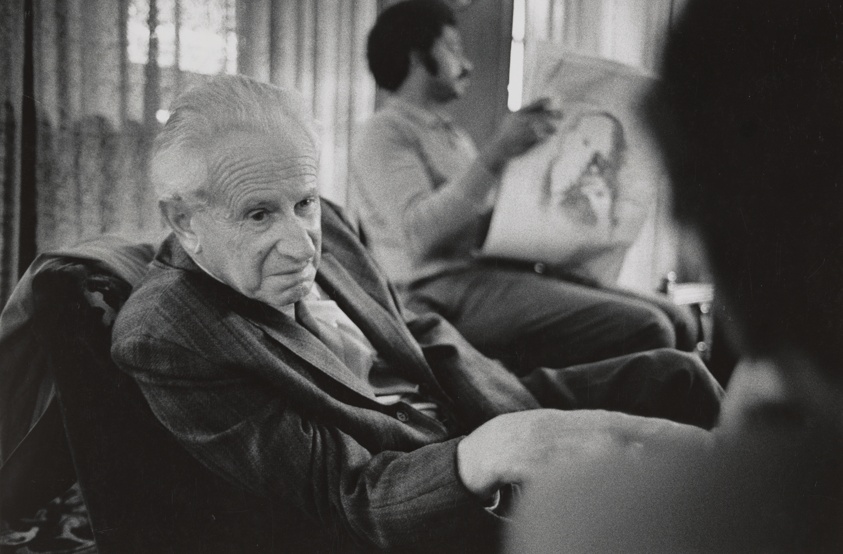
You buy the album, you wear the shirt, you say exactly what you think in a comment thread that ten thousand people will scroll past in four seconds, and something about all of it feels like freedom and costs you nothing, which should be the first sign that it isn’t.
Herbert Marcuse watched the 1960s happen in real time, and what troubled him most was not the repression of the counterculture but its gradual absorption. In 1955, he had published Eros and Civilization, reading Freud against Freud, arguing that civilization’s demand for sublimation — the rechanneling of erotic and aggressive energy into labor, art, deferred gratification — was not a biological necessity but a historical imposition, one that served the interests of a specific economic arrangement. The surplus repression that Freud had naturalized was, for Marcuse, a political instrument. But by the time One-Dimensional Man appeared in 1964, he was watching something stranger than repression: he was watching liberation being offered as a product, packaged and distributed with the same efficiency as the suppression it supposedly replaced.
He called it repressive desublimation. The mechanism works by inverting the psychoanalytic logic of sublimation without actually releasing its energy from the system of control. Where sublimation diverts libidinal energy upward — into culture, critique, art that strains against the given order — desublimation releases it downward, into immediate, sanctioned gratification that produces no distance from the world as it is. The body is permitted its pleasures. Sex saturates advertising, film, public discourse. The erotic is everywhere and therefore nowhere as a force of negation. What Freud’s civilization demanded you repress, late capitalism invites you to perform, provided the performance loops back into consumption and leaves the productive apparatus untouched.
Theodor Adorno and Max Horkheimer had laid the structural groundwork for this diagnosis in Dialectic of Enlightenment, written in California exile in 1944, the two men surrounded by the Hollywood machine they were trying to theorize. Their culture industry chapter argued that mass entertainment does not merely distract but actively trains its audiences in a specific cognitive posture: passive reception, the expectation of formulaic resolution, the evacuation of any aesthetic experience that might produce genuine discomfort or demand genuine thought. The radio fills silence. The film confirms what you already felt. The joke lands where predicted. What looks like pleasure is actually the rehearsal of compliance.
Marcuse took that analysis and drove it into the body. The point was not only that culture had become a management system for consciousness, but that desire itself had been colonized so thoroughly that the longing for something other than what exists could no longer find a stable object. When transgression is immediately commodified — the rebel aesthetic on sale before the rebellion has a name, the radical slogan on a tote bag — the psychic energy that might have organized itself into genuine refusal dissipates into style. This is not a failure of individuals to resist cleverly enough. It is the structural genius of a system that has learned to feed on its own critique.
What makes this mechanism so difficult to perceive from inside it is that the liberation it offers is real in every experiential register except the one that matters. You are genuinely less sexually repressed than your grandparents. You have genuinely more access to the archives of human expression than any prior generation. The constraint has moved inward and become atmospheric, which is to say it no longer announces itself as constraint at all, only as the neutral texture of how things are, the background hum against which your choices feel sovereign and your dissatisfactions feel personal.

The Great Refusal and Its Historical Betrayals
You are at the record store in 1968, and the music playing through the speakers is not entertainment — it is a declaration that the entire architecture of your daily life is a form of violence.
Marcuse had a name for the impulse behind that declaration. In “Eros and Civilization,” published in 1955, and sharpened into a political weapon by the time of “An Essay on Liberation” in 1969, he called it the Great Refusal: the absolute rejection of the rules of a game whose premise is the suppression of genuine human desire. For Marcuse, this refusal was not a policy position or a platform — it was a biological and erotic insurgency, the body’s refusal to accept as natural what had been engineered as inevitable. He placed his wager not on the industrial working class, which he believed had been successfully integrated into the system through rising wages and consumer goods, but on those the system had failed to absorb: Black Americans, student radicals, the colonial world, the sexually marginalized. These were the groups whose suffering could not be aestheticized into a car advertisement, whose exclusion from the table of administered comfort left them with a clarity the comfortable could not afford.
The historical record of what followed is precise enough to be painful. Between 1967 and 1972, the counterculture generated an aesthetic language of extraordinary force — the psychedelic poster, the protest anthem, the communal rejection of private property and individual ambition. Columbia Records signed protest folk artists not despite their politics but because of the demographic they represented. By 1971, youth market research conducted by firms including Daniel Yankelovich Inc. had established that American consumers under thirty represented a purchasing bloc of roughly 41 billion dollars annually, and the advertising industry reorganized itself accordingly. The language of rebellion was not suppressed; it was repackaged at a slight markup. Authenticity became a brand attribute. Dropping out became a lifestyle category.
What Marcuse had not fully calculated was the system’s capacity to metabolize its own negation without rupture. In “One-Dimensional Man,” he described repressive desublimation — the mechanism by which the release of libidinal energy through sexuality, art, and spectacle actually reinforces social control rather than threatening it. But he still believed that a sufficiently radical aesthetic rupture, a sufficiently uncontainable scream, could crack the surface. What the 1970s demonstrated instead was that the surface had no limit to its elasticity. By 1976, punk rock — designed explicitly as a cultural assault, its imagery borrowed from sadomasochism and nihilism precisely to make it unmarketable — had been signed to major labels within eighteen months of its emergence in London and New York. Malcolm McLaren, who had theorized punk partly through the Situationist writings of Guy Debord, watched his own act become a vehicle for selling trousers.
The student movements collapsed not through repression alone but through something more corrosive: the opening of a door. The expansion of university access, the creation of professional pathways in media, law, and culture for the same graduates who had occupied administrative buildings — this was the system’s most elegant maneuver. Herbert Marcuse watched from his position at the University of California San Diego as the generation he had theorized as the vanguard of the Great Refusal became, with remarkable speed, the creative directors, the brand strategists, the human resources consultants of the very apparatus they had once sworn to dismantle. The co-optation was not experienced as defeat because it did not feel like surrender — it felt like arrival.
What this exposed in Marcuse’s wager was not a flaw in his diagnosis but a gap in his theory of the subject: he had assumed that those who refused the system understood themselves as refusing it, that the refusal was conscious, chosen, held as an identity against pressure.
Language as a Closed Universe

You are reading a sentence right now, and somewhere in its grammar, the possibility of disagreement has already been removed. Not suppressed — removed. The difference matters enormously. Suppression leaves a trace, a wound in the text where something was cut. What Marcuse identified in One-Dimensional Man, published in 1964, was something more surgical: a language that had been restructured so that the space where negation would live simply no longer existed as addressable territory.
He called it operational language, and its defining feature was the collapse of the tension between a word and its referent. In classical rhetoric, and even in ordinary political dispute, there remained a gap between the name of a thing and the thing itself — a gap where critique could take root, where a word like “freedom” could be turned against the institutions that invoked it. Post-war American political discourse, Marcuse argued, had systematically closed that gap. When Dwight Eisenhower spoke of the “free world” in 1953, the phrase did not describe a condition to be evaluated; it designated a bloc, a military alliance, a side in a binary. The adjective had fused with the noun so completely that asking whether the free world was actually free became, grammatically, almost incoherent — a category error, like asking whether a proper name is accurate. Language had become a system of labels rather than a system of propositions, and labels cannot be argued with, only accepted or rejected wholesale.
Advertising perfected this logic at the level of desire. When a cigarette brand in the 1950s was marketed as “mild” and simultaneously “satisfying” — two qualities that in any pharmacological reality stand in tension — the contradiction was not hidden but dissolved by the sheer velocity of association. Vance Packard documented the machinery of this dissolution in The Hidden Persuaders in 1957, cataloguing how motivational research firms retrained American consumers to experience the brand identifier as a complete emotional unit, bypassing the evaluative pause that precedes a judgment. The word did not point to a product; it replaced the experience of encountering one. Marcuse read this not as clever manipulation but as anthropological evidence — proof that the linguistic structure of industrial capitalism had begun reengineering the architecture of thought itself, not its contents but its available moves.
What makes this analysis genuinely uncomfortable is how cleanly it maps onto the recommendation logic governing contemporary information environments. An algorithm that surfaces content does not censor; it sequences. Netflix’s recommendation engine, trained on approximately 250 million user profiles, does not prevent a viewer from encountering strange or destabilizing material — it simply makes the probability of that encounter approach zero by filling every available moment with content predicted to confirm existing taste. The mechanism is not ideological in any crude sense; it contains no message. But operationally it performs exactly the function Marcuse attributed to one-dimensional language: it eliminates semantic surprise, the experience of being confronted by something that has no home in your existing categorical furniture. Spotify’s Discover Weekly, launched in 2015, was celebrated as a tool of musical discovery, and in a narrow technical sense it was — but discovery bounded entirely by statistical proximity to what you already loved is not discovery; it is a more efficient form of repetition wearing novelty’s clothing.
The political consequence Marcuse feared was not that people would be told what to think. It was that the range of thinkable thoughts would contract without anyone noticing the contraction, because the language available for registering absence had itself gone missing. You cannot mourn a word you have never learned, cannot miss a form of argument you have never encountered, cannot feel the walls of a room whose dimensions you have always taken to be the dimensions of the world.
The Subject Who Cannot Step Outside
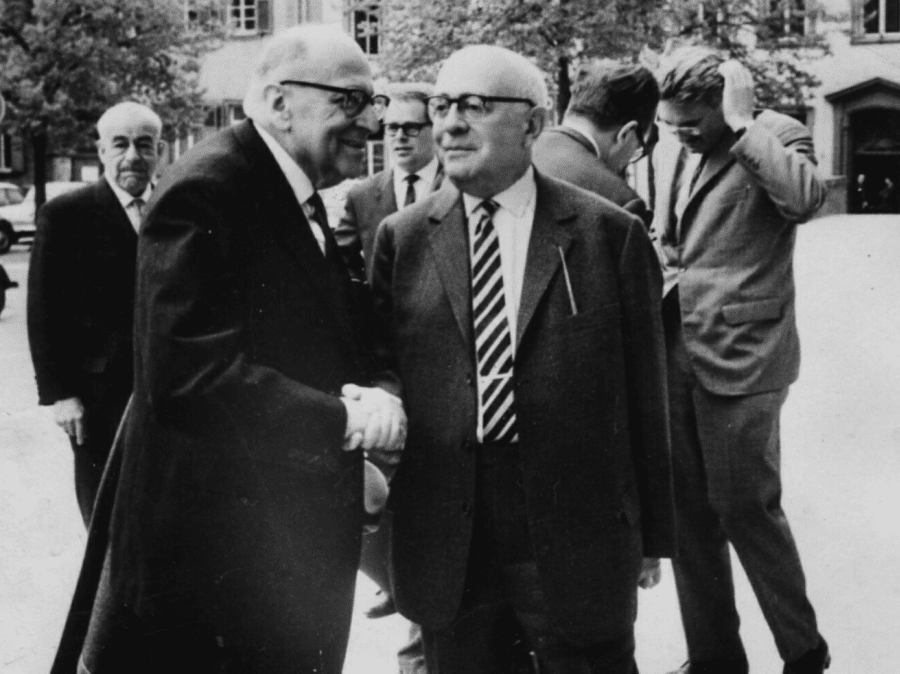
You already know the feeling — standing in a bookstore, reaching for something that disturbs you, something that refuses the easy comfort of the shelf beside it, and believing, with quiet conviction, that the act of reaching is yours alone.
Sigmund Freud argued that civilization is built on the systematic frustration of instinctual life. The organism wants pleasure, immediate and total, and the world answers with deferral, substitution, and prohibition. What Freud called the reality principle is not a wall erected against desire from outside — it is desire itself, restructured and redirected toward socially productive ends, so that the worker who labors for forty years and calls it meaning has not simply been coerced but has genuinely come to want what the structure required him to want. Marcuse, writing in 1955, accepted this architecture entirely and then asked one devastating question: what happens when the reality principle is no longer necessary for survival, when technological abundance could actually satisfy human needs, yet the system of repression remains in place not because scarcity demands it but because liberation would dissolve the apparatus of control? He coined the term surplus repression to name exactly this excess — the portion of instinctual renunciation that serves domination rather than civilization, that perpetuates unfreedom after the material justification for it has disappeared.
The trap this opens is deeper than political. If the very structure of the ego — the way a person organizes desire, defers gratification, selects objects worth wanting — is itself a historical product of a specific performance principle, the name Marcuse gave to the particular capitalist variant of the reality principle, then self-knowledge offers no exit. You cannot think your way out from inside a thought-form. The intellectual who believes she is practicing critique may be executing the system’s most elegant maneuver: channeling dissatisfaction into discourse, converting rupture into product, selling the aesthetics of refusal at full retail price. Herbert Marcuse watched this happen in real time, watching the counterculture of the late 1960s get absorbed into advertising within a decade, its symbols repurposed, its energy metabolized, its negation transformed into a lifestyle category available for purchase.
What makes this impasse genuinely philosophical rather than merely cynical is that it cannot be resolved by pointing to authentic resistance elsewhere. The claim that somewhere, in some margin or body or pre-linguistic drive, there exists an untouched human remainder that the system has not yet colonized — this claim is structurally identical to every other appeal to a pure outside, and purity of that kind has never survived contact with historical evidence. Marcuse himself could not fully escape this gravitational pull. Even in his most radical formulations, he reached toward Eros, toward the polymorphous body beneath the performance principle, as though biological life might constitute a ground from which critique could be launched. But biological life does not come to consciousness except through language, through culture, through the very mediations that are already administered.
This is where the framework refuses to close neatly. The drives are real — they press, they exceed, they refuse total sublimation, and every system of control in history has had to reckon with the remainder that will not be fully domesticated. Yet the moment the drive becomes legible, the moment it finds a name and a demand and a movement, it enters the field where absorption is possible. Marcuse left this tension standing because it is not a problem with a solution — it is the precise shape of what it means to be a conscious subject inside a totality that was there before you arrived and will process your resistance as raw material, unless the resistance carries within it something the totality genuinely cannot metabolize, something whose nature no one, including Marcuse, has yet been able to specify with enough precision to hand it to anyone.
A vision curated by a filmmaker, not an algorithm
In this video I explain our vision
🧩 The System, the Spectacle, and the Imprisoned Mind
Herbert Marcuse’s ‘One-Dimensional Man’ remains one of the most incisive diagnoses of modern Western society, revealing how advanced capitalism colonizes not only labor and desire but thought itself. These related articles trace the intellectual web connecting Marcuse’s critique to the broader landscape of critical theory, mass culture, and the philosophy of liberation.
Herbert Marcuse and Mass Culture
Marcuse’s analysis of mass culture is inseparable from his broader critique of one-dimensional society, where art and entertainment are absorbed into the system they once challenged. This article explores how Marcuse understood mass culture as a mechanism of domination that neutralizes dissent by turning it into a consumable product. Understanding this dimension deepens the reader’s grasp of the repressive tolerance at the heart of ‘One-Dimensional Man’.
GO TO THE SELECTION: Herbert Marcuse and Mass Culture
Herbert Marcuse and Art: The Aesthetic Dimension
In his later work, Marcuse turned to art as the last refuge of the negation that advanced industrial society tries so relentlessly to suppress. This article examines how Marcuse developed an aesthetic theory in which genuine art preserves a utopian promise precisely because it stands apart from the logic of utility and exchange. The aesthetic dimension thus becomes, for Marcuse, the political dimension by another name.
GO TO THE SELECTION: Herbert Marcuse and Art: The Aesthetic Dimension
Karl Marx and Alienation: Economic and Philosophical Manuscripts
Marcuse’s concept of one-dimensionality is deeply rooted in the Marxian tradition of alienation, which Karl Marx first elaborated in his Economic and Philosophical Manuscripts of 1844. This article traces the genealogy of alienation as a philosophical and political category, showing how the estrangement of labor becomes the estrangement of thought, desire, and selfhood. Reading Marx alongside Marcuse reveals the historical depth behind the critique of administered society.
GO TO THE SELECTION: Karl Marx and Alienation: Economic and Philosophical Manuscripts
Erich Fromm and the Sane Society
Erich Fromm, like Marcuse, was a member of the Frankfurt School tradition who asked whether modern society produces not freedom but a new, more insidious form of conformity. This article explores Fromm’s vision of a sane society built on authentic human needs rather than the artificial ones manufactured by consumer capitalism. Placed next to Marcuse’s ‘One-Dimensional Man,’ Fromm’s work reveals both the shared diagnosis and the profound differences in proposed remedies.
GO TO THE SELECTION: Erich Fromm and the Sane Society
Discover the Cinema That Thinks Against the Current
If Marcuse’s ideas have awakened something in you — a need for images that resist, that provoke, that refuse the one-dimensional gaze — then Indiecinema is your space. On our streaming platform you will find independent and auteur films that embody the critical spirit these thinkers called for, works that dare to imagine otherwise. Come and explore a cinema that has never stopped asking the difficult questions.
👉 EXPLORE THE CATALOG: Watch Indie Films in Streaming
A vision curated by a filmmaker, not an algorithm
In this video I explain our vision

