
The Checklist That Became a Verdict
You are sitting across a table from someone who has decided, before you opened your mouth, what kind of thing you are. They have a clipboard. They are scoring you. Not your words exactly, not the specific weight of what you have lived through or what you did at three in the morning when everything collapsed — they are scoring patterns, tendencies, the shape of your personality against a template developed in Canadian federal penitentiaries in the 1970s and formalized by Robert Hare into the Psychopathy Checklist-Revised in 1991. The number they arrive at will follow you into courtrooms, parole hearings, sentencing recommendations, and psychiatric files. It will outlive the conversation by decades.

Hare’s work did not emerge from nowhere. He spent years inside prisons in British Columbia, watching men who seemed to operate without the interior friction that most people experience when they cause harm — no guilt that reorganized their behavior, no anxiety that connected consequence to action. The clinical observation was real. The phenomenon he was trying to isolate, a kind of affective and interpersonal architecture that produces predatory behavior without the braking mechanism of remorse, had been described in psychiatry since Hervey Cleckley’s 1941 work The Mask of Sanity. What Hare did was translate that phenomenology into a scoring instrument: twenty items, rated zero to two, maximum score of forty, with thirty and above typically marking someone as a clinical psychopath. The checklist covers glibness, grandiosity, pathological lying, lack of empathy, shallow affect, parasitic lifestyle, poor behavioral controls, sexual promiscuity, juvenile delinquency, criminal versatility. Each item sounds precise. Together they create the illusion of measurement where what is actually happening is interpretation.
The problem is not that the PCL-R identifies nothing. The problem is what it does with what it identifies. A diagnostic instrument developed on incarcerated male populations in one country, scored by evaluators who have often spent less than three hours with the subject, became — with remarkable speed — the single most influential tool used to determine whether a human being is capable of change. Kent Kiehl at the University of New Mexico has spent years imaging the brains of incarcerated psychopaths and found consistent differences in paralimbic system activity, particularly in regions associated with emotional processing. But brain differences do not translate cleanly into behavioral destiny, and Hare himself acknowledged in a 2006 paper co-authored with Craig Neumann that inter-rater reliability — the degree to which two different evaluators produce the same score for the same person — fluctuates in forensic contexts in ways that should disturb anyone relying on these numbers to make irreversible decisions.
What courts needed was not ambiguity. They needed a number. And the PCL-R gave them one that arrived dressed in the authority of decades of peer-reviewed research, Hare’s own considerable credibility as a researcher, and the seductive clarity of a scale with a defined threshold. By the early 2000s, a high PCL-R score had become functionally equivalent, in many American and British jurisdictions, to a clinical argument for indefinite detention. Not because the science demanded that conclusion, but because institutions under pressure to appear both humane and decisive found in the checklist a way to outsource the moral weight of the verdict. The instrument did not call anyone irredeemable. It simply produced a score that everyone in the room agreed meant the same thing.
What almost nobody paused to examine was the circularity built into the architecture of the tool itself — the way several of its items score behaviors that are direct products of incarceration, poverty, childhood trauma, and systemic disadvantage as though they were stable personality traits independent of the conditions that produced them.
Stem Cell
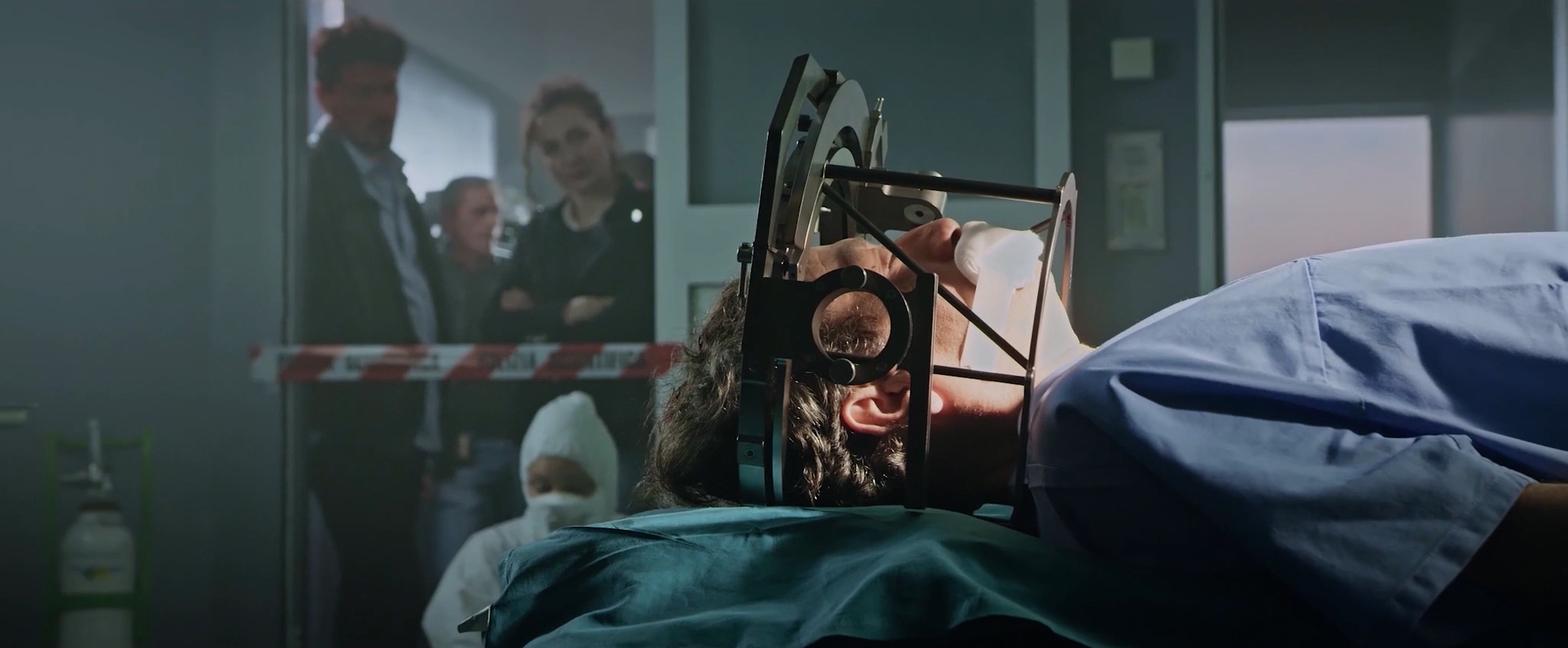
Stem Cell, directed by Giuseppe Di Giorgio, Italy, 2020.
A brilliant neurosurgeon is found murdered in his own operating room. The scene is gruesome. His killer used the very tools of his trade. Who is the murderer? A psychopath? Someone from within the institute? Commissioner Lorenzo Aliprandi and his team find themselves in a race against time to stop a killer who continues to murder using the same heinous methods, targeting other prominent doctors, leaving no trace behind except a trail of blood. New knowledge, intense experiences, and the race against time will test the strong character of Commissioner Aliprandi, who determined to uncover the murderers, will face every challenge head-on.
Based on the novel of the same name by Paolo Gaetani, a neurosurgeon by profession, Stem Cell addresses the major issues facing healthcare and its institutions, with a more poignant relevance than ever. Cinema thus complements the narrative and becomes a powerful tool for in-depth analysis and dissemination, exploring questions and proposing answers. It does so through the powerful tools of a fast-paced thriller rhythm and meticulous, bold cinematography. Alongside the main theme, the crimes unfold along with the intrigues, betrayals, economic interests, stories, and psychologies of all the characters.
Language: Italian
SUBTITLES: English, Spanish, French, German, Portuguese
Measurement as Power
You hand the clipboard to a stranger and ask them to evaluate another stranger. Twenty items, each scored zero, one, or two. Forty points maximum. Thirty or above, and the person on the other side of the glass has a name now — not a name their parents gave them, but a clinical one, stamped into their file with the quiet permanence of a diagnosis that travels with them through every parole hearing, every psychiatric review, every courtroom appearance for the rest of their lives.
The Hare Psychopathy Checklist-Revised, published in its revised form in 1991, does not describe a disease in the way a blood panel describes elevated cholesterol. It describes a pattern of observed and reported behavior, filtered through the interpretive judgment of a trained clinician, compressed into a numerical score, and then treated as though it had the ontological weight of a biopsy result. Ian Hacking, in his 1986 essay “Making Up People,” argued that classification does not simply describe pre-existing human types — it actively produces them. The categories we invent to measure human beings loop back into those human beings’ self-understanding and social reality, generating the very entities they claimed only to observe. The PCL-R is not a window. It is a factory.
Michel Foucault spent much of Discipline and Punish, published in 1975, demonstrating that the modern prison and the modern clinic share the same epistemic architecture: both are machines for producing the examined subject. The examination — clinical, judicial, psychiatric — is not a neutral act of measurement. It is an exercise in power that fixes individuals in a field of documentation, making them legible to institutions that require legibility to function. To be scored on twenty behavioral criteria is not to be understood. It is to be made administrable. The score does not capture a person; it replaces them with a profile that can be stored, compared, and acted upon without their presence or consent.
What is particularly treacherous about the PCL-R’s structure is that its criteria are designed to be self-confirming. Item seven measures shallow affect; item sixteen measures failure to accept responsibility. If a subject protests the diagnosis, the protest itself can be read as evidence of the diagnosis — a feature, not a bug, of a classification system that pathologizes the very behaviors most naturally produced by the experience of being pathologized. The circularity is not accidental. It is constitutive of what sociologist Erving Goffman, in Stigma published in 1963, identified as the fundamental dynamic of spoiled identity: the moment a label adheres to a person, every subsequent action they take is reinterpreted through the lens of that label, including the actions that would, in another context, be read as entirely ordinary.
The score of thirty also carries enormous practical leverage far beyond the clinic. Across multiple jurisdictions in the United States and Canada, a high PCL-R score functions as a statistical argument against release, treatment, or leniency — not because the individual has committed any new act, but because the number predicts they will. Actuarial risk assessment has replaced individual judgment in ways the courts have largely accepted without examining what, precisely, the instrument is measuring. The legal scholar Bernard Harcourt, in Against Prediction published in 2007, documented how actuarial tools embedded in criminal justice systematically encode historical patterns of group disadvantage into individual futures, presenting social inequality as biological destiny. A score that emerged from populations shaped by poverty, trauma, and institutional contact is then applied back to individuals from those same populations as proof of their individual nature.
The instrument validates itself by measuring what shaped the populations it was normed on, and the loop closes so quietly that almost no one in the room notices the room was always the point.

The Biology of Monstrosity
You are handed a brain scan at a conference, projected onto a screen the size of a wall, and the speaker says: look at the dark patches where the amygdala should be lighting up. The audience leans forward. Something in the room shifts — the discomfort of moral judgment dissolving into the cleaner satisfaction of diagnosis.
The neuroscientific findings that accumulated through the 1990s and into the early 2000s were genuinely striking in their consistency. Kent Kiehl’s neuroimaging work, conducted partly on incarcerated populations using a mobile MRI unit he drove to prisons across the American Southwest, found measurable reductions in paralimbic system activity among individuals scoring high on Hare’s scale — diminished amygdala response to distressing imagery, reduced connectivity in regions associated with emotional processing. James Blair at the National Institute of Mental Health documented similar patterns in the fear-potentiated startle response, showing that individuals diagnosed as psychopathic failed to register threat cues the way neurotypical subjects did. These were not fringe findings. They were published in respected journals, replicated across multiple labs, and cited thousands of times. The problem was not the data. The problem was what happened to the data the moment it left the laboratory.
Popular science writing performs a very particular kind of alchemy. It takes a correlation — reduced amygdala activation in a specific experimental context — and transforms it, through the pressure of narrative convenience, into an essence. By the time these findings reached Malcolm Gladwell’s columns, airport neuroscience books, and true-crime documentary voiceovers, the psychopath had acquired a brain that explained him completely, a neural fingerprint that preceded every act, every manipulation, every crime. The biological frame didn’t just describe the condition. It sealed it from the outside world. A person with those dark patches in their scan had always already been that way, would always be that way — which meant the question of what had shaped them became not only unanswerable but somehow impolite.
This is the function that biological essentialism has always served when applied to deviance: it transforms a historical question into a natural fact. Adrian Raine, whose work in biosocial criminology spans three decades and culminates in his 2013 book The Anatomy of Violence, is careful enough to insist on gene-environment interaction, on the way prenatal stress, early childhood trauma, and exposure to lead or malnutrition amplify genetic predispositions. But the amplification structure of media absorption ensures that the gene-environment half of that equation evaporates, leaving only the brain, floating free of its history. The institution — whether the prison, the corporation, the military, or the family organized around dominance and emotional unavailability — never appears in the scan. It cannot be imaged. It produces no dark patch.
What the biological frame accomplishes, structurally, is an enormous redistribution of explanatory weight. Every feature Hare’s PCL-R measures — the grandiosity, the callousness, the parasitic lifestyle, the impulsivity — these behaviors do not emerge from nowhere, and the research on adverse childhood experiences, pioneered by Vincent Felitti and Robert Anda in their 1998 study of seventeen thousand Kaiser Permanente patients, demonstrated with unusual statistical force that childhood abuse, neglect, and household dysfunction predict nearly every category of adult pathology on Hare’s scale. Yet the ACE study and the neuroscientific literature exist in almost entirely separate cultural ecosystems. One assigns responsibility diffusely, to the environments that shape nervous systems before children have any agency over them. The other locates the problem inside a skull, making it portable, self-contained, and — crucially — detachable from any institution that might otherwise be implicated in its manufacture.
The corporation that rewards precisely the emotional detachment, instrumental charm, and absence of guilt that Hare identifies as pathological has no neuroscientific literature written about it.
Who Gets Scored

You are sitting across a table from someone who will decide whether you go home. The room is institutional, the lighting fluorescent, the air carrying that particular stillness of places where futures get adjudicated. The person across from you holds a clipboard. They are about to score you on twenty items. What they will not tell you, because they may not even know it themselves, is that the instrument in their hands was built largely on data drawn from white male inmates in Canadian and American federal prisons during the 1970s and 1980s — a population that was never demographically neutral, never representative, and never intended to carry the universal authority it has since been granted.
The validation studies for the PCL-R were not secret about this. Robert Hare’s foundational samples were explicit in their composition. What happened afterward was a quiet institutional expansion that outpaced the science: the tool traveled into contexts — juvenile courts, civil commitment hearings, immigration detention, parole boards across jurisdictions with radically different demographic profiles — without the empirical scaffolding to justify that travel. A 2014 meta-analysis published in Psychological Assessment examining PCL-R predictive validity across racial groups found meaningful differences in how reliably the instrument predicted recidivism for Black and white defendants, with the tool performing measurably less consistently for Black individuals while still being applied with equal institutional confidence. The clipboard does not tremble when the science beneath it does.
What makes this more than a technical calibration problem is what David DeMatteo, Jennifer Skeem, and their collaborators have documented in studies examining forensic assessment bias: the PCL-R’s Factor 1 items, those measuring the so-called interpersonal and affective core of psychopathy — grandiosity, superficial charm, lack of remorse — require assessors to interpret behavior through a lens of intention and interiority. That interpretive act is never culturally innocent. Behaviors that register as callous detachment in one cultural context can reflect learned guardedness in environments where emotional disclosure has historically been punished. Behaviors that score as irresponsibility may trace directly to structural unemployment rates that have not fluctuated below double digits for Black men under twenty-five in the United States since the Bureau of Labor Statistics began tracking the category. The instrument cannot see the difference. The assessor, operating under time pressure with incomplete records, frequently cannot either.
Socioeconomic variables compound this in a way that has received far less attention than it deserves. Criminal history items on the PCL-R — components of Factor 2, covering antisocial behavior patterns — are not measuring an internal psychopathological trait in any straightforward sense. They are measuring contact with the criminal justice system, which is itself a profoundly unequal filter. A wealthy individual who commits fraud at scale, who manipulates employees and destroys livelihoods without legal consequence, will score dramatically lower on criminal history items than a person who has been repeatedly arrested for low-level offenses in an aggressively policed neighborhood. The PCL-R then reads this disparity as a difference in psychopathic personality rather than a difference in institutional exposure, and the parole board reads the PCL-R score as science.
The philosopher Ian Hacking wrote in The Social Construction of What?, published in 1999, about how classification systems do not merely describe the people they categorize — they interact with them, reshape them, create new possibilities for self-understanding and new vulnerabilities to institutional power. A man who is classified as a psychopath inside a carceral system faces a specific and nearly inescapable trap: the behaviors that system produces in him — hypervigilance, emotional suppression, strategic self-presentation, distrust of authority — are precisely the behaviors the instrument will subsequently score as confirmation of the original diagnosis.
The Psychopath in the Mirror

You have probably, at some point, taken an online version of the test yourself. Not the clinical instrument — the flattened, gamified shadow of it that circulates on personality websites and corporate assessment platforms, the one that promises to tell you whether you score “high” on charm, fearlessness, and immunity to remorse. And you clicked through it with a specific kind of private hope, didn’t you: not the hope of being normal, but the faint, slightly shameful hope of landing somewhere interesting.
That desire is not incidental to Robert Hare’s legacy. It is, in a very precise sense, the thing his framework accidentally manufactured. When Hare published “Without Conscience” in 1993, he was writing a clinical warning. When Jon Ronson followed with “The Psychopath Test” in 2011, reaching millions of readers who had never opened a DSM, the warning had become a taxonomy of secret admiration. The PCL-R’s twenty items — glibness, grandiosity, shallow affect, parasitic lifestyle, lack of remorse — had migrated from the forensic ward into the airport bookstore, and somewhere in transit they had changed valence entirely. What the checklist pathologizes, the market quietly celebrates.
This is not a coincidence produced by bad popularization. It reflects a structural contradiction at the heart of how contemporary societies organize desire and reward. Kevin Dutton’s 2012 book “The Wisdom of Psychopaths” made the argument explicit, citing studies suggesting that surgeons, lawyers, and chief executives score measurably higher on psychopathic trait dimensions than the general population. Dutton framed this as paradox. It is not a paradox. It is a description of selection pressure. The institutions that allocate status and compensation in post-industrial economies were not designed to filter out the traits the PCL-R flags as dangerous — they were, in many cases, designed to surface them. Boldness under uncertainty, emotional detachment from consequences, the capacity to charm without genuine investment: these are not accidental byproducts of corporate success. They are, in several sectors, the advertised product.
What makes this ideologically volatile is that clinical criminology and leadership literature arrive at the same psychological portrait and then draw opposite moral conclusions from it. The forensic psychologist sees a predator; the executive coach sees a high-performer. The person being described has not changed. Only the institutional context has shifted — and with it, the entire evaluative grammar. Paul Babiak and Robert Hare themselves confronted this directly in “Snakes in Suits” (2006), documenting how the corporate environment actively shields psychopathic behavior from consequence by mistaking manipulation for vision and emotional coldness for strategic clarity. The book was meant as an alarm. It was reviewed, in several business publications, as a guide.
There is something worth sitting with in the fact that Hare spent decades building a diagnostic instrument designed to identify individuals who cannot be rehabilitated, cannot feel guilt, and will inevitably reoffend — and that the cultural artifact most associated with his name is a personality quiz people take to feel special. The PCL-R was never designed to be a mirror. It was designed to be a wall, a clinical boundary between those who could be trusted to reenter society and those who could not. That it became a mirror says nothing about Hare’s intentions and everything about what a society looks like when it has lost confidence in the distinction between the predatory and the admirable, when the language of pathology and the language of aspiration have grown so semantically close that only the sentencing guidelines separate them.
The psychopath in the mirror is not a monster you failed to recognize. It is the image the culture held up and told you to emulate, dressed in the vocabulary of diagnosis so that the admiration could remain deniable.
A vision curated by a filmmaker, not an algorithm
In this video I explain our vision
🧠 The Dark Architecture of the Psychopathic Mind
Robert Hare’s psychopathy checklist opened a window onto one of the most unsettling corners of human psychology — the mind that feels no remorse, manipulates without guilt, and wears charm like a weapon. The articles below trace the philosophical, literary, and psychological roots of evil, deception, and the abuse of power.
The Psychology of Evil: Why People Commit Violent Acts
The psychology of evil is not a matter of monsters but of mechanisms — cognitive patterns that allow ordinary minds to commit extraordinary harm. This article explores how psychology and neuroscience have attempted to map the territory between moral failure and clinical disorder, offering essential context for understanding where psychopathy fits within the broader landscape of human cruelty.
GO TO THE SELECTION: The Psychology of Evil: Why People Commit Violent Acts
Affective Manipulation in Psychology
Affective manipulation is one of the defining traits measured by the Hare Psychopathy Checklist, yet it permeates relationships far beyond clinical settings. This article examines how psychological manipulation operates through charm, deception, and emotional exploitation, revealing the subtle strategies that make psychopathic behavior so difficult to detect and resist.
GO TO THE SELECTION: Affective Manipulation in Psychology
Banal Evil and Radical Evil: Kant and Arendt
Hannah Arendt’s concept of banal evil and Kant’s notion of radical evil together form a philosophical framework that haunts any serious discussion of psychopathy. This article investigates how evil can be both coldly calculated and disturbingly ordinary, raising questions about whether the psychopath represents an extreme of human nature or a terrifying mirror of it.
GO TO THE SELECTION: Banal Evil and Radical Evil: Kant and Arendt
Gaslighting: Psychology and Culture
Gaslighting is among the most studied expressions of psychopathic interpersonal control — a sustained strategy of reality distortion designed to destabilize the victim’s perception of truth. This article traces the psychological and cultural dimensions of gaslighting, connecting clinical research on manipulation with its devastating effects on identity, memory, and self-trust.
GO TO THE SELECTION: Gaslighting: Psychology and Culture
Explore the Cinema That Dares to Go Deeper
If these themes have stirred something in you, Indiecinema is the streaming platform where independent cinema meets the questions that mainstream culture avoids. Discover films that portray the psychology of power, manipulation, and moral ambiguity with the depth and honesty they deserve.
👉 EXPLORE THE CATALOG: Watch Indie Films in Streaming
A vision curated by a filmmaker, not an algorithm
In this video I explain our vision

