
The Smile You Didn’t Choose to Believe
You are mid-conversation when it happens. Not a dramatic moment — no raised voices, no tears, no ultimatum delivered across a kitchen table. Just a slight shift in their expression, a softening around the eyes, a pause that lasts perhaps half a second longer than necessary, and suddenly you find yourself agreeing to something you had not planned to agree to. You walk away from the exchange with a faint sense of having been generous, even virtuous, as though the decision were yours from the beginning. It was not.

What just occurred belongs to a category of human behavior so ordinary, so structurally embedded in daily life, that naming it feels almost aggressive — as though the naming itself were the violation rather than the act. Affective manipulation does not announce itself. It does not arrive wearing the costume of coercion. It arrives wearing the costume of warmth, of vulnerability, of a smile that seems involuntary and therefore trustworthy. The distinction between genuine emotional expression and its weaponized twin is not visible to the naked eye, and that invisibility is not accidental. It is, in a very precise sense, the mechanism.
Paul Ekman spent decades cataloguing the microexpressions of the human face, producing by the 1970s a cross-cultural atlas of emotion in which he argued that certain expressions — fear, contempt, surprise, disgust — are universally legible regardless of cultural origin. His 1978 Facial Action Coding System was a technical achievement, but it also accidentally illuminated something darker: if emotional expression is legible, it is also reproducible. What evolution gave us as a signaling system for authentic internal states, we learned to operate manually, like a switchboard. The face that softens to elicit your sympathy is not always lying, but it is not always telling the truth either, and the body has no reliable instrument for distinguishing between the two in real time.
This is where the social architecture of trust becomes a vulnerability rather than a resource. Robert Cialdini, in his 1984 work on the principles of influence, identified liking as one of the six central levers of persuasion — we comply more readily with people we find attractive, familiar, or emotionally attuned to us. But Cialdini was describing salesmanship, the relatively benign frontier of a much larger territory. In intimate relationships, the workplace, the family system, the liking lever does not operate as a single pull. It operates as a sustained atmospheric condition, a climate you live inside so continuously that you no longer notice it as weather. You notice it only in its absence, when the warmth is suddenly withdrawn and you feel, with bewildering intensity, that you have done something wrong.
That withdrawal is not incidental. Psychologists studying what John Gottman documented through his longitudinal research on couples — thousands of hours of recorded interaction at the University of Washington throughout the 1980s and 1990s — found that emotional responsiveness operates as a form of behavioral currency. The give and take of attunement, the bid and the response, structures expectation so deeply that its manipulation is almost indistinguishable from its genuine expression. A person who has learned to deploy warmth strategically does not need to be conscious of doing so. Many are not. The behavior becomes automatic precisely because it works, and it works because you are wired to respond to it before your prefrontal cortex has finished processing what is happening.
The uncomfortable truth is not that some people are manipulators and others are victims. The uncomfortable truth is that the capacity for affective manipulation is distributed across the human species with remarkable generosity, and that most of us have exercised it without vocabulary for what we were doing. The smile you gave someone to soften a refusal, the slight tremor you allowed into your voice when you needed something — these are not monstrous acts. They are the ordinary grammar of emotional life, which is precisely what makes the more calculated versions so difficult to identify, and so difficult, once identified, to stop believing.
Katabasis

Drama, Mystery, by Samantha Casella, Italy, 2025.
“Katabasis” is a journey into the underworld. Nora experienced that dark realm as a child, when she suffered abuse. This marked her, shaping her into an ambiguous and manipulative woman, dangerous in her inscrutability, constantly seeking disturbing situations to relive the only condition she has profoundly internalized: pain. And the love story between Nora and Aron is tormented, strictly secret. Aron is a young orphan oppressed by the star system which, orchestrated by Jacob, a cynical manager, made him a star and imposes another façade of life on him. In fact, only the people who revolve around the house-prison where the couple lives are aware of Nora's existence. That majestic villa is the stage for secrets, lies, deceit, as well as unsettling episodes, since Nora is able to communicate with the souls from the beyond.
Director Biography – Samantha Casella
Samantha Casella studied various aspects of cinema, including screenwriting, directing, cinematography, and acting, across Turin, Florence, Rome, and Los Angeles. Her directing thesis, the short film "Juliette," won 19 awards, including the "European Massimo Troisi Award." She continued her path directing surreal short films including "Silenzio Interrotto," "Memoria all'Isola dei Morti," and "Agape." In 2019, she directed "I Am Banksy." At the charismatic TCL Chinese Theater in Los Angeles, at the Golden State Film Festival, she won the award for Best International Short Film. In 2020, she directed the short film "A un Dio Sconosciuto." "Santa Guerra" is her feature film debut.
LANGUAGE: Italian
SUBTITLES: English, Spanish, French, German, Portuguese
What Psychology Named but Culture Normalized
You learn the word “gaslighting” from a podcast, probably, or a thread someone shared, and for a moment it clicks into place like a key in a lock you didn’t know existed. There it is. The thing that happened. Named, categorized, given a clinical spine. And then, almost immediately, the word begins to soften at the edges — used to describe a partner who forgot an anniversary, a coworker who misremembered a meeting, a politician who denied a statistic. The precision dissolves. The key stops fitting anything.
This is not accidental. The absorption of clinical vocabulary into casual speech follows a pattern that social psychologist Roy Baumeister traced in his 1997 analysis of how cultures process the language of victimhood — the terms travel from specificity to metaphor, and in doing so, they lose their capacity to name real damage. Gaslighting was not coined for minor disagreements. It describes a systematic dismantling of a person’s relationship to their own perception, a sustained campaign — and the word campaign is deliberate — to make someone distrust the evidence of their own mind. The psychiatrist Jonah Stern documented in clinical case studies throughout the 1980s how prolonged gaslighting produced symptoms indistinguishable from early dissociative disorders. Patients did not know what they had experienced. They had been taught not to know.
Love bombing entered the psychological literature even earlier, observed in the 1970s in studies of cult recruitment tactics — the overwhelming flood of affection, attention, and mirroring deployed to bypass rational evaluation and create rapid emotional dependency before the target has had time to develop any critical distance. Margaret Singer, whose work on coercive persuasion spans more than three decades, identified love bombing not as romantic intensity but as a technique that functions precisely because it mimics what genuine attachment feels like. The nervous system cannot tell the difference in real time. By the time the distinction becomes visible, the dependency is already structural.
Emotional coercion has an older clinical history still, threading through the work of Kurt Lewin on psychological force fields in the 1940s and formalized more rigorously in the trauma literature of the 1990s, particularly in Judith Herman’s 1992 work Trauma and Recovery, which drew direct parallels between the methods used to control hostages, prisoners of war, and domestic partners. The overlap was not metaphorical. The mechanisms — isolation, monopolization of perception, alternating punishment and reward — were functionally identical across contexts that culture had always treated as categorically separate. One was political. One was personal. Herman’s insistence that they were the same process remained, for years, professionally uncomfortable.
What happened to these concepts was not merely popularization. It was a kind of laundering. When a clinical term enters entertainment culture, it gets re-narrativized as conflict — as the dramatic texture of complicated relationships rather than a description of harm with a measurable psychological cost. The couple in the prestige drama series is toxic, manipulative, electric. The audience watches the gaslighting unfold across six episodes and calls it compelling television. The vocabulary that was built to identify injury becomes the aesthetic vocabulary of intensity. Suffering gets reframed as depth.
This reframing has a beneficiary, and it is not the person who was harmed. When manipulation is recoded as drama, accountability becomes a matter of taste rather than ethics. To name what was done to you requires that the person listening understand the term as a clinical description rather than a personality critique. But if gaslighting now means “made me feel confused,” the person who systematically dismantled your grip on reality stands behind a semantic shield you helped build by using the word too loosely. The vocabulary meant to protect you was repurposed into the very fog it was designed to name.

The Architecture of Dependence

You check your phone before you are fully awake. Not because you expect anything in particular, but because the last time you checked, something was there — a message that felt like relief, like proof, like the ground returning under your feet — and the time before that, nothing. The pattern has trained you more precisely than any deliberate instruction ever could.
Burrhus Frederic Skinner documented this dynamic first in pigeons. In his 1938 work “The Behavior of Organisms,” he demonstrated that animals subjected to variable-ratio reinforcement schedules — where rewards arrive not at fixed intervals but at unpredictable ones — exhibited compulsive, near-unbreakable behavioral loops. The pigeon that receives a food pellet on a random press of the lever does not learn to press with patience; it learns to press without stopping. Extinction, the technical term for when a behavior finally ceases, takes dramatically longer under variable reinforcement than under any other conditioning structure. Skinner was mapping the architecture of slot machines long before he understood he was also mapping the architecture of love.
What makes the application of this to human attachment so disturbing is not that it requires cruelty. The manipulator does not need to be consistently cold or consistently warm. Consistent coldness, paradoxically, produces detachment — the nervous system adjusts, recalibrates, eventually withdraws. What produces the binding is the oscillation: the unexpected warmth after withdrawal, the sudden tenderness after contempt, the rare afternoon when everything feels exactly right. The neurochemistry responds to unpredictability with dopamine spikes that consistent pleasure simply cannot generate. Jaak Panksepp’s affective neuroscience research, developed over decades and consolidated in “Affective Neuroscience” published in 1998, demonstrated that the seeking system — the brain’s primary motivational engine — activates most intensely not upon receiving reward but upon the anticipation of uncertain reward. The relationship that might give you something keeps you mobilized in a way that the relationship which reliably gives never can.
This is not a flaw in human cognition. It is the same mechanism that once ensured a hunter would pursue prey across unpredictable terrain rather than abandoning the chase because the last two attempts failed. The tragedy is that a survival architecture optimized for physical scarcity becomes the precise vector through which another person can colonize your attention without ever fully committing to your well-being. The structure does the work. The manipulator need not even be conscious of what they are doing — many are not — because the intermittency emerges naturally from their own inconsistency, their own emotional unavailability, their own fluctuating interest. The person bound by it experiences the oscillation as depth, as complexity, as evidence that the relationship contains something real and difficult and therefore worth pursuing.
Sociologist Randall Collins, in his work on interaction ritual chains, observed that emotional energy — the sense of confidence, enthusiasm, and belonging that humans derive from successful social interaction — functions as a resource that can be generated, depleted, and controlled through the choreography of inclusion and exclusion. When one person holds asymmetric power over the flow of that emotional energy in a dyad, the architecture of dependence builds itself. The person who is periodically excluded and then readmitted does not grow indifferent; they grow more attuned, more vigilant, more skilled at reading the micro-signals of the other’s mood. They become, in the precise clinical language, hypervigilant. What looks from outside like excessive investment is from inside an entirely rational response to an environment of genuine unpredictability. The problem is not that the response is irrational. The problem is that it is so rational, so adaptive, that it outlasts every conscious decision to stop.
And so the question that never quite resolves is whether a person caught in this structure is being manipulated or simply experiencing the logical consequence of a particular kind of attachment — and whether that distinction, at the level of lived suffering, makes any difference at all.
Return to Planet Underground

Drama, Thriller, by Gideon Homes, Netherlands, 2025.
A former underground techno DJ working in a large and famous law firm delves into the dark side of society. With one eye on the past and one on the future, he stirs up the ashes of the true underground. The demand of society to function superficially and deliver top performance increasingly clashes with the protagonist's questioning of his own life reality and the values of his past. After being employed for almost six years and being a respected employee, Tyrel falls ill. On top of that, he witnesses a fraud within the company and asks to leave. But the illness creates a complex situation in which his employer starts playing a game of chess with Tyrel.
In "Return To Planet Underground", director Gideon Homes gives the audience a gripping insight into the Dutch underground techno scene, offering a gripping drama set in a dark world, full of intense moments and touching human tragedies. This film is not just a visual feast; it is a gripping exploration that immerses viewers in the lives of its protagonists. Set to a backdrop of thumping techno beats, "Return To Planet Underground" takes audiences on a rollercoaster ride through the highs and lows of human desires, drug-fueled escapades, societal pressures and the pursuit of perfectionism. Drawing inspiration from iconic films such as Trainspotting, Berlin Calling and Human Traffic, Gideon Homes' work stands out for its unique stylistic devices and unconventional storylines. Based on real events and personal experiences, "Return To Planet Underground" faced numerous lawsuits before finally conquering audiences around the world. Prepare yourself for an immersive dive into a world where music, morality and the human spirit collide.
LANGUAGE: English, Dutch
SUBTITLES: Spanish, French, German, Portuguese
When Influence Became a Science
You are sitting in a chair across from someone who needs something from you. They have not asked yet. They are building a case, layer by layer, with warmth and patience and an almost uncanny attentiveness to your discomfort. You will say yes before you understand why, and the yes will feel like your own idea.
What Robert Cialdini documented in 1984 was not a theory. It was a taxonomy of what was already happening everywhere, every day, in sales floors and courtrooms and bedrooms and political speeches. Influence: The Psychology of Persuasion named six principles — reciprocity, commitment, social proof, authority, liking, scarcity — and in doing so handed a mirror to a civilization that had been operating by these levers for decades without admitting it. The book sold over three million copies not because it revealed something foreign but because it articulated something already intimate. Readers recognized their own compliance. They also recognized, in the same breath, how to manufacture it in others.
The machinery had older origins and grimmer sponsors. After 1945, American and Soviet governments found themselves in possession of large bodies of research on human suggestibility, much of it extracted from circumstances that made ethical review impossible. Project ARTICHOKE, launched by the CIA in 1951, was not a philosophy seminar. It was a systematic investigation into whether psychological pressure, chemical agents, and sensory disruption could reliably break the will of a subject and install new behavioral responses. The question they were asking was not whether influence was possible. They already knew it was. The question was how fast it could be made to work, and whether the subject could later be made to believe they had never been touched.
Edgar Schein, a social psychologist at MIT’s Sloan School of Management, published Coercive Persuasion in 1961, an analysis of the techniques used on American prisoners of war in Korea. What the Chinese military had done, Schein argued, was not brainwashing in the dramatic Hollywood sense. It was something more banal and therefore more disturbing: the systematic manipulation of social environment, identity, and reward. Isolation, incremental compliance requests, the strategic use of guilt and belonging — these were not exotic instruments. They were recognizable to anyone who had survived a difficult family, a controlling institution, or a religious community that monitored its members’ inner lives. Schein’s contribution was to show that coercion did not require a dungeon. It required only the right configuration of dependency.
What happened in the decades that followed was a quiet migration. The techniques mapped in military and intelligence contexts moved laterally into corporate training, marketing research, and consumer psychology. By the 1970s, advertising firms were commissioning studies in social influence that drew directly on the same academic literature used to analyze prisoner indoctrination. The distance between a loyalty program and a controlled social environment is not a moral one — it is a matter of scale and consent, both of which are easier to blur than to enforce. When B.F. Skinner published Beyond Freedom and Dignity in 1971, arguing that the self was largely a fiction and behavior a product of contingencies, he was not predicting anything. He was describing the operating logic of systems already in place.
The commercial codification of emotional influence produced something new not in kind but in reach. A manipulative dynamic that once required a specific relationship — a confessor and a penitent, a commander and a soldier, a parent and a child — could now be engineered at scale, distributed across populations through media, designed into the architecture of institutions. And because it was presented as science, it carried the epistemological authority that science carries in a secular age: the claim not to be ideology but to be simply how things work. That claim is worth sitting with. Because the moment you convince someone that influence is a natural phenomenon rather than a political one, you have already done the most important part of the work.
The Consent That Was Never There
You signed the form. You said yes. You were there, present, coherent, not under physical duress — and so the record shows consent, clean and unambiguous, a checkbox ticked in a world that runs on checkboxes. But there is a particular kind of pressure that leaves no bruise, no timestamp, no evidence of the moment the ground shifted beneath you, and by the time you realized you had agreed to something you never actually chose, you were already living inside the consequences of that agreement.
Hannah Arendt, writing in The Origins of Totalitarianism in 1951, observed something that most political theory still has not fully absorbed: that power does not only operate through force but through the systematic alteration of the conditions under which human judgment becomes possible. When the environment in which a decision is made has been sufficiently distorted — when the emotional stakes have been raised high enough, when isolation has narrowed the field of available alternatives, when one person’s need for approval has been weaponized against their own perception — the formal architecture of consent becomes a stage set. It looks like agreement. It performs agreement. It has none of agreement’s substance.
What makes affective manipulation so philosophically corrosive is precisely that it operates at the level of epistemology before it operates at the level of will. The manipulator does not force you to choose wrongly — they reconstruct the information available to you, the emotional weighting attached to each option, and the cost you believe you will pay for refusal. By the time the choice arrives, the outcome has already been engineered. The philosopher Onora O’Neill, drawing on Kantian ethics in her 2002 Reith Lectures published as A Question of Trust, argued that genuine consent requires not just the absence of coercion but the presence of adequate, accurate, and intelligible information — and that without these conditions, what passes for consent is closer to a managed performance than a free act.
Legal systems have struggled catastrophically with this distinction. The dominant framework in contract law, in medical ethics, and in most therapeutic guidelines still treats consent as binary: either it was given or it was not. This binary survives because the alternative — a spectrum model of consent, one that accounts for the degree to which emotional asymmetry, dependency, and manufactured vulnerability have compromised the conditions of choice — is administratively inconvenient and philosophically demanding. Courts cannot easily rule on the quality of someone’s internal state at the moment they said yes. And so the infrastructure defaults to the signature, the verbal affirmation, the witnessed agreement, all of which can be obtained from someone who has been psychologically cornered with extraordinary precision.
Therapeutic frameworks are not immune. A person who has been subjected to sustained emotional manipulation often arrives in clinical settings reporting confusion about their own preferences, a kind of motivational fog that researchers including Jennifer Freyd, in her 1996 work on betrayal trauma, have linked to the survival strategy of not fully knowing what has been done to you by someone on whom you depend. The consent given inside these states is not the consent of someone standing on level ground. It is the consent of someone who has learned that disagreement carries consequences they cannot afford, and who has reorganized their desires around the anticipated punishment for wanting otherwise.
What is never asked in any official record is the question that would actually matter: under what conditions did this person believe they were making this choice, and who constructed those conditions, and why? The absence of that question is not an oversight. It is a structural feature of systems that depend on the legibility of consent remaining simple, because the moment you allow consent to be complex, you have to ask who benefits from keeping it simple — and the answer to that question is never the person who said yes.
A Better Life
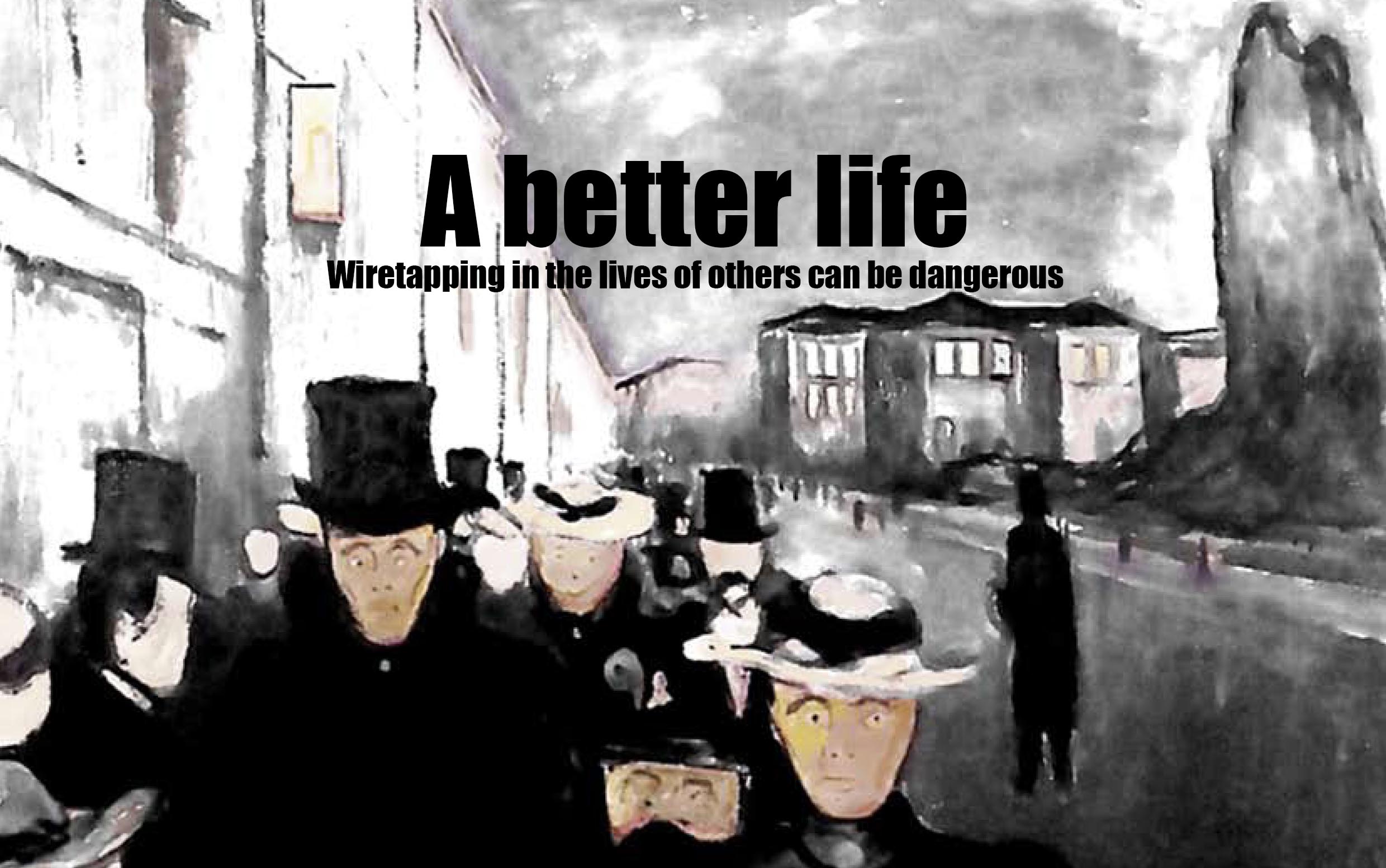
Drama, thriller, by Fabio Del Greco, Italy, 2007.
Rome: Andrea Casadei is a young investigator specializing in audio wiretapping who conducts investigations commissioned by husbands betrayed by their wives, or by parents worried about what their children are doing outside the home. But what interests him most is understanding the human soul, listening to casual conversations in the streets, knowing what people think. He often meets in Piazza Navona with his friend Gigi, a frustrated street artist obsessed with success at all costs, with whom he shares a passion for wiretapping. Shocked by the mystery of the disappearance of Ciccio Simpatia, another street artist common friend, Andrea decides to abandon the commissioned works to seek a better life and reflect on his own and others' existence. He will meet the actress Marina and with a bug he will slowly enter her life until he discovers her most unthinkable secrets. The film deals with an important theme of contemporary Western society: the lack of love. The mysterious and tormented figure of Marina is reflected in a gloomy and soulless Rome.
Director Fabio Del Greco declared about his film: "Perhaps this film is a reflection on the art of observing, of listening, in short, of what one does when one leaves the real world to tell about it. Perhaps he wants to talk about the subtle relationship between the mirages of success touted by today's society, power and the most authentic human relationships.A 'dark cloud' hangs over the city: it is engulfing everyone in a sort of indistinct, uniform mass, where everyone thinks the same things, where everyone they are more alone. Where is the truest part that makes us unique? Maybe you can try to intercept it only secretly."
LANGUAGE: Italian
SUBTITLES: English, Spanish, French, German, Portuguese, Dutch.
A vision curated by a filmmaker, not an algorithm
In this video I explain our vision
A Second Scene: The Room Where It Looks Like Care

There is a man in a gray office, and the office smells like lavender from a diffuser someone chose specifically to calm him. He has been referred here by his employer following what the HR documentation calls “a performance concern,” and the person sitting across from him has a degree on the wall and speaks in a voice that is almost inaudible, as though volume itself would constitute aggression. She asks him how he is feeling. She appears to mean it. She has been trained to appear to mean it, which is not the same thing as not meaning it, but which is also not the same thing as meaning it — and the difference lives in a place this man does not yet have the language to locate.
What makes this room dangerous is not that anyone in it is lying. The counselor may be genuinely compassionate. The employer who mandated the session may genuinely believe in wellbeing. The lavender is not a cynical prop. The danger is structural, not personal, and that is precisely what makes it so difficult to name. The sociologist Arlie Hochschild, in her 1983 study of emotional labor among flight attendants and bill collectors, identified what she called the “transmutation” of private feeling into a publicly managed resource — the systematic deployment of emotional expression in service of institutional goals. What she noticed among workers in commercial contexts, later researchers extended into therapeutic and organizational settings: when care is simultaneously genuine and instrumental, the person receiving it cannot use their own discomfort as a reliable signal. The signal has been softened at the source.
The man in the gray office begins to talk. He talks about the pressure he has been under, the unreasonable deadlines, the manager who communicates exclusively through implication. As he talks, the counselor nods with calibrated frequency. She reflects his language back to him using slightly different words, a technique rooted in Carl Rogers‘ person-centered approach, developed in the 1940s and 50s — but Rogers designed it to help clients access their own meaning, not to neutralize grievance. When the technique migrates from therapy into organizational wellness programs funded by the institution whose practices are themselves under examination, the reflective function reverses. The man hears his own words returned to him cleaned of their accusatory edge, and slowly, almost imperceptibly, he begins to understand his suffering as a personal difficulty rather than a systemic symptom.
This is what philosophers of language might call a performative reframing — not a lie told, but a context imposed. The Israeli psychologist Roy Baumeister, writing in the 1990s on what he termed the “victim role,” argued that suffering narratives carry social power, but he failed to adequately account for the institutional suppression of those narratives through the machinery of support itself. When the company pays for your therapy, the therapy is never fully uncoupled from the company’s interest in your continued productivity and reduced liability exposure. The warmth in that room is real. So is the cage.
In 1961, Erving Goffman published Asylums, his analysis of “total institutions” and the ways in which the helping professions could function as instruments of social control while maintaining the vocabulary of care. Six decades later, the mechanism has not disappeared — it has been refined, privatized, and rebranded as employee assistance. The institution no longer needs walls. It needs only a referral form, a confidentiality clause with enough ambiguity to be read multiple ways, and a professional trained to make a man feel that the most radical act available to him is to breathe slowly and identify his cognitive distortions.
The man leaves the session feeling, he thinks, a little better. That feeling is not false. It is also not freedom.
The Narcissism Diagnosis as Social Deflection
You have probably done it — scrolled through a checklist of narcissistic traits and felt the quiet satisfaction of recognition, not of yourself, but of someone who hurt you. The list fits. The grandiosity, the lack of empathy, the way they moved through rooms as though the air owed them something. You saved the article. Maybe you sent it to a friend. And in that moment, something shifted: a person became a diagnosis, a relationship became a case study, and your own wound acquired the clean authority of clinical language.
Christopher Lasch saw this coming, though not in the form it eventually took. When he published The Culture of Narcissism in 1979, he was not writing a manual for identifying damaged individuals — he was describing an entire civilization that had reorganized itself around self-presentation, competitive individualism, and the performance of inner life as social currency. His argument was structural: narcissism was not a personality aberration but the psychic signature of late capitalism, a culture that rewarded certain relational postures — charm without vulnerability, ambition without attachment, self-promotion without shame — and then pathologized those same postures when they appeared in the wrong person, at the wrong intensity, without sufficient social cover. The diagnosis, in other words, was always partly a class instrument.
What happened between 1979 and the current moment is that the structural argument got quietly inverted. Instead of asking what kind of world produces people who cannot tolerate dependence, we began asking how to identify and escape from the defective individuals who had failed to develop a proper self. The DSM-5’s Narcissistic Personality Disorder criteria, which require clinicians to assess grandiosity, need for admiration, and lack of empathy across context and time, were never designed for dinner-table deployment, yet that is precisely where they migrated. Critics within psychiatry itself — including those involved in the failed DSM-5 personality disorders revision, which attempted to move toward dimensional rather than categorical diagnosis — have pointed out that NPD as currently defined captures fewer than one percent of the population in any clinical sense, while informal usage has expanded to cover perhaps everyone who has ever disappointed someone who loved them.
The violence of this expansion is not that it incorrectly identifies cruelty. Some cruelty is real, patterned, and worth naming. The violence is that it converts a learned behavioral repertoire — one available to and practiced by virtually everyone under sufficient stress, threat, or social incentive — into a fixed interior essence that belongs to a particular person. Psychological research on ordinary social behavior, including the work emerging from social learning theory through figures like Albert Bandura in the 1970s and 1980s, demonstrated with uncomfortable clarity that manipulative behavior is not the exclusive property of broken people. It is taught. It is rewarded. It is situationally activated. The person who love-bombs a new partner learned somewhere that overwhelming affection produces compliance. The person who withdraws emotionally to punish learned that silence is leverage. These are techniques, not traits, and techniques circulate.
What the narcissism diagnosis does, socially, is create a clean border between the person who uses these techniques pathologically and the person who uses them occasionally, strategically, and with enough self-awareness to maintain plausible deniability. That border is less a psychological reality than a social fiction — one that protects the moderate manipulator from self-examination by assuring them that real manipulation looks different, more extreme, more diagnosable. The clinical label becomes a mirror that only shows you the other person, never your own reflection at three in the morning when you withheld something you knew they needed, just to feel the power of being needed back.
And the culture that benefits most from this individualization is precisely the one Lasch was describing — a culture in which systemic cruelties are consistently re-narrated as personal failures, where the answer to a social architecture that produces relational damage is always, in the end, a better vocabulary for blaming someone specific.
Feeling Seen as the Final Trap

What gets built in that moment of recognition is not a relationship. It is an asymmetry. You have disclosed; they have observed. You have handed over the coordinates of your interior landscape, and they now possess a map you cannot take back. The sociologist Erving Goffman spent much of his 1959 work The Presentation of Self in Everyday Life examining how social encounters are performances governed by mutual face-saving, but what he did not fully account for was the encounter where one party abandons the performance entirely, believing they have found a safe audience, while the other party never stops directing the scene. The vulnerability that feels like intimacy is, in those conditions, a form of unilateral disarmament.
The debt this creates is specific and largely invisible. It does not feel like obligation — it feels like love, or at least like its closest available approximation. Research published in the Journal of Personality and Social Psychology in 2003 by Roy Baumeister and colleagues on what they termed the “moral emotions” demonstrated that gratitude functions as a social binding agent, enforcing reciprocity even when the original gift was neither requested nor genuinely given. To be made to feel understood is experienced as a gift, and the psyche begins calculating repayment almost immediately, often without the conscious mind being notified. This is why people remain in arrangements that have long since stopped serving them — not because they cannot see the damage, but because some older part of their cognition insists the account is still open, the original gift still unpaid.
The truly refined version of this control does not require the manipulator’s continued presence. It operates retrospectively. Long after the relationship ends, the person who was made to feel seen continues to measure every subsequent encounter against that original intensity, finding everyone else somehow less perceptive, less attuned, less capable of holding them. The manipulator has installed a standard of recognition so high that ordinary human connection begins to feel like neglect. Frank Tallis, the clinical psychologist who wrote extensively on the pathologies of love, observed in The Incurable Romantic in 2018 that the brain in the aftermath of certain intense attachments behaves neurologically like a brain withdrawing from a substance — not because love is simply addiction, but because the particular calibration of self-recognition that was offered and then withdrawn creates a perceptual void that ordinary life cannot fill.
This is the architecture of the deepest manipulation: not the cage, but the imprint. Not the chain, but the template it leaves behind — the ghost measurement against which every open hand, every careful question, every honest attempt at closeness will be quietly and mercilessly weighed, and found wanting, for years, sometimes for the remainder of a life.
🧩 Minds Trapped in Their Own Labyrinth
Affective manipulation operates like an infinite maze — it distorts perception, rewires emotional memory, and traps its subjects in recursive loops of doubt and dependency. Literature and philosophy have long explored these psychological corridors through myth, identity, and the anguish of waiting. The following articles illuminate the deepest thematic corridors of this unsettling human experience.
Jorge Luis Borges and the Labyrinth of Identity
Borges conceived identity itself as a labyrinthine structure where the self is perpetually lost and refound through mirrors, doubles, and infinite regress. This resonates profoundly with affective manipulation, where the victim’s sense of self is systematically fragmented until they can no longer locate a stable inner truth. Borges’ literary mazes become perfect metaphors for the psychological traps constructed by manipulators.
GO TO THE SELECTION: Jorge Luis Borges and the Labyrinth of Identity
Beckett’s Waiting for Godot: Analysis
Beckett’s ‘Waiting for Godot’ stages the paralysis induced by emotional dependency and the manipulation of hope — two characters endlessly suspended by a promise that never materializes. This existential waiting mirrors the psychological state of manipulation victims, kept compliant through cycles of anticipation and disappointment. The play dissects how manufactured uncertainty becomes a tool of control over the human psyche.
GO TO THE SELECTION: Beckett’s Waiting for Godot: Analysis
In Search of Lost Time by Proust: Analysis
Proust’s monumental work investigates how memory is never neutral — it is always filtered through emotional states, desires, and the distortions imposed by others upon our inner life. This directly parallels affective manipulation, which systematically corrupts the victim’s emotional memory to rewrite shared history in the manipulator’s favor. Proust reveals that reclaiming one’s authentic past is itself a radical act of psychological liberation.
GO TO THE SELECTION: In Search of Lost Time by Proust: Analysis
The Journey as Metaphor in Literature
The journey as literary metaphor captures the disorienting experience of navigating a life reshaped by manipulative relationships, where the road forward is obscured and the path back seems forever altered. Across literature, the voyage inward is often more treacherous than any physical odyssey, particularly when the traveler’s inner compass has been deliberately tampered with. This thematic lens offers a powerful framework for understanding the long road to emotional recovery.
GO TO THE SELECTION: The Journey as Metaphor in Literature
Explore the Human Psyche Through Independent Cinema
The darkest corridors of affective manipulation have also inspired some of the most daring works of independent filmmaking — films that refuse easy resolutions and dare to portray psychological complexity with raw honesty. On Indiecinema, you will find a curated selection of independent films that venture deep into the human mind, exploring manipulation, identity, and emotional resilience. Step inside the maze — and discover cinema that truly challenges your perception.
👉 EXPLORE THE CATALOG: Watch Indie Films in Streaming
A vision curated by a filmmaker, not an algorithm
In this video I explain our vision

