
The Night You Heard Something That Was Not There
You are alone in the house when you hear it — not a creak from the settling frame, not the pipes adjusting to the cold, but something with intention behind it, something that seems to know you are listening. Your body responds before your mind does. The hairs on your forearm rise, your breathing shallows, and for roughly three seconds you are operating from a layer of cognition so old it predates language entirely. Then the rational mind catches up and begins its damage control: it was the wind, it was a neighbor, it was nothing. The translation happens so fast you almost miss the seam between the two states — the one in which something was genuinely there, and the one in which you have already decided it was not.

What is interesting is not the sound. What is interesting is the speed of the disavowal, and who it is directed at. You were not trying to convince the darkness. You were preemptively constructing your defense for other people — people who were not in the room, who may not even know you were home, but whose imagined judgment arrived faster than the sound itself had faded. The social architecture of ridicule is so thoroughly internalized that it functions as a first-responder, racing to the scene of the inexplicable before curiosity even has a chance to dress itself.
This reflex has a history, and the history is not flattering to the rationalists who believe they invented it. The systematic demotion of anomalous experience — what scholars of religion and anthropology now bracket under the term “paranormal” — is not a triumph of enlightenment over superstition. It is a specific cultural project with identifiable coordinates. In 1882, a group of Cambridge scholars including Frederic Myers, Edmund Gurney, and Henry Sidgwick founded the Society for Psychical Research in London, not to debunk strange experiences but to study them with the rigor applied to any other natural phenomenon. They were not credulous villagers. Myers was a classicist of considerable standing; Sidgwick held the Knightbridge Chair in Moral Philosophy at Cambridge. Their founding premise was that the boundary between what counted as legitimate experience and what counted as delusion had been drawn not by evidence but by consensus, and that consensus deserved scrutiny. Within a decade, they had collected over seventeen thousand cases of apparitions, hallucinations, and premonitions in what became the monumental 1886 work Phantasms of the Living, compiled by Gurney, Myers, and Frank Podmore. The academy received it with the particular condescension reserved for those who are too qualified to dismiss outright.
The paranormal, as a category, does not describe a stable set of phenomena. It describes the perimeter of the culturally permissible, the line drawn around what a given society agrees to take seriously at a given moment. That line moves. Mesmerism, which scandalized the French Royal Commission of 1784 — the commission that included Antoine Lavoisier and Benjamin Franklin and concluded that animal magnetism had no physical basis — was not merely a fringe curiosity. It was, within decades, reabsorbed into medicine as hypnosis, with its mechanisms still only partially understood. The scandal was not that the phenomena were fraudulent. The scandal was that they resisted the explanatory frameworks available at the time, and powerful men found that intolerable.
What your body knew in those three seconds in the dark room was not necessarily supernatural. But it was also not nothing. It was a signal fired by a nervous system that has been navigating ambiguous environments for approximately three hundred thousand years, long before the concept of the irrational existed to pathologize it. The question worth sitting with is not whether what you heard was real. The question is why the most sophisticated tool you possess for processing reality — your own direct experience — is the first thing you learned to distrust.
A Category Invented to Contain What Power Could Not Explain
You are sitting in a lecture hall in 1882, somewhere near the edge of respectability, watching men with serious credentials attempt to measure a ghost. Not metaphorically. Frederic Myers, Henry Sidgwick, and Edmund Gurney — Cambridge fellows, moral philosophers, men who had dined with Tennyson — are formalizing what they call “psychical research,” and the room carries the particular tension of people who believe they are doing something brave while suspecting they might be doing something absurd.
The word “paranormal” did not exist yet in any practical sense. It would not consolidate into common usage until well into the twentieth century, arriving as a bureaucratic adjective rather than a discovery — a filing label for phenomena that the preceding century had generated in enormous quantities and could not metabolize. The Latin prefix para means beside, adjacent to, just outside the boundary. What the term actually encodes is not a property of the phenomena it describes but a property of the institution doing the describing: normal is what we have already claimed, paranormal is everything we have not yet decided to abandon or absorb.
The Enlightenment had made a structural promise it could not keep. By insisting that reason, observation, and repeatable experiment constituted the only legitimate pathway to truth, it created a vast remainder — experience that was vivid, widespread, and socially real, but methodologically inconvenient. Max Weber would later call the broader process “the disenchantment of the world,” writing in 1917 about how technical rationalization produces not the elimination of mystery but its exile. What gets exiled does not disappear. It accumulates, often underground, and exerts pressure on the structures built to contain it.
By the 1870s, that pressure had become culturally visible in ways that embarrassed educated Victorian England. Séances were not a marginal entertainment — they were drawing rooms, they were aristocrats, they were grief made ritualized after the mass death of industrial warfare and epidemic. The Fox sisters in upstate New York had launched a transatlantic wave in 1848 that by 1882 had produced millions of practitioners and a literature too voluminous to dismiss and too irregular to confirm. The Society for Psychical Research was not founded to study this phenomenon with open minds. It was founded to produce a verdict about it that would satisfy both the men who needed it to be false and the men who could not stop experiencing it as true.
William James — who joined the American branch and later became its president — understood the institutional trap more clearly than most of his colleagues. His 1897 essay “The Will to Believe” had already argued that in questions touching on experience that exceeds current methodology, enforced skepticism is itself a metaphysical position, not a neutral one. What he saw in the SPR was not science extending its reach but science performing its authority in a domain it lacked the tools to actually enter. The organization collected thousands of testimonies, conducted controlled experiments with mediums including Leonora Piper, and published its findings in the Proceedings of the Society for Psychical Research — a journal that still exists — without ever arriving at a conclusion that either side could use cleanly.
That irresolution was not a failure. It was the product. A category called “paranormal” needed to remain permanently unsettled, because a settled answer in either direction would have been politically catastrophic. Confirmation would have shattered scientific authority at precisely the moment industrial capitalism needed that authority to legitimate itself. Debunking would have required confronting the grief, the longing, and the epistemological hunger of millions of ordinary people who were not confused about what they had experienced but simply lacked a language that institutional power would accept. The word “paranormal” solved this by being a container with no bottom — a category that held experience at arm’s length without ever having to process it.

The Church, the Witch, and the Threshold of the Real
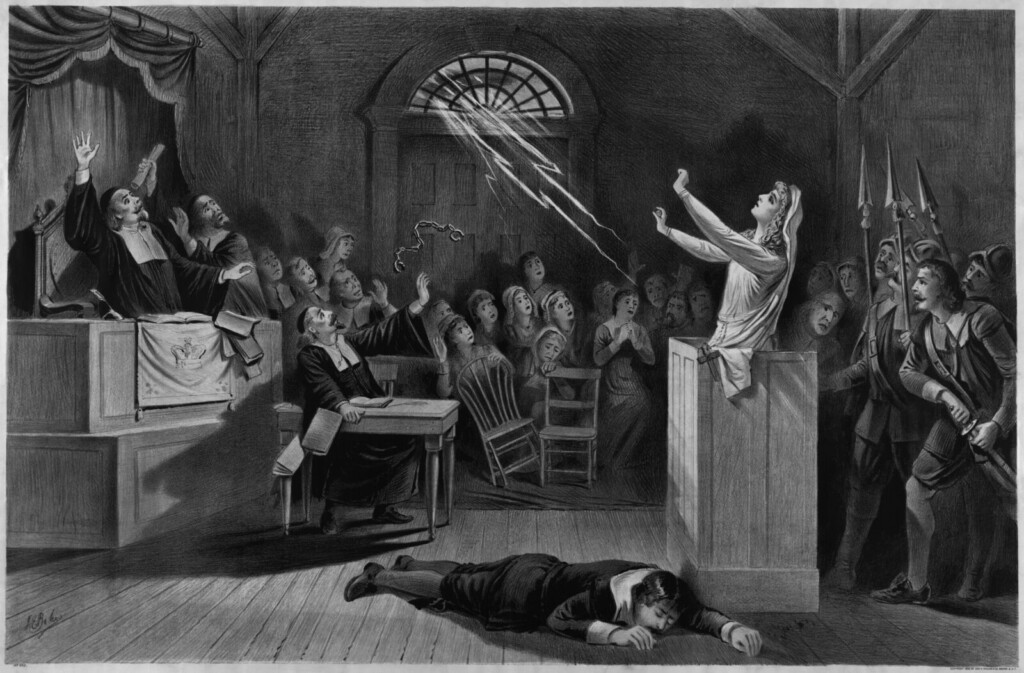
You are handed a confession, dated 1486, written by a woman who has never held a pen. She describes flying over rooftops, consorting with a figure whose cold hands left no warmth in the room, spoiling a neighbor’s milk by thought alone. The words are not hers — they belong to the inquisitor who shaped each answer with the grammar of theological certainty — and yet the document survives as evidence, catalogued, cross-referenced, admissible.
The Malleus Maleficarum, published that same year by Heinrich Kramer and Jacob Sprenger under the implicit endorsement of Pope Innocent VIII’s 1484 papal bull Summis Desiderantes Affectibus, was not a manual of superstition. It was an epistemological instrument. It told educated men precisely how the supernatural worked, who wielded it, what it felt like, and how to extract its confession from human tissue. The book went through at least fourteen editions before 1520, circulating through a literate Europe that had just encountered the printing press — which means the Church did not suppress this architecture of the uncanny. It mass-produced it.
This is the trap that every subsequent century has failed to examine cleanly: the institution that claimed exclusive mediation between the human and the divine had a structural interest in the existence of rival supernatural forces. Without the Devil operating at street level, without witches genuinely disrupting harvests and desire and childbirth, the Church’s protective function collapsed into ceremony. The witch was not the Church’s enemy. The witch was the Church’s proof of concept.
What the trials between roughly 1450 and 1750 accomplished — estimates place the number of executions between forty thousand and sixty thousand across Europe, with particularly dense concentrations in the Holy Roman Empire and Scotland — was the criminalization of unmediated supernatural experience. A woman who claimed direct visionary contact with the sacred, outside the sacramental structure, was not simply a heretic. She was a woman who had bypassed the epistemological toll booth. The violence was jurisdictional before it was theological.
Michel Foucault’s work on the history of madness, particularly his 1961 examination of how European modernity constructed its categories of unreason, illuminates something adjacent here: institutions do not merely react to phenomena they find threatening — they produce the phenomena in the very act of naming and prosecuting them. The accused witch, shaped by the inquisitor’s questions, the village’s accumulated resentment, and the theological framework that made her experience legible, became a social fact. Her reality was collaboratively authored. The paranormal was not a folk residue that the Church tried to scrub away; it was a text the Church kept rewriting to maintain its own authority over what counted as real.
When the prosecutions began to decline in the late seventeenth century, it was not because educated Europeans had become more rational. It was because competing institutions — emerging natural philosophy, centralizing state bureaucracies, a nascent medical profession — were developing their own mechanisms for defining and controlling anomalous experience. The Royal Society, founded in London in 1660, did not eliminate supernatural belief from its early membership; Robert Boyle and Isaac Newton both engaged seriously with questions that would later be classified as occult. What the new institutions introduced was a different set of gatekeepers, a different set of credentials required to speak authoritatively about the edges of the known.
The witch trial did not die because people stopped believing in witches. It died because the monopoly over naming the real had migrated, and the new landlords of reality had different preferred tenants. What remained, pushed below the threshold of institutional credibility, was the raw material that every subsequent generation would inherit without instruction manual — the persistent, embarrassing, irrepressible sense that something moves at the edge of what can be confirmed, and that the category built to contain it says more about power than about the thing itself.
William James in the Dark
You are sitting in a lecture hall in 1896, and one of the most celebrated psychologists in the Western world is telling you, with complete seriousness, that the evidence for telepathy deserves the same scrutiny as the evidence for any other natural phenomenon. The man is not a credulous eccentric. He holds the first professorship in psychology ever established at Harvard. He has spent twenty years building a discipline that insists on observable behavior, reproducible states, measurable responses. And yet here he is, arguing that dismissing the reports of the Society for Psychical Research — founded in London in 1882 by figures including the philosopher Henry Sidgwick and the classicist Frederic Myers — constitutes not scientific rigor but intellectual cowardice disguised as method.
William James spent eighteen years as a member of the American Society for Psychical Research, attended séances, evaluated mediums, and wrote extensively about cases that his professional peers preferred to ignore. His engagement with the medium Leonora Piper, which he documented across the 1890s, was not the hobby of a credulous man but a sustained methodological experiment. He arranged for strangers to sit with her without introduction, controlled for cold-reading, cross-examined her outputs. He never concluded she was fraudulent, and he never concluded she was supernatural. What he concluded was more unsettling: that the phenomena resisted both explanations, and that a framework which could only offer those two options was probably the problem.
This is the epistemological wound that the paranormal keeps reopening. Positivism — the conviction, hardened into doctrine by Auguste Comte’s Cours de philosophie positive published between 1830 and 1842 — held that genuine knowledge is produced only by empirical observation governed by natural law. It was a revolutionary claim in its moment, a scalpel against theology. But it calcified into something else: a gatekeeping apparatus that determined in advance what could count as evidence. James recognized this in his 1897 collection The Will to Believe, where he argued that the refusal to entertain certain hypotheses is itself a choice, carrying its own risks and its own epistemological costs. Neutrality, he insisted, is not a position outside the game. It is a move within it.
When he published The Varieties of Religious Experience in 1902, James was not merely cataloguing mystical states as cultural curiosities. He was making a claim about consciousness itself — that its ordinary waking form represents only one functional region of a much larger field, and that the boundaries of that field have never been empirically established, only assumed. He used the phrase “the subliminal self,” borrowed from Myers’s 1903 posthumous work Human Personality and Its Survival of Bodily Death, to describe the psychological terrain that standard laboratory method simply could not illuminate. The question was not whether ghosts exist. The question was whether the instrument being used to answer that question was adequate to the measurement.
What makes this historically significant is the timing. The late nineteenth century was the precise moment when scientific naturalism was consolidating its cultural authority, when Huxley’s agnosticism and Spencer’s social Darwinism were remaking the intellectual atmosphere of Europe and America. The paranormal was not a throwback to pre-modern credulity in this context — it was a contested frontier in an active war over what counted as real, what counted as knowable, and who had the authority to decide. James was not retreating from science. He was refusing to let a particular institutional version of science foreclose questions it had not actually answered.
The deeper provocation is this: the positivist framework succeeded so thoroughly that most people now experience its assumptions as facts about nature rather than choices about method. When something resists explanation, the trained modern response is to assume the phenomenon is false, not that the framework is incomplete. James would have recognized that reflex immediately — not as rationality, but as a form of faith wearing a laboratory coat.
What Folklore Actually Remembers
You are standing at the edge of a village in sixteenth-century Friuli, and the woman across from you is describing, with complete composure, how she leaves her body on the Ember Days to fight witches in the fields with a fennel stalk. She is not performing madness. She is not begging for mercy. She is explaining an obligation, a duty inherited from birth, and she expects you to understand it because she is telling you the only language available to her for what her community has always known and never been permitted to say directly.
Carlo Ginzburg spent years inside the Inquisition trial records of northeastern Italy before publishing “The Night Battles” in 1966, and what he found demolished the assumption that peasant supernatural belief was simply degraded theology or rural credulity. The Benandanti, those who described nocturnal spirit journeys to defend the harvest from malevolent forces, were not confessing to witchcraft. They insisted, sometimes to their own peril, that they were its opposite. Ginzburg recognized in their testimony the fossilized structure of a pre-Christian agrarian cult, a system of meaning that had survived centuries of official suppression by encoding itself inside the very narratives the Church had declared heretical. The supernatural vocabulary was not decoration. It was the container in which prohibited knowledge traveled across generations.
This is the function that academic folklore studies has chronically misread by treating it as quaint or as raw material for psychological projection. When a community develops a persistent tradition of a particular ghost haunting a particular road or a particular house, the mainstream interpretive reflex reaches immediately for grief, for unresolved anxiety, for the Freudian machinery of the return of the repressed. What it tends not to reach for is the historical archive, the land registry, the trial records, the census of who disappeared and when and under what circumstances that the official documentation was structured to obscure. Haunting, in the sociological sense that Avery Gordon explored in “Ghostly Matters” in 1997, is not a metaphor. It is a form of knowledge transmission operating below the threshold of what a society permits itself to acknowledge in sanctioned speech.
Possession narratives carry the same freight. Across West African diaspora religions forcibly transplanted by the slave trade, the spirits that mounted their devotees in ritual were not an eruption of superstition into modernity but a living archive of kinship structures, theological systems, and social hierarchies that the machinery of enslavement had been explicitly designed to erase. Vodou, Candomblé, Santería each developed intricate spirit taxonomies that encoded the memory of specific Yoruba, Fon, and Kongo lineages with a precision that plantation records never bothered to preserve. The supernatural catalog was doing the archival work that history refused.
Omen systems function by the same logic of displaced record-keeping. When anthropologist Mary Douglas analyzed pollution taboos in “Purity and Danger” in 1966, she demonstrated that what a community designates as dangerous, contaminating, or ominous maps with extraordinary precision onto the boundaries it most needs to police and the violations it has most urgently experienced. The omen is not irrational. It is a compressed notation system for categories of threat that explicit social language has no agreed vocabulary to name, often because naming them would require acknowledging culpability, structural violence, or forms of suffering that the dominant order depends on leaving unspoken.
The ghost, then, is not evidence of the supernatural as a category separate from the historical. It is what the historical looks like when the institutions responsible for recording it have chosen not to. Every tradition of a child’s spirit heard crying in a building where no child is known to have died, every regional legend of figures seen walking roads that were cleared for someone else’s benefit, every omen attached to the anniversary of a date that official memory has allowed to go unmarked contains, somewhere in its transmission, the outline of something that actually happened to people who had no other mechanism for insisting that it be remembered.
A vision curated by a filmmaker, not an algorithm
In this video I explain our vision
The Industrialization of the Uncanny

You are watching a man describe, in precise and trembling detail, the moment he believed something entered his bedroom. His hands move without his permission. His voice drops to a register he clearly does not control. Then the camera cuts to a commercial for truck insurance, and when it returns, a logo swoops across the screen in gothic lettering, and a narrator intones that the truth is out there, waiting. The man’s hands are still. The trembling is gone. Whatever was in the room with him has been successfully removed.
The twentieth century did not invent the commodification of fear, but it industrialized it with a precision that earlier eras lacked the infrastructure to achieve. By the 1970s, a publishing apparatus had already crystallized around paranormal experience: Erich von Däniken’s Chariots of the Gods, published in 1968, sold over seven million copies within a decade, not because it offered serious archaeological argument but because it offered readers the sensation of revelation without the cost of genuine uncertainty. The book’s genius was structural. It posed questions it never intended to answer rigorously, mistaking provocation for inquiry, and in doing so it taught the market what paranormal content needed to be: exciting, unresolved, and utterly safe to consume.
Television formalized this grammar into something almost liturgical. The format that emerged across American and British broadcasting from the late 1980s onward followed rules so consistent they approached the condition of ritual: a location with history, a team of investigators equipped with devices whose readings could not be independently verified, a climax of ambiguous audio or visual disturbance, and a final statement that neither confirmed nor denied. The ambiguity was not intellectual honesty. It was the product being sold. Closure would have ended the franchise. William James, in his 1896 address “The Will to Believe,” argued that the human need to commit to propositions beyond available evidence was not a failure of rationality but a constitutive feature of lived experience. What the entertainment industry understood, with no interest in James whatsoever, was that this need could be harvested indefinitely if you never quite fed it.
The digital era did not rupture this economy. It accelerated and atomized it. By 2010, the architecture of platforms like YouTube had created conditions in which a teenager filming their own home with a night-vision camera could insert themselves into a genre with a century of accumulated iconography behind it. The conventions were already fully formed: the jump cut, the hushed voice, the timestamp in the corner. What disappeared in this democratization was not the format but any residual friction between the experience and its packaging. The man with trembling hands had at least sat in front of another human being. The algorithm delivered content directly to a face illuminated only by a screen, and the encounter was over in eleven minutes, optimized for retention, structured around a midpoint spike in tension.
What gets systematically destroyed in this process is not belief itself but the phenomenological weight of what paranormal experience originally named. Scholars like Jeffrey Kripal, in his 2010 work Authors of the Impossible, have documented the extent to which genuine encounters with the inexplicable carry a quality he calls “the fantastic,” a rupture in the ordinary structure of meaning that is not reducible to either hallucination or literal supernatural event. The rupture is the thing. It does not fit inside eleven minutes. It does not resolve into merchandise. The market cannot sell a genuine destabilization of the subject’s relationship to reality, because a genuinely destabilized subject stops buying things and starts asking questions for which no product exists. So the industry sells the aesthetic of rupture while carefully preserving the structural stability of the consumer, and what circulates endlessly under the name of the paranormal is a simulation of the very experience it has learned to make commercially viable.
Psychology's Uncomfortable Inheritance
You are sitting with a therapist who uses the word “archetype” without blinking, as if it were as clinically neutral as “cortisol” or “serotonin,” and somewhere in that room the entire history of Western psychology is quietly holding its breath.
Carl Jung published “Synchronicity: An Acausal Connecting Principle” in 1952, the same year he turned seventy-seven, and the text reads less like a scientific paper than like a man finally saying aloud what he had been thinking for decades and knew would cost him. He described meaningful coincidences that could not be explained by causality — a scarab beetle appearing at a patient’s window at the precise moment she described dreaming of one, Rhine’s card experiments at Duke University producing statistical anomalies that standard probability could not absorb — and he proposed that the psyche and the physical world shared a common ordering principle that operated entirely outside the logic of cause and effect. This was not metaphor. He meant it structurally, ontologically, as a feature of reality. His collaborator on the paper was Wolfgang Pauli, one of the founding architects of quantum mechanics, which meant that the idea arrived with credentials that made dismissal genuinely uncomfortable.
What followed was not refutation so much as quarantine. Academic psychology in the postwar decades was fighting for its own legitimacy inside universities dominated by the physical sciences, and the price of admission was a particular kind of methodological hygiene. B.F. Skinner’s behaviorism had already established that anything not externally measurable was professionally inadmissible, and the cognitive revolution that followed it retained that demand for operationalization even as it reintroduced the interior life. Jung became the figure you cited when you wanted to signal that you had not entirely abandoned imagination, but his later work — the work on synchronicity, on the unus mundus, on the psychoid nature of archetypes existing at a threshold between psyche and matter — was treated as the output of an old man who had wandered past the edge of his own map. The institutional move was elegant in its economy: keep the vocabulary, discard the metaphysics.
What this concealed was that the metaphysics were doing most of the explanatory work. The collective unconscious was not simply a poetic term for shared cultural patterns; Jung’s actual claim, developed across volumes twelve through fourteen of his Collected Works, was that certain psychic structures existed prior to individual experience and could not be reduced to it — that the unconscious had a transpersonal dimension that touched something anterior to the individual self. This is precisely the claim that every major shamanic tradition, every initiatory religion, and every reported encounter with what people call the paranormal has made in its own idiom. Psychology arrived at the same address and then pretended it had been standing in front of a different building all along.
The discomfort is not primarily intellectual. It is professional and territorial. A discipline that defines itself against the supernatural cannot afford to discover that its most generative theorist had concluded, in the last decade of his life, that the boundary between psyche and world was permeable in ways that causality could not govern. The 1994 DSM-IV introduced the category of “religious or spiritual problem” as a V-code — a non-disorder requiring clinical attention — which meant that experiences previously coded as symptoms of psychosis now occupied an ambiguous middle space where their content could not be automatically pathologized. This was not a philosophical concession. It was a liability adjustment. The cases had accumulated in numbers that made uniform pathologization statistically indefensible, and the adjustment was made quietly, without fanfare, in the formatting language of insurance billing codes, which is the grammar through which American psychiatry encodes its actual beliefs about what is real.
The Paranormal as a Mirror for What Rationalism Cannot Hold
You are sitting alone at three in the morning, and something shifts in the room — not a sound exactly, not a movement, but a pressure in the air that makes the hairs on your forearms rise before your mind has assembled a single coherent thought about what is happening. The experience arrives faster than language. And when you reach for an explanation afterward, you notice that every framework available to you — neurological, psychological, sociological — explains the response without touching the thing itself, the raw fact that there was something it was like to be you in that moment, something irreducibly first-person that no amount of third-person description ever quite reaches.
This gap is not a mystical invention. David Chalmers named it with clinical precision in 1995, in “Facing Up to the Problem of Consciousness,” distinguishing the easy problems of cognition — attention, memory, behavioral response — from the hard problem: why any physical process gives rise to subjective experience at all. The hard problem has not been solved. It has been argued around, minimized, and occasionally declared a pseudo-problem, but it remains structurally intact, an open wound in the body of materialist philosophy. What is remarkable is not that people believe in paranormal phenomena — it is that the dominant intellectual culture treats that belief as the epistemological scandal, while leaving the hard problem largely untouched in the public conversation about reason and its discontents.
The discomfort directed at paranormal testimony is rarely discomfort with bad evidence alone. It carries a specific emotional signature: the irritation of a framework being threatened. Thomas Nagel, in “The View from Nowhere” published in 1986, argued that the ambition of objective science — to produce a picture of reality from no particular point of view — necessarily evacuates precisely the thing that makes reality real to any given person. The more complete the third-person account, the more it distances itself from the texture of lived experience. Paranormal claims, whatever their epistemic status, are almost always first-person claims. They arrive as testimony about what it was like — not what the instruments recorded, not what the statistics suggest, but what happened to a particular body in a particular room on a particular night. Dismissing them as irrational is also, quietly, a decision about whose inner life counts as evidence.
William James understood this with unusual honesty. His work for the Society for Psychical Research in the 1880s and 1890s was not motivated by credulity but by a genuine philosophical suspicion that orthodox science, by restricting its evidentiary standards to the repeatable and the measurable, was systematically discarding the most intimate data available to human beings. His “Principles of Psychology” from 1890 already contained the argument that consciousness resists reduction, that the stream of experience is not an epiphenomenon sitting on top of real processes but is itself the most fundamental datum any inquiry into reality could possibly have. The paranormal, for James, was not the fringe of science but the test of whether science was capable of intellectual honesty about its own boundaries.
What the history of paranormal belief ultimately reveals is not a record of human failure to think clearly, but a record of human insistence on taking experience seriously even when the available frameworks for legitimizing experience have been captured by interests — institutional, theological, political — that benefit from deciding in advance what counts as real. Every era produces its own version of that capture, and every era produces people who report something that does not fit, who cannot be fully explained away, who sit in the category of the anomalous not because they are broken but because the category of the normal was always drawn too narrowly to contain the actual range of what it is to be conscious and embodied and alive in a world that has never once confirmed, in writing, that it has finished revealing itself.
👻 Between Worlds: History, Mystery and the Unseen
The paranormal has haunted human imagination across every culture and century, blending fear, wonder, and the desperate need to make sense of what lies beyond the visible. These related articles explore the deep roots of supernatural thinking — from folklore and ghost traditions to the psychology of belief and the aesthetics of the uncanny.
Ghosts in Japanese Culture: History and Symbolism
Ghosts in Japanese culture occupy a central place in both religious practice and artistic expression, reflecting a worldview in which the dead remain intimately connected to the living. This article traces the history and symbolism of Japanese spirits, revealing how cultural frameworks shape what societies choose to fear and venerate. Understanding this tradition illuminates the universal human need to negotiate with the unknown.
GO TO THE SELECTION: Ghosts in Japanese Culture: History and Symbolism
The Vampire Myth: History and Symbolism
The vampire myth is one of the most enduring supernatural constructs in Western history, evolving from Eastern European folklore into a powerful cultural symbol. This article examines its origins and layered symbolism, showing how the figure of the undead mirrors anxieties about death, desire, and social transgression. Few paranormal archetypes have proven as adaptable or as psychologically revealing.
GO TO THE SELECTION: The Vampire Myth: History and Symbolism
The Literary Fantastic: Todorov and the Theory of the Fantastic
Tzvetan Todorov’s theory of the fantastic offers one of the most rigorous frameworks for understanding how literature navigates the boundary between natural and supernatural explanation. His concept of hesitation — the reader’s uncertainty about whether events are real or imagined — lies at the very heart of paranormal narrative. This article introduces his thought and its lasting influence on horror, gothic, and uncanny storytelling.
GO TO THE SELECTION: The Literary Fantastic: Todorov and the Theory of the Fantastic
Sheridan Le Fanu: Irish Gothic and Domestic Horror
Sheridan Le Fanu perfected a brand of Irish Gothic horror in which the supernatural erupts from within the domestic and the familiar, making the everyday world profoundly unsafe. His stories draw on Irish folklore and Protestant anxiety to create hauntings that feel both culturally specific and universally unsettling. Exploring his work is essential for anyone tracing the literary genealogy of paranormal fiction.
GO TO THE SELECTION: Sheridan Le Fanu: Irish Gothic and Domestic Horror
Discover the Cinema of the Invisible on Indiecinema
If these themes stir something in you — the pull of mystery, the shiver of the unexplained, the ancient question of what lies beyond — Indiecinema is the streaming platform where cinema dares to go there. From visionary independent films to rare documentary explorations of the paranormal and the sacred, Indiecinema gathers the stories that mainstream platforms leave in the dark. Come and explore what waits on the other side of the screen.
👉 EXPLORE THE CATALOG: Watch Indie Films in Streaming
A vision curated by a filmmaker, not an algorithm
In this video I explain our vision

