
Blood as Currency: The Economic Logic of the Undead
You wake up one morning and your livestock are dying. Not one, not two — the whole flock, systematically, as if something with a ledger is working through them in order. Your neighbor died six weeks ago, a man who owed debts he never settled, and people have started talking. The ground does not hold the dishonest the way it holds the virtuous. Everyone in the village agrees on this point without ever having agreed on it formally.

The cases that erupted in Serbia between 1725 and 1732 were not folklore. They were bureaucratic events. The Habsburg military administration, freshly installed over territories carved from the Ottoman Empire, sent actual medical officers to investigate reports of the undead. In January 1732, a team of Austrian army surgeons exhumed seventeen bodies near the village of Medvedja and filed an official report — Visum et Repertum, seen and found — which became one of the most widely circulated documents in early eighteenth-century Europe. The case of Arnod Paole, a soldier who had died after falling from a hay wagon and was blamed posthumously for the deaths of at least four neighbors, was not a ghost story whispered around a fire. It was a legal proceeding, complete with witnesses, signatures, and a verdict delivered by lancet and stake. The Enlightenment did not dissolve the vampire. It notarized him.
What the historical record exposes, beneath the theological panic and the reek of premature decomposition mistaken for reanimation, is a community trying to resolve problems that the living refused to resolve while they were still breathing. Peasant economies in the Balkans and Carpathian regions operated on dense webs of informal obligation — borrowed grain, shared grazing rights, marriages that were also land transfers, deaths that were also inheritance disputes. When a man died before those threads were untangled, the knot did not disappear. It simply moved underground and continued pulling. The vampire is, at its structural core, a creditor who will not foreclose cleanly.
Karl Marx understood something adjacent to this when he described capital as dead labor that dominates living labor, and he reached instinctively for the same image: in Das Kapital, published in 1867, he wrote that capital is dead labor which, vampire-like, lives only by sucking living labor, and lives the more the more labor it sucks. This was not ornament. It was diagnosis. The economic logic embedded in the peasant myth — that the dead retain claims on the living, that extraction continues beyond the grave, that the body itself can be a site of unresolved transaction — maps with uncomfortable precision onto the mechanics of debt inheritance, of land that passes encumbered, of obligations that outlast the person who incurred them.
There is a reason the vampire always returns to the house. Not to a stranger’s threshold, not to a foreign field — to the family. The folkloric vampire of the Slavic tradition is almost never a predatory outsider. He is the uncle who died owing his brother three seasons of labor. He is the widow’s first husband, whose plot of land she has remarried into someone else’s family. The horror is not the unknown. The horror is the familiar made monstrous by incompleteness, by the unfinished business that the living maintain the polite fiction of having finished.
By the time the vampire crossed into Western literary imagination — through Dom Augustin Calmet’s 1746 treatise Dissertations sur les apparitions, which Voltaire read and savaged, and through the anxious dispatches of travelers returning from the eastern frontier — the creature had already been laundered of its economic specificity. What arrived in the drawing rooms of Paris and London was a gothic frisson, a shiver of the irrational. What had been left behind in Medvedja was a village still arguing about who owned the field.
The Ecstasy of Isabel Mann

Horror, thriller, by Jason Figgis, United States, 2016.
Set in Ireland, the film tells the story of Isabel Mann, an introverted and lonely teenager who is drawn into a dark and seductive world of blood, violence, and vampirism. As the story unfolds, Isabel undergoes a disturbing transformation—from a vulnerable young girl to a ruthless creature—guided by a group of vampires who pull her into a spiral of murder and ritual. At the same time, a team of detectives attempts to shed light on a series of brutal killings that seem to be connected. However, their investigation leads them toward a truth far more unsettling than they could have anticipated.
The film stands out for its cold, disturbing atmosphere and a slow, reflective narrative that favors psychological depth over action. Vampirism here is not just a genre element, but takes on a symbolic meaning tied to adolescent alienation, the search for identity, and the longing to belong. *The Ecstasy of Isabel Mann* embraces an auteur style and carries the emotional intensity of Ellen Mullen’s lead performance. It’s a different kind of horror film—intimate and melancholic—capable of blending teenage tragedy with the vampire myth in a modern, introspective way.
LANGUAGE: English
SUBTITLES: Spanish, French, German, Portuguese
The Church, the Corpse, and the Politics of Decomposition
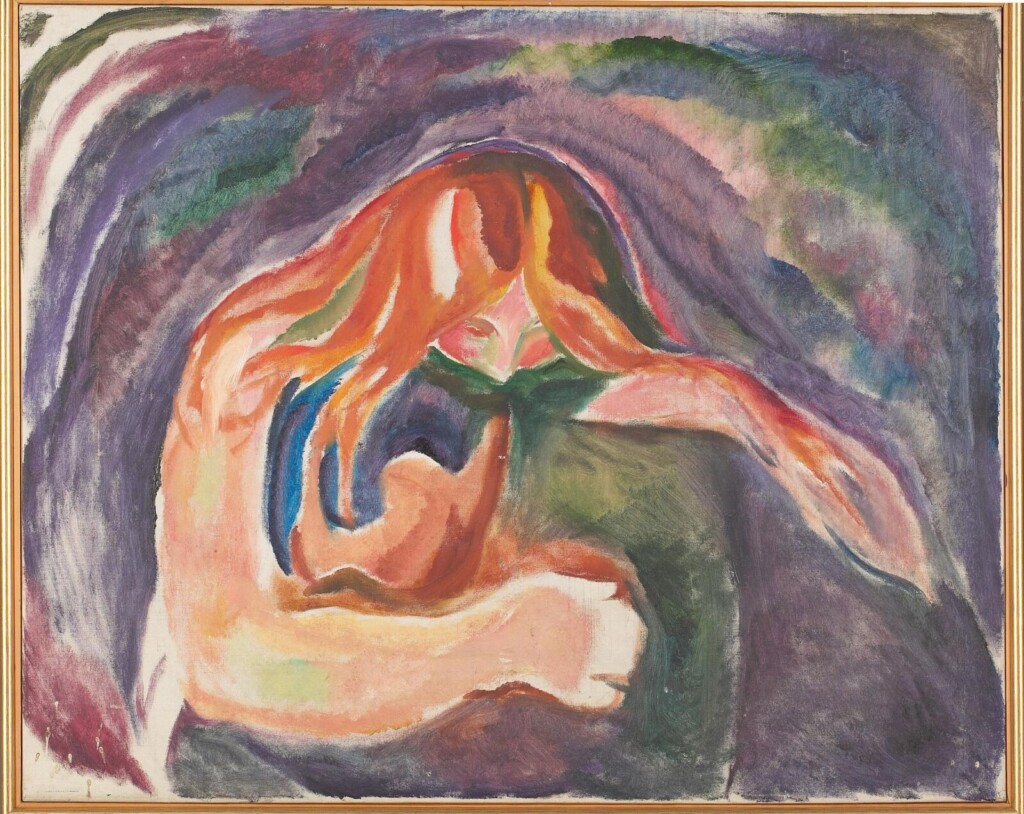
You open the coffin after three weeks and the body has bloated, shifted, turned onto its side, leaked dark fluid from its mouth. You did not expect it to look like this. You expected stillness, the pale horizontal surrender of death. Instead you find something that appears, grotesquely, to have moved toward you.
Paul Barber‘s 1988 forensic study of vampire folklore documents exactly this encounter in exhaustive, clinical detail, cataloguing the reports of eighteenth-century Eastern European exhumations that generated the most durable panic in pre-modern European memory. What those communities were witnessing was not supernatural but biological: the bloating produced by internal gases, the dark purge fluid mistaken for fresh blood, the skin slippage that makes a corpse appear to have grown new flesh beneath the old. The science was invisible to them. The Church, however, understood something more useful than science — it understood that the terror could be administered.
The doctrinal architecture the Catholic and Orthodox churches had spent centuries constructing around death was not primarily about comfort. It was a jurisdictional claim. Who died well, who died badly, who received the rites, who was buried in consecrated ground — these were not pastoral questions. They were political ones, and the corpse was the territory over which they were fought. Excommunication, the most catastrophic sentence a bishop could pronounce, did not merely exclude the living from sacraments. It retroactively contaminated the dead. The excommunicated body could not rest. It was, by the logic already embedded in folk tradition, the precise candidate for undead restlessness — a claim so convenient that ecclesiastical authorities had little incentive to dismantle it and every incentive to amplify it.
What makes this dynamic structurally elegant and historically verifiable is the way it operated in both directions simultaneously. When a vampire panic erupted in a Serbian village in 1725 — the documented case of Arnold Paole, which triggered official Habsburg military investigations and generated written reports examined across European courts — the Church did not step in to debunk the phenomenon. It stepped in to adjudicate it. Priests and bishops arrived not as scientists but as authorities empowered to determine whether the body in question had died in a state of grace. The criteria for that determination were, predictably, identical to the criteria for doctrinal obedience during life. The myth was not a product of ignorance that the Church reluctantly inherited. It was a diagnostic tool it had quietly sharpened.
The deeper structure here belongs to what Michel Foucault identified across his work as the biopolitical capture of the body — the historical process by which institutional power extends itself not through explicit coercion but by colonizing the meaning of biological events. Foucault never wrote about vampires, but his 1975 Discipline and Punish, tracing the shift from spectacular punishment of the body to its internal normalization, illuminates exactly how decomposition became a moral verdict. A body that rotted incorrectly, that swelled and leaked and resisted the peaceful dissolution of the righteous, was not just frightening. It was evidence of a life poorly submitted to authority.
This is why the vampire myth intensified precisely in regions where ecclesiastical control was contested, where Orthodox and Catholic jurisdictions overlapped, where the Reformation had already cracked the institutional monopoly on death. The corpse became a battleground for competing claims of interpretive authority, and communities caught between those claims had no framework except terror. What they saw in the grave was real. What they were told it meant was a political construction wearing the costume of the sacred, arriving exactly at the moment when the living were most vulnerable to instruction.

Aristocratic Predation and the Erotics of Surrender
You have met him before, though perhaps not by name — the man who enters a room and makes everyone slightly smaller, whose attention feels like a hand around the throat, whose charm is indistinguishable from threat. John William Polidori published “The Vampyre” in 1819 and gave that figure a literary body: Lord Ruthven, aristocratic, cold, socially magnetic, moving through drawing rooms and leaving ruin behind him in the form of young women and depleted fortunes. What Polidori encoded, working in the shadow of Lord Byron — whom he had watched seduce and discard across European salons — was not supernatural horror but a precise sociology of extraction. The noble does not need to ask. The noble does not need to threaten. The noble simply arrives, and the rest follow.
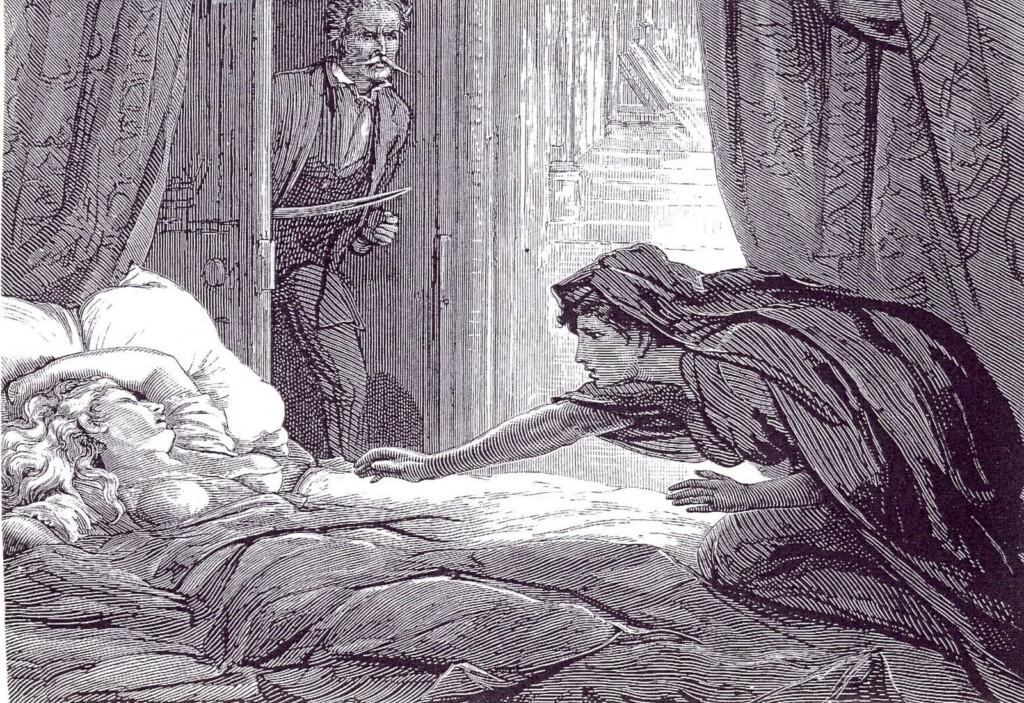
What makes this portrait so structurally precise is what the reader does with it. Sheridan Le Fanu‘s Carmilla, published in 1872, places the reader inside the victim’s perspective with uncomfortable intimacy. Laura does not simply endure Carmilla’s presence — she desires it, waits for it, feels its absence as deprivation. The novella was written three decades before Freud’s first major clinical writings, yet it performs a diagnosis he would later formalize: that submission and longing can be taught by the same hand, that a person shaped by powerlessness may come to experience powerlessness itself as the form desire takes. The erotic content of Le Fanu’s text is frequently described as transgressive for its lesbianism, but the deeper transgression is its insistence that the consumed genuinely wants to be consumed, and that this wanting is not pathology but social inheritance.
Bram Stoker‘s 1897 novel then does something structurally stranger: it places Dracula in the modern world of typewriters, telegrams, and railway schedules, and shows him failing precisely because the modern world has developed bureaucratic defenses against him. The crew of light that destroys Dracula is a professional class — a doctor, a lawyer, a professor — armed with documentation, schedules, and cooperative record-keeping. Stoker was writing at the precise historical moment when the British landed aristocracy was in measurable financial collapse, when the 1894 death duties imposed by the Harcourt budget began transferring ancestral wealth toward the state, when the old houses were being sold and subdivided. The monster arrives from the east seeking property in England and is defeated not by faith but by administration. The century that would inherit this story had already begun replacing bloodlines with paperwork.
The critical error in reading these three texts as moral fantasies of good versus evil is that they do not present predation as aberration. Ruthven, Carmilla, Dracula — none of them operate outside the social order. They operate as its concentrated expression, doing overtly and supernaturally what the social order does slowly and with paperwork. The landlord who extracts rent from tenants who cannot leave, the employer who purchases labor below its cost, the man who marries a fortune because law and custom have arranged that a woman cannot hold one independently — these are not metaphors for vampirism. They are its practical form. The literary vampire simply removes the delay and the paperwork, making the extraction legible.
Which is precisely why the reader identifies from both positions simultaneously. The fantasy of the vampire is never purely the fantasy of being devoured — it is also, and perhaps more honestly, the fantasy of being the one who takes without consequence, who moves through the world feeding and remaining unfed-upon, whose desire has structural permission behind it. The reader who feels the horror is the same reader who recognizes the privilege in the monster’s posture, the ease with which he enters rooms that were not built to keep him out.
Nosferatu
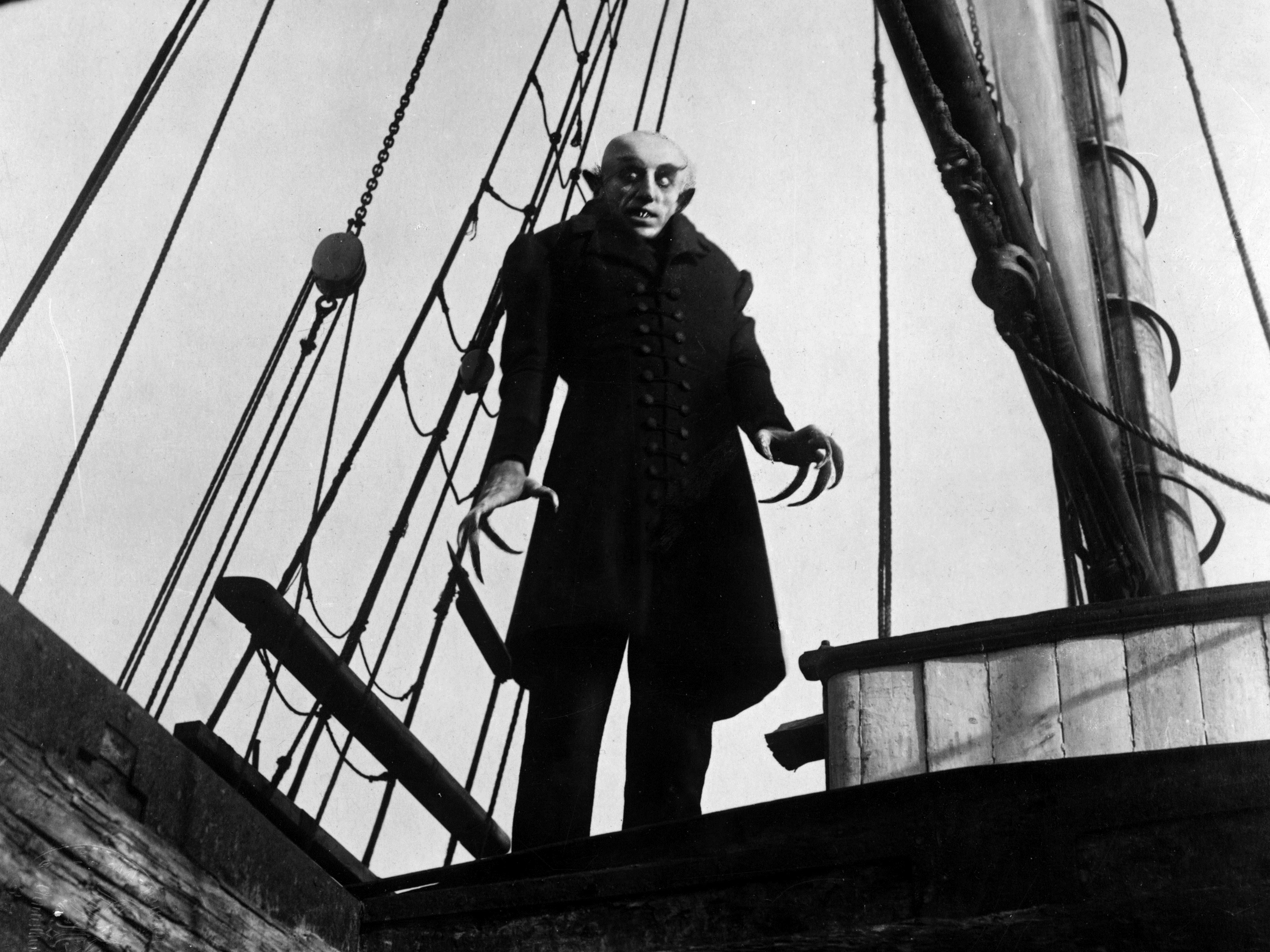
When a young real estate agent, Thomas Hutter, goes to the castle to close a deal, Orlok is attracted by his blood and decides to follow him to his hometown. The arrival of the count causes a series of mysterious deaths and spreads panic among the inhabitants.
Murnau, through evocative images and disturbing atmospheres, creates a work that goes far beyond the simple adaptation of Stoker's novel. The film explores universal themes such as the fear of death, isolation and the loss of humanity. The production of Nosferatu was characterized by some legal difficulties due to the copyright of Bram Stoker's novel. Despite this, Murnau and his crew managed to make a film of great visual impact. The choice of Max Schreck to play Count Orlok was ingenious. His cadaverous appearance and his unnatural movements have made the character of Orlok one of the iconic monsters in the history of cinema. Over the years, Nosferatu has become a cult film, influencing generations of filmmakers and becoming a reference point for the horror genre. The image of Count Orlok, with his elongated nails and sunken eyes, has become an icon of horror cinema.
The Immortality Trap: Nietzsche, Eternal Return, and the Horror of Persistence

You have lived the same argument with the same person seventeen times, and somewhere around the twelfth repetition you stopped noticing. The words arrive in the same order, the chest tightens in the same place, the silence afterward lasts exactly as long as it always has. Nothing is learned because nothing is risked. This is not a failure of memory. It is a failure of mortality.
The vampire’s immortality has always been read as the dream — the escape from biological terror, the body held still against time’s erosion. But the philosophical tradition understands persistence differently. When Friedrich Nietzsche posed the thought experiment of eternal recurrence in “The Gay Science” in 1882, he did not offer it as a cosmological claim. He offered it as a weight test: could you bear to live this life again, infinitely, with every detail preserved? The horror of the thought was not repetition itself but the revelation that most people are already living as though condemned to it — cycling through the same patterns, the same resentments, the same loves badly managed, without the productive terror of finitude to force any genuine revision.
What distinguishes the undead from the merely habitual is not the absence of a heartbeat but the foreclosure of genuine stakes. Transformation in human psychology requires what the psychoanalyst Otto Rank, writing in “The Trauma of Birth” in 1924, identified as a willingness to undergo symbolic death — the dissolution of a prior self-concept before a new one can consolidate. This is not metaphor dressed up as theory. The clinical literature on identity rigidity, developed extensively through work by Carol Dweck on fixed versus growth mindsets, documents measurable cognitive and emotional consequences for individuals who cannot integrate new experience into a revised self-understanding. They accumulate data without updating the model. The vampire hoards centuries of sensation — war, plague, the collapse of empires — and remains structurally identical to the predator who first rose from the grave.
There is something precise in the image of the vampire’s reflection. The absence in the mirror is not merely a gothic flourish. It literalizes the condition of an entity that cannot be witnessed by the future, cannot project forward into a self that does not yet exist, because that self — the transformed, the altered, the posthumous version of oneself — requires the pressure of an ending to become possible. Paul Ricoeur argued in “Oneself as Another” that narrative identity, the sense of a coherent self persisting through time, is not a static possession but an active interpretation that requires an awareness of one’s own finitude to maintain its forward direction. Strip out the ending and you strip out the capacity to mean anything by how you live.
The contemporary resonance is not subtle. Cultures that have extended life expectancy dramatically — in industrialized nations, average lifespans increased by more than thirty years across the twentieth century — have produced not proportional increases in wisdom or transformation but a particular type of prolonged adolescence, what the sociologist Zygmunt Bauman called the liquidity of identity: the endless deferral of commitment under the guise of remaining open. The immortal does not choose this deferral consciously. It is simply the structural consequence of removing the deadline. Time without terminus does not liberate desire; it dissolves it into a diffuse, directionless hunger that can consume endlessly without ever being satisfied — which is precisely the description that haunts every serious literary account of the vampire’s inner experience, the feeding that never nourishes, the longing that survives every object it attaches itself to.
What is feared in the vampire is not that it will kill you, but that you will recognize in its persistence something already operational in your own life —
The Mirror That Shows Nothing: Narcissism, Visibility, and the Modern Vampire
You stand in front of the camera every morning and you adjust the angle until the light erases the doubt in your face. The image that emerges is not you — it is the version of you that can withstand being seen. This is not vanity in the old sense. It is something more desperate: a ritual of existence, a daily proof that you are real enough to be looked at.
The vampire casts no reflection. Folklore established this long before Stoker codified it, and the explanation given was theological — the mirror reveals the soul, and the undead have none. But Heinz Kohut, writing in The Analysis of the Self in 1971, described something functionally identical in living people: the individual whose psychological architecture was never completed because no one in early life returned their gaze with genuine recognition. What Kohut called the mirroring selfobject — the other person whose eyes say you exist, you matter, you are real — is precisely what the vampire cannot access, and precisely what the modern subject pursues across every surface that can produce a reflection. The theological explanation was always a psychological one wearing a different costume.
Christopher Lasch, in 1979, documented the social conditions that had turned this wound from a private pathology into a collective orientation. The Culture of Narcissism was not a book about selfishness. It was a forensic account of what happens when institutions stop providing stable frameworks of meaning and people are left to construct identity entirely from external response. Lasch identified the performing self, the therapeutic sensibility that replaced moral conviction with emotional management, the compulsive search for validation dressed in the language of self-improvement. What he described is a civilization that has structurally removed the mirror while demanding that everyone remain constantly visible.
The vampire’s problem is not that it is too full of self. It is that there is a void where the self should cohere, and the blood of others is the only substance that temporarily fills the shape. This is not metaphor deployed loosely — it tracks with clinical precision against what Object Relations theorists observed: that the person who experienced chronic failures of early recognition develops an identity that can only be sustained by consuming the attention of others. The hunger is not greed. It is ontological. Without the other’s gaze, the vampire’s self simply does not register as existing.
What makes the contemporary moment genuinely strange is that platforms have been engineered to monetize exactly this dynamic. The architecture of social media is not incidentally suited to narcissistic loops — it was optimized for them, because engagement metrics discovered early that the hunger for reflected validation generates more compulsive behavior than almost any other psychological lever. A person checking their notifications two hundred times a day is not behaving irrationally. They are behaving exactly as Kohut predicted someone would who never had the wound closed: returning to the mirror, compulsively, to see if this time the image holds.
The oldest versions of the vampire did not seduce. They were not elegant. They came back from the grave because something unfinished pulled them, some incomplete transaction with the living, some debt of recognition never settled. The aristocratic predator came later, a Romantic projection that aestheticized the horror. But underneath that sophistication the original creature was always a thing that could not complete its own existence without taking something from others — presence, warmth, the biological currency of life. What the twenty-first century added was not a correction to this but a scaling of it: the same incompleteness, the same compulsive return to the surface that should show something, now running continuously across billions of screens, each one a mirror angled just right, each one showing exactly as much as the vampire’s legendary reflection has always shown — the outline of a person, and behind it, nothing at all.
A vision curated by a filmmaker, not an algorithm
In this video I explain our vision
🧛 Blood, Night, and the Undead: Myth and Symbolism
The vampire myth reaches far beyond horror fiction, drawing on deep currents of folklore, psychology, and cultural anxiety. To understand its enduring power, we must explore the symbolic territories it inhabits: the monster as mirror, the Gothic as aesthetic system, the supernatural as social metaphor.
The Monster Family in American Horror: History and Symbolism
The monster family in American horror has always served as a distorted reflection of the society that creates it. From Frankenstein’s creature to the wolf man, these figures embody fears about the body, death, and the boundary between human and inhuman — themes that lie at the very heart of vampire mythology.
GO TO THE SELECTION: The Monster Family in American Horror: History and Symbolism
Sheridan Le Fanu: Irish Gothic and Domestic Horror
Sheridan Le Fanu‘s Irish Gothic laid essential groundwork for vampire literature, most notably with his novella Carmilla, which predates Dracula by over two decades. His domestic horror — uncanny presences invading familiar spaces — captures the vampire’s essential symbolic charge: the intimate terror that comes from within the home.
GO TO THE SELECTION: Sheridan Le Fanu: Irish Gothic and Domestic Horror
The Aesthetics of Decadentism: When Beauty Became Illness
The aesthetics of Decadentism forged a direct cultural link between beauty, disease, and the undead. The vampire as seductive destroyer became a central icon of late nineteenth-century art and literature, embodying the Decadent obsession with transgression, exhaustion, and the dangerous allure of the forbidden.
GO TO THE SELECTION: The Aesthetics of Decadentism: When Beauty Became Illness
The Literary Fantastic: Todorov and the Theory of the Fantastic
Todorov’s theory of the fantastic provides one of the most powerful critical lenses for understanding vampire narratives. His concept of hesitation — the reader’s uncertainty between a natural and a supernatural explanation — maps perfectly onto the vampire’s ambiguous existence at the border between life and death.
GO TO THE SELECTION: The Literary Fantastic: Todorov and the Theory of the Fantastic
Discover the Shadows on Indiecinema
If these dark mythologies have stirred your imagination, Indiecinema streaming is where they come alive on screen. Explore our curated selection of independent films that dare to reimagine horror, folklore, and the uncanny beyond the conventions of mainstream cinema.
👉 EXPLORE THE CATALOG: Watch Indie Films in Streaming
A vision curated by a filmmaker, not an algorithm
In this video I explain our vision

