
The Locked Room at the Center of the House
You are sitting in a room you have lived in for years, and something is wrong. Not the furniture — the furniture is exactly where it has always been. Not the light, which falls through the window at the usual afternoon angle, warming the same patch of floor it has always warmed. Not the faces of the people around you, which are the faces you have known longest, whose expressions you can read before they form. The wrongness is prior to all of this. It lives underneath the recognizable surface of things, the way woodrot lives underneath paint that still holds its color, and the only evidence of it is a faint softness underfoot when you cross the floorboards, a give that was not there before, a yielding that the house itself seems to want to conceal from you.

Joseph Sheridan Le Fanu understood this wrongness as the central fact of human experience. Born in Dublin in 1814 into a Huguenot family of literary distinction — his great-uncle was Richard Brinsley Sheridan — he grew up inside an Anglo-Irish Protestant culture that was already in the process of losing its grip on Ireland, a community that inhabited houses built on centuries of dispossession, surrounded by a countryside that had never fully accepted them and never would. Le Fanu’s biography is itself an education in the uncanny domestic: his father was a Church of Ireland clergyman stationed in Chapelizod, a village on the Liffey outside Dublin that Le Fanu would later use as the setting for his 1863 novel The House by the Churchyard, a book in which the dead are not metaphors but neighbors, not symbols but structural inconveniences that the living must work around. He knew what it meant to be at home somewhere that was not entirely yours, to perform belonging inside a building whose foundations told a different story than the one you told yourself.
What he built from that knowledge was a literature of infiltration rather than invasion. The monster in Le Fanu does not arrive from outside. It is already inside, has always been inside, and the horror of his fiction is the slow recognition that the interior space you believed safe was never sealed. His 1872 collection In a Glass Darkly — organized under the fictional editorial supervision of a German physician named Dr. Martin Hesselius, a framing device that makes medicine itself complicit in the unease — presents five cases of psychological and supernatural disturbance in which the boundary between the protagonist’s mind and their environment has dissolved so gradually that neither the character nor the reader can identify the moment of contamination. The title announces this from the first word: seeing through glass, seeing imperfectly, seeing a reflection that is almost but not entirely your own face.
Sigmund Freud would not publish his essay on the uncanny until 1919, nearly fifty years after Le Fanu’s death in 1873, but the conceptual architecture Freud named das Unheimliche — the unhomely, the home turned strange, the familiar made threatening precisely because of its familiarity — describes Le Fanu’s fictional world with the accuracy of a diagnosis made posthumously. Freud’s argument, grounded partly in E.T.A. Hoffmann‘s work but applicable far beyond it, was that the most powerful dread is not fear of the foreign but fear of the domestic secret: the thing that was meant to remain hidden inside the home, the room that is never opened, the knowledge that circulates through a household without ever being spoken aloud.
Le Fanu’s houses are never neutral containers. They have memories. They exert pressure. The dread that accumulates in a Le Fanu narrative is not supernatural in the way that a ghost story is supernatural — it is architectural, structural, embedded in the very organization of the space the characters cannot bring themselves to leave.
Simon Marsden’s Haunted Life In Pictures
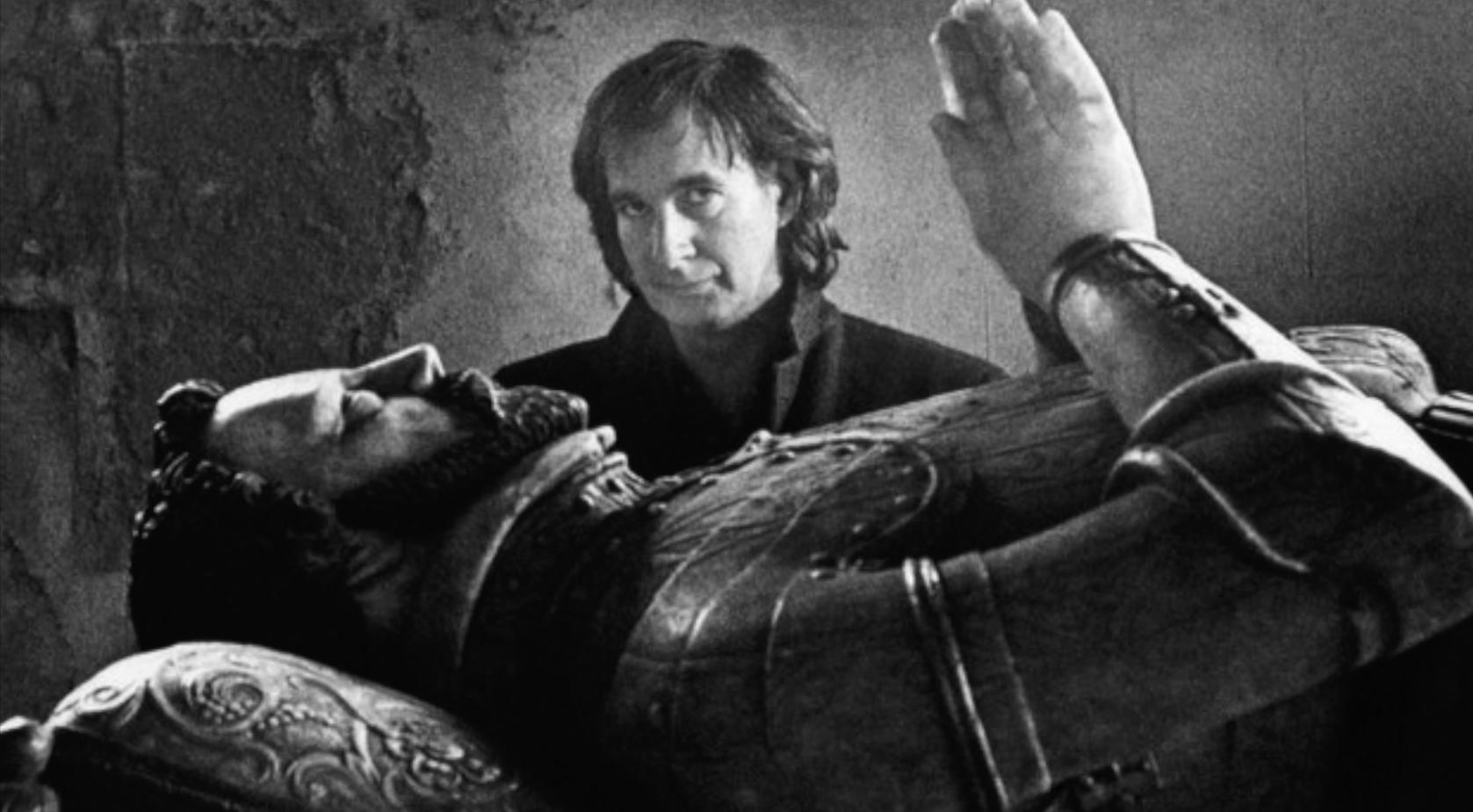
Documentary, by Jason Figgis, United States, 2019.
This documentary retraces the life and work of Simon Marsden, widely regarded as one of the foremost photographers of the supernatural. Premiered at the British Film Institute in London, the film offers a fascinating journey into his creative universe, appealing not only to photography enthusiasts but also to scholars, teachers, students, and anyone intrigued by the mysteries of the unseen. Through evocative imagery and first-hand accounts, it explores the artistic path of a photographer whose work has appeared in books, on U2 album covers, and in museum exhibitions around the world.
Although convinced of the existence of ghosts, Marsden never claimed to capture them directly with his camera. Instead, he used black-and-white infrared film to record the atmosphere and the invisible traces that, in his view, spirits left imprinted upon places. From the landscapes of Ireland to the vast expanses of Russia, passing through Venice and the American Southwest, he transformed historic buildings, ruins, and haunting locations into deeply evocative images capable of suggesting dark and unsettling stories. His photographs continue to captivate the imagination, demonstrating how the most powerful works of art can leave a lasting impression on those who behold them.
LANGUAGE: English
SUBTITLES: Spanish, French, German, Portuguese
Protestant Ascendancy and the Architecture of Guilt
You move through a house that was never yours, and somewhere below the floorboards you can feel the faint percussion of everything you refused to acknowledge. This is not metaphor. This was a material condition, a daily lived architecture, for the Anglo-Irish Protestant gentry who occupied the great houses of Ireland from the seventeenth century onward, administering an island whose population they had displaced, whose faith they had suppressed, whose land they had absorbed into an inheritance they dressed in the language of civilization and order.
Joseph Thomas Sheridan Le Fanu was born in Dublin in 1814 into precisely this world, the son of a Church of Ireland clergyman, educated at Trinity College, formed entirely inside the structures of the Ascendancy. His great-uncle Richard Brinsley Sheridan had already given the family a literary reputation, but the context into which Le Fanu arrived was not one of triumph. It was one of slow, barely acknowledged dissolution. The Act of Union had been signed in 1800, stripping the Irish Parliament of its existence and binding Ireland administratively to Westminster. The Catholic Emancipation Act of 1829 cracked open the political monopoly of the Protestant minority. The Famine of the 1840s would kill or displace over two million people on an island where many of the dying were tenants of landlords who continued to export grain while the countryside emptied into coffin ships. Le Fanu was writing through all of this, and what he was writing looked, on the surface, like entertainment.
The Gothic has always been the literature of bad inheritance. When Horace Walpole published The Castle of Otranto in 1764, he built his supernatural machinery around a fraudulent title to a house — the entire engine of horror driven by the question of who legitimately owns what has been taken. That structural question never left the form, and in the hands of an Anglo-Irish writer it acquired a specific density that no English practitioner could replicate from the outside. The English Gothic fears the irrational. The Irish Gothic, as the critic Seamus Deane and later Terry Eagleton both argued at length, fears accountability. The ghost in the Anglo-Irish house is not an intruder. It is the original occupant, still there, demanding an answer to a question the inhabitant has spent generations learning not to hear.
Le Fanu absorbed this without, it seems, ever fully naming it. His father lost his position during the Tithe War of the 1830s, when Irish Catholics were forced to pay tithes to support a church that was not theirs — a system so visibly unjust that it generated mass civil resistance. The family’s financial instability after that period was permanent, and Le Fanu watched the material foundations of Ascendancy life reveal themselves as contingent, fragile, dependent on a violence that could no longer sustain itself quietly. His fiction is full of houses that deteriorate, estates that cannot be held, patriarchs who are eroded from within by forces they cannot name and refuse to confront.
His wife Susanna died in 1858 after years of severe anxiety illness, and Le Fanu’s response was a near-total withdrawal from public life. He became nocturnal, writing through the night in his bed, surrounded by books, becoming the figure Dublin society called the Invisible Prince. This biographical fact has often been read as mere eccentricity, but it has another weight entirely: a man who belonged to a class that had always ruled by visibility, by presence in the big house, by the display of legitimate authority, retreating into invisibility suggests something more than grief. It suggests a man for whom the performance of belonging had become impossible to sustain.
The houses in Le Fanu do not simply contain horror. They generate it, the way a debt generates interest, silently, in the dark, compounding against a reckoning that keeps not quite arriving.

The Famine as Spectral Pressure
You are sitting in a drawing room in Dublin in 1847, and someone is playing the pianoforte. The tune is correct, the posture is correct, the tea has been poured at the correct temperature, and outside the window a country is dying at a rate that will reach its arithmetic peak of roughly twenty-five deaths per thousand per week before the worst of it passes. Nobody in the room mentions this. The omission is not accidental. It is the entire point of the room.
Le Fanu published “The Purcell Papers” across the 1830s and into the 1840s, and the atmosphere of those stories carries something that exceeds their stated supernatural content. The houses in those tales are not merely old — they are pressurized. Walls hold things in rather than keeping things out. The Irish Big House as a literary form had always carried the ambivalence of colonial architecture, structures built to project permanence over a landscape that resisted the projection, but what the Famine did was make that ambivalence into something closer to a scream held at a frequency too high for polite ears to register. One million dead between 1845 and 1852. Another million emigrated in conditions that killed a significant portion of them at sea or shortly after arrival. The island lost nearly a quarter of its population in under a decade, and Anglo-Irish Protestant society, the class to which Le Fanu belonged and from which his readership largely came, managed this catastrophe through a sustained and almost athletic act of non-acknowledgment.
What gets repressed in a culture does not disappear. It migrates. The historian Roy Foster, writing about nineteenth-century Irish culture in “Modern Ireland 1600-1972,” identifies the peculiar psychic split that characterized the Ascendancy response to mass suffering as a kind of learned imperception — a trained incapacity to see what was directly visible. The ghost story, in this context, is not an escape from historical reality. It is the precise shape that reality takes when a culture insists on not looking at it directly. The ghost is always the thing the household refused to bury properly, which means it is always, at some level, the thing the household refused to name while it was still alive.
Le Fanu’s domestic interiors are almost never described as politically infected, because the characters within them would never permit that description. Yet the structural logic of his hauntings follows an unmistakable pattern: something that was dispossessed, something that was silenced, something that was denied its legitimate claim, returns through the body of whoever is most vulnerable in the household — usually a woman, usually someone without full legal or economic agency, someone whose own perceptions can be dismissed as hysteria. Sigmund Freud would not publish his theoretical account of the uncanny until 1919, in “Das Unheimliche,” but the mechanism he describes — the return of the repressed through the domestic, the familiar made strange by what it conceals — is operating in Le Fanu’s fiction with a specificity that reads less like coincidence than like diagnosis.
The hunger that went unspoken in the drawing room did not stay outside the window. It entered the grammar of every relationship conducted inside. The landlord and the tenant, the Protestant and the Catholic, the living and the recent dead — these pairings restructured themselves inside fictional form as persecutor and victim, host and parasite, the seen and the unseeable. What Le Fanu understood, perhaps without being able to say it in the terms we would now reach for, is that horror does not originate in the supernatural. It originates in the decision a community makes about what it is permitted to perceive, and every ghost is merely the afterlife of that decision walking the corridor at three in the morning, touching the furniture it was never allowed to own.
Cathnafola - A Paranormal Investigation
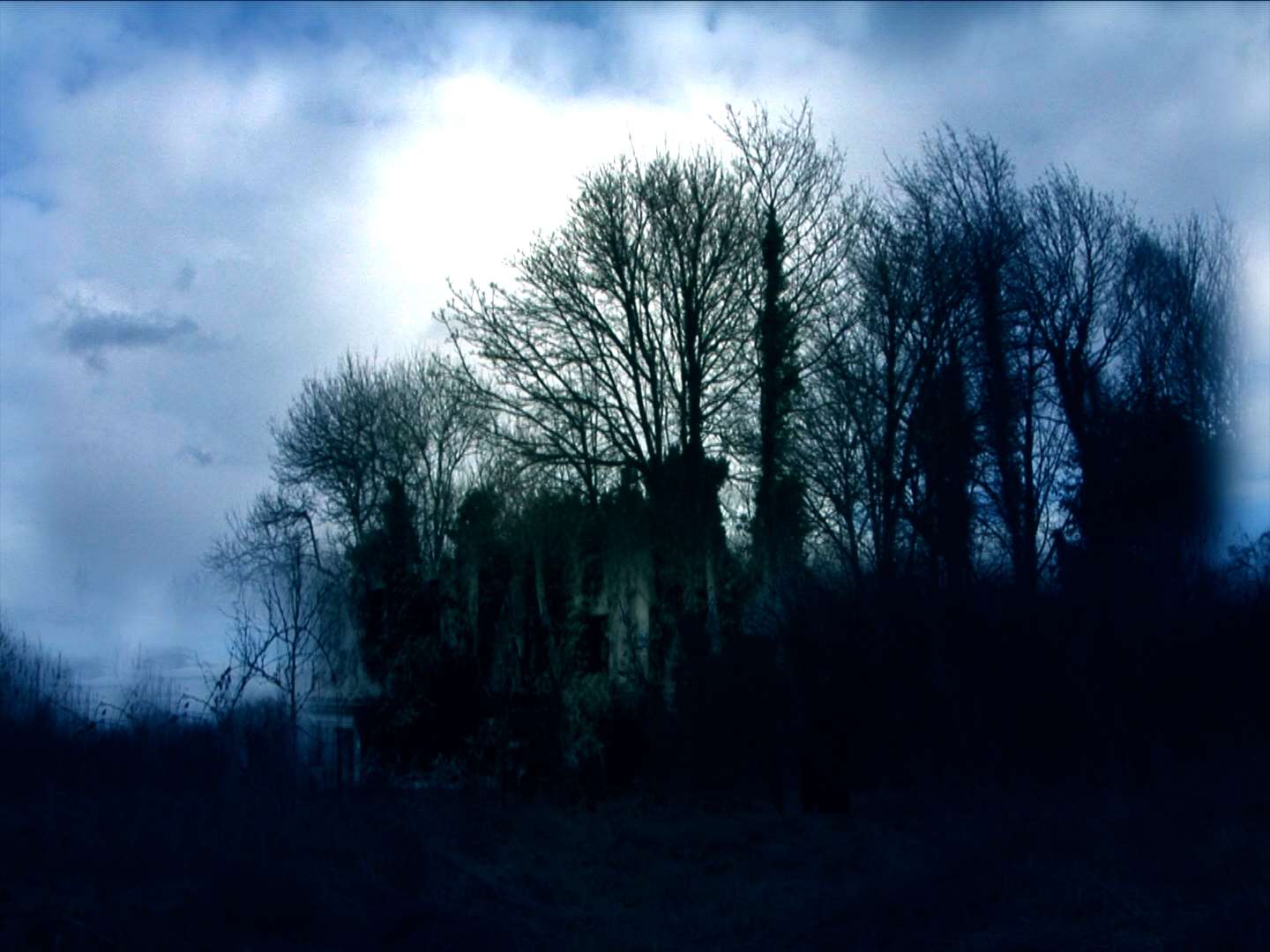
Documentary, horror, by Jason Figgis, USA, 2014.
In "Cathnafola", everything begins when renowned paranormal investigator Chris Halton of Haunted Earth UK receives footage filmed by three teenagers at the ruins of Cathnafola House in Ireland. Determined to unearth the truth behind the location’s bloody past, Halton embarks on a nighttime exploration of the infamous ruins—and soon uncovers terrifying and disturbing revelations.
LANGUAGE: English
SUBTITLES: Spanish, French, German, Portuguese
In a Glass Darkly and the Pathology of Perception
You are reading a case study written by a doctor who is absolutely certain he understands what is happening to his patient, and that certainty is the most terrifying thing in the text. Martin Hesselius, the German metaphysical physician who frames the five tales collected in 1872 under the title In a Glass Darkly, presents himself as a man of rigorous method, a synthesizer of spiritual and material science, someone whose very competence justifies the horror unfolding beneath his gaze. His patient in the opening story, the Reverend Mr. Jennings, is being destroyed by a small black monkey that only he can see — a creature that squats on his shoulder during sermons, that crowds into his vision during prayer, that follows him from the gas-lit streets of London into the privacy of his study. Hesselius diagnoses, takes notes, departs on another case, and returns to find Jennings dead by his own hand. The doctor’s final assessment is that the reverend’s green tea habit opened an interior eye prematurely, admitting a vision the nervous system could not sustain. This explanation is delivered with total professional composure, and it explains precisely nothing.
What Le Fanu understood before the vocabulary existed to name it is that the authority figure in a horror narrative does not neutralize the horror — he is its delivery mechanism. The physician’s confidence is not reassuring; it is another closed door in a house full of closed doors. Hesselius never doubts himself across the entire collection, not when confronted with a vampire in Styria, not when cataloguing a man’s slow psychological disintegration, not when the evidence directly contradicts his framework. His certainty is structural, not personal, and this is the distinction that matters. He represents a whole epistemic formation — the Victorian professional class organized around the belief that the real is legible, that trained observation can convert experience into knowledge, that naming a pathology constitutes mastering it.
Sigmund Freud would not publish his essay on the unheimlich until 1919, nearly five decades after Le Fanu’s collection appeared. Freud’s argument, drawn partly from the work of Ernst Jentsch, proposes that the uncanny arises when the familiar becomes strange — when the heimlich, the homely and concealed, flips into its opposite without changing its surface appearance. The domestic space, by this reading, is already haunted by its own repressed contents. This is genuinely useful, but it locates the problem inside the subject, in the mechanics of individual psychic return. Le Fanu’s architecture is colder and more structural than that. The monkey does not represent Jennings’s repressed sexuality or his ambivalence toward the church. It represents the failure of an entire model of perception — one that insists the drawing room is safe, the medical report is final, the rational framework holds. The horror is not erupting from within the self; it is exposing the self as a construct that was always insufficient for the world it claimed to inhabit.
The collection’s title, drawn from Paul’s first letter to the Corinthians — “For now we see through a glass, darkly” — is not a lament about limited vision. It is a diagnosis of the condition of seeing itself. Every character in Le Fanu’s five tales perceives through instruments — the doctor’s clinical eye, the traveler’s educated observation, the young woman’s rational self-accounting — and every instrument fails at the precise moment it is most needed. This is not a romantic argument for mysticism or second sight. It is something colder: an indictment of the epistemological confidence that the mid-Victorian decades had built into the architecture of the home, the consulting room, the written report. The glass does not merely distort. It convinces you that what you see through it is the thing itself.
Carmilla and the Violence of Normative Intimacy
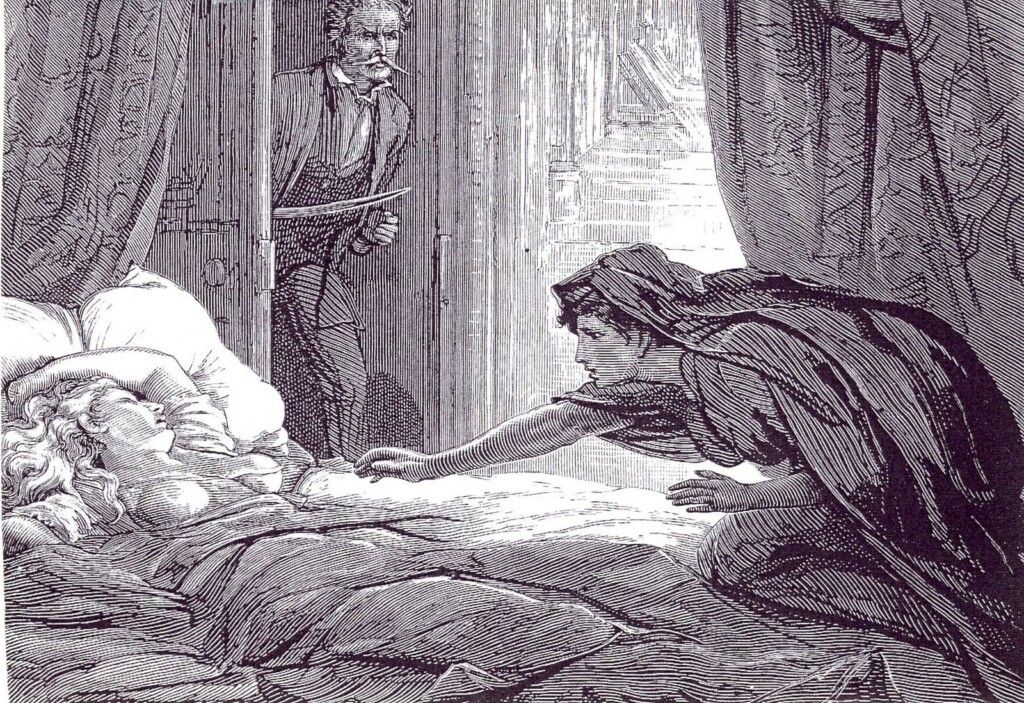
You wake one night to find someone sitting on the edge of your bed. She is beautiful. She knows your name. She has been sleeping in the room next to yours for weeks, invited in by your father, who found her stranded on a country road after a carriage accident. She calls you darling. She says she has loved you longer than you know.
The architecture of Carmilla is not supernatural. It is domestic. Le Fanu, writing in 1872, constructs his predator not as an invader who breaches the walls of civilization but as a figure who arrives through its front door, carried in on the arms of hospitality itself. Carmilla does not terrorize the household of the unnamed Austrian Styrian narrator — she inhabits it, softly, gradually, with the grammar of a daughter or a visiting sister. The horror is not that something alien has entered. The horror is that nothing about the intrusion looks wrong from the outside. Every convention of bourgeois feminine intimacy — the shared confidences, the physical tenderness between women, the daily proximity enforced by provincial boredom — becomes the vector of the attack. The social script and the predatory script are identical.
Eve Kosofsky Sedgwick, writing in Between Men in 1985 and deepening those excavations in Epistemology of the Closet in 1990, gave critical vocabulary to precisely this mechanism: the way Gothic fiction in the Victorian period circulates what it cannot name, preserving deviant desire in the very structure of its condemnation. The narrative of Carmilla enacts this perfectly. Laura’s attraction to her nocturnal companion is rendered in prose of unusual physical candor for its era — the warmth of Carmilla’s breath, the softness of her lips, the intoxicating languor that follows their embraces — and then the text immediately disciplines its own content by framing this as symptom, as victimhood, as the clinical evidence of vampiric infection. Desire is transcribed in order to be pathologized. The reader is allowed to feel it precisely because the apparatus of punishment is already assembled and waiting.
What makes this more than a formal observation is the specific social institution Le Fanu is dissecting. The enforced companionship of women in the Victorian household was not incidental to bourgeois domestic life — it was structural. Women’s intimacy was simultaneously mandated and unspeakable. Daughters were expected to be close, sisters to share everything, female companions to provide the emotional and physical proximity that men did not supply. The system produced intensity and then refused to name it. Le Fanu does not invent Carmilla’s predatory closeness; he simply literalizes what was already present in the arrangement, renders visible the violence latent in an intimacy that was never chosen and could never be refused.
The Countess Karnstein’s real transgression in the text is not that she feeds on the young. It is that she desires without the institutional frame that would make desire legible. Marriage gives a name to appetite. The family absorbs possession into duty. Carmilla has no such cover. Her want is undisguised, unlegitimated, wandering through centuries without a social container. She is destroyed not because she kills but because she loves in a mode that has no recognized form. The men who stake her — the doctor, the general, the father — are not defeating a monster. They are enforcing a taxonomy.
And Laura, recovering in the final pages, still dreams of her. Still hears, at the edge of sleep, the sound of Carmilla’s footsteps on the stone corridor. Le Fanu does not close this. He lets it remain, trembling, in the text — the knowledge that what was destroyed was not only dangerous but also the only thing in the novel that approached Laura with something that felt, however lethally, like being seen.
A vision curated by a filmmaker, not an algorithm
In this video I explain our vision
The Narrative Frame as Instrument of Suppression

You are handed a manuscript found in a dead man’s study, its pages annotated by a physician who never met the original author, edited by a scholar who vouches for the physician’s integrity but cannot verify the events described. Before the horror has even begun, you are three removes from it, and Le Fanu has already done his work.
The nested frame was not a stylistic affectation in the Victorian period — it was a cultural technology for managing what could not be stated plainly. But Le Fanu’s deployment of it operates at a different frequency than, say, Wilkie Collins‘s epistolary arrangements, where multiple witnesses triangulate toward a single verifiable truth. In works like “In a Glass Darkly,” published in 1872 and presented as the casebook of the fictitious Dr. Martin Hesselius, the apparatus of scholarly mediation does not stabilize the material — it quietly licenses its most disturbing elements by pretending to contain them. Hesselius vouches for nothing. He appears as a framing device while remaining conspicuously absent from the crises he supposedly oversees. The editorial voice reassures while the actual narratives — “Carmilla,” “Green Tea,” “The Familiar” — spiral into territory no reassurance can reach.
Walter Benjamin, writing in 1936 in “The Storyteller,” observed that the authority of a narrative is always borrowed from death — that a story becomes fully tellable only when the teller has been separated from the living experience they describe, whether by distance, time, or the literal fact of dying. The story acquires its weight precisely because the witness is no longer fully present to contest or complicate it. Le Fanu understood this almost physiologically. His narrators are characteristically men who survived something — or who found documents left by someone who did not. The layering is never neutral. Each additional frame is another small death of proximity, another step away from the event and therefore, paradoxically, another increase in narrative authority.
What this produces in the reader is a peculiar double sensation: the reassurance of scholarly distance and the creeping recognition that the distance is theatrical. The physician’s preface to “Carmilla” does not make the vampire less real — it makes her more so, because the apparatus of rational management exists only where something has genuinely defeated reason. You don’t build a containment structure around nothing. The very elaborateness of the framing confesses the magnitude of what it claims to frame, and the reader’s nervous system registers this confession before the conscious mind processes the argument.
There is also something specifically Irish in this structural evasiveness, though it would be too simple to call it merely colonial mimicry of English narrative propriety. The nineteenth-century Irish Protestant writer occupied a position where direct speech about history, land, dispossession, and belonging carried consequences that indirect speech could sidestep. The frame permitted the articulation of catastrophe through the voice of someone else, in documents that could be disowned, in testimonies whose reliability was always already qualified. Le Fanu never says: the house is built on violence and the violence is returning. He constructs an editorial apparatus through which a dead man’s account of a haunting is presented to you with appropriate scholarly reservations, and the violence announces itself through the gaps between the editorial decorum and the shrieking content below it.
This is not evasion in the cowardly sense. It is a formal intelligence that treats the frame as a pressure system — the tighter you seal it, the more force accumulates beneath. By 1864, when “Uncle Silas” appeared, Le Fanu had refined this to the point where the naive narrator, Maud Ruthyn, functions as a living frame: her incapacity to fully comprehend her situation becomes the vessel through which the reader comprehends it with terrible clarity. She reports; we understand what she cannot. The gap between her perception and ours is where the horror lives, and it is a gap the text opens deliberately, then refuses to close.
Domestic Space as Disciplinary Technology
You have lived in a room that was meant to keep something out but was actually designed to keep you in, and the genius of the arrangement was that you furnished it yourself, hung pictures you chose, called it home.
Michel Foucault‘s 1975 Discipline and Punish mapped the way enclosed spaces operate not through overt coercion but through the slow normalization of surveillance, the internalized gaze that eventually requires no external watcher. He was writing about prisons and clinics, but the architecture he described — the partitioned cell, the corridor that permits observation from a fixed point, the room whose occupant cannot see who is watching — had already been perfected in the bourgeois Victorian house decades before Bentham’s Panopticon became theoretical currency. Le Fanu understood this not as theory but as the texture of daily existence in Dublin and London drawing rooms, and his fiction is full of houses that do not merely reflect social power but actively produce it, wall by wall, lock by lock.
The sickroom in Victorian domestic culture was perhaps the most disciplinary space ever devised outside a court of law. It concentrated surveillance under the name of care, immobilized its occupant under the name of rest, and controlled information flow — who could enter, what news could be delivered, which letters were intercepted — under the name of protection. In Le Fanu’s Uncle Silas, published in 1864, the heroine Maud Ruthyn spends vast portions of the narrative in states of enforced convalescence, her physical weakness manufactured or prolonged by the very figures nominally responsible for her recovery. The sickroom is not a refuge from the plot; it is the plot’s primary mechanism, the space where inheritance law, family secrecy, and bodily control converge into a single architectural fact.
The locked study operates differently but with equal precision. In Le Fanu’s world, the room that cannot be entered by women or servants is also the room where wills are altered, debts are concealed, and the financial scaffolding of the household is quietly rotting. Its locked door does not signal private masculine creativity in the romantic sense; it signals the point where the household’s performed respectability ends and its actual structure begins. The inaccessibility of that room trains everyone outside it to maintain a fiction, because to press the question of what is inside it would be to acknowledge that the entire domestic arrangement rests on something no one is permitted to verify.
What makes this more than architectural symbolism is that the people inside these spaces genuinely mistake confinement for belonging. The parlor — that carefully managed theater of feminine accomplishment, with its piano and its embroidery and its calibrated social calls — did not present itself as a cage. It presented itself as the content of a woman’s life, the proof of her value, the site where her identity was both performed and confirmed. Erving Goffman’s later work on total institutions, particularly his 1961 Asylums, traced how enclosed social environments reshape identity by eliminating the individual’s capacity to maintain a self that exists independently of the institution’s definitions. The Victorian parlor was a total institution that served afternoon tea.
Le Fanu’s houses accumulate this pressure across generations. The decaying estates in his work are not simply Gothic atmospherics; they are the physical record of how a family’s unspoken agreements — about money, about shame, about which children matter and which do not — have been built into the load-bearing walls. When a floor gives way or a window is found inexplicably broken from within, he is showing you that the structure was never as stable as its inhabitants needed to believe, that the silence required to maintain it was always a form of structural stress, and that what presents itself as a haunting is simply the house doing what it was always going to do when the weight of what was never said finally exceeded what the architecture could hold.
The Irish Gothic as Counter-Colonial Form
You are standing in a house that belongs to someone else, and the law agrees with them. This is not metaphor — this is the structural condition that produced one of the most psychologically precise literary traditions in the English language, a tradition that has been misread for two centuries as mere atmosphere, as candles and cobwebs and Anglo-Irish eccentricity, when it was in fact a rigorous and devastating account of what it feels like to inhabit a territory that has been juridically removed from underneath you.
The English Gothic — Walpole’s castle, Radcliffe’s abbey, the whole machinery of crumbling aristocratic spaces — is animated by the anxiety of invasion. Something from outside threatens the coherent interior. The monster comes from elsewhere, from the south, from the past, from beneath the rational floor of Enlightenment selfhood. The house might be penetrated, but it remains, conceptually, the house. The boundaries are what the narrative works to restore. What Charles Maturin understood, writing Melmoth the Wanderer in 1820, and what Le Fanu refined across decades of fiction set in the drowning estates of County Dublin and County Cork, is that this grammar of invasion and restoration was a lie unavailable to Irish writers — because in Ireland, the invasion had already concluded, the monster had already won, and the monster was hosting dinner parties and collecting rent.
Le Fanu’s haunted houses are not threatened from without. They are already wrong from within, already structured around an original dispossession so complete it has calcified into architecture. The Palladian facades of the Ascendancy estate carry the wrongness inside their geometry. When the supernatural arrives in his fiction, it does not break the domestic order — it reveals the domestic order for what it already was. The ghost is not an intruder; it is the repressed logic of the property deed finally becoming visible to the senses.
Terry Eagleton, in Heathcliff and the Great Hunger published in 1995, argues that Irish culture is organized around a foundational wound that cannot be healed because healing would require a return to a prior wholeness that no living person can actually remember. The wound is not an event that happened and ended. It is a structure that keeps producing the present, keeps determining who inherits and who is displaced, keeps ensuring that the most intimate spaces — the home, the family, the body — are also the most politically saturated. What Eagleton identifies as cultural logic, Le Fanu had already encoded as narrative grammar: the horror in his fiction is never resolved because the condition that generates it has not been resolved. The haunting continues because the historical cause of the haunting continues.
Bram Stoker, writing Dracula in 1897 from London, exported this logic into a form the English market could consume, but the displacement barely conceals the source material. The Count is a landlord who drains his tenants and cannot be killed by ordinary legal means. He arrives in England and the English characters must scramble to learn a grammar of supernatural threat that the Irish tradition had been writing for a century — not because the Irish were more superstitious, but because they were more honest about power.
What the Irish Gothic produced, finally, was a literature of the already-happened, a literature in which the catastrophe is never approaching but always already structuring the ground beneath the reader’s feet. Le Fanu did not invent this. He inherited it, refined it, and pressed it into the most intimate register available to Victorian fiction — the domestic interior, the family secret, the marriage, the will — because he understood that the places where people believe themselves to be most private are precisely where the public violence of history does its quietest and most durable work.
🕯️ Shadows, Spirits & the Gothic Imagination
Sheridan Le Fanu‘s world of domestic dread and Irish Gothic terror does not exist in isolation — it emerges from a long tradition of supernatural literature, uncanny aesthetics, and the philosophical fascination with fear. These four articles trace the literary and cultural currents that flow through Le Fanu’s haunted corridors.
Arthur Machen: Life and The Great God Pan
Arthur Machen, like Le Fanu, understood that true horror does not lurk in distant castles but seeps through the walls of ordinary life. His novella ‘The Great God Pan‘ transforms the familiar English countryside into a space of ancient, incomprehensible dread, echoing Le Fanu’s own technique of making the domestic uncanny. Exploring Machen’s life and work reveals a parallel tradition of Gothic literature rooted in hidden evil and the terror of the everyday.
GO TO THE SELECTION: Arthur Machen: Life and The Great God Pan
The Literary Fantastic: Todorov and the Theory of the Fantastic
Tzvetan Todorov‘s theory of the fantastic provides one of the most rigorous analytical frameworks for understanding writers like Le Fanu, who deliberately keep readers suspended between rational and supernatural explanations. The hesitation Todorov describes — that uncomfortable uncertainty at the heart of the Gothic tale — is precisely the mechanism Le Fanu exploited in stories such as ‘Carmilla’ and ‘Green Tea.’ This article offers the critical vocabulary needed to read Irish Gothic fiction with new depth and precision.
GO TO THE SELECTION: The Literary Fantastic: Todorov and the Theory of the Fantastic
The Aesthetics of the Sublime: When Beauty Is Frightening
The aesthetics of the sublime — beauty fused with terror, wonder shadowed by dread — form the philosophical backbone of the Gothic literary tradition to which Le Fanu belongs. This article traces how the sublime moved from landscape painting and Romantic poetry into the darker chambers of Gothic fiction, where fear becomes an aesthetic experience in itself. Understanding the sublime illuminates why Le Fanu’s horrors feel not merely frightening but strangely beautiful and emotionally overwhelming.
GO TO THE SELECTION: The Aesthetics of the Sublime: When Beauty Is Frightening
Robert Louis Stevenson: Life and Works
Robert Louis Stevenson, a near-contemporary of Le Fanu, shared his obsession with the divided self, the secrets concealed within respectable Victorian households, and the thin membrane separating civilized life from monstrous dissolution. Both writers used the Gothic mode to expose the psychological hypocrisies of nineteenth-century society, revealing rot beneath polished surfaces. Examining Stevenson’s life and works deepens our appreciation of the broader literary culture in which Le Fanu’s domestic horror found its most powerful expression.
GO TO THE SELECTION: Robert Louis Stevenson: Life and Works
Discover the Films That Dare to Go Deeper
If Le Fanu’s Gothic shadows have stirred something in you, Indiecinema is the streaming home for films that share that same courage — independent cinema that refuses easy comfort and explores the dark, the strange, and the profoundly human. Come and discover a world of films that think, haunt, and endure.
👉 EXPLORE THE CATALOG: Watch Indie Films in Streaming
A vision curated by a filmmaker, not an algorithm
In this video I explain our vision

