
The Woman at the Foot of the Bed
You wake at three in the morning and she is already there. Not moving. Not threatening. Simply present at the foot of the bed with her hair falling forward across her face in a sheet of black that reaches her waist, her body draped in white cloth that you recognize without knowing how you recognize it, her legs ending somewhere above the floor in a way that the darkness makes ambiguous but your nervous system has already decoded. You don’t scream. That is the strangest part. You freeze, and something older than fear takes over — something closer to recognition, as though this figure has always been waiting at the periphery of your perception and tonight simply failed to hide in time. You lie still. You count your breath. And when you finally look again, the room holds nothing but the particular quality of silence that follows a presence, not precedes one.

What you encountered in that moment — real or dreamed or assembled from years of images absorbed without consent — is not a Japanese ghost in the folkloric sense. It is a yūrei, and the distinction carries centuries of theological and psychological weight. The word dissolves into its components to reveal something precise: yū, meaning faint or dim, and rei, meaning soul. A dim soul. Not a dead soul, not a damned one, but one rendered transparent by the violence of how it was forced to leave the world. Japanese Buddhist cosmology, as it crystallized across the Heian period between 794 and 1185, understood death as a threshold that required preparation — ritual, mourning, the proper performance of farewell. When those rituals failed, when grief was denied its form, the soul could not dissolve into the cycle of rebirth. It remained, thin and luminous with unfinished anguish, tethered to the site of its wound.
The white kimono is not theatrical costume. It is the actual burial garment of feudal Japan, the katabira, worn by the dead before cremation. When artists of the Edo period began formalizing the visual grammar of the yūrei — and the painter Maruyama Okyo is credited with one of the earliest and most influential depictions around 1750, a rendering of his deceased lover so precise in its trembling grief that contemporaries reportedly wept — they did not invent the iconography. They transcribed it from the mortuary practices already surrounding them. The absence of feet, the most destabilizing element of the figure, emerged from the logic of hovering: a spirit unmoored from the earth has no need to touch it. But the psychological resonance runs deeper than logic. A figure without feet cannot be tracked. It cannot be heard approaching. It exists outside the grammar of approach and retreat that mammals use to calculate safety, and so it trips every wire in the threat-detection system while simultaneously denying the system any usable information.
The hair is its own argument. In Heian aristocratic culture, a woman’s unbound hair was charged with erotic and spiritual power — kept long, kept ordered, kept managed as a form of social legibility. To let it fall loose was to signal a dissolution of the social self, a crossing into a state beyond decorum and containment. The yūrei’s hair does not simply hang: it obscures the face, erasing the very feature through which we read intention and emotion in another person. We are left with a figure that is human in outline, feminine in cultural coding, and illegible at the precise point where we most need to read. The threat it poses is not violence. It is the withdrawal of the information that makes another person comprehensible to us, and in that withdrawal lives something the body experiences as more destabilizing than any weapon.
You already knew all of this before you ever encountered the word yūrei.
Ugetsu
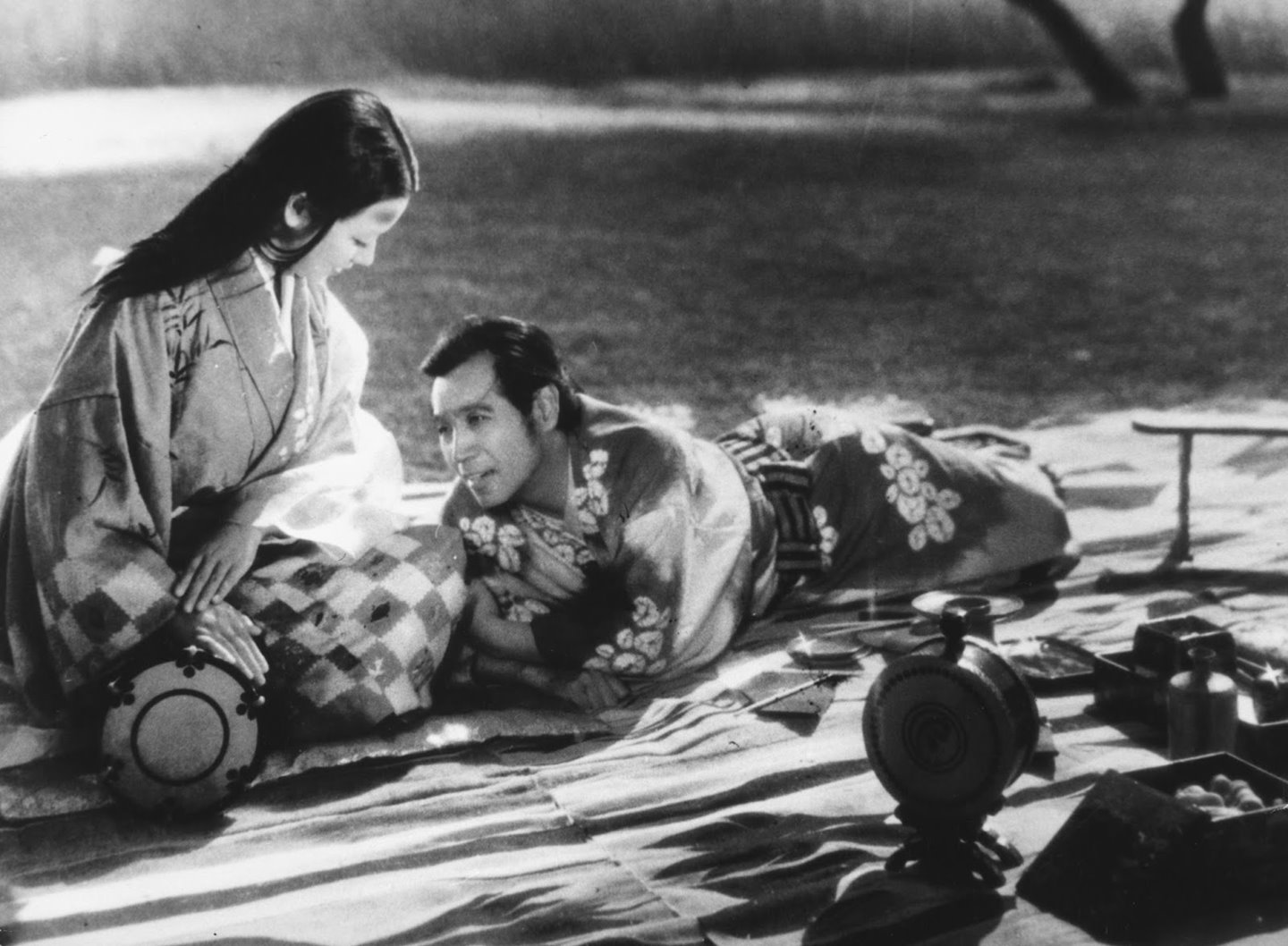
Drama, fantasy, by Kenji Mizoguchi, Japan, 1953.
Japan, late 16th century: the potter Genjurō and his brother Tobei live with their wives Miyagi and Ohama in a village in the Omi region; Genjurō, convinced that he can earn a lot of money by selling his goods in the nearby city, goes to the county of Omizo with Tobei, who joins him with the sole purpose of being able to become a samurai. Back home with a good income, the two work hard to make even more money; Tobei, increasingly obsessed with the ambition of becoming a samurai, needs the money to buy an armor and a spear while Genjurō, overcome by greed, tries to cook a batch of crockery with his brother in just one night. Legend and innovation of cinematic language, a wonderful world next to a brutal and cruel world. Mystery film that opens a discourse with the invisible planes of existence, ghosts and forays into the fantastic, made by Kenji Mizoguchi in a Japan still frozen by the two atomic bombs dropped on Hiroshima and Nagasaki. Fundamental work by Mizoguchi, recognized as one of the greatest expressions of the Seventh Art. A lofty lesson in directing that creates wonder with a dramatic tale of greed and lust for possession. A woman who is a tempting demon and a wife abandoned to a fate of war and misery, Mizoguchi uses the camera to enter "another world".
Food for thought
According to ancient Eastern traditions there are other non-physical planes beyond the physical plane. The etheric plane envelops the physical body, gives it vital energy and acts as an intermediary with the higher levels. Beyond the etheric plane there is the astral plane where entities may exist that have not been able to resign themselves to the loss of their body and wander in search of sensations. They are what are commonly referred to as "ghosts". These entities are looking for bodies that have unbalanced etheric planes to "hook up" to in order to experience sense satisfaction through them.
LANGUAGE: Japanese
SUBTITLES: English, Spanish, French, German, Portuguese
A Fear Older Than Buddhism
You are standing at the edge of a rice field at dusk, somewhere in the Kinai region, somewhere around the eighth century, and the air has already changed in that way it changes when the light stops being light and becomes something else. You do not think: a ghost might appear. You think: I have not paid what I owe, and the world knows it.
This is not superstition. This is cosmology. Before the first Buddhist monk set foot on the Japanese archipelago, before the sutras were copied onto silk and the temples raised their curved eaves toward a heaven organized by imported metaphysics, there was already a fully operational architecture of dread rooted in the texture of daily life. The Kojiki, compiled in 712 CE under imperial commission as a record of origins and divine genealogy, is not primarily a ghost story — but it cannot help becoming one. The deities bleed, the dead return, the boundaries between the living and the realm of pollution are permeable in both directions, and the traffic across them is constant. Izanagi descending into Yomi to retrieve his dead wife Izanami encounters not a passive absence but an active, furious presence: a corpse that has already begun to rot, a woman who has eaten the food of the underworld and now belongs to it, who chases him out with the shrieking dead behind her. He seals the entrance with a great boulder. She shouts from the other side that she will kill a thousand people each day. He answers that he will then cause fifteen hundred births. The negotiation is over, but the logic has been established forever: the dead do not disappear, they balance.
The animist substrate underneath this exchange is what scholars of Shinto practice call the logic of kegare — ritual pollution, the contamination that attaches itself to death, to blood, to anything that crosses the threshold between states. It is not moral judgment in any recognizable Western sense. You do not become polluted because you sinned. You become polluted because you were present, because existence itself generates debt and residue, because the act of living leaves marks on the invisible fabric that must be periodically cleansed through harae, purification rituals documented across the Heian period as both civic and intimate necessities. The scholar of religion Allan Grapard, writing on the combinatory religious systems of medieval Japan, identified this not as primitive fear but as an extraordinarily coherent accounting system: the world maintained itself through the continuous settling of spiritual balances, and any imbalance — a sudden death, an unavenged wrong, an unfulfilled promise — left an active charge in the atmosphere.
Mono no ke, the spirit that afflicts the living in the diaries and tales of the Heian court, is the name for that charge when it becomes unbearable enough to notice. It is not a demon in any dualistic theology. It is more like a pressure that has been building because something was left unfinished and the world, indifferent to human comfort, requires completion. The afflictions recorded in the diary of Murasaki Shikibu and in the medical-spiritual consultations preserved from the imperial court at Kyoto are disturbingly specific: headaches, paralysis, sudden speech disorders, loss of consciousness — the body of the living person becoming the site where the unresolved tension of the dead presses forward to be acknowledged. There is no evil in this framework, only the enormous, impersonal insistence of incompleteness.
What Buddhism would later bring to this landscape was not a new fear but a new vocabulary for an old one. The infrastructure of dread was already load-bearing. The ghosts were already circling, not because they wanted revenge in any simple sense, but because the living had not yet found a way to let them go — and the living, in this cosmology, rarely do.

What Onryō Actually Punish
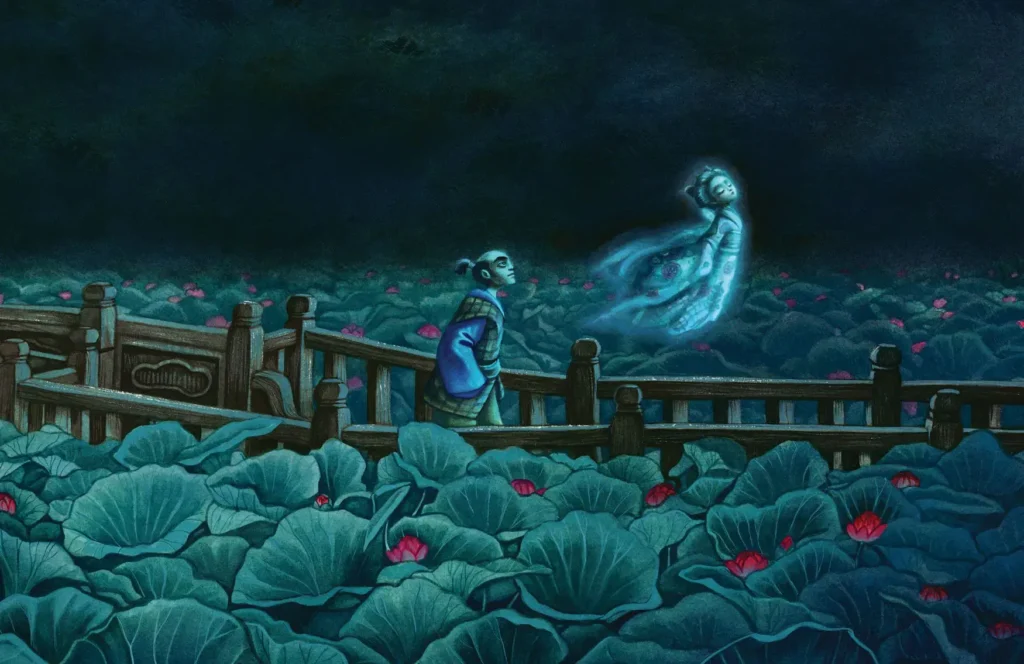
You are sitting across from someone who no longer looks at you the way they once did, and you feel it before you can name it — that specific withdrawal, the almost imperceptible retraction of attention that precedes being left. Now hold that feeling and follow it somewhere much older and much more disturbing than any breakup you have survived.
The onryō enters Japanese literary record in the Nihon Shoki, compiled in 720 CE, where the spirits of the wronged dead are described not as abstract forces of evil but as precise emotional architectures — entities whose power derives directly from the quality and intensity of what they felt before dying. What is striking, when you read the primary sources rather than their horror-genre descendants, is how structurally specific the grievance always is. These are not spirits who punish cruelty. They punish the withdrawal of regard. The distinction collapses the comfortable moral logic most readers bring to the concept of supernatural justice.
Noh theatre, which crystallized as a formal dramatic tradition under Zeami Motokiyo in the late 14th century, made this operational. Plays like Aoi no Ue, drawn from The Tale of Genji, stage the living spirit of Lady Rokujō attacking Genji’s pregnant wife — and Rokujō is not a villain in any recognizable sense. She is a woman of exceptional refinement and social standing who loved someone who became emotionally unavailable to her. The violence she enacts is proportional not to any wrong committed against her in conventional moral terms but to the precision and depth of what she was made to feel and then denied. The Noh stage, with its stripped geometry and its masked performers moving at speeds that make ordinary time feel grotesque, was designed to make this distinction impossible to look away from.
What this theatrical tradition was encoding, centuries before psychology had a clinical vocabulary for it, was something closer to what the British psychoanalyst John Bowlby would formalize in his attachment theory research beginning in the 1950s: that the rupture of attachment bonds produces responses in human beings that are neither rational nor proportionate to external moral categories, but are instead driven by the nervous system’s fundamental inability to process abandonment as anything other than annihilation. The onryō is what happens when that annihilation is complete and the person who caused it continues to live without consequence.
This is where the tradition becomes genuinely destabilizing rather than merely eerie. The men in these narratives are rarely monstrous. They are distracted, politically ambitious, emotionally shallow in ways that are entirely recognizable and socially rewarded. Genji himself is celebrated in the text that contains his worst behaviors. The female spirit who returns is not correcting an obvious injustice — she is introducing a violence that the social order had no mechanism to register, because what was done to her had no name. Being turned away from by someone who once turned toward you — slowly, plausibly, with the perfect deniability of gradually shifting attention — was not a crime. It was simply life. The onryō insists, with a ferocity that Noh theatre rendered formally beautiful, that this insistence is wrong.
By the Edo period, the kabuki tradition had expanded the onryō into a broader cultural phenomenon, most famously in the 1825 staging of Yotsuya Kaidan, in which Oiwa’s spirit returns not because her husband murdered her — though he did — but because he replaced his attention with someone else’s face before she was even dead. The murder is almost incidental. What her ghost cannot metabolize is the substitution. This granularity about the specific texture of betrayal suggests that Japanese culture was using the supernatural to say something about emotional reality that the social contract was structurally prevented from acknowledging in any other register.
The ghost, in this tradition, is not a punishment delivered from outside the social order. It is the social order’s repressed contents returning through the only available door.
The Edo Machinery of Dread
You are sitting in a room with ninety-nine other people, each holding a candle, and the agreement is simple: tell a ghost story, then extinguish your flame. The room grows darker with each tale. By the time the hundredth candle goes out, something is supposed to arrive — something drawn by accumulated dread, by the residue of all those spoken fears given shape in the dark. The hyaku monogatari kaidankai, these ritual gatherings of a hundred ghost stories practiced throughout the Edo period, were treated by participants as genuinely dangerous. You did not play this game carelessly. Which raises the question that the participants themselves could never have asked aloud: dangerous to whom, exactly, and in whose interest was that danger carefully contained within a single room?
The Tokugawa shogunate that governed Japan from 1603 to 1868 was not a regime that tolerated ambiguity. It had codified every social relationship into hereditary castes, surveilled religious practice, restricted foreign contact to a single port, and made political dissent a matter of family-level punishment — meaning your children paid for your opinions. Under such a system, what happens to grief that has nowhere legitimate to go, to anger that cannot name its object without destroying the speaker? It finds a costume. The onryō, the vengeful spirit returning from the dead to settle accounts it could not settle in life, became one of the most culturally productive fictions in Japanese history precisely because it was the only grammar available for a sentence the living were forbidden to complete.
What makes Ueda Akinari‘s Ugetsu Monogatari, published in 1776, so structurally strange is that it refuses to let the supernatural remain metaphorical. In the story “Asaji ga Yado,” a man abandons his wife to chase wealth and status during a period of civil unrest, returns years later to find her waiting, makes love to her in the dark — and discovers at dawn that he has been sleeping beside a corpse that loved him faithfully enough to remain. The horror is not the corpse. The horror is that her devotion outlasted his humanity, that the social logic which made his departure reasonable and her waiting obligatory had produced a situation in which the dead woman was morally superior to the living man. Akinari published this under the cover of Chinese literary tradition, borrowing the form of the classical Tang tale collection to give himself the alibi of translation. A ghost story in borrowed clothes, wearing someone else’s cultural address on its chest.
There is a sociology buried in this machinery. Norbert Elias argued in The Civilizing Process, first published in 1939, that the intensification of social regulation across early modern Europe produced a corresponding intensification of the inner emotional life — that as external behavior became more controlled, the interior became more turbulent, more pressurized. Edo Japan compressed this dynamic into a century and a half of extraordinary cultural productivity in precisely the registers that could not be officially regulated: kabuki theater, woodblock prints, popular fiction, and ghost stories. The kaidan boom was not a sign of a culture obsessed with death. It was the sign of a culture that had found the single pressure valve its governors had forgotten to seal.
What the ritual gatherings actually industrialized was a very specific emotional technology: the permission to feel structural dread collectively, in company, without ever having to name its source. One hundred people in a darkening room, each feeding the shared atmosphere with a story about someone wronged, someone abandoned, someone whose suffering had not been acknowledged by any court or any lord, and the understanding was always tacit — the ghost was not the danger. The ghost was the witness.
Gender, Silence, and the Architecture of Haunting
You are walking through a museum gallery, and you stop in front of a woodblock print you have seen reproduced a hundred times — the white kimono, the black cascade of hair falling across a face that is partly obscured, the hands hanging limp from wrists that seem to have forgotten the existence of bone. You assume it is a woman before you read the label. You have always assumed this, every time, without noticing that you assumed it.
The near-total feminization of the yūrei in Japanese visual and dramatic culture is so complete that it reads, to most observers, as a natural fact rather than a historical construction. But the figure did not emerge from some timeless folklore about feminine volatility or emotional excess. It crystallized with remarkable precision during the Edo period, between the seventeenth and nineteenth centuries, exactly as the Tokugawa shogunate was codifying the ie system — a legal and social architecture built around patrilineal households in which women held no independent standing. Under this framework, a wife’s legal identity was absorbed entirely into her husband’s family register. She could not own property, could not initiate divorce without her husband’s consent, could not testify in most legal disputes. The ie was not a domestic arrangement; it was an annihilation of juridical personhood conducted in the language of tradition and filial harmony.
Marcia Yonemoto’s scholarship on Tokugawa gender and household law, particularly her work in The Problem of Women in Early Modern Japan published in 2016, documents how completely this system erased the mechanisms through which women might articulate grievance. There was no formal channel, no petition, no recognized speech act that could carry a woman’s injury from private suffering into public acknowledgment. What the legal structure closed off, the cultural imagination routed elsewhere. The kabuki and bunraku stages of the same period became saturated with female ghosts — not as entertainment in any simple sense, but as the only theater in which a woman’s accumulated wrong could be spoken aloud, could be witnessed by a crowd, could compel a response. Tsuruya Nanboku IV’s 1825 play Yotsuya Kaidan gave the world Oiwa, poisoned and disfigured by a husband who wanted her out of the way, returning with a devastation so methodical it resembles jurisprudence more than vengeance.
The specific iconography is worth holding precisely here: the long unbound hair, the white burial kimono, the downward-hanging hands. Each element is doing documentary work. In Tokugawa society, a woman’s hair was managed, arranged, pinned — controlled. Unbound hair on a living woman signaled madness, disgrace, or extreme grief. On the ghost, it signals something more structural: the permanent undoing of the grooming performed to make her socially legible, socially placeable, socially containable. The white kimono is burial dress, but burial dress specifically, not simply death. It marks a body that was processed through the rituals of proper disposal and still would not stay disposed of. The hanging hands are the detail that carries the most weight — hands that in life were kept busy with the labor of the household, the invisible maintenance work that the ie system required of women and rendered structurally invisible, now simply hanging, doing nothing, refusing the posture of utility.
What the yūrei encodes is not feminine hysteria or some essentialized female capacity for supernatural attachment. It encodes the precise shape of a legal void. A ghost appears where a claim could not be filed, where a name could not be entered into the record, where a body was managed but a person was never acknowledged. The ie system did not create haunted women; it created conditions in which the ghost was the only grammatically correct form a woman’s unresolved existence could take within the shared imagination of her culture — not a metaphor stretched over historical pain, but the pain itself, rendered with the accuracy of a legal brief that the law refused to accept.
A vision curated by a filmmaker, not an algorithm
In this video I explain our vision
Lafcadio Hearn and the Invention of Atmosphere
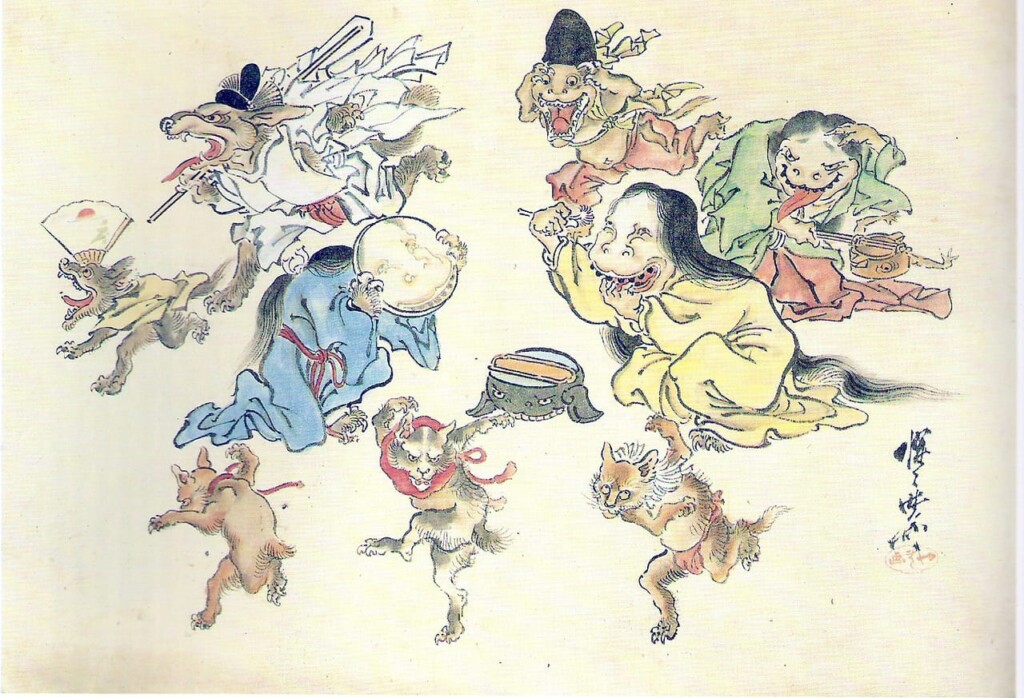
You pick up the book expecting folklore and instead find something stranger — a man so homesick for a country he was not born in that he dissolved himself into it, legally changing his name, taking a Japanese wife, adopting her family’s debts, and finally dying in 1904 as Koizumi Yakumo, a Greek-Irish writer who had become, by sheer obsessive will, a Japanese citizen. Lafcadio Hearn’s Kwaidan, published that same year of his death, is not simply a collection of ghost stories. It is a document of a particular kind of longing, which is also a particular kind of violence.
The Meiji Restoration, launched with the 1868 imperial decree that dismantled the shogunate, was not merely a political revolution. It was a systematic erasure. Within two decades, Japan had acquired a Western legal code, a Western military structure, compulsory Western-style education, and a governing class that wore frock coats to state functions. The oral traditions that had carried yurei stories through winter nights, the provincial priests who performed the bon festivals, the storytelling lineages that kept the dead in conversation with the living — these were not outlawed so much as rendered embarrassing, provincial, incompatible with the national project of modernity. Hearn arrived into this gap. He collected what was being abandoned, transcribed what educated Japanese were quietly learning to be ashamed of, and sent it westward in exquisite English prose.
The problem is that preservation and aestheticization are not the same act, even when they look identical on the surface. Georg Simmel, writing in his 1903 essay “The Stranger,” described a figure who sees a culture with the peculiar clarity of one who is neither inside nor outside it — but Simmel also noted that this clarity is purchased at the cost of abstraction, of converting lived experience into the interesting. Hearn’s prose is ravishing precisely because it is that conversion in action. The drowned woman who becomes Yuki-Onna, the warrior haunted by the blind biwa player, the severed head that speaks — in Kwaidan they arrive wrapped in a mood so carefully constructed, so tonally controlled, that the terror is always also aesthetic pleasure. The reader is never truly at risk. The ghost has been framed.
What Hearn framed, every subsequent Western interpreter inherited without knowing it. The chill silence of a certain kind of Japanese horror — the long dark hair, the pale face, the slow approach from a place the architecture should not allow — has its genealogy not only in Edo-period woodblock prints but in the literary atmosphere Hearn installed around those images. When Lafcadio Hearn described the supernatural as something felt in the quality of silence before a storm, he was also creating a Western reader who would thereafter expect Japan’s dead to arrive with that specific meteorological grammar. The expectation became a tradition. The tradition became a market.
There is something genuinely irreducible in what he saved. The story of Mimi-nashi Hoichi, which Hearn translated in Kwaidan from a much older source, encodes a real theological architecture — the idea that the dead can recruit the living into their unfinished mourning, that grief without resolution becomes a gravitational field. That idea has roots in Buddhist conceptions of the hungry ghost, the gaki, the being trapped between states because attachment was never released. Hearn understood this intellectually and rendered it beautifully, but beauty is also a kind of glass case. The thing inside is visible but no longer dangerous in the way it was designed to be.
The danger, in the original tradition, was not aesthetic. It was ethical. The ghost did not appear to be contemplated. It appeared because something owed remained unpaid, because the living had failed in an obligation so specific that the dead could not move without its resolution. Hearn’s ghost appears because the atmosphere is right.
The Ghost as Mirror of Economic Failure
You are standing in a corridor that does not end. The fluorescent light flickers at a frequency just below conscious notice, and somewhere ahead, a figure moves through a door that should not open. This is not a nightmare. This is an office building in Tokyo in 1997, and the man who sees the figure has not slept in three days because his department no longer exists on paper, though everyone still shows up, still bows, still files reports that no one reads. The ghost and the salaryman are occupying the same hallway for the same reason.
The asset bubble that collapsed in 1991 did not merely destroy financial value. It destroyed a particular story Japan had been telling itself about the nature of progress — the idea that modernization was a one-directional escalator, that sacrifice accumulated into permanence, that the future would honor the debts of the present. When the Nikkei lost nearly half its value and real estate prices fell into a decade-long paralysis, what vanished was not just capital but the temporal logic that had organized Japanese identity since the Meiji period. A society does not simply adjust its expectations after that kind of rupture. It haunts the place where the expectation used to live.
Marilyn Ivy, writing in 1995 in Discourses of the Vanishing, identified something that economists could not measure: Japan’s modernity had been built on a systematic management of disappearance, a constant drive to suppress or aestheticize whatever was archaic, rural, or unassimilable into the national narrative of development. Folklore, regional dialects, agrarian ritual — all of it was either museumified or quietly erased. What Ivy traced was the anxiety that accumulates when a culture is constituted by its own acts of forgetting, and how that anxiety finds form in the very things it tried to suppress. The ghost is not a failure of modernization. It is modernization’s return address.
J-horror did not emerge in the 1990s despite the economic collapse. It emerged because the collapse had made the ghost the only accurate symbol available. Hideo Nakata‘s Ringu appeared in 1998, seven years into the Lost Decade, and its central image — a woman who cannot stay dead, who travels through the channels of domestic technology to claim the living — encoded something precise about a generation that had inherited promises it could not redeem and infrastructures it could not dismantle. The vengeful female ghost, the onryō, had always carried in Japanese tradition the charge of the structurally wronged: women who died in states of betrayal, abandonment, or rage too large for the social body to absorb. Reassigning that archetype to the medium of the VHS tape was not a gimmick. It placed unresolved historical grief inside the most ordinary object of the household economy.
Sociologist Eiko Ikegami, in her work on emotional culture and social bonds in Japan, described the particular burden carried by those whose shame is collective but whose suffering is individual — a structural condition that the Lost Decade imposed on an entire generation of workers, particularly young men entering a labor market that had already closed its doors. The hikikomori phenomenon, clinically documented through the 1990s and into the 2000s, described hundreds of thousands of individuals withdrawing entirely from social space, becoming, in a quite literal sense, presences behind walls that the outside world continued to pretend were empty rooms. The ghost and the shut-in share an ontological condition: they occupy space without being permitted to exist in it.
What the horror films of that decade understood instinctively was that Japan was not being haunted by the past. It was being haunted by a future that had been promised and revoked — by the specific cruelty of a modernity that trained its subjects to desire progress and then withdrew the material conditions that made progress legible. The ghost, in this light, is not evidence of irrationality or superstition surviving into the modern. It is the form that rationality takes when it finally confronts what it has been doing all along.
What the Feet Reveal
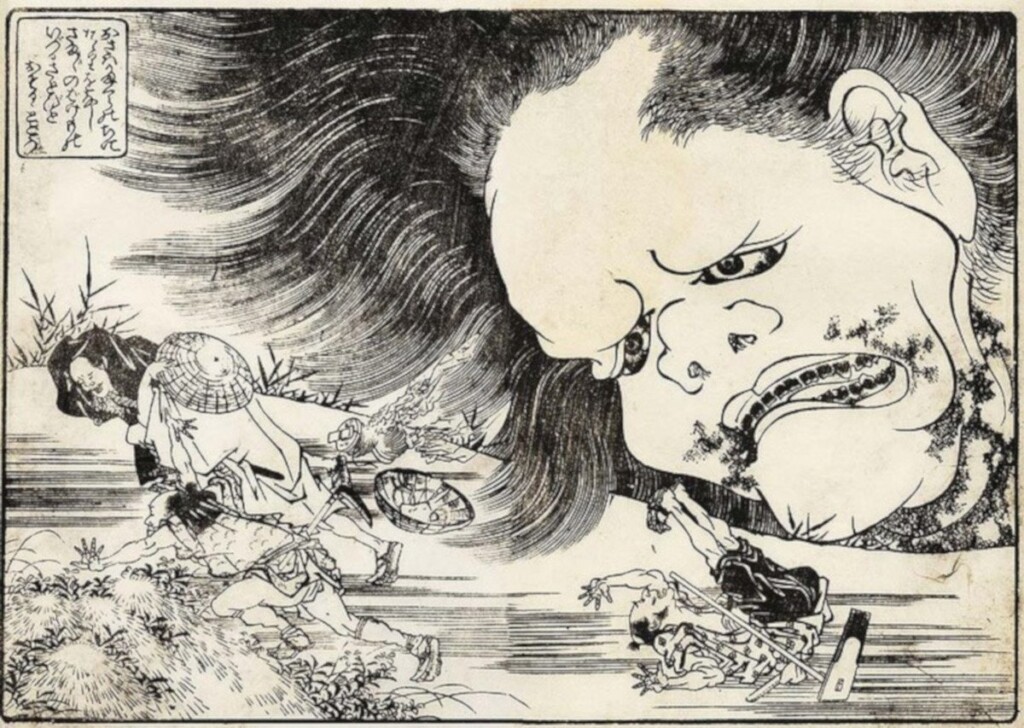
You are standing in a museum, alone in front of a hanging scroll, and the figure painted there is unmistakably human — robes, long black hair, a face that might belong to a woman you once knew — except that below the hem of the garment there is nothing. No feet, no ground, no point of contact with the world. The absence does not read as incompletion. It reads as statement.
The attribution of this iconographic convention to Maruyama Ōkyo, the eighteenth-century Kyoto painter who founded the Maruyama school of naturalistic art, is itself a strange piece of cultural history. The story goes that Ōkyo painted the ghost of his deceased lover from memory and from a dream, and that in his grief he rendered her exactly as she appeared — hovering, untethered, denied the ordinary terrestrial fact of standing somewhere. Whether or not the biographical detail is accurate, it circulated and it stuck, which tells us something more interesting than the truth: a culture chose this origin story because it felt right, because it explained something the culture already believed about the relationship between the dead and the ground beneath the living.
What is formally interesting about this iconographic choice is that it runs against the dominant logic of how most traditions render the supernatural threatening. The monster typically overwhelms through addition — excess teeth, extra limbs, a body that is too much body, a presence that takes up more space than it should. The Japanese yurei works through the opposite principle. It is the human form with something essential removed, and what has been removed is precisely the capacity for rootedness, for arrival, for the mundane act of walking into a room and leaving footprints. The terror is not in what has been grafted on but in what has been quietly taken away.
Roland Barthes, in his 1970 study of Japan, L’Empire des signes, noticed that Japanese aesthetic culture organized itself repeatedly around the productive power of emptiness — ma, the meaningful interval, the pause that carries more weight than the note. He was writing about haiku and urban space, not about ghost iconography, but the structural intuition applies: the missing feet are not an omission. They are the most carefully considered element of the image, the place where meaning concentrates precisely because matter has been withdrawn.
Sociologists of religion like Robert Smith, whose 1974 work Ancestor Worship in Contemporary Japan documented how ritually central the dead remain in daily Japanese domestic life, noted that the dead in Japanese culture are not imagined as having departed to some remote elsewhere. They are proximate, requiring feeding, requiring attention, capable of suffering from neglect. The yurei who cannot leave is not simply a frightening image — it is a literalization of an anxiety that already structures ordinary life: the fear that the dead are still here, still needing something, still held in place by unresolved attachment or undelivered justice.
What the footless figure makes visible is that the society imagining it has never fully committed to the idea of departure. In cultures where death is a clean crossing — a threshold, a gate, a moment of translation into somewhere else entirely — the dead leave. They go. Their absence is spatial and absolute. The Japanese supernatural imagination refuses this geography. It insists that certain kinds of dying produce a creature that is no longer fully present but is equally no longer absent, stranded at the boundary not because it chose to linger but because something unfinished in the living world acts as a gravitational force that even death cannot overcome.
The question this leaves open is one that no iconography can answer on its own: when a culture imagines its dead as beings who have lost the physical capacity to walk away, it may be confessing that what binds them there is not the ghost’s unfinished business at all, but the living’s unwillingness to let the ground go unmarked by those who once walked on it.
👻 Spirits, Shadows, and the Invisible World
Ghosts in Japanese culture are not mere folklore curiosities — they are windows into deeper questions about death, memory, and the boundaries between worlds. These related articles explore how different cultures and thinkers have grappled with the uncanny, the supernatural, and the persistence of the dead among the living.
Venetian Legends and Ghosts of the Lagoon
Venice has long been a city haunted by its own past, and its lagoon legends offer a fascinating parallel to Japanese ghost traditions. This article explores the spectral stories embedded in Venetian culture, where the dead linger in canals, palaces, and narrow calli, refusing to be forgotten. Like the Japanese yurei, the ghosts of Venice speak to universal anxieties about loss, place, and unresolved grief.
GO TO THE SELECTION: Venetian Legends and Ghosts of the Lagoon
The Literary Fantastic: Todorov and the Theory of the Fantastic
Tzvetan Todorov‘s theory of the fantastic provides one of the most rigorous frameworks for understanding why ghost stories unsettle us so profoundly. His analysis of hesitation between natural and supernatural explanations maps perfectly onto the ambiguity that defines Japanese ghost narratives. Understanding the literary fantastic helps us see why cultural ghost traditions endure and evolve across centuries.
GO TO THE SELECTION: The Literary Fantastic: Todorov and the Theory of the Fantastic
Day of the Dead: History and Meaning
The Day of the Dead offers a striking cross-cultural counterpoint to Japanese beliefs about spirits and ancestral return. Like the Obon festival in Japan, this Mexican tradition frames the dead not as threats but as beloved visitors who temporarily re-enter the world of the living. Comparing these two traditions reveals how death ritual and ghost symbolism serve as profound expressions of cultural identity.
GO TO THE SELECTION: Day of the Dead: History and Meaning
Must-see Movies about the Afterlife
Cinema has long been one of the most powerful mediums for exploring what lies beyond death, and this curated film list gathers essential works on the afterlife from around the world. Several selections draw directly on Asian ghost traditions, including Japanese horror films that have redefined global perceptions of the supernatural. Watching these films alongside a study of Japanese ghost culture deepens the emotional and philosophical resonance of both.
GO TO THE SELECTION: Must-see Movies about the Afterlife
Discover Cinema that Crosses the Boundary Between Worlds
If these themes of spirits, memory, and the invisible have stirred something in you, Indiecinema is the streaming platform where independent cinema meets depth of vision. Explore films that dare to look beyond the surface of everyday reality — from Japanese ghost stories to visionary international cinema that mainstream platforms will never offer you.
👉 EXPLORE THE CATALOG: Watch Indie Films in Streaming
A vision curated by a filmmaker, not an algorithm
In this video I explain our vision

