
The Cry Before Death
You are half asleep when it reaches you — not through the window, not through the walls, but through something older than architecture, some channel the body keeps open even when the mind has locked its doors for the night. It is not a scream. You have heard screams. This is below screaming, or perhaps above it, occupying a register that has no business existing in a world governed by wind and animal and the ordinary violence of weather. You sit up in the dark of a farmhouse in County Clare, or Galway, or Tipperary — the county does not matter, because the sound does not belong to geography. It belongs to time. Specifically, it belongs to the time just before something ends.

Your first instinct is the rational one. A fox, perhaps — the red fox of rural Ireland produces a cry so human and so wrong that it has unsettled travelers for centuries. But you know almost immediately that this is not that. The fox’s cry is urgent and finite; it spends itself quickly, like a match. What you are hearing does not spend itself. It sustains. It rises and folds back on itself with a kind of terrible patience, as though whatever is producing it has no particular need for air, no biological requirement to pause and breathe, no concern for whether you believe in it or not. It is not performing for you. That is perhaps the most frightening part. The sound is not aimed at you. It is aimed at someone, and the only question your body has already begun to answer — before your mind has caught up — is whether that someone is you.
The pre-linguistic registers of human fear are far more sophisticated than neuroscience has historically been willing to credit. Antonio Damasio’s work on somatic markers, particularly in Descartes’ Error published in 1994, established that the body computes threat through emotional signals embedded in the flesh long before conscious reasoning assembles a verdict. What this means in practice is that when you hear something that activates the deepest strata of biological alarm, the shaking in your hands is not a response to your fear — it is your fear, arriving before thought, running ahead of language the way a shadow runs ahead of a person walking toward the sun. The body already knows. The mind is simply the last to be informed.
Ireland’s landscape has always been the kind of place that makes the body’s knowledge feel credible. The boglands of the midlands stretch for miles under skies that move too fast, as though the atmosphere is in a hurry to be somewhere else. The limestone karst of the Burren, ancient and pale and stripped of topsoil, looks less like terrain than like the exposed skeleton of something immense that died before anyone was watching. These are not metaphors applied retrospectively by romantic literature — they are geological facts that have shaped the psychological inheritance of the people who worked them for five thousand years. When the land itself looks like evidence of loss, the imagination does not need much encouragement.
What emerged from that imagination was not, at its origin, a monster. The creature the Irish called the bean sí — rendered in anglicized form as banshee, from the Old Irish ben síde, meaning woman of the fairy mound — was never conceived as a predator. She does not cause death. She announces it. This distinction matters enormously, because it relocates the figure from the category of threat to the category of witness, and a witness to your death is a far stranger and more intimate thing than anything that merely wants to harm you. A threat can be outrun, outwitted, survived. A witness simply sees.
Grief as Supernatural Commodity
You are standing in a house where someone has just died, and the body is still warm, and no one knows what to do with their hands. The crying has not started yet. There is a moment — anyone who has been in that room knows it — where grief has no form, where it exists as pressure without direction, a sound looking for a throat. The banshee is that sound given a body, sent outside, made into something that existed before the death and will exist after it, made into something that is not yours to carry alone.
The temptation is to read the banshee as primitive meteorology, as a pre-scientific attempt to explain the inexplicable fact of death. This is the comfortable interpretation, the one that places the Irish peasant safely below us on an evolutionary ladder of understanding. But Émile Durkheim, writing in The Elementary Forms of Religious Life in 1912, dismantled this condescension without even targeting it directly. His argument was not that ritual emerges from ignorance but that it emerges from necessity — specifically, the necessity of making private anguish legible to a community. The mourning cry, in Durkheim’s framework, is not a spontaneous expression of individual pain. It is a social obligation, a performed emotion that binds the living to each other precisely because the dead have broken the bond. What he called collective effervescence — that electric fusion of individual feeling into communal body — does not require belief in the supernatural to function. It requires only the shared enactment of grief, the synchronized wail, the recognized signal that loss has occurred and the community must now reconstitute itself around the wound.
The banshee makes this reconstitution possible before the death has even been confirmed. She is not a response to grief; she is its announcement, its permission structure. When the keening woman outside the window is supernatural, the grief she licenses becomes larger than personal. It becomes cosmological. The family does not merely mourn one man; they participate in a drama that has been running since before their grandparents were born, one that will continue after their grandchildren die. This scalar shift — from the intimate to the eternal — is not a comfort. It is a technology. It allows the unbearable to be borne because it reframes the unbearable as something the universe itself recognizes and has always recognized.
The professional keeners of pre-Famine Ireland, the mná caointe, understood this implicitly. These were women paid to cry — not to simulate crying, but to cry with genuine force and craft, their laments composed in real time around the specific life of the specific dead. The caoine was not a generic wail. It was a biography delivered in grief’s register, a public accounting of what had been lost. When the Catholic Church began suppressing this practice in the eighteenth and nineteenth centuries, framing it as pagan excess, what it actually suppressed was a distributed system for processing collective loss. The banshee, in this context, is what remains when the living keener is taken away — the echo of a role that society still needed but could no longer officially sanction. She is the institutionalized grief cry stripped of its human practitioner and relocated into legend, where no bishop can silence her.
What this reveals is that the supernatural is sometimes a workaround — not a failure of knowledge but a failure of permission. The culture knew grief needed to be loud, communal, and formally acknowledged. When the formal channels were closed, the need did not disappear. It migrated. It found a figure who could not be excommunicated, could not be told she was being excessive, could not be asked to lower her voice at the graveside because the neighbors would talk.

The Gendering of Doom
You are standing at the edge of a field somewhere in County Clare, and a woman you do not know is screaming for someone you have never met, and yet every hair on your body rises as though the grief belongs to you personally. That is the first clue that something is being communicated here that predates language, or at least predates the language you were taught to trust.
The banshee is never male. This is not incidental. In the entire architecture of Irish supernatural tradition, she arrives exclusively as a woman — ancient, wild-haired, her face either hideously aged or devastatingly beautiful, her voice carrying the specific pitch of absolute loss. Scholars of folklore have catalogued hundreds of regional variants from Connacht to Ulster, and across all of them this gendering remains fixed as stone. The question worth pressing is not what this reveals about supernatural belief but what it reveals about who was permitted, historically, to perform grief at all.
In Gaelic Ireland, the caoineadh was not a private act of mourning. It was a structured, skilled, and socially essential practice performed by women called mná caointe — keening women — who were sometimes paid professionals, sometimes hereditary mourners attached to specific clans. Angela Bourke, in her 1993 essay “More in Anger than in Sorrow” published in the collection Feminist Messages, documented how keening functioned as a form of oral poetry requiring years of cultivation, capable of encoding genealogy, political grievance, and communal memory within what sounded to the untrained ear like raw wailing. Women like Máire Bhuí Ní Laeire in early nineteenth-century Cork were composing and performing laments of genuine literary complexity at a moment when they had no legal right to own property, sign contracts, or speak in any formal civic proceeding. Their grief-work was indispensable to the community and simultaneously unacknowledged as work at all.
The Catholic Church moved systematically against keening from the seventeenth century onward, issuing repeated condemnations through diocesan synods — Tuam in 1660, Cashel in 1810 — that characterized the practice as pagan, disorderly, and incompatible with Christian composure in the face of death. What the Church was suppressing was not merely a folk custom but an entire female economy of meaning-making, a technology for processing collective devastation that communities had relied upon for centuries. When you ban a practice without addressing the need it served, the need does not disappear. It migrates.
The banshee is precisely that migration. She carries onto the supernatural plane the labor that patriarchal and ecclesiastical authority could no longer tolerate being performed by actual women in actual fields. She is keening with the social accountability removed — no body to pay, no woman to silence, no professional to dismiss as hysterical. The terror she generates is in exact proportion to the discomfort that real keening produced in those who wanted grief to be quiet, contained, and male-supervised. Every reported encounter with her wail in the oral record — and the collector Patrick Kennedy documented dozens of such accounts in his 1866 Legendary Fictions of the Irish Celts — reproduces the same visceral detail: the sound is unbearable not because it is alien but because it is devastatingly, uncomfortably human.
There is a deep structural irony operating here that feminist theory would later develop into explicit argument. Silvia Federici in Caliban and the Witch, published in 2004, traced across early modern Europe the consistent pattern by which female communal practices were driven from the social body and returned as superstition — as something feared rather than compensated, haunting rather than employed. The banshee does not haunt because she is supernatural. She haunts because the grief she carries was never allowed to be ordinary.
Colonial Silence and the Suppressed Wail
You are standing at a graveside in County Clare in 1847, and the women around you have gone silent. Not because there is nothing to grieve — the ground has been receiving bodies for months, the hunger has made undertakers of everyone — but because the magistrate posted a notice two parishes over warning against the “savage and indecorous practices” of public lamentation, and the silence that follows is not peace. It is amputation.
The Act of Union of 1800 did not simply dissolve the Irish Parliament into Westminster’s machinery. It inaugurated a civilizational project, one that required the Irish body, and specifically the Irish female body in mourning, to be legible within English Protestant frameworks of grief. Those frameworks demanded restraint, interiority, a sorrow that stayed behind doors and expressed itself in handkerchiefs rather than in the convulsive, ecstatic, professionally honed vocal performance that keening represented. The British administrative and ecclesiastical apparatus described keening in documents throughout the nineteenth century using a remarkably consistent vocabulary: primitive, hysterical, pagan, disruptive. What they were actually describing was a form of collective memory that bypassed literacy, bypassed church authority, and bypassed the very mechanisms of cultural control they were attempting to install.
The Catholic Church, already compromised in its relationship with colonial power and anxious to demonstrate the respectability of Irish Catholicism to an English audience that viewed it as superstition in vestments, became an unlikely enforcer. Synodal decrees issued across the mid-nineteenth century explicitly condemned keening at gravesides as incompatible with Christian burial. Parish priests, themselves under social pressure to perform a certain kind of civilized religiosity, began refusing to officiate at funerals where keening women were present. The women who had carried this practice for generations — the mná caointe, the professional keeners whose art involved precise genealogical recitation, rhythmic melodic structures, and a physical choreography of grief that could last hours — found themselves pushed to the margins of the ritual they had once commanded. By the 1890s, Lady Augusta Gregory was already documenting keening as a disappearing practice, collecting fragments the way one collects the last letters of someone recently dead.
And yet the banshee did not disappear. She intensified. The decades of sharpest cultural suppression — the Famine years, the clearances, the enforcement of the National Schools system after 1831 which conducted all instruction in English and treated Irish as the language of backwardness — correspond precisely to the periods in which banshee accounts proliferate most densely in folklore collections. Douglas Hyde, compiling his material in the 1890s, found the banshee everywhere in oral testimony, more vivid and more specific than she had been in earlier centuries. This is not coincidence. When the living woman who wailed was silenced, the mythological woman who wailed became load-bearing. She carried what could no longer be openly performed.
There is a particular violence in being told that your way of mourning is the problem. Grief is not merely emotional discharge — it is epistemological, it is how a community processes what has been lost and insists on its having mattered. To criminalize its public expression is to deny not just the feeling but the ontological claim embedded in the feeling: that this person’s death demands witness, demands noise, demands that the world be interrupted. The colonial project understood this intuitively, which is why the keening prohibition was never merely aesthetic. A people who cannot publicly mourn their dead cannot fully account for what has been taken from them.
The banshee, then, is not folklore in the sense of charming cultural residue. She is the sound that survived the silencing, the wail that could not be posted a notice against because she lived in a register the magistrate could not reach — the place where the dead are named by someone who loved them, in a language the empire had not yet managed to kill.
The Aristocracy of Dying
You are standing at a graveside in Connacht sometime in the early seventeenth century, and nobody is coming. No wail rises from the hillside, no pale figure combs her hair at the river’s edge, no unearthly keening threads itself through the wind off the Atlantic. The man being buried worked the same soil his father worked and his father’s father before that, and the cosmos, apparently, has nothing to say about it.
The banshee was never democratic. The earliest systematic accounts of her — most precisely assembled by the antiquarian Patrick Kennedy in his 1866 Legendary Fictions of the Irish Celts, and before him by Thomas Crofton Croker in the 1820s — are consistent on a point that modern retellings almost universally suppress: she attached herself to specific bloodlines, and those bloodlines were noble. The families she mourned bore the prefix Ó or Mac, markers of Gaelic aristocratic lineage. The O’Neills of Ulster, the O’Briens of Thomond, the Kavanaghs of Leinster — these were the dynasties whose dying warranted cosmic annotation. The death of a tenant farmer, a laborer, a woman who lived and perished without record, summoned nothing from the supernatural order. The universe, structured by the logic of Gaelic aristocracy, registered their absence in the same register it had registered their presence: silence.
What this reveals is not merely a social hierarchy but an ontological one. Medieval and early modern Gaelic Ireland organized prestige around a highly elaborated system of rank codified in the Brehon laws, where honor-price — the legal concept of lóg n-enech, literally the price of one’s face — determined a person’s social weight in every transaction, including their death. A noble’s death had a measurable value that reverberated through kinship networks, political alliances, and territorial claims. A serf’s death had no such price. The banshee, in this reading, is not a supernatural being who happens to prefer aristocrats — she is the supernatural face of lóg n-enech itself, the cosmological expression of a society that had already decided, in its legal and economic architecture, that some deaths mattered more than others.
The French sociologist Pierre Bourdieu spent decades demonstrating that symbolic capital — the accumulated prestige, recognition, and social authority a person holds — is as real and consequential as economic capital. In his 1979 work La Distinction, he showed how cultural hierarchies reproduce themselves through systems of taste, recognition, and legitimacy that feel natural precisely because they have been so thoroughly internalized. The banshee is a myth, but myths are not innocent: they externalize and sanctify whatever hierarchy the living have already constructed. To claim that a supernatural figure marks the deaths of the noble and ignores the deaths of the poor is to recruit the metaphysical world into an argument about whose life had weight.
The more destabilizing question is what happens when you notice that this logic did not die with the Brehon laws. The nineteenth century, which saw the banshee story proliferate in print, was also the century of the Great Famine, during which between one and two million Irish people died between 1845 and 1852, and the literary and journalistic apparatus of Britain produced almost nothing that acknowledged those deaths as cosmically significant, as deserving of mourning at the level of civilization. The machinery that renders certain deaths invisible and others worthy of elegy is not folklore’s invention — folklore only gives it a face and a cry.
What the banshee’s aristocratic exclusivity exposes is that grief, as a cultural institution, has always been rationed. The decision about whose passing the world should pause to register is not a natural response to loss — it is a political act wearing the clothes of feeling, and the wail from the hillside, heard only by the right families, is less a premonition than a verdict already rendered by the living.
A vision curated by a filmmaker, not an algorithm
In this video I explain our vision
What the Living Cannot Say

The hospital corridor smells of recycled air and hand sanitizer, and when the doctor finally comes, she speaks in a language assembled entirely from distances. She says “we were unable to,” and “at this point in time,” and “I’m so sorry for your loss,” and every syllable is technically accurate and absolutely hollow, because institutional language was engineered precisely to survive grief rather than meet it. The family stands there receiving these words the way a shore receives fog — without resistance, without grip, without anything being genuinely touched. The woman who was your mother has become a file number and a time of death, which will appear later on a certificate alongside a cause listed in Latin, as though the bureaucratic dignification of a dead language could do what living speech has failed to do.
Grief has always required a sound that lies outside language’s jurisdiction. What the banshee offered was not information — it was vibration, frequency, the body’s knowledge arriving before the mind could construct its defenses. Keening, the practice from which the banshee’s cry descends, was a communal vocal form practiced at Irish wakes well into the nineteenth century, and its suppression by the Catholic Church beginning in the seventeenth century was not incidental. Church authorities condemned it explicitly as pagan, uncivilized, an obstacle to proper Christian mourning, which was meant to be contained, hopeful, oriented toward resurrection rather than rupture. What they were actually disciplining was the body itself — its insistence on making raw sound in the face of extinction, its refusal to convert loss into the acceptable grammar of spiritual progress.
The anthropologist Geoffrey Gorer identified in 1965 what he called the pornography of death — the phenomenon by which modern Western culture had come to treat death with the same mixture of fascination and institutional suppression once reserved for sex. His observation lands harder now than when he made it: we have constructed an entire professional architecture whose purpose, however kindly intended, is to manage the experience of loss into something that does not disturb the surrounding social fabric. Grief counselors, bereavement leave policies, condolence cards with pre-printed language, the entire industry of tasteful funeral aesthetics — all of it performs the same function as the hospital corridor, which is to ensure that the sound grief actually wants to make never quite escapes into public air.
The banshee persists, then, not as superstition but as a diagnosis. She names the gap between what loss feels like in the body and what the available cultural forms allow anyone to express. She is the cry that gets swallowed in the parking lot after the paperwork is signed. She is the sound that forms in the throat at two in the morning and has nowhere to go because the apartment walls are thin and the neighbors have work tomorrow and there is no tradition left that would recognize the noise as sacred rather than alarming. Every culture that has suppressed its keening practices has produced that particular modern silence — not peace, not acceptance, but a containment so thorough it eventually becomes indistinguishable from numbness.
What makes the myth endure is that it refuses the consolation that modernity insists upon. She does not come to comfort. She does not suggest that the dying have gone somewhere better, that the grief is temporary, that meaning can be recovered from the wreckage. She comes to scream the plain fact of ending, and the ancient Irish mind understood something in that — that being witnessed in your annihilation, even by something inhuman, is not the same as being abandoned to it. The acknowledgment itself, wordless and catastrophic, was a form of presence. And presence, in the face of absolute loss, is the one thing no bureaucratic language has ever learned to provide.
The Predictive Body and the Sounds It Makes
You already know something is wrong before anyone tells you. The sensation arrives not as thought but as weight — a pressure behind the sternum, a slight cooling of the skin at the back of the neck, a quality of silence in a room that has not yet gone quiet. The body has completed a calculation the conscious mind hasn’t started, and it delivers its verdict without language, without argument, without the possibility of appeal.
Antonio Damasio spent decades mapping this territory in clinical neurology, and what he found dismantled the Cartesian arrangement we still secretly believe: that the rational mind sits above the messy biological machinery and issues clean decisions from a safe distance. His somatic marker hypothesis, developed across his 1994 work Descartes’ Error, demonstrated that patients with damage to the ventromedial prefrontal cortex — the region that integrates bodily signals with decision-making — did not become more rational without emotional interference. They became incapable of choosing. They could reason endlessly about options and never act, because the body’s rapid-assessment system, the system that encodes past experience as physical sensation and sends it forward into present judgment, had been severed. Without the body’s predictions, cognition loops without landing.
What this means is that the body is not the passenger. It is the instrument through which knowledge that cannot yet be spoken is nonetheless known. And every culture that predates the clinical language for this has built a figure to exteriorize it — to give shape and sound to what the body processes before the self can consent to the information. The banshee does not arrive to inform. She arrives to perform a knowledge that is already, somewhere beneath awareness, held.
Robert Hertz, writing in 1907 on secondary burial practices across Southeast Asia in his essay collected posthumously in Death and the Right Hand, observed something that cut against the tidy Western assumption that death is a single event. In the Dayak communities he analyzed, death was understood as a process — a gradual social and spiritual transition that the community had to actively accompany, often across months or years, through ritual, through the careful management of the corpse’s decomposition, through ceremonies that moved the deceased incrementally from the world of the living into a stabilized place among the dead. The moment of biological death was not the moment of social death, and the gap between the two was not silence but labor. Grief was not private feeling but collective work, and the body — the actual, decaying, present body — was the medium through which that work was performed.
What Hertz had found, without framing it this way, was that cultures manage the unbearable by giving it a physical process to follow. The body — or its representation, its effigy, its spectral extension — must be moved through stages because the psyche cannot absorb catastrophic loss in a single instant. The banshee belongs to this logic entirely. She is the body that precedes the corpse, the mourning that arrives before the death is confirmed, the wail that gives the community’s nervous system somewhere to discharge what it cannot yet cognitively accept. She is not supernatural as opposed to natural. She is the natural pushed to its outer limit, where the body’s predictive intelligence exceeds what consciousness can organize and must therefore be projected outward, given a figure, given a voice.
There is a reason the banshee’s cry is described, across centuries of testimony, not as heard but as felt — in the chest, in the gut, as a vibration that precedes understanding. This is not poetic elaboration. It is precise phenomenological reporting. People are describing what Damasio’s patients lost the capacity to experience: the body’s advance knowledge, arriving as sensation before it can be processed as meaning, demanding acknowledgment before the mind is ready to give it.
When the Myth Stops Fitting
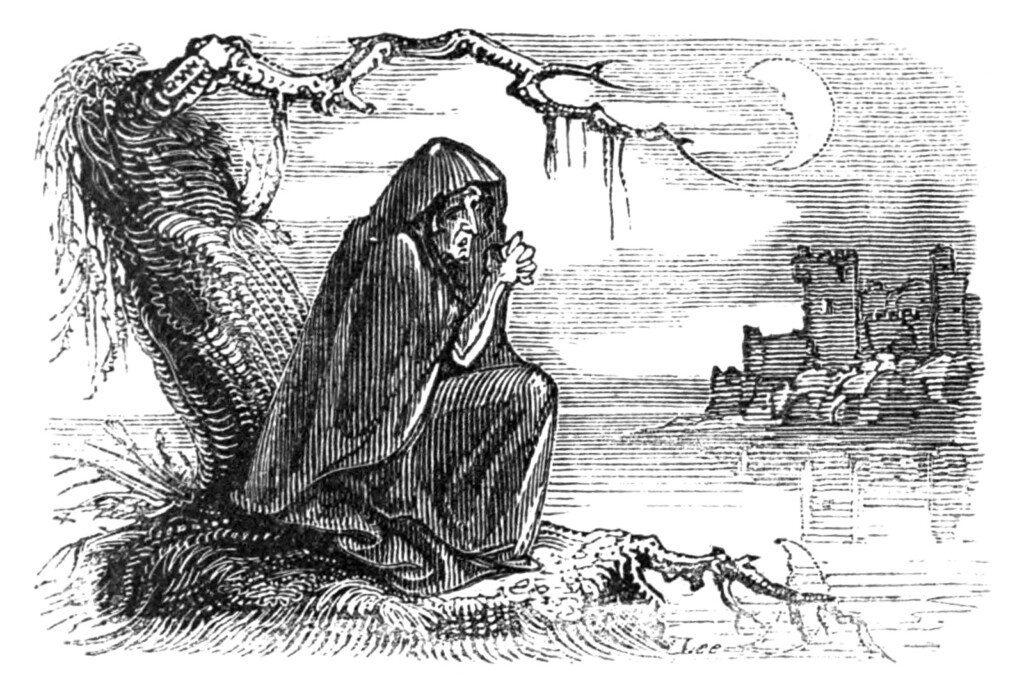
You packed the banshee in the same trunk as the rosary beads and the photograph of a house you would never see again, and she traveled badly.
There is something almost violent in what emigration does to a mythology built from specific ground. The banshee is not a portable figure. She was constructed from the intimate geography of particular counties, particular families, particular boglands where the fog moves in ways that require generations of inherited perception to read correctly. The Ó Briain keening woman belongs to Clare, to the limestone karst and the Atlantic wind that strips the gorse down to its wire frame. When the Famine ships emptied Ireland between 1845 and 1852 — carrying roughly two million people out of a population that had already lost another million to starvation — they carried her too, but the vessel had no idea what it was transporting. She arrived in Boston, in Melbourne, in Buenos Aires, stripped of the only sensory grammar that made her intelligible.
The Irish diaspora, which by the early twentieth century numbered more outside Ireland than within it, performed an act of unconscious preservation that was also, necessarily, an act of distortion. They told the stories. They kept the names. But folklore, as the anthropologist Alan Dundes argued in his 1964 study of folk narrative transmission, is not text — it is performance embedded in context, and when the context dissolves, what survives is the skeleton without the body heat. The banshee her emigrants carried into the tenements of South Boston or the sheep stations of Queensland was already a ghost of a ghost, a sound separated from the landscape that had given it acoustic meaning.
This created something stranger than forgetting. A woman in a terrace house in Melbourne in 1910, Irish-born, hears a sound outside her window at night and reaches for the banshee as explanation — but the sound is eucalyptus branches, an ecology her mythology never encoded. The figure she summons to account for her dread is a figure built for oak and hawthorn and the cry of particular coastal birds. She applies her to a continent that predates European mythology by sixty thousand years of entirely different dreaming, and something in the application simply does not hold. The banshee becomes, in that moment, not a living figure but a homesickness wearing a familiar face — which is to say, she becomes a symptom of displacement masquerading as supernatural presence.
What this reveals about mythology more broadly is uncomfortable. We tend to speak of myths as if they carry truth horizontally across time and geography, as if the deep meaning travels intact wherever the people go. But the banshee’s migration suggests instead that mythological figures are ecological entities, dependent on the same conditions as the plants and weather systems that shaped the culture that generated them. Uproot them and they do not simply relocate — they begin to perform a function they were never designed to serve, which is the function of nostalgia, of marking the wound of severance rather than the presence of death. In Argentina, where a significant Irish community settled the pampas throughout the nineteenth century, the banshee appears in family oral histories not as a harbinger encountered but as a story told to children to maintain a sense of Irish distinctness against the vast Spanish-speaking world pressing in from every direction. She becomes, there, less a figure of death than a figure of identity — which is precisely the opposite of what she was at home, where identity was so saturated into the land itself that it required no mythological reinforcement.
The cruelest irony is that the banshee may be most loudly invoked where she is least able to speak, crying out across geographies that do not know how to carry her sound, mourning losses that now include the very ground from which she was born.
🌿 Death, Grief, and the Spirits That Remain
The Banshee is one of Ireland’s most haunting figures — a keening voice at the threshold between the living and the dead. These articles explore the cultural, psychological, and mythological dimensions of death, loss, and the supernatural traditions that give shape to our deepest fears.
Dark Ireland in Literature and Folklore
Ireland’s literary and folkloric tradition is saturated with darkness, mystery, and the uncanny presence of spirits that refuse to depart. From ancient Celtic mythology to the Gothic prose of Sheridan Le Fanu, the Irish imagination has always treated the boundary between worlds as permeable and charged with meaning. Understanding this tradition is essential to grasping why figures like the Banshee occupy such a central place in Irish cultural identity.
GO TO THE SELECTION: Dark Ireland in Literature and Folklore
Contemporary Ireland in Culture and Literature
Contemporary Ireland carries within it the weight of its mythological and historical past, even as it transforms into a modern European nation. The tension between ancient superstition and present-day identity gives Irish storytelling its distinctive emotional charge, where grief is never entirely private but communal and ancestral. This article examines how Irish culture today still negotiates with the shadows of its origins.
GO TO THE SELECTION: Contemporary Ireland in Culture and Literature
Grief and the Processing of Loss
Grief is not merely an emotion but a profound psychological and cultural process through which communities and individuals encounter mortality. The Banshee, as a harbinger of death, externalizes this inner experience into a figure of collective mourning, giving voice to what cannot otherwise be expressed. Exploring the psychology of loss helps us understand why death-announcing myths persist with such vitality across generations.
GO TO THE SELECTION: Grief and the Processing of Loss
Sheridan Le Fanu: Irish Gothic and Domestic Horror
Sheridan Le Fanu is the master of Irish Gothic, a tradition that locates terror not in exotic landscapes but in the familiar home and the inherited past. His work draws deeply from Irish folklore, turning domestic spaces into stages for supernatural dread and unresolved family trauma. Le Fanu’s fiction is perhaps the closest literary companion to the myth of the Banshee, sharing its grammar of foreboding and feminine mourning.
GO TO THE SELECTION: Sheridan Le Fanu: Irish Gothic and Domestic Horror
Discover the Cinema That Dares to Look Beyond
If these themes of death, myth, and ancestral memory have stirred something in you, Indiecinema is the streaming platform where independent cinema explores exactly these territories — with courage, depth, and artistic freedom. Discover films that mainstream platforms will never show you, and let independent storytelling take you further.
👉 EXPLORE THE CATALOG: Watch Indie Films in Streaming
A vision curated by a filmmaker, not an algorithm
In this video I explain our vision

