
The Document as Weapon
You are sitting in a wooden chair that has been designed, with considerable forethought, to be slightly too small for your body. The room smells of tallow and damp stone. A man across the table from you holds a document. He does not look at you when he speaks. He reads from the page, and what he reads is already your confession — your words arranged in an order you do not recognize, your silence treated as admission, your protests recorded as further evidence of the very guilt they are meant to disprove. The document precedes you. It will outlast you. You are, in the most precise sense, secondary to the paperwork.

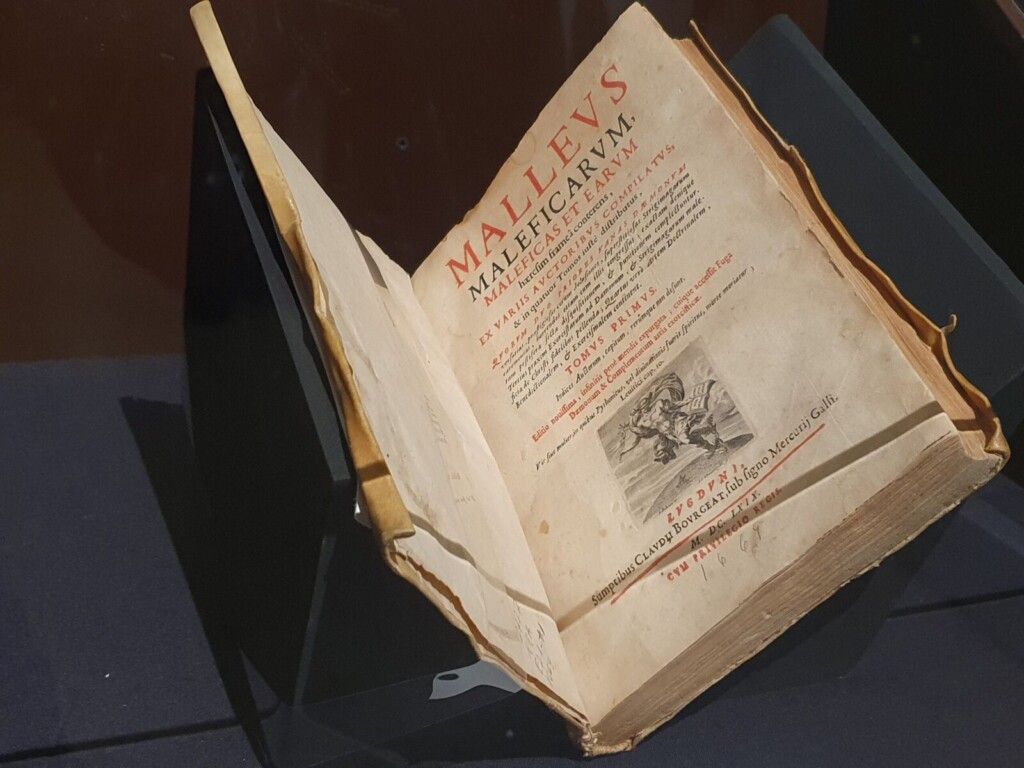
In 1486, Heinrich Kramer published a book that made this scene not merely possible but procedurally inevitable. The Malleus Maleficarum — the Hammer of Witches — appeared in Strasbourg with a preface that included a papal bull, Summis desiderantes affectibus, issued by Innocent VIII in 1484, strategically reprinted at the front of the volume to imply ecclesiastical endorsement of everything that followed. Jacob Sprenger’s co-authorship has been disputed by historians including Christopher Mackay, whose 2009 Cambridge critical edition demonstrated that Sprenger’s involvement was likely minimal and possibly fabricated to lend institutional weight to what was, at its core, Kramer’s personal obsession dressed in the vestments of theology. The book went through roughly twenty-eight editions between 1486 and 1600. It was not a fringe pamphlet. It was a bestseller, moving through the new infrastructure of the Gutenberg press with the efficiency of any product that meets a market demand — in this case, the demand for systematic justification.
What Kramer built was not primarily an argument. Arguments can be refused. What he constructed was a procedure — a closed epistemic loop in which the accused witch could not, by any available move, exit the frame of guilt. If she wept during interrogation, the Malleus explained that witches shed false tears to deceive. If she did not weep, her composure was evidence of supernatural hardness. Confession confirmed guilt. Denial confirmed guilt through its suspicious persistence. The instrument was not designed to discover truth. It was designed to produce a predetermined output with the appearance of due process, which is a far more dangerous thing than open violence, because it borrows the moral authority of reason while dismantling the conditions under which reason could operate.
Hannah Arendt, writing about totalitarian bureaucracy in The Origins of Totalitarianism in 1951, identified the particular horror of systems that transform murder into administration — that route destruction through paperwork precisely so that no individual hand appears responsible for the outcome. The Malleus predates her analysis by four and a half centuries, but it instantiates her insight with chilling exactness. Kramer did not ask inquisitors to hate. He asked them to follow instructions. The hatred was already embedded in the taxonomy, in the categories, in the leading questions printed on the page. The executioner could feel, with genuine sincerity, that he was merely completing a process someone else had designed.
The book’s targets were overwhelmingly women. Kramer states this not as an incidental demographic observation but as a theological proposition — the Latin root of femina, he argues with spectacular philological dishonesty, derives from fe and minus, meaning lesser in faith. Approximately forty thousand to sixty thousand people were executed across Europe during the witch trial period spanning the fifteenth through the eighteenth centuries, with estimates from historians including Brian Levack suggesting that around seventy-five percent of the condemned were female. These numbers did not emerge from mass hysteria alone. They emerged from a document that gave hysteria a filing system, a courtroom protocol, and a Latin title that conferred upon it the dignity of scholarship.
The Witches of Mount Sciliar

Docufiction, by Andrea Dalfino, 2022, Italy.
The Witches of Scillar is a documentary that delves deeply into the trials that took place in Alto Adige, in Castel Presule and surrounding areas at the beginning of the 16th century, following which more than 10 were condemned to the stake on charges of witchcraft, becoming the real and precursors of the infamous Witch Hunt. Starting from the analysis of the historical context and intertwining local legends with actual events and analyzing the locations of the events with the help and guidance of experts, this film offers a new historical perspective on what happened, culminating with the exposition of what remains of the witches in South Tyrol today and how the crimes of the inquisition are judged in retrospect today.
Alto Adige is a land full of mystery, where history and legend are intertwined, with its magical and fascinating scenarios that push the mind and imagination to wander, investigate, discover. Here is the Sciliar, a suggestive mountain massif located in the natural park of the same name against the backdrop of the Dolomites, and no other mountain is so full of myths and legends as this one, on which it is said that fairy creatures and spirits of all sorts live , and in the Middle Ages it was held up as a meeting place for witches and devils. Here, during the time of the Inquisition, 10 women accused of witchcraft were tried and killed. Director Andrea Dalfino made the documentary The Witches of the Sciliar, enriching the film with fictional scenes that retrace the intricate events of the Fiè trial.
LANGUAGE: Italian
SUBTITLES: English, Spanish, French, German, Portuguese
Institutional Legitimacy and the Printing Press
You are holding a book that was printed before most Europeans had ever held a printed book. That specific sensation — the weight of something newly mass-produced in a world still organized around the singular, hand-copied manuscript — is the first thing to understand about how the Malleus Maleficarum operated. It was not merely a text about power. It was itself a performance of power, engineered at the precise historical moment when the technology of reproduction had outrun the cultural frameworks for evaluating what reproduction meant.
Johann Gutenberg’s press had been operational since roughly the mid-1440s, and by 1487, when Heinrich Kramer completed his manuscript, Europe possessed a distribution infrastructure that no previous theological or juridical document had ever been able to exploit. The Malleus went through fourteen editions between 1487 and 1520, and another sixteen between 1574 and 1669. These are not bibliographic footnotes — they are the anatomy of a genocide. Each new edition carried the same prefatory document, the same opening gesture of institutional endorsement, the same apparent seal of papal authority. The book reproduced not just its content but its legitimacy with every copy, because the two had been fused into a single object by design.
That prefatory document was the papal bull Summis Desiderantes Affectibus, issued by Pope Innocent VIII in December 1484. Kramer embedded it in his preface not because it endorsed the Malleus — it did not; it predated the book by three years and addressed a narrower jurisdictional dispute about Kramer’s authority in the Rhine valley — but because its physical presence on the opening pages created the impression of direct papal sanction. The bull was real. The implication was forged. This distinction, which should have been immediately visible to any careful reader, was functionally invisible in a culture still learning how to read printed authority, still developing the hermeneutic suspicion that manuscript culture, paradoxically, had trained its scholars to apply. When a document was copied by hand, the copyist was a known intermediary, a potential corruptor. When something appeared in print, identical across hundreds of copies, the uniformity itself read as proof.
Umberto Eco argued in his work on semiotics and textual power — particularly in the frameworks he developed across his theoretical writings of the 1970s and 1980s — that texts do not merely describe institutional authority but actively constitute it through the codes they mobilize and the contexts they exploit. A text performs legitimacy by assembling the recognizable signs of legitimacy, regardless of whether the underlying authority actually exists. The Malleus understood this, intuitively or deliberately, with a sophistication that most modern propaganda operations would recognize as professional. The papal bull at its opening was not evidence; it was scenography. It transformed the reader’s relationship to everything that followed before a single argument had been encountered.
What the printing press added to this was scale without variance. A forged endorsement in a manuscript could be traced, compared, interrogated — other copies might lack it, or render it differently, exposing the seam. In a printed book, the forgery traveled identically across every copy, acquiring through sheer repetition the texture of the official. By the time the Cologne Faculty of Theology — whose endorsement Kramer also claimed in the preface, and which was similarly obtained through procedural manipulation — had any reason to object, the Malleus had already reached courts and inquisitors across Germany, France, and beyond. The institutional machinery for correction operated at manuscript speed. The machinery for error operated at print speed. That gap between velocities is where the witch trials lived.
There is something in this that the sixteenth century could not have named but that a reader today should feel with cold precision: the medium had become the mechanism of coercion, and no one had yet developed the vocabulary to say so.

The Anatomy of the Accused
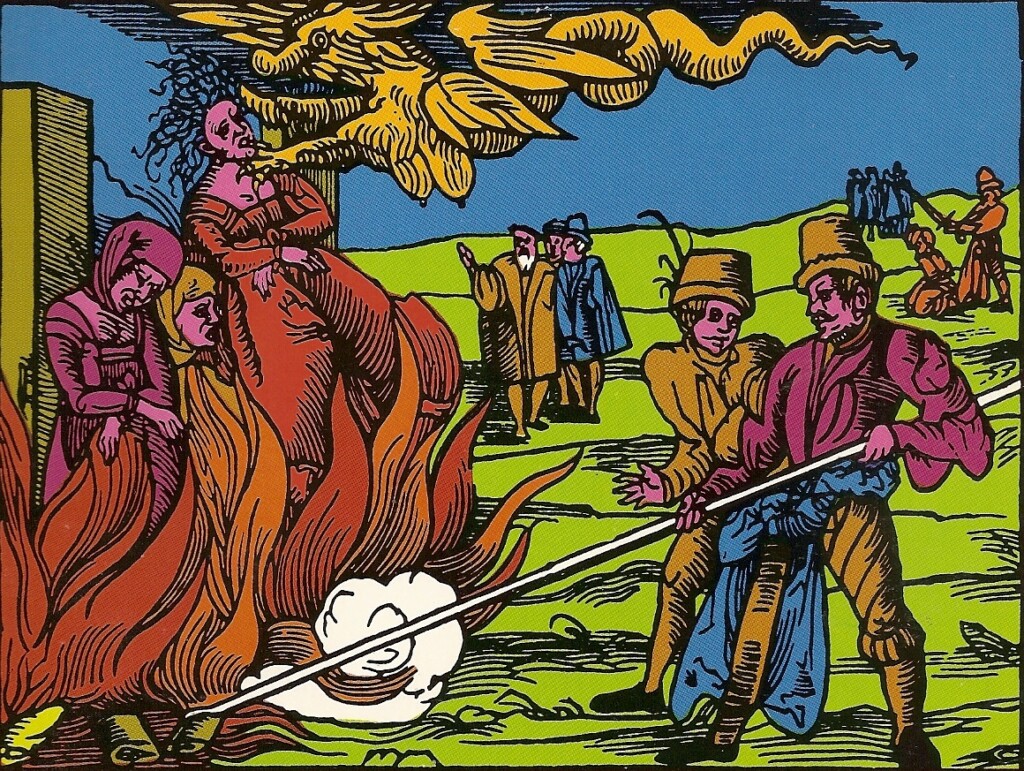
You are sitting across from a woman you have known your entire life — your neighbor, your midwife, your grandmother’s closest friend — and the document being read aloud in the room has already decided what she is. The decision was made before she walked in. It was made in the grammar of the text itself, in the Latin clauses that describe her body as a wound that never healed, a structure built from defective material, an organism whose very capacity for sensation made her porous to diabolical influence. The Malleus Maleficarum did not accuse individual women. It accused the category.
Kramer’s theoretical scaffold for this accusation was borrowed — selectively and dishonestly — from Aristotelian biology, which had proposed in the Generation of Animals that the female was essentially a failed male, a body that lacked the vital heat necessary to complete its own formation. Kramer did not cite this as a historical curiosity. He wielded it as a biological proof. Because women were constitutionally incomplete, they were constitutionally susceptible: their openness to physical impression mirrored, in his logic, their openness to spiritual corruption. The argument was circular in the way that all totalizing systems are circular — the conclusion was buried inside the premise before any evidence was introduced.
What made this particularly lethal was the way it transformed ordinary female behavior into diagnostic symptom. Weeping became evidence of duplicity, because Kramer quotes a misreading of Ecclesiasticus to argue that a woman’s tears are a weapon of deception. Sexual appetite, whether real or rumored, became proof of the demonic pact, since the text insists that all witchcraft originates in carnal lust, which in women burns without limit and without conscience. Even healing knowledge — the kind accumulated over generations of tending the sick, managing childbirth, knowing which plants reduced fever — was reframed as occult power suspiciously acquired. The woman who knew too much about the body was precisely the woman the Malleus described as dangerous.
Brian Levack, working through the surviving trial records of early modern Europe in his 1987 study, calculated that somewhere between 40,000 and 60,000 people were executed for witchcraft across the three centuries following the Malleus’s publication. Of those, roughly 75 to 80 percent were women. That number is not an abstraction. It is the demographic shape of a doctrine. The Malleus did not merely reflect existing misogyny; it gave misogyny a procedural form, a jurisdictional language, and a theological mandate. It turned cultural contempt into a prosecution template.
The geography of persecution followed the logic of social vulnerability rather than any consistent theological enthusiasm. Regions with fragmented political authority — the Holy Roman Empire’s patchwork of territories, parts of Scotland, certain Swiss cantons — produced higher execution rates precisely because there was no centralized legal apparatus to slow the momentum of local accusation. In the Prince-Bishopric of Würzburg alone, between 1626 and 1631, over 300 people were executed in a concentrated burst that killed members of the town council, children, and the bishop’s own nephew. The Malleus had provided the conceptual architecture; local grievance, economic strain, and the logic of denunciation under torture supplied the names.
What the text had done, structurally, was to make women the default suspect class for an invisible crime — an offense defined by its unverifiability, prosecutable on the basis of confession extracted under conditions designed to produce confession. The epistemological trap was elegant and complete: the accused could not demonstrate innocence because the crime left no external trace, and the only evidence accepted as definitive was the accused’s own voice, broken at the point where pain and despair converge into whatever words the interrogator required.
The female body, in this architecture, was not a person’s body. It was a site of proof already written before the trial began.
Confession Engineered by Procedure
You are already guilty before you open your mouth. The inquisitor knows this. The procedure exists not to discover the truth but to manufacture the shape of a truth that was decided in advance, and your body is simply the material from which it will be cut. In the interrogation rooms described across the third part of the Malleus Maleficarum, published in 1487 by Heinrich Kramer, the accused witch was not questioned so much as sculpted — pressed, deprived, disoriented, and broken until she produced the confession that the presiding judge had already written in outline before she entered the room.
Sleep deprivation was not incidental. The Malleus instructs that the accused be kept awake across consecutive nights, not as punishment but as methodology — because exhaustion dissolves the boundary between what one believes and what one is told to believe. After seventy-two hours without sleep, the human brain begins generating its own hallucinations, its own false memories, its own desperate need for the ordeal to end at any cost. The confessor was waiting precisely at that threshold. The leading questions followed a liturgical logic: not “did you meet the devil” but “how many times did you meet the devil,” not “did you harm your neighbor” but “what method did you use to harm your neighbor.” The answer was already embedded in the question like a seed in soil, and the accused needed only to water it with her exhaustion.
Michel Foucault, writing in Discipline and Punish in 1975, identified this as the central epistemological violence of pre-modern juridical systems: the confession was not extracted from a subject who possessed a hidden truth — it was produced in a subject who was made to embody a truth that existed elsewhere, in the institution, in the doctrine, in the social need for a legible enemy. The body became a writing surface. Torture was not a failure of reason or a lapse into barbarism; it was the most coherent application of a system in which physical suffering was understood as epistemologically valid, as a reliable conduit to truth. The Malleus made this logic explicit and procedural, which is what makes it so uniquely disturbing: it did not apologize for the mechanism. It codified it.
Kramer specified that the accused should first be shown the instruments of torture before they were applied — a theatrical gesture that served a precise psychological function. The sight of the strappado, the rack, the thumbscrews, was designed to produce speech before contact was even made. The confession that emerged from this anticipatory terror was considered no less valid than one extracted under actual pain. Which means the instrument of production was not the iron or the rope but the imagination of suffering — the mind turning against itself under the pressure of what it could foresee. The body was almost redundant. What the procedure required was a psyche sufficiently destabilized to agree to anything that would stop the future from arriving.
What is rarely acknowledged is that the Malleus also protected the inquisitor from the testimony of the accused. A woman who accused her torturer of cruelty during interrogation could not be believed, because her accusation was itself evidence of demonic influence working to discredit God’s servants. The procedural architecture was hermetically sealed: every resistance proved guilt, every accusation proved deception, every silence proved concealment. There was no position from which the accused could speak that was not already interpreted as confirmation of what the procedure already knew. This is not a system designed to find truth. This is a system designed to make truth impossible to contest, which is a different and far more durable form of power — one that does not need violence to sustain itself once the structure is sufficiently internalized by those it governs.
The Social Function of the Scapegoat
You have watched it happen in a room you thought was safe — a group fractured by pressure, by scarcity, by some unnamed dread, and then, suddenly, one person becomes the explanation for everything. Not because they did anything. Because the group needed someone to.
René Girard spent decades building the argument that this is not a failure of reason but reason’s most efficient operation under duress. In Le Bouc Émissaire, published in 1982, he dismantled the comfortable idea that scapegoating is a primitive reflex, a hysteria that overtakes otherwise rational people. His claim was structurally colder: communities under pressure generate violence that must be redirected outward onto a legible victim in order to prevent that violence from consuming the community itself. The witch was not a symptom of social breakdown. She was its solution.
The villages of the Rhine Valley in the 1480s, the years immediately preceding the Malleus Maleficarum’s composition, were not experiencing collective madness. They were experiencing simultaneous catastrophe — successive crop failures, the demographic scarring left by plague cycles that had not fully released their grip since 1347, and the theological tremors of a Church that could feel its monopoly cracking decades before Luther made the crack visible. Kramer did not invent the witch. He codified a figure that communities had already begun to isolate, because the machinery of blame had already been running. What the Malleus provided was bureaucratic legitimacy for a process that had been operating informally, giving it the grammar of law, the authority of theology, and the procedural respectability that transformed a mob’s intuition into a court’s verdict.
Girard’s mechanism depends on one specific condition: the victim must be marked as different enough to serve as a container for the community’s violence, but similar enough to be believable as a genuine threat from within. This is why accusations rarely landed on figures completely outside the social fabric. The women tried at the Trier witch trials between 1581 and 1593, which eventually consumed an estimated 368 lives across the region, were not strangers. They were midwives, healers, widows — people whose roles placed them at the threshold of life and death, whose proximity to the community’s most vulnerable moments made them available for suspicion. Their integration was precisely what made them useful targets. A foreign enemy can be expelled or fought. A neighbor who has delivered your children and who now, in a season of infant deaths, stands at the border of your trust — that figure can absorb an entire community’s unresolved grief.
What the Malleus Maleficarum accomplished that informal accusation could not was the production of certainty. Girard observed that the scapegoat mechanism loses its social function if the community retains doubt — the violence must be experienced as justice, not as violence at all. Kramer’s text provided the epistemological framework that made doubt structurally impossible. If the accused confessed under torture, that was evidence. If she refused to confess, her resistance was itself evidence of diabolical fortitude. If she showed no marks on her body, that proved demonic protection. If she bore unusual marks, those were the devil’s signature. The logical system was sealed from the inside, which is not a flaw in the Malleus but its central achievement — a closed hermeneutic circle that converted every piece of evidence into confirmation and left no position from which innocence could be demonstrated.
This is where the social violence became genuinely rational, in the coldest sense of the word. Communities that had no mechanism to explain why children died, why harvests failed, why God appeared to have withdrawn his protection, needed a causal account that was also an action plan. The witch provided both simultaneously. Her identification explained the past and her execution promised to repair the future, restoring the community’s relationship with divine order.
A vision curated by a filmmaker, not an algorithm
In this video I explain our vision
Expertise, Credentialing, and the Monopoly on Reality

You already know what it feels like to have your knowledge dismissed by someone holding a credential. The dismissal arrives not as argument but as posture — a slight recalibration of the face, a patience that is really contempt thinly administered. What you know from experience, from proximity, from years of watching a body respond to what you gave it, is reclassified in that moment as anecdote. What they know, certified and laminated, becomes the only knowledge that legally exists.
The Malleus Maleficarum performed exactly this reclassification in 1486, but at a scale so total it required the simultaneous destruction of an entire epistemic class. Heinrich Kramer did not simply argue that witches were dangerous. He argued, with painstaking scholastic architecture, that only a trained inquisitor — male, clerical, university-formed — possessed the interpretive equipment necessary to detect, assess, and prosecute supernatural crime. This was not incidental to the text. It was the text’s operating logic. The witch-hunter was not a zealot; he was a professional. And the profession required, as all professions do, a monopoly on the legitimate reading of reality.
Andrew Scull, in his sociology of psychiatric expertise, traced how professional authority is never simply earned through demonstrated competence — it is constructed through the simultaneous delegitimization of competing practitioners. His work on the rise of institutional psychiatry in the nineteenth century showed that the alienist and later the psychiatrist consolidated power not by proving they could cure madness but by successfully arguing that the people who had previously managed it — families, parishes, village healers — were dangerously unqualified. The mechanism is identical regardless of century: you do not simply build your authority up. You tear competing authority down, and you use the state to ratify the demolition.
Barbara Ehrenreich and Deirdre English identified in 1973 what had been hiding in plain sight across several centuries of European history. The women prosecuted as witches were, in significant proportion, the primary medical practitioners of their communities. They managed childbirth, prepared herbal analgesics, treated fevers, performed abortions, and held the accumulated pharmacological knowledge of generations. This was not marginal folk superstition — it was functional medicine, empirically derived, locally tested, and socially trusted. The Malleus explicitly targeted the obstatrix, the midwife, calling her more dangerous than any other category of witch, because her access to birth and death placed her at the precise threshold where the Church and the emerging university-trained physician both needed to plant their flags. A woman who could control fertility, manage labor, and ease dying held power that no institutional structure could tolerate as independent.
The criminalization of this knowledge was not a byproduct of witch persecution. It was one of its primary functions. By the time the major witch trials had run their course through the sixteenth and seventeenth centuries, the formal medical profession — organized through guilds and universities from which women were categorically excluded — had successfully repositioned itself as the only legitimate site of healing. The village healer did not lose her practice because she was proven wrong. She lost it because she was proven dangerous, which is an entirely different epistemic operation, one that requires no evidence of error, only evidence of threat.
What Kramer’s text produced, then, was a template for professional self-constitution through criminalized alterity. You define the expert by defining the criminal, and you make the criminal the person who was doing the work before the expert arrived. The Malleus gave this process theological sanction, but the sociology it instantiated was not theological at all — it was the same sociology that would govern the professionalization of law, psychology, and education in centuries to come. The handbook was not only a hunting manual. It was a credentialing document, and what it certified was the right of certain men to be the sole arbiters of what counted as knowledge, what counted as healing, and what counted as
The Persistence of the Epistemic Template
You have held a document in your hands before — a policy manual, a diagnostic guide, a training protocol — and noticed how its very structure made certain conclusions inevitable. The questions it instructs you to ask are designed to produce a particular category of answer. The categories it offers you are exhaustive in appearance but hermetically sealed in practice. You filled out the form and the form filled out the verdict before you finished.
This is not a bureaucratic accident. It is a technology, and the Malleus Maleficarum was among its earliest systematic deployments in Western institutional life. What Kramer engineered in 1486 was not merely a theology of witchcraft but a procedural architecture: a manual that defined the investigator’s role, calibrated his suspicions, and constructed the epistemic conditions under which guilt became the only coherent outcome. The accused who confessed confirmed the system. The accused who denied confirmed it equally, since denial was itself indexed as a symptom of diabolical stubbornness. The manual had sealed its own circuit before the interrogation began.
Robert Lifton, working from interviews with survivors of Chinese re-education camps and Korean War prisoners in his 1961 study, identified what he called “milieu control” as the foundational mechanism of totalist systems — the saturation of an environment with a single interpretive framework so complete that alternative readings of experience become literally unthinkable. What Lifton documented in twentieth-century political contexts had been operational in ecclesiastical ones five centuries earlier. The Malleus achieved milieu control not through walls and guards but through epistemology: by defining in advance what counted as evidence, what counted as expertise, and what counted as a legitimate question. Inquisitors trained in its logic did not encounter the world and then apply categories to it. They inhabited the categories first, and the world arranged itself accordingly.
Lifton also described what he called “sacred science” — the quality that certain ideological systems possess of elevating their core assumptions to the status of axioms immune from challenge, such that questioning the framework is treated as a moral failure rather than an intellectual act. The Malleus operated precisely this way. Its opening section, the Quaestio Prima, disposed of skepticism not by answering it but by pathologizing it: to doubt the reality of witchcraft was to contradict scripture, and to contradict scripture was to risk heresy. Doubt was converted from an epistemic virtue into a spiritual liability. The reader who found the argument unconvincing had thereby demonstrated something troubling about himself.
What makes this template persistent across centuries is not conspiracy but convenience. Closed systems that generate their own confirming evidence are extraordinarily efficient. They do not waste resources on genuine inquiry. They deploy investigators who already know what they are looking for, process subjects through procedures that sort them into pre-existing categories, and produce documentation that appears rigorous because it follows a method — regardless of what that method was designed, consciously or not, to find. The Diagnostic and Statistical Manual of Mental Disorders in its successive editions has been critiqued along precisely these lines: not as a sinister document but as a structure in which the definitions of disorder and the criteria for diagnosis are developed by the same professional community that then applies them, certifies practitioners in their use, and produces research that the framework itself shapes. The philosopher Ian Hacking called this “looping” — the way classification systems alter the behavior of the classified, which then appears to validate the original classification.
What the Malleus accomplished was to make the loop invisible by dressing it in theological certainty. The contemporary equivalents are more modest in their claims but structurally identical in their operation: the manual arrives first, and the evidence it was always going to find arrives faithfully behind it, wearing the face of discovery.
What the Handbook Cannot Survive
You are sitting across from a judge who has already decided. The form of the question changes — it is rephrased, softened, then hardened again — but the destination of the answer never does. What breaks this, historically, is not a sudden access of conscience. It is bureaucratic friction.
The Malleus Maleficarum began losing its operative grip not because Europe woke up but because competing institutions discovered that witch trials were expensive, jurisdictionally disruptive, and increasingly difficult to contain. Secular courts in the late sixteenth and early seventeenth centuries found that once the logic of spectral evidence was admitted, the accusations metastasized beyond any manageable perimeter. In 1563, Johann Weyer’s De Praestigiis Daemonum argued that the women being burned were not powerful agents of Satan but mentally disturbed individuals incapable of the vast conspiratorial feats attributed to them — a medical reframing, not a humanitarian one. Weyer was not arguing for mercy; he was arguing for diagnosis. His challenge to the Malleus was procedural before it was ethical, which is precisely why it carried any traction at all in learned circles. Moral objection alone rarely dismantles an institution that serves power. Jurisdictional inconvenience does.
Friedrich Spee von Langenfeld understood this with a precision that remains almost unbearable to read. In 1631, the Jesuit priest published the Cautio Criminalis anonymously — anonymously because he knew what happened to the wrong kind of witness — and what he produced was not a theological repudiation but an internal audit. He had accompanied condemned women to their executions in Würzburg and Paderborn and had watched the torture protocols extract confessions that conformed perfectly to the expectations of the interrogators. His question was deceptively simple: how would an innocent person survive this process? His answer was that they could not. The Cautio did not argue that witches did not exist. It argued that the procedure guaranteed false convictions regardless of the guilt or innocence of the accused, and that therefore the courts had no epistemic ground on which to stand. This was not enlightenment arriving on horseback. It was a Jesuit with a ledger, demonstrating that the machinery was producing garbage and calling it proof.
What accelerated the decline was a collision of interests rather than a conversion of values. The Thirty Years’ War, ending in 1648, had so thoroughly shattered the administrative coherence of the Holy Roman Empire that the sustained coordination required for large-scale witch prosecution became practically impossible. Centralized skepticism arrived through exhaustion as much as through reason. England’s last execution for witchcraft occurred in 1682; Scotland’s in 1727; the last judicial execution in the Holy Roman Empire in 1775. These dates do not describe a moral arc. They describe a slow institutional withdrawal driven by Enlightenment jurisprudence’s demand for naturalistic evidence, by the consolidation of state power that no longer needed the delegated terror of the inquisitorial court, and by an emerging economic rationality that found the disruption of local communities through mass accusation counterproductive.
What cannot be fully processed, even now, is that the Malleus Maleficarum was never formally repudiated by the institutions that gave it force. It simply became inconvenient. The architecture of the text — its fusion of theological authority with procedural instruction, its construction of a target category defined by unfalsifiable interior states, its use of the accused’s denial as confirmatory evidence — did not dissolve when the burning stopped. It migrated. The heresy of the witch became available as a template: a way of organizing suspicion, extracting confession, and producing guilt from the very machinery of the investigation itself. The specific target, the woman marked by the devil’s sign, was historically contingent. The method of targeting was not, and the question of where exactly that method went when the stake was dismantled remains one the historical record refuses to answer cleanly.
🔥 When Fear Becomes a Tool of Power
The Malleus Maleficarum stands as one of history’s most chilling monuments to institutional violence, weaving theology, misogyny, and judicial terror into a single devastating manual. To truly understand its legacy, one must explore the deeper structures of prejudice, persecution, and social control that made such a text not only possible but widely celebrated. These related articles illuminate the cultural and psychological roots of the witch hunt and its echoes in our present.
The roots of social prejudice and the mechanisms of exclusion
The roots of social prejudice run deep, fed by fear, ignorance, and the need to identify a scapegoat upon whom collective anxieties can be projected. The witch hunts documented and legitimized by the Malleus Maleficarum are perhaps the most brutal historical example of how exclusion mechanisms can be codified into law and doctrine. Understanding these dynamics is essential to recognizing their modern disguises.
GO TO THE SELECTION: The roots of social prejudice and the mechanisms of exclusion
Gender-Based Violence: History, Data and Prevention Tools
Gender-based violence has ancient and institutionalized roots, and the persecution of women accused of witchcraft represents one of its most systematic historical manifestations. The Malleus Maleficarum explicitly framed women as inherently susceptible to demonic influence, transforming misogyny into theological dogma and juridical procedure. Tracing this history reveals how violence against women has repeatedly been normalized through cultural and religious authority.
GO TO THE SELECTION: Gender-Based Violence: History, Data and Prevention Tools
The Psychology of Evil: Why People Commit Violent Acts
The psychology of evil invites us to ask how ordinary individuals—judges, priests, inquisitors—could participate in the systematic torture and execution of thousands of innocent people. The Malleus Maleficarum created a framework that made cruelty not only permissible but morally obligatory, illustrating how ideology can override individual conscience. Understanding the mechanisms behind collective participation in evil remains one of the most urgent tasks of modern psychology.
GO TO THE SELECTION: The Psychology of Evil: Why People Commit Violent Acts
Wollstonecraft’s A Vindication of the Rights of Woman
Mary Wollstonecraft‘s foundational feminist text reminds us that the subjugation of women has always required ideological justification, whether religious, medical, or philosophical. The world that produced the Malleus Maleficarum was one in which women’s bodies, minds, and voices were treated as inherently dangerous and in need of control. Reading Wollstonecraft in the shadow of the witch trials reveals the long, unbroken thread connecting institutional misogyny across centuries.
GO TO THE SELECTION: Wollstonecraft’s A Vindication of the Rights of Woman
Discover Independent Cinema on Indiecinema
If these themes stir something in you—the abuse of power, the persecution of the different, the courage of those who resist—then independent cinema has stories waiting for you. On Indiecinema you will find films that dare to look where mainstream culture looks away, giving voice to histories and truths that refuse to be silenced. Come and explore a cinema that thinks, provokes, and illuminates.
👉 EXPLORE THE CATALOG: Watch Indie Films in Streaming
A vision curated by a filmmaker, not an algorithm
In this video I explain our vision

