
The Mirror You Were Taught to Love
Before you have spoken a single word this morning, you have already performed. You stood in front of the mirror longer than you needed to. You adjusted something — a collar, a hem, the angle of your jaw — not because it was uncomfortable, but because you were rehearsing. Rehearsing for what, exactly? For the eyes that will land on you before anyone asks your name, before anyone learns what you think or what you are capable of building or breaking. The mirror did not ask you to do this. You did it willingly, automatically, with the quiet fluency of someone who has been practicing since childhood without ever being formally taught.

This is not vanity. Vanity implies choice, implies a kind of excess that a more disciplined person could simply set aside. What you did this morning was something far more structural than vanity. It was obedience. And the remarkable thing is that you did not feel it as obedience at all. You felt it as care, as professionalism, perhaps even as self-expression. The trap, when it is well-constructed, does not feel like a trap. It feels like your own reflection.
In 1792, a woman named Mary Wollstonecraft sat down to write what she called, with deliberate plainness, A Vindication of the Rights of Woman. She was thirty-three years old, she had survived poverty and professional humiliation and the particular cruelty that the eighteenth century reserved for women who thought too loudly, and she was furious in the most precise and surgical way a person can be furious — not at individuals, but at systems. Not at men as such, but at the architecture of expectation that had been built so carefully around women that most of them could no longer distinguish the walls from the air.
Her central argument was not, as it is sometimes lazily summarized, simply that women deserve education. It was something more unsettling than that. It was that women had been so thoroughly trained to seek approval through their appearance and their agreeableness that they had become, in her exact word, “weak.” Not biologically weak. Culturally, systematically, deliberately weakened. Weakened by the same forces that claimed to be protecting and admiring them. She wrote that women were rendered “objects of pity” and “borderers on the confines of folly,” not because of any inherent deficiency, but because every institution surrounding them — education, religion, literature, marriage — conspired to keep their ambitions anchored firmly to the surface of their bodies.
What Wollstonecraft diagnosed was not a personal failing but a social technology. Pierre Bourdieu, writing almost two centuries later in Masculine Domination, published in 1998, would give this technology a name: symbolic violence. The violence that does not strike you but shapes you. The violence you participate in yourself, often with a kind of pleasure, because you have been made to understand that your value flows through your compliance with a particular image. Bourdieu argued that this form of domination is the most durable precisely because it is the most invisible — it is incorporated into the body itself, into gesture, posture, the way you enter a room, the way you adjust your collar in the mirror before you have said a single word.
Wollstonecraft saw this in 1792 without the vocabulary of sociology, with nothing but her own furious clarity. She saw that teaching a girl to be beautiful and pleasing before teaching her to be capable and autonomous was not an act of love. It was an act of sabotage dressed as devotion. The mirror you were taught to love was never really showing you yourself. It was showing you the version of you that the world had decided it could use.
And the cruelest part is how long it takes to see the frame around the glass.
Eve of the Irises
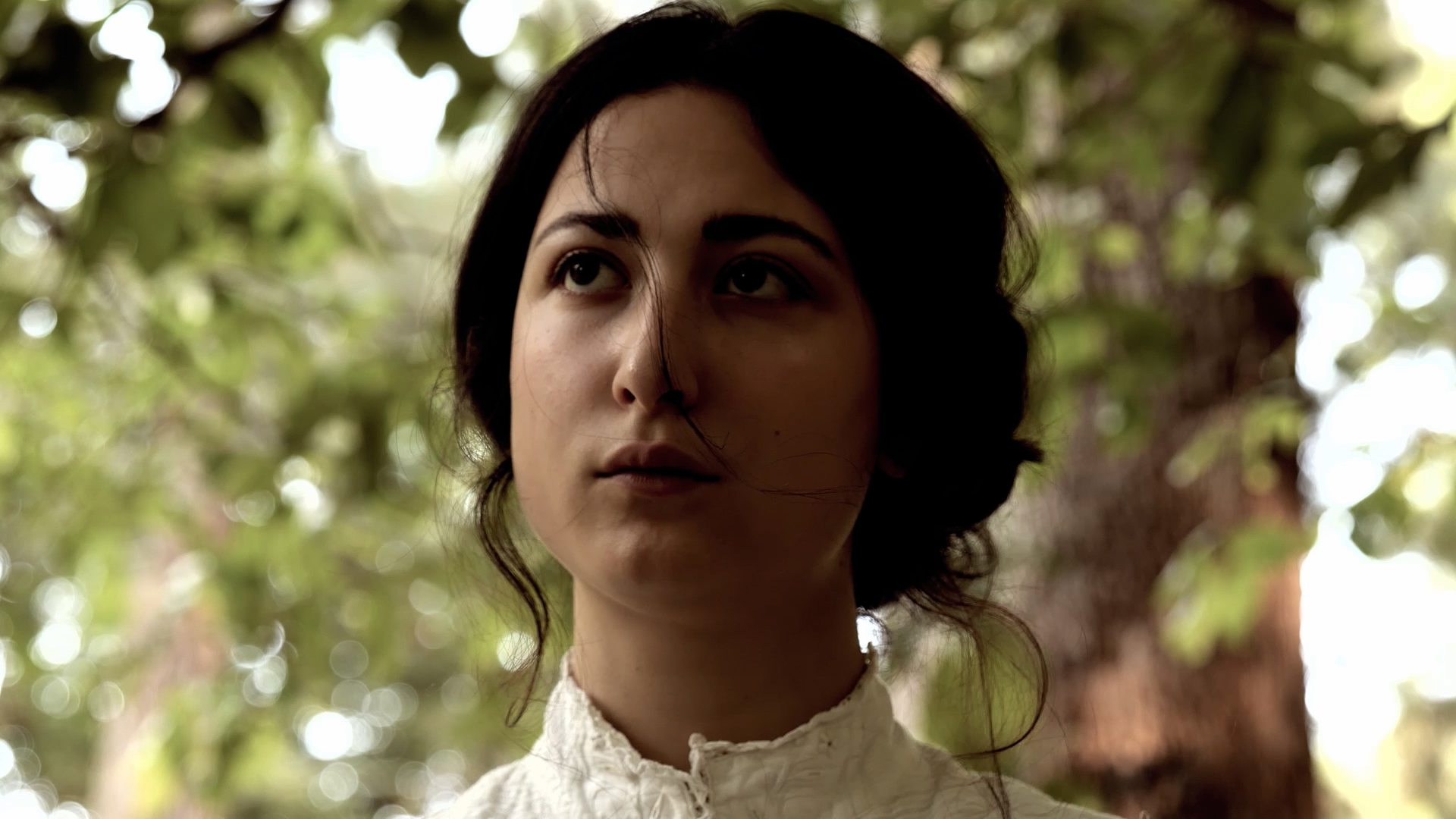
Documentary, by Isabel Russinova, Rodolfo Martinelli Carraresi, Italy, 2026
Eva of the Irises is a historical biographical docu-film about the scientist Eva Mameli Calvino, a botanist and pioneer of environmentalism in Italy, mother of the writer Italo, born in Sassari in 1886. The film, based on a multidisciplinary approach that combines several genres—such as theatre, documentary, cinema, and research—moves between memories, reflections on life, as well as the goals and missions the scholar still wished to achieve.
The multifaceted artistic sensibility of Isabel Russinova is expressed across many fields, from writing to acting, from directing to civic engagement, and finds one of its highest expressions in the docu-film Eva of the Irises, created with Rodolfo Martinelli Carraresi. The film blends scientific rigor and poetic refinement to portray the extraordinary figure of the botanist Eva Mameli Calvino, mother of Italo Calvino but above all an independent protagonist of 20th-century scientific culture. It is told through a combination of archival materials, interviews, and evocative staging capable of elegantly and profoundly conveying her intense human and professional story.
LANGUAGE: Italian
SUBTITLES: English, Spanish, French, Portuguese
A Woman Educated Into Weakness
She was quick at seven. Quick in the way that unsettled people, the way that made adults pause mid-sentence and recalibrate their tone. She asked why the sky looked different at dusk than at noon, and then, before anyone could reach for a simple answer, she had already suggested three possibilities and was testing them against each other out loud. Her mother watched this with something complicated moving behind her eyes — pride, yes, but also a species of dread. Because this girl was going to need to become something else entirely. And the work of becoming that something else would take years, and it would require the cooperation of everyone around her, and it would be so gradual and so loving in its application that the girl herself would eventually not recognize it as a form of destruction.
Mary Wollstonecraft saw this mechanism with a clarity that bordered on fury. In 1792, she published A Vindication of the Rights of Woman, a text that did not argue women were being treated unfairly so much as it argued they were being carefully manufactured. The inferiority of women, she insisted, was not a fact of nature but a product of deliberate cultivation. Women were not born weak in reason. They were educated into weakness, systematically, patiently, with enormous social investment. The treatise arrives not as a polite request for inclusion but as an indictment — of the educational philosophies, the domestic ideals, the cultural machinery that had conspired to produce a creature incapable of serious thought and then cited that incapacity as proof of natural limitation.
The target she selects most precisely is Jean-Jacques Rousseau, and the choice is not incidental. Rousseau‘s Émile, published thirty years earlier in 1762, had constructed a vision of ideal education built on the premise that reason, autonomy, and moral development were the proper goals of human formation — but only for boys. His chapter on Sophie, the ideal female companion for Émile, reads like a blueprint for deliberate intellectual atrophy. Sophie is to be raised to please. She is to be trained in compliance, in beauty, in the arts of charm and domestic arrangement. Her education exists entirely in relation to Émile’s needs. She is not a subject developing toward her own ends but an object being refined for someone else’s purposes. Rousseau saw no contradiction in this because he genuinely believed women’s nature inclined them toward ornament and sentiment rather than reason. Wollstonecraft read this and felt something that could only be described as cold rage.
Her argument is precise where Rousseau is sentimental. If you raise a human being without rigorous intellectual formation, without the experience of making real decisions and facing real consequences, without access to the habits of mind that constitute genuine moral agency, you will produce a person who is weak, vain, and dependent. This is not biology. This is pedagogy. This is what you get when you design a curriculum around pleasing rather than thinking. The girl becomes a woman who mistakes flattery for understanding, who has been praised for her delicacy so consistently that she has learned to perform fragility as a form of power — because it is, in that world, the only power available to her.
There is a moment when a woman is in a room full of people who are deciding something that will directly affect her life, and she understands the decision perfectly, sees the logical gaps and the bad faith, and says nothing. Not because she lacks the intelligence to speak, but because she has been so finely trained in the social cost of speaking that silence has become a reflex indistinguishable from instinct. Wollstonecraft’s point is that this silence was not born into her. It was taught. Carefully, lovingly, by everyone who ever told her she was most beautiful when she was quiet.

Reason Has No Sex
There is a moment you may recognize with something close to nausea. A woman stands in a room — a committee chamber, a departmental meeting, a hospital corridor — and she has already spoken. She has made the argument, clearly, with evidence, with precision. And then the man beside her restates what she said, in slightly flatter language, and the room turns toward him and nods. Not because he said it better. Because the room was waiting for him to say it at all. Her voice had been a kind of rehearsal for his. Her competence, a raw material to be processed through a male interpreter before it could be received as knowledge.
This is not a scene from another century. It happened this morning somewhere. And what makes it so corrosive is that no one in that room believes themselves to be doing anything wrong.
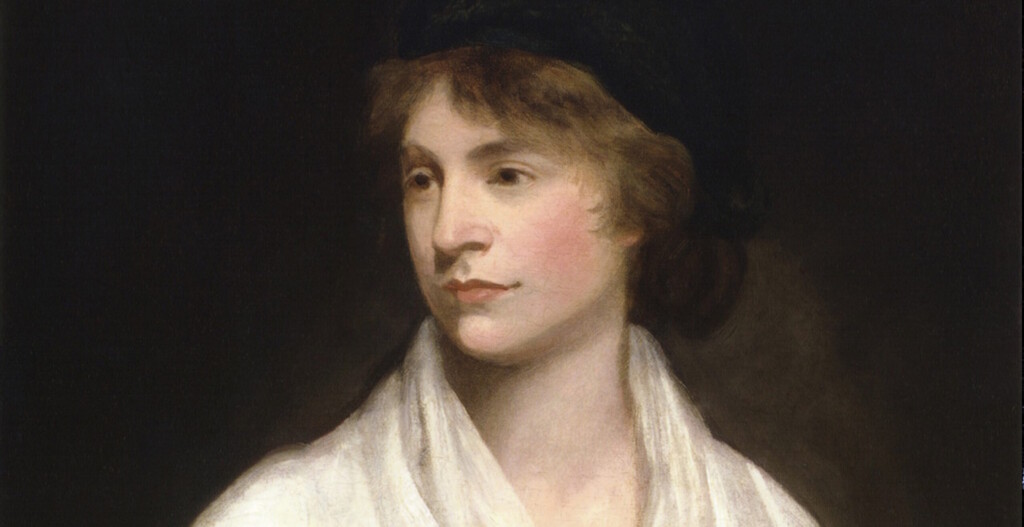
Mary Wollstonecraft understood exactly this mechanism, and she named it in 1792 with a precision that still cuts. In A Vindication of the Rights of Woman she did not argue that women deserved more kindness, or better treatment, or a softer captivity. She argued something philosophically uncompromising: that reason is the defining faculty of the human being, and that to deny women its full exercise is not to protect them but to amputate something essential from their humanity. The argument is surgical. If reason is what distinguishes humans from animals, and if women are human, then stunting their rational development does not preserve their nature — it destroys it. You cannot call a clipped wing a form of care.
What makes this claim radical even now is its refusal to negotiate. Wollstonecraft did not ask for women to be given access to reason as a privilege. She insisted that they already possessed it, and that the elaborate social machinery of her era — the sentimental education, the insistence on ornament over thought, the training toward pleasing rather than knowing — was an active mutilation dressed up as cultivation. “Taught from their infancy that beauty is woman’s sceptre,” she wrote, “the mind shapes itself to the body, and roaming round its gilt cage, only seeks to adorn its prison.” The cage is gilded. That is the precise horror. The captive is taught to polish the bars.
The bitter philosophical irony is that Wollstonecraft was writing at the exact moment that Immanuel Kant had defined the Enlightenment project in its most famous terms. In his 1784 essay Was ist Aufklärung — What Is Enlightenment? — Kant declared that enlightenment was humanity’s emergence from self-imposed immaturity, the courage to use one’s own understanding without the guidance of another. Sapere aude. Dare to know. The entire European intellectual project of the eighteenth century was built on this premise: that the autonomous rational subject was the foundation of moral and political life. And yet the autonomous rational subject, as Kant and almost every major philosopher of that century imagined him, was gendered without acknowledgment. The universal was not universal. It was a particular in disguise.
Wollstonecraft saw this with devastating clarity. She was not working against the Enlightenment — she was holding it to its own logic. If reason has no sex, as she effectively insisted, then any social arrangement that treats a woman’s reason as subordinate to a man’s is not a natural order but a political choice, and a cowardly one. It maintains itself not through argument but through the continuous, daily theater of the committee room: the woman speaks, the man translates, the room believes it has heard from reason.
That woman at the table already knew the answer. The question is why the room required a man to hand it back to her before it became real.
The Prison Built from Compliments
There is a particular kind of compliment that arrives like a door closing. You have just said something sharp, something that cut through the noise of a room, and the man across from you smiles and says: you are remarkable, you know that? And somehow, in the space between his words and your next breath, the thought you had — the actual thought, with its edges and its implications — has disappeared. What remains is only the fact of you, standing there, being remarkable. The thought has been replaced by the thinker as spectacle.
This is not rudeness. That would be easier to name and resist. This is its precise opposite, and that is what makes it so difficult to see without squinting. Simone de Beauvoir, writing in 1949 with a clarity that still feels like a scalpel, identified the mechanism with surgical precision: woman has been designated as immanence, as the fixed and the enclosed, while man claims transcendence, the capacity to project himself into the world and remake it. The worshipped object and the dismissed inferior are not opposites. They are the same gesture performed in two different registers. One says you are too little to matter. The other says you are too precious to move.
Consider a woman who has spent years becoming indispensable — not through need but through genuine competence, through a quality of attention that others orbit without quite knowing why. And then one evening, in a room full of people who claim to admire her, she watches herself being described. They speak of her warmth, her grace, the way she holds a space together. Every word is generous. Every word is also a reduction. Because warmth is not the same as intelligence. Grace is not the same as vision. And holding a space together is what furniture does.
She smiles. She has learned to smile at this. The learning itself is the damage.
De Beauvoir understood that the pedestal and the cage are constructed from the same material: the refusal to grant a woman the dignity of her own becoming. Chivalry does not protect women. It protects men from the discomfort of encountering women as full subjects. The knight who opens the door, who pulls out the chair, who insists on carrying what she is perfectly capable of carrying, is not performing respect. He is performing the management of an entity that must be kept in its assigned coordinates — elevated enough to be decorative, contained enough to be safe.
Mary Wollstonecraft saw this two hundred and thirty years before it had a philosophical vocabulary. She saw that the very education designed to make women pleasing — the emphasis on softness, on agreeableness, on the arts of attraction rather than the arts of thought — was not a gift but a sentence. A woman trained to be admired has been trained not to think, because thinking produces roughness, contradiction, discomfort, all the qualities that erode the smooth surface required for worship.
The compliment that arrives like a door closing is not accidental. It is systemic, which means it does not require malice, which means it does not require awareness, which means it perpetuates itself through the very people it flatters into compliance. There is a scene that belongs to many women’s memories — the moment of being called extraordinary at precisely the instant one’s ideas were going to be taken seriously, as if the praise were a preemptive substitute for the engagement. You are remarkable, so I will not have to reckon with what you just said. The admiration absorbs the argument. The woman remains. The thought is gone.
De Beauvoir called this mystification. Wollstonecraft called it a gilded cage, though she would not have used that precise phrasing. Both were describing the same architecture: a structure you cannot quite feel pressing against you because it was built to feel like love.
What Sentimentality Conceals
You walk into the room already reading it. Before you have removed your coat, you have registered the tension between two people near the window, the brittle cheerfulness of someone who has been crying, the particular silence of a man who feels overlooked. Nobody asked you to do this. Nobody will thank you for what happens next, which is the slow, invisible work of adjusting the atmosphere — a question here, a laugh placed precisely there, a moment of attention directed toward the person most likely to combust. By the end of the evening the room will have cohered. Someone will say it was a wonderful night. Nobody will know why.
Wollstonecraft knew exactly what was happening in that room, and she despised the cultural machinery that made it not only inevitable but celebrated. The feminine sensibility that her era worshipped was not, she argued, a natural gift. It was a trained incapacity dressed in the language of grace. The woman who wept at the right moment, who softened the right conflict, who intuited the emotional needs of everyone present before attending to her own — she was not more feeling than her male counterparts. She was more practiced, more pressured, more economically compelled to perform feeling as a survival strategy. Wollstonecraft wrote in 1792 that women were rendered weak and luxurious by the very education designed to please, that their sensibility was cultivated precisely at the expense of their understanding, that the praise heaped on feminine emotion was the most elegant form of imprisonment she knew.
What she lacked was the sociological vocabulary to name the mechanism with clinical precision. That came almost two centuries later, when Arlie Hochschild published The Managed Heart in 1983 and introduced the concept of emotional labor — the work of inducing or suppressing feeling in order to sustain the outward countenance that produces the proper state of mind in others. Hochschild observed that this labor was not distributed evenly. Women, particularly working-class women and women in service industries, were required to perform it constantly and were compensated for it least. The flight attendant who smiles through aggression, the nurse who absorbs fear and grief, the receptionist who softens institutional coldness with personal warmth — they are all doing something real, something exhausting, something that has a cost. And that cost is systematically unacknowledged because the work has been naturalized. It is not work. It is simply who they are.
This is precisely the trap Wollstonecraft was dismantling, though the trap had not yet acquired its industrial form. In 1792 the sphere was domestic and the labor was private. By 1983 it had been exported into the marketplace and made profitable for everyone except the person performing it. What changed was the scale. What did not change was the fundamental logic: the emotion of women is a resource to be harvested, and the most efficient way to harvest it is to convince women that expressing it is their deepest nature and their highest virtue.
The cult of sensibility that dominated Wollstonecraft’s England did not merely sentimentalize women. It philosophically disqualified them. If feeling is your gift, then reason is not your domain. If your instinct is to tend and soothe, then analysis is foreign to your temperament. The binary was not accidental. It was structural. A woman absorbed in managing the emotional temperature of every room she enters does not have her hands free for anything else. She does not have her mind free. And she has been given a story — a beautiful, flattering, deeply poisonous story — about why this arrangement reflects her own most authentic self.
The room coheres. The evening is a success. You drive home tired in a way you cannot quite explain to anyone, least of all to the people who just told you what a wonderful host you are.
A vision curated by a filmmaker, not an algorithm
In this video I explain our vision
The Husband as the State

There is a dinner table. Everything is in its place — the plates aligned, the conversation measured, the silence between sentences filled with the particular quality of air that exists only inside a long marriage. Nothing is wrong. That is precisely what is wrong. Across the table, a woman adjusts her opinion mid-sentence, catching herself before the disagreement fully forms, redirecting it into something softer, something palatably decorative. She does not look afraid. She looks practiced. The correction happens so far upstream from consciousness that she herself could not tell you it occurred.
This is not a cage. It is something far more durable than a cage.
Wollstonecraft understood the geometry of this arrangement with a clarity that her contemporaries found either threatening or absurd, which amounts to the same response. In A Vindication of the Rights of Woman, published in 1792, she does not merely argue that women are treated unfairly within marriage. She makes a structural claim: the household is a political institution, and the husband, in his relation to his wife, replicates with extraordinary precision the logic of despotism. The parallel is not metaphorical for her. It is architectural. Both the tyrant and the husband justify their authority by appealing to nature — to an order that supposedly precedes human arrangement and therefore cannot be questioned without questioning reality itself. The despot says the people are not fit to govern themselves. The husband says the same thing, in different rooms, with more affection.
What makes this argument so difficult to dismiss is that it does not require the husband to be cruel. Wollstonecraft is not writing about monsters. She is writing about the ordinary man who genuinely believes he knows better, who provides, who protects, who loves — and who, in doing all of this, produces a woman incapable of the self-governance that would make his protection unnecessary. The benevolent despot is the most stable despot, because he gives the subjugated population no grievance clear enough to name.
John Stuart Mill would return to this exact architecture seventy-seven years later in The Subjection of Women, identifying what Wollstonecraft had intuited: that marriage was the last feudal institution standing inside liberal society, the one relationship in which a legally free person could be bound by custom and law into a state of permanent subordination. Mill noted in 1869 that no other form of servitude required the servant to smile, to love her master, to internalize his preferences as her own. The genius and the horror of domestic power is that it colonizes interiority. It does not merely govern behavior. It governs desire.
This is where Foucault’s analysis, constructed nearly two centuries after Wollstonecraft’s, becomes not an addition to her argument but its X-ray. In Discipline and Punish, published in 1975, Foucault describes how modern power operates not through the spectacle of punishment but through the architecture of surveillance — the panopticon’s central tower from which one might always be watched, so that the watched person eventually watches herself. External chains become unnecessary when the prisoner has learned to function as her own jailer. The dinner table, the adjusted sentence, the swallowed disagreement — these are not failures of courage. They are the successful operation of a disciplinary system so thoroughly internalized that it no longer requires enforcement.
The woman who corrects herself before speaking is not weak. She has simply been educated by a structure that Wollstonecraft named, that Mill measured, and that Foucault diagrammed — a structure that presents itself as domestic warmth while functioning as something considerably colder. The hearth, in this reading, is not the opposite of the state. It is the state’s most efficient branch, the one that operates without a budget, without officials, without a single document that could be challenged in court.
Independence as a Moral Imperative
There is a particular kind of woman you may have encountered — perhaps you have been her — who, when asked what she wants, goes quiet not from shyness but from something deeper and more troubling. Not the silence of someone thinking. The silence of someone who has forgotten how to locate the question inside herself. She was not born without desires. She was trained, across years and by a hundred small corrections, to redirect them, muffle them, translate them into the desires of others until the original signal disappeared entirely.
Wollstonecraft understood this not as a misfortune but as a moral catastrophe. Her argument in A Vindication of the Rights of Woman, published in 1792, is not primarily about fairness, nor is it a sentimental appeal to the natural goodness of women. It is a philosophical claim about the structure of virtue itself. A being who cannot act freely, who is materially and intellectually dependent on another for her survival and her self-definition, cannot be moral in any meaningful sense. She can perform compliance. She can rehearse goodness as a kind of theater. But she cannot choose it, and a virtue that cannot be chosen is not virtue at all — it is obedience wearing virtue’s clothes.
Hannah Arendt, writing more than a century and a half later in The Human Condition, arrived at a related truth from a different direction. For Arendt, genuine human life — political, moral, genuinely human — depends on the capacity to initiate, to begin something new, to act in a way that cannot be fully predicted or controlled by the conditions that preceded it. She called this natality, the power to introduce into the world something that was not there before. Strip a person of that capacity and you do not produce a simpler or purer being. You produce a being who has been evacuated of the very condition that makes moral life possible. You produce, in Arendt’s language, someone who is no longer fully a person in the political sense — someone who exists but does not act, who is present but does not begin.
What the removal of economic and intellectual autonomy actually creates is not contentment. Not peace. Watch closely and you see something else forming: a self that has learned, through repeated disappointment and foreclosure, to stop wanting what it was never permitted to approach. This is not resignation in the noble sense. It is a kind of interior amputation, performed so gradually and so thoroughly that the person herself often does not register the wound. She says she never wanted a career, never wanted to travel alone, never wanted to speak in rooms where decisions were made. And perhaps by the time she says it, she means it. The wanting has been educated out of her so completely that its absence feels like a preference.
A man once watched a woman he had known for thirty years sort methodically through the contents of a house after her husband’s death — every document, every account, every record of a life she had shared but never legally held. She had to ask her son to explain things she had lived beside for decades. Not because she was unintelligent. Because the architecture of that life had been arranged so that those things were never hers to know. The knowledge had been withheld not through malice but through the ordinary operations of a world that found her dependence convenient.
Wollstonecraft named this mechanism in 1792 and refused to call it love. Dependence dressed as protection. Ignorance maintained as innocence. The corruption of virtue through the systematic removal of its preconditions. And what unsettles most about her argument is not its radicalism but its precision — the way it describes something you can still see happening, right now, in rooms where no one is using the word oppression at all.
The Revolution That Left Her at the Door
There is a moment — you have felt it, even if you cannot name it precisely — when you arrive at the feast of history only to discover that your invitation was a mistake, a clerical error, a courtesy extended without intention of being honored. The doors are open. The torches are lit. The speeches about freedom and human dignity are still echoing off the stone walls. And then someone, gently or not so gently, redirects you toward a side entrance, a smaller room, a waiting area where you will be informed of the outcomes decided in your absence.
This is not metaphor. This is the architecture of revolution as it has actually been built.
Wollstonecraft composed the Vindication in 1792, in the electric atmosphere of a world that seemed to be remaking itself from the foundation upward. The Bastille had fallen three years before. The Declaration of the Rights of Man had proclaimed, in language of almost religious grandeur, that liberty was the natural and imprescriptible right of every human being. She believed them. Or rather, she held them to their own words with the precision of someone who understood exactly what it costs to be excluded from a universal. She did not ask for charity. She asked for consistency. If reason is the measure of moral standing, and if women possess reason, then the mathematics are not complicated.
But history is not mathematics. It is politics, which is to say it is the art of determining who counts when counting becomes inconvenient.
Olympe de Gouges understood this with terrible clarity. In 1791, she published her Declaration of the Rights of Woman and of the Female Citizen, mirroring the revolutionary document almost line by line, substituting “woman and man” wherever the original had written only “man.” It was a gesture of devastating simplicity. She did not invent a new argument. She applied the existing argument to the half of humanity it claimed to represent. For this, she was guillotined in November 1793. The charge was that she had forgotten the virtues of her sex. The revolution that proclaimed universal liberty decided that a woman who spoke politically had abandoned her nature. Liberty was universal. It was simply not intended for her.
And then the Napoleonic Code of 1804 made the arrangement permanent, in law rather than merely in practice. Women became legal dependents of their husbands, forbidden from signing contracts, opening bank accounts, or exercising any civic function without male authorization. The revolution had not forgotten women. It had considered them, weighed them, and written their subordination into the document that would govern Europe for generations. This was not a failure of the revolution. It was one of its accomplishments.
There is a scene that stays in the mind long after everything else fades. A celebration is underway. People who have been waiting for years, who have organized and sacrificed and risked everything, have finally gathered in a public square to mark a turning. There is music. There is the specific quality of light that belongs to moments of collective release. And one of them — a woman who was there at the beginning, who carried the same risks and the same hopes as everyone else — realizes, gradually and then all at once, that the speeches being delivered are not addressed to her. That the future being described, with its freedoms and its dignities and its new order, contains her only as a supporting figure in someone else’s transformation. She does not leave. Leaving would mean accepting that she was never there. She stays and watches the celebration that is also, in a precise and structural sense, her exclusion.
Wollstonecraft died in 1797, five years after the Vindication, of complications following childbirth — the condition that the entire tradition she was arguing against had used to define and confine her. The irony does not resolve. It accumulates. And the question she placed at the center of her work, the question of whether the principles of liberty can survive their own selective application, is not a historical curiosity. It is still circulating in the body of every institution that speaks the language of equality while counting very carefully who gets to be equal.
🔥 Voices That Changed the World: Women, Rights, and Thought
Mary Wollstonecraft‘s A Vindication of the Rights of Woman stands as a founding pillar of feminist philosophy, demanding reason and equality at a time when women were denied both. The articles gathered here trace the intellectual lineage of her ideas through literature, philosophy, and political thought, revealing how her revolutionary voice echoed across centuries.
Woolf’s A Room of One’s Own: Feminism and Writing
Virginia Woolf‘s A Room of One's Own directly inherits Wollstonecraft’s demand for intellectual autonomy, extending it into the specific conditions that women writers require to create freely. Woolf argues that economic independence and a physical space of one’s own are not luxuries but prerequisites for genuine literary expression. Reading it alongside Wollstonecraft reveals a continuous feminist lineage spanning over a century of struggle.
GO TO THE SELECTION: Woolf’s A Room of One’s Own: Feminism and Writing
Simone de Beauvoir: Life and Philosophical Thought
Simone de Beauvoir‘s philosophical project builds explicitly on the Enlightenment feminist tradition that Wollstonecraft inaugurated, pushing the argument from rights into the deeper territory of existential freedom. Her concept of woman as ‘Other’ dissects the cultural mechanisms by which patriarchy perpetuates itself long after formal legal barriers fall. Together, Wollstonecraft and de Beauvoir form the twin pillars of Western feminist philosophical thought.
GO TO THE SELECTION: Simone de Beauvoir: Life and Philosophical Thought
Hannah Arendt: the Philosopher Who Unmasked the Banality of Evil
Hannah Arendt, though not a feminist thinker in the strict sense, engaged profoundly with questions of political participation, public reason, and the conditions under which human dignity can be claimed and exercised. Her analysis of how tyranny thrives by silencing voices resonates powerfully with Wollstonecraft’s insistence that women’s exclusion from reason is itself a form of political violence. Arendt’s philosophy offers a compelling companion lens for understanding the stakes of Vindication.
GO TO THE SELECTION: Hannah Arendt: the Philosopher Who Unmasked the Banality of Evil
Annie Besant: From Socialist Activism to Theosophical Leadership
Annie Besant‘s extraordinary trajectory from socialist activist to international leader of the Theosophical Society illustrates how women seized intellectual and institutional authority in defiance of every social convention. Her early career as a freethinker and advocate for workers’ rights places her squarely within the tradition of radical women Wollstonecraft had envisioned. Besant’s life is a living testament to what becomes possible when the rights Wollstonecraft demanded are actually exercised.
GO TO THE SELECTION: Annie Besant: From Socialist Activism to Theosophical Leadership
Cinema That Asks the Questions That Matter
The ideas explored in these articles — equality, reason, freedom, and the courage to speak — find their moving image counterpart in the world of independent cinema. On Indiecinema you will find films that challenge, question, and inspire in the same spirit that Wollstonecraft once put to paper. Explore our streaming catalog and discover stories that dare to change the way you see the world.
👉 EXPLORE THE CATALOG: Watch Indie Films in Streaming
A vision curated by a filmmaker, not an algorithm
In this video I explain our vision

