
The First Murderer as Cultural Mirror
You are standing in a field with no witnesses. The sky does not darken. No thunder arrives to mark the occasion. There is only your brother, and then there is not. The oldest story of human violence does not take place in a battle, not in a throne room, not between nations with flags and grievances formalized in treaties. It happens in an open field, between two men who shared the same womb, over something as abstract and ungrievable as divine favor. What makes the story unbearable is not the killing. It is the silence in which it occurs, and the terrible normality of the motive.

Genesis 4 is one of the most compressed and structurally consequential passages in the Western canon, occupying fewer than twenty-five verses yet establishing the narrative grammar through which entire civilizations would later interpret crime, punishment, exile, and the relationship between individual transgression and collective order. Scholars of comparative religion have noted that the Cain narrative shares deep structural features with Sumerian and Akkadian traditions predating the Hebrew text by centuries, including the Dumuzi-Enkimdu cycle, in which a shepherd and a farmer compete for divine preference. But something critical shifts in the biblical redaction: the loser kills. The text does not explain why God rejected Cain’s offering. No moral framework is offered, no criteria disclosed. Favor, in this story, is arbitrary, and murder is its consequence. The Western tradition built an entire architecture of just punishment on a foundation where the original crime emerges not from wickedness but from a preference the universe never bothered to explain.
What the story encodes, beneath its surface theology, is something René Girard spent the better part of four decades trying to name. In Violence and the Sacred, published in 1972, Girard argued that societies do not prohibit violence because they find it abhorrent. They prohibit it because they find it contagious. The murder of Abel is not presented in Genesis as the first sin, though Christian tradition has often absorbed it into that category. It is presented as the first rupture in social order, and the response to it is not punishment in any recognizable judicial sense. Cain is marked and exiled. He is made to wander. He is protected from being killed himself by a divine prohibition, a warning that killing the murderer will produce sevenfold vengeance. God, in other words, stops the cycle by removing Cain from proximity to the community rather than by eradicating him. The logic here is not retributive. It is epidemiological.
Civilizations have never stopped performing this ritual in different costumes. The murderer exiled to the frontier, the criminal quarantined in the prison, the deviant expelled to the colony, the enemy othered into a category that places them beyond the boundary of the human community — all of these are structural repetitions of the Cain solution. The point is not to eliminate the violence but to spatialize it, to push it to the edge of the map where it cannot contaminate the social body. The historian of punishment Michel Foucault, writing in Discipline and Punish in 1975, described the transformation of criminal justice from public spectacle to institutional isolation as a shift in technique, not in purpose. The body moves from the scaffold to the cell, but the underlying imperative remains: remove the contaminating element from visible circulation.
What no civilization has ever managed to do is answer the question the text itself refuses to answer. Why did God reject Cain? The myth does not misplace its complexity. It locates it precisely there, in the absence of justification, because every act of communal violence that follows in the historical record carries the same structural wound: someone decided, without transparent criteria, that one offering was acceptable and another was not.
Sacrifice, Rejection, and the Divine Arbitrariness Problem
You bring an offering. You have worked for it, you have calculated what to give, you have arrived before whatever altar your life has constructed — and the smoke from your neighbor’s gift rises cleanly upward while yours flattens and disperses at ground level. No explanation. No criterion announced in advance. The rejection simply happens, and you are left holding the charred evidence of your own inadequacy, trying to reconstruct a logic that was never offered to you.
This is not a failure of ancient narrative craft. The text of Genesis 4 is doing something far more precise and far more unsettling than its surface simplicity suggests. God accepts Abel’s firstborn lambs and rejects Cain’s fruit of the ground — and the author of the text offers no justification, no divine commentary, no theological footnote. Generations of interpreters have rushed to fill this silence: Cain’s attitude was wrong, his offering inferior in quality, his faith deficient. But these explanations are retrofitted anxieties, the reader’s compulsion to install a mechanism where the text has deliberately left a void. The preference precedes any moral distinction between the brothers. It arrives before Cain has done anything wrong. The crime follows the rejection; it does not produce it.
René Girard, working through what he called mimetic desire in Violence and the Sacred in 1972, gave this structure a name that the biblical author could not have possessed but somehow anticipated. Girard’s argument was that human desire is never spontaneous or original — it is always triangulated, always borrowed from the desire of a model who already wants what we now want. When God visibly favors Abel, he does not merely reward him; he designates him. He makes Abel the model, the one whose possession of divine regard becomes the very thing Cain must now covet. The arbitrary preference does not reveal a pre-existing rivalry. It manufactures the rivalry from scratch, ex nihilo, with the same casual authority with which it presumably made everything else.
What makes this theologically scandalous is not that God behaves capriciously — ancient Near Eastern religion was entirely comfortable with divine caprice — but that the text seems aware of the scandal and refuses to resolve it. The God of Genesis 4 does not explain himself, but he does intervene, warning Cain that “sin is crouching at the door” and that he must master it. This intervention is philosophically monstrous in its implications: the divine actor who created the conditions of resentment now instructs the resentful party to transcend those very conditions through willpower alone. The structural cause is never addressed. Only the symptomatic emotion is policed.
This pattern — ignite rivalry through arbitrary hierarchy, then demand that the subordinated party manage its own resulting violence — is not a primitive theological mistake that modernity has corrected. It is the operating logic of most social stratification systems that followed. Pierre Bourdieu spent much of his career between the 1960s and his death in 2002 documenting how systems of cultural distinction reproduce themselves precisely by presenting their arbitrary preferences as objective merit, as natural hierarchy, as the inevitable outcome of excellence freely expressing itself. The child who grows up in a home without books does not fail the standardized test because she is less intelligent. She fails because the criteria were set by people who looked like Abel before she was born, and nobody was required to say so.
What Genesis 4 grasps, at a mythological depth that precedes sociology by three millennia, is that the moment of unexplained rejection is generative. It does not merely wound the one rejected. It produces the category of the rejected as a social necessity — someone whose exclusion confirms the legitimacy of the included, someone whose violence, when it eventually arrives, will retroactively justify the original exclusion as prophylactic wisdom.

The Mark of Cain as Protective Stigma
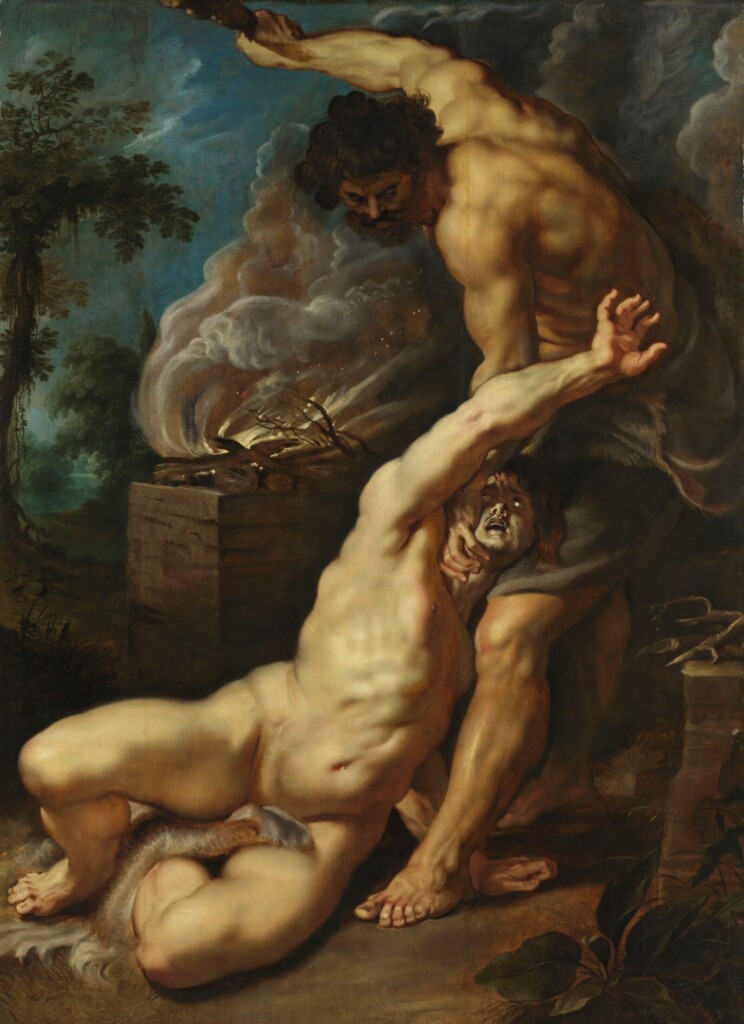
You have probably never questioned the assumption that the mark God placed on Cain was a sentence — a visible condemnation burned into the skin of a murderer so that the world would know what he had done. That reading is so old, so sediment-thick with repetition, that it passes for textual fact. But the Hebrew of Genesis 4:15 does not say that. It says God set a sign upon Cain so that no one finding him would strike him down. The mark is not a punishment. It is a shield.
This inversion is not trivial. For roughly two and a half millennia, Western moral imagination has recruited Cain’s mark as the founding emblem of criminal branding — the scarlet logic that says transgression must be made visible on the body of the transgressor. Medieval courts burned letters into foreheads. Colonial administrations tattooed convict numbers onto wrists. The United States Supreme Court upheld chain-gang uniforms as late as 1871, in Ruffin v. Commonwealth, on the explicit ground that a convicted man was “a slave of the state.” All of this reaches backward toward a biblical proof-text that, when you actually read it, argues the opposite of what it has been made to say.
What the text actually stages is stranger and more disturbing than a punishment. God drives Cain out, yes — but then immediately acts to preserve him. The exile is real. The protection is also real. Cain is simultaneously expelled from the community and placed under divine guarantee. He exists in a condition that is neither fully inside the social order nor simply outside it. He is banished and protected at once, which means the community requires his continued existence even as it cannot accommodate his presence. This is not a paradox the text resolves. It is the tension the text is built to hold.
Giorgio Agamben, writing in Homo Sacer in 1995, gave this structural position a precise name. Bare life — zoe as opposed to bios, biological existence stripped of political qualification — is the life that sovereign power produces by excluding it, and which it simultaneously needs in order to define the boundary of inclusion. The homo sacer of Roman law could be killed by anyone without it constituting murder, yet could not be sacrificed, could not be incorporated into ritual. He was outside the law and also held in place by it. Agamben’s point is that this figure is not a historical curiosity but the hidden foundation of sovereignty itself: the exception that constitutes the rule. Cain, seven verses into the first murder narrative in Western literature, is already occupying that exact position. He is the originary homo sacer — killable in theory, protected in practice, expelled from the city he will immediately go on to found.
That last detail deserves full weight. In Genesis 4:17, in the verse that follows the mark, Cain builds a city and names it after his son. The wandering exile becomes the first urban founder. The man driven from the soil becomes the architect of the structure that replaces soil as the ground of human life. Every city in the subsequent genealogy — the lineage of Jabal, Jubal, Tubal-Cain, the inventors of herding, music, and metallurgy — descends from the marked one. Civilization, by the internal logic of this text, is not built by the righteous. It is built by the outcast whose continued existence the community quietly required.
Modern states perform this same operation with considerable sophistication. They produce a class of people who are formally excluded — from voting rights, from housing, from legal personhood in various degrees — and then extract labor, data, biological material, and economic value from their exclusion. The prison-industrial complex in the United States generated over eleven billion dollars in revenue in 2019 from a population it had stripped of civic existence.
Fratricide and the Political Founding of Cities
You watch a man draw a boundary in the dirt, a line so thin it looks like an accident, and then you watch another man step over it and die for that crossing. The first man does not flee. He measures the perimeter of what he has just done and begins to build.
This is not a story about rage or jealousy gone too far. It is a story about what gets built on top of the act. In Genesis 4, Cain’s first recorded gesture after killing Abel is not remorse and not exile passively endured — it is construction. He goes to the land of Nod and founds a city, naming it Enoch after his son. The narrative offers this detail without irony, without commentary, as if it were the most natural sequence in the world: murder, then masonry. The text does not explain the connection because, at some level, it does not need to. The connection is the grammar.
Eight centuries and an entirely different civilization produce the same sentence. Romulus draws the sacred boundary of Rome, the pomerium, and his twin brother Remus jumps over it, mockingly or defiantly, depending on which version you inherit. Romulus kills him. The city rises. What the parallel reveals is not that these two stories influenced each other — the historical evidence for direct transmission is thin — but that both cultures were reaching for the same structural truth, encoding it in the only language that survives millennia: myth. The founder cannot found alongside someone else. The political space requires, at its origin, a singular authority, and singularity is purchased by elimination.
Hannah Arendt spent the better part of On Revolution, published in 1963, trying to understand why modern revolutions kept devouring their own architects, why the men who made the break could rarely survive the order they inaugurated. Her answer moved through Roman law, through the American constitutional moment, through the terror of 1793, but underneath all of it ran a deeper unease: that the act of founding is structurally violent not because founders are cruel men, but because the very gesture of establishing a new beginning requires the destruction of competing legitimacies. You cannot found a city with two voices claiming equal authority over its walls. One of them has to become the wall.
What makes this more than a political observation is what it demands of memory. The city of Enoch is named for a child, not for the act that enabled it. Rome’s founding myths cycle endlessly through Romulus as patriarch, as lawgiver, as the man raised by wolves — the killing of Remus appears in the tradition, but it sits awkwardly, reduced in some tellings to an accident, in others to justified punishment for sacrilege. The violence gets metabolized into procedure: Remus violated the sacred boundary, therefore the law was enforced, therefore this was not murder but order asserting itself. Cain’s city undergoes the same laundering across centuries of interpretation, becoming a symbol of secular ambition or urban pride, the fratricide receding behind the architecture.
This is where the mythological grammar becomes something more disturbing than political theory. Every city that has ever existed rests on a prior dispossession — of land, of people, of a competing claim to the same ground. The founding violence does not disappear into the past; it gets institutionalized, formalized, renamed as the legitimate use of force. The Roman legions that later march under standards bearing the she-wolf are marching inside a story that has already absorbed the murder and converted it into founding energy. The city walls are not built despite the blood spilled at the boundary — they are built because of it, with it, out of the peculiar cement that violence produces when it is immediately followed by naming.
The Wanderer as Threat to Sedentary Power
You are standing at a checkpoint somewhere between the river and the open steppe, and the guard is not looking at your face — he is looking for your papers, your address, your fixed coordinates in space. The question underneath his question is not who you are but where you can be found when the state needs to find you.
Cain’s punishment is not death. It is something the authors of Genesis understood to be worse: he is sentenced to move. “A fugitive and a wanderer shalt thou be in the earth” — and the text records his response not as relief but as despair. He does not mourn his exile from a place. He mourns his exile from legibility. Without a fixed location, he cannot be witnessed, cannot be accounted for, cannot be absorbed into the system of obligations that constitutes membership in a community. The mark placed upon him is not a brand of shame in the modern sense — it is a registration number. It says: even this man, even the cursed one, must be readable. Even the wanderer must carry the state’s notation on his body.
James C. Scott, writing in Against the Grain in 2017, made an argument that most political theorists had been too invested in progress narratives to make cleanly: that early agrarian states were not the natural culmination of human development but rather a specific and violent imposition, one that required the subjugation of populations who had survived for millennia outside grain-based sedentary structures. The archaeological record at sites like Abu Hureyra in Syria shows not a smooth transition from hunting and gathering to farming but evidence of repeated retreats — populations that tried settlement, abandoned it, returned to mobility, and were eventually trapped inside the walls of surplus and debt. Scott’s word for what states required of these populations is legibility: the capacity to be seen, measured, taxed, conscripted, and punished from a fixed administrative center. The nomad, the pastoralist, the seasonal migrant — these figures were not simply outside the state. They were its negative image, the proof of its incompleteness, and therefore its obsession.
What Genesis encodes, centuries before Scott had the vocabulary for it, is the political theology of that obsession. Cain the farmer does not become a wanderer because farming failed him. He becomes a wanderer because he committed the act that made him unassimilable — and the narrative logic insists that unassimilability and wandering are the same condition. Abel the shepherd was already moving, already ungoverned by the soil, already what the emerging agricultural order feared most. His elimination from the text is swift and total. Cain’s survival as a wanderer is the story’s way of saying: this is what remains when the state cannot fully absorb a body. A man-shaped problem that keeps moving.
The history of sedentary civilizations’ relationship to mobile populations is not a history of indifference or even straightforward hostility — it is a history of compulsive documentation. The Roman Empire classified its barbarian neighbors obsessively, producing ethnographies that were simultaneously descriptions and threat assessments. The Qing dynasty’s policies toward Mongol populations in the eighteenth century operated on the same logic: the mobile body was not dangerous because of what it did but because of what it resisted — the census, the cadastral survey, the poll tax, the draft. In the Ottoman Empire, the term for the process of forcibly settling nomadic tribes was iskan, and it was administered with the same bureaucratic energy as road-building and tax collection, because to the imperial mind these were equivalent projects. They were all methods of making the wandering body stop.
The mark of Cain, then, is not a punishment layered onto wandering — it is the fantasy that wandering can be made to carry the state’s signature even as it escapes the state’s grasp.
A vision curated by a filmmaker, not an algorithm
In this video I explain our vision
Blood, Soil, and the Invention of Guilt

You have stood in a courtroom, or watched someone else stand in one, and felt the peculiar weight of the floor beneath your feet — as though the room itself were listening, as though the walls had absorbed every lie ever told inside them and were now silently testifying. That sensation is not paranoia. It is the oldest juridical instinct in the Western imagination, and its first articulation appears in a single sentence from Genesis 4:10, where the divine voice does not say that witnesses saw the crime, or that evidence was found, but that the blood of Abel cries out from the ground.
The earth speaks. This is the structural revolution hidden inside that verse. Before any human tribunal, before any system of testimony or archive, the land itself is constituted as the primary witness to violence. The ground receives the blood, holds it, and then becomes a moral ledger that cannot be falsified. No Mesopotamian legal code contemporary with the Genesis tradition — not the Laws of Ur-Nammu around 2100 BCE, not the Code of Hammurabi around 1754 BCE — imagined the territory as a juridical subject. They imagined kings, priests, and gods as arbiters. Genesis does something categorically different: it grants the land a voice, and that voice is the voice of the murdered.
This is not merely theological decoration. When the land becomes a witness, land rights and guilt become inseparable. To own territory where blood was shed is to inherit the testimony of that territory. The Hebrew concept of tumah, ritual impurity, extended this logic explicitly: Numbers 35:33 states that blood defiles the land, and the land can only be purged by the blood of whoever shed it. The land does not forget. It keeps accounts. And this accounting system, embedded in Levitical law, became the invisible architecture beneath centuries of Western property theology — the idea that title to earth is never merely legal but always moral, always haunted by what the soil has absorbed.
Augustine of Hippo, writing his City of God between 413 and 426 CE, transmuted this soil-witness logic into the doctrine of collective inherited guilt. What begins in Genesis as the land crying out for one man’s blood becomes, in Augustine’s hands, the condition of the entire species. Original sin is precisely the inheritance of a crime one did not commit, recorded in the body the way blood is recorded in soil. The juridical metaphor migrated from geography into biology, from the earth beneath your feet into the flesh you were born wearing.
The consequences of that migration are not distant from you. Every legal tradition that speaks of a nation “stained” by its history, every argument about reparations that invokes the unpaid debt of the soil, every political theology that frames occupied land as “crying out” for its rightful inhabitants — these are not secular inventions. They are the Cain narrative operating at civilizational scale, with the earth still positioned as the moral ledger that human courts cannot override. When indigenous land rights movements in the twentieth century argued before international bodies that their territory retained the memory of dispossession, they were making a juridical claim whose deepest grammar was written in this text, regardless of whether anyone in the room had ever opened Genesis.
The disturbing precision of the metaphor is that it makes guilt structural rather than individual. Cain’s punishment is not imprisonment or execution but exile — he is expelled from the very ground that now testifies against him. The land itself becomes uninhabitable for the one who defiled it. And this is the logic that will later authorize, in ways the text cannot have anticipated, the expulsion of entire peoples on the grounds that the soil rejects them, that the land’s memory demands their removal.
The Absent Witness and the Architecture of Impunity
You are walking behind your brother on a road that does not yet have a name, in a world that does not yet have a second grave, and there is no one else alive to see what your hands are about to do. That absence is not incidental. It is the architecture of the act itself. The myth does not forget to include a witness — it deliberately constructs a scene from which the witness has been structurally evacuated, leaving two men in a field where the only eyes capable of registering the event as crime belong to the perpetrator.
Moral restraint, as a behavioral phenomenon, does not operate from the inside out. Stanley Milgram demonstrated this with uncomfortable precision in his 1963 obedience experiments at Yale, where ordinary participants delivered what they believed to be severe electric shocks to strangers simply because an authority figure in a lab coat remained present in the room. The lesson most people extract from Milgram is about obedience to authority, but the structural revelation runs deeper: what regulated the subjects’ behavior was not conscience operating in isolation but the presence of a watching figure, a social eye capable of registering and judging the act. Remove that eye, and the internal governor loses much of its traction. The field where Abel dies is a Milgram room with the experimenter gone and no voltage dial, just a jaw and a stone and a brother who stopped being a brother the moment he became invisible to everyone except God — and Cain, in this moment, appears to have decided that God does not count.
Philip Zimbardo spent decades after the 1971 Stanford Prison Experiment trying to articulate why ordinary young men became capable of systematic cruelty within seventy-two hours of being placed in a simulated prison. His 2007 synthesis in The Lucifer Effect shifted the explanatory weight away from personal disposition toward what he called situational evil — the thesis that context, role, and above all the removal of individuating observation can transform behavioral thresholds almost without the subject noticing. What Zimbardo found is not that people become monsters but that the situation quietly hands them permission slips they had no idea they were capable of accepting. The field in Genesis 4 is one of the oldest situational permission slips in the literary record: two sons, one inheritance dispute, no crowd, and a geography so empty it might as well have been designed by a theorist of impunity.
Closed systems generate their own forensic silence. This is not a metaphor but a structural reality visible across documented history — in the administration of colonial violence where European legal frameworks deliberately excluded indigenous testimony, in the internal disciplinary practices of institutions that processed their own wrongdoing without external review, in the family home where the walls have always been thicker than the law. The United Nations Office on Drugs and Crime noted in its 2023 Global Study on Homicide that intimate partner and family violence accounts for over half of all female homicide victims globally, a figure that consistently correlates with the degree to which the act occurs outside institutional visibility. The first murder in the Abrahamic textual tradition is a domestic killing, a family killing, a killing between two people who shared the same parents and the same origin story — and it happens in the one place no institutional gaze had yet been built to reach.
What makes the Cain narrative so disquieting is not the violence but the lucidity with which it maps the preconditions. The text does not moralize in advance. It does not warn Abel. It places the two men in the field with the kind of narrative neutrality that feels almost clinical, and then it lets the physics of unwitnessed space do the rest, as if the author understood something about human behavior that would not acquire a theoretical vocabulary for another three thousand years.
Genealogy of Killers as Genealogy of Civilization
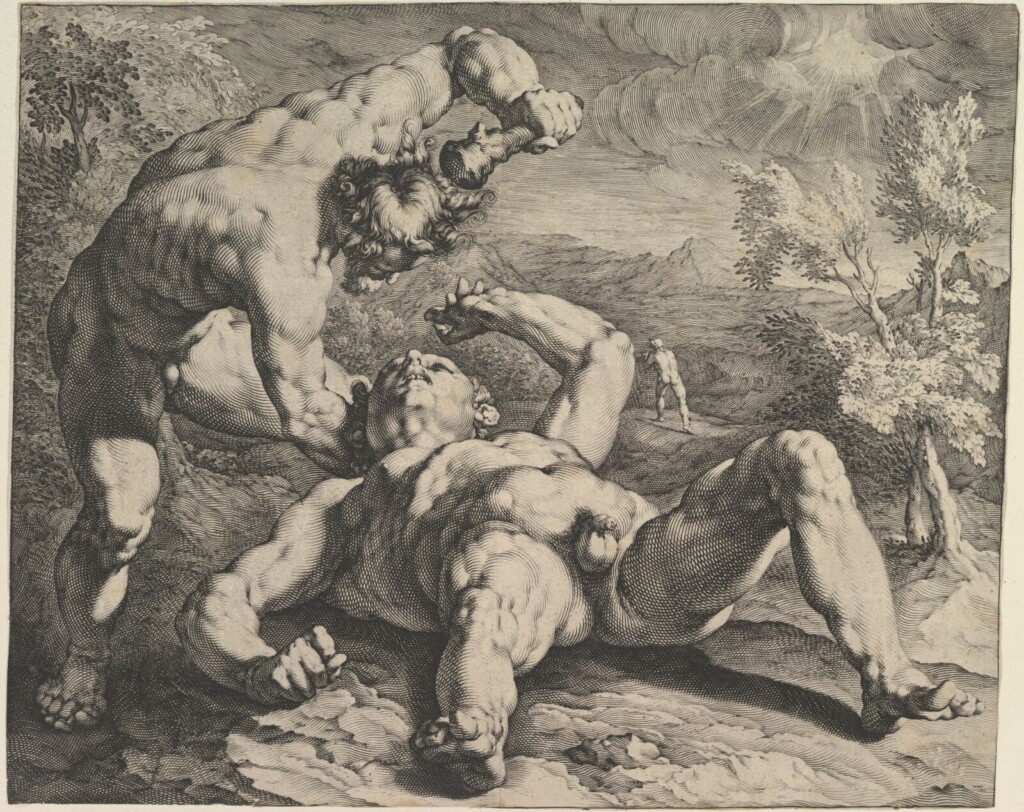
You already know the names, even if you have never read the chapter. They come down to you through a genealogy that Genesis 4 lays out with the cool precision of a legal document: Cain begets Enoch, Enoch begets Irad, Irad begets Mehujael, Mehujael begets Methushael, and Methushael begets Lamech. Five generations separate the first murderer from a man who takes two wives — the first recorded act of polygamy in Scripture — and then, standing before those wives Adah and Zillah, delivers a boast so naked it reads less like confession than manifesto: he has killed a young man for wounding him, and if Cain’s vengeance was sevenfold, his will be seventy-sevenfold. The escalation is written into the bloodline like a genetic marker. Violence does not dissipate across generations; it compounds interest.
What makes the genealogy genuinely strange is what surrounds that boast. Adah bears Jabal, who becomes the ancestor of those who dwell in tents and keep livestock — the pastoral economy, the foundation of settled wealth. His brother Jubal is named as the father of all who play the lyre and the pipe. Zillah bears Tubal-cain, who forges every cutting instrument of bronze and iron. In four verses, Genesis 4 attributes the origins of animal husbandry, music, and metallurgy to the direct descendants of the first killer. The text does not present this as irony. It presents it as genealogy, which is a far more disturbing rhetorical move, because genealogy implies inheritance, continuity, a logic of transmission that cannot be undone by moral disapproval.
René Girard spent the better part of his intellectual career, from Violence and the Sacred in 1972 through to Things Hidden Since the Foundation of the World, arguing that human culture is not something layered on top of violence but something secreted from it — the way an oyster produces a pearl around an irritant. The founding murder, in his account, is not the origin of a problem that civilization then solves; it is the mechanism by which the first social bonds are formed, the first distinctions drawn, the first prohibitions articulated. Genesis 4 does not contradict this reading. It illustrates it with an almost uncomfortable fidelity, because the very chapter that introduces homicide also introduces the technical and aesthetic achievements that most confidently announce human distinction from the animal.
Lewis Mumford argued in Technics and Civilization, published in 1934, that the history of tools cannot be separated from the history of organized killing, that the metallurgical tradition which gave humanity the plow also gave it the sword, and that the two applications were not accidents of misuse but constitutive twins from the very forging. Tubal-cain stands at exactly that junction, his name fused in later traditions with the forge and with the blade. The text does not choose between the two. It refuses the choice with what can only be read as deliberate silence.
Music is the detail that cuts deepest. Jubal’s lyre and pipe are not weapons. They are the instruments through which human beings have most consistently claimed access to something outside violence — grief, transcendence, communion. And yet Jubal shares a father with Tubal-cain and shares a grandfather with Lamech’s seventy-sevenfold revenge. The text plants them in the same family not to condemn music but to refuse the consolation that culture represents a departure from its own origins. Every civilization that has ever produced great art has done so within social structures built on coercion, conquest, and the monopoly of force. Genesis 4 knew this before there was a word for civilization, and it recorded the knowledge not as accusation but as genealogy — which is the oldest human way of saying that what came before you is already inside you, whether you have read the chapter or not.
🩸 Blood, Guilt, and the Roots of Human Violence
The myth of Cain and Abel is far more than a biblical episode — it is the founding narrative of envy, fraternal rivalry, and the first act of human violence. These articles explore the deep psychological, social, and philosophical roots of that primal crime, tracing its echoes across history, culture, and the human psyche.
The Psychology of Evil: Why People Commit Violent Acts
Why do ordinary human beings commit acts of devastating violence? This article explores the psychology of evil, examining how envy, exclusion, and the collapse of moral boundaries can transform a person into a perpetrator — a dynamic that mirrors Cain’s descent from resentment to murder. Understanding these mechanisms is essential to confronting the darkness that exists within every human community.
GO TO THE SELECTION: The Psychology of Evil: Why People Commit Violent Acts
Brotherhood and Family Conflicts
The story of Cain and Abel is, at its core, a story about brotherhood turned to ruin. This article examines how sibling relationships become arenas of rivalry, jealousy, and unresolved conflict, drawing on psychology and literature to illuminate why family bonds can be both the deepest source of love and the most fertile ground for violence. The fraternal wound is one of humanity’s oldest and most recurring tragedies.
GO TO THE SELECTION: Brotherhood and Family Conflicts
Vengeance as distorted justice: anatomy of a killer
When justice fails or is perceived as unequal — as Cain believed when God accepted Abel’s offering and not his own — vengeance emerges as a distorted substitute. This article dissects the anatomy of the killer driven by a sense of injustice, tracing the psychological path from wounded pride to violent act. The myth of Cain resonates powerfully here as the archetype of a murderer who believes himself wronged.
GO TO THE SELECTION: Vengeance as distorted justice: anatomy of a killer
The psychology of the scapegoat and mass hysteria
Cain’s curse and his transformation into a marked wanderer anticipate one of humanity’s most enduring social mechanisms: the designation of a scapegoat to bear collective guilt. This article explores the psychology of scapegoating and mass hysteria, showing how communities have always sought to project internal violence onto a single expelled figure. The mark of Cain is not only punishment — it is the first emblem of social exclusion.
GO TO THE SELECTION: The psychology of the scapegoat and mass hysteria
Discover the Cinema That Dares to Look at Human Darkness
If these themes stir something in you — that ancient tension between guilt, violence, and the search for meaning — then independent cinema is where you will find their most honest and uncompromising expression. On Indiecinema, you can explore a carefully curated selection of films that dare to confront the shadows of the human condition, far beyond the reach of mainstream storytelling.
👉 EXPLORE THE CATALOG: Watch Indie Films in Streaming
A vision curated by a filmmaker, not an algorithm
In this video I explain our vision

