
The Merchant Class as Unclaimed Territory
A father sits at the head of a table that cost more than the church tithe, calculating what his daughter is worth. Not her happiness, not her disposition, not even her beauty in any sense that a poet would recognize—her price, denominated in rubles, measured against the debts he owes and the debts owed to him, a ledger disguised as a family. Across Moscow in the 1840s, in the tangled streets south of the river where the merchant class had built its wooden houses and brick warehouses, this scene repeated itself with the monotony of ritual. Daughters were currency. Sons-in-law were acquisitions. Bankruptcy was staged, faked, negotiated like a theatrical performance in its own right, except no one thought to call it theatre, because no one thought this world deserved a stage at all.

That is the strange fact standing behind Alexander Ostrovsky’s emergence in Russian letters: an enormous swath of the population, economically dominant, culturally distinct, linguistically rich, simply did not exist in dramatic literature. The merchants of Zamoskvorechye—the district south of the Moscow River where Ostrovsky was born in 1823 and where his father worked as a legal official navigating exactly the kind of property disputes and inheritance schemes that defined merchant life—were invisible to Russian drama. Gogol had given the country grotesque bureaucrats. Pushkin had given it aristocrats wrestling with fate and honor. But the merchant, the kupets, with his beard, his abacus, his Old Believer piety wrapped around commercial ruthlessness, remained theatrically unclaimed territory, a population too vulgar for tragedy and too serious for farce.
Ostrovsky knew this world from the inside because he had worked inside its machinery. Before he wrote a single play, he spent years as a clerk in the Moscow Conscience Court and then the Commercial Court, institutions built precisely to adjudicate the disputes this class generated—fraudulent bankruptcies, disinherited children, contested dowries, family businesses torn apart by exactly the kind of patriarchal debt structures that made marriage indistinguishable from liquidation. He was not observing merchant life from a drawing room. He was reading their depositions, hearing their testimony, watching the state try to impose order on a domestic economy that ran on concealment.
In 1849 he took this material and turned it into “It’s a Family Affair—We’ll Settle It Ourselves,” a play about a merchant who fakes his own bankruptcy to cheat his creditors, only to be cheated in turn by the son-in-law he has maneuvered into the family to execute the scheme. There is no hero in it. There is no redemptive figure standing outside the corruption to comment on it. The rot is the entire architecture of the household, patriarchal authority weaponized as financial strategy, marriage reduced to a mechanism for asset protection. Nicholas I’s censors read it and understood immediately what Ostrovsky had done: he had not exaggerated this world for satirical effect, he had simply reported it, and the report was unbearable precisely because merchants across the empire recognized themselves in it. The play was banned from the stage for over a decade. Ostrovsky himself was placed under police surveillance, his position at the Commercial Court effectively terminated because a bureaucracy that depended on maintaining the fiction of merchant respectability could not employ the man who had just publicly dismantled it.
What makes this moment decisive is not merely the censorship, which was almost a predictable tax on honesty in Nicholas’s Russia, but the fact that an entire class of Russian life—commercially essential, numerically vast, previously unspoken for—had just acquired, for the first time, a mirror.
Language as Class Warfare
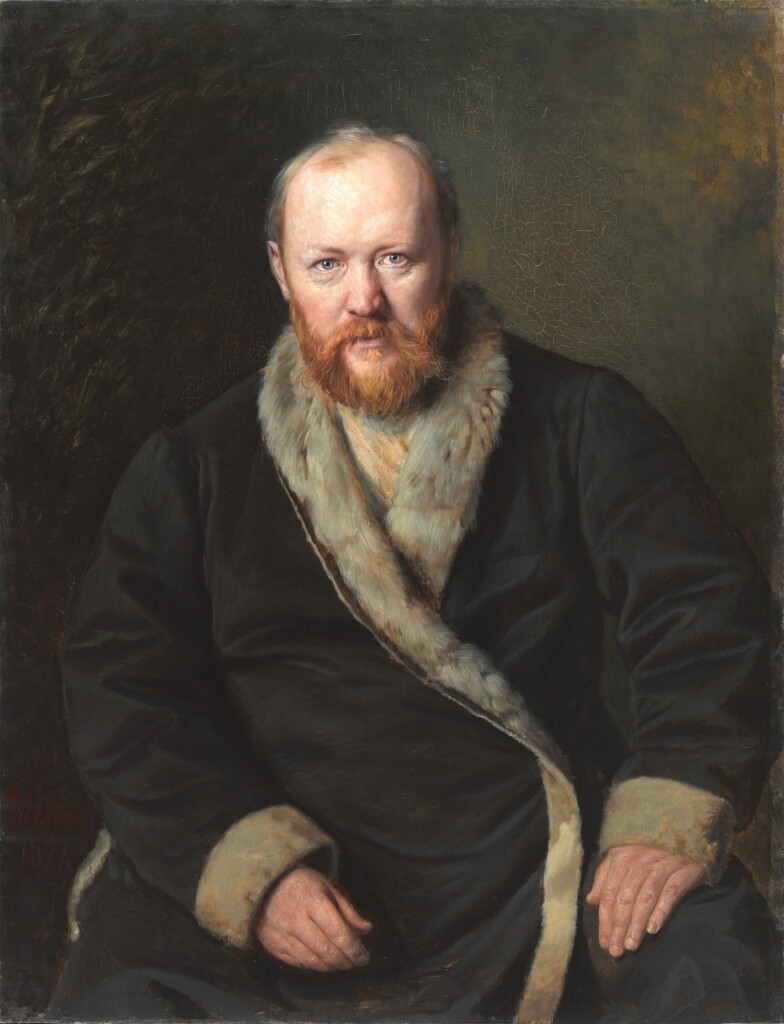
You open a play from the 1850s and the first thing you notice is the absence of something you expected: no marquis, no drawing room wit exchanged in half-French, none of the borrowed Voltairean cadence that had furnished Russian comedy since Fonvizin and Griboyedov made aristocratic banter into a national pastime. Instead you get a merchant’s wife haggling over a dowry with the syntax of the marketplace, proverbs dropped mid-argument like coins onto a counter, insults that only make sense if you have stood in a provincial bazaar in Zamoskvorechye and heard how money talks when it talks in Russian rather than in translation. This was not an aesthetic preference. It was an act of confiscation.
Russian theater before Ostrovsky had a mouth problem, or rather it had one mouth for everyone, and that mouth belonged to the nobility. The language of the stage descended from the salons of Petersburg, cross-bred with French neoclassical models, groomed until even the servants in a comedy spoke with the polish of their masters, because the assumption baked into the dramatic form itself was that legitimate speech, speech worth putting into verse or prose worth staging, originated in one class and trickled downward as imitation or parody. Ostrovsky’s merchants do not imitate anyone. They do not aspire to the drawing room’s cadence. They possess their own grammar of insult, their own liturgical patter of superstition, their own commercial poetry built from units of rubles and reputations, and the plays refuse to translate this into something more palatable for aristocratic ears.
Mikhail Bakhtin, writing decades later in his work on the novel, gave a name to what happens when a single text stops pretending that language is one uniform substance and instead admits that a nation is a chorus of dialects, professional jargons, generational slang, and class-bound intonations all pulling against each other inside the same sentence structure of a society. He called this heteroglossia, the many-languagedness that the novel, in his account, was uniquely built to absorb and dramatize, unlike the poetic genres that strained toward a single unified voice. Ostrovsky, working in a dramatic form that theory usually excludes from this privilege, did something structurally novelistic on stage: he let Zamoskvorechye speak in its own register without subtitles, without a narrator’s ironic distance smoothing it into anecdote, and without the reassuring presence of an educated character available to translate the provincial dialect into terms the parterre could digest.
This mattered because dramatic legitimacy in nineteenth-century Russia was never just about who got a plot. It was about who got a diction sophisticated enough to carry a plot’s moral weight. A servant could have lines, certainly, but usually lines calibrated for laughter, malapropism, comic relief that confirmed the audience’s sense of hierarchy rather than disturbing it. When Ostrovsky gave a merchant’s widow or a tyrannical patriarch the same density of idiom, the same command of proverb and rhetorical maneuver that Griboyedov had reserved for his wits and schemers, he was redistributing something more valuable than stage time. He was redistributing the right to be linguistically complex, to be capable of irony, self-deception, cruelty expressed with style rather than expressed as mere symptom of low birth.
The bureaucrats who reviewed his early plays for the censors sensed this and could not quite articulate why it unsettled them beyond citing coarseness, beyond complaining that merchant life had no business filling an entire evening at the Maly Theatre. But the discomfort was structural. A society organizes itself partly through who is allowed to sound intelligent in public, and Ostrovsky, play after play, at the Maly and eventually across some forty works for the stage, kept handing the microphone to people the literary establishment had trained audiences to hear as background noise.

The Thunderstorm and the Architecture of Female Entrapment
She stands at the edge of the Volga at dusk, and Marfa Kabanova’s voice is already inside her head before the old woman has even spoken, because that is what forty days of marriage into this household have done: installed a permanent internal tribunal that judges every gesture before it is made. You bow too shallow when your husband leaves for Kazan, you weep in the wrong key, you stand at the window a moment too long and the whole house already knows what it means. Katerina Kabanova does not live in a room, she lives inside a verdict that renews itself every morning at breakfast, delivered by a mother-in-law who has turned Orthodox ritual into an instrument of surveillance so total that even solitude has been confiscated. This is the second interior Ostrovsky builds for us, and it could not be more different from the counting rooms and dowry negotiations of the merchant fathers: here the trap is not made of ledgers but of liturgy, not of money but of the exact number of times a daughter-in-law must prostrate herself before an icon while being watched to see if the prostration was sincere enough.
What Ostrovsky stages in 1859, the year before serfdom’s abolition was already being drafted in committee rooms in Petersburg, is a psychology under siege, and he does it with a precision that owes nothing to melodrama’s usual shortcuts. Katerina is not a symbol waiting to be decoded. She remembers, in her own words to Varvara, a childhood of freedom so vivid it functions almost as a lost country, mornings spent among flowers and holy wanderers, a mother who let her rise when she wanted and pray when she wanted, and this memory is not nostalgia, it is evidence, entered into the play’s record, that the suffocation she now endures is not natural law but a specific arrangement enforced by specific people for specific reasons. The tyranny has a name, Kabanikha, and a mechanism, the daily humiliation ritual through which obedience is extracted and then declared to be love. When Tikhon, her husband, is ordered by his own mother to instruct his wife in submission before an audience, down to the exact words he must use, we are watching the reproduction machinery of the whole system laid bare, generation manufacturing generation, cruelty passed down as pedagogy.
Nikolai Dobrolyubov read the play within months of its premiere and produced an essay whose title alone reoriented Russian criticism for a generation, calling Katerina a ray of light in a kingdom of darkness, and the phrase did something dangerous to the play’s reception: it insisted that her final act, her drowning in the Volga, was not sin, not weakness, not the collapse of a woman incapable of managing her own passions, but the only form of protest available to a consciousness that had exhausted every other exit. Dobrolyubov, writing in Sovremennik in 1860, was not offering literary appreciation so much as a political reading disguised as one, arguing that the merchant world Ostrovsky depicted was a microcosm of autocratic Russia entire, and that Katerina’s suicide indicted not her own soul but the structure that left death as the single ungoverned space remaining to her. This claim provoked real argument, not academic footnotes but public controversy, because to call self-destruction an assertion of will rather than a moral failure was to hand ordinary readers, in a country where the church still classified suicide as mortal sin and denied consecrated burial to its victims, a framework for reinterpreting despair itself as a form of intelligence. Critics like Dmitry Pisarev pushed back hard, insisting Dobrolyubov had romanticized a woman whose actions were simply incoherent, neither principled resistance nor rational calculation, and the disagreement between these two critics became its own battlefield, one where the real question was whether Russian social conditions could be said to produce inevitable outcomes in individual lives, whether determinism excused or explained, whether a woman drowning herself in a provincial river could be read, correctly, as an argument against an entire civilization’s arrangement of power inside its own households.
Institution-Building Against Cultural Indifference

You picture a man in his fifties, hunched over correspondence rather than manuscript paper, writing not dialogue but petitions, drafting statutes, calculating percentages of box office receipts that should rightfully flow to the people who invented the words being spoken on stage. This is not the image anyone carries of Ostrovsky, and that omission is itself an accusation against how literary history gets told. We remember the merchants of the Zamoskvorechye district, the tyrannical patriarchs, the young women destroyed by provincial hypocrisy — but we forget that the man who wrote them spent nearly as much energy fighting the Imperial Theatres Directorate as he did filling notebooks with plays.
Before 1874, a Russian playwright existed in a condition barely distinguishable from indentured servitude. Theatres in Moscow and St. Petersburg were state monopolies, and the bureaucrats who ran them paid authors flat, arbitrary fees that bore no relationship to a play’s success, its number of performances, or the revenue it generated. A dramatist could write a piece that ran for years to full houses and receive, essentially, a one-time honorarium decided by clerks who owed him nothing and answered to no one. There was no mechanism for royalties in any modern sense, no copyright protections worth the name, no professional body to negotiate on a writer’s behalf. Ostrovsky himself, despite being by the 1870s the most performed living playwright in the country, watched theatre managers and provincial troupes stage his work without payment, without permission, sometimes without even crediting him correctly on the playbill.
So he did something almost without precedent among Russian men of letters: he organized. In 1874 he founded the Society of Russian Dramatic Writers and Opera Composers, an institution whose primary purpose was blunt and unglamorous — to secure payment for authors whose work was being performed, and to create a legal and administrative apparatus that made theft of intellectual labor harder to commit and easier to punish. This was not a literary salon. It was a lobbying body, a collection agency, a legal defense fund, all fused into one, run substantially by Ostrovsky himself for the rest of his life, through endless correspondence with provincial theatre directors who had never paid a kopeck in royalties and saw no reason to start.
The resistance he met was not ideological but bureaucratic, which is often harder to defeat because it does not argue, it simply delays. Ostrovsky spent decades writing memoranda to the Ministry of the Imperial Court, proposing reforms to how state theatres selected repertoire, trained actors, and compensated writers, and watched most of these proposals sit unanswered in some official’s drawer. He wanted a Russian national theatre school with genuine standards; he wanted juries of working writers, not court appointees, involved in deciding what got staged; he wanted the absurd censorship apparatus that had mutilated his own early plays reformed into something less arbitrary. Some of this he got, late, exhausted, only months before his death in 1886, when he was finally appointed head of the repertoire section of the Moscow Imperial Theatres — a position that let him implement in his last year what he had been demanding for nearly thirty.
What makes this a distinct kind of revolution is that it changed nothing about how a play sounds and everything about who gets to write one. Aesthetic innovation dies with its inventor unless somebody builds the scaffolding that lets the next generation inherit the ground gained. Chekhov, writing his first plays in the 1880s, benefited from a professional and legal environment that Ostrovsky had spent his career prying into existence — an environment where a playwright without noble patronage or independent wealth could plausibly survive on the proceeds of his own writing. That survival was not guaranteed by talent. It was guaranteed, to the degree it was guaranteed at all, by statutes, by a registered society, by the tedious machinery of royalty collection that nobody puts in a biography’s opening chapter because it does not photograph well against the drama of the plays themselves.
The Afterlife of a Repertoire No One Asked For
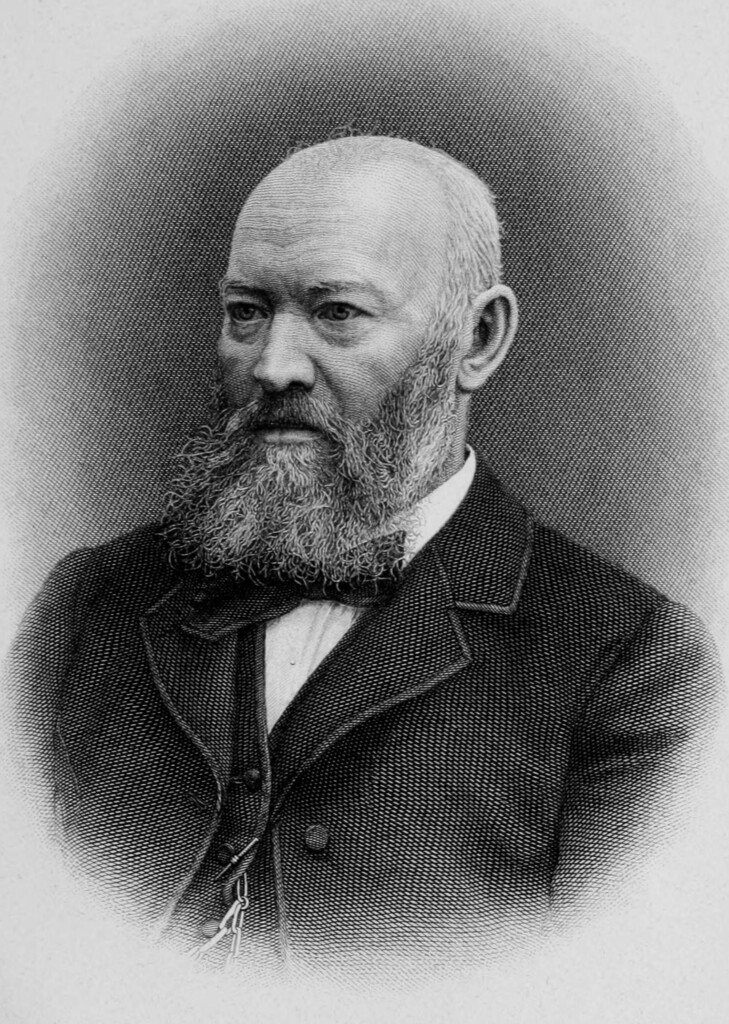
You can walk into the Maly Theatre in Moscow on any given week of the season and find a play by Alexander Ostrovsky on the bill, the way you might find Shakespeare at the Globe or Molière at the Comédie-Française, except that neither of those comparisons quite holds, because Shakespeare and Molière travel, they have been translated, mistranslated, adapted, stolen, and restaged from São Paulo to Tokyo, while Ostrovsky, who wrote something like fifty plays between 1847 and his death in 1886, who essentially built the physical and institutional infrastructure of Russian dramatic realism, remains almost entirely unperformed outside the borders of the language he wrote in. This is not a minor asymmetry. This is a rupture in the way literary reputation is supposed to work, where quality and canonical durability are assumed to correlate with international circulation, and Ostrovsky’s case suggests that assumption was always a convenient fiction.
Consider the mechanics of how a national dramatist becomes a world dramatist. It rarely happens through the sheer force of the text alone. Chekhov’s ascension into the global repertoire owed enormously to specific historical accidents: Konstantin Stanislavski staging The Seagull in 1898 at the newly founded Moscow Art Theatre, the subsequent codification of an acting method that traveled to New York through people like Richard Boleslavsky and Lee Strasberg in the 1920s and 1930s, and a generation of English-language translators and directors who found in Chekhov’s plotlessness something that resonated with modernist sensibilities already forming in the West. Ostrovsky offered no such vehicle. His plays are dense with merchant-class social specificity, with the particular linguistic textures of Zamoskvorechye traders, with a moral universe organized around domostroi patriarchal codes that require footnotes even for Russian audiences a century and a half later. The Storm, from 1859, depends for its devastation on a reader understanding exactly what it meant for Katerina to be trapped inside a merchant household’s suffocating hierarchy of mothers-in-law and husbands, a structure so historically particular that it resists the kind of universalizing gesture that let Chekhov’s provincial estates become legible as anywhere, as everywhere, as the general condition of thwarted longing.
There is also the matter of who does the exporting. Translation is never a neutral technical act; it is an act of selection performed by people with their own aesthetic commitments, and the modernist translators and impresarios who shaped the early twentieth-century Western reception of Russian literature were drawn to ambiguity, interiority, the unresolved. Ostrovsky’s plays resolve. They punish, they moralize, they end with a kind of social clarity that fit uneasily against the appetite for ambiguity that made Chekhov and, later, Dostoevsky’s psychological labyrinths so exportable. A dramatist who tells you clearly what a merchant’s greed costs his daughter is doing something Tolstoy also did, at great length, and Tolstoy survived translation because the novel as a form carries its own portable interiority, while a play needs a stage, a director, an audience physically present, and no diaspora of Ostrovsky specialists ever assembled abroad the way Chekhov specialists did around Stanislavski’s method.
So the plays stayed home, and stayed working. Nearly the entire Ostrovsky corpus remains in active rotation at the Maly, an institution sometimes still called “the House of Ostrovsky,” with a bronze statue of the playwright sitting outside its entrance since 1929, watching audiences enter to watch merchants swindle each other in plays written when serfdom had barely ended. This is not preservation in the sense of a museum; it is repertoire in the fullest sense, plays that still draw paying audiences on their own dramatic merit, without the crutch of historical curiosity. What this leaves unresolved is not a question about Ostrovsky’s talent, which the sustained domestic demand answers definitively, but a question about what the international canon actually measures when it claims to identify greatness. It has never been a scale of literary merit. It has always been a record of which nations got to build the export infrastructure first, and which writers happened to stand near the machinery when it started running.
A vision curated by a filmmaker, not an algorithm
In this video I explain our vision
🎭 Voices of the Russian Stage
Alexander Ostrovsky’s revolutionary dramaturgy did not emerge in a vacuum: it was part of a broader current of Russian and European cultural transformation that reshaped theatre, society, and art. These related articles explore the adjacent worlds of Russian creative revolution, social critique, and theatrical innovation that echo Ostrovsky’s legacy.
Russian constructivism: art, design and utopia
Russian constructivism shared with Ostrovsky’s theatre a deep ambition to reimagine art as a force for social transformation, breaking from academic convention to speak directly to a changing society. Both movements emerged from the turbulent energy of Russian cultural life, seeking new languages to represent modern experience. Exploring constructivism illuminates the broader artistic revolution that Ostrovsky’s realist drama helped set in motion.
GO TO THE SELECTION: Russian constructivism: art, design and utopia
Yakov Protazanov and the origins of Soviet science fiction
Yakov Protazanov‘s pioneering work in Soviet cinema represents another chapter in Russia’s restless artistic imagination, transposing bold narrative experimentation onto the emerging medium of film. Like Ostrovsky, he navigated the tensions between popular entertainment and artistic ambition within a rapidly transforming Russian cultural landscape. This connection highlights how Russian creative innovation moved fluidly between stage and screen across generations.
GO TO THE SELECTION: Yakov Protazanov and the origins of Soviet science fiction
Aleksandra Ekster and costume design as art
Aleksandra Ekster‘s revolutionary approach to costume design as an art form parallels Ostrovsky’s insistence on theatre as a serious vehicle for social and aesthetic expression. Her work bridged avant-garde visual art and the practical demands of the stage, much as Ostrovsky bridged literary ambition with the commercial realities of Russian theatre. Together they represent the multifaceted creative explosion that redefined Russian performing arts.
GO TO THE SELECTION: Aleksandra Ekster and costume design as art
Shakespearean Theatre: History and Scenic Language
Examining Shakespearean theatre alongside Ostrovsky’s work reveals fascinating parallels between two playwrights who each forged a national dramatic language rooted in their own culture’s speech, character, and social fabric. Both writers elevated vernacular life onto the stage, giving voice to merchants, nobles, and common people alike. This comparison illuminates the universal power of theatre to capture the soul of a nation.
GO TO THE SELECTION: Shakespearean Theatre: History and Scenic Language
🎬 Continue the Journey Through Independent Cinema
If Ostrovsky’s revolutionary spirit for the stage has sparked your curiosity, discover how independent filmmakers continue to challenge convention and reshape storytelling today. Dive into Indiecinema’s curated streaming library for bold, original cinema that dares to break the mold, just as Ostrovsky once did for Russian theatre.
👉 EXPLORE THE CATALOG: Watch Indie Films in Streaming
A vision curated by a filmmaker, not an algorithm
In this video I explain our vision

