
The Bare Stage as Philosophical Provocation
You are standing in a wooden O, and there is almost nothing to look at. The stage juts out into the yard where you stand pressed among hundreds of bodies, the smell of river mud and roasting chestnuts mixing with the sharper tang of unwashed wool. There are no curtains to part. There is no painted horizon to gaze toward, no clever machinery to lower gods from the heavens at a dramatically appointed moment. There is a bare platform, some trapdoors, a few pillars holding up a partial roof, and then — an actor walking forward, opening his mouth, and saying: we are in Denmark. And you believe him, not because he has shown you Denmark, but because he has made you build it.

This is the founding philosophical act of Elizabethan theatre, and it was not an accident born of poverty or technical limitation. The Globe, opened in 1599 on Bankside in Southwark with a capacity scholars now estimate at between two and three thousand spectators, was a deliberate architectural argument. Philip Henslowe’s diary and the builder Peter Street’s contract reveal a structure engineered with considerable sophistication — its thrust stage approximately forty-three feet wide, its tiring house facade presenting a permanent architectural backdrop of doors and upper gallery. The emptiness at the center was chosen. It could have been filled. It was not.
What fills it instead is a cognitive demand placed on every person in that yard, a demand so total it constitutes something close to a Kantian aesthetic category before Kant existed to name one. In the Critique of Judgment, published in 1790 — nearly two centuries after the Globe’s first season — Kant would argue that aesthetic experience is not passive reception but active synthesis, the mind completing and organizing sensory data into something coherent. The Elizabethan stage had already institutionalized this insight architecturally. The audience was not an audience in the modern sense, a darkened mass consuming images delivered to them. They were co-authors, their imagination explicitly recruited by the prologue of Henry V when the Chorus apologizes for the inability to fit the vasty fields of France into a wooden O, then immediately instructs the spectators to piece out the actors’ imperfections with their thoughts. This is not modesty. It is a theory of representation.
Somewhere in that theory lies a challenge to assumptions so embedded in contemporary entertainment culture that they have become invisible. The modern conviction that spectacle equals meaning — that the scale of a visual effect is proportional to the depth of the experience it produces — represents a complete inversion of what the bare stage understood about human attention. When everything is rendered for you, your imagination atrophies from disuse, and you receive images the way you receive weather: passively, as something happening to you rather than something you are making. The neuroscientist Stanislas Dehaene, in his 2009 work Reading in the Brain, demonstrated that language activates motor and sensory cortices in ways that direct visual presentation often does not — hearing a word for fire produces traces of heat and light in the brain that a photograph of fire can fail to generate. The Elizabethan stage had no neuroscience, but its dramaturgy operated on precisely this principle: language given to an active imagination produces more vivid interiors than any painted flat.
The social implications of this architecture were not incidental. A theatre where the image exists inside the spectator rather than in front of them is a theatre that cannot be entirely controlled by the people who built it. The groundling in the yard and the gentleman in the lord’s room were not watching the same play in any empirically verifiable sense — they were constructing different plays from the same verbal and gestural material, each mind furnishing the empty space according to its own history, its own hunger, its own idea of what a king looks like when he falls.
Bruto
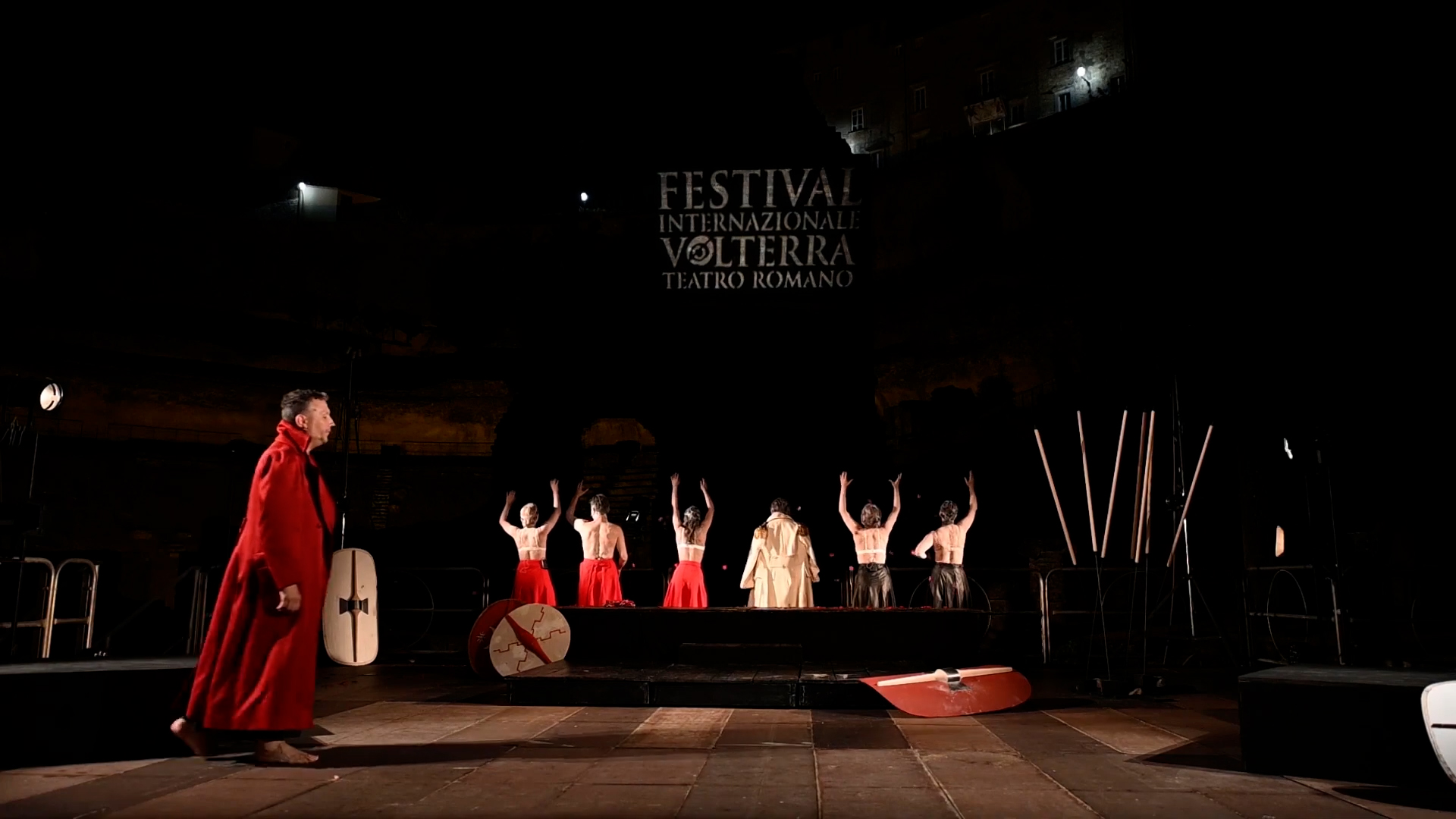
Theatrical show, by Nicola Fano e Simon Domenico Migliorini, Italy, 2022
The protagonist is Brutus, the celebrated instigator, along with Cassius, of the conspiracy of the Ides of March in 44 B.C., the assassin of Caesar. He enters the stage calling loudly for Cassius, his alter ego: we find ourselves in Philippi, where both conspirators have already fought and lost against the troops of Marcus Antonius, who has become the guarantor of justice towards Caesar and Rome. The story written in books materializes on stage with the words of Shakespeare, infinite, immortal, eternal words. The spectator listens, a symbolic battlefield and dead bodies appear before him, on which Brutus, defeated, wounded, almost dying, crawls and invokes and looks around bewildered, shocked at the appearance of the ghost of Caesar.
Brutus is Simone Migliorini, who speaks, moans, shouts, modulates those phrases of Shakespearean tragedy and makes them his own, as they have been generated, also in the adaptation from Shakespeare's "Julius Caesar" by the playwright Nicola Fano, who worked on the text focusing on the most controversial figure, that of the leader of the conspirators, the assassin of Caesar, specifically for Migliorini, who has studied and deepened the text and characters. But here Brutus, as the show unfolds, also becomes Macbeth, also Henry V, both tyrants, both assassins, soldiers, courageous or cowardly, great or infamous, in a flow of words and famous phrases, spoken, planted, recited, whispered, shouted by Simone Migliorini who with this performance confirms himself as a high-level interpreter. What strikes is the protagonist's ability to transform himself, from time to time, from Brutus into other characters, even into Marcus Antonius. A change of costume is enough for him, on stage. And it is here that Brutus looks into Antony's eyes and Antony scrutinizes Brutus, doubled by the same actor in a virtuosity that is extremely congenial to him. The actor is capable of being, at the same time, the one who kills and the one who exalts the killed; the one who is prey to doubts and remorse but is proud of his love for Rome and its freedom, and the one who exalts and celebrates the slain Caesar before the people, holding his will in his hand, in the famous Oration that has always been the flagship of the greatest actors.
LANGUAGE: Italian
SUBTITLES: English, Spanish, French, German, Portuguese
The Globe's Architecture as Social Anatomy
You are standing in the yard, which means you paid a penny, which means you are nobody in particular — a tradesman, an apprentice, a fishwife who left the stall early, a young man from the provinces who has never seen anything like this and probably never will again. The ground beneath you is packed earth and hazelnut shells, the debris of ten thousand previous afternoons, and you are pressed against strangers on all sides, your neck craned upward, the open sky above you doing nothing to keep out the smell of bodies or the occasional rain. You are, in the language of the time, a groundling, and that word was not affectionate.
The Globe Theatre, raised in Southwark in 1599 from the salvaged timbers of an earlier playhouse, was a machine for organizing human beings before it was ever a machine for entertaining them. Its circular or polygonal frame — scholars still debate the precise geometry, though the 1989 excavation of the original foundations suggested a twenty-sided polygon approximately one hundred feet in diameter — encoded the entire social hierarchy of Elizabethan England into three tiers of galleries plus a standing yard. The penny admission bought the yard. Two pennies bought a seat in the lower gallery. Three pennies bought a cushion and an elevated view, and the lords’ rooms flanking the stage itself cost considerably more, positioning their occupants not where they could best see the play but where the play could best see them. This was not incidental. It was the design.
What the architectural historian Glynne Wickham argued in his three-volume Early English Stages, completed in 1981, is that the Elizabethan stage inherited a vertical cosmology from the medieval mystery cycles: heaven above, earth in the middle, hell below. At the Globe, the canopy over the stage was painted with stars and called the heavens; the trapdoor through which ghosts emerged from beneath the boards was called the hell. The audience did not sit outside this cosmology — they were inserted into it. The gentry in the upper galleries occupied, symbolically, the same register as celestial authority. The groundlings who could not afford to sit were spatially aligned with the underworld they were told, from pulpit and statute both, they morally risked. The building was not illustrating a theology; it was making it feel like physics.
And yet the groundlings were closest to the actors. The thrust stage projected directly into the yard, which meant that when an actor knelt to die, or whispered a confession to the audience, or pointed a sword outward into the crowd, he was pointing at the nobody standing in the mud. The high-paying galleries were farther from the action, screened slightly by posts, watching from a distance that was comfortable and removed. Power in Renaissance England understood its image better from a distance. The body — the sweating, laughing, gasping body — was a problem that proximity made worse, and the Globe’s geometry forced the well-dressed to experience that problem every time they paid for elevation.
This is where the social anatomy becomes genuinely strange. The theatre created a zone that did not exist elsewhere in London, a licensed suspension in which a boy could play a queen and a commoner could watch a king unmade. Michel Foucault‘s concept of heterotopia, developed in his 1967 lecture “Des espaces autres,” names spaces that exist within the social order but operate by an inverted or suspended version of its rules — mirrors, prisons, ships, and yes, theatres, which he included explicitly. The Globe was heterotopic not because it pretended class did not exist but because it arranged class spatially while simultaneously performing its own undoing. The earl in the lords’ room paid to be seen watching. The fishwife in the yard paid to watch without being seen at all, and sometimes what she watched was a king who had nothing left, stripped of everything the architecture above her still promised.

Language as the Only Scenography

You are standing in a theater with no ceiling, midday sun hammering the stage, and the actor opens his mouth and says it is midnight, bitterly cold, and not a mouse stirring. You believe him. Not because the lighting rig has shifted to blue gel, not because a fog machine has exhaled across the boards, but because the language itself has done something to your nervous system that no visual cue could replicate with the same precision or speed. This is not a metaphor for imaginative generosity. It is the structural reality of how Elizabethan theatrical meaning was constructed and delivered.
The Globe Theatre, completed in 1599 on Bankside in Southwark, was an open-air amphitheater seating approximately three thousand spectators across its three galleries and standing yard. Performances began at two in the afternoon. There was no artificial lighting, no painted backdrop, no darkened house to signal a shift in mood or location. What the stage possessed instead was language at a pitch of scenic density that modern drama has almost entirely abandoned. When Francisco and Bernardo speak in the opening of Hamlet, the cold is not a stage direction. It is an argument made inside the dialogue, repeated, confirmed by Horatio’s own shivering acknowledgment, architecturally embedded in the verse itself so that the audience’s body responds to words the way it would respond to actual temperature.
The scholar Andrew Gurr, in his meticulous 1970 study of the Shakespearean stage, documented how playwrights of the period were required by the physical conditions of their theaters to develop what he called verbal scene-painting — a technique by which dialogue bore the full burden of communicating time, weather, architectural setting, and emotional atmosphere simultaneously. This was not compensation for poverty. The plays that emerged from this constraint are among the most spatially precise texts in the Western canon. When Prospero describes the island in The Tempest, when Iago constructs Othello’s jealousy through the accumulation of verbal images rather than visible evidence, the language is doing something that a set designer cannot do: it is operating directly inside the listener’s cognitive and sensory processing, bypassing the mediating distance of spectacle.
What this reveals about the present requires a certain discomfort to state clearly. Contemporary theatrical and cinematic culture has inverted the hierarchy entirely, treating the image as primary evidence and the word as caption. The neuroscientist Antonio Damasio, in Descartes’ Error published in 1994, demonstrated that emotional response and rational cognition are not separable systems — they are entangled processes rooted in the body’s somatic signals. Language, because it forces the listener to internally construct the image, activates this entanglement more completely than a delivered image, which the passive visual cortex can process without the same cognitive and emotional participation. Shakespeare’s audiences were not less sophisticated than ours. They were more activated.
The danger is not that cinema or digital spectacle exists. The danger is the epistemological habit that spectacle trains in its consumers: the belief that what has not been shown has not been proven. Political life now runs entirely on this assumption. Testimony without footage is routinely discounted. Suffering that produces no image is institutionally invisible. The capacity to receive and trust a verbal account — to let language build the room you are standing in — has atrophied so precisely in proportion to the rise of visual media that the correlation is difficult to dismiss as coincidence. When you cannot believe in midnight without a lighting cue, you have lost something that is not merely aesthetic.
A culture that requires spectacle to confirm reality has also made itself extraordinarily easy to manage, because spectacle is the one dimension of communication that power has always been able to control most completely, and the one dimension that language, at its most exact and most demanding, has historically been able to resist.
The Boy Actor and the Fiction of Identity
You are watching a boy speak in a woman’s voice, and something in your chest tightens — not with discomfort exactly, but with the unsettling recognition that you cannot locate the seam between artifice and truth.
This was the ordinary condition of the Elizabethan playgoer. Between roughly 1576 and 1642, the span covering the construction of The Theatre in Shoreditch to the Puritan closure of the playhouses, every female character on the English public stage was played by a boy or young man. Cleopatra’s impossible grandeur, Desdemona’s terrible innocence, Lady Macbeth’s cold ferocity — all of it filtered through voices that had not yet broken, through bodies still narrow at the hip, through faces that had never grown a beard. The historians who document this, from Andrew Gurr in The Shakespearean Stage to Stephen Orgel in Impersonations, tend to frame it as a pragmatic constraint of the era, a cultural norm inherited from classical and medieval performance traditions. And it was. But pragmatic constraints, when they persist long enough and are executed with sufficient skill, stop being limitations and start being epistemological events.
What the boy actor produced, night after night in the yard of the Globe, was a living argument against the idea that gender is something a body carries inside it like a bone or an organ. Every inflection learned, every gesture rehearsed, every sob or laugh calibrated to an audience’s expectation of femininity was a demonstration that these things are acquired, not innate. Judith Butler’s argument in Gender Trouble, published in 1990, is that gender is not an expression of some prior inner truth but a performance consolidated through repetition — a set of acts that create the illusion of a stable interior self. She drew on J.L. Austin’s speech act theory and the work of Michel Foucault to build this case with philosophical rigour. The Elizabethan stage had been running the experiment without the theory for nearly four centuries.
The particular cruelty of Shakespeare’s deployment of this condition is that he refused to let it be invisible. In As You Like It, Rosalind — played by a boy — disguises herself as a boy named Ganymede, then agrees to roleplay as Rosalind for the lovesick Orlando. The audience watches a boy play a woman playing a boy playing a woman, and at no point does the structure collapse into absurdity. It holds, because every layer feels equally real, which means every layer is equally constructed. The play does not resolve this vertigo. It accelerates it. When Rosalind steps forward in the epilogue and says “If I were a woman,” the pronoun has become genuinely unstable — not as a punchline but as a philosophical rupture in the middle of a comedy.
The economic and social machinery around the boy actors reveals something equally unsettling about how cultures manage the things they cannot quite name. These boys were apprentices, bound to adult players in the professional companies, trained from early adolescence in movement, voice, and emotional mimicry. Their femininity was a skilled trade, taught systematically, assessed commercially. The femininity of the women they portrayed — those fictional Juliets and Cordelias and Portias — was therefore something learned, not discovered. And yet the culture that employed these boys simultaneously insisted, in its legal codes, its medical texts, its theological frameworks, that femininity was a natural state belonging to a body of a particular kind. The stage quietly demolished that insistence every afternoon at two o’clock for an audience of several thousand people, most of whom never noticed the demolition because they were too busy weeping at Juliet’s death to examine what Juliet actually was.
The question this leaves open — and that no amount of historical documentation fully closes — is whether the playgoers who wept did not notice, or whether they noticed and chose the weeping anyway, knowing the whole architecture was constructed, and finding that it did not matter at all.
Patronage, Censorship, and the Art of Survival
You are sitting in a theatre in 1597, watching a history play about a king who is weak, indecisive, and surrounded by flatterers who drain the kingdom of its vitality. You understand perfectly well that the king is not medieval. Everyone in the room understands this. The playwright understands that everyone understands this. And yet nothing will be said aloud, because the moment it is said aloud, the mechanism of collective pretense collapses, and the play becomes a pamphlet, and the pamphlet becomes a trial.
The office of the Master of the Revels was established formally under Henry VIII and consolidated into a licensing tyranny by Edmund Tilney, who held the post from 1579 to 1610. Tilney did not merely approve or reject scripts — he read them line by line, crossed out passages with a physical pen, and demanded revisions before any company could legally perform. The surviving manuscript of Sir Thomas More, in which Shakespeare likely contributed several pages, bears Tilney’s marginal notation ordering the deletion of all scenes depicting popular insurrection. The note is not a suggestion. It is a condition of existence. What remained after the censor’s pen was not a diminished play but a trained intelligence that had learned to speak through texture rather than statement, through the weight of a pause or the ambivalence of a metaphor that could mean two irreconcilable things simultaneously.
Aristocratic patronage compounded this constraint with a different kind of pressure, one that was less violent and therefore more insidious. The Lord Chamberlain’s Men, reorganized as the King’s Men in 1603 when James I assumed direct patronage, were no longer artists in the modern romantic sense — autonomous individuals expressing private vision. They were household servants with a legal fiction attached to them. Their livery connected them to power, which meant their survival depended on not embarrassing the body that owned their name. When the Essex faction paid the Lord Chamberlain’s Men forty shillings in February 1601 to revive Richard II — including its deposition scene, which had been suppressed in print — the company suddenly found itself entangled in a failed coup. Shakespeare’s colleagues were interrogated. The company survived only by demonstrating that they had been used, not recruited. The distinction between art and instrument had never been thinner.
What this produced, over decades of navigating these twin pressures, was not a debased theatre but one of extraordinary obliquity. The court masque celebrated power directly and therefore said nothing true about it. The commercial playhouse, precisely because it could not speak directly, developed a grammar of displacement: tyranny examined through Roman history, sexual politics addressed through Illyrian comedy, theological crisis encoded in the hesitation of a Danish prince. Michel Foucault argued in Discipline and Punish that power produces rather than merely represses — and the censorship apparatus of Elizabethan England produced, among other things, the conditional sentence, the dramatic irony that allows a character to mean more than they say, and the double plot that runs a low comic register beneath a tragic one so that the audience can receive disturbing political content through the safer channel of laughter.
Modern readers encounter this language and assume they are in the presence of ornament, of Elizabethan verbal excess, of a culture that simply enjoyed elaborate metaphor the way later centuries enjoyed wallpaper. What they are actually reading is the residue of a survival strategy so successful that it outlasted the conditions that produced it. The indirection became beautiful. The evasion became art. And the fact that we no longer feel the danger that generated the language is itself a kind of historical forgetting — a comfortable amnesia that lets us sit with the text as though it were written for us, in our safety, from a position of freedom that its author never once possessed.
A vision curated by a filmmaker, not an algorithm
In this video I explain our vision
The Repertory System and the Myth of the Singular Masterpiece

You go to see Hamlet and you leave believing you have witnessed something eternal, a text that arrived whole and luminous from a singular mind, untouched by the grinding machinery of commerce or the sweaty panic of a Tuesday afternoon rehearsal. That belief is one of the more elegant lies the cultural institution has ever produced.
The Lord Chamberlain’s Men — the company Shakespeare wrote for and part-owned — performed a rotating repertory of roughly thirty different plays per season, cycling through as many as six distinct titles in a single week. There was no extended run, no settling into a production’s rhythms over months of repetition. A play might be staged once, then shelved, then revived weeks later with different actors filling gaps left by illness or defection. Philip Henslowe’s diary, a meticulous account ledger kept between 1592 and 1603, records the Admiral’s Men performing twenty-three different plays in the first month alone of one season. What that number describes is not artistry operating in contemplative isolation — it is a logistics problem, managed under financial pressure, with the Rose Theatre’s weekly receipts depending on the company’s ability to keep the programme perpetually fresh.
Within that system, texts were not sacred objects. They were working scripts, subject to continuous alteration by playwrights hired to add scenes, by actors who knew what the groundlings wanted, by the company’s sharers who had commercial stakes in what landed. The concept of a definitive authorial version barely existed as a category of thought. When Richard II was printed in 1597, the deposition scene — where the king formally surrenders his crown — was omitted entirely, almost certainly for political reasons, and appeared in print only after Elizabeth I’s death in 1603. The play had already existed in multiple forms before any editor ever touched it. The text was permeable by design, responsive to the specific pressures of its moment: legal, commercial, theological.
The singular masterpiece as a category was largely invented by the editors who came after. Nicholas Rowe‘s 1709 edition of Shakespeare’s works — the first serious attempt at a collected, annotated edition — introduced act and scene divisions, regularized spelling, and supplied stage directions that appear nowhere in the original quartos or the First Folio of 1623. Rowe was working from the assumption that these were literary monuments requiring scholarly stabilization, applying the editorial logic of classical texts to documents that had never been conceived in that spirit. By the time Samuel Johnson produced his edition in 1765 and argued in the preface that Shakespeare’s plays had already withstood the test of time — Johnson’s specific phrase was that they had “passed through variations of taste and changes of manners” — the transformation was complete: a commercial playwright working in a brutally competitive weekly repertory had been retroactively elevated into a figure outside of time.
What gets erased in that elevation is the collaborative and contingent nature of theatrical meaning-making. The Elizabethan audience member who watched a play on Wednesday had likely seen something from the same company on Monday and would see something else on Friday. Individual plays accrued meaning in relation to each other, in dialogue with the repertory as a whole, in tension with the shared vocabulary of character types, dramatic conventions, and physical space that the audience carried with them. Meaning was relational and cumulative, not sealed inside a single text. The isolation of Hamlet or King Lear as self-contained monuments of Western literature required stripping away precisely that web of contingent relations — the company’s financial pressures, the competing plays of that week, the specific actor whose particular vocal habit shaped a role’s reception in ways no printed text can recover.
What remains after that stripping is not the play as it existed but a ghost of it, cleaned and stabilized for an institution that needed timeless objects to justify its own authority.
Plague, Closure, and the Fragility Underneath the Canon
You have probably never thought of the plays you studied in school as emergency documents. The sonnets Shakespeare wrote during the 1593–1594 closure were not composed in a comfortable study between rehearsals — they were written because the theatres were physically locked by civic order, the players scattered, the income gone, and the plague was killing between ten and fifteen thousand Londoners in a single outbreak. The literary form that looks most private and introspective in the entire Shakespearean corpus emerged not from solitude chosen but from catastrophe imposed.
The Privy Council’s authority to close all London playhouses whenever plague deaths in any single week exceeded a threshold — thirty, then later forty per parish — meant that theatrical production existed permanently inside a conditional clause. Between 1593 and 1594, the closure lasted nearly two years. The Globe’s greatest period of output, roughly 1599 to 1603, was itself bracketed by shutdowns. Then in 1603, the year James I took the throne and the Lord Chamberlain’s Men became the King’s Men by royal patent, a new plague wave closed the theatres for another extended stretch reaching well into 1604. By 1608, when the company acquired the indoor Blackfriars Theatre as a winter venue, another epidemic forced closures that scholars estimate lasted nearly eighteen months. The arithmetic is brutal: in the two decades that produced the entire tragic canon, the theatres may have been shuttered for roughly a third of that time.
What this did to the surviving texts is something literary scholarship spent much of the twentieth century avoiding, because the implications corrode the mythology of the singular genius working in uninterrupted creative flow. The quartos that circulated during plague closures were sometimes unauthorized — pirated from memory by actors, assembled from fragments, sold to printers by companies desperate for income while the stages were dark. The 1603 quarto of Hamlet, the so-called “bad quarto,” is almost certainly one of these reconstructions, and it contains passages so garbled and compressed that the text reads like a dream of the play rather than the play itself. What the canon actually preserves is a negotiation between theatrical intention and material survival, not a transparent window onto a single authorial mind.
Philip Henslowe’s diary, that indispensable ledger of Elizabethan theatrical commerce spanning roughly 1592 to 1609, records payment after payment halted, loan after loan extended to players who had no performances from which to repay them. The Rose Theatre’s accounts go silent during the closures with an abruptness that carries more pathos than any elegy. Henslowe was not a poet — he was a financier and impresario who thought in pounds and shillings — and yet his ledger narrates the fragility of the entire enterprise more honestly than any contemporary reflection on the theatre’s cultural importance.
The companies that survived did so partly by touring. When London closed, the players moved — to the provinces, to noble households, to university towns. This meant that Hamlet may have been performed in a great hall in the Midlands before it reached the Globe, that plays we associate entirely with the architecture of the amphitheatre were also played in rooms with candlelight and intimate proximity, that the texts flexed and contracted depending on the space and audience. The stage directions in several quartos carry traces of these adaptations: reduced casts, collapsed roles, simplified prop requirements that point toward performance conditions nothing like the open-air theatres around which the entire romantic mythology of Elizabethan drama was constructed in the nineteenth century.
The Romantics needed Shakespeare to be timeless precisely because they could not afford to see how time-bound and accident-shaped he was. Coleridge’s 1811 lectures, Keats’s marginalia, Hazlitt’s essays on the characters — all of them built a Shakespeare who transcended circumstance, which is another way of saying they built a Shakespeare who could not be threatened by circumstances like theirs.
The Revenge of the Unspectacular
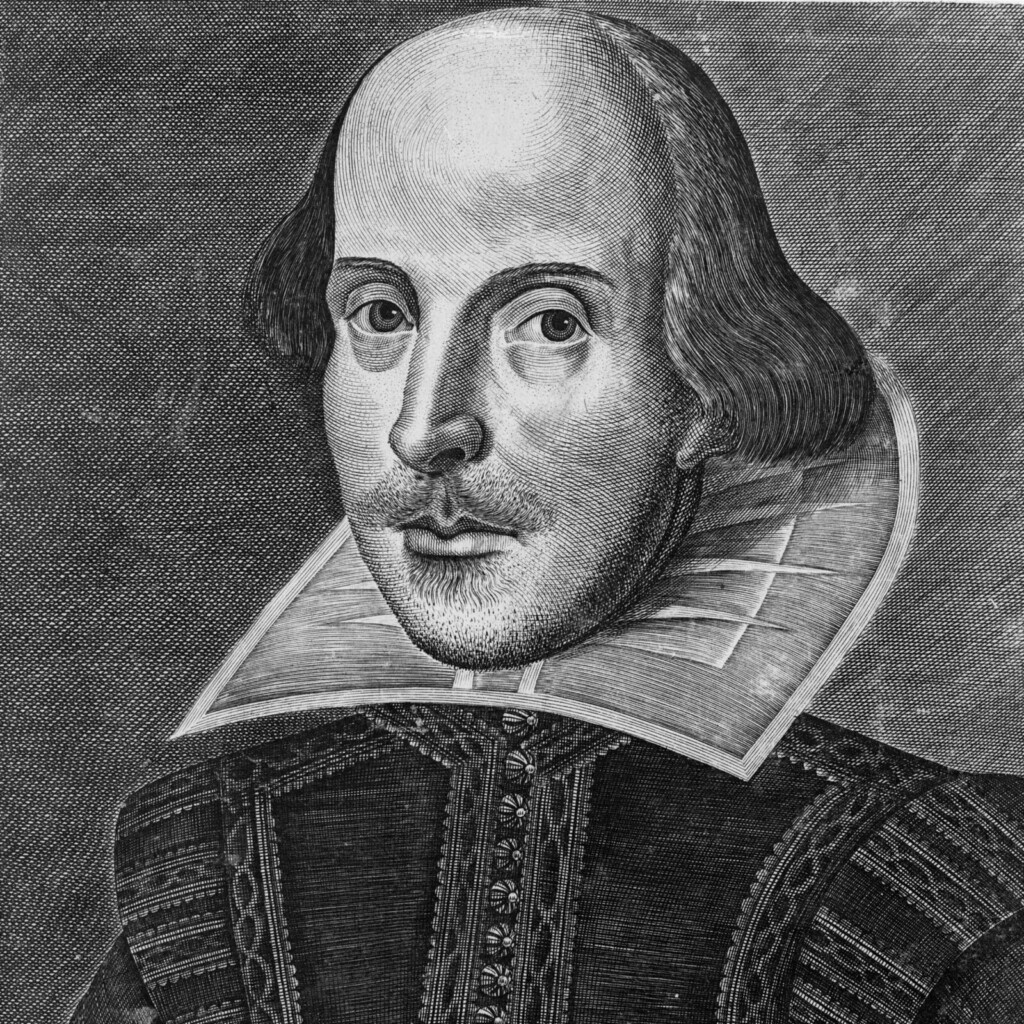
You are sitting in a theatre that cost forty million dollars to build, watching a play that was first performed in a yard for a penny, and the play is winning.
There is something quietly devastating in that fact, something the industry of contemporary performance has never fully metabolized. The Globe Theatre of 1599 had no electrical lighting, no amplification, no fly system, no revolve, no projection surface. Its stage was a raised platform of bare oak. Its actors wore their own clothes augmented by rented costumes. Its special effects amounted to a trapdoor, a cannon loaded with smoldering rags, and the human voice thrown raw into open air. From those conditions emerged a body of work performed today in over a hundred and eighty languages, staged in every cultural context from Japanese noh adaptation to South African township drama, from Buenos Aires to Seoul, without apparent diminishment or exhaustion. The tools did not scale. The work did. That asymmetry should provoke more discomfort than it does.
The historian Erica Ostwald noted in her work on early modern theatrical economics that the Elizabethan playhouse operated on a margin so thin that innovation was structurally impossible. There was no budget for experimentation in the technological sense. What remained was language as the only available instrument of escalation, and so language was pushed into territory it had never occupied before — carrying weather, carrying interiority, carrying the texture of night and the weight of ambivalence simultaneously within a single speech. The poverty was not a limitation that genius overcame. The poverty was the condition that made the particular genius necessary.
This is where the cultural mythology of progress becomes something closer to a swindle. The dominant narrative of artistic development follows the same logic as industrial development: accumulation of tools, refinement of methods, expansion of available means. Museums are built around this narrative. Curricula are structured by it. Funding bodies reward it. The underlying assumption is that more capacity produces more meaning, that a stage with greater technical possibility is a stage with greater expressive range. What the Shakespearean inheritance quietly disproves, across four centuries of empirical evidence, is that meaning does not scale with apparatus. It scales with necessity.
The sociologist Richard Sennett argued in The Craftsman, published in 2008, that resistance in materials — the friction between the maker and the intractable properties of what they work with — is not an obstacle to craft but the source of its intelligence. A material that yields to every intention teaches nothing. The actor who cannot vanish into a lighting state, who cannot be rescued by a soundscape, who stands in full afternoon daylight before two thousand people with nothing but syllables, is working against maximum resistance. That resistance does not diminish the art. It is the art’s structural skeleton.
What contemporary theatrical culture finds difficult to accept is that stripping away is not primitivism — it is a different and equally demanding sophistication. The director Peter Brook spent decades in pursuit of what he called the empty space, a concept he introduced in 1968, but what his work actually demonstrated is that emptiness is not absence. It is a form of pressure. When there is nothing to look at except a human being speaking, the speaking becomes unbearably precise. Every hesitation costs something. Every word arrives with the weight of the silence it displaced.
The four-hundred-year persistence of this theatrical language across radically incompatible cultures, economies, and political systems suggests something that the innovation industry cannot comfortably accommodate: that the works survived not despite their original constraints but because those constraints forced the language to become load-bearing in ways that no technology can replicate or replace, and that every generation that encounters them discovers, without being told, that the scarcity was always the point.
🎭 Stages, Masks, and the Craft of the Scene
Shakespearean theatre did not emerge in isolation: it grew from a deep tradition of performance, language, and spectacle that connects dramatic art to philosophy, politics, and the human condition. These related articles trace the living threads between the Elizabethan stage and the broader world of theatre, masks, and scenic imagination.
Commedia dell’Arte: When the Mask Becomes Truth
Commedia dell’Arte represents one of the most powerful theatrical traditions to develop alongside Elizabethan drama, sharing with Shakespeare a fascination for masked characters, improvisation, and the paradox of the performer who hides truth behind a face. This article explores how the mask in Italian popular theatre became not a concealment but a revelation of deeper human types. The connection between the Commedia’s stock characters and Shakespeare’s comic archetypes is one of theatre history’s richest dialogues.
GO TO THE SELECTION: Commedia dell’Arte: When the Mask Becomes Truth
Shakespeare’s Richard III: Meaning and Analysis
Shakespeare’s Richard III is one of the most dazzling examples of how the Elizabethan stage transformed political power into scenic language, giving voice to villainy with an almost seductive theatrical energy. This analysis examines the play’s dramatic structure and its roots in the moral theatre tradition, where the stage became a mirror of statecraft and corruption. Understanding Richard III is essential to grasping how Shakespearean theatre used scenic spectacle to interrogate history.
GO TO THE SELECTION: Shakespeare’s Richard III: Meaning and Analysis
Luigi Pirandello: Life and Works
Luigi Pirandello, though centuries removed from Shakespeare, shared with the Bard a profound obsession with identity, performance, and the instability of the self on stage. This article on Pirandello’s One Nobody and One Hundred Thousand reveals how modern theatre inherited and radicalized the Shakespearean question of who we truly are beneath the roles we perform. The theatrical lineage from the Globe Theatre to the twentieth-century stage passes inevitably through Pirandello’s fractured mirrors.
GO TO THE SELECTION: Luigi Pirandello: Life and Works
Antonin Artaud’s Theater of Cruelty
Antonin Artaud‘s Theatre of Cruelty represents one of the most radical responses in modern history to the scenic language that Shakespeare helped establish, pushing beyond text and representation toward raw sensory experience. This article explores Artaud’s visionary and disturbing theories, which sought to strip the theatre of its literary comfort and restore it as a space of transformation and danger. Reading Artaud alongside Shakespeare illuminates the full spectrum of what the theatrical stage can demand of its audience.
GO TO THE SELECTION: Antonin Artaud’s Theater of Cruelty
Discover Independent Cinema on Indiecinema
If these explorations of theatrical history and scenic language have stirred your imagination, Indiecinema streaming is where that curiosity finds its moving image. From avant-garde performances to films that rethink the boundaries of drama and spectacle, our platform brings you the independent cinema that dares to ask the same questions Shakespeare once posed from the wooden stage. Join us and let the screen become your theatre.
👉 EXPLORE THE CATALOG: Watch Indie Films in Streaming
A vision curated by a filmmaker, not an algorithm
In this video I explain our vision

