
The Body as Ideological Surface
You are standing in a rehearsal space in Moscow, sometime around 1922, and the performer walking toward you is wearing something that does not make sense to your eyes in any familiar way. It is not a costume in the sense you carry in your memory — no illusion of another era, no prettified historical surface, no feathers gesturing at a character’s inner softness. What you see instead is a construction: geometric planes of scarlet and black that do not follow the body’s contours so much as argue with them, panels of contrasting fabric that activate only when the performer moves, that seem designed not to clothe a character but to produce one through motion itself. You feel, before you understand, that something fundamental has shifted in what a dressed body is being asked to do.

Aleksandra Ekster arrived at that question from a direction that most of her contemporaries in theatrical design had not yet considered passable territory. Trained in Kiev and then deepened by years moving between Paris and the Russian avant-garde, she had absorbed Cubism not as a style to imitate but as a structural logic to weaponize. What Cubism had done to painted space — fragmenting it, flattening it, refusing the viewer the comfort of a single coherent perspective — Ekster understood could be done to the human figure in motion. The costume, in her hands, became a device for multiplying the body’s visual presence across time: a single movement produced several simultaneous images, and the spectator was denied the passive consumption of a stable, decorative surface.
This was a direct assault on a tradition that had governed European theatrical dress for centuries. From the court masques of the seventeenth century through the grand opera productions of the nineteenth, costume had operated as a subordinate art — its function was to identify, to ornament, to confirm what the libretto or the script had already told the audience to think about a character. The designer served the narrative. Ekster refused this entirely. Her work for Tairov’s Kamerny Theatre, including her 1916 designs for Salome and her later constructivist productions, proceeded from the opposite premise: that the body on stage was not a vehicle for a pre-existing text but a primary material, and that what covered it could reorganize the entire perceptual field of a performance.
The political valence of this position in post-revolutionary Russia was not incidental. Leon Trotsky, writing in Literature and Revolution in 1923, argued that the new Soviet culture had not yet been born and could not be born from the old forms — that the task was not to inherit aesthetic traditions but to invent new relationships between the human body, collective space, and productive life. Ekster was not illustrating this argument; she had reached the same conclusion through a different route, and her costume work materialized it with a precision that theory alone could not achieve. When a performer wore one of her constructed garments, the ideology was not represented — it was performed structurally, in the relationship between fabric and limb, between color and velocity.
What made this genuinely unsettling rather than merely formally interesting was its insistence on the body as a site of argument rather than a surface of display. Western fashion, even at its most radical, had always retained the figure as a kind of neutral ground to be ornamented. Ekster’s costumes treated the figure as already ideological — as something that needed to be reorganized, not decorated. The person wearing the costume was not enhanced by it; they were, in a precise sense, produced by it, called into a different relationship with their own movement and with the space around them.
Aelita
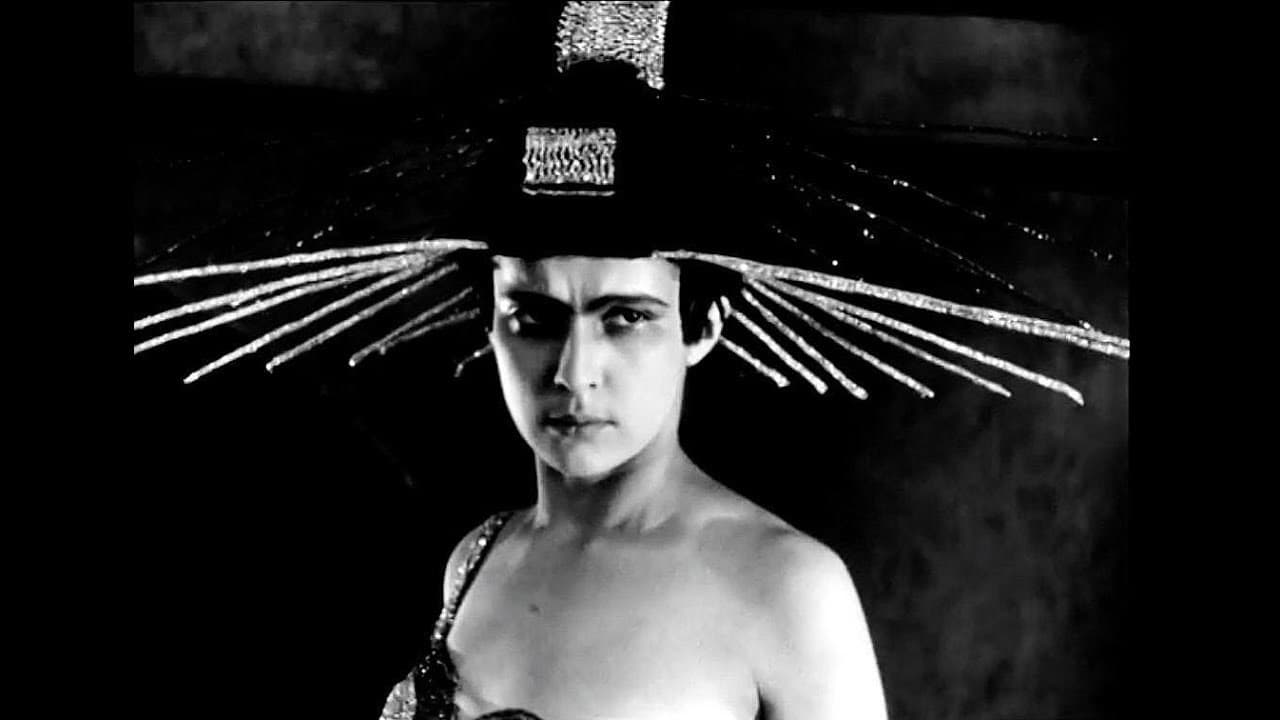
Science fiction, by Yakov Protazanov, Soviet Union, 1924.
The film follows the story of Los, an engineer who dreams of traveling through space. One day, during an experiment, he receives a transmission from Mars, which seems to come from Queen Aelita. Los builds a spaceship and departs for Mars, where he discovers a technologically advanced Martian civilization, ruled by the same Queen Aelita that he had seen in his dreams of her. Los falls in love with Aelita and helps her get rid of the tyrant who rules Mars, but her adventure turns out to be just a dream.
The film was positively received upon its release, both in the Soviet Union and abroad, and achieved great commercial success. "Aelita" was praised for its technical innovations, such as special effects and space flight scenes, which were achieved with the use of miniatures and stop-motion. The film deals with social and political issues such as class struggle and the question of the communist revolution. He was criticized for the way he portrayed Martian society as a utopian place, with no internal conflicts, which appeared to be an ideological vision of the communist future. "Aelita" was one of the first science fiction films ever made and had a significant impact on Russian and international popular culture. A film to be seen also for its innovative cinematic techniques, including stop-motion animation, and for its political message on the power of the working class. The most famous sequence is the one set in the extraordinary Martian constructivist set by Isaac Rabinovich and Victor Simov, with costumes designed by Aleksandra Ekster. Their influence can be seen in a number of later films, including the Flash Gordon serials, Metropolis, Fritz Lang's, Woman in the Moon, and most recently Liquid Sky.
LANGUAGE: English
SUBTITLES: Spanish, French, German, Portuguese
Constructivism's Demand on Materiality
You are wearing something right now, and you almost certainly did not choose it the way you choose an argument or a belief — you chose it the way you breathe, half-consciously, under pressures you would struggle to name if pressed.
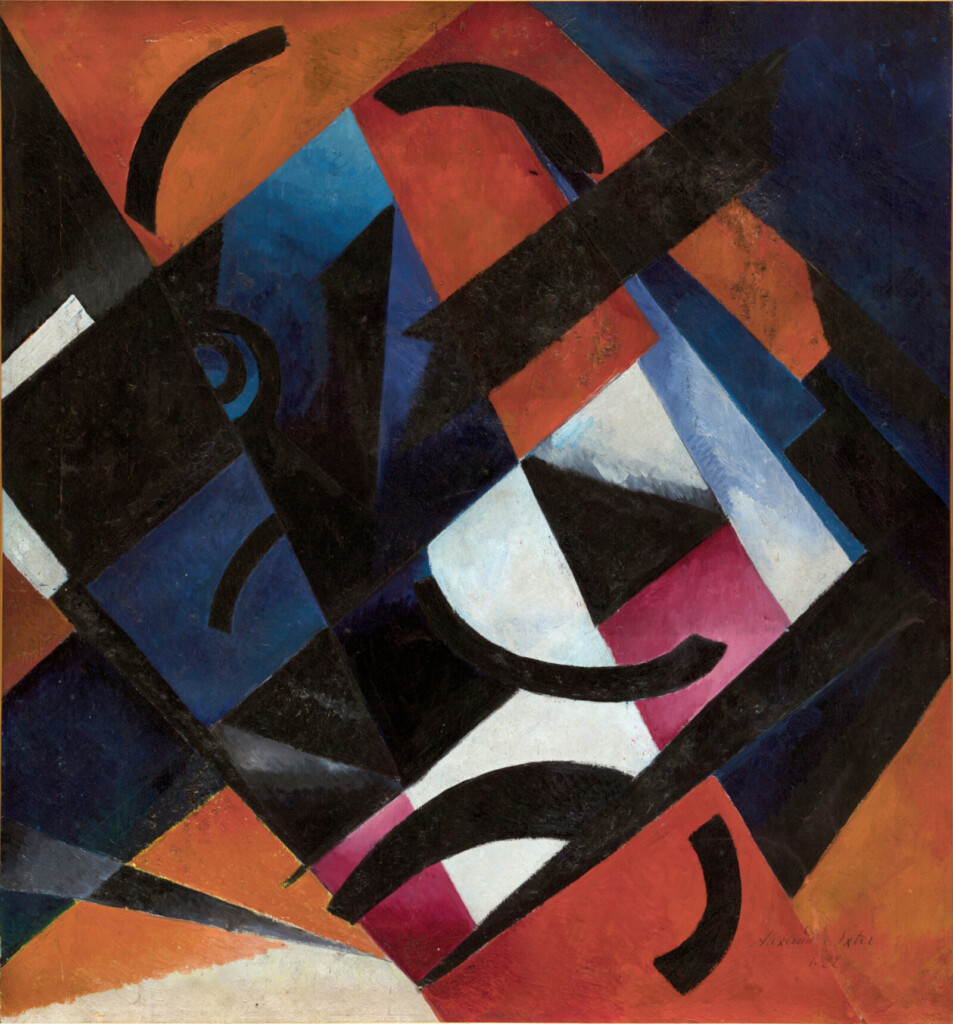
That unreflective intimacy between body and cloth is precisely what the Constructivists wanted to destroy, not out of aesthetic violence but out of a conviction that had hardened by 1921 into something close to doctrine: art that exists for itself is a luxury the revolution cannot afford. When Alexander Rodchenko signed the declaration effectively renouncing easel painting at the INKhUK debates in Moscow, he was not performing humility — he was making a structural claim that the artist’s proper place is inside production, inside the factory, inside the designed object that millions of hands would touch. His 1921 manifesto framing the artist as constructor rather than creator set the conceptual ground rules: form must justify itself through use, and use must be measurable against social transformation.
Varvara Stepanova took this demand into textile design with a precision that is still underappreciated. Her sports clothing designs from 1923, developed alongside her theoretical writings, treated pattern not as surface ornament but as a system coordinating the body’s movement with visual information. She argued explicitly that textile design was a branch of industrial production and that the designer’s task was to solve problems of function while simultaneously reshaping the visual environment of everyday life. Her designs for the First State Textile Factory were grounded in the belief that repeated geometric forms at scale — worn by workers, seen in crowds, integrated into the fabric of street life — constituted a genuine material intervention in collective perception. Decoration, for Stepanova, was not merely wasteful; it was epistemologically dishonest, a way of disguising the object’s real structural logic under a layer of sentiment.
Aleksandra Ekster accepted the Constructivist logic of function and then refused its tendency to flatten the sensory body into a diagram. Where Stepanova’s approach treated the clothed figure as a node in a system of visual information, Ekster treated fabric itself as a medium with its own resistant intelligence — one that pushed back against the body, shaped space around it, and altered the quality of attention in a room. Her theatrical costume work, developed most intensively through her collaboration with the Kamerny Theatre in Moscow from 1916 onward, showed her working with layered silks, contrasting textures, and spatial volumes not to illustrate a character but to produce a perceptual event. The costume was not a sign pointing to a meaning outside itself; it was a force field, something that reorganized the spectator’s visual cortex before any narrative information had been delivered.
This is a more radical claim than it first appears. It means that Ekster was treating the dressed body as an architectural element — something that structures experience rather than communicates within it. Leon Trotsky, in Literature and Revolution published in 1924, had worried openly about the Constructivist tendency to subordinate aesthetic complexity to utilitarian schematism, sensing that something irreducible in human sensory life was being discarded in the rush to make art useful. Ekster’s practice answered that worry not by retreating from utility but by expanding the definition of what utility could mean. If a garment could alter the way a body moved through space — could make its wearer’s gestures more deliberate, could sharpen the visual contrast between figures in a crowd — then the garment was doing social work that no slogan could accomplish, operating below the threshold of conscious ideology at the level of felt experience.
The cut of a sleeve is not a neutral technical decision when the person who cuts it understands that geometry acts on the nervous system before the mind has time to interpret it.

The Hierarchy That Costume Design Was Never Supposed to Escape
You already know what a museum is for, even if you have never thought about it consciously — it is a machine for deciding what counts as thought. Walk through any major collection of early twentieth-century European modernism and the evidence is spatial, almost architectural: oil on canvas hangs at eye level, commanding the room’s silence, while sketches for theatrical productions are pressed behind glass in a side corridor, labeled with the word “study” or “preparatory work,” as though the garment that followed were merely the degraded copy of the real idea. The hierarchy is not argued. It is arranged.
Kant built the philosophical scaffold for this arrangement in the Critique of Judgment, published in 1790, where he separated aesthetic experience from utility with a precision that would prove catastrophically durable. The beautiful, for Kant, demanded disinterestedness — a pleasure untethered from function, purpose, or need. Whatever served the body fell beneath the threshold of true art. This was not a casual distinction. It became the operating logic of institutions, academies, and eventually museum acquisition committees, which inherited the premise without inheriting the argument. By the time the modernist canon was being formalized in the early decades of the twentieth century — in the manifestos, the galleries, the critical journals — the Kantian boundary had hardened into professional common sense. A costume was something worn. Something worn was something used. Something used could not be art.
What is rarely named is how perfectly this logic mapped onto gender. Griselda Pollock, writing in Vision and Difference in 1988, demonstrated that the avant-garde was not simply a set of stylistic ruptures but a social space with enforced access points — and that the exclusions operating at those access points followed the same lines of gender that structured bourgeois life more broadly. The studio, the café, the street at night: these were the territories from which modern art drew its radical energy, and they were territories from which women were systematically barred or stigmatized for entering. What women were permitted — textile, embroidery, costume, decoration — was then used as evidence of their incapacity for the serious, the universal, the disinterested. The circle was closed before anyone admitted it had been drawn.
Ekster’s work did not fall through a crack in this system. It was actively sorted. Her costume and set designs for Alexander Tairov’s Kamerny Theatre in Moscow between 1916 and 1921 were celebrated in theater histories as revolutionary scenography — praised for their dynamic color relationships, their Constructivist spatial logic, their refusal of naturalistic illusion. But the same formal qualities that, in a canvas by Fernand Léger or a lithograph by El Lissitzky, warranted inclusion in histories of painting and abstraction, were in Ekster’s case absorbed into histories of performance and fashion. The object determined the category. The category determined the archive. The archive determined what could be remembered as thinking.
This is not a conspiracy. It does not require one. What it requires is a set of inherited assumptions operating so smoothly beneath institutional practice that no individual curator or critic ever needs to articulate them. When the Museum of Modern Art organized its landmark survey of Constructivism and the Russian avant-garde in 1992, the critical apparatus around that show — the catalog essays, the wall texts, the hierarchies of room placement — reproduced the same sorting. Ekster appeared, but she appeared at an angle, her textile and theatrical work separated from the painting and collage even when the formal vocabulary was indistinguishable across all of it. The separation was presented as organizational. It was metaphysical.
Simultaneity, Color, and the Phenomenology of Dressed Space

You are standing in a theater in Kyiv in 1916, and something is wrong with the stage. Not wrong in the way a misplaced prop is wrong, or a missed cue — wrong in the way a room feels wrong when the walls have moved slightly while you were sleeping. The performers in Salome are not simply wearing costumes. The costumes are wearing the space around them.
Robert Delaunay had spent the previous decade dismantling the static color relationships that Western painting had inherited from the Renaissance, arguing in his 1912 notes on simultaneous contrast that colors placed in proximity do not merely coexist — they act upon each other, generating optical vibration that produces the sensation of movement without any object moving at all. He borrowed the physics from Michel Eugène Chevreul’s 1839 treatise on chromatic contrast and turned it into an aesthetic manifesto. Aleksandra Ekster absorbed this with the precision of someone who had sat in Delaunay’s Paris studio and understood not just the theory but its bodily implication: that the eye is not a neutral receiver but an organ under siege from competing chromatic pressures. Where Delaunay remained, fundamentally, a painter of flat surfaces and circular solar forms, Ekster recognized that the human figure introduced a variable he had bracketed out entirely — volume, movement, the fact that the object carrying the color was itself alive and unpredictable.
Her Salome costumes for the Kamerny Theatre broke the body into competing chromatic zones that refused to resolve into a unified silhouette. Crimson against black against gold, arranged not to represent Salomé’s desire or Herod’s decadence but to create what she described in her own notes as a “dynamic color architecture” — a phrase that treats the dressed human being as a structure in the engineering sense, something that organizes the forces acting upon it. When the performer turned, the relationship between color fields changed. The stage didn’t show movement; it became movement. The audience’s nervous systems were being addressed, not their imaginations.
Maurice Merleau-Ponty, writing in Phenomenology of Perception in 1945, described what he called the body-schema — the pre-conscious map the body maintains of its own spatial extensions, a map that is not fixed but constantly revised by what the body encounters, wears, and inhabits. A blind person’s cane becomes part of the schema. A surgeon’s sense of the field through her instruments rewrites it. The philosophical insight that matters here is that the boundary between self and environment is not anatomical but phenomenological — it is drawn by experience, not by skin. Ekster was working in exactly this territory nearly three decades before Merleau-Ponty named it, using color and geometric fragmentation to extend or contract the performer’s body-schema into the surrounding architectural space, so that what the audience perceived was not an actor in a costume but an event that had no clean edge.
By 1924, designing for the science-fiction film Aelita, she scaled the problem outward. The Martian costumes she produced were constructed from cones, cylinders, and intersecting planes of reflective and matte material — not because the future looked geometric, which is the naive reading, but because she needed the filmed body to generate its own spatial field in a medium that collapsed three-dimensional space into a flat rectangle. Film flattens. Ekster countered the flattening by building dimensional conflict directly into the garment: surfaces that caught light differently depending on the angle of the camera, ensuring that no single frame resolved the figure into a stable object. The viewer’s perception was kept in a state of perpetual reorganization, which is not the same thing as confusion — it is the condition of genuine attention, the cognitive state in which the body has not yet decided what it is looking at and therefore cannot look away.
What the Applied Arts Category Conceals About Artistic Intention
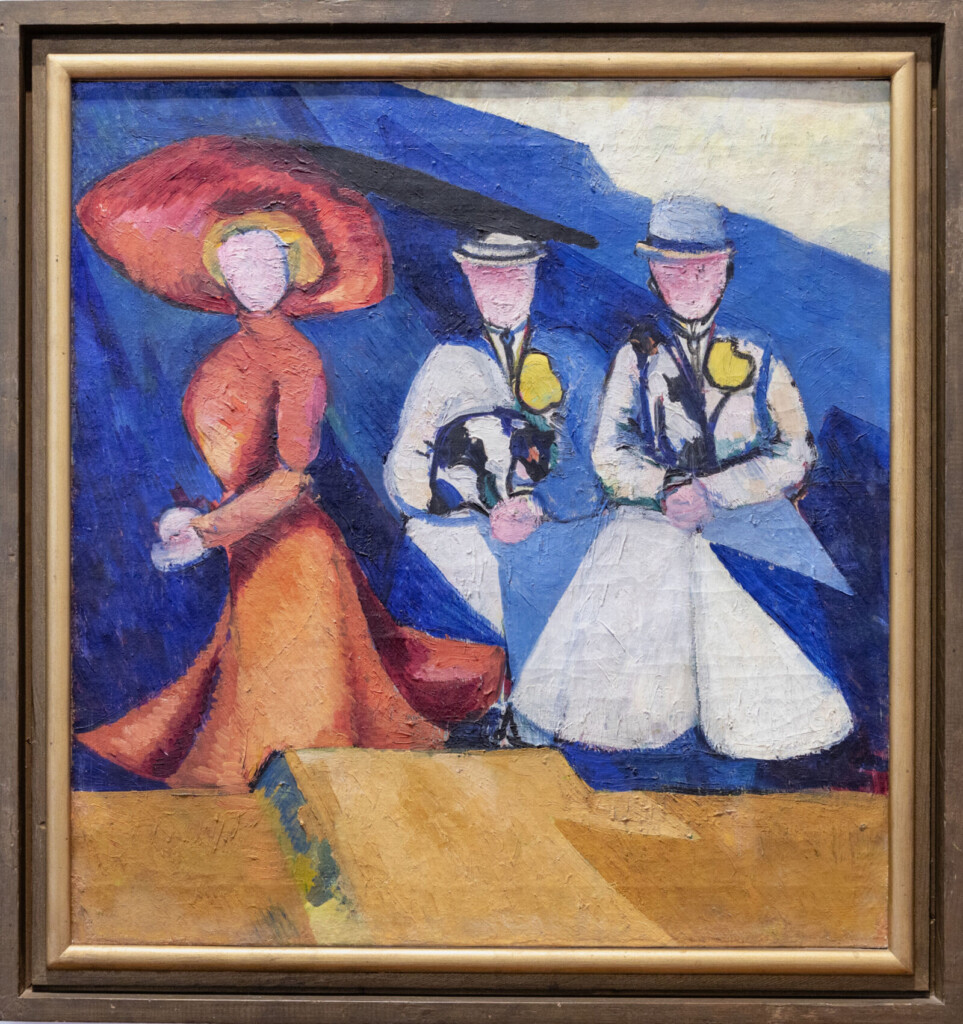
You stand in the museum, close enough to the glass to fog it with your breath, reading a small white label that says “applied art, gouache on paper, 1921,” and something in you accepts this without question, the way you accept the price tag on a painting or the footnote in a history book, as though the institution has simply reported a fact rather than made a decision that will shape everything you are about to feel.
The label is not neutral. It is an act of retrospective governance, a quiet bureaucratic judgment that arrived decades after Aleksandra Ekster had already moved between painting, theater, set construction, costume conception, and pedagogy without herself drawing any hierarchy among these activities. The category “applied art” carries a philosophical burden it rarely acknowledges: it assumes that the work was made in service of something else, that the intention behind the hand was instrumental rather than sovereign. But intention is precisely what cannot be archived. What survives in the vitrine is the object; what was burned in the making of it is the mind that refused the distinction the label now imposes.
Hans-Georg Gadamer, writing in Truth and Method in 1960, argued that understanding is never a purely cognitive act performed on a passive object — it is always a collision between the horizon of the interpreter and the horizon embedded in the work itself. He called the productive result of this collision a Horizontverschmelzung, a fusion of horizons, but the fusion only works if both horizons are allowed to exert pressure. When a curatorial label pre-determines the frame, it collapses one horizon entirely before the encounter even begins. The museum visitor does not fuse their understanding with Ekster’s; they fuse it with the institution’s prior judgment of Ekster, which is a fundamentally different and far less honest transaction.
What makes this particularly violent in Ekster’s case is that her costume designs for the Kamerny Theatre between 1916 and 1924 were not subordinate illustrations of a dramatist’s vision. They were structural propositions about space, movement, and the body as geometric volume — ideas she had developed from her direct exposure to Cubist studios in Paris and her subsequent synthesis with Constructivist principles of materiality back in Kyiv and Moscow. When she designed costumes for Tairov’s productions, she was extending onto a moving human form the same spatial logic she applied to canvas. The seam was not a concession to function; it was a line in three-dimensional space, calculated with the same intentionality as any mark she laid down when painting.
The art historical category system that separated fine art from applied art was itself a product of a specific European bourgeois formation consolidated through the nineteenth century, one that needed to protect the market value of autonomous aesthetic objects by distinguishing them sharply from objects made for use. Ekster’s practice was a living refutation of this taxonomy, which is perhaps why the taxonomy has been applied to her so aggressively in its aftermath. Categories are most ferociously defended when a body of work threatens to dissolve them.
Every major retrospective of her work — including the significant exhibition organized around her contributions to the 1925 Exposition Internationale des Arts Décoratifs in Paris, the very event that gave the world the term “Art Deco” — has had to choose between framing her as a painter who also made costumes, or a designer who also painted. Neither frame holds. Both are ways of stabilizing, for institutional convenience, a practice that was deliberately and philosophically unstable, constituted precisely by its refusal to stay within the lines that the archive now draws around it with such confident, damaging clarity.
A vision curated by a filmmaker, not an algorithm
In this video I explain our vision
🎭 Where Art Becomes Body, Color, and Stage
Aleksandra Ekster’s vision of costume design as autonomous art form does not exist in isolation — it grows from a dense network of avant-garde movements, female creative courage, and the radical reinvention of the relationship between image and meaning. These articles trace the deeper currents that animate her work, from experimental cinema to the iconography of women who dared to remake their worlds through form.
Experimental cinema: history and avant-gardes
Experimental cinema and the avant-gardes of the early twentieth century share with Ekster’s costume work the same fundamental ambition: to break representation and rebuild it as pure sensation. Artists working across theatre, film, and textile in the Soviet and European spheres understood that every visual element — fabric, movement, silhouette — was a language in its own right. Ekster’s theatrical and cinematic costumes were never decoration; they were arguments made in cloth and color.
GO TO THE SELECTION: Experimental cinema: history and avant-gardes
Maya Deren and the language of dreams
Maya Deren‘s exploration of dreamlike visual language offers a compelling parallel to Ekster’s treatment of costume as transformative skin. Both artists understood that the body dressed and staged becomes something other than ordinary — a threshold between the real and the symbolic. Deren’s films, like Ekster’s designs, insist that form carries meaning that words cannot reach.
GO TO THE SELECTION: Maya Deren and the language of dreams
Women in Contemporary Art: History and Protagonists
The history of women in contemporary art is inseparable from the struggle to have practice recognized as thought, craft recognized as vision. Aleksandra Ekster stands as one of the foundational figures in this ongoing reclamation, bridging Cubo-Futurism, Constructivism, and the applied arts at a moment when such bridges were acts of defiance. Understanding the broader landscape of women artists illuminates just how singular and how exemplary her contribution remains.
GO TO THE SELECTION: Women in Contemporary Art: History and Protagonists
The Weimar republic: art, culture and decadence
The Weimar Republic was one of the great laboratories of the twentieth century for the fusion of art, performance, and politics — a context deeply resonant with Ekster’s own creative milieu. The radical questioning of boundaries between fine art, design, theatre, and everyday life that defined that era mirrors the experimental energy of Russian Constructivism in which Ekster thrived. To understand the cultural ferment of interwar Europe is to understand the world that made her work not only possible but necessary.
GO TO THE SELECTION: The Weimar republic: art, culture and decadence
Discover the Films That Changed the Language of Images
If these ideas ignite something in you, Indiecinema is the place to follow the spark further. Our streaming platform gathers independent and auteur cinema from around the world — films that, like Ekster’s costumes, refuse to be merely decorative and insist on meaning at every frame. Come explore a cinema that thinks, feels, and transforms.
👉 EXPLORE THE CATALOG: Watch Indie Films in Streaming
A vision curated by a filmmaker, not an algorithm
In this video I explain our vision

