
The physiology of the unwitnessed self
You notice it around the third day, usually, though the timeline varies by temperament. You are alone in a rented room, the kind with a single window facing a brick wall, or in a house recently emptied of someone else’s furniture and someone else’s noise, and you catch your own reflection in a darkened window at dusk. The face looking back is not the face you know. The jaw hangs slightly open. The eyebrows have settled into a neutral sprawl you never see in mirrors, because mirrors are consulted, and consultation is itself a form of performance. Your shoulders have dropped two inches from where you carry them in an office or at a dinner table. Your breathing has slowed and deepened without instruction, the diaphragm doing work it apparently does all the time when nobody is asking your face to do something else. You have, without deciding to, stopped holding yourself.

This is not a minor observation about posture. It is the first crack in the assumption that there is a stable, continuous “you” that simply gets exposed to different social settings like a lamp switched between rooms. Erving Goffman spent his career arguing the opposite, most exactly in The Presentation of Self in Everyday Life, published in 1956 out of research he’d conducted in the Shetland Islands, where he watched islanders modulate their bearing depending on who stood in the room. Goffman’s central image was theatrical: life as a series of performances given on a front stage, before an audience, with a supporting backstage where the performer drops character to prepare for the next entrance. The mistake most people make when they first encounter this idea is to assume Goffman meant we are all liars, all fake, wearing masks over some truer face underneath. He meant something colder and more interesting. He meant there might not be a face underneath at all, only an infinite regress of masks, each one calibrated to a specific audience, each one just as real as the others because reality, in the social sense, was never the point. The point was the successful maintenance of an impression.
What happens, then, when the entire theater empties out. Not just the scene partner, not just the particular audience of a particular Tuesday, but the whole apparatus of witnessing, for weeks, for a season, for however long a person has chosen to disappear into a rented room with a view of brick. Goffman himself was less interested in this condition, because his data came from continuously social creatures, hotel staff, waiters, mental patients under observation, people who could never fully exit the stage even in their most private moments, since someone was always eventually going to walk back in. But withdrawal from society, real withdrawal, produces something Goffman’s framework gestures toward without fully describing: a backstage with no forthcoming front stage performance to prepare for. The muscles that held the eyebrows in their public arrangement simply stop being told what to do. The voice, unused for speaking, degrades in ways people report with a kind of shock, a rasp, a stranger’s timbre, because the vocal cords were being tuned constantly for an audience whose absence now becomes audible.
The unsettling part is not that the face changes. It’s the implication buried inside the change: that the sensation of being a coherent self, continuous from morning meeting to evening phone call to bedtime, was doing more labor than advertised, propped up by a thousand micro-adjustments made in response to other people’s eyes, and that without those eyes, something structural goes slack. Not a mask coming off to reveal a truer face. A structure losing its scaffolding, with no guarantee of what, if anything, stands underneath once the scaffolding is gone.
The historical manufacture of gregariousness
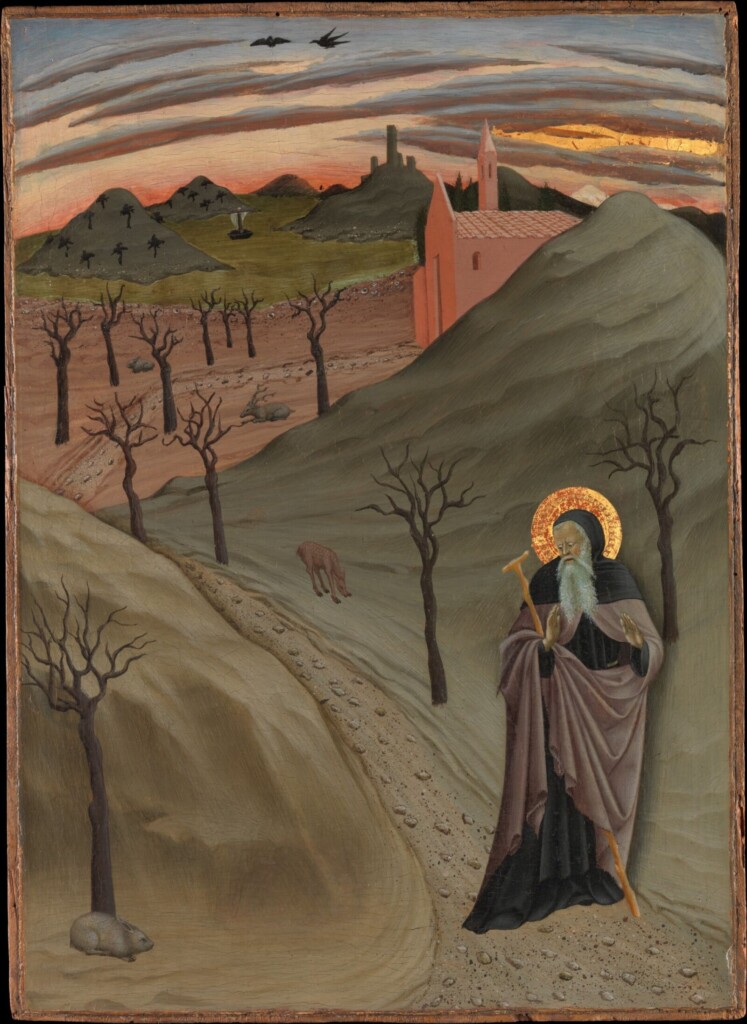
In the fourth century, a man named Antony walked into the Egyptian desert and stayed there for roughly twenty years, and the people who eventually found him did not consider him diminished by the experience. They considered him finished, in the sense that a sculpture is finished. Athanasius, writing his biography around 360 AD, describes crowds traveling to the desert not to rescue Antony from his isolation but to extract wisdom from it, as though solitude were a kind of furnace that had burned away everything ordinary and left something worth consulting. This is the detail that gets lost when solitude is discussed today as a symptom: for centuries, Western culture possessed a fully developed vocabulary for withdrawal as achievement. The Desert Fathers did not flee society because they had failed at it. They left because they judged it to be a lesser arena, a place where the self got diluted into performance and habit, and they believed the only way to meet God, or truth, or the unmediated structure of one’s own mind, was to remove every social mirror that told you who you were supposed to be.
That framework did not survive industrialization intact, and the reasons are less mysterious than they seem. A subsistence economy built on scattered farms could absorb a hermit; an economy built on factories, timetables, and interdependent labor could not. Solitude stopped being read as spiritual concentration and started being read as a failure to report for duty. The moral vocabulary flipped with startling speed, and nowhere is this flip more visible than in the emerging discipline of sociology, which took the isolated individual not as a mystic but as a statistic.
Émile Durkheim’s Suicide, published in 1897, is the document where this shift gets formalized with numbers. Durkheim was not writing about the Desert Fathers, he was writing about French, German, and English suicide registries, and he wanted to prove that suicide rates track social integration far more reliably than they track individual psychology. He found that Protestants killed themselves more often than Catholics, unmarried people more often than married, and he attributed this to what he called anomie, a state of normlessness produced when the individual’s ties to the collective loosen past a survivable threshold. His argument was rigorous and, within its data, largely correct. But something happened in its afterlife that Durkheim himself did not fully intend: the concept of anomic solitude, which described a specific pathological unraveling of social bonds during rapid economic change, got quietly generalized into the idea that any solitude, of any duration, chosen or unchosen, is a warning sign. The distinction between a man cut loose from meaning and a man who has deliberately withdrawn to think collapsed into a single diagnostic category.
This collapse was convenient for an industrial society that needed reliable, co-present labor and, later, for a consumer society that needed reliable, co-present spending. A person alone in a room is not clocking hours and is not easily monetized; a person alone in a room is also, not incidentally, harder to survey, harder to advertise to, harder to fold into the metrics that a mass economy depends on. Sociability stopped being one possible virtue among others and became something closer to a civic obligation, the assumed baseline against which any deviation required explanation. Robert Putnam‘s Bowling Alone, though written a century after Durkheim, extends the same anxiety into the late twentieth century, treating the decline of bowling leagues and civic clubs as evidence of social decay rather than considering that some of that decline might reflect people choosing differently structured lives.
What gets erased in this long transition from Antony’s cave to Durkheim’s suicide tables is the possibility that gregariousness itself is not a default state of human nature but an infrastructure, built, maintained, and enforced the same way roads and calendars are, and every infrastructure has an interest in describing its absence as a wound rather than an alternative.

Winnicott's paradox and the capacity to be alone
A child sits on the floor of a room, absorbed in some private arrangement of blocks or string or nothing at all, and does not look up. The mother is present, reading, or folding laundry, or simply existing in the periphery of the child’s attention, and the child does not need her to speak, does not need her to intervene, does not even need her to be watching. What the child needs is only this: that she could be summoned if summoned were necessary, and that she is not going anywhere. This scene, unremarkable to the point of invisibility, is the one Donald Winnicott chose in 1958 as the site of a psychological event he considered more significant than most of what psychoanalysis had until then treated as developmentally central. He called it the capacity to be alone, and he insisted, against the grain of intuition, that this capacity is not learned in solitude at all. It is learned in company. A person becomes able to be alone, Winnicott argued, only after having spent enough time being alone in the presence of someone else.
The paradox sits at an angle to everything the culture assumes about independence. The common story is developmental in a linear, almost muscular sense: a child starts dependent, then through some combination of maturation and encouragement gradually sheds that dependency the way a splint comes off a healed bone, until eventually an adult stands there, self-sufficient, capable of solitude because the scaffolding has simply been removed. Winnicott’s clinical experience, accumulated across decades as a pediatrician before he became one of the central figures of the British object-relations school, told him this was backwards. He had watched thousands of children and their mothers in consulting rooms and clinics, and what he saw was not a graduation from dependency but a specific, nameable internal event: the child, having repeatedly experienced the mother’s reliable presence during moments of unintegrated, private experience, eventually takes that presence inside. The child does not stop needing another person. The child comes to carry the other person internally, as a kind of ambient trust, and this internalized companionship is what makes actual physical solitude bearable, even generative, later on.
What this means clinically is that solitude has a genealogy, and the genealogy determines its quality. Two adults can be sitting alone in a room and appear, from any external vantage, identical. One of them is resourced. The silence around her is furnished; she carries an internal population of people who found her tolerable when she needed nothing from them, and this internal population makes the absence of external company feel spacious rather than threatening. The other adult is not alone in the same sense at all. He is abandoned, or he is performing a self-sufficiency he does not possess, and the quiet in the room is not spaciousness but a held breath. Winnicott’s paper gives psychology a way to distinguish these two conditions that has nothing to do with behavior and everything to do with history. The question is never whether someone can tolerate physical isolation. The question is what that isolation is built on.
This reframes withdrawal in a way that unsettles the moralizing vocabulary usually applied to it. If solitude only becomes generative after a specific relational foundation has been laid, then the ability to withdraw well is not a rejection of development but its late fruit, arriving only for those whose early experience included enough of what Winnicott, in the same body of work, called good-enough mothering, a phrase he chose deliberately to lower the bar from perfection to adequacy, because perfection was never the mechanism. Adequacy was. And this means most adults who flee into isolation, who cannot tolerate stillness without dread, who fill every silence with noise or company or compulsive productivity, are not failing at solitude through weakness of character. They are revealing, involuntarily, that the specific developmental transaction Winnicott described either never happened for them or happened too unreliably to be internalized. Their inability to be alone is not the opposite of dependency. It is dependency’s unfinished business, still looking, decades later, for the presence it never got to take inside.
The economics of constant availability

The fork sits untouched beside the plate while she scrolls, thumb moving with the automaticity of a reflex arc, not a decision. Her daughter has asked the same question twice about a science project due Friday, and both times the answer arrived a half-second late, arriving from somewhere else, a voice patched in from another room of the self. Nobody at the table names what is happening because it has stopped being an event. It is the texture of the meal now, has been for years, this low continuous leak of attention out of the kitchen and into servers in Virginia or Oregon, and the strange part is not the distraction itself but the muscle memory of guilt that flickers and then dissolves, unresolved, already overwritten by the next notification.
Jonathan Crary, in his 2013 book 24/7: Late Capitalism and the Ends of Sleep, names this condition with a bluntness that still startles on rereading: sleep itself, he argues, is the last remaining barrier to a fully monetized human existence, the one biological stretch of time that has so far resisted colonization by markets, and even that is under quiet siege by devices and pharmaceuticals designed to shrink it. Crary is not writing metaphorically. He traces a genuine historical shift in which the boundary between labor and rest, once policed by factory whistles and shop closing hours, has been dissolved by a technological architecture that never closes, never sleeps, never stops soliciting a response. The dinner table scene is not a lapse in discipline. It is the intended outcome of a decades-long infrastructure project.
What makes this different from earlier forms of exploitation is the target. Marx, writing in the 1860s, was concerned with hours of labor extracted from the body, the length of the working day fought over in Parliament and in Capital’s chapters on the working day itself. The commodity being extracted now is not muscle or time in that older sense but attention, a resource so intimate that its extraction barely registers as extraction at all. It feels like choice. It feels like curiosity, like connection, like keeping up. The genius of the system Crary describes is that it has made the harvesting of attention indistinguishable from the exercise of freedom, so that refusing it looks not like resistance but like deprivation, like falling behind, like missing something that everyone else already has.
This is why solitude, in the strict sense of uninterrupted, unmonitored, unmonetized time, has become almost structurally impossible to inhabit without friction. The waiting room offers the clearest laboratory version of the problem: a professional sits for eleven minutes before an appointment, no meeting to prepare, no message that cannot wait, and the hand moves to the pocket within twenty seconds, not from urgency but from something closer to withdrawal in the clinical sense, a discomfort that has no object except the absence of input. Herbert Simon, the economist who thought about attention before it was fashionable to do so, observed in 1971 that a wealth of information creates a poverty of attention, and the task of any information environment is therefore to allocate that scarce attention efficiently. What Simon did not anticipate, or perhaps chose not to say aloud, is that an entire economy would organize itself around making that allocation impossible to control, engineering scarcity of attention into abundance of demand for it.
Sherry Turkle‘s research at MIT, gathered across interviews later assembled in Alone Together in 2011, found adolescents describing silence itself as a problem to be solved rather than a condition to be tolerated, something to be filled the way a draft is filled with insulation. To sit doing nothing, thinking one’s own unprompted thoughts, had become for many of her subjects a mildly aversive state, avoided instinctively, the way one avoids a cold room. Solitude under these conditions is no longer a lifestyle preference weighed against sociability. It is closer to fasting in an environment engineered for continuous eating, a deliberate interruption of a supply chain that has been built, invested in, and optimized specifically to prevent that interruption from occurring.
Withdrawal as epistemic rupture
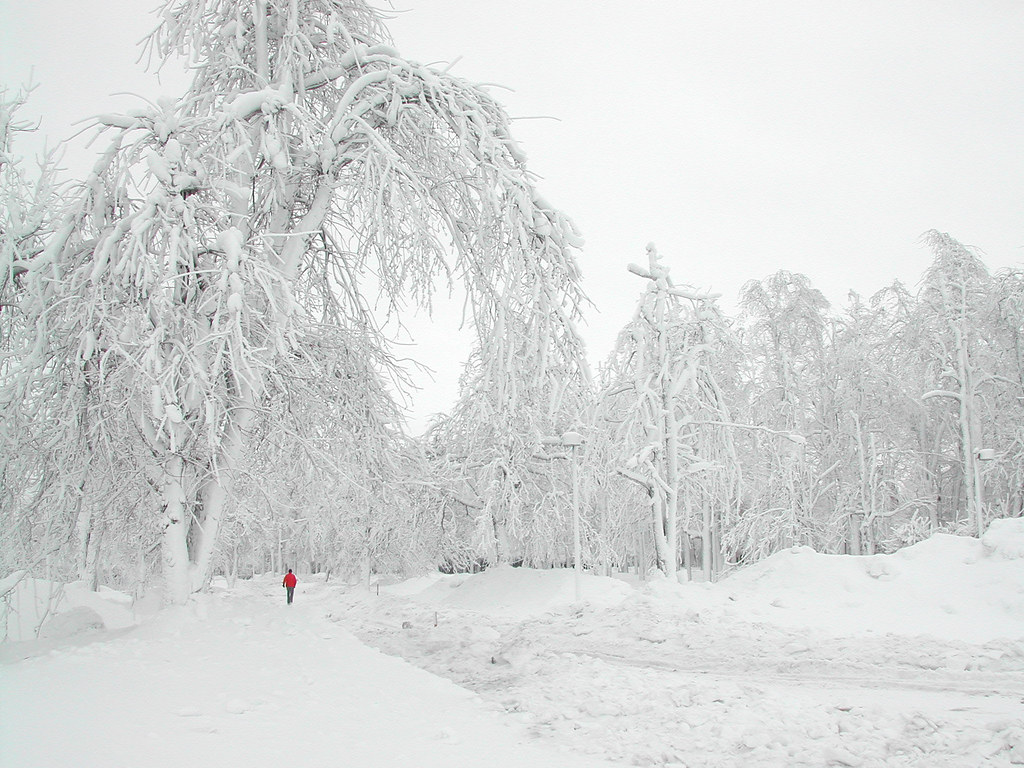
You stop answering the phone on a Tuesday and by the following Tuesday you notice that the voice in your head has started using words you don’t remember choosing. It says something and you actually pause, the way you would if a stranger on a train said something too accurate to ignore. This is not madness. This is what happens when the machinery of thought, built for centuries to run on the friction of other people, suddenly runs on nothing but itself.
Hannah Arendt, writing in the shadow of the catastrophe she spent The Origins of Totalitarianism trying to explain, drew a line that most people collapse without noticing. Loneliness, she said, is the experience of being abandoned by others, a deprivation, a wound inflicted from outside. Solitude is something else entirely: being alone with oneself, and therefore, crucially, still in company, because thought itself has an internal duality, a self that talks and a self that listens. For Arendt this distinction was not academic. She had watched totalitarian regimes manufacture loneliness deliberately, isolating individuals from every intermediate structure — family, guild, neighborhood, congregation — precisely because a lonely person, cut off from others and unable to find companionship even in their own mind, becomes desperate for the total explanation, the ideology that promises to fill the silence. Solitude, by contrast, was for her the precondition of thinking itself, the only state in which the two-in-one of consciousness could have its argument in peace.
What she does not dwell on, because her subject was politics and not phenomenology, is what happens when that internal duality goes on for so long without external interruption that it starts to sound foreign. Ask anyone who has spent a real stretch of time without speaking aloud, weeks on a boat, months in a cabin, a long illness endured without visitors, and they will tell you, often sheepishly, that their own thoughts began to sound like someone else’s. The interior monologue, which had always functioned as a kind of ambient hum beneath the noise of the day, becomes the only signal left, and signals examined too closely stop resembling themselves. You hear a sentence form in your mind and it arrives with a strange intonation, as if borrowed. This is not dissociation in the clinical sense, though it borders that territory closely enough to worry people who experience it for the first time. It is closer to what happens when you repeat a common word forty times in a row until it disintegrates into pure sound, an effect psychologists call semantic satiation, first documented experimentally by Leon Jakobovits James in 1962. Thought, unspoken, unchecked, unmirrored by another face registering comprehension or confusion, begins to do the same thing to itself. It loses the reassurance of being obviously yours.
There is a version of this that people seek out on purpose, monks, mystics, the long tradition running from the Desert Fathers through to contemporary retreatants who pay to sit in silence for ten days at a stretch, precisely because they want the interior voice to become strange enough to interrogate. The premise is that the ordinary self, the one who orders coffee and answers emails, is a performance so continuous that it has been mistaken for the whole person, and only when the audience disappears does something else have room to speak. But nobody who has actually done this returns describing pure clarity. They describe disorientation first, a kind of vertigo where the familiar landmarks of personality go soft, and only later, if at all, something that might be called recognition, though recognition of what is rarely specified with confidence.
This is the part that resists tidy resolution, because the self that surfaces in extended withdrawal does not announce itself as either the true one finally uncovered or a stranger produced by deprivation, and there is no reliable test to distinguish discovery from dissolution from the inside of the experience itself. You cannot ask the voice whether it is you. It will answer either way.
A vision curated by a filmmaker, not an algorithm
In this video I explain our vision
🌑 Pathways into Chosen Isolation
Withdrawing from society is not always a symptom of defeat—sometimes it is the deliberate architecture of transformation, a retreat that reshapes identity from within. These pieces explore solitude as both wound and workshop, tracing how isolation can fracture or forge the self.
The psychological effects of social isolation in peripheral contexts
This piece examines how social isolation in overlooked, peripheral environments reshapes the psyche, often blurring the line between imposed exclusion and chosen retreat. It offers a grounded lens for understanding withdrawal not as an abstract philosophical stance but as a lived, often painful, everyday reality. The analysis resonates deeply with narratives of solitude as a response to a world that no longer feels hospitable.
GO TO THE SELECTION: The psychological effects of social isolation in peripheral contexts
The necessity of a meditative life in a hyperactive world
A meditation on why silence and slowness might be the antidote to a culture addicted to noise and constant motion. This article reframes withdrawal not as escapism but as a necessary discipline for reclaiming inner clarity. It positions solitude as an active, almost radical practice of self-preservation against hyperactive modern life.
GO TO THE SELECTION: The necessity of a meditative life in a hyperactive world
Existential Emptiness: When Life Loses Meaning
This exploration of existential emptiness speaks directly to the void that often precedes or accompanies withdrawal from the world. It traces how the loss of meaning can push individuals toward isolation, and how that same emptiness can become fertile ground for reinvention. The piece captures the paradox at the heart of solitude: it can hollow us out or rebuild us entirely.
GO TO THE SELECTION: Existential Emptiness: When Life Loses Meaning
Hesse’s Steppenwolf: Analysis
Hesse’s Steppenwolf remains one of literature’s defining portraits of a man torn between society and the wilderness of his own soul. This analysis unpacks how the novel’s protagonist uses alienation and self-imposed exile as a crucible for psychological rebirth. It’s an essential reference point for understanding solitude as a transformative, if agonizing, journey inward.
GO TO THE SELECTION: Hesse’s Steppenwolf: Analysis
🎬 Continue the Journey in Solitude
If these reflections on withdrawal and inner transformation have struck a chord, Indiecinema offers a curated selection of independent films that explore isolation, identity, and quiet rebellion with the same depth and nuance. Dive into stories that linger in silence and find meaning in the margins.
👉 EXPLORE THE CATALOG: Watch Indie Films in Streaming
A vision curated by a filmmaker, not an algorithm
In this video I explain our vision

