
The Hollow at the Center of a Full Life
You are standing in your kitchen at 7:14 on a Tuesday morning, coffee in hand, the apartment exactly as you arranged it, the city audible below in its reliable percussion of buses and voices. Your calendar is populated. Your rent is paid. Someone who loves you is asleep in the next room. By every measurable coordinate, you have arrived. And then, without warning, without the decency of a cause, the floor does not exactly drop — it simply reveals that it was never entirely there. The coffee is warm. The light is good. Nothing is wrong. And that is precisely what is wrong.

This is not depression in the clinical sense, though clinicians have sometimes reached for that word when the real phenomenon resists their instruments. It is not grief, because nothing has been lost — or rather, nothing that can be named and therefore mourned. What has occurred is something closer to what the philosopher Albert Camus described in 1942 in “The Myth of Sisyphus” as the absurd’s sudden intrusion into ordinary habit: the moment when the machinery of daily life, which usually runs on the quiet fuel of assumed meaning, simply stops pretending. Camus called it a confrontation, not a pathology. He was precise about the timing — it tends to arrive not in crisis but in the interlude, not when everything falls apart but when everything is, by all external evidence, perfectly fine.
The peculiar cruelty of this experience is that it cannot be solved by acquisition or correction. There is nothing to fix because nothing, structurally, is broken. Viktor Frankl, writing from the rubble of the 20th century’s worst catastrophe in “Man's Search for Meaning” published in 1946, identified what he called the existential vacuum — a widespread condition he predicted would intensify as Western societies grew wealthier and more comfortable, precisely because those societies were systematically dismantling the traditional frameworks that had once handed meaning to individuals pre-assembled. He was not wrong. The rates of what psychologists now classify as anhedonia and existential depression have climbed steadily through decades of measurable material improvement. The correlation is not incidental.
There is a cultural script for almost every variety of human suffering, which gives sufferers the modest comfort of a recognizable role. Divorce has its rituals. Unemployment has its narrative arc. Even addiction has, by now, a well-worn story with known chapters and possible endings. But the person standing in their adequate kitchen, feeling the quiet evacuation of everything that was supposed to matter, has no script. Society does not issue a name for what they are experiencing because the experience implicitly accuses the society that produced it. To name it clearly would be to admit that the entire architecture of striving — the promotions, the optimized routines, the carefully curated relationships — was erected not over solid ground but over a question that nobody agreed to ask aloud.
What makes this moment so specifically modern is not the feeling itself, which has visited human beings across every recorded century, but the unprecedented absence of inherited containers for it. Medieval theology, Stoic philosophy, even the cyclical cosmologies of non-Western traditions all provided structures within which meaninglessness could be metabolized — not eliminated, but housed. The secular liberal individual of the early 21st century has been handed freedom of belief as though it were self-evidently a gift, without being told that freedom of belief is also the freedom to believe in nothing, and that this freedom arrives with a weight that the architects of Enlightenment rationalism consistently underestimated. Friedrich Nietzsche saw it coming in the 1880s and was not celebrated for the accuracy of his forecast.
The hollow at the center of a full life is not a symptom of personal failure. It is the precise location where a civilization’s unexamined promises meet the organism that was asked to live by them.
Irene
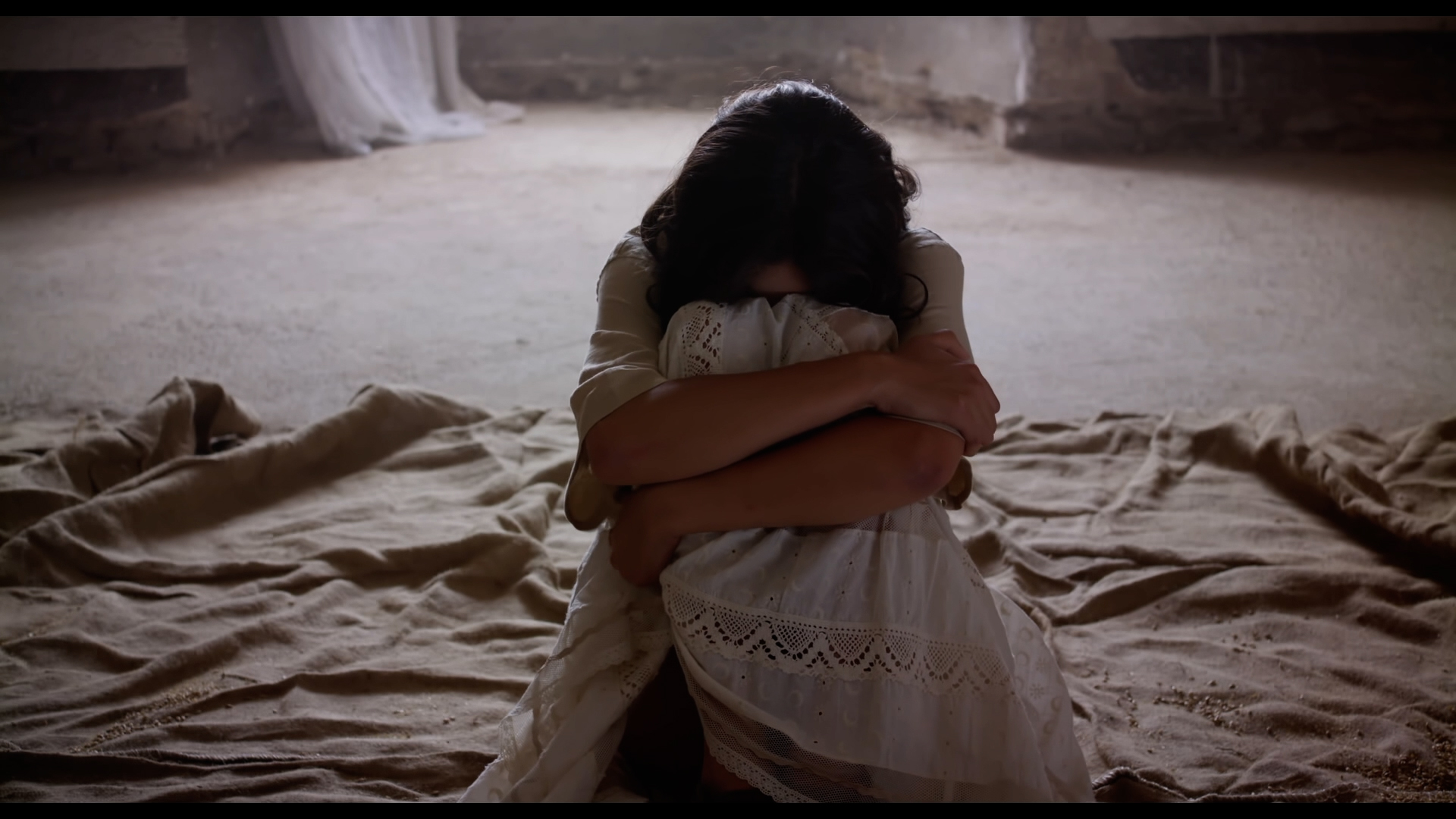
Drama, by Valerio Pampaglini, Italy, 2023.
Irene is trapped within her own unconscious, empty and ruined like an abandoned house. Through broken glass and shady figures dressed in black, a song awakens something long forgotten inside her. The film, written and directed by Valerio Pampaglini, is supported by the Rome Film Academy. It was shot in the summer of 2022 in the province of Perugia, in the municipality of Todi and at the Montenero castle.
LANGUAGE: Italian
SUBTITLES: English
Meaning Was Never Yours to Lose

You are sitting across from someone who loves you, and you cannot feel it. Not because you are broken, not because the love is insufficient, but because somewhere between the sensation and the recognition, a wire has been cut — and you are not sure when it happened, or whether you were the one who cut it.
The postwar West did not invent meaninglessness, but it industrialized the response to it. Between 1945 and 1970, an entire infrastructure of self-interpretation rose from the ruins of collective catastrophe: human resources departments, psychotherapy waiting rooms, personality inventories, five-year plans written in leather journals. Abraham Maslow published his hierarchy of needs in 1943, but its cultural penetration came later, slowly reframing the ancient question of how to live into a ladder one climbs, rung by rung, toward something called self-actualization — a word that sounds like enlightenment but functions like a performance review. What had been a metaphysical wound became a developmental gap. What had been a confrontation with the abyss became a project with milestones.
Viktor Frankl survived the Nazi camps and published “Man's Search for Meaning” in 1946, and the testimony is real, the suffering undeniable, the intellectual courage extraordinary. But the system he built from that survival — logotherapy — did something philosophically consequential that rarely gets named. By asserting that the primary human drive is the search for meaning, and that a therapist could assist that search, Frankl quietly relocated the crisis from the structure of existence to the interior of the patient. The philosophical problem was not dissolved; it was privatized. Meaning ceased to be something the world either offers or withholds and became something you were responsible for finding, cultivating, and maintaining — a psychological competency, like impulse control or emotional regulation. If you failed to find it, the failure was yours.
There is a particular violence in being handed a script so seamlessly that you never notice the handoff. The narrative of meaning-as-personal-quest arrived not as ideology but as common sense, embedded in educational frameworks, career counseling, and eventually in the language of wellness apps that ask you each morning to rate your sense of purpose on a scale of one to ten. Charles Taylor argued in “Sources of the Self” in 1989 that the modern identity is defined by its orientation toward a good — a horizon of significance against which choices become meaningful. What he did not dwell on is how efficiently that horizon gets manufactured and sold back to you as authenticity.
The productivity framework did the same work with less philosophical pretension. When time management theorist Frederick Winslow Taylor introduced scientific management in 1911, he was reorganizing factory floors, not interior lives. But the logic of optimization, once normalized, does not stay contained. By the late twentieth century, the self had become a resource to be allocated efficiently, and a life without measurable output carried a faint but persistent smell of moral failure. Meaninglessness was no longer just an existential condition — it was also a productivity problem, a symptom of poor self-management, a failure to leverage one’s human capital.
What gets lost in this architecture is the possibility that the emptiness is not a malfunction but a perception — accurate, clear-eyed, and structurally produced. You were given a story about what a meaningful life looks like, assembled from very specific historical materials: Western, postindustrial, Protestant in its underlying grammar of effort and reward. And then you were told to find yourself within it, as though the self doing the searching had not already been shaped by the very script it was searching through.
The wire that was cut was not inside you.

The Machinery of Purpose Built on Sand
You were told, from the moment you were old enough to absorb it, that things were getting better. Not as a comfort — as a structure. Progress was the skeleton inside every institution you moved through, every curriculum that shaped you, every political speech that asked for your patience in exchange for a promised trajectory upward. The Enlightenment did not merely produce new ideas; it manufactured a replacement cosmology, one in which history itself became the deity and rational improvement its sacrament. You were enrolled in that faith before you could question it.
What Friedrich Nietzsche diagnosed in 1882, in the aphorism of the madman running through the marketplace in The Gay Science, was not the death of religious belief in the narrow sense. It was the collapse of the entire gravitational system that had held human meaning in orbit. The madman does not celebrate; he screams, because he understands that the void left by metaphysical certainty cannot simply be patched with secular optimism. The Enlightenment had quietly borrowed its sense of direction — its teleology, its moral seriousness, its conviction that suffering was purposeful — from the very theological tradition it was dismantling. When the scaffolding finally came down in the nineteenth century, the building it had supported came down with it.
Max Weber, writing in the early twentieth century, named the resulting condition with clinical precision: Entzauberung, the disenchantment of the world. In The Protestant Ethic and the Spirit of Capitalism and the later lecture “Science as a Vocation,” delivered in 1919, Weber described a world increasingly governed by rational-bureaucratic logic, in which every question of value had been expelled from public life into private conscience. The consequence was not liberation but a peculiar kind of homelessness — the individual left standing in a cosmos that functioned perfectly well and meant absolutely nothing. Efficiency had replaced enchantment, and no amount of efficiency can tell you why any of it matters.
The sociological consequences were measurable well before anyone thought to measure them philosophically. Émile Durkheim, publishing his landmark study Suicide in 1897, identified what he called anomic suicide — death driven not by personal despair in any ordinary sense, but by the breakdown of the normative frameworks that give individual life its coordinates. Anomie was not poverty; it struck hardest during periods of rapid social change, including periods of sudden prosperity, when the old structures dissolved faster than new ones could form. Durkheim’s data showed suicide rates rising in precisely those modernizing European societies that had, by every conventional metric, succeeded. Progress, it turned out, could be lethal at the level of meaning.
Into that structural void, two forces moved with extraordinary speed and appetite. Consumer capitalism arrived with a ready-made answer: desire itself as purpose, acquisition as forward motion, the self-improvement industry as a secular soteriology that promised not salvation but optimization. By the late twentieth century, the average American was exposed to between 4,000 and 10,000 advertisements per day — each one a small theological claim, insisting that the incompleteness you feel has a purchasable solution. Identity politics, whatever its legitimate grievances, also filled the vacuum in an identifiable way: offering the individual a narrative of belonging, of historical significance, of a struggle larger than personal biography. Both systems are sincere in their own registers. Both are also, at bottom, rented meaning — frameworks that require continuous re-enrollment, that collapse the moment you stop performing them.
What neither system could address is the specific texture of the emptiness they were designed to cover: not the absence of things to do or causes to join, but the sensation, arriving usually in silence, that the entire architecture of your daily purposefulness is suspended over nothing load-bearing at all.
When the Self Becomes the Last Religion

You have been told, with the quiet authority of someone stating the obvious, that the answer lives inside you. Not in doctrine, not in lineage, not in obligation to anything beyond your own contours — inside you, specifically, waiting to be excavated like a precious and singular ore. This instruction arrives so early and so often that by the time you are old enough to question it, you have already organized your entire life around the project of its fulfillment.
Charles Taylor spent much of Sources of the Self, published in 1989, tracing how this conviction was not a liberation from religion but a displacement of its architecture. The sacred did not dissolve in Western modernity; it migrated inward. The self became the locus of ultimate significance, the place where meaning was both generated and verified, and the consequence of that migration was not freedom but a peculiar new form of bondage — because the self, unlike God, unlike the cosmos, unlike any structure genuinely larger than the individual, cannot bear the weight of being its own ground. It collapses under the pressure of being asked to originate rather than receive.
What accelerated after roughly 2010 was not the invention of this theology but its industrialization. The digital infrastructure of self-presentation created a situation in which the inner life was not merely cultivated but continuously published, and publishing requires a product. The journal entry that stays in the drawer can be raw, contradictory, unresolved — it answers to no audience. The curated profile answers to thousands, and it answers instantly, and its reception is measured in units that arrive as notifications. What gets optimized, gradually and without anyone deciding to optimize it, is not the self but the image of a self that performs coherence, intentionality, and above all authenticity — because authenticity is the highest currency in a market that has already absorbed every other value.
The paradox is structural and merciless. Authenticity, to mean anything at all, must refer to something prior to its performance — some inarticulate core that precedes the words used to describe it. But the injunction to be authentic, delivered through platforms that reward visibility, requires that this core be made legible, repeatable, and consistent enough to constitute a brand. The moment the inner life becomes content, it submits to the logic of content: it must hold attention, it must be recognizable, it must not contradict itself too violently across posts. The excavation promised by self-discovery produces not depth but a mirror, and the mirror has an algorithm.
What fills the resulting void is not nothing — which would at least be honest — but noise that mimics substance. Personality frameworks proliferate because they offer the sensation of self-knowledge without the discomfort of genuine encounter with one’s own opacity. Millions of people learn a four-letter code or an enneagram number and experience it as revelation, as though being categorized were the same as being understood. Erich Fromm diagnosed something adjacent in Escape from Freedom in 1941: the anxiety of genuine selfhood is so vertiginous that people will surrender their interiority to any structure that promises to name it for them, because being named feels like being found. The digital era did not invent this flight — it franchised it.
There is a particular kind of exhaustion that belongs exclusively to this configuration. It is not the exhaustion of overwork or grief or physical depletion. It arrives in people who have done everything correctly by the standards of the culture — who have journaled and meditated and gone to therapy and curated their values and built a life that reflects their stated identity — and who sit inside that life and feel, with a precision that frightens them, absolutely nothing. Not sadness. Not longing. The specific blankness of someone who has spent years constructing a self and arrived at the finished object only to discover that no one was waiting inside it to move in.
Emptiness as Evidence

You are sitting with something that will not move, and every method you have tried to shift it has quietly confirmed its weight. That is not a symptom. That is information.
Martin Heidegger, in Being and Time published in 1927, described Angst not as a pathological state requiring treatment but as a fundamental mood that discloses something true about existence — namely, that there is no ground beneath it. Not hidden ground, not ground you have not yet located. No ground at all. The vertigo you feel is not a distortion of reality. It is reality arriving without the usual insulation of habit, routine, and social noise. Most of philosophy before him had treated anxiety as an obstacle to clear thinking. Heidegger reversed the architecture entirely: the anxiety is the clarity.
What this means in practice is that every apparatus modern culture has constructed to manage existential emptiness — productivity systems, therapeutic frameworks, spiritual practices, the relentless monetization of wellness — operates by restoring the insulation. The goal is to get you back to not feeling what you were feeling. And there is a particular violence in how effectively this works, because it is not experienced as suppression. It is experienced as healing. You feel better, which is taken as evidence that something was wrong and is now less wrong, rather than as evidence that a signal was interrupted before it could finish its transmission.
Simone Weil, writing in the 1940s in her notebooks later collected as Gravity and Grace, went further in a direction that is genuinely difficult to hold. She argued that the void — the experience of absolute absence, of meaning withdrawn, of the self with nothing to cling to — is not the problem to be solved but the only honest starting point available to a human being. Everything else, she wrote, is what we use to fill it. And the filling is not neutral. Every substitute we pour into the void — love, ideology, ambition, identity — takes the shape of the void while hiding its dimensions. You mistake the shape of what you poured for the shape of what you are.
The impulse to resolve emptiness is not a sign of health. It is the most sophisticated form the emptiness takes when it wants to remain invisible. When you move urgently toward meaning — a new project, a new relationship, a new framework for understanding yourself — you are not escaping the void. You are performing a kind of motion that keeps you convinced you are not standing still. The motion itself becomes the evidence that something real is happening, that the self is engaged, progressing, oriented. But orientation was precisely what the emptiness had removed, which means the urgency to find it again is generated by the same groundlessness you are trying to outrun.
There is a diagnostic tradition, hardened into clinical protocol across the twentieth century, that treats persistent emptiness as a disorder of mood or personality, something to be corrected toward a baseline of functional engagement with life. The DSM-5, published in 2013, lists chronic emptiness as a criterion for borderline personality disorder — a single data point that reveals an entire cultural consensus: that the feeling of groundlessness is a malfunction rather than a perception. The person who feels it is classified. The feeling itself is not interrogated.
What neither the diagnostic tradition nor the redemptive philosophical tradition can easily accommodate is the possibility that emptiness might be the most accurate thing you have ever felt — not because life is objectively meaningless, but because the meanings you were handed were always someone else’s solution to someone else’s vertigo, passed down through families and institutions and cultural scripts as though they were discoveries rather than inheritances, and the day you stopped being able to use them is the day you became, for the first time, genuinely available to the question of what it actually is to be alive.
A vision curated by a filmmaker, not an algorithm
In this video I explain our vision
🕳️ The Abyss Within: When Meaning Disappears
Existential emptiness is not merely a philosophical concept but a lived experience that has haunted literature, psychology, and cinema for centuries. From the absurdist tradition to logotherapy, thinkers and artists have circled the same terrifying void: the moment when life loses its sense of purpose. The articles below trace the deepest contours of this human condition.
Albert Camus: Life and Philosophical Thought
Albert Camus confronted the absurd as the foundational condition of modern existence, arguing that the universe offers no inherent meaning to human longing. His philosophy does not lead to despair but to a defiant, lucid revolt against meaninglessness. Understanding Camus is essential for anyone who has ever stared into the void and asked whether there is any reason to go on.
GO TO THE SELECTION: Albert Camus: Life and Philosophical Thought
Viktor Frankl: Life and Logotherapy
Viktor Frankl survived the Nazi concentration camps and emerged with a radical insight: meaning can be found even in the most unbearable suffering. His logotherapy posits that the will to meaning is the primary human drive, and its absence produces the existential vacuum that defines so much of contemporary life. Frankl’s work remains one of the most powerful antidotes ever conceived to the experience of emptiness.
GO TO THE SELECTION: Viktor Frankl: Life and Logotherapy
Loneliness in Contemporary Society
Loneliness in contemporary society has reached epidemic proportions, eroding the inner sense of belonging that gives life its texture and direction. Sociologists and psychologists alike warn that disconnection from others accelerates the collapse of personal meaning, leaving individuals adrift in a world of surface interactions. This article maps the cultural and psychological roots of a crisis that is inseparable from existential emptiness.
GO TO THE SELECTION: Loneliness in Contemporary Society
Camus’s Myth of Sisyphus: The Absurd Explained
Camus’s Myth of Sisyphus is the definitive literary meditation on the absurd, asking whether life is worth living in a universe indifferent to human desire. The image of Sisyphus condemned to roll his boulder up a hill for eternity becomes, paradoxically, a symbol of defiant joy rather than defeat. This analysis unpacks how Camus transforms meaninglessness into a philosophy of radical presence.
GO TO THE SELECTION: Camus’s Myth of Sisyphus: The Absurd Explained
Discover Cinema That Dares to Ask the Deepest Questions
If these themes resonate with your search for meaning, Indiecinema offers a curated streaming library of independent and auteur films that confront existential emptiness with honesty, beauty, and courage. From European arthouse to visionary world cinema, our catalog is built for those who believe that watching a film can be an act of self-discovery. Join us and let cinema become your companion in the labyrinth.
👉 EXPLORE THE CATALOG: Watch Indie Films in Streaming
A vision curated by a filmmaker, not an algorithm
In this video I explain our vision

