
The Architecture of Consent in Nora's Marriage
You have signed nothing. That is the first thing to understand about Nora Helmer — not that she is naive, not that she is childlike, not that she has been deceived by a man who loves her badly. The first thing to understand is that her signature, the one she forged on the promissory note to save her husband’s life, is legally meaningless not because it is fraudulent but because it was already meaningless before she put pen to paper. A married woman in Norway in 1879 did not possess contractual personhood. She could not enter a binding financial agreement. Her name on a document was, in the strictest juridical sense, decorative.

Ibsen understood this with the precision of a lawyer’s clerk, which is partly what made A Doll’s House so detonating when it premiered at the Royal Theatre in Copenhagen on December 21, 1879. The play was not a romantic critique of one bad marriage. It was a structural indictment of a legal architecture that had been quietly perfected over centuries. Under Norwegian law at the time, directly derived from Danish common law traditions that had governed Scandinavian domestic life since the seventeenth century, a wife’s property, income, and civic transactions were subsumed entirely under her husband’s legal identity. She did not lose rights upon marriage — she had never, in any operative sense, possessed them to lose. The subordination was not a punishment. It was the default condition, invisible because it was foundational.
What Ibsen stages in the Helmer household is not a marriage gone wrong but a marriage functioning exactly as designed. Torvald is not a villain in the conventional theatrical sense. He is an administrator. He manages Nora with the same bureaucratic affection one might apply to a ledger that has always balanced. His pet names for her — his little skylark, his squirrel — are not symptoms of cruelty but of a categorical error so deeply embedded in the period’s legal and social imagination that it had become indistinguishable from tenderness. John Stuart Mill had argued in The Subjection of Women in 1869, a full decade before Ibsen’s play, that the legal structure of marriage bore a closer resemblance to the condition of slavery than to any arrangement between consenting adults, precisely because consent had never been a structural requirement of entry. A woman married under the conditions of the time because the alternatives — financial destitution, social exile, the complete withdrawal of institutional support — constituted a coercion so total it did not need to announce itself.
The debates surrounding the Married Women’s Property Act in Britain, which had been grinding through Parliament since the 1850s and would reach a significant legislative moment in 1882, illuminate the precise ideological fault line Ibsen was excavating. The opposition to granting married women independent property rights was not primarily grounded in contempt. It was grounded in a coherent theory of household unity — the legal fiction known as coverture, by which husband and wife became a single legal person, and that person was, categorically, the husband. Reformers like Barbara Leigh Smith Bodichon, whose 1854 pamphlet A Brief Summary in Plain Language of the Most Important Laws Concerning Women had laid out the consequences of coverture with devastating clarity, understood that what was at stake was not sentiment but personhood. The household was not a refuge from legal relations. It was where legal relations were most ruthlessly organized.
Nora’s forgery, then, is not a crime in the moral sense that Krogstad and eventually Torvald insist on treating it. It is a woman attempting to exercise an agency that the entire surrounding legal order had declared she could not possess, and doing so in the only register available to her — the unofficial, the hidden, the technically inadmissible.
Freedom as a Structurally Forbidden Category
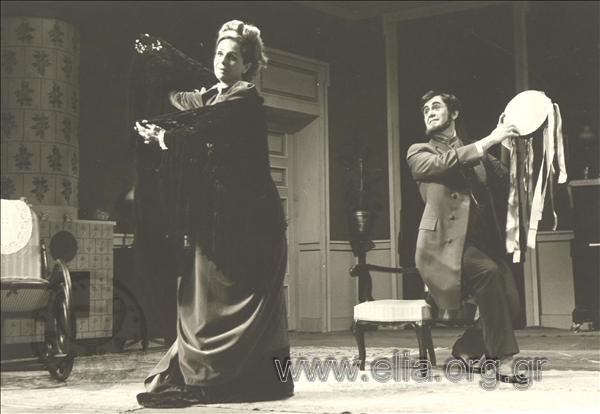
You already know the moment: the door closes, and the sound it makes is not dramatic — it is administrative. A woman has just done the paperwork of her own existence, and everyone in the room treats it as a symptom.
What made Nora Helmer’s departure so violently unreadable to its first audiences in 1879 was not its emotional charge but its logical structure. She did not flee in grief, did not collapse in martyrdom, did not dissolve into the moral vocabulary available to women of her class. She reasoned her way out. She sat across from her husband and conducted what amounted to a philosophical audit of her own life, concluded the numbers did not add up, and left. The scandal was not the leaving. The scandal was the reasoning. A woman deploying syllogistic clarity to justify the abandonment of her domestic role struck the bourgeois imagination not as an argument to be refuted but as evidence of disorder — the way a fever is not argued with but treated.
John Stuart Mill had anticipated exactly this reception a decade earlier. In The Subjection of Women, published in 1869, he identified a mechanism far more efficient than outright prohibition: the construction of female autonomy as a category error. The legal and social architecture of the nineteenth century did not need to punish women who sought independence at every turn because it had done something more elegant — it had made independence definitionally incompatible with femininity itself. A woman who pursued her own judgment was, by the prevailing taxonomy, either deluded, unwomanly, or mentally compromised. Mill called this arrangement “the legal subordination of one sex to the other” and traced it not to nature but to the sheer historical weight of custom presented as fact, a weight so massive that most people living inside it could not see its edges. The 1869 text sold modestly, was reviewed with condescension by men who considered it sentimental, and was weaponized by almost no one at the time. Its actual radicalism was structural: it said that what appeared to be women’s natural preferences had been manufactured under conditions that made any other preference not merely difficult but grammatically impossible to express.
The grammar of impossibility is the precise instrument Ibsen is working with. Nora has not been kept in a cage — she has been kept in a sentence that has no first-person singular. Her husband Torvald’s entire erotic and domestic investment in her depends on her remaining a noun rather than a verb, an object of care rather than an agent of will. The moment she generates a coherent first-person claim — I must think for myself, I cannot accept that the law is right when I know it is wrong — the entire relational syntax collapses. This is not a love story that goes wrong. It is a grammatical system encountering a speaker it was never designed to accommodate.
What the bourgeois moral framework of the 1870s required was not the suppression of female desire but the suppression of female epistemology. A woman could want things — comfort, children, beauty, social approval — provided she derived the authority for those wants from someone else’s authorization. The catastrophe Nora enacts is not wanting to leave. It is believing that her own perception of reality constitutes valid evidence. In a world where women’s testimony about their own interiority was systematically classified as unreliable — too emotional, too partial, too bodily — the act of trusting one’s own observations was itself transgressive. Not because anyone had forbidden it explicitly, but because the entire infrastructure of respectable life had been built on the assumption that it would never happen.

The Performance of Smallness as Survival Strategy
You have rehearsed smallness so many times it has begun to feel like your actual size. The macaroons hidden in her pocket, the practiced stumble over a legal term she almost certainly understands, the bright and darting energy performed for a man who needs to believe he is the gravitational center of the room — none of this is stupidity. It is something far more demanding than intelligence: it is intelligence that has learned to impersonate its own absence.
Erving Goffman published The Presentation of Self in Everyday Life in 1956, and what he mapped there was the exhausting architecture of social performance — the front stage where we perform acceptable selves, the backstage where the mask loosens, and the almost unbearable cognitive labor involved in maintaining the distinction. What Goffman could not have fully anticipated, because his framework was largely gender-neutral in its application, was the specific tax levied on women who perform not merely social competence but social incompetence as strategy. Nora does not simply perform a self. She performs a diminished self, which requires the additional effort of continuously suppressing the fuller one.
The psychological literature on this is precise and uncomfortable. In conditions of coercive dependency — where a person’s material survival is contingent on satisfying another person’s need for superiority — the performance of inadequacy becomes a rational adaptive mechanism. What psychologists studying coercive control, including Evan Stark in his 2007 work Coercive Control, have documented in clinical settings is that victims of controlling relationships frequently develop sophisticated systems of managed incompetence: they forget things strategically, defer on matters where they hold knowledge, and calibrate their visible capability to remain below the threshold that would threaten the controlling partner’s self-concept. This is not passivity. It is surveillance and calculation running continuously beneath the surface of performed lightness.
Ibsen wrote A Doll’s House in 1879, and he did something unusual for a male playwright in that moment: he placed the audience inside the experience of this calculation. The famous tarantella scene in Act Two, where Nora dances with a kind of desperate, controlled frenzy, is not merely emotional expression. It is a woman using performance as distraction, as misdirection, buying herself cognitive time while Torvald watches the surface and sees only his charming wife. The dance is a lie performed at high velocity, and it works precisely because it looks like joy. The audience sees both layers simultaneously, which is what makes it unbearable to watch.
What gets destroyed by sustained performance of this kind is not intelligence, which survives remarkably well, but something closer to what the philosopher Charles Taylor, writing in Sources of the Self in 1989, called the narrative coherence of identity — the capacity to experience oneself as a continuous being whose actions reflect genuine interiority. When your performed self and your actual self diverge long enough and completely enough, you do not simply lose authenticity in some abstract philosophical sense. You lose the thread. You begin to experience your own genuine reactions as suspicious, as potentially dangerous, as something requiring management rather than expression. Nora, by the final act, has been performing smallness for so long that her eruption into clarity arrives with the quality of a stranger speaking from inside her own body.
The cost is not paid at the moment of performance. It accumulates in the gap between what is shown and what is known, in every room where a competent woman has elected, for reasons of survival, to ask a question she already knows the answer to.
Choice Without Infrastructure Is Not Choice

You already know what she walked into. Not freedom — a street. Oslo in 1879, gas-lit and indifferent, where a woman without a husband’s name attached to her credit could not sign a lease, could not open a bank account, could not enter a labor contract that a court would enforce on her behalf. The Norwegian Married Women’s Property Act would not arrive until 1888, nearly a decade after Nora closed that door, meaning the very legal architecture required to make an independent life legible did not yet exist. She did not step into possibility. She stepped into a juridical void wearing the clothes of a middle-class wife, which is to say, clothes entirely unsuited to the cold.
The liberal reading of her exit has always depended on a strategic ellipsis — it stops at the door, at the sound of the latch, at Torvald’s face crumpling in the dark. It treats the threshold as the conclusion rather than as the opening condition of an entirely different problem. John Stuart Mill, writing only eleven years earlier in The Subjection of Women, had already named the mechanism with uncomfortable precision: the legal subordination of women was not incidental to Victorian and Nordic bourgeois society, it was load-bearing. Remove it and you did not liberate a person — you removed the only scaffolding that had ever held her weight, before building anything to replace it. Mill was describing England, but the Norwegian Civil Code of 1869 operated on nearly identical premises: a married woman was, in most contractual senses, a legal appendage of her husband rather than a discrete subject.
What Nora had, materially, upon leaving was this: no professional training, no employment history, no credit standing, no property, and children she legally could not retain custody of under the terms her husband could invoke. The idealization of her choice requires ignoring that these are not secondary inconveniences — they are the substance of the choice itself. Friedrich Engels, in 1884, five years after the play premiered, would argue in The Origin of the Family, Private Property and the State that the bourgeois household was not incidentally but structurally an economic unit that made the woman’s dependency its operating condition. He was not being poetic. He was describing the precise mechanism that made Nora’s situation a trap rather than a life.
And yet the play is not cynical about her departure. That is what makes it genuinely disturbing rather than merely bleak. Ibsen does not show us what comes next. He understood that showing it would allow audiences to grieve for her future and thereby avoid sitting with the more unbearable truth: that she left anyway. Not because the path was clear, but because staying had become the more total destruction. This is not triumph — it is a person choosing between two forms of damage and finding one of them marginally less annihilating than the other. The category of choice, under those conditions, has been so compressed it barely deserves the name, and yet it is the only category available.
There is a particular kind of violence in naming that compressed space freedom. It allows a society to celebrate the gesture while leaving the structure that made it desperate entirely intact. By 1900, Norwegian women still could not vote. By 1907, they gained limited suffrage. Full political equality came in 1913 — thirty-four years after Nora’s door closed. The applause that greeted her exit in European theaters across the 1880s and 1890s was, in this sense, the sound of audiences moved by a woman’s courage while remaining entirely comfortable with the conditions that required it.
The Inheritance We Refuse to Name
You check the productivity app on your phone at 11 p.m., after the dishes, after the bedtime story, after the work email you promised yourself you would not answer, and the app tells you that you have been insufficiently intentional about your goals today.
The architecture of the trap has not changed since 1879; only the interior has been renovated. Ibsen placed Nora inside a set of legal and financial structures that made her dependency legible, visible, almost embarrassingly literal. The contemporary version operates through diffusion — the constraint is everywhere and therefore nowhere, impossible to point at without someone suggesting you are pointing at yourself. Arlie Hochschild spent years documenting what she called the second shift in her 1989 study of the same name: the phenomenon by which American women who entered the paid workforce full-time nonetheless continued to perform the overwhelming majority of domestic labor at home, logging what she calculated as an extra month of work per year compared to their male partners. What Hochschild captured was not a transitional anomaly on the road to equality but a settled arrangement that both partners had largely stopped questioning, having absorbed the explanation that it reflected natural preference rather than negotiated surrender.
The economics confirm what the sociology describes. The gender wage gap in the United States, measured in 2023 by the Bureau of Labor Statistics, showed women earning approximately 84 cents for every dollar earned by men in full-time, year-round employment — a figure that has moved fewer than fifteen cents in four decades of sustained political attention. More revealing than the aggregate number is where the gap widens: it accelerates sharply at the moment of first childbirth, a phenomenon economist Claudia Goldin documented extensively in work that earned her the Nobel Prize in Economics in 2023. Goldin identified that what penalizes women is not their sex per se but the market’s systematic overvaluation of temporal flexibility and availability — the willingness to be on call, to absorb unpredictable hours, to structure one’s entire existence around professional demand. That willingness is purchased at home by someone else’s unpaid labor, and the architecture of who performs that labor has not been structurally renegotiated simply because both parties now carry a briefcase.
What has changed is the ideological framing available to explain the outcome. Where the nineteenth century offered women the vocabulary of duty and natural femininity to account for their position, the early twenty-first century offers the vocabulary of choice and self-actualization. The effect is a kind of privatization of structural failure: when the system produces an unequal result, the available explanation is a personal one — a woman’s ambivalence about success, her imposter syndrome, her difficulty leaning in, her unresolved relationship with power. This translation of political economy into therapeutic language is not accidental. It is extraordinarily efficient. It takes what is a distributional problem — who gets time, money, credit, rest — and converts it into a psychological problem, one that can be addressed through coaching, journaling, or a better morning routine, none of which alter the number of hours in a day or the price of childcare.
Nora’s final act — the door closing, the marriage abandoned, the self chosen at catastrophic cost — was Ibsen’s refusal to offer his audience a comfortable resolution. What the contemporary inheritance has accomplished is to make the door feel unnecessary by making the room appear to be a choice. The woman who stays, who manages the double burden, who absorbs the wage penalty and schedules her ambition around the school calendar, is invited to understand herself not as constrained but as having curated a life that reflects her values, which is perhaps the most sophisticated ideological achievement of the century: the transformation of a structural ceiling into a personal aesthetic.
A vision curated by a filmmaker, not an algorithm
In this video I explain our vision
🚪 When Women Choose: Freedom, Rebellion, and Identity
Henrik Ibsen’s A Doll’s House shook the foundations of Victorian society by placing a woman’s moral awakening at the center of the stage. The dilemma of female choice — between social expectation and authentic selfhood — resonates across literature, philosophy, and cinema. These articles explore the cultural and intellectual landscape that surrounds Nora’s unforgettable exit.
Witch hunts as an archetype of gender control
Witch hunts have historically served as instruments of patriarchal control, targeting women who deviated from prescribed social roles. Like Nora’s rebellion in A Doll’s House, the transgression of female autonomy has long been met with systemic punishment and moral condemnation. This article traces the deep historical roots of gender control as a cultural and political phenomenon.
GO TO THE SELECTION: Witch hunts as an archetype of gender control
Wollstonecraft’s A Vindication of the Rights of Woman
Mary Wollstonecraft’s foundational text argued, long before Ibsen, that women are rational beings deserving the same freedoms as men — a claim radical enough to scandalize an entire era. Her vindication of women’s rights forms the philosophical backbone of every female character who dares to question her domestic imprisonment. Reading Wollstonecraft alongside Ibsen reveals just how slowly society has moved toward genuine equality.
GO TO THE SELECTION: Wollstonecraft’s A Vindication of the Rights of Woman
Impossible Desire: Adultery as Rebellion
The theme of impossible desire and adultery as rebellion illuminates the condition of women trapped within suffocating social institutions, much like Nora trapped within her doll’s house. Across cultures and centuries, female desire has been coded as transgression, and the woman who acts on it risks everything. This article examines how literature has used forbidden love as a lens for exposing the violence of social conformity.
GO TO THE SELECTION: Impossible Desire: Adultery as Rebellion
Repressed Desire: When Society Stifles Feelings
Repressed desire is not simply an emotional state but a social condition imposed upon those — especially women — deemed too dangerous if allowed full selfhood. Ibsen understood that the cage Nora inhabited was built not from iron but from expectation, guilt, and internalized shame. This article explores how society manufactures the suppression of feeling as a mechanism of control.
GO TO THE SELECTION: Repressed Desire: When Society Stifles Feelings
Discover the Cinema That Dares to Tell the Truth
If these themes of female awakening, social rebellion, and the courage to choose resonate with you, Indiecinema is the streaming platform where stories like Nora’s come alive on screen. Independent cinema has always been the space where difficult, necessary truths find their most honest expression — explore our catalog and let the films ask the questions that matter.
👉 EXPLORE THE CATALOG: Watch Indie Films in Streaming
A vision curated by a filmmaker, not an algorithm
In this video I explain our vision

