
The Body as Evidence
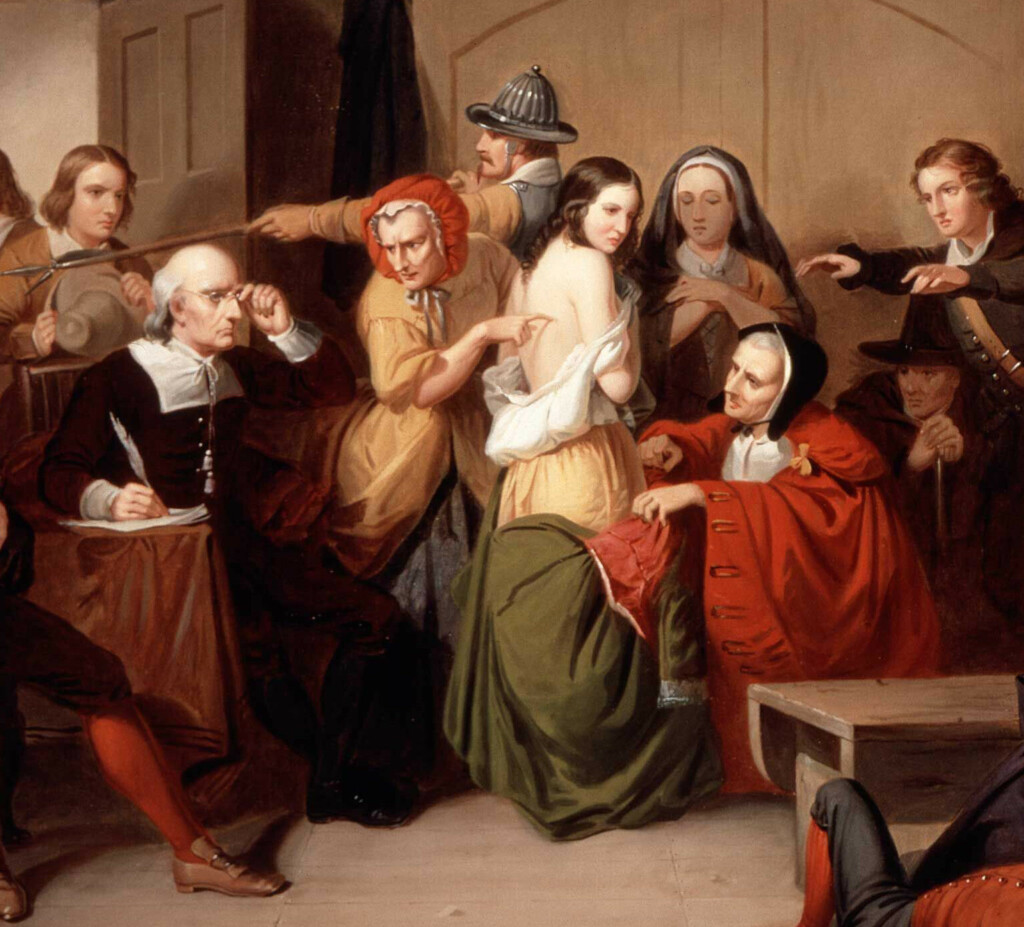
You are standing in a room that smells of wet stone and tallow smoke, and someone is describing your body to a crowd. Not your actions. Not your words. Your body. The mole behind your left shoulder is a devil’s mark. The fact that you did not weep during the reading of the charges is proof of something. The midwife who examined you this morning found a supernumerary nipple — or said she did — and that finding is now entered into the record as evidence. You have not committed a crime in any recognizable legal sense. You have simply been a body that someone, for reasons that may have nothing to do with you at all, decided to read aloud in the wrong register.

The witch trials of early modern Europe were not aberrations of superstition in an otherwise rational age. They were a technology. Between roughly 1450 and 1750, somewhere between 40,000 and 60,000 people were executed for witchcraft across European territories, and historians like Brian Levack, in his 1987 work The Witch-Hunt in Early Modern Europe, have demonstrated that approximately 75 to 80 percent of those killed were women. This is not incidental. The female body had become, by the fifteenth century, a specific kind of legal and theological text — one that required authorized interpreters and could always be made to say the wrong thing. The Malleus Maleficarum, published in 1486 by Heinrich Kramer and Jakob Sprenger, codified what had previously been a loose set of misogynist anxieties into something that functioned like a diagnostic manual. It argued that women were more susceptible to demonic influence by nature of their incomplete rationality, their voracious sexuality, and their fundamental instability of character. The body itself became the index of this instability.
What makes this particular machinery so durable — and so worth examining with precision — is the way it converted social suspicion into physical proof. The accused did not need to have done anything. She needed only to have a body that could be interpreted. Pricking tests were administered to locate insensate spots on the skin. Swimming tests operated on the logic that water, a medium associated with baptism and therefore with God, would reject the witch’s body. If you floated, you were guilty. If you sank, you were innocent but often dead. The epistemological violence here is nearly elegant in its closure: the body was the evidence, the interpreter controlled the reading, and the accused had no metalanguage available to her. She could not step outside the system of signs that had been built around her flesh.
Silvia Federici, in her 2004 study Caliban and the Witch, pushed the analysis further by situating the hunts within the broader project of primitive accumulation — the forcible reorganization of European social life that preceded capitalism. The women most frequently targeted were healers, midwives, widows living outside male household structures, and women who held informal community authority over reproduction and local medicine. Federici’s argument is that the trials served to discipline an entire class of women whose bodies represented autonomous knowledge — knowledge of contraception, of childbirth, of herbal treatment — at precisely the moment when that knowledge needed to be expropriated and transferred to male-controlled institutional medicine. The body being read as suspect was also, specifically, a body that knew things it was no longer permitted to know.
This reframing does not make the witch trials merely economic or merely ideological. It makes them something more unsettling: a demonstration that the female body has historically functioned as contested terrain, a site where social order gets written and rewritten, often in blood. The question of who controls the interpretation of that body — who decides what a physical mark means, what a silence means, what a floating means — is not a question that closed when the last trial ended.
The Witches of Mount Sciliar

Docufiction, by Andrea Dalfino, 2022, Italy.
The Witches of Scillar is a documentary that delves deeply into the trials that took place in Alto Adige, in Castel Presule and surrounding areas at the beginning of the 16th century, following which more than 10 were condemned to the stake on charges of witchcraft, becoming the real and precursors of the infamous Witch Hunt. Starting from the analysis of the historical context and intertwining local legends with actual events and analyzing the locations of the events with the help and guidance of experts, this film offers a new historical perspective on what happened, culminating with the exposition of what remains of the witches in South Tyrol today and how the crimes of the inquisition are judged in retrospect today.
Alto Adige is a land full of mystery, where history and legend are intertwined, with its magical and fascinating scenarios that push the mind and imagination to wander, investigate, discover. Here is the Sciliar, a suggestive mountain massif located in the natural park of the same name against the backdrop of the Dolomites, and no other mountain is so full of myths and legends as this one, on which it is said that fairy creatures and spirits of all sorts live , and in the Middle Ages it was held up as a meeting place for witches and devils. Here, during the time of the Inquisition, 10 women accused of witchcraft were tried and killed. Director Andrea Dalfino made the documentary The Witches of the Sciliar, enriching the film with fictional scenes that retrace the intricate events of the Fiè trial.
LANGUAGE: Italian
SUBTITLES: English, Spanish, French, German, Portuguese
Misogyny Codified: The Malleus Maleficarum as Legal Architecture
You are sitting in a courtroom that has already decided your guilt before you entered it. The bench, the procedure, the taxonomy of your crime — all of it assembled not from evidence but from a prior conviction about what kind of creature you are. This is not a metaphor. For thousands of women across the Holy Roman Empire, the Rhineland, and the Alpine territories between the 1480s and the early seventeenth century, this was the literal architecture of their death.
Heinrich Kramer did not write a work of superstition. That framing is itself a historical alibi, a way of making the Malleus Maleficarum seem like a relic of credulity rather than what it actually was: a procedural manual, a bureaucratic instrument, a legal technology. Published in 1486 and reprinted at least fourteen times before 1520, the Malleus circulated not through the channels of folk belief but through courts, episcopal offices, and secular tribunals. It told prosecutors how to extract confessions, how to evaluate testimony, how to classify the body of the accused as evidence. It was less a theology of evil than a forensics of femininity.
Kramer’s central argument was not that some women practiced magic. It was that women, by nature of their constitution, were structurally more susceptible to demonic influence than men — and this susceptibility was framed not as a misfortune but as a moral failing. He drew directly on Thomas Aquinas‘s reading of Aristotle to establish women as imperfect males, deficient in rational faculty, governed by appetite rather than reason. This was not fringe doctrine. Aquinas had written in the Summa Theologica in the 1260s that the female is a misbegotten male, a formulation itself borrowed from Aristotle’s Generation of Animals written around 350 BCE, in which the female contributes only matter to reproduction while the male contributes form — that is, essence. Kramer compressed seven centuries of philosophical authority into a juridical instrument and handed it to inquisitors as a set of operating procedures.
What made the Malleus lethal was not its theology but its epistemology. It systematically dismantled the evidentiary standards that would have protected the accused. Kramer argued that witchcraft, by its secret and diabolical nature, could not be proven by conventional witness testimony, which meant that confession — extracted through torture — became the primary mode of establishing guilt. He also ruled that witnesses who were themselves of suspect character, including accomplices and heretics, could testify against the accused. This was a closed loop: the impossibility of conventional proof justified extraordinary measures, and those measures guaranteed the production of the evidence that had been predetermined to exist. Sociologist Nachman Ben-Yehuda, analyzing the witch trials in his 1980 article in the American Journal of Sociology, identified this as a self-validating system — a social mechanism that generates precisely the deviance it claims to discover.
The text also did something subtler and more durable: it gendered the category of maleficence itself. Crimes of disruption, of social disorder, of illicit power operating outside sanctioned channels — these were mapped onto the female body as its natural expression. The witch was not a woman who did something wrong. She was wrong in her essence, and her actions were simply that essence made visible. This distinction matters because it foreclosed the possibility of innocence. A man accused of a crime could demonstrate his conformity to the norm. A woman accused of witchcraft was accused of being what she was, which meant the only exculpation available was the erasure of her selfhood entirely — recantation, submission, the performance of annihilation.
The Malleus was formally denounced by the Inquisition in Kramer’s own lifetime. The institution distanced itself from the text even as secular courts continued using it. That gap — between official disavowal and practical application — is where legal architecture actually lives, not in what a system claims about itself but in what it produces.

The Economic Substrate of Persecution
You are in the market square the morning after they took the old woman from the edge of the village, and you notice something nobody says out loud: her herb garden has already been cleared. The plot where she grew pennyroyal and tansy and the roots whose names she alone remembered has been turned over, and a fence post marks one corner of it. The speed of that erasure is the real confession.
Silvia Federici spent decades reconstructing what that speed meant, and the argument she built in her 2004 book is one of the most uncomfortable pieces of historical materialism produced in the last half-century, because it refuses to let the witch trials remain a story about superstition or religious hysteria. The persecutions peaked between 1580 and 1630 — a window that overlaps almost perfectly with the enclosure of the commons across England and the European continent, the legal and violent process by which land held collectively for centuries was transferred into private ownership. Federici’s claim is not merely that these two phenomena coincided. She argues they required each other. The woman who knew which plants interrupted pregnancy, who midwifed her neighbors through birth and grief, who held the accumulated reproductive knowledge of a community, was an obstacle to a specific economic transformation — the transformation that needed bodies to be productive in a new and measurable way, that needed reproduction itself to become a function of the emerging labor market rather than a collective practice managed by women outside male and ecclesiastical supervision.
What makes this argument land on the body rather than in the library is the question of what was actually criminalized. The charge of witchcraft in the sixteenth and seventeenth centuries was routinely attached to knowledge — herbal knowledge, obstetric knowledge, the ability to cause or prevent pregnancy, to accelerate or complicate birth. The Malleus Maleficarum, written by Heinrich Kramer in 1486, devoted substantial attention to witches who “impede the generative act” or cause sterility, and Kramer was not inventing a fantasy. He was identifying, with predatory precision, the specific competencies that needed to be suppressed for a new regime of population management to take hold. When a peasant economy gives way to one in which labor-power must be continuously reproduced and delivered to emerging markets, control over reproduction cannot remain in the hands of women who answer to a village and its accumulated customs. It must be medicalized, institutionalized, supervised by men with credentials issued by the new professional order.
The timing of the university-trained physician’s rise to dominance over childbirth runs directly parallel to the elimination of the midwife as a figure of authority. By the late seventeenth century, in the regions where prosecution had been most intense, the male obstetrician was beginning to replace the female practitioner — not because his outcomes were better, which they were demonstrably not, but because his practice was legible to the new apparatus of the state. Legibility, here, is not a metaphor. It means recordable, taxable, controllable, disconnected from the informal female networks of knowledge transmission that had no documentation because they had never needed any.
Federici pushes further into territory that economic historians rarely follow her into: the argument that the destruction of commons and the destruction of female reproductive autonomy were not parallel processes but a single process with two faces. Common land sustained the possibility of subsistence outside the wage relation. Women’s reproductive knowledge sustained the possibility of managing fertility outside the demands of labor supply. Both had to go simultaneously, and the theological language of demonology gave the violence a grammar that ordinary property law could not yet provide. The stake was not punishment. It was pedagogy — a public lesson delivered at maximum cost to the body watching from the edge of the crowd, about what category of knowledge now belonged to whom.
Heresy of Autonomy: What the Accused Actually Did
You own a small plot of land on the edge of the village. Your husband died three winters ago, and you did not remarry. You know which roots bring down a fever and which bark calms a laboring woman’s body. Neighbors come to you. You charge what you need. This, in the legal imagination of the sixteenth century, is a confession waiting to be extracted.
The biographical data assembled by historians over the last five decades collapses the mythology of the witch as a figure of supernatural menace into something far more banal and far more revealing. Lyndal Roper, in her 2004 study Witch Craze, documented that accused women in the German territories were disproportionately older, frequently postmenopausal, and living outside active male supervision — widows above all, but also spinsters, healers operating without guild authorization, and women who held property in their own names. These were not marginal outcasts universally despised by their communities. Many had been trusted figures for years before accusations surfaced. The timing of accusation frequently coincided with moments of economic friction: inheritance disputes, contested land boundaries, unpaid debts to the accused woman that became far easier to dissolve once she was imprisoned and discredited.
Anne Llewellyn Barstow’s Witchcraze, published in 1994, cross-referenced witch trial records across England, Scotland, France, and the German principalities and found that approximately seventy-five to eighty percent of those executed were women, with widows and women over forty constituting a striking plurality within that group. The reproductive utility that patriarchal economies assigned to women had, for these individuals, expired or been declined. They had stepped, whether by circumstance or design, outside the transaction that structured female existence: the exchange of reproductive labor and domestic subordination for male economic protection. Once outside that arrangement, their competence became threatening rather than useful. Their knowledge of herbs and bodies, which in a married woman would have been domestic virtue, became evidence of a pact with forces that operated beyond male authority.
Silvia Federici’s analysis in Caliban and the Witch, drawing on the transition from feudal to early capitalist land regimes, places the witch trials within the violent enclosure of the commons — the simultaneous seizure of communal land and the redefinition of female bodies as instruments of demographic production. Women who practiced contraception, who facilitated abortion, who shared reproductive knowledge outside the control of ecclesiastical or emerging state structures, were not simply committing heresy in the theological sense. They were disrupting an emerging economic logic that required predictable, controllable population growth to sustain expanding labor markets. The midwife, the herbalist, the woman who knew how to end a pregnancy — her knowledge was a competing system of governance over bodies, and competing systems of governance are not tolerated by consolidating powers.
What makes the sociological profile so difficult to absorb comfortably is that it asks you to abandon the idea that persecution finds its targets randomly, or that it is driven purely by irrational fear. The accused were not random. Functional independence — economic, reproductive, epistemic — served as the organizing criterion of selection with a consistency that spans geography and confession. Protestant and Catholic courts alike prosecuted women whose lives demonstrated that female existence could be organized without male mediation at its center. The accused midwife in a Scottish burgh and the widowed landowner in a Rhineland village share no theology, no ethnicity, no personal story, but they share a structural position: they occupied social space that the consolidating logic of early modern governance needed to reclaim.
There is something almost bureaucratic in the pattern, once you see it clearly enough. The crime was not what they had done to crops or cattle. The crime was the demonstration, through lived example, that the architecture of dependence was not inevitable — that a woman could know, could own, could refuse, and still persist. That possibility required management.
The Confession as Technology of Self-Erasure
You are sitting in a chair that is not quite a chair — it is a structure designed to make your body a problem that only words can solve. The pain is not the point. The confession is the point. What the inquisitors understood, with a precision that no theorist had yet named, is that a woman who speaks her own guilt into existence becomes the author of her erasure, and the institution walks away clean.
Michel Foucault spent the last decade of his life excavating what he called “veridiction” — the ancient obligation to tell the truth about oneself as an act of self-constitution. His 1982 lectures at the Collège de France, later published as The Hermeneutics of the Subject, traced how certain confessional practices did not reveal a pre-existing self but manufactured one. The witch trial weaponized this dynamic with surgical efficiency. The accused was not asked to confirm what the court already knew. She was asked to narrate herself into a category that the court required her to inhabit. The confession was not evidence. It was fabrication dressed as disclosure.
The Malleus Maleficarum, published in 1487 by Heinrich Kramer and Jakob Sprenger, provided explicit procedural guidance on how to extract and shape these confessions. What is almost never discussed is the document’s deep anxiety about narrative coherence. Kramer and Sprenger worried obsessively about women who confessed incompletely, who admitted to small heresies but refused the full architecture of diabolism. The manual instructs judges to press for specific details — the sabbath, the pact, the names of accomplices — because only a sufficiently complete story produces a sufficiently complete witch. Partial confession created a partial creature, legally and ontologically ambiguous. Full confession created a category. The category, once spoken, justified everything that had already been done to extract it.
This is the trap with no outside. A woman who refused to confess was tortured until she did. A woman who confessed was executed as a witch. The only variable was how long the middle part lasted. But what made this machinery so historically durable was not its brutality — brutality is common and forgettable — it was its epistemological elegance. The institution never claimed to be producing truth. It claimed to be receiving it. The woman’s own voice was the mechanism. Her tongue, her words, her first-person narration transformed institutional violence into self-revelation. Judges did not create witches. Witches, speaking, created themselves.
The sociologist Lyndal Roper, in her 2004 work Witch Craze, spent years reading actual trial transcripts from sixteenth and seventeenth century Bavaria and found something deeply uncomfortable: many accused women elaborated their confessions beyond what was asked of them. They added details. They named specific nights, specific sensations, specific agreements with figures they described with unexpected intimacy. Roper’s interpretation refuses the comforting explanation of pure coercion. What she identifies instead is a process by which women, under extreme psychological and physical pressure, began to inhabit the narrative offered to them — not because they believed it, but because the narrative gave shape to suffering that had no other available language. The confession became the only coherent story available for what was happening to their bodies.
This is the dimension that purely structural accounts miss. The witch trial did not simply punish women. It recruited their interiority as the instrument of punishment. It made self-narration into a weapon aimed inward. Every detail a woman added, every name she supplied, every sabbath she described with hallucinatory specificity, tightened the architecture of a category that would consume her. What Foucault saw in confessional culture broadly — that speaking oneself truthfully is always already a form of subjection to the one who receives the truth — the witch trial enacted with a totality that peacetime institutions could never quite achieve.
And the category, once established through enough women’s voices, stopped needing individual confessions to survive.
A vision curated by a filmmaker, not an algorithm
In this video I explain our vision
Continuity Without Costume: Contemporary Equivalents

You are sitting in a fluorescent-lit room, and the person across the desk from you has a clipboard. You have described something that happened to your body. They are writing, but not what you said — they are writing their interpretation of what you said, which is a different document entirely, and that document will travel farther and last longer than your voice ever will.
The structure that produces this moment did not begin in the twentieth century. When the Malleus Maleficarum was published in 1486 by Heinrich Kramer, it codified something that was already culturally operational: the principle that a woman’s account of her own experience requires external verification in a way that a man’s does not. The witch did not simply stand accused — she stood accused of lying about her own innocence, which meant the burden of proof was inverted before she opened her mouth. What is remarkable is not that this logic existed in the fifteenth century but that it migrated, intact, into institutions that consider themselves its opposite.
Kate Manne’s work in Down Girl, published in 2018, identifies what she calls “himpathy” — the structural tendency of social and legal systems to extend interpretive generosity toward men while subjecting women’s testimony to a skepticism framed as rigor. This is not bias in the colloquial sense, the accidental distortion of an otherwise fair system. It is the operating logic of the system itself, which means correcting for it requires not adjustment but demolition. In courtrooms adjudicating sexual violence, the credibility gap functions precisely as the inquisitorial procedure did: the accused’s denial carries epistemic weight that the accuser’s claim does not, and the mechanisms invented to evaluate testimony — prior sexual history, demeanor analysis, delay in reporting — serve primarily to produce doubt rather than truth.
Medicine performs its own version of this epistemological asymmetry. The research of Diane Hoffmann and Anita Tarzian, published in the Journal of Law, Medicine and Ethics in 2001, documented that women’s reports of pain are systematically undertreated compared to men’s, that women are more frequently diagnosed with psychological causes for symptoms later identified as physiological, and that the distance between a woman’s description of her body and a clinician’s recorded interpretation of it is measurably wider than the equivalent distance for male patients. Endometriosis affects an estimated 190 million people globally, and the average diagnostic delay runs between seven and ten years — years spent being told that the experience is manageable, psychosomatic, exaggerated. The body as unreliable narrator is an ancient accusation wearing a stethoscope.
Reproductive autonomy enters this architecture at the point where the policing becomes legislative. What the witch trial accomplished through ecclesiastical and civic authority — the removal of a woman’s claim over her own body by framing that claim as dangerous to the community — contemporary law accomplishes through precisely the same rhetorical move: the body in question is redefined as a public concern, its autonomy as a threat to an order that must be protected from it. The language shifts from sin to safety, from heresy to health, but the jurisdictional claim is identical. Someone else acquires the authority to adjudicate what happens inside a body that is not theirs.
What makes these continuities difficult to see is that they carry no costume. The inquisitor wore robes; the epistemological structure he operated within now wears bureaucratic neutrality, clinical objectivity, juridical proceduralism. Silvia Federici, in Caliban and the Witch, argued that the witch hunts were not an aberration of early modernity but a constitutive violence — the mechanism by which a new economic and social order disciplined the bodies it needed to control. If she is right, then the question is not whether that mechanism was eventually dismantled, but what it became when it learned to describe itself as something else.
The Spectator's Complicity and the Social Utility of Fear
You are already watching before you realize you have chosen to watch. The village square fills, the crowd thickens, and something in you does not leave — not because you are cruel, but because the spectacle carries a message addressed specifically to your body, your sex, your daily negotiation with the boundaries of acceptable behavior. The accused woman at the center is, in this precise sense, a pedagogical instrument, and the lesson is never about her.
René Girard’s 1972 work La Violence et le Sacré mapped the mechanism with clinical precision: the community selects a victim who concentrates collective anxiety, expels or destroys that victim, and achieves a temporary social cohesion that would otherwise be impossible. What Girard did not emphasize, but what the historical record of early modern Europe makes unmistakable, is that the scapegoat mechanism operates with far greater refinement when the victim belongs to a socially legible category — when the selection is not random but systemic. Between 1580 and 1650, in the territories that now constitute Germany alone, somewhere between thirty and forty thousand people were executed for witchcraft, and the demographic consistency of the accused across decades and geographies was not accidental noise. It was signal. The target was a type, and the type was being communicated to everyone watching who shared its features.
Behavioral conformity does not require that everyone be punished. Solomon Asch demonstrated this in 1951 with nothing more than lines on paper: a subject surrounded by confederates giving obviously wrong answers would abandon correct perception rather than stand alone. Translate that dynamic into a context where the wrong answer ends in burning, and the conformity curve becomes absolute. Proximity to visible punishment does not merely deter the specific prohibited act — it reorganizes the entire experiential field of the observer, shrinking the range of gestures, words, associations, and relationships that feel safe. Women who watched a neighbor accused did not simply avoid whatever that neighbor had been accused of doing. They became more careful in every direction simultaneously, a diffuse self-surveillance that required no enforcer beyond the memory of what they had witnessed.
Keith Thomas in Religion and the Decline of Magic, published in 1971, documented something crucial buried in the accusation records: the women most frequently targeted were those who had refused a request — a neighbor asking for milk, grain, a small loan — and whose refusal was followed by misfortune befalling the requester. The accused had said no. The psychological inversion embedded in this pattern is extraordinary: the person who experienced guilt for having refused then displaced that guilt outward onto the woman who had maintained her boundary. What the community then punished, publicly and ritually, was precisely an act of female refusal. The watching women understood the grammar of this without needing it explained.
What makes this structure so tenacious is that it does not require conscious conspiracy. No magistrate needed to write in his notes that the purpose of a trial was to discipline the female population into compliance. The mechanism is self-executing because it runs on affect — on fear, on the need to belong, on the animal calculation that the accused woman is not me only as long as I remain nothing like her. Michel Foucault‘s insight about the panopticon — that surveillance becomes most effective when internalized, when the watched begin to watch themselves — finds its most complete historical instantiation not in the prison architecture he described in 1975 but in the open-air theater of the witch trial, where the audience was simultaneously the intended target and the mechanism’s most essential component.
The hunt was never finished when the accused died. It was finished when the women watching returned home and adjusted themselves accordingly — smaller, quieter, more careful with whom they healed, whom they refused, and what they knew.
Knowledge as the Original Transgression
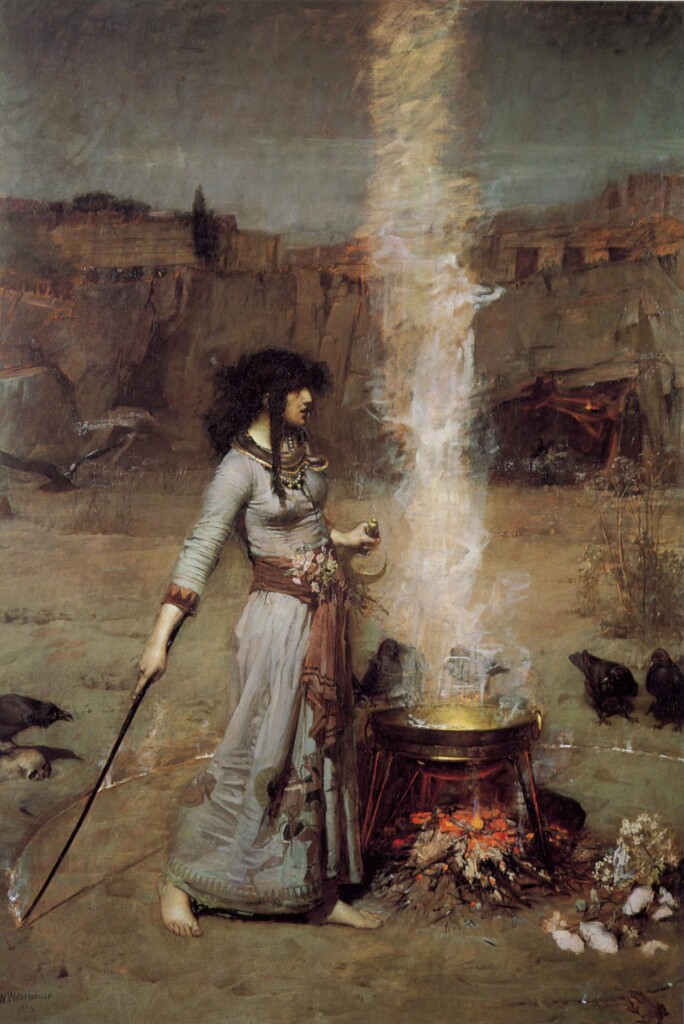
You are standing in a garden that does not belong to you anymore. The herbs are still there — yarrow, pennyroyal, black cohosh, the dense and bitter tangle of centuries — but the knowledge of what they do, how much, in what season, has been severed from you so cleanly that you experience the severance as nature, as the way things always were.
The accusation was never really about the devil. The devil was administrative. What the inquisitors, the village priests, the newly credentialed physicians of the fifteenth and sixteenth centuries were actually prosecuting was a rival epistemology — a system of knowing the body that derived its authority not from university Latin or ecclesiastical hierarchy but from proximity, repetition, and transmission between women across generations. Silvia Federici, in Caliban and the Witch published in 2004, documented with considerable precision how the criminalization of female healing knowledge coincided almost exactly with the professionalization of medicine in Europe, a process that systematically excluded women from formal guilds and then prosecuted the informal practice that exclusion forced them to maintain. The timing is not coincidental. It is structural.
What made botanical expertise threatening was not its potential for harm but its potential for autonomy. Reproductive knowledge — how to delay pregnancy, how to interrupt it, how to manage the rhythms of a body over a lifetime — represented a specific form of female self-determination that operated entirely outside male institutional authority. Barbara Ehrenreich and Deirdre English, in their 1973 study Witches, Midwives, and Nurses, traced how the midwife’s domain over birth was gradually colonized by male obstetrics, a process requiring not just professional displacement but the delegitimization of everything the midwife carried in her hands and memory. To make the new authority legible, the old one had to be made criminal.
There is something precise that happens when a form of knowledge is not simply defeated but made shameful. The knowledge does not merely disappear — it becomes unspeakable, and in becoming unspeakable it becomes unthinkable, and eventually the people who might have carried it begin to experience their own ignorance as innocence. This is a more complete form of dispossession than burning a library. A burned library is still a wound you can point to. But when the destruction is metabolized as natural, when women in the seventeenth century began to believe that their bodies were legitimately mysterious to themselves and properly legible only to male doctors, the expropriation became self-sustaining.
Michel Foucault‘s analysis of the clinical gaze in The Birth of the Clinic, published in 1963, identified how the reorganization of medical knowledge in the eighteenth century positioned the patient’s body as an object to be read by a trained external observer rather than a subject with interior knowledge of itself. What his framework does not fully foreground is that this reorganization landed with catastrophically different weight on bodies that had already been told their self-knowledge was heresy. The epistemological dispossession was gendered before it was generalized.
What this means is that gender control was never primarily about behavior. Behavior is downstream of knowledge. Control the categories through which a person understands her own body, her own fertility, her own pain and its remedies, and you have controlled something far more fundamental than her conduct — you have controlled the terrain on which she could even begin to resist. The witch hunt’s deepest violence was not the fire. It was the systematic dismantling of an entire mode of knowing — embodied, relational, transmitted through practice rather than text — and the replacement of that knowing with authorized ignorance dressed as protection. What remains is a civilization that still, centuries later, treats female self-knowledge as presumptuous, that still asks women to defer to external experts on the most intimate territories of their own existence, and calls this deference health.
🔥 When Bodies Become Battlegrounds of Power
Witch hunts were never simply about superstition or fear of the unknown — they were systematic instruments for controlling women’s bodies, knowledge, and autonomy. To understand this archetype of gender violence is to trace a long history of exclusion, moral condemnation, and institutionalized terror that echoes powerfully into the present.
Gender-Based Violence: History, Data and Prevention Tools
Gender-based violence is not an aberration but a structural feature of societies built on hierarchies of power. Understanding its historical roots — from medieval persecution to contemporary femicide — reveals how the body of the woman has long been treated as a political territory to be governed, punished, and disciplined. The witch hunt is perhaps the most dramatic chapter in this uninterrupted story of control.
GO TO THE SELECTION: Gender-Based Violence: History, Data and Prevention Tools
The roots of social prejudice and the mechanisms of exclusion
Social prejudice does not emerge spontaneously: it is constructed, codified, and transmitted through institutions, language, and collective rituals of exclusion. The mechanisms that branded women as witches — denunciation, spectacle, confession under torture — are the same mechanisms that define every form of social marginalization across history. Examining these structures helps us recognize how persecution legitimizes itself through the language of order and morality.
GO TO THE SELECTION: The roots of social prejudice and the mechanisms of exclusion
Wollstonecraft’s A Vindication of the Rights of Woman
Mary Wollstonecraft‘s foundational text stands as one of the first systematic refusals to accept the reduction of women to passive, dangerous, or irrational beings — precisely the stereotypes that fueled centuries of persecution. Her argument that women’s apparent irrationality was the product of deliberate social conditioning resonates directly with the logic behind witch hunts. To read her is to understand how gender control operates through education, law, and the very definition of the human.
GO TO THE SELECTION: Wollstonecraft’s A Vindication of the Rights of Woman
The Contemporary Feminist Movement: History and Key Figures
The contemporary feminist movement did not emerge from a vacuum but from centuries of accumulated resistance against exactly the kind of gender violence that witch hunts represent at their most extreme. Tracing its history and key figures illuminates how women have continuously reclaimed their bodies, voices, and social legitimacy against structures designed to silence them. The archetype of the witch — dangerous, independent, knowledgeable — has been reclaimed as a symbol of that ongoing resistance.
GO TO THE SELECTION: The Contemporary Feminist Movement: History and Key Figures
Discover the Cinema That Dares to Tell These Stories
If these themes ignite something in you, independent cinema is where they burn brightest. On Indiecinema you will find films that refuse comfortable narratives and explore power, gender, and resistance with the courage that only independent voices can afford — come and discover them.
👉 EXPLORE THE CATALOG: Watch Indie Films in Streaming
A vision curated by a filmmaker, not an algorithm
In this video I explain our vision

