
The Person Who Is Still There
You sit across from her at the kitchen table where she once corrected your homework, and she looks at you with the polite, slightly wary expression she reserves for strangers. The coffee you made is going cold between her hands. She does not know your name. She does not know she ever knew your name. And you smile back at her because there is nothing in the entire architecture of human social behavior that has prepared you for what you are supposed to do with your face right now.

The body is present. The breath is there, the warmth, the familiar angle of the jaw. What is absent is harder to name precisely because every language we have built for absence assumes a before and an after divided by a single, dateable event. We have funerals because we need a moment to stand on, a coordinate in time around which the people who loved someone can organize their devastation. Grief, as most people have been taught to experience it, is retrospective. It looks backward at something finished. What happens when the loss is ongoing, accumulative, and refusing the dignity of a clean edge — when you are asked to mourn someone who will be sitting across from you again tomorrow morning, reaching for coffee they will not remember drinking?
Elisabeth Kübler-Ross published On Death and Dying in 1969, and her five stages became so embedded in popular culture that people began using them as a checklist, an itinerary for the interior life. What almost nobody discusses is that Kübler-Ross developed her framework primarily by interviewing terminally ill patients about their own approaching deaths, not by studying the people watching someone they loved disappear incrementally from the inside. The model was never designed for the witness. It was built for the one departing, and we have been pressing the bereaved into its shape ever since, which is a little like handing someone drowning in open water a manual written for people standing at the edge of a swimming pool.
Pauline Boss, the family therapist who spent decades working with families of soldiers declared missing in action after Vietnam, coined the term “ambiguous loss” in the 1970s to describe exactly this structure of grief without closure. Her research, formalized in Ambiguous Loss: Learning to Live with Unresolved Grief published in 1999, identified two distinct forms: the person who is physically absent but psychologically present, and the person who is physically present but psychologically absent. It is the second category that carries a specific cruelty, because it produces grief that the world around you does not recognize as grief. You cannot take bereavement leave for it. You cannot receive casseroles or condolence cards. The person is still there, after all. People will tell you this, helpfully, as though you had somehow failed to notice the body in the chair.
There is a particular social conspiracy of optimism that surrounds illnesses like Alzheimer’s, like certain late-stage depressions, like the slow personality erasure that follows some neurological events. The conspiracy insists on progress reports, on good days, on the sentence “but she still recognizes you sometimes, doesn’t she?” — as though partial recognition were a form of wholeness, as though love could be divided into percentages and the remaining fraction should be enough to suspend your mourning. What this optimism actually does is enforce silence. It teaches the person who is losing someone alive to distrust their own experience, to feel guilty for grieving prematurely, to perform a hope they do not feel in order to make the people around them more comfortable.
The relationship has already ended. The specific relational being — the one who knew your history, who carried the shared private language of years, who could finish your sentences because they had heard the first half of every story you owned — that person is gone.
Days Blows by in a Moment
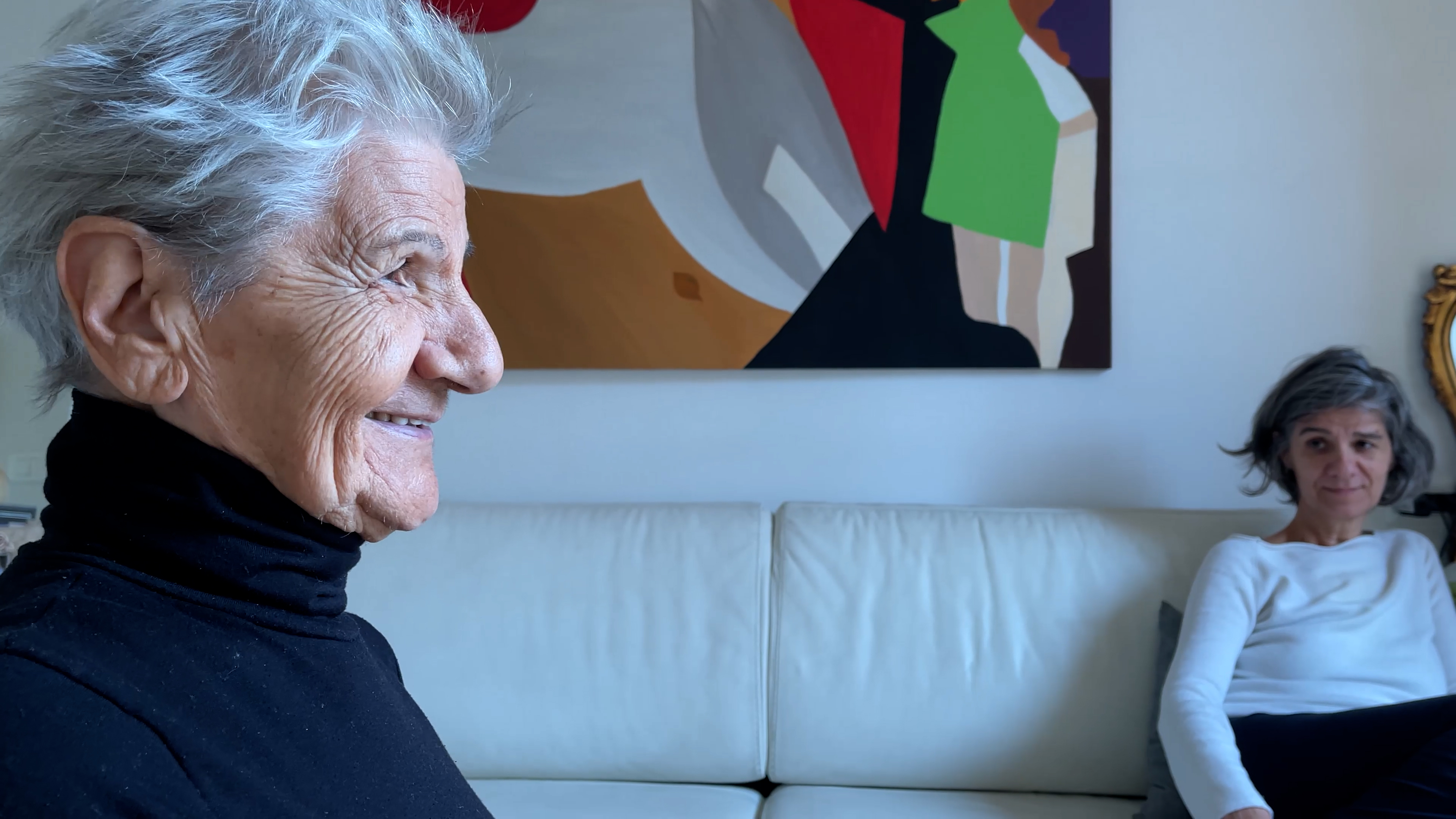
Documentary, by Cristiana Donghi, Italy, 2022.
Ancilla is 86 years old. Two years ago, she moved in with her daughter Emanuela at the pandemic's beginning. Ancilla is slowly losing her memory. He does not remember what she had for lunch, she only remembers events from the past, perhaps only because she has been repeating them for years. Emanuela takes care of her, day after day she wakes her up, prepares her food, washes her, dresses her, and accompanies her a couple of days a week to the hospice and does physiotherapy. This is one of the few contacts with the rest of the world she has left. Ancilla has another child, Mauro, who has been living in London since he left looking for a job. She hasn’t seen him for two years. Daily routines always repeat themselves and change only with the changing seasons. The mother's memories slowly introduce us to Ancilla, her past, the life she lived and that transported her here. Melancholy moments alternate with funny ones and those where patience reaches its limits. Ancilla's sympathy brings a light, fresh breeze into the lives of those around her and allows them to see everything in a way where even the most ominous clouds are blown away momentarily by a breath of wind.
LANGUAGE: Italian
SUBTITLES: English, Spanish, French, German, Portuguese
Grief Without Permission
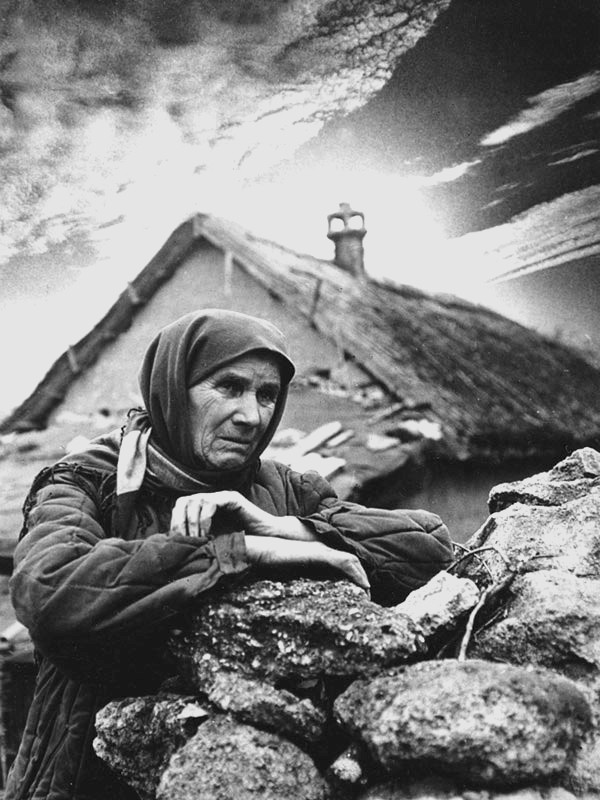
You sit across from your mother at the dinner table and she asks you, for the third time in twenty minutes, what day it is. You answer. You watch her write it down on a notepad she keeps beside her plate. She smiles at you with complete sincerity, as though the question is new, as though you are new, as though this whole quiet catastrophe is entirely invisible to her. And you understand, somewhere beneath language, that you are already grieving. But there is no word for what you are doing. There is no form to fill out. There is nowhere to put it.
Western mourning infrastructure is built on a single load-bearing assumption: that loss requires a body. The architecture is precise and ancient in its logic — the funeral, the burial, the condolence card, the three to five days of bereavement leave granted by an employer who has decided, institutionally, what an appropriate unit of sorrow looks like. These rituals are not arbitrary. They emerged from centuries of theological and social negotiation over how communities absorb the shock of death. But their organizing principle is biological finality, the stopped heart, the signed certificate, the closed casket. Everything before that moment is, in the grammar of collective mourning, not yet real.
Philippe Ariès spent decades excavating the history of Western attitudes toward death, and in his 1977 work “The Hour of Our Death” he traced a long and damning arc: the gradual removal of dying from the center of communal life into the antiseptic margins of clinical institutions. In medieval Europe, death was a public event, socially witnessed and ritually absorbed. The dying person held court, offered farewells, participated in their own departure. By the twentieth century, Ariès argued, death had been sequestered — hidden in hospital rooms, managed by professionals, stripped of its social theater. The living were protected from it. The dying were isolated within it. The result was not comfort but illegibility: a culture that had lost the vocabulary to process mortality as it actually unfolds, which is slowly, across months and years, long before the final hour.
What Ariès could not fully anticipate was the specific cruelty this sequestration would inflict on those grieving someone who has not yet died. If death itself had become socially invisible, anticipatory grief had become doubly so — invisible even to the grieving person, who has no cultural mirror in which to recognize what they are experiencing as legitimate mourning. The sociologist Kari Bø Rygg, writing on ambiguous loss in dementia caregiving contexts, observed that caregivers consistently reported feeling fraudulent in their own sorrow, as though grief required external permission they had not been granted. This is not a psychological deficiency. It is the entirely rational response to a culture that has built no ceremony, no language, and no institutional recognition around the loss of a person who is still breathing.
Ambiguous loss, a term the psychologist Pauline Boss introduced in her 1999 book of the same name, names the condition of loving someone who is simultaneously present and absent — the dementia patient who sits at the table but no longer knows your name, the parent whose body continues while their history with you quietly dissolves. Boss documented how this particular form of loss produces grief that cannot complete itself, cannot move through the stages that popular psychology has trained people to expect, because there is no terminus, no event, no moment at which mourning is socially authorized to begin. The loss is ongoing and unwitnessed. And because it is unwitnessed, it is also, in the cruelest bureaucratic sense, unrecognized — absent from bereavement policies, absent from condolence rituals, absent from the collective grammar of sympathy that a community extends to those who have lost someone they love.
The person sitting across from you at that dinner table is still alive. Which means, by every official measure, you have lost nothing yet.

The Self That Disappears Before the Body Does
You are sitting across from someone you have known for thirty years, and they are looking at you with a kind of openness that used to mean recognition, but now means something closer to welcome — the look a person gives a stranger they find pleasant. The room is the same. The hands on the table are the same. But the navigation system that once ran between you, that silent mutual geography built from shared memory and private language, has gone quiet.
Therese Rando, in her 1986 clinical work on anticipatory grief, was among the first to insist that what happens in this moment is not pre-grief, not rehearsal, not a dry run for the real loss to come. It is loss itself, already in motion, already accumulating damage. Her distinction carries weight precisely because the culture around dying tends to treat grief as an event with a start date, something that officially begins at death and not a day before. Rando saw that the mourning begins the moment the person in front of you starts to become someone else — when the illness rewrites personality, or dementia erodes the architecture of a self, or the body begins its long withdrawal from everything it once made possible. The bereaved is not waiting. They are already in the wreckage.
What makes this psychologically unnavigable in ordinary terms is the simultaneity it demands. The griever must hold two contradictory relational postures at the same time: full presence with the person who is still there, and a mourning that has no grave, no ceremony, no social permission to be public. Rando distinguished this from what she called preparatory grief — the quiet, internal bracing that a person does when they know death is near but the relationship is still essentially intact. Anticipatory grief is something more destabilizing, because the object of mourning has not departed. They are in the chair. They are asking for water. They are laughing at something on television. And yet the person who used to argue with you about that film, who remembered the name of your first apartment building, who knew without asking how you take your coffee — that person is being unmade in real time, and there is no ritual language for what you are losing because the loss has no singular moment, no date to mark.
The clinical literature on ambiguous loss, developed by Pauline Boss across decades of research including her 1999 book of the same name, identifies this as one of the most psychologically corrosive forms of grief precisely because it cannot be resolved. Resolution requires closure, and closure requires an ending that is legible. A death produces documentation, a body, a funeral, a legal restructuring of the world. The dissolution of a person while they remain biologically present produces none of these. The griever is left in a permanent liminal state, mourning something that society still insists is not yet gone.
This creates a specific cognitive schism that ordinary grief does not impose. The mourner must continue to act within the relationship — to make decisions on behalf of the person, to maintain caregiving, to sustain interaction — while privately processing a loss that is already profound. There is no clean separation between grieving and relating. Every tender act of care is shot through with the awareness that it is also a form of farewell. Every moment of connection is also evidence of what has already been lost, because the connection itself is now asymmetrical in ways it never was before, built on one person remembering and another person slowly forgetting, one person holding the full weight of the shared past while the other grows lighter by the day.
Love as a Form of Sustained Disorientation

You have built yourself, quietly and without noticing, around another person. Not in the sentimental sense, not in the way love songs mean it, but architecturally — the way a city builds itself around a river that has always been there. Your rhythms, your reflexes, your private vocabulary, the specific angle at which you tolerate uncertainty: all of it calibrated, over years, in relation to someone whose presence you absorbed so completely it stopped feeling like a relationship and started feeling like a feature of reality itself.
John Bowlby spent decades demonstrating that this is not metaphor but biology. His attachment theory, developed across three volumes published between 1969 and 1980, argued that the bonds formed with primary figures are not decorative additions to the self — they are structural. The nervous system literally organizes itself around proximity to the attachment figure: their voice, their predictability, their availability as a safe base. When that base begins to shift — not disappear cleanly, but shift, slowly, like ground softening before it gives — the nervous system does not receive a clear signal of loss. It receives something far more disorienting: a continuous, low-frequency alarm with no identifiable source and no actionable response.
This is the specific cruelty that Pauline Boss named in 1999 with surgical precision. Ambiguous loss, she argued, is not a variant of ordinary grief — it is a structurally different category of suffering, one that the dominant cultural grammar of loss is completely unequipped to process. The frameworks we inherit — mourning as a linear passage, grief as something that moves through stages toward resolution, closure as the destination — were built around a model of loss that is clean, final, and verifiable. Death certificates exist. Funerals exist. The moment of rupture is dateable. Ambiguous loss offers none of this. The person is present and absent simultaneously, and no ritual, no ceremony, no social acknowledgment is designed for that contradiction. Boss was not describing a psychological failure of the bereaved. She was describing a structural impossibility: you cannot grieve someone who is still in the room, and you cannot stop grieving them either.
What this produces in the self is not sadness in the ordinary sense but something closer to a persistent ontological confusion. You find yourself mid-sentence, about to reference something the person would have known — an old joke, a shared shorthand, a memory only the two of you hold — and you stop. Not because they are gone, but because the version of them who held that knowledge is no longer reliably present. The reference has nowhere to land. And in that suspended moment, you begin to understand that what is dissolving is not only them but the specific self that existed in conversation with them. The self that was funny in a particular way, or serious in a particular way, or permitted to be fragile in a particular way: that self was always partly constructed in their presence, for their presence.
Identity, when examined with any real honesty, is far less interior than we prefer to believe. William James noted in 1890 that a person has as many social selves as there are individuals who recognize them. Each relationship does not merely reflect a pre-existing self — it constitutes a portion of one. When a person begins to recede while still inhabiting the same body, the selves organized around them do not simply grieve. They lose their addressee. They continue speaking into a space that no longer responds in the ways that made the speaking feel like it meant something, and the silence that returns is not the silence of absence but the far stranger silence of a presence that can no longer confirm you back into existence.
The Trap of Anticipation Itself

You have told yourself, quietly, in the margins of ordinary Tuesday afternoons, that at least you will be ready. That knowing in advance is a kind of armor. That watching the slow withdrawal of someone you love — their words coming less frequently, their eyes focusing on something slightly behind your face — is painful, yes, but useful in the way that rehearsal is useful before a performance that cannot be cancelled.
This belief is not yours alone. It is embedded in the professional architecture of grief counseling, in the language of hospice brochures, in the way well-meaning people nod and say, at least you had time to say goodbye. The implicit contract is clear: foreknowledge purchases readiness, and readiness purchases a softer landing. The entire logic of anticipatory grief as a clinical category has, since John Bowlby’s attachment theory work in the 1970s and the popularization of Elisabeth Kübler-Ross’s stage model, leaned on this premise — that emotional processing done in advance depletes the eventual devastation, the way spending a currency before a crash leaves you with less to lose.
Camille Wortman’s longitudinal research, developed through the 1990s and consolidated in her challenges to stage-based grief models, dismantled this arithmetic with uncomfortable precision. Studying bereaved individuals over extended periods, Wortman and her colleagues found that those who had experienced prolonged anticipatory grief did not grieve less intensely after the death — and in several documented cases, they grieved more. The mechanism is not mysterious once named: prolonged anticipation does not drain the reservoir. It fills it. Every day of watching someone diminish is not a day of grief subtracted from the total; it is a day of grief added, compounded, layered over the previous days, until the actual death arrives not at the end of a process but as a rupture inside one that was already tearing.
What anticipation actually produces, in many cases, is not preparation but a peculiar form of chronological vertigo — the bereaved person living simultaneously in a present that still contains the living body of the loved one and in a future that has already, imaginatively, swallowed them whole. Paul Ricoeur wrote in Oneself as Another that identity is fundamentally narrative, that we understand who we are by the stories we can tell about our continuity across time. Anticipatory grief attacks this narrative from both ends simultaneously: the story of the relationship is still being written while the ending is already known, producing a text that no longer coheres, a grammar in which the present tense and the past tense occupy the same sentence.
The clinical literature sometimes describes a phenomenon called premature detachment, in which caregivers or family members begin emotionally withdrawing from a dying loved one months before death, unconsciously attempting to complete the grief in advance, to get it done. Studies in palliative care contexts have documented the guilt this generates — the person who pulls away, not from cruelty but from a kind of psychological self-defense, and then must carry the knowledge that in the final weeks, they were already half-gone. Anticipation, in this reading, does not protect the relationship. It can quietly cannibalize it.
And here is the thing that the armor-logic of anticipatory grief cannot absorb: the loss is not only the death. It is the loss of the version of yourself that existed inside the relationship. No amount of foreknowledge prepares you for the specific weight of a world in which a particular person is structurally absent, because that world does not exist until it does, and its texture cannot be imagined in advance, only entered. The anticipation gives you a map of a territory that has not yet been created, and when you finally arrive, the map and the territory share almost nothing, and you are standing in an unmapped place holding a document that describes somewhere else entirely.
A vision curated by a filmmaker, not an algorithm
In this video I explain our vision
💔 When Loss Begins Before the Goodbye
Anticipatory grief is one of the most disorienting forms of mourning — we grieve a person who is still present, caught between love and the shadow of absence. These related articles explore the emotional landscapes that surround this paradox: loss, family bonds, emotional silence, and the weight of time.
Grief and the Processing of Loss
Grief does not always arrive after death — it can begin long before, reshaping our inner world while the person we love is still with us. This article explores the psychology of loss and the stages of mourning, offering essential context for understanding why anticipatory grief carries such unique and often unacknowledged pain. Recognizing grief as a process rather than an event is the first step toward allowing ourselves to feel it fully.
GO TO THE SELECTION: Grief and the Processing of Loss
The Emotional Legacy of Parents: How the Past Shapes Us
The emotional legacy of our parents lives within us long before we face their decline or loss, shaping our fears, our habits, and our capacity for connection. This article examines how the patterns passed down through family relationships continue to define us even when those relationships are fragmenting or fading. Understanding this inheritance can help us navigate anticipatory grief with greater self-awareness and compassion.
GO TO THE SELECTION: The Emotional Legacy of Parents: How the Past Shapes Us
Masculinity and the Inability to Express Emotions
Many people — especially men — face the slow loss of a parent or loved one without the language to express what they are experiencing, trapped in a cultural silence around vulnerability. This article investigates the psychological and social roots of emotional repression and its cost in moments of profound human fragility. Anticipatory grief, when left unspoken, can calcify into something far harder to release.
GO TO THE SELECTION: Masculinity and the Inability to Express Emotions
Joan Didion and Loss: The Year of Magical Thinking
Joan Didion‘s raw and luminous account of losing her husband illuminates the way grief distorts time, memory, and the very sense of self. Though her loss was sudden, her reflections resonate deeply with those grieving someone still alive — the anticipation of absence reshapes the present in similar, disorienting ways. This article is an essential companion for anyone seeking to understand how great writers have transformed mourning into meaning.
GO TO THE SELECTION: Joan Didion and Loss: The Year of Magical Thinking
Discover Cinema That Speaks to the Heart
If these themes stir something deep within you, independent cinema offers some of the most honest and courageous explorations of grief, love, and the complexity of losing someone we cannot yet let go. On Indiecinema, you’ll find a curated selection of films that dare to look at the human condition without flinching — stories that hold space for the emotions we rarely know how to name.
👉 EXPLORE THE CATALOG: Watch Indie Films in Streaming
A vision curated by a filmmaker, not an algorithm
In this video I explain our vision

