
The Inherited Wound
You are in the middle of an argument you did not start — not really. Your voice has taken on a particular edge, clipped and cold, the kind that shuts a room down rather than opens it, and somewhere beneath the mechanics of whatever conflict is actually happening, a faint recognition flickers: you have heard this tone before. Not from yourself. From a doorway. From a kitchen. From a car ride where the silence was so dense it had texture. You learned this before you had language for it, before you understood that a person could wound another person simply by becoming very, very still.

The disturbing part is not that it happened. The disturbing part is that you did not decide to do it.
Something is operating in you that you did not install, and it runs with a fluency that your conscious intentions cannot match. The psychoanalyst Christopher Bollas, writing in 1987, called the earliest parental influence the “unthought known” — the vast territory of what the body learned before the mind could narrate it, the emotional grammar absorbed from caregivers so early and so completely that it never registers as learned at all. It simply feels like the shape of reality. The tone of voice that silences a room is not remembered as a lesson. It was absorbed the way a language is absorbed by an infant: not through instruction but through total immersion, before the critical faculty existed to say, wait, I am not sure I want this.
What parents transmit is rarely what they intend to transmit. The conscious curriculum — the values they articulate, the behaviors they correct, the stories they repeat at the dinner table — accounts for a fraction of what actually crosses the threshold. The remainder is transferred through the body: through proximity and withdrawal, through the specific quality of eye contact and its absence, through what happened in the nervous system of the child when the parent was frightened, ashamed, furious, or simply unavailable. The developmental psychologist Allan Schore spent decades documenting how the right brain of the infant and the right brain of the caregiver communicate directly, beneath language, exchanging regulatory information that will form the child’s entire baseline understanding of whether the world is safe and whether they themselves are acceptable within it. These are not metaphors. These are neurological events that establish patterns of arousal and suppression that the adult carries decades later without ever tracing them back to their source.
The word “inheritance” usually conjures wills and estates, the deliberate passage of assets from one generation to the next. But the more consequential inheritance moves through no legal document. It travels through the quality of a touch, through what was permitted to be felt aloud and what was not, through the emotional atmosphere that surrounded ordinary Tuesday evenings. John Bowlby’s attachment theory, developed through the 1960s and 1970s, established that the strategies a child develops to remain connected to a caregiver — strategies born of pure survival necessity, not character — become the templates through which the adult later manages intimacy, conflict, loss, and self-worth. The child who learned that emotional need went unanswered does not simply remember that lesson as a sad fact. They become a person organized around the anticipation of that abandonment, pulling away before they can be left, or clinging in ways that confirm their deepest fear.
What makes this particularly difficult to see is that the inherited pattern presents itself as personality. It announces itself as “who you are” — your instincts, your preferences, your natural reactions under pressure. The flinch reads as sensitivity. The cold silence reads as composure. The hypervigilance reads as intelligence. Nobody hands you a document at birth explaining which parts of your inner life were constructed as adaptations to a specific person in a specific household during a specific period of your early childhood, and which parts are genuinely, freely yours.
Along For The Ride
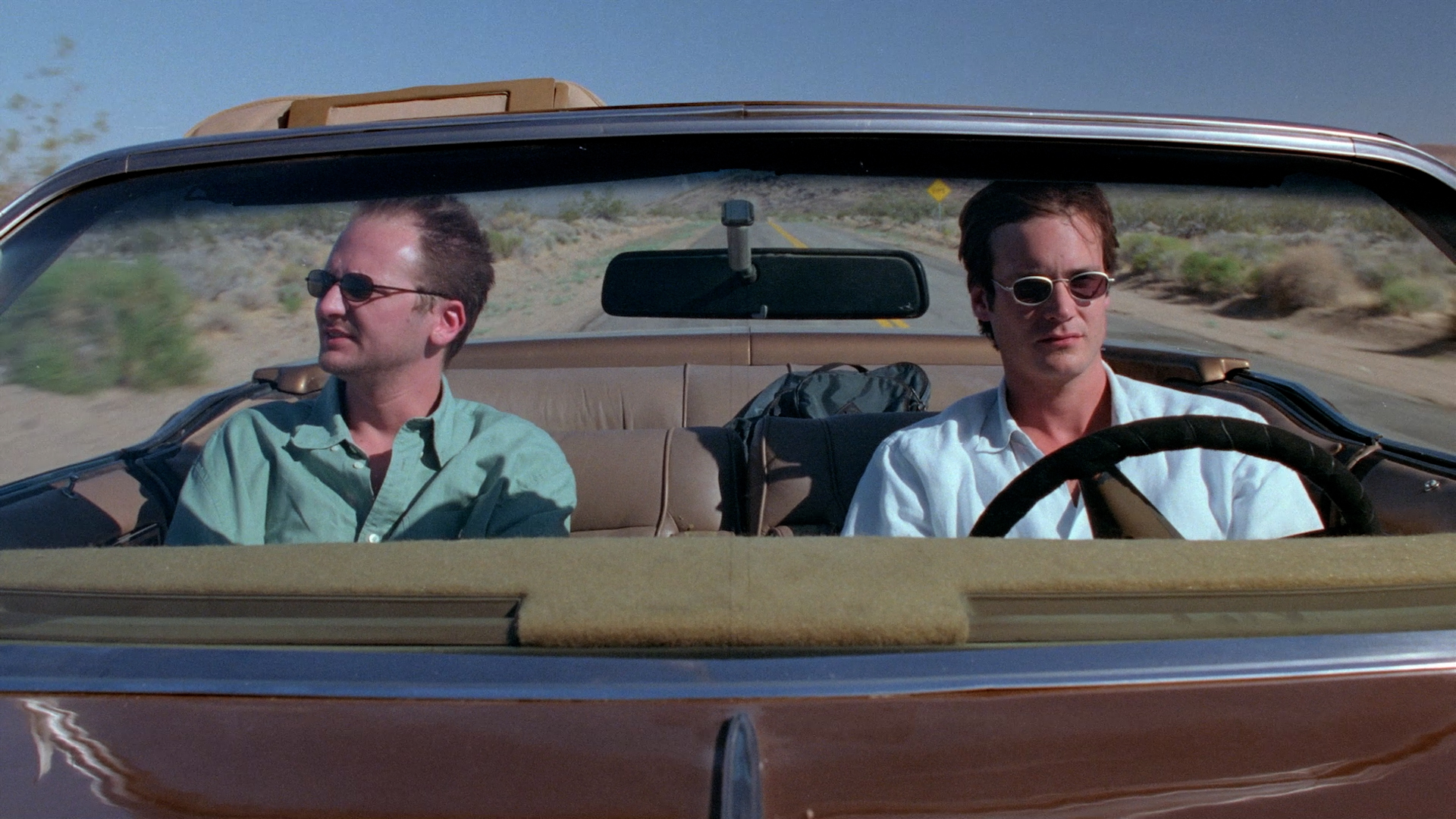
Drama, Comedy, by Bryan Simon, USA, 2001.
Two brothers, Terry (Randy Batinkoff) and Vance (Dylan Haggerty), embark on a journey into the desert with the body of their recently deceased father. Their goal is to find a burial site for him, but along the way unresolved family conflicts resurface. Terry, a successful former baseball player, has always exerted a dominant influence on the younger Vance, a humble mailman. Both carry within themselves the burden of a complicated relationship with their father, Jake (J.E. Freeman), a former professional player obsessed with sports. Even after his death, Jake appears to his children in dream sequences, but instead of offering wise advice, he continues to be distant and authoritarian. The journey thus becomes not only a physical but an emotional journey, in which the two brothers confront their mutual grudges and the emotional legacy of their father.
The film, directed by Bryan Simon with a budget of 150,000 dollars, was shot in extreme weather conditions, with a screenplay adapted by Jim Moores from a work by Randall Wheatley. The film also explores the role of sport as a vehicle for communication between father and son. For many men, expressing feelings is difficult, while talking about sport is a natural and shared language. "Along for the Ride" addresses these issues with sensitivity and realism, resulting in a touching work for those who have experienced similar family dynamics. An indie not to be missed for lovers of quality independent cinema.
LANGUAGE: English
SUBTITLES: Spanish, French, German, Portuguese
Emotional Transmission as Historical Fact
You are sitting across from someone you love, and without knowing why, you flinch. Not at what they said — at the tone. A particular frequency of impatience, a slight tightening around the eyes before a criticism lands. Your body has already responded before your mind has formed a word, and the response is not yours alone. It was rehearsed, in some other room, decades before you were old enough to call it fear.
This is not metaphor. The science behind it is now dense enough to make comfortable dismissal difficult. In 2013, researchers at Emory University — Kerry Ressler and Brian Dias among them — demonstrated in a study published in Nature Neuroscience that mice conditioned to fear a specific scent passed that fear response to their offspring, and to the generation after that, through epigenetic modifications to sperm DNA. The mice who had never encountered the threat shuddered at its smell. The body remembered what the body had never experienced. Transposing this directly onto human psychology requires caution, but the directional implication is not subtle: biological inheritance and emotional inheritance are not separate channels.
What John Bowlby spent the better part of three decades mapping — across the three volumes of his Attachment trilogy, published between 1969 and 1980 — was precisely the architecture through which early relational experience becomes internal structure. His central claim was neither sentimental nor clinical in any comfortable sense: the infant does not simply respond to care, it builds from care a working model of the world, a set of predictions about whether closeness is safe, whether need will be met, whether another person can be trusted to remain. These models, formed before language, before narrative self-awareness, operate beneath the threshold of conscious revision. They are not beliefs you hold. They are the lens through which you look without knowing you are looking.
Mary Ainsworth’s Strange Situation experiments, conducted in the late 1960s and published in her 1978 work Patterns of Attachment, gave Bowlby’s framework its empirical skeleton. By observing infants separated briefly from and then reunited with their caregivers, Ainsworth identified what she called secure, anxious-ambivalent, and avoidant attachment patterns — categories that turned out to predict, with uncomfortable reliability, how those same children would handle intimacy, conflict, and loss thirty years later. Subsequent longitudinal work, including the Minnesota Longitudinal Study of Risk and Adaptation begun in 1975, tracked children from infancy into adulthood and found that early attachment classification correlated with peer relationships, romantic partnerships, and even parenting behavior in the next generation. The pattern did not merely persist. It reproduced.
What makes this data socially uncomfortable is what it implies about agency. Western liberal culture is built on a foundational story of the self as autonomous architect — the individual who chooses, who decides, who is ultimately responsible for what they become. Against this, Bowlby and Ainsworth’s findings do not suggest determinism exactly, but they do suggest that a significant portion of what feels like choice is actually execution of a prior script. The adult who withdraws from emotional intimacy the moment it deepens is not making a free decision. They are running a subroutine installed before they had a name for what they were doing.
Epigenetics complicates the picture further by dissolving even the boundary between experience and biology. The ACE study — Adverse Childhood Experiences, conducted by Vincent Felitti and Robert Anda beginning in the mid-1990s with over seventeen thousand Kaiser Permanente patients — found that childhood exposure to abuse, neglect, and household dysfunction produced measurable alterations in stress response systems, immune function, and neurological architecture that persisted into adult disease. The body does not forget what the mind has buried. Grief, fear, and chronic alarm leave chemical signatures that circulate decades after the original wound.

The Myth of the Self-Made Person
You have probably met someone who describes themselves as entirely self-made — not in the financial sense, but emotionally, as though they assembled their inner life from raw materials chosen freely and deliberately, as though they arrived at their temperament the way an architect arrives at a blueprint. The claim is usually delivered with a quiet pride that itself tells you something: that the person believes their emotional autonomy is an achievement worth announcing, a proof of character. What they cannot see, and what is almost impossible to tell them without triggering the very defensiveness the claim protects, is that the architecture was already half-built before they ever drew a line.
The Enlightenment handed Western culture a story about the individual that has proven almost impossible to dislodge. Kant’s conception of the autonomous rational agent, developed across the Critique of Pure Reason in 1781 and refined in his moral philosophy, placed the self at the center of its own construction — capable, in principle, of reasoning its way free from tradition, instinct, and inherited prejudice. This was philosophically radical and historically necessary. It also installed in the cultural imagination a model of selfhood that had no real mechanism for explaining what travels through families before a child can form a sentence. Rationality cannot account for the emotional weather a body absorbs in its first months of life, because the instrument Kant celebrated — reason — is precisely what has not yet arrived when the deepest transmissions occur.
What arrives instead is the body. Bessel van der Kolk’s clinical research, documented in The Body Keeps the Score published in 2014, demonstrated through neuroimaging and longitudinal trauma studies that the nervous system of a caregiver and the nervous system of an infant regulate each other in real time — that an unresolved fear in a mother, an ungrieved loss in a father, does not stay enclosed inside that adult’s private emotional world but bleeds into the biochemical environment the infant inhabits. The infant does not interpret this transmission. It does not understand it. It simply becomes it, the way a plant becomes the quality of the soil it grows in, without choosing the soil and without being able to remember a time before it.
Shame, specifically, is transmitted in this pre-linguistic register in ways that make it extraordinarily difficult to locate later. The psychologist Gershen Kaufman, writing in Shame: The Power of Caring in 1980, argued that shame is fundamentally an interpersonal experience — it is born in the look of another person, in the severing of what he called the interpersonal bridge, and its earliest forms are coded not into narrative memory but into the body’s sense of its own visibility and worth. A child raised by a parent who carries unprocessed shame does not receive a story about inadequacy. They receive a posture, a hesitation, a silence at the dinner table, a particular quality of absence when they brought something that needed celebration. By the time language arrives, the lesson is already architectural.
Longing operates through a different but equally covert channel. The sociologist Arlie Hochschild, in The Managed Heart published in 1983, documented how emotional labor functions as an invisible economy — how what people perform socially is not the same as what they feel, and how the gap between the two is managed, suppressed, and passed along. Children do not inherit their parents’ performed emotions. They inherit the gap. They grow up sensing that something is being held back, that the warmth offered is managed rather than overflowing, and they spend decades reaching toward a quality of connection that was never modeled for them because their parents were themselves reaching for it, in silence, in a family that also never named it.
The self-made person, then, is not a lie exactly — it is a photograph taken too late, after the landscape had already been shaped by forces that left no caption and no signature.
Ancestral
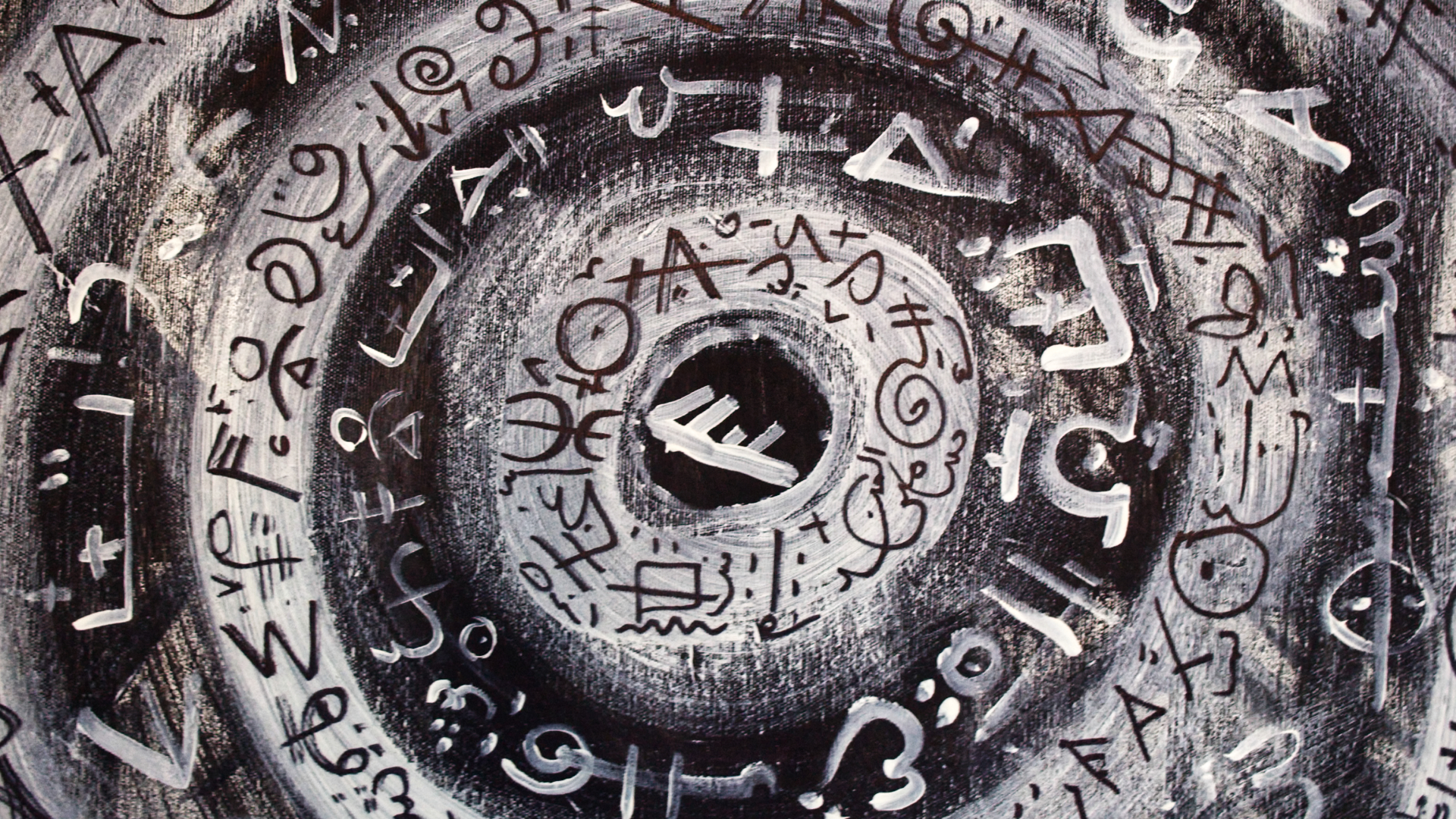
Documentary, by Lumar Brothers, Italy, 2023.
“Ancestral: Life and Art of Massinissa Askeur” is a documentary that explores the life and art of Algerian painter Massinissa Askeur. The film follows Askeur on his creative journey, showing his artistic process and his commitment to the preservation of Berber culture and tradition. Through interviews with Askeur, his family, friends and testimonies from people who knew him on a personal, professional and artistic level, the documentary tells the story of his past and his deep connection to his Berber roots. Askeur displays his art, from canvases to sculptures, which are inspired by the shapes and symbols of Berber culture, representing his search for a connection between the past and the present.
The documentary also explores the challenges Askeur faced throughout his life, including racial discrimination, poverty and the difficulty of making his art known outside of Algeria. However, despite these difficulties, Askeur continues to create and promote his art as a form of cultural resistance and celebration of his ancestral heritage. A vision far from art as a commercial product and very close, instead, to the exploration of the depths of one's own soul and the soul of the world. Massinissa's mission is to leave a testimony of his time to future generations.
LANGUAGE: Italian
SUBTITLES: English, Spanish, French, German, Portuguese
What Parents Could Not Say
You learned to read the silences before you learned to read words. The particular way your mother left a room when certain topics surfaced, the slight hardening around your father’s jaw when his own childhood was mentioned — these were your first grammar, and you absorbed them with a fluency that no classroom could replicate or undo.
Nicolas Abraham and Maria Torok, working together through the 1970s and publishing their landmark collection The Shell and the Kernel in 1987, gave a name to what that grammar was actually transmitting. They called it the crypt: a sealed chamber constructed inside the psyche not to protect the self, but to entomb something that could never be spoken aloud — a grief too shameful, a loss too illegitimate, a desire too dangerous to mourn openly. The crypt is not repression in the classical sense. Repression buries what the individual cannot face. The crypt buries what the culture, the family, or history itself declared unspeakable, and it passes the burial instructions down through the generations like an inheritance with no paper trail. The child does not receive the secret. The child receives the symptom.
This distinction matters enormously, because it relocates the site of suffering. A man who cannot explain his own chronic shame, who collapses inward at any suggestion of exposure, who mistakes ordinary professional criticism for an annihilation — he may be carrying a wound that was never his to begin with. His grandfather may have survived something that the era required him never to name: a bankruptcy that humiliated the family, a wartime collaboration too dangerous to confess, a child given up under economic duress in a decade when poverty made that choice and silence made it survivable. The emotion was encased. The body that carried it died. But the crypt transferred, invisibly, into the next architecture.
What makes this concept so disturbing is that it dismantles the comfortable boundary between biography and inheritance. Cultures with strong traditions of collective silence — postwar European families processing occupation and collaboration, American families navigating the unspoken violence of racial hierarchy, immigrant households where the old country was mentioned only in euphemism — produced children who were fluent in absence. These children grew up knowing, without knowing, that something large existed just outside the perimeter of language. The French historian Henry Rousso documented in The Vichy Syndrome (1987) how entire nations can institutionalize forgetting, creating a social crypt so vast that it generates political neurosis for decades. What happens at the national scale happens at the kitchen table with greater intimacy and greater damage.
The economic dimension of parental silence is almost never discussed in therapeutic frameworks built around middle-class assumptions of interiority. When survival was the daily transaction, the luxury of naming feelings did not exist. A woman raising four children through the American Depression of the 1930s, watching her husband lose work for the third consecutive winter, was not withholding her emotional vocabulary out of psychological defense — she was rationing energy the way she rationed flour. Her silence was not a failure of love. It was the shape that love took under conditions of scarcity. But her children, who had no access to the structural explanation, read that silence as something personal, as evidence of some deficiency in themselves that made them unworthy of her interior life. They carried that misreading forward and encoded it into their own parenting before therapy existed as a common recourse and before the language of emotional availability had entered ordinary conversation.
What the body cannot articulate, it choreographs. The stiffness that descends in a household whenever financial stress appears, the peculiar aggression that erupts around questions of loyalty, the specific texture of anxiety that a family produces when someone gets too close to a particular topic — these are performances of the crypt, enacted by people who have no idea they are performing anything at all, who believe they are simply reacting to the present moment when in fact they are repeating something ancient and sealed.
The Social Architecture of Feeling
You are in a room full of people who are laughing, and you cannot find the entrance to the laugh. You watch their mouths, you replicate the shape, but something in you remains sealed behind glass — not broken, not cold, just formatted in a different register, tuned to frequencies this room was never designed to receive.
What you are experiencing is not shyness, not introversion, not some private pathology. It is class. It is migration. It is the year your grandmother spent in a displacement camp before she learned to treat comfort as a threat, and passed that lesson down through silence, through the way food was stored, through the precise tension in her jaw when money was mentioned in mixed company. Pierre Bourdieu, writing in The Logic of Practice in 1980, described the habitus as a system of durable dispositions — structured structures predisposed to function as structuring structures. He was talking about taste in music, body posture, the grammar of social navigation. But the architecture he described runs deeper than aesthetic preference. It runs through the chest wall. It determines what emotions are legible within a given life, and which ones are quietly sentenced to illegibility before a child even learns to name them.
The family does not invent its emotional grammar in isolation. It inherits it from the material conditions that shaped the generation before, which inherited it from the generation before that, each transmission compressing historical event into bodily habit until the original cause has long since been forgotten and only the posture remains. Populations that survived industrial displacement in nineteenth-century England — the enclosures, the factory system, the destruction of communal land tenure described in detail by E.P. Thompson in The Making of the English Working Class — did not simply lose land. They lost the affective architecture that land had organized: the rhythms of seasonal feeling, the emotional contracts of communal labor, the particular form of grief that comes from belonging to a place. What replaced it was a different emotional economy, calibrated for precarity, for the suppression of vulnerability in environments where vulnerability invites exploitation.
War compresses this process into years rather than generations. The psychiatric literature on second-generation Holocaust survivors, beginning with clinical work published in the late 1960s by Vivian Rakoff and later systematized by researchers like Yael Danieli, documented something that defied the individualist model of trauma: children who had not experienced the camps themselves presented with emotional signatures — hypervigilance, difficulty with intimacy, a specific relationship to joy that treated it as provisional, always already borrowed — that belonged structurally to their parents’ experience. The transmission was not symbolic or narrative. It was somatic, relational, carried in the precise quality of a parent’s attention when the child cried, in what was permitted to be felt openly and what was metabolized in private.
Migration performs a related violence with a different instrument. The person who crosses a border carries with them an emotional vocabulary developed for one social context and arrives in another where that vocabulary is either illegible or actively stigmatized. The first generation suppresses, adapts, performs. The second generation inherits the suppression without the original context that made it rational. They grow up feeling emotions they cannot name, in a language that has no word for what their body already knows. This is not metaphor. Research on intergenerational linguistic displacement, including work associated with scholars of heritage language loss in North American immigrant communities, consistently finds that emotional precision — the capacity to differentiate and articulate internal states — correlates strongly with access to the mother tongue. To lose the language is, in measurable ways, to lose resolution in the emotional image.
What this means is that the feeling you cannot access in that laughing room was manufactured somewhere specific, by forces that had names and addresses and balance sheets, and the person who handed it to you did not choose to hand it to you, and did not know that they were.
A vision curated by a filmmaker, not an algorithm
In this video I explain our vision
When Love and Harm Share the Same Face

You are sitting across from someone who loved you more than almost anyone ever will, and you are trying to explain why their love left marks that look, from certain angles, indistinguishable from wounds. The conversation keeps collapsing. Not because you are wrong, and not because they are lying when they say they only ever wanted good things for you. Both statements are true simultaneously, and that simultaneity is what no one prepared you to hold.
The instinct, when confronted with damage, is to locate its source in a failure of feeling. We assume that what hurt us came from somewhere cold, somewhere indifferent or cruel. This assumption is not naive — it is structurally necessary. It gives suffering a clean address. But Donald Winnicott, writing in the 1950s and 1960s on what he called the “good enough mother,” was circling something far more unsettling: that the earliest injuries rarely arrive through absence of care but through its specific shape. The mother who cannot tolerate her child’s distress does not withhold comfort — she floods it, prematurely, before the child has had a moment to discover that distress can be survived. The result is not a child who felt unloved. It is a child who never learned that they could endure.
Overprotection does not announce itself as control. It arrives wearing the grammar of devotion. In 1983, the psychologist Diana Baumrind published extensive research distinguishing between authoritative parenting — responsive, structured, willing to allow consequence — and what she identified as permissive and authoritarian extremes. What her data could not fully capture was the category that sits between them: the parent who intervenes not out of rigidity or indulgence but out of a terror so refined by love that it becomes invisible even to themselves. Every obstacle cleared, every discomfort preempted, every silence filled. The child grows into an adult who experiences ordinary uncertainty as emergency, because they were never permitted to practice otherwise.
The silence, when it comes instead, operates through a different mechanism but arrives at a comparable destination. There are families where the unspoken is the primary language — where entire emotional territories are never named because naming them would require someone to admit they existed. A father who never discusses his own fear teaches his son something more durable than any explicit lesson: that fear is not discussable, which quietly becomes fear is not survivable, which becomes I am someone who must not be afraid. The prohibition is never stated. It is performed, decade after decade, until the child internalizes it so completely that they mistake it for character.
What makes this territory so resistant to resolution is that blame and absolution are both forms of closure, and closure is precisely what the evidence refuses. The parent who overprotected you did so from a version of love that was real — real enough to cost them something, real enough to organize their life around. The harm and the love are not layered on top of each other. They are the same gesture, executed from the same impulse, landing on the same child. To say “they hurt me” without qualification flattens what was actually there. To say “they did their best” performs a similar violence in the opposite direction, because “their best” had a specific texture and that texture left specific impressions on a specific nervous system that now belongs to you.
Alice Miller argued in “The Drama of the Gifted Child,” first published in German in 1979, that the child’s tragedy is not cruelty but invisibility — being seen only as a vehicle for the parent’s own unresolved needs, even when those needs were wrapped in what felt, from the inside, like total dedication. The child who was loved this way does not grow up feeling unloved. They grow up feeling somehow responsible for a weight they were handed before they had the language to refuse it, carrying it forward into rooms where no one else can see what they are holding.
The Second Scene: A Different Rupture
She is forty-three, standing in the kitchen of a house she chose precisely because it looks nothing like the one she grew up in. Open plan, light flooding in from the south, no dark corridors, no rooms that close. She has read the books — not metaphorically, but literally: she has annotated Daniel Siegel‘s “The Developing Mind,” dog-eared John Bowlby’s attachment trilogy, underlined passages in Bessel van der Kolk’s “The Body Keeps the Score” with three different colors of ink. She knows the vocabulary of rupture and repair. She knows what attunement means, what co-regulation looks like, why the window of tolerance matters. And now her daughter, fourteen, is crying at the kitchen table over something that sounds small — a friend who excluded her, a social slight — and the mother feels something close unexpectedly in her chest, a door swinging shut in a space she thought she had renovated.
What she does next is the most revealing thing, not because it is cruel or negligent but because it is technically correct. She kneels to her daughter’s eye level. She names the emotion she sees. She says the right words in the right sequence, words she has rehearsed not cynically but earnestly, because she genuinely does not want to repeat what was done to her. And her daughter looks at her with an expression that is not quite gratitude and not quite relief — it is something more like recognition of a performance, a child watching a parent try very hard, which is its own specific loneliness.
The philosopher Maurice Merleau-Ponty argued in his “Phenomenology of Perception,” published in 1945, that the body is not an instrument the mind wields but the very medium through which meaning is made. Trauma does not live in memory as a file that can be retrieved and edited. It lives in posture, in the pace of breathing, in the micro-second delay before a voice softens. The mother’s words were correct. Her body, trained in a different grammar for four decades, was half a beat behind them. And children, who have not yet learned to prioritize language over sensation, read the body first.
This is not a failure of effort or intention. It is something far more structurally unsettling: the pattern was not in her behavior. It was in her nervous system’s relationship to distress. Pierre Bourdieu called this the habitus — the durable, transposable dispositions that organize perception and action below the threshold of conscious deliberation, laid down in childhood like sediment that eventually becomes bedrock. By the time she was reading Bowlby, her habitus was already thirty years old. The reading changed her concepts. It did not change the sediment.
What makes this particular rupture different from simple repetition is that she knows it, somewhere beneath the performance of knowing. The self-awareness is real. So is the gap between awareness and reorganization. In 1980, the psychologist Paul Watzlawick described what he called second-order change — not a change within the rules of a system but a change of the rules themselves — and he was precise about how rarely it happens and how much more comfortable it is to mistake first-order adjustment for it. Buying a lighter house, learning the vocabulary, kneeling at eye level: these are first-order moves inside an unchanged system. The system is the nervous system. The system is forty-three years old.
Her daughter will carry something forward from that kitchen — not the words her mother said, which were good words, but the half-second gap between them and the warmth that should have preceded them, and she will not know she is carrying it, which is precisely how it travels, moving forward through time not as a memory anyone could point to but as a reflex that will one day feel entirely like her own.
The Unfinished Animal
You were handed a self before you could refuse it. Not a rough draft, not a provisional version — a structure, already load-bearing, already deciding what would feel like danger and what would feel like home, long before you had language to name either. The animal born into the world most unfinished, most naked in its neural incompleteness, is the one that spends the rest of its life trying to read the blueprint it never consented to receive.
Sigmund Freud called it Nachträglichkeit — deferred action, sometimes translated as afterwardness — the idea that psychic events do not produce their full meaning at the moment they occur. A wound lands without registering as a wound. Only later, when a second experience arrives that rhymes with the first, does the original event acquire its traumatic charge retroactively. The past, in other words, is not behind you. It is a substance that keeps being synthesized in the present, changing its molecular structure each time new experience touches it. This is not a metaphor for healing. It is a description of a permanent condition: the childhood you lived is never finished being lived.
What makes this distinctly human is not the suffering — other mammals carry fear memories, other species encode relational loss in their bodies. What is uniquely human is the compulsion to narrate it, to force the formless into syntax, to demand that the wound explain itself. No other creature is burdened with the need to make sense of its own formation. A dog does not lie awake constructing a theory of its early neglect. The human animal does, and this symbolic labor is not optional — it is the condition of survival for a being whose nervous system requires coherent story to regulate itself. The psychiatrist Daniel Siegel, working at the intersection of attachment research and neuroscience in the 1990s, demonstrated that the single greatest predictor of a child’s secure attachment was not whether the parent had a happy childhood, but whether the parent had constructed a coherent narrative about an unhappy one. The story did not have to be pretty. It had to be integrated.
But integration is not the same as resolution, and this is where most cultural narratives about healing quietly commit their fraud. The therapeutic promise — that you can process the past and be free of it — carries within it a concealed denial of irreversibility. You cannot un-be someone’s child. You cannot retroactively install a different nervous system. The person your parents were in the years before you had the cognitive capacity to evaluate them has already finished its structural work inside you. What remains is not undoing but translation: learning to read what was written in you before you were literate enough to read anything at all.
There is a particular vertigo that arrives when a person first genuinely understands that their parents were themselves unfinished animals, handed a self they did not choose, acting from formations they could not see. Not as an excuse — the damage done is still damage — but as a fact that reorganizes the architecture of resentment. The wound does not disappear. Its address changes. It stops pointing at a villain and starts pointing at a chain, long and impersonal, stretching back through generations who also never got to revise the blueprint before it was already structural.
The human being is the only creature for whom growing up is not a biological completion but a permanent epistemological project — always arriving late to understand what was already decided, always reading a text whose first chapter was written in a language you had not yet learned, always discovering that the self you thought you were choosing was already, in its deepest grain, chosen.
🧠 Wounds That Echo: The Inner Landscape of Inherited Pain
The emotional legacy left by parents is rarely simple or visible — it hides in our reactions, our fears, and the silent scripts we carry into adulthood. These articles trace the psychological and cultural roots of how the past inhabits us, shaping identity long after childhood ends.
Forgotten Memory: When the Past Resurfaces
Memory does not simply store the past — it buries it, and what is buried has a way of returning with surprising force. This article explores the psychological mechanisms by which forgotten or repressed experiences resurface, often through symptoms, relationships, or dreams. Understanding how the past resurfaces is essential to grasping how parental emotional legacies become invisible architects of adult life.
GO TO THE SELECTION: Forgotten Memory: When the Past Resurfaces
Dissociation in Psychology: When the Mind Divides
Dissociation is the mind’s way of surviving what it cannot fully integrate, a fracture that often originates in early relational wounds. This article examines how psychological splitting functions as both a defense and a prison, trapping individuals in patterns that echo unresolved family dynamics. The divided mind is frequently the direct inheritance of an emotionally unstable or traumatic parental environment.
GO TO THE SELECTION: Dissociation in Psychology: When the Mind Divides
Regression in Psychology: When the Mind Returns to Childhood
Regression in psychology describes the unconscious return to earlier stages of development, often triggered by stress, loss, or unresolved childhood experiences. This article investigates why adults sometimes behave like frightened or needy children, especially in intimate relationships — a phenomenon deeply connected to the emotional climate created by one’s parents. Recognizing regression is a crucial step toward breaking the intergenerational cycle of emotional wounding.
GO TO THE SELECTION: Regression in Psychology: When the Mind Returns to Childhood
The Double Life in Psychology: When the Past Returns to Claim You
The double life in psychology speaks to those who present one face to the world while carrying a hidden inner reality shaped by past suffering. This article explores how unacknowledged family trauma forces individuals to split their existence into public performance and private pain. The past does not stay past — it claims us from within, wearing the mask of our daily choices and relationships.
GO TO THE SELECTION: The Double Life in Psychology: When the Past Returns to Claim You
Explore the Cinema That Dares to Look Inward
If these themes resonate with you, Indiecinema is where the conversation continues — through films that dare to portray the invisible wounds, the inherited silences, and the long work of becoming free. Discover independent cinema that takes the inner life seriously, streaming now on Indiecinema.
👉 EXPLORE THE CATALOG: Watch Indie Films in Streaming
A vision curated by a filmmaker, not an algorithm
In this video I explain our vision

