
The Memory You Call Yours
You remember the afternoon clearly. The kitchen smells of something burnt and sweet at the same time, your grandmother is standing at the stove with her back to you, and the light coming through the window is that particular yellow-gold that only exists in childhood. You are six, maybe seven. You could stake your identity on this memory — it feels more real than most of what happened last Tuesday. The emotional texture is so precise, so inhabited, that doubting it feels like a form of self-betrayal.

And yet what you are experiencing in that moment of recall is not a retrieval. It is a construction. The brain does not store memories the way a hard drive stores files — static, intact, waiting to be opened. Every time you remember something, you are rebuilding it from fragments, filling the gaps with inference, expectation, and the person you have since become. The yellow-gold light may have been grey. Your grandmother may have already left the kitchen before you arrived. The smell may belong to a different afternoon entirely, three years later, in a different house. You will never know, and more disturbingly, you feel no uncertainty whatsoever.
This is the foundational problem of autobiographical memory: it is the category of memory most saturated with personal meaning and simultaneously the least reliable in terms of factual accuracy. What we call the story of our life is not documentation. It is a genre of fiction we mistake for testimony, written and rewritten each time we remember, shaped by mood, social context, and the narrative conventions of the culture we inhabit.
Frederic Bartlett understood this before most people were willing to accept it. His 1932 work Remembering demonstrated through systematic experimentation that human memory is not reproductive but reconstructive — that subjects consistently altered stories they were asked to recall, smoothing out unfamiliar cultural elements, imposing familiar schemas, and producing versions that were coherent but factually corrupted. Bartlett’s subjects were not lying. They were doing what human minds do automatically: making meaning. The distortions were not noise in the system. They were the system functioning exactly as designed, organizing experience into forms that could be integrated, carried, and used.
What makes autobiographical memory distinct from other forms of memory is precisely this entanglement with identity. When you misremember a telephone number, nothing essential is at stake. When you misremember why your first serious relationship ended, or when you construct a memory of being unfairly treated as a child that may or may not reflect what actually occurred, you are misremembering the grounds on which you understand yourself. The philosopher Paul Ricoeur, in his three-volume Temps et Récit published between 1983 and 1985, argued that narrative is not something we impose on experience after the fact — it is the structure through which we experience time at all. We do not live and then narrate. We narrate in order to live, to make the sequence of events cohere into something that has a protagonist, a direction, a wound, a redemption. Autobiographical memory is the raw material of that narration, which means it is always already shaped by the story we need to tell.
The need does real work. It is not passive. Research conducted by Martin Conway and Christopher Pleydell-Pearce in 2000 proposed a self-memory system in which autobiographical memories are regulated by a working self whose goals actively constrain what is retrievable, what is emphasized, and what is suppressed. The self is not the passive recipient of memories that float up intact from the past. It is an executive function with an agenda, and the memories that surface are the ones that serve it — which means the archive of your life has been curated by someone with a vested interest in a particular version of events.
Days Blows by in a Moment
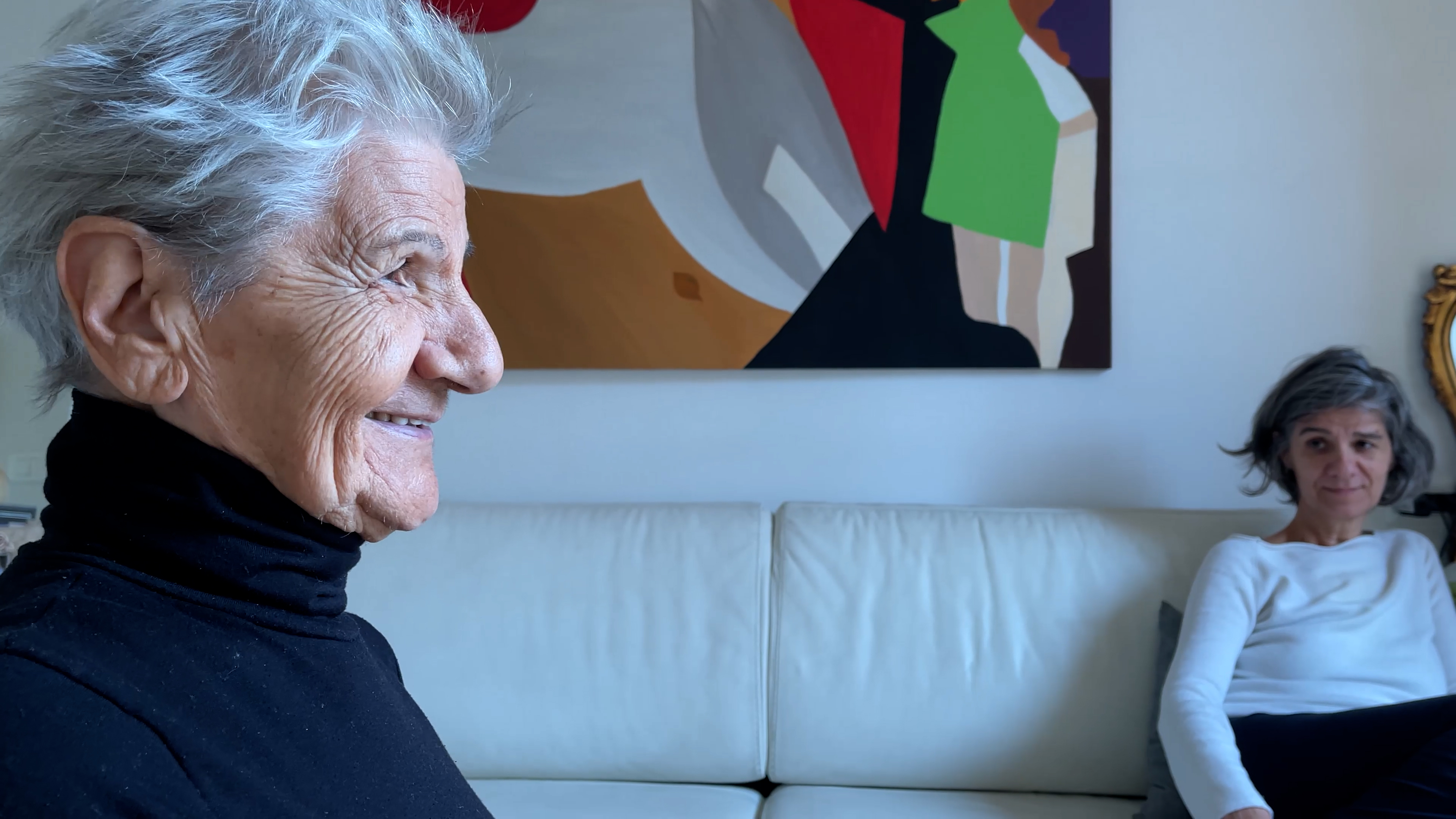
Documentary, by Cristiana Donghi, Italy, 2022.
Ancilla is 86 years old. Two years ago, she moved in with her daughter Emanuela at the pandemic's beginning. Ancilla is slowly losing her memory. He does not remember what she had for lunch, she only remembers events from the past, perhaps only because she has been repeating them for years. Emanuela takes care of her, day after day she wakes her up, prepares her food, washes her, dresses her, and accompanies her a couple of days a week to the hospice and does physiotherapy. This is one of the few contacts with the rest of the world she has left. Ancilla has another child, Mauro, who has been living in London since he left looking for a job. She hasn’t seen him for two years. Daily routines always repeat themselves and change only with the changing seasons. The mother's memories slowly introduce us to Ancilla, her past, the life she lived and that transported her here. Melancholy moments alternate with funny ones and those where patience reaches its limits. Ancilla's sympathy brings a light, fresh breeze into the lives of those around her and allows them to see everything in a way where even the most ominous clouds are blown away momentarily by a breath of wind.
LANGUAGE: Italian
SUBTITLES: English, Spanish, French, German, Portuguese
A Science Built on Sand: The Emergence of Memory Research
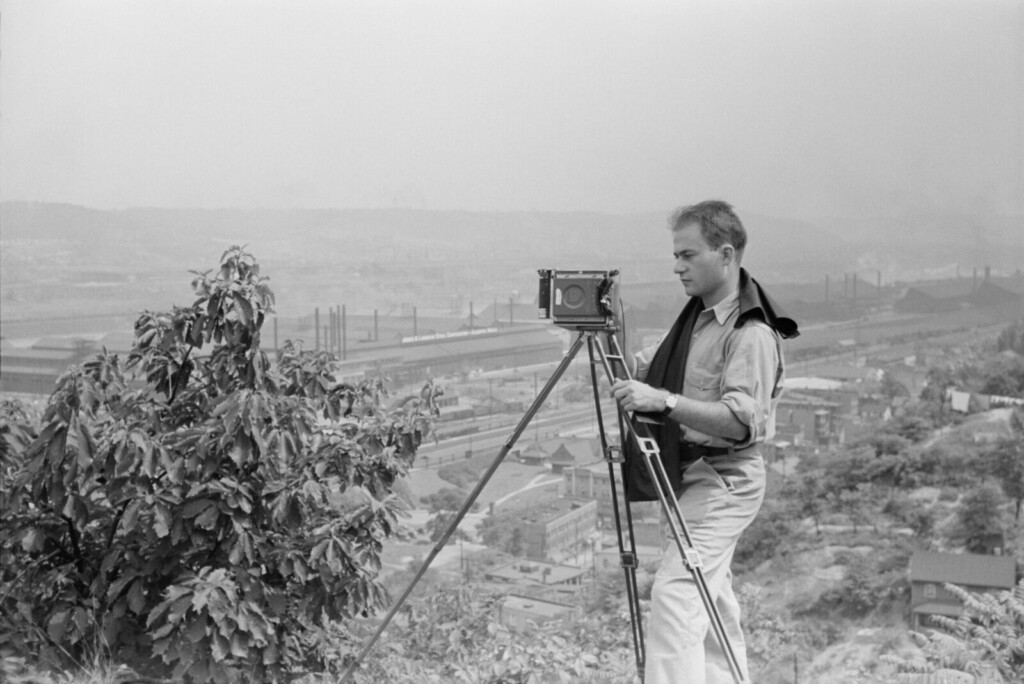
You are sitting in a laboratory in 1879, and a man with extraordinary sideburns and a near-religious faith in measurement is asking you to respond to a list of words as quickly as possible. Francis Galton, cousin of Darwin and inventor of the weather map, is watching a stopwatch. He believes that by timing how long it takes you to produce an association, he can read the contents of your mind like a ledger. What he discovers, and what quietly unsettles him enough to bury the results for months before publishing them in Brain, is that the same handful of childhood memories keep surfacing — unbidden, embarrassing, repetitive. He had expected to find the architecture of intellect. He found instead something closer to a haunting.
Galton’s experiment was the first systematic attempt to treat personal memory as scientific data, and the assumptions baked into it never fully left the discipline that followed. He was a quantifier by temperament and a eugenicist by conviction, and his interest in memory was inseparable from his interest in mental superiority — he wanted to prove that faster, cleaner associations indicated higher-grade minds. The methodology survived; the ideology became invisible. When Hermann Ebbinghaus published Über das Gedächtnis in 1885, he deliberately stripped memory research of its personal dimension entirely, memorizing thousands of nonsense syllables in isolation and plotting forgetting curves with the precision of an engineer. The result was a science of retention without a subject — rigorous, replicable, and almost entirely disconnected from the texture of a lived life.
For nearly a century, that disconnection held. Behaviorism made memory a function of stimulus and response, something that happened to an organism rather than something an organism constructed. The dominant laboratory model involved rats in mazes and lists of paired words, not human beings trying to locate themselves in time. The implicit argument was that what made memory scientific was precisely the removal of the self from the equation. William James had written in his Principles of Psychology in 1890 that personal memory involves the feeling of warmth and intimacy — a phenomenological claim that the experimental tradition could not operationalize and therefore quietly discarded, as though a thing unmeasurable were also unreal.
The rupture came not from inside the laboratory but from a provocation delivered at a conference table. In 1978, Ulric Neisser stood before colleagues at Cornell and made an argument that functioned less like an academic proposal and more like an accusation: the entire edifice of memory research had been studying almost nothing that mattered to actual human experience. His 1982 edited volume Memory Observed formalized the challenge, insisting that memory should be studied in naturalistic contexts — in courtrooms, in childhood recollection, in the distortions of eyewitness testimony. The field he was effectively naming, autobiographical memory, came into existence partly as a correction, a late admission that decades of controlled laboratory conditions had been controlling away the very phenomenon they claimed to study.
What this history exposes is not incompetence but something more structurally interesting: a discipline that absorbed the cultural priorities of its founding figures and mistook those priorities for objectivity. Galton’s faith in quantification, Ebbinghaus’s preference for the isolated and the nonsensical, the behaviorists’ allergy to interiority — these were not neutral methodological choices. They were positions taken within specific intellectual climates, by men whose definition of scientific legitimacy had been shaped by the physical sciences of their era, sciences that dealt with objects rather than persons. Autobiographical memory arrived late not because it was discovered late, but because the institutions built to study mind had organized themselves around a definition of rigor that structurally excluded the first-person.

The Self as Fiction: Bartlett, Narrative, and the Rewriting Mind
You remember your father’s voice at the dinner table — the precise cadence of it, the weight it carried, the exact words he used the night everything changed. Except you don’t. What you have is a construction assembled from mood, from subsequent conversations, from the emotional residue of a hundred other evenings that resembled that one closely enough to bleed into it. The voice you hear in your memory is partly real and partly authored, and the authorship is yours, running continuously and invisibly beneath every act of recall.
Frederic Bartlett demonstrated this with uncomfortable precision in his 1932 Remembering, a work that landed quietly and then detonated slowly across a century of cognitive science. His method was deceptively simple: he had participants read an unfamiliar Native American folk tale called “The War of the Ghosts,” then recall it at intervals over weeks and months. The distortions were not random. They followed a pattern. Details that didn’t fit the reader’s existing cultural schemas were dropped, softened, or replaced by details that did. The story was not degraded — it was rationalized. Memory wasn’t a film rewinding; it was an editor cutting for coherence, always in service of a narrative that the remembering subject could recognize as their own.
What Bartlett named “effort after meaning” is not a bug in the system. It is the system. The brain does not archive raw experience and retrieve it on demand. It stores fragments, emotional intensities, relational contexts — and then reconstructs, each time slightly differently, depending on who you have become by the time you remember. Jerome Bruner, writing in his 1987 essay “Life as Narrative” and later in Making Stories in 2002, pressed this further: he argued that the self is not the author of narrative, but its product. We do not tell stories about ourselves because we have a self. We have a self because we tell stories. The biographical coherence a person feels — the sense of being the same person who was once six years old and afraid of the dark — is a narrative achievement, not a psychological given.
This rewriting serves survival. A person who cannot integrate painful events into a tolerable life story is clinically fragile in measurable ways; narrative rigidity and narrative collapse both predict psychological breakdown. But the service the mind renders to the present self is not without its casualties. Every time a memory is reconstructed in the light of current knowledge, current relationships, current emotional needs, it is subtly altered — and the altered version is stored as the new original. The past doesn’t fade. It gets replaced.
The consequences outside the consulting room are not abstract. The wrongful conviction literature in the United States is thick with cases where eyewitness testimony, reviewed after DNA exoneration, reveals not lying but genuine confabulation — people certain they saw what they in fact composed. The Innocence Project, which since its founding in 1992 has contributed to over two hundred exonerations, identified eyewitness misidentification as the leading contributing factor in the majority of those cases. Courts continue to treat confident recall as reliable recall, despite four decades of research demonstrating that confidence and accuracy are statistically independent variables. Elizabeth Loftus showed in her 1974 studies on post-event information that a single misleading question asked after a witnessed event can permanently alter what a subject subsequently remembers seeing — not what they report seeing, what they remember.
Families are not courts, but they conduct their own trials. The argument about what was actually said, what was actually done, who actually started it — these are not disputes about facts but about competing reconstructions, each internally consistent, each sincere, each shaped by the emotional position of the person doing the remembering.
Flashbulb Illusions and the Politics of Collective Remembering

You remember exactly where you were. The light in the room, the texture of the chair beneath you, the specific voice that carried the news — you would stake your life on the precision of these details. That certainty itself is the first symptom of something worth examining.
Roger Brown and James Kulik published their study in 1977 in the journal Cognition, coining the term “flashbulb memory” to describe the phenomenon by which emotionally charged public events — assassinations, disasters, sudden ruptures in the social fabric — seem to burn themselves into the mind with photographic fidelity. Their research suggested a special neural mechanism, a kind of biological shutter that fires under conditions of extreme surprise and emotional consequence, preserving the scene around the shock the way amber preserves an insect. The metaphor was seductive because it confirmed what people already believed about themselves: that at the moments that mattered most, they were reliable witnesses to their own lives.
What the decades that followed revealed was something considerably more unsettling. When researchers tracked the same individuals across time — asking them to describe their memories of the Challenger explosion immediately afterward, then again two and a half years later — the confidence with which people recalled the scene remained stable or even increased, while the accuracy of the details collapsed. The chair, the voice, the light: wrong, contradicted by their own earlier accounts, yet defended with the same conviction as before. Confidence and accuracy, it turned out, were not merely uncorrelated — they were nearly orthogonal. The vividness of the memory was measuring something real, but that something was the intensity of the emotional encoding, not the truthfulness of the content.
Elizabeth Loftus spent the better part of four decades demonstrating, in study after study, that human memory is not a recording but a reconstruction — and that reconstruction is socially contaminated from the moment it begins. In her 1974 work with John Palmer, she showed that the wording of a single post-event question could alter what a witness believed they had seen. In later experiments, she went further, successfully implanting entirely false childhood memories — being lost in a shopping mall, being attacked by an animal — in a significant percentage of adult subjects, simply by having a trusted family member describe the event as though it had happened. Once planted, these memories grew. Subjects elaborated them, added sensory detail, defended them against correction. The memory felt autobiographical because it had been absorbed into the autobiographical self, regardless of its origin.
This is where the private and the political become indistinguishable. National traumas function precisely as Loftus’s trusted family members do: they arrive through authoritative channels, surrounded by emotional intensity and social consensus, and they install themselves in the first-person. An entire generation can share a memory of witnessing something they only heard described, can recall a grief that was performed for them before it was felt, can carry a wound whose origin lies not in their own nervous system but in the repeating machinery of collective narrative. The family myth operates by the same mechanism at smaller scale — the story told at every gathering about who each person was in childhood, which becomes the story each person tells themselves about who they are, which eventually becomes what they actually remember, complete with textures and light and the weight of certainty.
What makes this a political act is not malicious intent but structural inevitability. Memory is the medium through which identity is claimed, and identity is the ground on which belonging, exclusion, grievance, and loyalty are organized. To control what a population remembers — not by erasing records but by saturating the emotional environment with particular versions of events — is to govern at the level of the self, below the threshold of conscious resistance, in the very place where people feel most irreducibly their own.
Identity on Loan: What You Remember Is Who You Were Told to Be
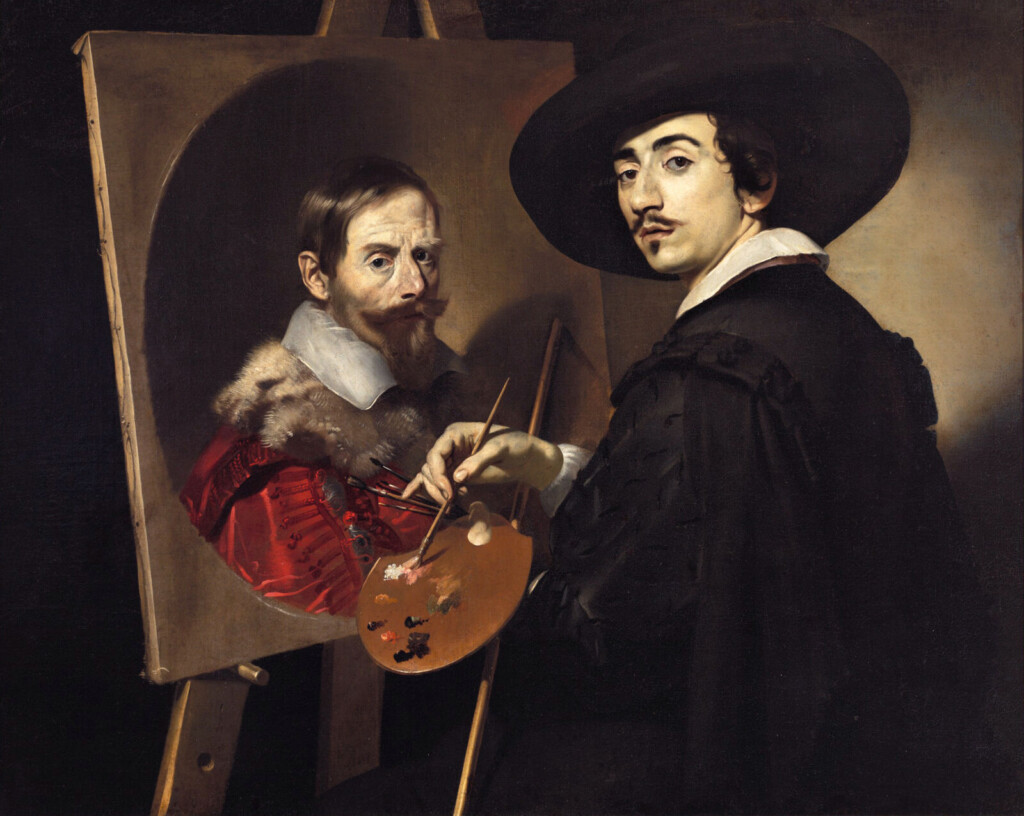
You did not arrive at your own story. Someone handed it to you before you were old enough to know what a story was, and by the time you could question it, you had already mistaken it for memory.
Paul Ricoeur spent decades working through the distinction between two Latin words the English language carelessly collapses into one: idem, the sameness of a thing that persists unchanged across time, and ipse, the selfhood that holds itself responsible through a promise, through a narrative, through a willingness to say “I am the one who did that.” His 1990 work Oneself as Another argues that personal identity is not a substance but a story — and that this is not a comforting metaphor but a structural vulnerability. If you are a story, you are editable. If you are editable, the question is not whether you have been edited, but by whom and toward what end.
Dan McAdams, the Northwestern University psychologist whose life-story model of personality reshaped the field across the 1990s and into the 2000s, went further in empirical terms by demonstrating that people with coherent, redemptive personal narratives — stories in which suffering leads to growth — consistently score higher on measures of psychological well-being and civic engagement. This sounds like a finding about resilience. It is also a finding about conformity. The redemptive narrative is the culturally approved shape of a life in Western Protestant-inflected societies, where suffering that does not produce visible transformation is treated as waste, as failure, as something therapeutically unresolved. McAdams documented the template; he was less interested in interrogating who wrote it.
The family is the first institution that writes you, and it does so through the stories it chooses to repeat. Every family has its mythology — the ancestor who overcame, the crisis that forged the clan, the member whose fate operates as warning. These are not neutral transmissions. Family memory selects for cohesion, for the version of events that keeps relationships intact, for the narrative that assigns roles people can be held to. What gets remembered at the dinner table across thirty years is not what happened; it is what the family needs to have happened in order to remain a family. The child who internalizes this archive does not know they are inheriting a political document.
Nations operate identically at larger scale, with more deliberate machinery. The compulsory curricula, the commemorative calendars, the monuments placed in the visual field of every schoolchild — these are not memory aids. They are memory substitutes. Benedict Anderson’s 1983 analysis of nationalism as imagined community rested on exactly this mechanism: the nation requires its members to share memories of events they did not witness, to mourn deaths they did not suffer, to feel pride in victories that preceded their birth by centuries. Autobiographical memory, at its civic edges, blurs into collective fiction the individual experiences as personal feeling.
Therapy culture, which presents itself as the antidote to these distortions, introduces its own. The therapeutic frame — particularly in its dominant narrative forms, where the patient is asked to construct a coherent account of how they became who they are — rewards stories with clear causality, identifiable wounds, and forward-pointing arcs of healing. The therapy room does not ask you to question whether the self being narrated is real; it asks you to narrate it more honestly. This is a subtle foreclosure. It assumes that beneath the distortions there is an authentic autobiographical self waiting to be accurately told, rather than entertaining the darker possibility that the self is entirely the product of the telling, that there is no bedrock beneath the construction, and that the demand for a coherent life story is itself one more institution with interests of its own — the last one you would think to suspect, precisely because it arrives wearing the face of your liberation.
A vision curated by a filmmaker, not an algorithm
In this video I explain our vision
🧠 Memory, Identity, and the Architecture of the Self
Autobiographical memory is not merely a repository of past events — it is the living structure through which we construct identity, meaning, and continuity. These related articles explore the psychological, philosophical, and literary dimensions of memory, time, and the self, offering a rich intellectual landscape for those who wish to understand how the past shapes who we are.
Forgotten Memory: When the Past Resurfaces
Memory does not simply fade — it transforms, surfaces, and reclaims us in unexpected moments. This article explores the psychological mechanisms behind forgotten memories and the complex ways in which buried experiences re-emerge to reshape our present identity and emotional life.
GO TO THE SELECTION: Forgotten Memory: When the Past Resurfaces
Proust’s In Search of Lost Time: Analysis
Proust’s monumental work is perhaps the most profound literary meditation on autobiographical memory ever written, tracing how involuntary memory reconstructs the self across time. This analysis examines how Proust’s narrative technique mirrors what psychology now understands about the reconstructive and emotional nature of personal recollection.
GO TO THE SELECTION: Proust’s In Search of Lost Time: Analysis
Paul Ricœur: Life and Philosophy of Memory
Paul Ricœur devoted much of his philosophical work to understanding how narrative and memory intertwine to form personal and collective identity. This article examines his philosophy of memory, exploring the ethical and temporal dimensions of how we remember, forget, and tell the stories of our own lives.
GO TO THE SELECTION: Paul Ricœur: Life and Philosophy of Memory
Friedrich Nietzsche and Memory: On the Uses and Disadvantages of History
Nietzsche’s provocative essay on history raises fundamental questions about the relationship between memory, forgetting, and the vitality of the self. This article examines how an excess of historical consciousness — personal or collective — can become a burden that paralyzes the living present, a theme deeply relevant to contemporary psychology.
GO TO THE SELECTION: Friedrich Nietzsche and Memory: On the Uses and Disadvantages of History
Discover the Cinema of Memory and Identity on Indiecinema
If these themes resonate with you, Indiecinema is the streaming platform where memory, identity, and the unconscious come alive on screen. Explore our curated selection of independent and auteur films that dare to go where mainstream cinema never ventures — join us and let cinema become your most intimate mirror.
👉 EXPLORE THE CATALOG: Watch Indie Films in Streaming
A vision curated by a filmmaker, not an algorithm
In this video I explain our vision

