
The Myth of the Reluctant Killer
You are standing in a room where a decision has already been made, and everyone in the room knows it, and everyone in the room is still pretending to deliberate. The words being spoken are real words — honor, republic, liberty, the common good — but they function less as arguments than as rituals, ceremonies of self-permission that allow what has already been decided to arrive wearing the costume of reluctance. This is the room Marcus Junius Brutus occupied in the weeks before March 15, 44 BC, and the remarkable thing is not that he killed Julius Caesar. The remarkable thing is how desperately history has needed him not to have wanted to.

The myth of the reluctant killer is one of the most durable and flattering illusions in the Western moral imagination. It requires that violence, when committed by a person we admire, be surrounded by visible suffering — that the killer grieve, hesitate, lose sleep, write letters to friends about the weight of what must be done. Brutus satisfies every requirement. Plutarch gave him the tortured nights, the conversations with his wife Porcia, the philosophical anguish of a man trained in Stoic discipline who finds himself at the edge of an act that Stoic discipline cannot quite sanction. Shakespeare, drawing from Plutarch in 1599, sealed the characterization for English-speaking civilization: “It must be by his death.” The conditional necessity, the impersonal construction, the absence of desire — every grammatical choice in that line is doing moral work, displacing agency from a man who is very much an agent.
What gets buried under the grief is the career. Brutus was not a disinterested philosopher who wandered into politics. He was a creditor who had charged the people of Cyprus interest rates of forty-eight percent annually, an arrangement so predatory that Cicero — a man not given to squeamishness about financial arrangements — found it embarrassing to defend. He was a man whose political fortunes had run through Caesar’s mercy after Pharsalus in 48 BC, a pardoned enemy who accepted the proconsulship of Cisalpine Gaul from the very hands he would later drive a blade into. The philosopher Seneca, writing a generation after the assassination, understood something that sentimentality resists: that moral sincerity and political calculation are not opposites, and that a man can genuinely believe in the principles he uses to justify what benefits him. This is not hypocrisy in the crude sense. It is something more structurally interesting and more widely distributed.
Cognitive dissonance research since Leon Festinger’s foundational 1957 work “A Theory of Cognitive Dissonance” has demonstrated consistently that human beings do not first decide what is right and then act. They act, or find themselves on the verge of acting, and then assemble the moral framework that makes the action coherent with their self-image. The mind does this work not cynically but earnestly — the justifications feel real because they are real, generated in good faith by a brain whose primary loyalty is not to truth but to the integrity of the self-narrative. Brutus did not fake his anguish. That is precisely the point. The anguish was the mechanism by which a decision made in ambition and fear and wounded pride became, in his own experience, a decision made in virtue.
What cultures then do with figures like Brutus reveals what those cultures need to believe about themselves — that conscience is separable from interest, that idealism is a force independent of the conditions that produce it, that the person who hesitates before an act of violence is categorically different from the person who performs it without hesitation. The hesitation becomes the moral credential. A civilization that has conducted its share of necessary, liberty-invoking, reluctantly executed violence has every reason to keep that credential in circulation.
Bruto
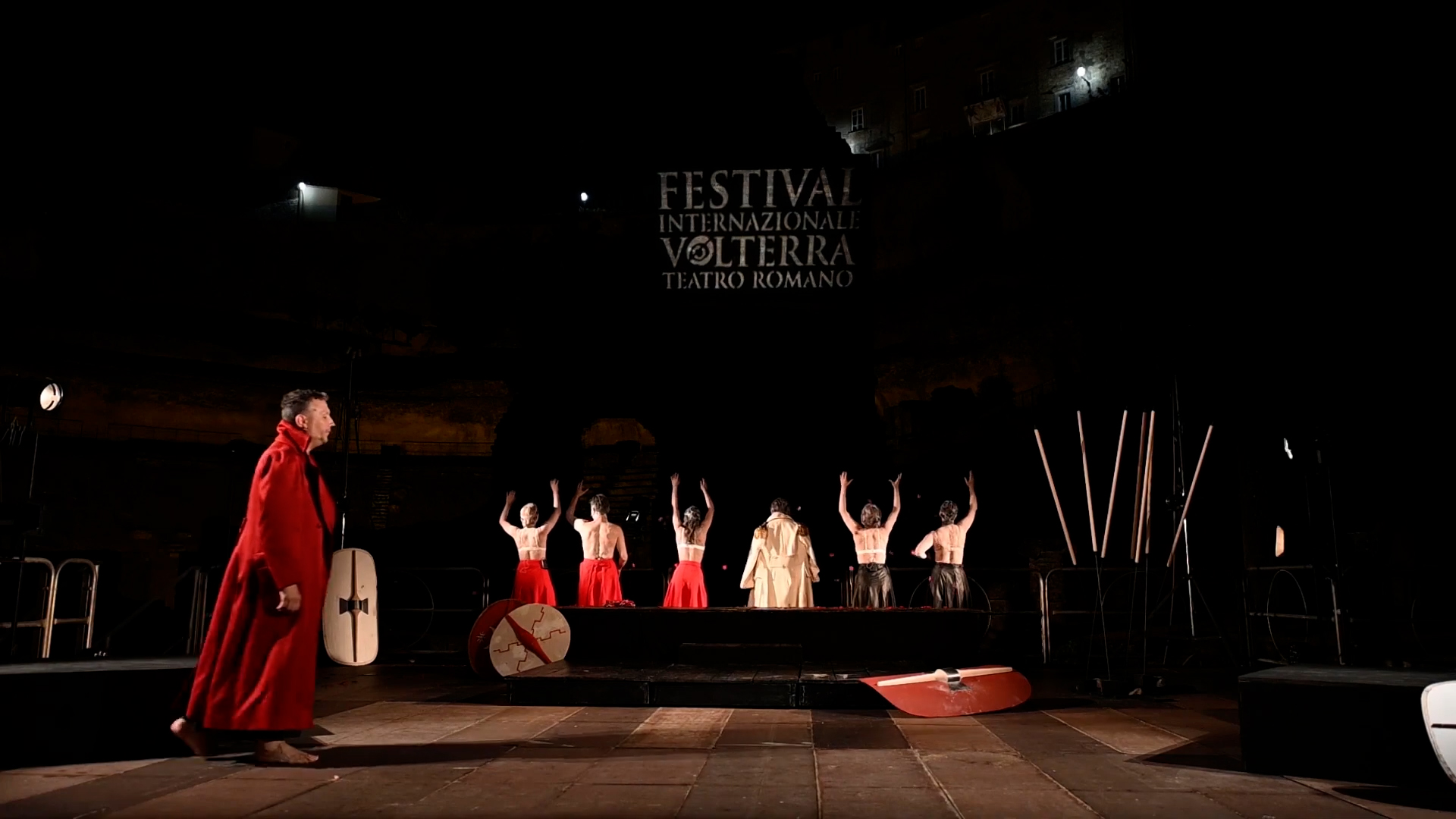
Theatrical show, by Nicola Fano e Simon Domenico Migliorini, Italy, 2022
The protagonist is Brutus, the celebrated instigator, along with Cassius, of the conspiracy of the Ides of March in 44 B.C., the assassin of Caesar. He enters the stage calling loudly for Cassius, his alter ego: we find ourselves in Philippi, where both conspirators have already fought and lost against the troops of Marcus Antonius, who has become the guarantor of justice towards Caesar and Rome. The story written in books materializes on stage with the words of Shakespeare, infinite, immortal, eternal words. The spectator listens, a symbolic battlefield and dead bodies appear before him, on which Brutus, defeated, wounded, almost dying, crawls and invokes and looks around bewildered, shocked at the appearance of the ghost of Caesar.
Brutus is Simone Migliorini, who speaks, moans, shouts, modulates those phrases of Shakespearean tragedy and makes them his own, as they have been generated, also in the adaptation from Shakespeare's "Julius Caesar" by the playwright Nicola Fano, who worked on the text focusing on the most controversial figure, that of the leader of the conspirators, the assassin of Caesar, specifically for Migliorini, who has studied and deepened the text and characters. But here Brutus, as the show unfolds, also becomes Macbeth, also Henry V, both tyrants, both assassins, soldiers, courageous or cowardly, great or infamous, in a flow of words and famous phrases, spoken, planted, recited, whispered, shouted by Simone Migliorini who with this performance confirms himself as a high-level interpreter. What strikes is the protagonist's ability to transform himself, from time to time, from Brutus into other characters, even into Marcus Antonius. A change of costume is enough for him, on stage. And it is here that Brutus looks into Antony's eyes and Antony scrutinizes Brutus, doubled by the same actor in a virtuosity that is extremely congenial to him. The actor is capable of being, at the same time, the one who kills and the one who exalts the killed; the one who is prey to doubts and remorse but is proud of his love for Rome and its freedom, and the one who exalts and celebrates the slain Caesar before the people, holding his will in his hand, in the famous Oration that has always been the flagship of the greatest actors.
LANGUAGE: Italian
SUBTITLES: English, Spanish, French, German, Portuguese
Cassius and the Sociology of Resentment
You have spent time in a room with someone who was right about everything and whom no one would listen to, not because the argument was weak but because the voice carried a particular quality — too tight, too hungry, too aware of the slight it was describing. The room did not hear the content. The room heard the need.
Gaius Cassius Longinus entered Roman political memory wearing exactly that quality, and two thousand years of reception have never let him remove it. He was the man who noticed first, organized most effectively, and got the least credit, both in his own lifetime and in every subsequent century that decided to dramatize what happened on the Ides of March. The displacement is not accidental. It follows a logic that cultures apply with remarkable consistency to figures whose grievance is structurally legitimate but aesthetically disqualifying.
Friedrich Nietzsche, writing in the Genealogy of Morals in 1887, gave this dynamic a name: ressentiment, the festering inward resentment of those who cannot act and so convert their impotence into moral condemnation. The concept was razor-sharp as a description of a particular psychological formation, but it became a cultural weapon almost immediately upon publication, used to preemptively invalidate any complaint that arrived with visible emotion or personal investment. The sleight of hand is breathtaking once seen: if your anger shows, the anger becomes the subject, and the condition producing it vanishes from the frame entirely. What Nietzsche diagnosed as a pathology of the powerless became a filter that societies apply to silence the powerless — while the actual structure of power that generated the grievance continues undisturbed, now additionally protected by the philosophical vocabulary meant to describe something else entirely.
Cassius had watched Julius Caesar accumulate exceptions to every republican norm Rome had built across five centuries. He had served under Caesar in the Parthian campaigns, understood the military architecture of the man’s dominance, and had arrived at a conclusion that Cicero, Brutus, and the Senate’s more comfortable members reached later, more slowly, and with considerably more reassurance from one another that they were acting on principle rather than fear. That Cassius reached it first, with less social cushioning and more direct personal exposure to what Caesarean power actually felt like in practice, is treated by the historical tradition not as evidence of sharper perception but as evidence of prior resentment. The chronology of his concern becomes proof of its corruption.
What gets erased in this move is the sociology of vantage point. People positioned closer to the operational reality of a power structure — lower in the hierarchy, more exposed to its daily mechanics, less insulated by prestige — consistently perceive its nature earlier and more accurately than those whose comfort the structure is currently sustaining. This is not psychology. It is geometry. But the geometry is invisible to any interpretive framework that treats emotional distance as synonymous with analytical clarity, as though Caesar’s friends were better positioned to assess Caesar’s danger than the man who had watched him override a provincial governorship, accept a dictatorship in perpetuity, and place his own image on Roman coinage while still living. Plutarch records Cassius’s lean and hungry look as if it were a character flaw rather than a reasonable physiological response to spending years inside a system that was being quietly dismantled.
The specific aesthetic register of Cassius — urgent, calculating, unwilling to perform the gracious detachment that Roman aristocratic culture demanded even of its critics — marks him as the kind of figure every political culture needs to suppress in order to maintain the narrative that legitimate dissent arrives calmly, through proper channels, after all other options have been exhausted.
Those channels, by definition, are controlled by the people the dissent is about.

The Roman Senate as a Machine of Consent
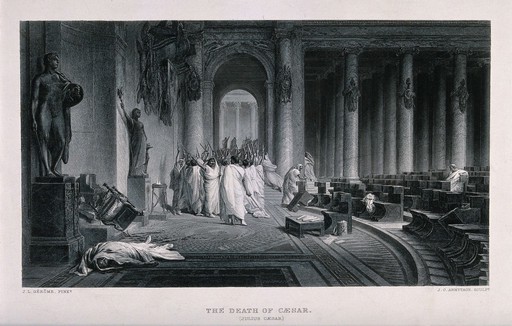
You already know what a senate looks like from the inside, even if you have never set foot in one. You have sat in a meeting where the outcome was decided before anyone spoke, where the room’s arrangement — who stood near whom, whose name was called first, whose silence was read as assent — had already determined what the minutes would record. The vote at the end was not a decision. It was a ceremony of ratification, a collective genuflection before a conclusion reached elsewhere, in a corridor, at a dinner, between two men who understood each other without needing to finish their sentences.
This is what Fergus Millar spent a career dismantling, and what his 1998 study The Crowd in Rome in the Late Republic forced classical scholars to confront with uncomfortable precision. Millar’s argument was not that the Roman Republic was a sham — it was more damaging than that. He demonstrated that Roman political life operated through a dense, layered system of popular assemblies, contiones, and public acclamation that was genuinely participatory in its forms while being structurally controlled in its outcomes. The Senate itself was never, at any point in its functional history, a body that deliberated from a position of open uncertainty. It was the place where men who had already agreed confirmed that they agreed, in the presence of witnesses who would remember it.
The senators who gathered in the Curia were drawn exclusively from a propertied class whose minimum census qualification had been set at 400,000 sesterces, a threshold that by the late Republic functioned less as a financial floor than as a hereditary filter. These were men whose family names, whose networks of obligation, whose webs of patronage and debt, were older than any political principle they might invoke. When Cicero delivered his speeches against Catiline in 63 BCE — speeches later canonized as the defense of Republican virtue — he was not appealing to abstract constitutional norms. He was mobilizing a social machine to destroy a man whose redistribution proposals had threatened the property arrangements on which every senator in that room depended. The eloquence was genuine. The interests underneath it were not complicated.
What Brutus and Cassius were defending on the Ides of March, then, was not the Republic as a governing philosophy but the Senate as a specific class instrument — one that had been losing its grip on Roman political life for almost a century before Caesar ever crossed the Rubicon. The Gracchi had been murdered by senatorial mobs in 133 and 121 BCE precisely because they had attempted to use the popular assemblies in ways that bypassed senatorial consensus. Sulla had marched on Rome twice. Marius had rewritten the composition of the legions in ways that unmoored soldiers from civilian loyalty and reattached them to their commanders. The Senate had not prevented any of this. It had adapted to each shock, absorbed it, and continued ratifying outcomes determined by whoever held the most force at the relevant moment.
The conspirators spoke the language of ancestral custom — the mos maiorum — as though it were a living constitutional principle rather than a rhetorical inheritance. But the mos maiorum had never been codified, which meant it could never be violated in any legally verifiable sense. It existed precisely to be invoked selectively, to give the weight of tradition to positions that were in fact the positions of whoever was powerful enough to claim tradition’s authority. Brutus, whose intellectual formation included years of Stoic study in Athens and a genuine philosophical engagement with the idea of the res publica, understood this at some level — his own great-uncle Cato had watched the machinery fail in real time and chosen theatrical suicide over accommodation. What Brutus could not bring himself to see was that the machinery had never, even in its most idealized iteration, been designed to produce outcomes different from those it had always produced.
What Caesar Actually Was
You have probably been told, at some point in your education, that Julius Caesar was a man who wanted to be king — that the senators who surrounded him on the Ides of March were, whatever their faults, defending something real. The word “tyrant” arrived in your mind early and settled there without much resistance, the way most political verdicts do when they come dressed in the language of liberty.
Suetonius, writing in “De Vita Caesarum” roughly a century and a half after the assassination, does not give us a tyrant in any recognizable sense. He gives us an administrator of unusual competence and even unusual restraint: a man who reformed the Roman calendar, reorganized provincial governance, reduced debt through land redistribution, and extended Latin rights to the Gallic provinces in 49 BCE — a move that enfranchised hundreds of thousands of people who had previously existed at the legal margins of the empire. These were not the gestures of a man consolidating personal despotism. They were the actions of someone dismantling the structural advantages that Rome’s aristocratic class had spent two centuries constructing and defending.
The land reforms deserve particular attention because they make the mechanics of the conspiracy legible in a way that rhetoric about kingship does not. Rome’s ager publicus — public land nominally belonging to the state — had been progressively absorbed by wealthy senatorial families across the second and first centuries BCE, a process that Tiberius Gracchus had tried to reverse in 133 BCE and paid for with his life. Caesar’s distributions of land to veterans and urban poor did not merely offend senatorial pride; they threatened a material system of wealth generation that the aristocracy had come to treat as natural order. When Brutus stood in the Senate with a bloodied knife, he was not defending the republic as an idea. He was defending the republic as a property arrangement.
Cicero, who did not participate in the killing but celebrated it lavishly in his letters, wrote to Atticus in April of 44 BCE that the conspirators had the courage of men but the wisdom of children — by which he meant they had removed Caesar without any plan for what the removal would produce. This is usually read as strategic criticism. It is more accurately read as an inadvertent confession: Cicero’s circle knew that Caesar’s death would not restore senatorial governance because what they called senatorial governance was already a fiction by the time Caesar crossed the Rubicon. The republic they mourned had functioned, for at least a generation, as an oligarchic rotation of power among a few dozen families. Caesar’s crime was not ambition in the abstract but the specific ambition to route political authority around that rotation.
What makes this harder to absorb is that Caesar genuinely believed in his own exceptional nature, and his beliefs about himself were not modest. His commentary on the Gallic Wars, written between 58 and 52 BCE, is simultaneously a military record and a sustained act of self-mythologization — a text in which he appears in the third person, as though already observing himself from history’s vantage point. The man had an ego calibrated to geological scale. But ego is not the same as tyranny, and the conflation of the two has served the reputations of his killers rather more than the historical record warrants.
There is something almost structurally necessary about the way the tyrant label has persisted. If Caesar was a tyrant, then Brutus and Cassius were liberators, and the assassination becomes a story about principle meeting power. If Caesar was instead a reformer whose policies genuinely threatened the material interests of Rome’s ruling class, then the story becomes one about an elite defending its own privilege through political violence — and that story is considerably harder to render as tragedy, considerably harder to teach without discomfort, considerably harder to allow into the room where children first encounter antiquity.
The Ides of March as a Class Event
You are standing in a room full of men who have already decided what the law means, and the law means whatever keeps them rich. The knives come out on the fifteenth of March, 44 BCE, not because a tyrant has finally gone too far, but because a particular arrangement of property, prestige, and inherited privilege has been threatened in ways that senatorial eloquence can no longer neutralize. Twenty-three wounds. Sixty conspirators who knew and said nothing beforehand. This is not the spontaneous combustion of republican conscience. This is coordination, and coordination at that scale requires a shared material interest far more binding than any philosophical commitment to libertas.
Michael Parenti spent the better part of his 2003 study dismantling exactly the edifice of noble self-presentation that has governed how the Western tradition remembers this murder. His forensic reading of the primary sources — Cicero, Suetonius, Appian, Plutarch — exposes a consistent pattern: the men who killed Caesar were overwhelmingly drawn from the nobiles, the hereditary aristocracy whose wealth derived from vast landholdings, slave labor, and a stranglehold on provincial tax farming. When Parenti asks who materially benefited from preserving the republic’s institutional structure, the answer is not the Roman plebs, not the veterans waiting for land resettlement, not the Italian poor whose debt slavery Caesar had begun to regulate through legislation like the debt-relief measures of 49 BCE. The answer is the men holding the knives.
What gets called constitutional principle in the aftermath is, under Parenti’s reading, a vocabulary of legitimation doing the oldest kind of work: translating the defense of class advantage into the language of civic virtue. Brutus invokes ancestral precedent. Cassius speaks of freedom. Neither man pauses to specify whose freedom they mean, because specificity would be fatal to the argument. The Roman res publica they claim to be restoring had never been a democracy in any functional sense — the centuriate assembly weighted votes by property class, the Senate excluded virtually the entire Italian population well into the first century BCE, and the consulship had cycled through a remarkably narrow pool of gentes for generations. To restore that republic is not to restore freedom. It is to restore a cartel.
Caesar’s actual legislative record makes the conspirators’ anxiety concrete rather than abstract. His land distributions to veterans and the poor, his extension of citizenship to Gallic provincials, his reduction of the debt burden, his reorganization of the corn dole — these were not the eccentricities of a power-drunk autocrat. They were structural interventions that threatened the economic arrangements from which the senatorial class derived everything. Parenti notes that Caesar even moved against the practice of employing slave labor on large estates in favor of requiring minimum proportions of free workers, a reform that struck directly at the productive base of aristocratic wealth. The men in the Theater of Pompey that morning were not defending an abstraction. They were defending their income streams.
The genius of the conspirators’ public relations — and it was genius, however short-lived — was to dress this entirely in the toga of Stoic philosophy and ancestral mos maiorum, the customs of the ancestors that had always served as Rome’s most conservative ideological instrument. Cicero, who was not in the room but understood the optics with predatory clarity, immediately positioned the act within a framework of tyrannicide drawn from Greek political theory. By routing the murder through Aristotle and Polybius, through the long tradition of legitimate resistance to one-man rule, the nobiles transformed an act of oligarchic self-defense into a philosophical gesture available for centuries of admiring repetition. Shakespeare would still be staging it seventeen hundred years later as a tragedy of conscience rather than a transaction in blood and property.
What no rhetorical architecture could finally conceal was the reaction of the city itself.
A vision curated by a filmmaker, not an algorithm
In this video I explain our vision
Ideology as Anaesthesia

You wake one morning and discover that the word you have been using your entire life to mean “conscience” actually means “convenience,” and that the substitution happened so gradually, so elegantly, that no one in your social circle ever noticed, because everyone in your social circle made the same substitution at the same time.
Stoicism arrived in Rome not as a philosophy of endurance for the dispossessed but as a grammar of self-authorization for the powerful. When Panaetius of Rhodes introduced systematic Stoic thought to the Roman aristocracy in the second century BCE — befriending Scipio Aemilianus, circulating his incomplete treatise that Cicero would later reconstruct as De Officiis — he handed the senatorial class a vocabulary that made their preferences sound like cosmic obligations. The logos, the rational order underlying all things, turned out to coincide with astonishing precision with the prerogatives of men who owned latifundia and commanded legions. This was not hypocrisy in the ordinary sense. It was something more structurally interesting: a philosophical system that had been domesticated so thoroughly that its practitioners could no longer detect where principle ended and self-interest began.
Cato the Younger became the purest expression of this mutation. His suicide at Utica in 46 BCE, after Caesar’s victory, was staged with careful deliberation — he read Plato’s Phaedo twice before opening his wound — and it was immediately canonized as Stoic martyrdom. But what Cato died for was not an abstract principle of freedom. He died rather than submit to the mercy of a man he regarded as his social and moral inferior, a man born outside the closed fraternity of the nobiles who had governed Rome as a hereditary guild. His Stoicism gave that social refusal the grammar of universal ethics. Cicero enshrined it in the Cato, a laudatory text Caesar found so threatening he wrote an Anti-Cato in response, which has not survived. The philosophical hero and the aristocratic die-hard had been fused into a single figure, and Brutus inherited that fusion entire.
What this meant practically, in the months leading to the Ides of March 44 BCE, was that Brutus could experience an act of premeditated killing as a form of suffering. He was not Caesar’s enemy in any personal sense — Caesar had pardoned him after Pharsalus, had favored him, had reportedly intervened to protect him even during the chaos of battle. The killing required Brutus to override affection, loyalty, and gratitude, and the Stoic framework transformed that overriding into evidence of virtue rather than its violation. The harder the act, the more it confirmed his moral seriousness. Pain became proof. This is the anaesthetic function operating at full capacity: the philosophy does not eliminate the discomfort of what you are doing, it reinterprets that discomfort as the sensation of nobility.
Cassius operated on different fuel — his grievances against Caesar were more nakedly personal, his temperament more Epicurean by intellectual affiliation, his motivations more legible as resentment — but he understood perfectly well that Brutus’s Stoic self-image was the conspiracy’s most valuable asset. A plot that included Cassius alone was a revenge scheme. A plot that included Brutus was a philosophical event. The distinction mattered enormously for recruitment and, more crucially, for the story the conspirators would tell about themselves afterward. Ideology in this mode is not primarily about convincing others. It is about maintaining the internal coherence of men who need to act decisively without experiencing themselves as the kind of men who act that way.
The senators who gathered in the Theater of Pompey that morning had not abandoned ethics. They had perfected a version of ethics so calibrated to their own psychological needs that it left no gap through which doubt could enter, no threshold at which the question of whose freedom was actually being defended might have forced itself, uncomfortably, into the light.
The Permanence of the Unintended
You plan the cut with surgical precision, rehearse the justifications until they feel like axioms, and then you act — and the world that emerges on the other side of your action bears almost no resemblance to the one you intended to build. This is not failure in any ordinary sense. It is something structurally deeper, something that Hannah Arendt identified in 1958 with the kind of philosophical clarity that makes you want to look away: action, she wrote in The Human Condition, is irreversible. Once released into the web of human relationships, a deed generates consequences that no actor can foresee, control, or recall. The gap between intention and outcome is not a bug in the system of history. It is the system.
What Brutus and Cassius released on the Ides of March, 44 BCE, was not the restoration of republican virtue. It was the proof that the republic was already a corpse they had mistaken for a sleeping man. The institutions they believed they were defending — the Senate, the consulship, the annual rotation of power — had already been hollowed out by decades of military strongmen who discovered that loyalty to a general could be purchased with land, plunder, and the promise of belonging. Caesar had simply been the most efficient at exploiting a mechanism that Marius and Sulla had assembled before him. The conspirators killed the symptom and called it a cure, and in doing so they accelerated the very pathology they claimed to be treating.
Within months of the assassination, the political vacuum the conspirators created was being fought over not by restored senators deliberating in orderly session, but by warlords commanding private armies. Mark Antony seized momentum immediately, turning Caesar’s funeral into a masterclass in crowd manipulation that neutralized Brutus’s careful oratory before the ashes had cooled. The eighteen-year-old Gaius Octavius — who became Octavian and then Augustus — understood something Brutus never could: that the republic’s vocabulary was still useful, but only as a costume over the skeleton of autocratic power. He kept the Senate, the titles, the rituals, and methodically stripped each of any independent authority. By 27 BCE, he held tribunician power for life, imperium over the provinces that contained the legions, and a prestige so carefully cultivated that no one needed to call him king because everyone already behaved as if he were.
Arendt’s irreversibility cuts deepest here because it refuses the comfort of blame. The conspirators did not fail due to incompetence or cowardice, though both were present. They failed because they operated on a theory of political reality that had already been superseded by facts on the ground, and because the act of killing generated ripples through a system so complex and so charged with competing forces that their own intentions became irrelevant the moment the daggers were sheathed. Arendt argued that only two things can interrupt the chain of consequences unleashed by an irreversible act: forgiveness, which annuls the deed morally, and promise, which stabilizes the future through binding commitments. The conspirators had neither to offer. They had no forgiveness to extend — they had killed — and they commanded no network of promises robust enough to bind the armies, the mob, the eastern provinces, or the veterans who remembered Caesar as the man who had made them rich and kept them alive.
What makes this historically vertiginous is that Octavian understood the lesson the conspirators taught him precisely by watching what destroyed them. He spent the rest of his extraordinarily long reign — dying in 14 CE after four decades of dominance — ensuring that no single figure could ever again occupy the symbolic position Caesar had carelessly allowed himself to inhabit. He dispersed the target. He institutionalized his own indispensability so gradually that by the time anyone thought to resist, the architecture of one-man rule had become indistinguishable from the architecture of Roman order itself.
Loyalty, Betrayal, and the Narrative We Inherit
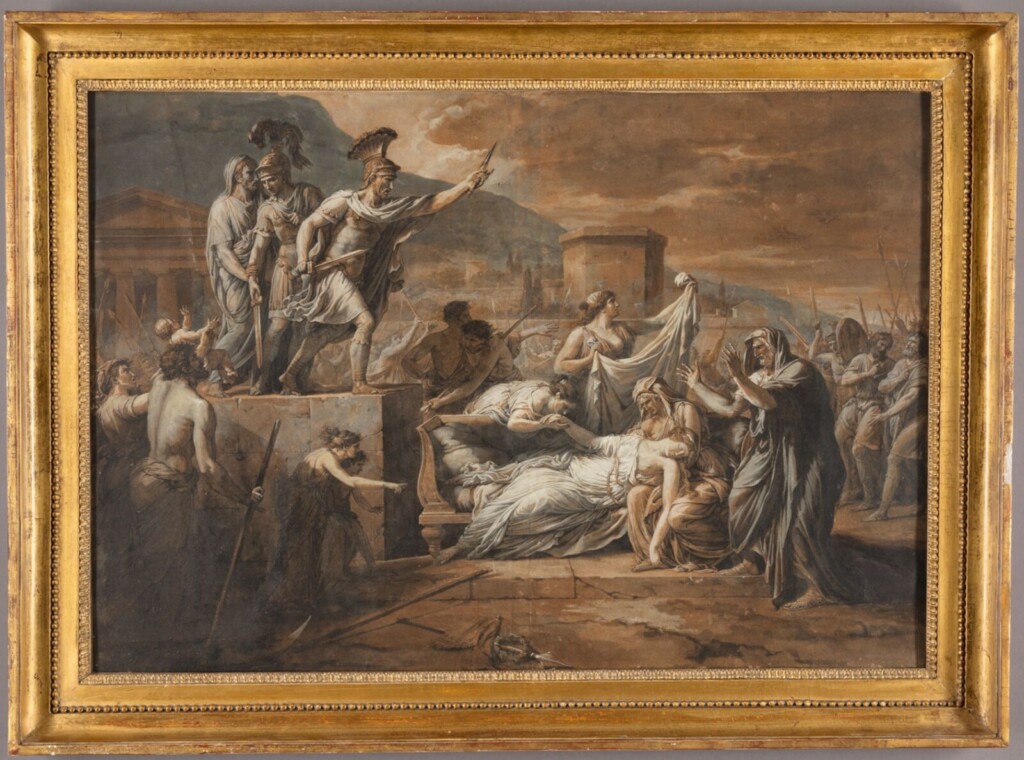
You already know the story — not because you studied it, but because it entered you somewhere between adolescence and the first time someone you trusted chose power over principle. “Et tu, Brute?” You did not need a classroom to feel the weight of those three words. You absorbed them the way you absorb a fear of the dark: before you had the vocabulary to question where it came from.
What you were not told is that those words were written in 1599 by a playwright working under Elizabeth I, a monarch who had spent decades watching her own court calculate the distance between loyalty and ambition, and who had banned public discussion of succession so thoroughly that even printing on the subject carried legal risk. Shakespeare did not write Julius Caesar in a vacuum of pure artistic freedom. He wrote it inside a political atmosphere where the wrong staging of a wrong king’s death could empty a theatre and fill a prison. The Globe was not the Parthenon. It was a commercial venue operating under surveillance, and every choice about who deserved sympathy — Caesar’s certainty, Brutus’s anguish, Antony’s grief — was made by a man who understood that art produced under power is never innocent of that power.
This is the mechanism that most literary education quietly conceals: a dramatic text written to navigate one specific political crisis became the foundational moral grammar through which the entire Western tradition processes tyrannicide. When political scientists in the twentieth century needed a framework for discussing assassination — from the debates surrounding the July 20, 1944 plot against Hitler to the ethical literature that exploded after Kennedy’s death — they reached, instinctively, for Shakespeare’s categories. Brutus became the archetype of the honorable conspirator undone by his own idealism. Cassius became the archetype of the man whose motives are too complicated to be pure. These are not historical conclusions. They are dramatic constructions, and they have been doing the work of historical conclusions for four centuries.
The philosopher Bernard Williams, writing in “Moral Luck” in 1981, argued that our assessments of moral agents are almost always contaminated by outcome: we judge the man who failed differently from the man who succeeded, even when the decision at the moment of choice was structurally identical. What he did not extend this argument to — though it follows cleanly — is that we also judge historical actors through the narratives that survived them, not through the decisions those actors actually faced. Brutus in 44 BCE was not performing nobility inside a five-act structure. He was moving through a city of rumor, faction, and genuine constitutional uncertainty, where the question of what Caesar intended was not yet answered by history because history had not yet happened. The tragedy Shakespeare gave him is retrospective. It is the tragedy of a man who already knows he will lose, because the playwright knows Rome will not become a republic again. The real Brutus did not know that.
What we inherit from this is a cultural reflex so deep it feels like moral instinct: the belief that political betrayal is legible, that we could recognize it in real time, that noble motives are distinguishable from convenient ones by some interior quality we would detect if we paid close enough attention. This is perhaps the most durable fiction the Western tradition has produced about power — not that Caesar was a tyrant or that Brutus was a hero, but that we, watching, would have known the difference before the knives came out. The conspirators who changed Rome did not change it by killing Caesar. They changed it by becoming the story through which every subsequent generation has rehearsed, in the safety of theater and literature, a decision it believes it would have made correctly.
🗡️ Power, Betrayal, and the Fate of Rome
The story of Brutus and Cassius is inseparable from the great themes that haunted the ancient world: political ambition, moral compromise, and the violence at the heart of power. These related articles trace the cultural and philosophical threads connecting Roman conspiracy to literature, rhetoric, and the enduring tragedy of betrayal.
Betrayal as a Theme in World Literature
Betrayal is one of the most ancient and universal themes in world literature, from the treachery of Judas to the daggers of the Senate. This article explores how writers across centuries have returned obsessively to the act of betrayal as a lens for examining loyalty, conscience, and the collapse of trust between human beings. Understanding this tradition helps illuminate why the conspiracy against Caesar still resonates so powerfully in our moral imagination.
GO TO THE SELECTION: Betrayal as a Theme in World Literature
Machiavelli’s The Prince: Meaning and Analysis
Machiavelli's The Prince remains the most ruthless and lucid meditation on political power ever written, and its pages seem to breathe the very air of the Roman Senate. This analysis explores how Machiavelli dissected the mechanics of conspiracy, loyalty, and the calculation behind every act of statecraft. Reading it alongside the story of Brutus and Cassius reveals how little the logic of power has changed across the centuries.
GO TO THE SELECTION: Machiavelli’s The Prince: Meaning and Analysis
Shakespeare’s Richard III: Meaning and Analysis
Shakespeare’s Richard III is one of the theatre’s greatest explorations of political ambition and the moral corruption that accompanies the ruthless pursuit of power. This article analyses how Shakespeare constructed his iconic villain as both a product and a destroyer of a political order built on shifting allegiances and calculated violence. The echoes of Julius Caesar resonate throughout, reminding us that Shakespeare’s Roman and English histories share a common obsession with conspiracy and its consequences.
GO TO THE SELECTION: Shakespeare’s Richard III: Meaning and Analysis
Niccolò Machiavelli: Life and Political Thought
Niccolò Machiavelli stands as the thinker who most systematically transformed the moral dilemmas of ancient Rome into a political philosophy for the modern world. This article examines his life and thought, tracing how his experience of Florentine power struggles led him to study Roman history with unprecedented realism and cold clarity. For Machiavelli, Brutus and Cassius were not simply traitors or heroes but case studies in the fatal miscalculations of men who underestimated the forces they had unleashed.
GO TO THE SELECTION: Niccolò Machiavelli: Life and Political Thought
Discover the Cinema of History and Power on Indiecinema
If these stories of ambition, conspiracy, and moral reckoning have stirred your imagination, Indiecinema offers a curated selection of independent and auteur films that bring the great dramas of history and power to life in unexpected ways. Explore our streaming catalog and find the films that dare to ask the questions that empires tried to silence.
👉 EXPLORE THE CATALOG: Watch Indie Films in Streaming
A vision curated by a filmmaker, not an algorithm
In this video I explain our vision

