
The Afternoon Everything Stopped
You are standing in the kitchen doorway and nothing is wrong yet. The coat is still on the hook. The coffee cup sits on the counter with a thin brown ring dried into the bottom, left there the way it always was when someone meant to come back for it. The cereal bowl from breakfast has not been washed. The radio is on a low murmur in the other room. Everything is arranged exactly as it was this morning, which is why your body has not caught up to what your mind was just told, which is why you are standing here looking at a coat hook as though the answer might be in the wool itself, in the brass of the button, in the familiar smell that is already, though you cannot know this yet, beginning its long, slow departure from the fabric.

This is not how grief is depicted. In every story children are given about loss, something breaks, something falls, the weather changes. But the body of a child encountering the permanent absence of a parent for the first time does not behave like a story. It behaves like a system encountering an input it has no prior category for. It keeps running its ordinary functions. The heart beats. The lungs fill. The eyes track movement. The confusion is not emotional, not yet. It is almost mechanical, a searching of the environment for the data point that will make the equation resolve.
John Bowlby spent decades mapping what happens when that equation refuses to resolve. His three-volume work Attachment and Loss, completed in 1980, described the particular horror of what he called protest, the phase in which a child does not accept the permanence of separation but continues to search. Children cry, call out, scan doorways, listen for footsteps. This is not irrationality. This is the attachment system doing precisely what it was built to do: locate the caregiver, restore proximity, survive. The system cannot be told to stop. It was never designed to receive the information that the object of its search no longer exists in the world.
What Bowlby could not fully account for was the ordinary room. The phenomenology of objects left mid-task. A half-drunk cup of coffee is not a symbol of grief. It is something far more disorienting: evidence of a life that was interrupted rather than concluded. The parent who left that cup was not saying goodbye. They were doing what people do when they will be back in twenty minutes. The child who stands looking at it understands, somewhere beneath language, that the world has divided into before and after at a seam so thin it is invisible, located somewhere between one sip and the next.
George Bonanno’s longitudinal research at Columbia University, published across several studies in the early 2000s, found that a significant portion of bereaved adults show what he called resilience trajectories, stable functioning maintained even through acute loss. But his samples were adults. The child brain is not a smaller adult brain. The prefrontal cortex, responsible for processing finality and abstract futures, is not functionally complete until the mid-twenties. A seven-year-old told that a parent is not coming back is working with cognitive architecture that was not built to process permanence. The concept arrives like a transmission in a frequency the receiver cannot yet decode.
So the child stands in the kitchen. The coat stays on the hook for weeks, because no one can bring themselves to move it, and then one morning it is gone and that absence is its own small detonation. The radio gets turned off. The cereal bowl gets washed. The room slowly stops being the room where someone was about to return and becomes the room where someone used to live, and the child’s body, still running its search protocols, still listening for a particular set of footsteps, does not know how to file that reclassification.
Children Of A Darker Dawn
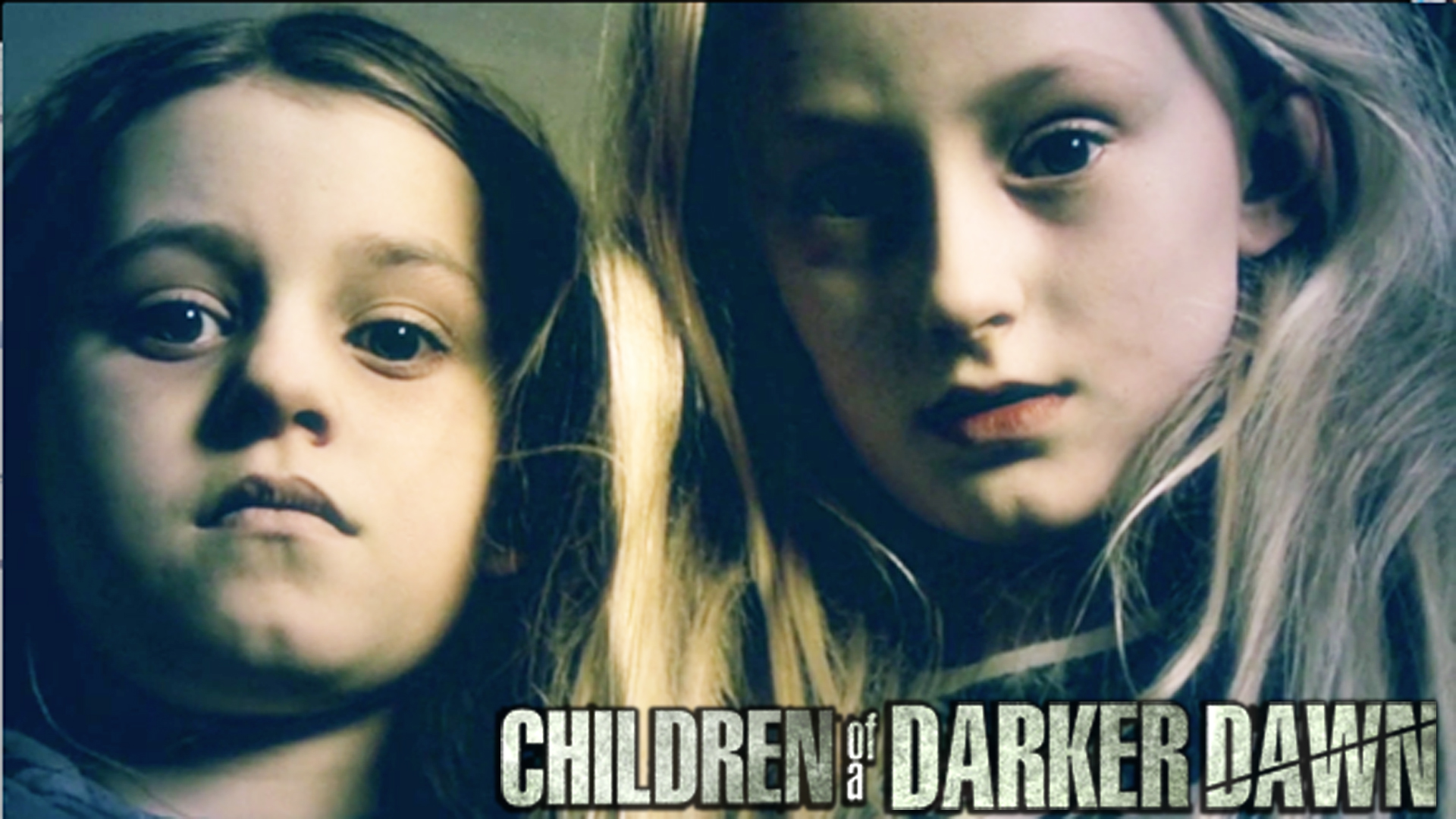
Drama, horror, sci-fi, by Jason Figgis, United States, 2012.
In a post-apocalyptic Ireland, a pandemic has wiped out the adult population, struck down by a mutant strain of flu that turns them paranoid and violent before killing them. Nine months later, the surviving children wander through abandoned buildings in search of food and shelter. Among them are Evie and her younger sister Fran, trying to survive while avoiding potentially dangerous groups of kids. Their only comfort is The Railway Children, the book their mother used to read to them. The arrival of Alice, a girl who has escaped from a gang led by her sister Kate, changes their path. After being betrayed by the gang, Evie decides to confront them, triggering a series of events that will lead to tensions and conflicts within the group.
The film, directed by Jason Figgis with limited resources but great sensitivity, is a post-apocalyptic drama that goes beyond horror, focusing on grief and the emotional fragility of its characters. The tone is somber, marked by melancholy, disturbing flashbacks, and unstable relationships. Though it recalls films like 28 Days Later, The Road, or Lord of the Flies, Children of a Darker Dawn finds its own voice through strong character development and powerful performances from its young cast.
LANGUAGE: English
SUBTITLES: Spanish, French, German, Portuguese
The Lie We Tell About Resilience
You have probably said it yourself, or heard it said with such conviction that you nodded along without questioning it: children are resilient. Someone loses a parent at six, at nine, at eleven, and the adults in the room reach for this word the way they reach for a glass of water — automatically, gratefully, because it costs nothing and closes the conversation. The child goes back to school. The child laughs again at something on television. The child eats dinner. And the adults, relieved, file this as evidence of recovery rather than what it often actually is: the spectacular human capacity to continue functioning while something foundational has been permanently altered.
The myth of childhood resilience did not emerge from careful observation of grieving children. It emerged from the discomfort of adults who needed grief to have an endpoint, and who found in children’s apparent adaptability a convenient permission slip to stop looking closely. It is a belief that serves the living more than the bereaved. John Bowlby spent the better part of three decades documenting precisely what gets erased by this convenience. His trilogy — Attachment in 1969, Separation in 1973, and Loss in 1980 — constitutes one of the most rigorous and consequential arguments in twentieth-century psychology, and its central finding is deeply uncomfortable for anyone who has ever reached for that word resilient as a form of reassurance. Bowlby demonstrated that the bond between a child and a primary caregiver is not a sentimental relationship but a biological architecture. It is not metaphor. It is the actual scaffolding around which the nervous system constructs its model of the world, of safety, of what other human beings are likely to do to you.
When that bond is severed — not strained, not complicated, but severed permanently through death — the child’s developing neurological system does not simply grieve and reorganize. It encodes the loss as a structural fact about reality. Bowlby called this the internal working model: the unconscious template through which all subsequent attachment relationships are interpreted. A child whose primary attachment figure disappears without return does not merely learn that people die. The nervous system registers something far more primitive and operational — that closeness is a precondition for loss, that depending on someone means exposing yourself to an annihilation you cannot survive twice. This is not a conscious belief. It is a physiological orientation. It shapes proximity-seeking behavior, tolerance for intimacy, the capacity to trust without building in a pre-emptive emotional exit strategy.
What looks like resilience from the outside is frequently dissociation from the inside. The child who returns to playing, who stops crying in public, who says they are fine — this child has often not processed the loss but rather routed around it the way water routes around an obstacle, finding a new path that avoids the wound entirely. George Bonanno at Columbia University spent years studying bereavement trajectories and found in his 2004 paper in the American Psychologist that what presents as resilience in the immediate aftermath of loss is one of several distinct patterns — and that it is far less common than the culture assumes, and far less stable than it appears. Children classified as resilient in the months following parental death frequently show significant psychological disruption years later, at developmental thresholds that demand what the loss already took from them: the capacity to attach without terror, to separate without panic, to let someone matter without preparing for their disappearance.
The cruelty of the myth is not just that it is false. It is that it isolates the child precisely when isolation is most dangerous. A seven-year-old who does not perform devastation according to adult expectations quickly learns that her grief is socially inconvenient, which means she learns to hide it, which means the adults around her never have to see it, which means she carries it entirely alone into an adolescence that will have no idea what hit it.

What the Nineteenth Century Invented

You are handed a black armband and told to wear it for exactly one year. After that, the mourning is finished. The Victorian era did not simply ritualize grief — it administered it, converted it into a social calendar with entry and exit points, and in doing so invented something far more lasting than the armband itself: the idea that grief has a correct duration, and that those who exceed it are failing at something.
Before the nineteenth century, death moved through domestic space without apology. Children watched their parents die in the same beds where they had been born. The body stayed in the house for days. Grief was not a private psychological event but a communal, visible, almost liturgical process in which children were full participants. The industrialization of Europe — and particularly the acceleration of urban poverty in England between 1830 and 1880 — began dismantling this arrangement with remarkable efficiency. When a parent died in a factory town, the economic machinery did not pause. The surviving household had to reorganize immediately around the question of productivity, and children who were too young to work became, in the language of the institutions built to receive them, “surplus dependents.”
The Foundling Hospital in London, originally established in 1739 by Thomas Coram, had been conceived as a mercy. By the Victorian expansion of its model — replicated across dozens of county orphan asylums throughout the 1850s and 1860s — the architecture of mercy had been quietly replaced by the architecture of management. Philippe Ariès, in his 1960 work “Centuries of Childhood,” documented how the modern conception of childhood as a protected, separate category of existence emerged precisely alongside the industrial conditions that made that protection economically inconvenient. The orphan institution was the site where these two impulses collided: childhood was precious, so the orphan must be educated; childhood was also economically useless, so the orphan must be made useful as quickly as possible. The grief itself — the actual psychological devastation of losing a parent — was not anywhere in that equation.
What the nineteenth century effectively accomplished was the removal of death from the child’s immediate sensory world. As Philippe Ariès later argued in “The Hour of Our Death” (1977), Western modernity progressively moved dying out of the home and into specialized institutions, a process already well underway by 1870. For a bereaved child, this meant something specific and largely unremarked: they were no longer witnesses. They did not see the body, did not participate in the preparation of the dead, were frequently sent away from the house during the final hours, and were then handed back to a world that had already reorganized itself around the absence. The loss arrived secondhand, through adult announcement, and the child’s visible distress became socially inconvenient almost immediately.
The social architecture built around the nineteenth-century bereaved child was not cruel by intention. It was engineered by people who genuinely believed that distraction healed, that structure protected, that the most compassionate response to a child’s grief was to fill the hours until the grief subsided. Charles Dickens was not writing pure invention when he placed his orphaned protagonists into systems of relentless labor and cheerful brutality — he was transcribing a logic his contemporaries considered reasonable. The orphan who wept too long was not seen as a child in pain. He was seen as a child resisting his own recovery.
What that century bequeathed to every subsequent generation is not the armband or the asylum — both are largely gone. What it bequeathed is the underlying assumption that a grieving child is a problem to be resolved rather than a person to be accompanied, and that the resolution should happen quickly enough not to inconvenience the living world that continues turning around the small, stopped center of that child’s loss.
The Body Keeps the Score Before the Mind Knows There Is One
You are seven years old and your stomach has been hurting for six months. The doctors find nothing. Your teacher notices you flinch when someone raises their voice near you, a small animal reflex that does not belong in a classroom. Your mother died in February, and the adults around you have decided, with genuine kindness, that you are “doing well” because you have stopped crying in public.
The body, however, has not reached this consensus. It has been conducting its own reckoning entirely below the threshold of language, rewriting the architecture of the nervous system with a precision that no grief counselor’s session has yet touched. Bessel van der Kolk spent decades documenting this interior catastrophe, and what his clinical research revealed — published in full in “The Body Keeps the Score” in 2014, though grounded in work stretching back through the 1980s and 1990s — is that traumatic experience does not wait for narrative to organize it. It encodes directly into tissue, into the subcortical regions of the brain that predate conscious thought, into the body’s hormonal rhythms that operate on timescales memory cannot access.
The ACE study, launched in 1995 through a collaboration between the CDC and Kaiser Permanente and published across several landmark papers beginning in 1998, produced numbers that were almost too clean to be believed. Researchers surveyed over 17,000 adults about their childhood experiences and then tracked their health outcomes across decades. Parental loss appeared as one of the ten categories of adverse experience, and the data showed a dose-response relationship of brutal simplicity: the higher the ACE score, the higher the statistical likelihood of autoimmune disease, heart disease, cancer, depression, and early death. Not metaphorically higher. Measurably, reproducibly, structurally higher. The body had been keeping the accounting all along.
What makes this particularly difficult to absorb is that the mechanism operates most aggressively in the developmental window when children have the fewest conceptual tools to recognize what is happening. The hypothalamic-pituitary-adrenal axis — the system that regulates cortisol, the body’s primary stress hormone — is still calibrating itself during early childhood. When a child loses a parent, the sustained activation of this system does not simply spike and return to baseline. It can reset the baseline itself, producing a nervous system chronically tuned for threat, one that will interpret ambiguous social situations as dangerous, that will flood the bloodstream with cortisol at stimuli that a different nervous system would process as neutral. This is not weakness. It is adaptation to conditions that no longer exist, written permanently into the body before the child had words for loss.
Neuroimaging research emerging from the early 2000s onward has made visible what grief does to the developing brain in specific anatomical terms. The hippocampus, central to memory consolidation and the regulation of the stress response, shows measurable volume reduction in individuals who experienced early parental loss — particularly under conditions where the grief was not adequately witnessed or supported. The prefrontal cortex, responsible for impulse regulation, planning, and the capacity to mentalize about one’s own emotional states, develops more slowly and sometimes less fully in children whose early environments were destabilized by loss. These are not destiny. Neuroplasticity is real and documented. But they are not metaphors either.
The cruelty embedded in this biology is that it makes the child’s distress legible only in forms adults often misread — behavioral problems, somatic complaints, immune vulnerability, a strange flatness in the affect of a ten-year-old who seems fine. The grief has not disappeared. It has simply migrated into a register that the culture surrounding the child does not have instruments to read, a register where it will continue its work in silence, shaping immune responses, cortisol rhythms, relational patterns, long after the funeral flowers have been thrown away and everyone has agreed, out of love and exhaustion, that it is time to move on.
How Schools Became the Great Normalizers
You come back on a Tuesday. The desk is the same desk. The fluorescent lights hum the same hum. Someone has written something funny on the whiteboard and half the class is still laughing when you walk in, and the teacher looks at you with that particular expression — warm, careful, slightly pained — and then asks everyone to open to page forty-seven. And just like that, the institution has made its position clear: we are glad you are here, and we will prove it by treating you as if nothing happened.
The school did not invent this logic. It inherited it from a much older architecture of social management, one that Frederick Winslow Taylor described in mechanical terms in 1911 but that had already been operating in human institutions for centuries before him: efficiency requires continuity, and continuity requires that disruption be absorbed rather than acknowledged. The grieving child is a disruption. Not maliciously, not cruelly — the school does not hate the child — but structurally. The curriculum does not have a column for loss. The standardized assessment does not measure what happens to a nine-year-old’s capacity for symbolic reasoning when the person who read to them every night no longer exists. And so the child is routed back into the flow, because the flow is the only thing the institution knows how to protect.
What makes this particularly precise as a mechanism of harm is that it disguises itself as kindness. Returning to routine is genuinely recommended by some grief counselors as one component of recovery — there is real evidence that structure can provide a kind of scaffolding for children whose internal world has collapsed. But scaffolding is not a building. It is temporary, load-bearing in a specific direction, meant to support construction rather than replace it. When the school offers routine as the entire response to loss, it converts the scaffold into a permanent facade, and the child learns to perform functioning because the alternative — visible grief, uncontained emotion, the sudden inability to care whether fractions reduce correctly — is socially illegible within the institution’s grammar.
William Worden, whose four tasks of mourning, outlined in Grief Counseling and Grief Therapy, first published in 1982, remain among the most clinically durable frameworks for understanding loss, was explicit that children need permission to grieve in doses, repeatedly, over years. They do not grieve once and integrate. They revisit the loss at each developmental stage, which means the child who loses a parent at seven will grieve again at twelve, again at sixteen, again when they graduate, again when they fall in love. The school, by contrast, operates on a fiscal-year logic. It gave the child three days. It sent a counselor once. It considers the file closed.
The deeper problem is what gets measured. Since the early 2000s, in the wake of No Child Left Behind in the United States and its various equivalents across Europe, educational systems have become increasingly dominated by performance metrics that quantify outcomes in ways that are both narrow and consequential. A child’s reading score is tracked. Their attendance is tracked. Their capacity to remain emotionally regulated enough to produce legible academic output is, in effect, tracked — not because anyone is cruel, but because the system can only see what it can count. Grief produces no countable output. It produces silence, distraction, regression, sudden anger at minor provocations, and an occasional terrifying flatness that adults find uncomfortable and tend to interpret as recovery because the crying has stopped. The crying stopping is not recovery. It is often the child understanding, with a sophistication that should disturb us, that the crying is no longer welcome.
There is a particular kind of intelligence that children develop under these conditions — a social fluency in the performance of normalcy that costs them something they will spend years trying to name.
A vision curated by a filmmaker, not an algorithm
In this video I explain our vision
A Different Kind of Orphan

You are standing at the edge of someone else’s kitchen, holding a paper cup of juice you stopped drinking twenty minutes ago, watching a woman across the room reach over and straighten the collar of her daughter’s dress. It is such a small gesture. Two fingers, a half-second of contact, the collar lying flat again. The girl barely registers it, already turning back to her friends, and the mother has moved on before anyone else in the room noticed it happened. But you noticed. You are eleven, or fifteen, or thirty-four, and you noticed, and the noticing does something to the inside of your chest that has no name in any language you have been given.
What that child at the party is experiencing is not grief in its acute form. The acute form came earlier, in the weeks and months after the death, when the absence was a physical fact the body had to absorb like a wound. What arrives at the birthday party is something structurally different — a form of loss that does not diminish with time but instead gains new surface area as life expands. George Bonanno, whose research at Columbia University produced one of the most empirically rigorous accounts of bereavement trajectories, identified in 2004 a pattern he called resilient grieving, demonstrating that the majority of bereaved adults show a stable, low-distress trajectory rather than the prolonged suffering the culture assumes is inevitable. But resilience, in Bonanno’s framework, is not the absence of pain. It is the capacity to function. These are not the same thing, and the distinction matters enormously when applied to children who lose parents, because a child can be functionally resilient — attending school, forming friendships, performing normalcy with extraordinary competence — while carrying a grief that has gone entirely underground, waiting for a collar to be straightened.
The clinical literature distinguishes between anticipatory grief, which occurs before a loss when death is expected, and delayed grief, which surfaces long after the loss has technically concluded. Children, however, often experience a third configuration that fits neither category cleanly: a grief that is neither anticipated nor delayed but perpetually deferred, because the child does not yet possess the emotional architecture to process what has happened and keeps encountering the loss anew each time life presents a situation the dead parent should have inhabited. Adolescence restructures the loss. Adulthood restructures it again. Each developmental threshold — a graduation, a marriage, a child of one’s own — does not reopen the wound so much as reveal that the wound was always shaped differently than it appeared from the outside.
The cultural narrative around orphanhood tends to locate the tragedy at the moment of death, as though grief were an event rather than a condition that accretes meaning across decades. This is partly why bereaved children are so often assessed as having recovered when they have merely adapted. Bowlby’s attachment theory, developed through the 1960s and 1970s, proposed that early bonds with caregivers form the template through which all subsequent relationships are interpreted, which means that losing the architect of that template does not simply remove a person from the child’s life — it destabilizes the foundational grammar through which love and safety and continuity are understood. The child learns to speak a second language fluently while the first one, the one spoken before the loss, becomes something half-remembered, accessible only in flashes, in gestures witnessed across crowded rooms.
What makes this particular texture of loss so difficult to articulate is that it is not located in the past. It lives in the present tense of every moment that should have been ordinary — every collar, every hand on a shoulder, every voice calling a name from another room, all the infrastructure of being known by someone who has been watching you since before you knew how to be watched.
The Gender Trap Inside Grief
You are seven years old and your father has just been buried, and someone your mother’s age crouches down, grips your shoulders, and says: “You’re the man of the house now.” Nobody in that room thinks they have just handed a child a prison sentence. They believe they are offering dignity.
What that sentence actually does is foreclose grief before it begins. The boy standing in his borrowed suit is not being invited to feel the loss — he is being conscripted into a performance of its absence. Stoicism here is not a temperament; it is an assignment. And the tragedy is that the assignment arrives precisely at the moment when the nervous system most desperately needs permission to collapse, to wail, to be structurally useless for a while. That permission is revoked before the child even knew he had it.
Phyllis Silverman and Steven Nickman, in their landmark 1996 collection “Continuing Bonds: New Understandings of Grief,” documented something that contradicted decades of clinical assumption: bereaved children do not and should not sever their attachment to the dead parent. Healthy grieving, their research showed, involves maintaining an inner, evolving relationship with the lost figure — one that changes as the child grows. What they also found, embedded in the data from bereaved families across gender lines, was that boys and girls were being systematically routed into incompatible relationships with this process. Boys were being pushed toward disconnection — precisely what the research identified as harmful — while girls were being enrolled in a different but equally distorting script.
The girl who loses her mother at nine is often told, with complete unconscious cruelty, how capable she is. How mature. How much her father needs her. Within months she may be managing household logistics, mediating her father’s moods, softening grief for her younger siblings. Every adult who praises her composure is unknowingly rewarding her for burying herself. Her mourning does not disappear — it migrates, becoming the substrate beneath every caretaking act, unnamed and therefore unprocessable. What looks like resilience from the outside is, from the inside, a slow erasure.
These patterns do not dissolve when the children grow up. They elaborate. The boy who learned to perform imperviousness at seven will, twenty years later, interpret his partner’s grief as a demand he cannot meet, or respond to his own losses with a rage that confuses everyone including himself — because rage was the one emotion that was not quarantined under stoicism. It moves. It disguises itself. The woman who learned at nine that her value resided in her capacity to absorb others’ pain will find relationships that confirm this economy, will mistake her exhaustion for love, will feel guilty the first time someone suggests she is allowed to need something.
The sociologist Arlie Hochschild, writing in “The Managed Heart” in 1983, described emotional labor as the work of inducing or suppressing feelings in order to sustain an outward appearance that produces a desired state in others. She was writing about flight attendants and bill collectors. But the architecture she described is exactly what bereaved children perform — except without a wage, without a contract, and without the ability to clock out. They are doing emotional labor for a grieving family system before they have developed the cognitive tools to understand what grief is.
What makes this particularly resistant to correction is that neither the stoic boy nor the caretaking girl is being obviously mistreated. They are being handled with the full, sincere toolkit of their culture’s love. The community believes it is helping. The relatives believe the child is coping. Everyone around the child is reading the performance as the reality, which means the child eventually does too — and the internal distance between what they feel and what they are permitted to feel becomes a gap so familiar it stops registering as a gap at all.
What Remains When Nothing Is Said

You are seven years old and the adults around you have decided, with absolute tenderness, to destroy you slowly. They keep their voices low when they speak near the door. They change the subject when you walk into the room. The photographs on the shelf get rearranged — one less face, one less frame — and nobody mentions it, because mentioning it would mean explaining it, and explaining it would mean breaking something they have decided to keep whole.
The instinct is ancient and almost forgivable. Protecting a child from death feels like the most natural act of love available to a grieving adult who is barely surviving their own loss. But what gets called protection is structurally something else entirely. When adults remove a child from the funeral, intercept the questions with distraction, replace the word “dead” with “gone” or “sleeping” or “in a better place,” they are not shielding the child from reality — they are amputating the child’s right to participate in it. The child already knows something has ended. The body knows before the mind has language. What the silence does is not prevent grief but orphan it, leaving it without a name, without a ritual, without any collective permission to exist.
Françoise Dolto, whose clinical work with children in France across the mid-twentieth century remains some of the most demanding thinking ever done on the subject, argued that children are capable of bearing symbolic truth at any age — that what damages them is not the truth itself but the absence of it dressed up as care. Her concept of symbolic castration, which describes the necessary separations that allow a child to individuate and grow, carries an uncomfortable implication: that withholding reality from a child is itself a form of mutilation, not a prevention of one. The silence does not protect the inner world of a child. It colonizes it. It installs, in the place where a parent once lived, a void that cannot be mourned because it has never been officially acknowledged.
Clinical literature on complicated grief in adults consistently traces its origins to exactly this. Research gathered across several decades, including longitudinal studies from the 1990s conducted by researchers at Harvard’s Child Bereavement Study, found that children who were excluded from funeral rites, denied clear information about cause of death, or surrounded by adults who modeled emotional suppression were significantly more likely to develop prolonged grief disorder, depression, and attachment difficulties in adulthood. The numbers are not abstractions — they are the accumulated weight of thousands of adults sitting in therapists’ offices trying to mourn someone they were never allowed to bury.
There is a particular cruelty in the logic of the censored photograph. When the image of the dead parent disappears from the walls, the child receives a message more powerful than any spoken sentence: that this person is now unspeakable, that grief is a contamination, that love itself has an expiration date after which it becomes inappropriate. The child does not think this consciously. The child absorbs it the way water absorbs color — completely, invisibly, without resistance. And then, twenty or thirty years later, that same child — now an adult — finds themselves unable to speak about their parent without a strange embarrassment, a feeling that the loss is too old to still hurt, that they should be over it by now, without ever understanding that they were never allowed to begin.
What remains, in the end, when nothing is said, is not peace. It is a room in the interior that nobody ever entered, where something waits in the dark with the patience of everything that was never given a funeral — not asking to be healed, not asking to be solved, only asking, with the quiet insistence of a seven-year-old standing outside a closed door, to finally be seen.
💔 When Loss Shapes the Heart of a Child
Grief in childhood is one of the most profound and disorienting experiences a young person can face. The loss of a parent reshapes identity, memory, and the child’s relationship with the world around them. These related articles explore the psychological, literary, and cultural dimensions of mourning, loss, and the inner life of those who grieve.
Joan Didion and Loss: The Year of Magical Thinking
Joan Didion‘s memoir on losing her husband is one of the most searing literary accounts of grief ever written. Her concept of ‘magical thinking’ — the irrational belief that the dead might return — resonates deeply with how children process the loss of a parent. Didion shows how mourning distorts time, memory, and the very fabric of daily reality.
GO TO THE SELECTION: Joan Didion and Loss: The Year of Magical Thinking
C.S. Lewis and the Death of His Wife: A Grief Observed
C.S. Lewis wrote ‘A Grief Observed‘ as a raw, unfiltered diary of mourning following the death of his wife, confronting despair and faith with brutal honesty. His experience illuminates how grief can feel like a kind of childhood regression, reducing even the most rational adult to helplessness and confusion. For children who lose a parent, this dissolution of certainty is especially acute and formative.
GO TO THE SELECTION: C.S. Lewis and the Death of His Wife: A Grief Observed
Regression in Psychology: When the Mind Returns to Childhood
Regression in psychology describes the mind’s tendency to retreat to earlier, safer emotional states when faced with overwhelming stress or loss. For children who lose a parent, this mechanism is particularly significant, as the psyche may become fixed at the developmental stage where the trauma occurred. Understanding regression helps illuminate why grief in childhood can leave such lasting marks on adult personality and attachment patterns.
GO TO THE SELECTION: Regression in Psychology: When the Mind Returns to Childhood
Loneliness in Contemporary Society
Loneliness in contemporary society has reached epidemic proportions, and its roots often trace back to early experiences of abandonment or loss. A child who loses a parent encounters not only grief but a sudden, bewildering solitude that can shape their entire emotional landscape. This article explores how modern culture struggles to hold space for deep, enduring loneliness — a struggle that begins, for many, in childhood bereavement.
GO TO THE SELECTION: Loneliness in Contemporary Society
Discover Cinema That Dares to Speak of Loss
If these themes move you, Indiecinema is the streaming platform where independent cinema speaks the language of genuine human experience — including grief, childhood, and the unspoken weight of loss. Explore films that major platforms would never recommend, curated for those who believe that cinema can heal as much as it reveals.
👉 EXPLORE THE CATALOG: Watch Indie Films in Streaming
A vision curated by a filmmaker, not an algorithm
In this video I explain our vision

