
Here is a curated selection of independent films that perfectly embody the theme of identity, exploring its cracks, masks, and infinite possibilities. Cinema, in its purest essence, is a mirror. But while mainstream cinema tends to offer us a polished and reassuring reflection, independent and arthouse cinema hands us a shattered mirror. In those shards, in those fractures, we find a more complex, contradictory, and ultimately truer image of what it means to be human.

Free from commercial constraints and pre-packaged narrative formulas, independent drama films ventures into the gray areas of existence, where identity is not a given, but a constant question. It is a territory of searching, of crisis, of transformation. Independent directors use bold formal languages to give shape to the fragmentation of the psyche, the fluidity of gender, cultural alienation, and existential crisis.
This guide is a journey through thirty of those shards. Each film is a door to an inner universe, an investigation into the construction of the self that challenges our certainties. From underground cinema, born as a form of cultural subversion, to contemporary works that redefine the boundaries of representation, these films show us that identity is not a monolith to be discovered, but a fragile mosaic that we compose and recompose throughout our lives.
Fragmented Psyche – Identity, Memory, and Dissolution
Cinema has always sought to give form to the invisible, to translate the labyrinths of the mind into images. The films in this section go further, using cinematic language to visualize the subject’s internal crisis. Here, identity is a fragile construct, an echo of memory, a social performance constantly on the verge of collapse. These works deconstruct the notion of a stable “I,” showing how the psyche can dissolve, merge with another, or become trapped in a loop of representations. This is a cinema that does not tell the story of a crisis, but embodies it in its very form.
Persona (1966)

Elisabet, an acclaimed actress, suddenly falls into a catatonic silence. She is entrusted to the care of Alma, a young and talkative nurse, in an isolated seaside cottage. The forced intimacy and Elisabet’s deafening silence push Alma to confess her deepest secrets, triggering a process of psychological fusion and dissolution between the two women, where the boundaries of their identities begin to dangerously blur.
Ingmar Bergman‘s masterpiece is an abyssal dive into the psyche. The film explores the Jungian concept of the “persona” as the social mask we wear to face the world. Elisabet’s silence is not absence but an extreme act of rebellion: the refusal to perform anymore, to lie with every gesture and every smile. Bergman, with Sven Nykvist‘s almost tactile cinematography, uses the close-up as a surgical tool to dissect the soul, leading to the famous, terrifying shot where the two women’s faces merge into one. Persona does not merely represent an identity crisis; it provokes one, going so far as to tear the film itself in half, as if to suggest that art, like the self, is a fragile construct that can shatter.
Don Barry: A Quixotic Exploration

Docufiction, Experimental, by Paul Smart, Mexico, 2026.
Don Barry: A Quixotic Exploration is a debut feature that places the biography of an eighty-year-old experimental filmmaker and artist, Barry Gerson, within the metanarrative of Miguel de Cervantes’ Don Quixote. Don Barry was filmed in the city of Guanajuato during the 51st edition of the Cervantino Festival, as well as during the vibrant Day of the Dead celebrations held in the city’s UNESCO-listed tunnels. The film honors the director’s long friendship with artist Barry Gerson, drawing inspiration from Cervantes’ Don Quixote. Paul Smart’s directorial choices create something new that celebrates life and goes beyond conventional storytelling. A search for magic in our real lives. A moving film about the meaning of life, art, and death. Not to be missed.
Paul Smart is a proud outsider filmmaker with a long history of film screenings. In the 1980s, he emerged in New York’s vibrant youth art scene, working in theater production and later filmmaking, before retreating to rural upstate New York, in the Catskill Mountains, where he made a living writing and screening independent films in old parish halls for rural audiences, many of whom had never seen a film.
LANGUAGE: English
SUBTITLES: Spanish, French, German, Portuguese
Synecdoche, New York (2008)

Caden Cotard, a hypochondriac and unhappy theater director, receives a prestigious grant that allows him to create a work of absolute honesty. He decides to stage his own life, building a life-size replica of New York in a warehouse. The project expands uncontrollably, with actors playing him and the people in his life, and then other actors playing the actors, in a recursive loop that consumes decades and blurs every boundary between art and reality.
Charlie Kaufman‘s directorial debut is a monumental and heartbreaking work about the solipsistic search for an authentic self. The narrative structure, which folds back on itself endlessly, is the perfect metaphor for Caden’s mind, trapped in a never-ending analysis. Identity here is not something to be discovered, but an endless performance, a series of roles we play until we forget who the director is. The title itself, referring to a figure of speech where the part represents the whole, is the key: Caden’s drama is the drama of existence, the desperate attempt to capture the totality of life in a representation, an endeavor doomed to fail.

Aftersun (2022)

Twenty years after a holiday in Turkey with her father, an adult Sophie reflects on those days. Through her fragmented memories and the grainy footage from a camcorder, she tries to piece together the image of her father, Calum, a loving but enigmatic man who was struggling with a darkness she, as an eleven-year-old, could only glimpse. Memory becomes an act of investigation and reconciliation with a figure both so close and so elusive.
In her stunning debut, Charlotte Wells explores memory not as an archive, but as an active and painful process of identity construction. The alternation between film, which gives the memories a dreamlike and idealized quality, and the DV camcorder footage, which serves as “objective” but incomplete evidence, highlights the gaps that only imagination can fill. Calum’s identity is defined not by what we see, but by what the adult Sophie projects onto those moments, suggesting that the identity of those we love is a mosaic composed as much of their fragments as of our own.
Arte
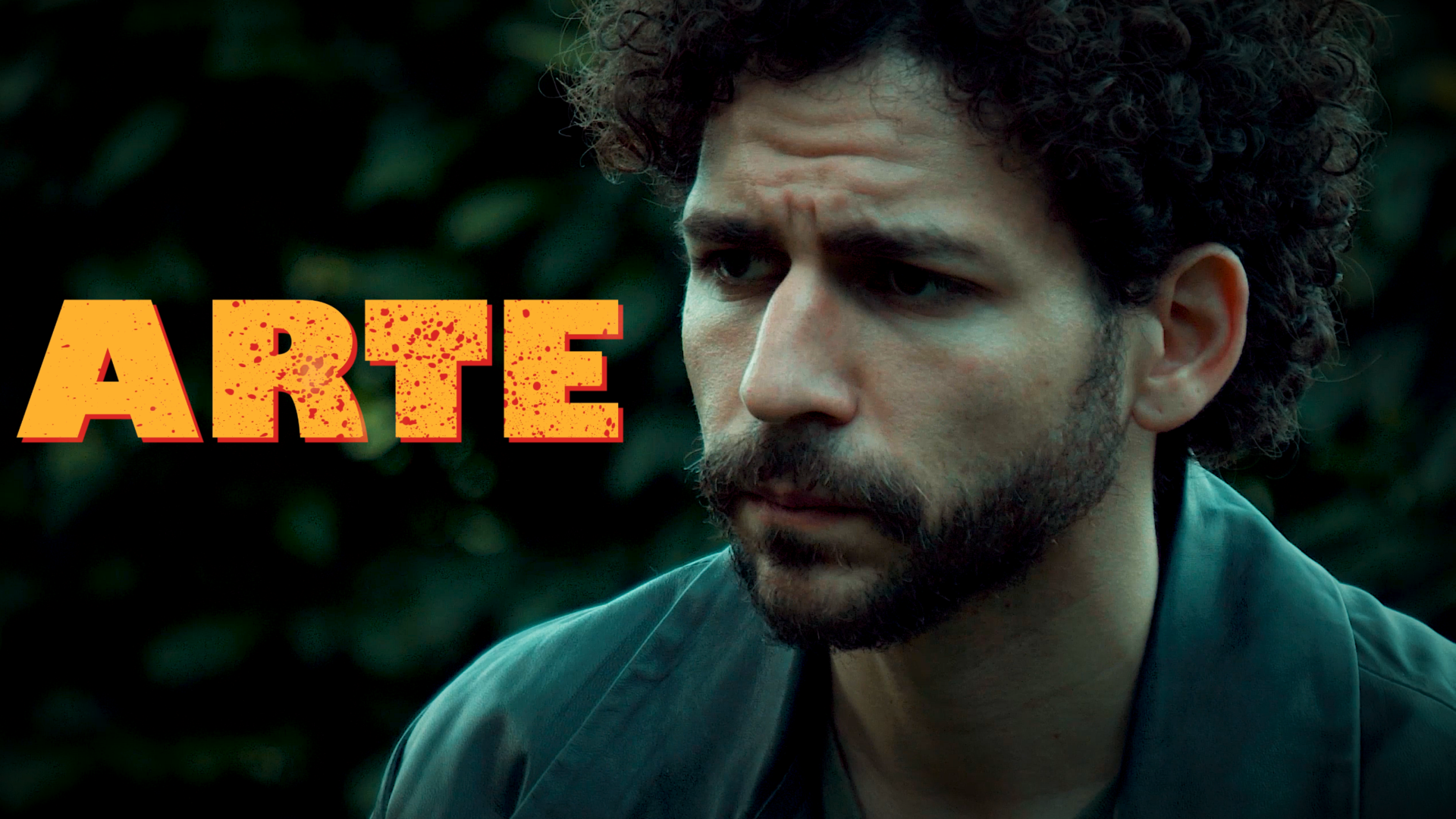
Drama, thriller, by Stefano Scala, Simone Arcidiacono, Italy, 2023.
In a secret and fascinating world, four people meet every week at the mysterious "The Circle" for a gripping game, knowing nothing about each other. However, fate has a different plan for them. As the game progresses, their lives begin to intertwine in unpredictable ways. The boundaries between the game and reality start to blur, revealing buried secrets and creating unthinkable connections. In the heart of "The Circle," the masks fall, and the players' lives will be forever changed.
LANGUAGE: Italian
SUBTITLES: English, Spanish, French, German Portuguese
Wild Strawberries (1957)

The elderly and egocentric professor Isak Borg undertakes a long car journey to receive an honorary degree. During the trip, accompanied by his daughter-in-law, a series of dreams, memories, and chance encounters force him to confront his past: a lost love, an unhappy marriage, and a life marked by emotional coldness. This physical pilgrimage transforms into a profound inner journey towards self-understanding and forgiveness.
Bergman again, here in one of his most accessible and moving works, uses the road movie structure as an archetype for the journey of self-discovery. The Swedish landscape flowing past the car window is a reflection of Isak’s inner landscapes of memory. Through iconic images and dream sequences laden with symbolism, Bergman dramatizes one man’s struggle to dismantle the rigid identity he has built for himself his entire life and rediscover the humanity he had suppressed. It is an elegant meditation on old age, regret, and the possibility of a final reconciliation with one’s own existence.
Waltz with Bashir (2008)

Director Ari Folman realizes he has a black hole in his memory regarding his experience as a soldier during the 1982 Lebanon War, particularly during the Sabra and Shatila massacre. To recover this lost past, he interviews old comrades, whose testimonies mix with surreal and dreamlike visions. The film becomes an investigative inquiry into the fragile and traumatic nature of memory.
This revolutionary animated documentary demonstrates how identity is shaped as much by what we forget as by what we remember. The animation is not a mere stylistic flourish but the only language capable of visualizing the inexpressible: dreams, hallucinations, memory gaps, and psychological defenses in the face of trauma. Folman’s search is not just personal; it becomes an exploration of collective guilt and the construction of Israeli national identity, showing how history, both individual and collective, is an unstable and constantly renegotiated narrative.
The Ecstasy of Isabel Mann

Horror, thriller, by Jason Figgis, United States, 2016.
Set in Ireland, the film tells the story of Isabel Mann, an introverted and lonely teenager who is drawn into a dark and seductive world of blood, violence, and vampirism. As the story unfolds, Isabel undergoes a disturbing transformation—from a vulnerable young girl to a ruthless creature—guided by a group of vampires who pull her into a spiral of murder and ritual. At the same time, a team of detectives attempts to shed light on a series of brutal killings that seem to be connected. However, their investigation leads them toward a truth far more unsettling than they could have anticipated.
The film stands out for its cold, disturbing atmosphere and a slow, reflective narrative that favors psychological depth over action. Vampirism here is not just a genre element, but takes on a symbolic meaning tied to adolescent alienation, the search for identity, and the longing to belong. *The Ecstasy of Isabel Mann* embraces an auteur style and carries the emotional intensity of Ellen Mullen’s lead performance. It’s a different kind of horror film—intimate and melancholic—capable of blending teenage tragedy with the vampire myth in a modern, introspective way.
LANGUAGE: English
SUBTITLES: Spanish, French, German, Portuguese
A vision curated by a filmmaker, not an algorithm
In this video I explain our vision
A Woman Under the Influence (1974)

Mabel Longhetti is a loving housewife and mother whose eccentric behavior and desperate search for affection put her on a collision course with the expectations of her family and society. Her husband Nick, a construction worker, loves her deeply but is unable to understand her emotional instability. The pressure to conform to an idea of “normality” pushes Mabel towards a psychological breakdown.
John Cassavetes, with his raw and almost documentary-like style, demolishes the notion of conventional female identity. Gena Rowlands‘ monumental performance is not the portrayal of an illness, but the struggle of a soul that cannot wear the mask of wife and mother. Cassavetes’ use of improvisation and the handheld camera immerses us in Mabel’s inner chaos, reflecting her fragmented identity and her desperate, and ultimately tragic, search for authenticity in a world that wants her to be “normal.”
Cléo from 5 to 7 (1962)

Cléo, a young and beautiful pop singer, wanders the streets of Paris for two hours, from 5 to 7 PM, while awaiting the results of a biopsy that could confirm a cancer diagnosis. In this time, her perception of herself and the world changes radically. From being an object of others’ gazes, narcissistic and superstitious, Cléo begins to observe the life around her, transforming into a subject aware of her own existence and mortality.
A masterpiece of the Nouvelle Vague and a seminal work by Agnès Varda, the film is a profound existential meditation on identity. Varda explores how self-perception is constructed by the gaze of others. At the beginning, Cléo’s identity is a performance: she is the “beautiful singer” everyone sees. The threat of death forces her to shed this mask. The abundance of mirrors and reflections in the film does not serve to celebrate her beauty, but to question the fragmented nature of her self. Her journey is not just a physical path through Paris, but a transition from a passive, objectified identity to an active, conscious subjectivity.
Cultural Identity – Exile, Belonging, and Uprooting
No individual is an island. Our identity is a constant, and often conflicting, dialogue with the place we live, the culture we breathe, and the history that precedes us. The films in this section explore how exile, immigration, and the clash between different worlds become catalysts for a profound questioning of the self. The “place” is never a passive backdrop, but an active agent that shapes, challenges, and sometimes shatters identity, forcing characters to constantly renegotiate their sense of belonging.
The Lost Poet
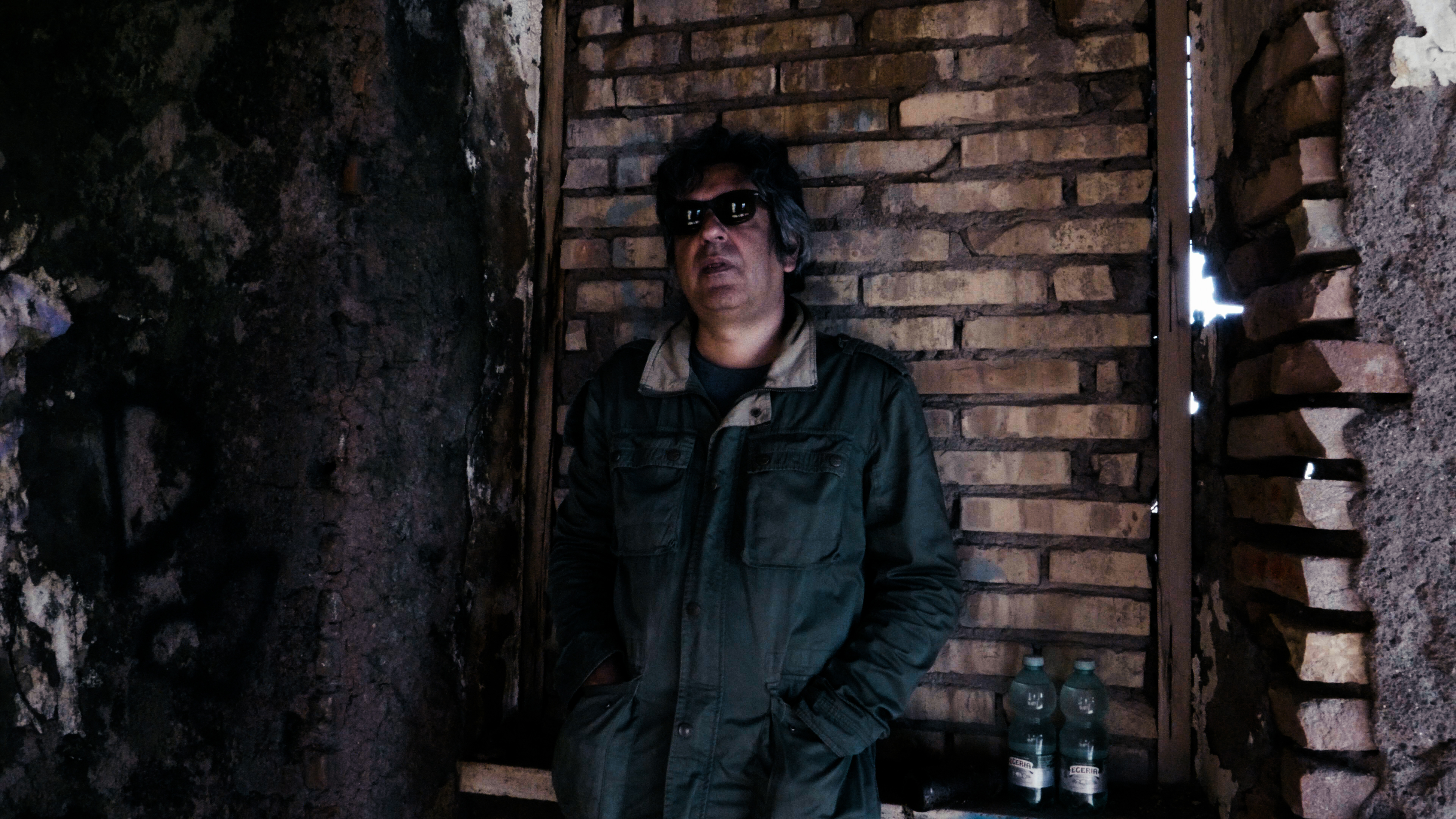
Drama, by Fabio Del Greco, Italy, 2024.
Dante Mezzadri wants to see an old friend, nicknamed the Iguana, whom he has lost sight of for many years, and who has managed to turn their shared youthful passion for poetry into a job, becoming a famous writer and poet. The man escapes from his bourgeois life and his wife to live homeless on the Roman coast, printing and trying to sell his poetry collections. At night he sleeps in a park of old carnival floats, inside a papier-mâché tank, and waits for the opportunity to meet his old friend, who however never shows up for appointments in the places they frequented when they were young, now in ruins. Dante's poetry books do not interest anyone and to support himself he is forced to "change product": he starts selling the infamous "cannibal pill" on behalf of young drug dealers, a new drug that sells like hot cakes and causes sensory and consumerist ecstasy. However, he realizes that this powerful drug is very dangerous for those who take it, he comes into conflict with his ethical conscience and throws all the pills into the sea. However, the dealers want to collect their money.
Shot over a period of 2 years, the film is a reflection on the cultural and artistic rubble of the society in which the protagonist lives, in an increasingly mechanized, consumerist and arid world. Dante Mezzadri is yet another human being who has renounced his inspiration and his creativity, but unlike many he is not willing to give his life to a system that distances him from his true identity. The physical world around him, however, seems constructed in such a way that it seems impossible to escape from this "invisible cage". The enthusiasm of the people he meets is ignited only by sensory gratification, by unreal visions of personal affirmation and success, by "metaverses" that offer an escape into an illusory and destructive reality. The poet's house on the coast, where he met with his friends as a young man, is just a pile of abandoned rubble. What happened to all those who wanted to become poets and ended up becoming something else? Are there internal forces with which that house can be "rebuilt"?
LANGUAGE: Italian
SUBTITLES: English, Spanish, French, German, Portuguese
Stranger Than Paradise (1984)

Willie, a Hungarian immigrant living in New York, has adopted a “cool” and Americanized lifestyle of betting, TV dinners, and an air of studied indifference. His routine is disrupted by the arrival of his sixteen-year-old cousin Eva from Hungary. Along with his friend Eddie, the trio embarks on a aimless journey to Cleveland and then Florida, discovering a desolate and uniform America, as alien as their own feelings.
Jim Jarmusch‘s existential comedy is an iconic portrait of alienation and cultural identity in Reagan-era America. The minimalist style, long static shots, and grainy black and white accentuate the characters’ inner emptiness. Willie’s identity is not a synthesis of two cultures, but an empty performance: he rejects his Hungarian roots for a superficial and disappointing idea of America. The film suggests that cultural identity in a postmodern world is less an inheritance and more a precarious project, a mask worn to navigate a landscape devoid of true reference points.
Return to Seoul (2022)

Frédérique, known as Freddie, a 25-year-old French woman, impulsively decides to travel to Seoul, the city where she was born before being adopted by a French couple. Without a clear plan, her trip turns into a chaotic and unpredictable search for her origins. The encounter with her biological parents and the confrontation with a culture that is not her own push her to question her very identity over a span of eight years.
Davy Chou‘s film is a powerful and anti-romantic deconstruction of the concept of “roots.” Freddie’s return to Korea is not a catharsis, but a violent clash with the expectations of others. Her abrasive behavior and mercurial nature are a form of defense against those who would box her into a “Korean” identity. Return to Seoul shows transnational identity not as a bridge between two worlds, but as a space of perpetual conflict, a process of continuous and painful self-renegotiation that offers no easy answers or a definitive sense of belonging.
The Farewell (2019)

Billi, a young Chinese-American writer living in New York, discovers that her beloved grandmother, Nai Nai, in China has only a few weeks to live. The family decides to hide the truth from the matriarch, organizing a fake wedding as a pretext to gather everyone to say goodbye. Billi, conflicted by this “good lie” that goes against her Western values, returns to China and confronts the complex family dynamics and her divided identity.
Based on a true story, Lulu Wang‘s film is a delicate and sharp investigation of cultural clash and the diasporic experience. The lie at the heart of the plot becomes the prism through which to analyze different conceptions of family, individual, and compassion. Billi’s identity is that of someone living “in-between”: not fully American, no longer fully Chinese. The film explores this state of suspension with humor and tenderness, showing how the immigrant’s identity is a constant act of translation, not just linguistic, but also emotional and cultural.
Mystery of an Employee

Drama, thriller, by Fabio Del Greco, Italy, 2019.
Someone wants to control the life of the employee Giuseppe Russo: the products he buys, his political and religious faith, his private life, even his dreams. But he will do anything to escape control and find his true self. Giuseppe is a man of around 45, married, with a stable job and a home of his own. His life flows seemingly peacefully when he meets a mysterious tramp who gives him some old VHS video cassettes. Giuseppe begins to see video tapes in which he is filmed in some moments of his life since he was a child, then as a teenager and as a young man. Who shot those videos that he remembers nothing about? Giuseppe has the strange sensation of being constantly observed and begins to investigate what is happening. Through his investigation of him, he begins to rediscover his true identity and become aware of who he truly is.
Employee's Mystery is a film that highlights the danger of social control and shows a society where everyone is constantly monitored and conditioned in their deepest selves. The film is also an analysis of human nature and identity. Fabio Del Greco, who plays Giuseppe, gives an engaging performance. Equally good is Chiara Pavoni, in the role of Giada Rubin and Roberto Pensa in the role of the tramp. Employee's Mystery is a film that addresses important themes in an original way, a psychological thriller that keeps the viewer glued to the screen until the end: a metaphor for contemporary society, in which people are increasingly monitored and conditioned by the media and technologies . It is a courageous and provocative work, which addresses important themes in an original way.
LANGUAGE: Italian
SUBTITLES: English, Spanish, French, German, Portuguese
Paris, Texas (1984)

A man, Travis, reappears from the Texas desert after four years of silence and amnesia. His brother Walt finds him and helps him reconnect with his seven-year-old son, Hunter. Together, father and son embark on a journey across the American landscape in search of Jane, the missing wife and mother, in an attempt to rebuild a shattered family and identity.
Wim Wenders‘ elegy, with Robby Müller’s poignant cinematography and Ry Cooder‘s iconic score, is a meditation on memory, loss, and identity within the context of the American myth. The desert is not just a physical place but a space of the soul, a symbol of Travis’s self-erasure. His quest is not only to find his family but to find himself through the fragments of a painful past. Paris, Texas poetically demonstrates how identity is inextricably linked to the places, people, and stories we have left behind.
In the Mood for Love (2000)

In 1962 Hong Kong, Mr. Chow and Mrs. Chan move into the same apartment building on the same day. They soon discover that their respective, often absent, spouses are having an affair. Hurt and lonely, the two begin to spend time together, finding comfort in each other, but their relationship remains platonic, suspended in a limbo of unexpressed desire and adherence to social conventions.
Wong Kar-wai’s masterpiece is a visual poem about repressed identity. The sumptuous yet claustrophobic cinematography, with its “frame within a frame,” traps the characters in narrow corridors and cramped rooms, metaphors for the moral and social constraints that suffocate their true selves. The protagonists’ identities are defined by their public performance, an impeccable etiquette that hides a turmoil of emotions. Set in a community of Shanghai immigrants, the film also captures a cultural identity in transition, pervaded by nostalgia and a sense of uprooting that mirrors the existential condition of its protagonists.
Ghost Dog: The Way of the Samurai (1999)

Ghost Dog is an African American hitman who lives alone on a rooftop, communicating only through carrier pigeons. His life is governed by an ancient code of honor, that of the samurai, taken from the book Hagakure. He is a loyal servant to a small-time Italian American mobster who once saved his life. When the mafia decides to eliminate him, Ghost Dog applies the principles of the warrior to defend himself.
Jim Jarmusch’s film is a brilliant and postmodern essay on the construction of a hybrid identity. In a globalized world, identity is no longer a monolithic inheritance but a creative assembly, a “sampling” of different cultural codes. Ghost Dog merges the Zen philosophy of the samurai, hip-hop culture, and the criminal ethics of the mafia to create a unique and personal code of life. Jarmusch uses this syncretism to deconstruct film genres and to reflect, with irony and melancholy, on the possibility of forging an authentic identity in a world saturated with influences.
Y Tu Mamá También (2001)

Two Mexican teenagers from different social classes, Tenoch and Julio, set off on an impromptu road trip to a secret beach. With them is Luisa, an older and charismatic Spanish woman, married to Tenoch’s cousin. During the journey, amidst sexual discoveries and growing tensions, an omniscient narrator reveals harsh details about the social and political reality of Mexico that the boys ignore.
Alfonso Cuarón transforms a coming-of-age road movie into a sharp allegory of Mexican national identity at the beginning of the 21st century. The protagonists’ identities are defined as much by their exploration of desire as by their blissful unawareness of the context of inequality and corruption that surrounds them. The voice-over acts as a historical conscience, contrasting their personal search for freedom with a country still captive to its contradictions, showing how identity, both personal and collective, is always inscribed in a specific historical and social reality.
Bodies and Desires – Gender and Sexual Identity
Identity is not an abstract concept; it is written on our skin, in our desires, in the way our body inhabits the world. This section is dedicated to films that challenge binary and normative conceptions of gender and sexuality. From the New Queer Cinema, which reclaimed the representation of marginalized identities, to more recent works that explore the complex intersections of race, class, and desire, these films show how identity is a fluid performance, an embodied experience, and a continuous negotiation with social expectations.
Moonlight (2016)

Divided into three chapters, the film follows the life of Chiron, a young African American, from childhood to adulthood as he grows up in a tough Miami neighborhood. Chiron struggles to come to terms with his identity and sexuality, facing bullying, neglect from his drug-addicted mother, and the search for a father figure. His life is a painful journey towards self-acceptance in a world that seems to have no room for his vulnerability.
Barry Jenkins‘ masterpiece adopts an intersectional approach to show how Chiron’s identity is forged by the convergence of race, class, and sexuality. The three stages of his life are not just phases of growth, but the construction of different masks for survival. The film contrasts the harsh hyper-masculinity that Chiron is forced to perform to protect himself with moments of lyrical intimacy, often linked to the symbolism of water and the color blue, which represent rare moments of authenticity. Moonlight is a work of devastating sensitivity about the difficulty of building an identity when every part of you is stigmatized.
The Watermelon Woman (1996)

Cheryl, a young Black lesbian filmmaker working in a Philadelphia video store, decides to make a documentary about an African American actress from the 1930s, known only as “The Watermelon Woman” for her stereotypical “mammy” roles. As her research leads her to uncover the actress’s secret life and sexuality, Cheryl finds herself navigating her own relationship with a white woman and reflecting on her own identity.
A milestone of New Queer Cinema, Cheryl Dunye‘s film masterfully intertwines racial, sexual, and historical identity. Cheryl’s research is not just a historical investigation but a metaphor for the search for one’s own place in the world and in history. By deconstructing stereotypes and questioning official archives, the film shows how queer and Black identities have been systematically erased from the dominant narrative, affirming the need to create and tell one’s own stories in order to exist.
Tomboy (2011)

Laure, a ten-year-old girl, moves with her family to a new neighborhood during the summer. With her short hair and clothing, she is mistaken for a boy by her new friends. Instead of correcting them, Laure seizes the opportunity to introduce herself as Mickaël and experiences a summer living with a new gender identity, exploring the dynamics of the group of boys and a budding attraction to her friend Lisa.
Céline Sciamma addresses the exploration of gender identity in childhood with a naturalistic and non-judgmental gaze. The film does not pathologize Laure/Mickaël’s fluidity but observes it as an experience of discovery, play, and performativity. The intimate direction and luminous cinematography capture the joy and anxiety of this double life, showing how social pressures and gender norms begin to manifest from a young age, without imposing a definitive trajectory on the character’s identity, leaving it open and in flux.
Orlando (1992)

The story follows Orlando, a young nobleman in Elizabethan England whom Queen Elizabeth I orders never to grow old. Orlando traverses four centuries of English history, experiencing adventures, loves, and disappointments. Midway through his journey, he mysteriously awakens transformed into a woman. This transformation allows him to experience life and social constraints from a completely different perspective, continuing his search for love and self.
Sally Potter‘s visionary adaptation of Virginia Woolf‘s novel is an epic exploration of the fluidity of gender identity. Orlando’s transformation is not just a fantastical device but a powerful tool to critique how gender roles are historical and arbitrary constructs that limit the individual. With a perfect and androgynous Tilda Swinton, the film suggests the existence of a core self that transcends the gender binary and historical eras, an identity that remains constant despite changing bodies and social contexts.
Portrait of a Lady on Fire (2019)

At the end of the 18th century, the painter Marianne is hired to create the wedding portrait of Héloïse, a young woman fresh out of a convent and reluctant to marry. Since Héloïse refuses to pose, Marianne must observe her by day and paint her in secret at night. An intimacy based on glances, gestures, and words develops between the two women, transforming into a passionate love destined to end.
Céline Sciamma’s film is a manifesto on the “female gaze” as a tool for the mutual construction of identity. Unlike the male gaze, which objectifies, the exchange of looks between Marianne and Héloïse is a dialogue that allows both to see and define themselves for the first time. The creative act of painting becomes a metaphor for the creation of a shared identity, a love that exists and flourishes in a temporary space outside of patriarchal constraints, leaving an indelible mark on memory.
My Own Private Idaho (1991)

Mike, a narcoleptic street hustler, is obsessed with finding the mother who abandoned him. His only anchor is Scott, his best friend and fellow hustler, the rebellious son of the mayor who lives on the streets to defy his father. Together, they embark on a journey from Oregon to Idaho and on to Italy, a fragmented path that reflects Mike’s broken memory and precarious identity.
Gus Van Sant paints a lyrical and poignant portrait of identity on the margins. Mike’s identity is defined by his vulnerability, his body that betrays him with sudden sleep, and his unrequited love. The film mixes raw realism with dreamlike sequences and Shakespearean dialogue, creating a unique representation of a fluctuating existence, a “private Idaho” inaccessible to the outside world. It is a poetic exploration of the search for home and love as the foundations of a stable identity.
Weekend (2011)

After a night out with straight friends, Russell, a lifeguard, goes to a gay club and spends the night with Glen, an artist. What was supposed to be a one-night stand turns into an intense weekend of conversations, sex, and confessions. Over 48 hours, the two men explore their differences, fears, and hopes, confronting what it means to be gay today and what it means to truly connect with another person.
Andrew Haigh offers one of the most authentic and nuanced representations of contemporary gay identity, moving away from the clichés of the genre. The film is not a “coming out” story but a mature exploration of how one negotiates one’s identity in relation to another and to society. The intimacy of the weekend becomes a space of revelation, a catalyst for a deeper self-perception, showing that identity is not a static label but a constantly evolving dialogue.
Tangerine (2015)

It’s Christmas Eve in Los Angeles. Sin-Dee Rella, a transgender prostitute just released from prison, learns from her best friend Alexandra that her boyfriend and pimp has cheated on her with a cisgender woman. Enraged, Sin-Dee embarks on a frantic and raucous search through the streets of Hollywood to find the lover and confront the cheater, dragging a reluctant Alexandra with her.
Shot entirely on an iPhone, Sean Baker‘s film is an explosion of energy that offers a vibrant and non-victimizing representation of transgender identity. Far from pitiful narratives, Tangerine celebrates the resilience, humor, and agency of its protagonists. Identity here is not a problem or a source of anguish, but simply the point of view through which to experience a chaotic day. It is a film about loyalty, friendship, and survival, which reclaims the right to a complex and human representation.
Controlled and Performed Identities – The Staging of Reality
What happens when identity is not a discovery, but a script to be learned? When it is not an essence, but a performance imposed by absurd rules? The films in this final section use the grotesque, satire, and alienation to unmask the social, familial, and political structures that manufacture identities. In these worlds, being oneself is a luxury, if not an impossibility. Identity becomes a role to be played, often with terrifying or hilarious consequences, revealing the artificiality of the norms that govern our lives.
Dogtooth (Kynodontas, 2009)

Three teenagers live completely isolated from the outside world in a villa with a garden, protected by a high fence. Their parents have built an alternative reality for them, teaching them a distorted vocabulary (where “sea” means “armchair”) and making them believe that cats are ferocious creatures and that they can only leave when a canine tooth falls out. This controlled existence is undermined by the arrival of an outsider.
The film that launched Yorgos Lanthimos and the “Greek Weird Wave” is a powerful allegory of totalitarian control over identity formation. The family becomes a micro-authoritarian state that manufactures reality to maintain power. Lanthimos’s sterile and detached visual style, with shots that often cut off faces, reflects the dehumanization of the characters, whose identity is entirely constructed and denied. Dogtooth is a chilling exploration of how language and knowledge shape our perception of ourselves and the world.
The Lobster (2015)

In a dystopian society, being single is illegal. Uncoupled people are arrested and transferred to a hotel where they have 45 days to find a partner. If they fail, they are turned into an animal of their choice. David, abandoned by his wife, finds himself in this situation and desperately seeks a partner based not on love, but on sharing a distinctive trait, like nearsightedness.
Lanthimos again, this time with a surreal satire of the social pressures that push for coupledom. The film takes to the extreme the idea that identity is defined by relationship status. The search for a partner becomes a grotesque performance, a struggle for survival in which individual identity is sacrificed on the altar of “compatibility.” The Lobster is a fierce and hilarious critique of how society imposes life models, forcing individuals to conform or be marginalized.
Beau Travail (1999)

In a French Foreign Legion outpost in Djibouti, Sergeant Galoup harbors an almost devout admiration for his commander, Forestier. The routine of ritualistic and stylized training is interrupted by the arrival of a new, young, and promising legionnaire, Sentain. Galoup’s growing jealousy and repressed desire for Sentain will lead him to an act of sabotage that will seal his ruin.
Claire Denis deconstructs masculinity as a performative and ritualized identity. The soldiers’ bodies, filmed in choreographed sequences that resemble a dance, become the site where a rigid virile identity is inscribed, based on repetition and control. Galoup’s repressed homoerotic desire shatters this facade, revealing the fragility and insecurity hidden behind the performance of masculinity. Beau Travail is a hypnotic work on the discipline of the body as both a construction and a prison of identity.
Certified Copy (2010)

An English writer, James Miller, is in Tuscany to present his latest book, which theorizes that a copy has the same value as the original in art. There he meets a French gallery owner, who takes him on a tour of a nearby village. During the day, their relationship ambiguously transforms: from two strangers who have just met, they begin to behave like a couple married for fifteen years, with recriminations and tenderness.
Abbas Kiarostami‘s film is a sophisticated intellectual game about the nature of authenticity, applied not only to art but also to identity and human relationships. It is impossible for the viewer to determine the “true” relationship between the two protagonists. Kiarostami suggests that identity, especially in a long-term relationship, is a continuous performance, a “certified copy” of a past self or an ideal of a couple. Authenticity does not lie in a lost “original,” but in the validity of the performance itself.
Fish Tank (2009)

Mia, a fifteen-year-old hot-tempered and isolated teenager, lives in a council estate in Essex. Expelled from school and in conflict with her mother and younger sister, her only outlet is hip-hop dancing, which she practices alone in an empty apartment. Her monotonous and angry life is shaken by the arrival of Connor, her mother’s new and charming boyfriend, who seems to be the only one who sees her and encourages her passion.
Andrea Arnold‘s social realism is raw and immersive. Fish Tank is a powerful portrait of a teenager’s search for identity in an environment of social and emotional deprivation. The title itself is a metaphor for her existence: a life confined to a small, suffocating space. For Mia, dance becomes the only tool to build her own identity, a language to express an otherwise inarticulate anger and vulnerability. Arnold’s handheld camera sticks to her struggle for self-determination in a world that seems to offer few escape routes.
The Son (Le Fils, 2002)

Olivier is a carpenter who teaches at a rehabilitation center for teenagers. His life is methodical, silent, marked by a deep and unprocessed grief: the death of his son. One day, a new boy, Francis, arrives at the center. Olivier discovers that he is his son’s killer. Instead of rejecting him, he decides to take him on as his apprentice, beginning to follow him with an obsession that oscillates between a desire for revenge and an incomprehensible drive for forgiveness.
The Dardenne brothers, with their hyper-realistic style and handheld camera that follows the characters, immerse us in Olivier’s moral and physical struggle. The film is an extraordinary exploration of redefining identity through grief and the possibility of forgiveness. Olivier’s identity, that of a father whose son was taken from him, is radically challenged. His transformation is not psychological, but physical and moral: it is in his body, in his carpenter’s gestures, in his gaze, that the battle is fought to decide whether to remain a prisoner of the past or to open up to an unthinkable future.
A vision curated by a filmmaker, not an algorithm
In this video I explain our vision

