
Rome. The name itself evokes a powerful imaginary, carved into the collective consciousness by decades of great cinema. We think of Audrey Hepburn on a Vespa in Roman Holiday, or the statuesque beauty of Anita Ekberg in La Dolce Vita. These films, undisputed masterpieces that built the “postcard Rome,” are a magnificent open-air set.

But this guide is also a journey into a more obscure, complex, and vital territory. It is an exploration of the city through the gaze of directors who did not use it as a backdrop, but interrogated it as a protagonist. It is the Rome of Pasolini’s fierce slums, Antonioni’s alienating geometries, and the blood-stained streets of the poliziottesco.
This is not a simple list, but a path that unites the most famous films with the most radical auteur cinema. An alternative narrative that dismantles the myth to reveal the raw, contradictory, and infinitely more fascinating truth of the Eternal City.
Rome, Open City (1945)

Shot amidst the still-warm rubble of the newly liberated city, this film is the birth of Neorealism. Roberto Rossellini tells the story of the Roman Resistance’s struggle against the Nazi-Fascist occupation, intertwining the lives of a communist engineer, a courageous priest, and a woman of the people, Pina. Their fight for freedom becomes a symbol of the rebirth of an entire nation.
An absolute masterpiece and a symbolic work of a new cinematic era, Rome, Open City does not just narrate history: it captures it at the very moment it happens. Rossellini, with makeshift means and film stock that was difficult to find, takes the camera into the real streets, turning places like Via Raimondo Montecuccoli in the Prenestino district into the stage of a real tragedy. The famous, heart-wrenching run of Anna Magnani towards the truck taking her man away is not just an iconic scene; it is cinema becoming testimony, a scream, a body. Rossellini strips Rome of all monumental rhetoric to show it as a wounded city, a living organism made of common people elevated to heroes by the necessity of history.
The Lost Poet
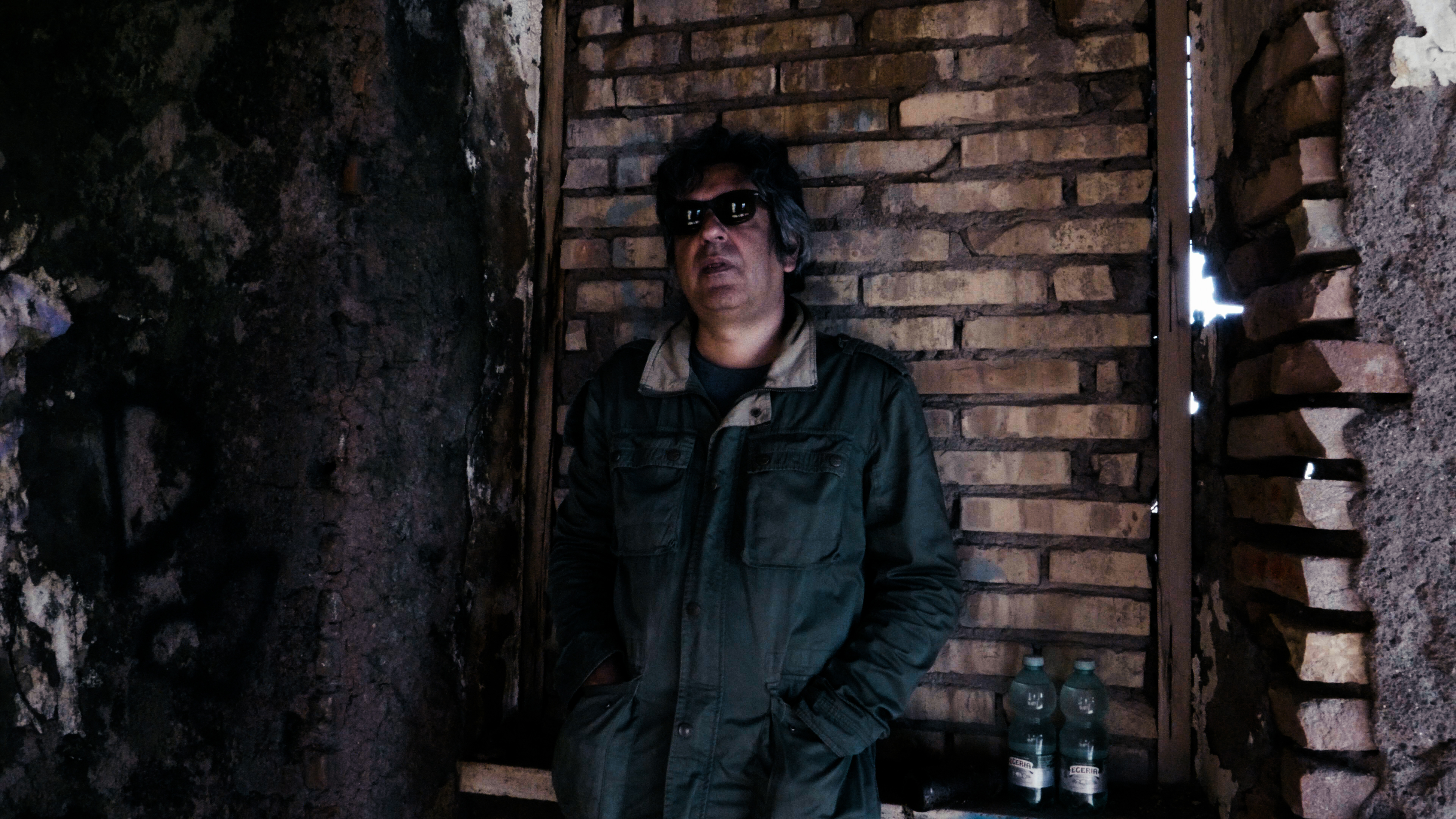
Drama, by Fabio Del Greco, Italy, 2024.
Dante Mezzadri wants to see an old friend, nicknamed the Iguana, whom he has lost sight of for many years, and who has managed to turn their shared youthful passion for poetry into a job, becoming a famous writer and poet. The man escapes from his bourgeois life and his wife to live homeless on the Roman coast, printing and trying to sell his poetry collections. At night he sleeps in a park of old carnival floats, inside a papier-mâché tank, and waits for the opportunity to meet his old friend, who however never shows up for appointments in the places they frequented when they were young, now in ruins. Dante's poetry books do not interest anyone and to support himself he is forced to "change product": he starts selling the infamous "cannibal pill" on behalf of young drug dealers, a new drug that sells like hot cakes and causes sensory and consumerist ecstasy. However, he realizes that this powerful drug is very dangerous for those who take it, he comes into conflict with his ethical conscience and throws all the pills into the sea. However, the dealers want to collect their money.
Shot over a period of 2 years, the film is a reflection on the cultural and artistic rubble of the society in which the protagonist lives, in an increasingly mechanized, consumerist and arid world. Dante Mezzadri is yet another human being who has renounced his inspiration and his creativity, but unlike many he is not willing to give his life to a system that distances him from his true identity. The physical world around him, however, seems constructed in such a way that it seems impossible to escape from this "invisible cage". The enthusiasm of the people he meets is ignited only by sensory gratification, by unreal visions of personal affirmation and success, by "metaverses" that offer an escape into an illusory and destructive reality. The poet's house on the coast, where he met with his friends as a young man, is just a pile of abandoned rubble. What happened to all those who wanted to become poets and ended up becoming something else? Are there internal forces with which that house can be "rebuilt"?
LANGUAGE: Italian
SUBTITLES: English, Spanish, French, German, Portuguese
Bicycle Thieves (1948)

In post-war Rome, an unemployed bill-poster, Antonio Ricci, gets a job for which a bicycle is essential. When it is stolen on his first day, he begins a desperate search through the city streets with his young son Bruno. What seems like a small misfortune turns into a heartbreaking odyssey through the misery and indifference of a society on its knees.
Vittorio De Sica, with a screenplay by Cesare Zavattini, creates a merciless fresco of post-war Rome. The city is not a picturesque backdrop, but a labyrinth of despair. Antonio and Bruno’s journey takes us from the working-class neighborhood of Val Melaina to the chaotic market of Porta Portese, a human anthill where the stolen bicycle is just one object among thousands, impossible to find. De Sica shows a city where institutions are absent or powerless, and solidarity is a luxury no one can afford. The bicycle becomes the symbol of lost dignity and unattainable hope, in a masterpiece of humanism that has forever marked the history of cinema.

Umberto D. (1952)

Umberto Domenico Ferrari is an elderly retired civil servant who cannot survive on his meager pension. Threatened with eviction by his landlady, he wanders through Rome with his only friend, his little dog Flike, trying to maintain his dignity in a world that seems to have forgotten him. His lonely struggle is an indictment against the indifference of society.
Considered by many to be the pinnacle of Neorealism, Umberto D. is an incredibly touching exploration of loneliness and marginalization. De Sica uses Rome not as a city of wonders, but as a cold and impersonal urban space that amplifies the protagonist’s isolation. Umberto’s struggle not to give in to the temptation of begging, his meticulous care of his appearance despite his poverty, are desperate gestures to cling to an identity that the city threatens to erase. The tender and heart-wrenching relationship with Flike becomes the only bastion of affection against the cruelty of the world.
The White Sheik (1952)

Two newlyweds from the provinces arrive in Rome for their honeymoon. While the husband has a strict schedule of visits to relatives and a papal audience, the wife, obsessed with photo-novels, runs off to meet her hero, the “White Sheik,” only to discover the disillusioned reality behind the fantasy.
In his first solo film, Fellini uses Rome as a stage for the clash between provincial naivety and metropolitan disillusionment. The city is not the monumental capital, but a place of cheap myths and prefabricated dreams, from the world of photo-novels to the rigid conventions of the petty-bourgeois family. It is a satirical look at a society that prefers fantasy to reality, a theme that would become central to all of Fellini’s work.
Nights of Cabiria (1957)

Cabiria is a tenacious and eternally optimistic prostitute who wanders the nights of Rome dreaming of true love. Despite being constantly deceived and humiliated, she never loses her childlike faith in a better future, getting back up after every fall with a heartbreaking smile.
Fellini returns to the Roman periphery, but with a different tone from neorealism. Cabiria’s Rome is a world of outcasts, a “demi-monde” where the sacred and the profane coexist. From the squalid slums to the luxurious nightclubs of Via Veneto, the film paints a portrait of a city of stark contrasts. Cabiria’s final walk, where she finds the strength to smile again amidst a group of young people, is a hymn to an indestructible human spirit that finds life even in the most desolate corners of the metropolis.
A vision curated by a filmmaker, not an algorithm
In this video I explain our vision
Big Deal on Madonna Street (1958)

A group of bumbling, working-class Roman petty thieves attempts to pull off a major heist: robbing a pawn shop. Led by a retired safecracker, this ramshackle gang of “usual unknowns” proves to be hopelessly inept, turning their ambitious plan into a series of hilarious failures.
Mario Monicelli‘s masterpiece is considered the progenitor of the “Commedia all'italiana” (Comedy Italian Style). It is a brilliant parody of both American heist films and Italian neorealism, portraying the poverty of post-war Rome not with tragic drama, but with cynical humor and profound humanity. The city’s working-class neighborhoods provide the backdrop for a story about the art of getting by, where the dream of the big score inevitably collides with a much more modest reality: a plate of pasta and chickpeas.
The Facts of Murder (1959)

In an elegant building on Via Merulana, a jewelry theft and a brutal murder disrupt the bourgeois tranquility. Inspector Ingravallo, a disillusioned and philosophical man, is assigned to the investigation. Digging into the seemingly respectable lives of the tenants, he discovers an underworld of secrets, lies, and hidden passions, where no one is truly innocent.
Based on the novel That Awful Mess on Via Merulana by Carlo Emilio Gadda, Pietro Germi‘s film is an atypical noir and a sharp social investigation. Rome is not the sunny city of comedy, but a dark and claustrophobic place. The entire film takes place almost entirely inside the building, which becomes a microcosm of Roman society, a stage where the comedy of appearances is performed. Germi uses the structure of a detective story to perform a veritable autopsy of bourgeois morality, revealing the hypocrisy and corruption hidden behind the respectable facades.
Accattone (1961)

Vittorio, known as “Accattone,” is a pimp from the Roman slums who lives by exploiting his prostitute, Maddalena. When she ends up in prison, Accattone finds himself penniless and spirals into an existential crisis. He attempts to redeem himself through his love for the pure Stella and an honest job, but his world of violence and misery will drag him back into a tragic vortex.
Pier Paolo Pasolini‘s directorial debut is a dazzling and brutal work, a punch to the gut that brings the sub-proletariat of the Roman peripheries to the screen with unprecedented force. Pasolini films the slums of Pigneto and Testaccio not with documentary detachment, but with a gaze that blends raw realism and sacredness. The life of Accattone, a hopeless “boy of the streets,” is elevated to a Christ-like passion, underscored by the alienating use of Bach’s music. Pasolini’s Rome is an archaic, pre-industrial world, a universe with its own laws and language, destined to be swept away by bourgeois conformity.
L’eclisse (1962)

Vittoria, a young translator, leaves her partner and begins an uncertain relationship with Piero, a dynamic and cynical stockbroker. Their story unfolds in an almost unrecognizable Rome: that of the modern and monumental EUR district. Their encounters are marked by an inability to communicate, an emotional void that seems to be reflected in the desolate spaces surrounding them.
The concluding chapter of Michelangelo Antonioni‘s “trilogy of incommunicability,” L’eclisse is a masterpiece of existential cinema. Antonioni transforms the rationalist and metaphysical architecture of the EUR district into the true protagonist of the film. The empty squares, imposing buildings, and geometric lines are not just a backdrop, but the visual manifestation of the characters’ alienation and inner emptiness. The famous final sequence, in which the camera returns to the places of their missed encounters, showing only objects and urban details, is the definitive statement of how the modern world and its geometries have “eclipsed” human feelings.
Il Sorpasso (1962)

In a Rome deserted for the Ferragosto holiday, the exuberant and superficial forty-year-old Bruno Cortona drags the shy law student Roberto Mariani on an impromptu trip in his Lancia Aurelia convertible. What begins as a carefree adventure along the Tyrrhenian coast turns into a sharp and bitter reflection on Italy’s economic boom.
Dino Risi‘s masterpiece is much more than a comedy: it is an existential road movie that captures the spirit of an entire era. The journey, which starts from Rome to get away from it and then makes a tragic return, is a perfect metaphor for a society racing at full speed towards a material well-being that hides a deep moral void. Bruno, with his roguish vitality, embodies the illusions and contradictions of a country that has mistaken consumerism for happiness. The initial, empty and silent Rome is the starting point for an escape that will prove impossible, ending with a finale as sudden as it is devastating.
Mamma Roma (1962)

Mamma Roma, a former prostitute played by a monumental Anna Magnani, tries to build a new bourgeois life for the sake of her teenage son, Ettore. Leaving the streets behind, she moves into a modern INA-Casa building in the Quadraro district, dreaming of a respectable future for the boy. But her past, embodied by her former pimp, returns to haunt her, shattering her dream of redemption.
Pasolini’s second film, Mamma Roma continues the exploration of the sub-proletariat, but with an even more intense tragic charge. The new architecture of the expanding periphery, with its anonymous apartment blocks, becomes the symbol of a desired but unattainable social integration. Mamma Roma desperately tries to assimilate a petty-bourgeois model that does not belong to her, but her plebeian vitality and her past cannot be erased. The tragic fate of her son, whose death is filmed with an explicit reference to Mantegna’s Dead Christ, elevates the story to a powerful allegory about the defeat of the marginalized.
The Monsters (1963)

A collection of twenty short, satirical vignettes that mercilessly skewer the vices, hypocrisies, and moral ugliness of Italian society during the economic miracle. Vittorio Gassman and Ugo Tognazzi play a gallery of grotesque characters, from corrupt politicians to abusive fathers and cowardly husbands.
Dino Risi creates a “human comedy” in which Rome serves as the stage for a parade of modern “monsters. The film is a fierce and hilarious critique of a nation that, in its rush toward modernity and wealth, seems to have lost its moral compass. Each episode is a sharp, cynical snapshot that, taken together, composes a powerful and still-relevant portrait of the dark side of the Italian boom.
The 10th Victim (1965)

In a futuristic 21st century, war has been replaced by “The Big Hunt,” a global televised game where participants hunt and kill each other for fame and fortune. An American huntress arrives in Rome for her tenth and final victim, an Italian man, but their deadly game is soon complicated by unexpected feelings.
Elio Petri uses Rome, particularly the modernist and alienating architecture of the EUR district, as the perfect setting for his pop-art style sci-fi dystopia. The city becomes a sleek, cold, and media-saturated arena where human life is a spectacle. The film is a sharp satire on consumer society, the cult of violence, and the battle of the sexes, transforming the Eternal City into a cynical, futuristic playground.
The Bird with the Crystal Plumage (1970)

Sam Dalmas, an American writer in Rome suffering from writer’s block, witnesses the attempted murder of a woman in an art gallery. He becomes trapped between the glass doors, a helpless witness to the scene. Obsessed by a detail his memory cannot grasp, he begins a personal investigation that drags him into a spiral of terror, haunted by a mysterious serial killer.
Dario Argento‘s directorial debut is a revolution for the Italian and world thriller. Argento transforms Rome into a dreamlike and terrifying labyrinth, where modern architecture and the sterile spaces of art galleries become theaters of stylized violence. The city is no longer a real place, but a mental space, a reflection of the killer’s twisted psyche and the protagonist’s fallible perception. The opening sequence is a masterclass in direction that uses urban space to create a sense of helplessness and voyeurism, themes that will become central to all his cinema.
Investigation of a Citizen Above Suspicion (1970)

A high-ranking and respected police official, just promoted to head of the political section, murders his mistress in her apartment. Instead of covering his tracks, he deliberately plants clues that lead to him. His goal is to prove to himself and the system that his power makes him untouchable, above all suspicion and the law itself.
Elio Petri‘s masterpiece and Oscar winner is a merciless allegory about power and its corrupting nature. Set in a dark and oppressive Rome, the film uses the places of power—police stations, ministerial offices—as settings for a Kafkaesque nightmare. Gian Maria Volonté’s performance is monumental in embodying the arrogance and neurosis of a man who is both the incarnation and the victim of the authoritarian system he represents. It is a fundamental work for understanding the tensions and paranoia of Italy’s Years of Lead.
Fellini’s Roma (1972)
![Roma (1972) ORIGINAL TRAILER [HD]](https://blog.indiecinema.co/wp-content/plugins/wp-youtube-lyte/lyteCache.php?origThumbUrl=https%3A%2F%2Fi.ytimg.com%2Fvi%2FO_NAlPgwiSg%2F0.jpg)
Federico Fellini abandons all semblance of a plot to create a visionary, chaotic, and deeply personal portrait of the Eternal City. The film is a stream of consciousness that mixes memories of his arrival in Rome as a young man from the provinces, scenes of daily life, documentary sequences on the construction of the subway, and surreal phantasmagorias, like an ecclesiastical fashion show.
Roma is Fellini’s attempt to capture the elusive essence of the city, not through a logical narrative, but through a total immersion in its “official delirium.” The city is presented as a great maternal womb, an open-air circus, a brothel, a necropolis. Fellini does not film the Rome of monuments, but that of popular trattorias, variety theaters, and the Grande Raccordo Anulare (the great ring road) traversed at night by a horde of motorcyclists. It is an overflowing and magnificent work, an act of love for a city that, according to the director, can only be understood through dreams and imagination.
The Violent Professionals (1973)
![High Crime (1973) ORIGINAL TRAILER [HD 1080p]](https://blog.indiecinema.co/wp-content/plugins/wp-youtube-lyte/lyteCache.php?origThumbUrl=https%3A%2F%2Fi.ytimg.com%2Fvi%2FdN0e5cuxXys%2F0.jpg)
Commissioner Belli, a policeman with rough methods and a strong sense of justice, investigates an international drug trafficking ring that is bloodying the streets of Rome and Genoa. Clashing with slow bureaucracy and high-level corruption, Belli decides to act outside the rules, unleashing a no-holds-barred war against organized crime.
Directed by Enzo G. Castellari and starring Franco Nero, this is one of the cornerstones of the “poliziottesco” genre, which dominated Italian cinema in the 1970s. These films reflected the climate of violence and social insecurity of the Years of Lead. Rome, in particular, becomes an urban battlefield, the scene of breathtaking chases, brutal shootouts, and an underlying pessimism towards a judicial system perceived as weak and ineffective. It is a visceral, action-packed cinema that portrays a city in the grip of chaos.
We All Loved Each Other So Much (1974)

The film traces thirty years of Italian history, from the Resistance to the 1970s, through the story of three friends: Gianni, Antonio, and Nicola. Their lives, loves, ideals, and compromises intertwine and diverge over the decades, all revolving around the woman they all loved, Luciana.
Ettore Scola creates an epic and melancholic fresco in which Rome is not just a backdrop, but a living witness to the transformations of an entire country. From the post-war hopes, symbolized by a black-and-white Rome, to the colorful but disillusioned city of the economic boom, the film uses iconic locations like the Trevi Fountain and working-class neighborhoods like Garbatella to map the personal and collective journey of a generation that “wanted to change the world, but the world changed us”.
Deep Red (1975)

English jazz pianist Marc Daly, in Rome for work, witnesses the murder of a psychic. Convinced he saw a crucial detail at the crime scene that he cannot remember, he begins to investigate with a tenacious journalist, Gianna Brezzi. His search for the truth will lead him into an abyss of family secrets, childhood traumas, and a series of increasingly brutal murders.
Although largely shot in Turin, Deep Red is the apotheosis of the style Dario Argento forged in Rome, and it remains an essential reference point. It is a work that transcends the giallo to become a gothic tale about the horror that lurks in memory. The Rome of the film is a nocturnal and spectral city, where baroque squares and Art Nouveau theaters become the backdrop for a nightmare. Argento builds masterful tension, alternating scenes of unbearable suspense with explosions of baroque violence, all accompanied by the legendary soundtrack by Goblin.
Down and Dirty (1976)

In a shantytown built illegally on the outskirts of Rome lives the vast and monstrous family of Giacinto Mazzatella, a one-eyed and tyrannical old man. He jealously guards a million lire, the result of a compensation payment, and has no intention of sharing it with his greedy and grotesque offspring, who in turn plot in every way to rob him.
Ettore Scola‘s grotesque masterpiece is a ruthless and fiercely comical portrait of the Roman sub-proletariat. If Pasolini found a sacred and tragic dimension in the slums, Scola finds a secular hell, a Dantean circle populated by characters moved only by the basest instincts: greed, lust, violence. The film is a pitch-black comedy that demolishes all sentimentality about poverty, showing a humanity regressed to a primitive state, in a struggle for survival that knows no morals. The shantytown, with St. Peter’s Dome ironically silhouetted in the background, is the stage for this cruel and unforgettable farce.
The Tough Ones (1976)

Commissioner Tanzi, a tough and violent policeman, fights the rampant crime in Rome. His nemesis is “the Hunchback,” a ruthless criminal who is spreading panic in the city. Tanzi’s manhunt turns into a descent into hell, in a Rome depicted as an asphalt jungle where the law of the strongest is the only one that matters.
Directed by Umberto Lenzi, this is perhaps the most emblematic and violent poliziottesco. Starring the genre icon Maurizio Merli and an unrecognizable Tomas Milian as the Hunchback, the film is a concentrate of brutal action and nihilism. The Rome of the film is a theater of urban warfare, a hopeless place where the violence of the state and that of crime mirror each other. It is the raw and unfiltered portrait of a city and a country on the brink of collapse.
An Average Little Man (1977)

Giovanni Vivaldi, a humble and obsequious civil servant nearing retirement, is willing to do anything to secure a similar job for his beloved son, even joining a Masonic lodge. But when his son is tragically killed by a stray bullet during a robbery, the “average little man” transforms into a ruthless angel of vengeance.
Mario Monicelli directs a film that begins as a grotesque comedy about Italian bureaucracy and social climbing and takes a shocking turn into a dark, merciless thriller. The film offers a bleak portrait of Rome, far from the glamour of the city center, focusing on the anonymous suburbs and the moral vacuum of the middle class. Alberto Sordi‘s masterful performance captures the terrifying transformation of an ordinary man into a monster, making this a powerful and disturbing critique of a society where justice is absent and grief turns into brutal violence.
A Special Day (1977)
![Una giornata particolare (1977) ORIGINAL TRAILER [HD 1080p]](https://blog.indiecinema.co/wp-content/plugins/wp-youtube-lyte/lyteCache.php?origThumbUrl=https%3A%2F%2Fi.ytimg.com%2Fvi%2Fi_9BAH_qO-4%2F0.jpg)
On May 6, 1938, the day of Hitler’s visit to Rome, a lonely housewife and a persecuted homosexual radio announcer meet by chance in their nearly deserted apartment building. While the entire city celebrates the fascist parade, these two marginalized souls share a few hours of unexpected intimacy and understanding.
Scola empties Rome of its monumental grandeur to focus on a single domestic space, the Palazzo Federici, which becomes a microcosm of fascist society. The building itself, with its courtyard acting as a panopticon, is a protagonist, a symbol of social control and forced conformity. The constant drone of the parade’s radio commentary serves as an oppressive soundtrack, highlighting the isolation of the two characters and creating a powerful counter-narrative to the official history being celebrated outside.
The Terrace (1980)

A group of aging left-wing intellectuals—a screenwriter, a producer, a journalist, a politician—gathers on a Roman terrace for a dinner party. Over the course of the evening and in a series of flashbacks, they confront their personal failures, creative crises, and political disillusionment.
In this chamber piece by Ettore Scola, the Roman terrace becomes a gilded cage, an isolated stage where an entire intellectual class enacts its own funeral. High above the real city, these characters are disconnected from the social reality they claim to represent. Rome, visible only as a panoramic backdrop, symbolizes the world they have lost touch with, making the terrace a powerful metaphor for the self-referential and sterile crisis of the Italian left at the end of the 1970s.
Tenebrae (1982)

Peter Neal, an American horror novelist, arrives in Rome to promote his latest book, “Tenebrae.” Shortly after his arrival, a series of brutal murders begins to bloody the city, with the victims killed in the same manner described in his novel. Neal finds himself embroiled in a perverse and deadly game, trying to uncover the killer’s identity.
With Tenebrae, Dario Argento makes a radical aesthetic choice: he abandons the dark and gothic atmospheres of his previous films to set his giallo in a blindingly bright, modern, and hyper-realistic Rome. Shot largely in the EUR district, the film is dominated by a cold light and rationalist architecture that creates a sense of alienation and unease. Argento wants to show that horror does not only hide in the dark, but can explode in broad daylight, in the most aseptic and orderly spaces. The city becomes a labyrinth of white and reflective surfaces, a place where the darkness is that of the soul.
Toxic Love (1983)

A group of young heroin addicts from Ostia live their days in a desperate routine of schemes to get their fix, petty thefts, and unstable relationships. Cesare, Michela, and their friends move through a desolate landscape, between the coast and the Roman periphery, trapped in a present without a future and in a love that is just another name for addiction.
Claudio Caligari’s cult work is a shocking film, a punch to the gut that tells the tragedy of drug addiction with an almost documentary-like realism. A direct heir to Pasolini’s lesson, Caligari chooses to have real drug addicts act in the film, erasing the line between fiction and reality. His Ostia is a terminal place, a non-place of absolute marginality. The raw language, the street slang, and the unfiltered depiction of addiction make Toxic Love a unique and heartbreaking work, the unforgettable portrait of a lost generation.
The Belly of an Architect (1987)

Stourley Kracklite, an American architect, arrives in Rome with his young wife to curate an exhibition dedicated to the visionary 18th-century architect Étienne-Louis Boullée. As he immerses himself in the project, Kracklite develops an obsession with his own body, particularly his belly, which is tormented by excruciating pains. His physical and psychological decline is mirrored in the monumental and yet decaying grandeur of the Eternal City.
Peter Greenaway‘s film is a visually sumptuous and intellectually complex work. The English director uses the architecture of Rome—from the Pantheon to the Vittoriano—as a grand metaphor for the human body, its beauty, and its inevitable corruption. The city becomes an allegorical stage where art history, geometry, and biology intertwine. The architect’s belly, which could contain a new life or an incurable disease, becomes the symbolic center of a film that reflects on creativity, mortality, and the weight of history.
Dear Diary (1993)

Divided into three chapters, the film is an autobiographical diary in which Nanni Moretti plays himself. In the first, “On My Vespa,” the director wanders through a semi-deserted Rome in August, commenting with his unmistakable irony on houses, neighborhoods, and the habits of Romans. The second, “Islands,” sees him traveling to the Aeolian Islands. The third, “Doctors,” recounts his real-life health odyssey in discovering a tumor.
The first chapter of Dear Diary is one of the most beautiful and original declarations of love ever made to Rome. Moretti avoids the monumental and touristy center to explore the lesser-known areas, from Garbatella to Casal Palocco, creating an intimate and personal map of the city. His Vespa ride is a meditative experience, a way to reclaim the urban space and observe it with a new, critical but deeply affectionate gaze. It is a unique portrait of Rome, far from any cliché, that captures its casual beauty and daily contradictions.
Il Divo (2008)

A grotesque, pop, and dazzling portrait of Giulio Andreotti, one of the most powerful and enigmatic figures in Italian political history. Paolo Sorrentino‘s film focuses on the period of his seventh government, in the early 1990s, reconstructing through a visionary style his network of power, his relationships with the Mafia, and the crimes and mysteries that marked the First Republic.
Sorrentino transforms Italian politics into a baroque opera, and Rome into its cold and spectral theater. The palaces of power, the corridors of Parliament, the gloomy churches become the backdrops of a phantasmagoria in which disturbing masks move. The city is not a living place, but a monumental and impassive setting where dark plots are consumed. Il Divo is a ruthless analysis of power, using a hyperbolic visual style to tell the story of the emptiness and loneliness of a man who has become an impenetrable icon of Italian mystery.
The Black Sheep (2010)

Nicola grew up in an asylum, “the institute of a hundred gates,” where the mad are protected from the world and the world is protected from the mad. Through his memories, which intertwine with the present, he tells stories of a marginalized humanity, suspended between madness and a disarming lucidity. His life is a choral tale that questions the boundaries between normality and insanity.
Based on his theatrical performances, Ascanio Celestini‘s film is a poetic and surreal work that explores the world of mental illness. The asylum, located on the outskirts of Rome, becomes a microcosm where the logic of the outside world is turned upside down. Celestini, with his storytelling style and deep empathy, gives a voice to the voiceless, showing how behind the label of “madness” lie stories of pain, love, and surprising wisdom. It is a film that uses the physical and existential periphery for a universal reflection on the human condition.
The Great Beauty (2013)

Jep Gambardella, a society journalist and theater critic, is an icon of Roman high society. After his 65th birthday, a growing dissatisfaction leads him to wander through a magnificent and spectral Rome, between decadent parties on terraces overlooking the Forums, encounters with grotesque characters, and sudden, dazzling epiphanies of beauty. His is a melancholic search for a lost meaning.
Paolo Sorrentino’s Oscar-winning film is an explicit homage to Fellini’s Rome, but reinterpreted with the disenchanted sensibility of the new millennium. The city is an absolute protagonist, a shell of poignant beauty that hides an abysmal void. Sorrentino contrasts the magnificence of historic palaces, secret gardens, and ancient ruins with the superficiality and cynicism of its inhabitants. It is the portrait of a city and a humanity lost “amidst vices and dissolute life in search of a lost beauty.”
Sacro GRA (2013)

A documentary that explores the unknown world pulsating along the Grande Raccordo Anulare (GRA) of Rome, Italy’s largest urban motorway. Far from the monumental center, director Gianfranco Rosi discovers a surprising and invisible humanity: a decadent nobleman living in a studio apartment, an eel fisherman on the Tiber, a botanist studying palms infested by a parasite.
The first documentary to win the Golden Lion in Venice, Sacro GRA reveals a Rome that no one had ever told. The ring road is not the subject of the film, but the thread that connects stories of marginality, loneliness, and unexpected poetry. Rosi transforms a “non-place” par excellence into a territory rich with life and surreal tales. It is an anthropological gaze that discovers a parallel universe, another city that exists on the margins of the known one, proving that the most incredible stories are often found where no one stops to look.
They Call Me Jeeg (2015)
![Lo chiamavano Jeeg Robot Official Trailer [2015]](https://blog.indiecinema.co/wp-content/plugins/wp-youtube-lyte/lyteCache.php?origThumbUrl=https%3A%2F%2Fi.ytimg.com%2Fvi%2FjwNsfL9GCMY%2F0.jpg)
Enzo Ceccotti is a small-time, lonely criminal living in the Tor Bella Monaca slum. One day, while fleeing the police, he dives into the Tiber and accidentally falls into a barrel of radioactive material. He emerges with superhuman strength. Initially, he uses his new powers for selfish purposes, but his encounter with Alessia, a fragile girl obsessed with the Japanese anime Jeeg Robot, will push him to become the hero Rome needs.
Gabriele Mainetti‘s film is a true revolution for Italian cinema, capable of grafting the American superhero comic genre onto the social fabric of the Roman periphery. They Call Me Jeeg does not mimic Hollywood models but reinterprets them in a local, raw, and authentic key. Tor Bella Monaca, with its concrete towers and its suffering humanity, becomes a credible and powerful setting for the birth of a reluctant and deeply human superhero. It is an innovative work that masterfully combines action, drama, and pop culture.
Don’t Be Bad (2015)

Ostia, 1990s. Cesare and Vittorio have been friends forever, “brothers of the street.” Their life is a whirlwind of nights at the disco, fast cars, alcohol, synthetic drugs, and dealing. Vittorio, however, tired of that life, tries to save himself by finding a job and distancing himself from Cesare. But the bond between the two is too strong, and the call of that self-destructive world is a constant temptation.
Claudio Caligari’s spiritual testament, completed posthumously thanks to the efforts of Valerio Mastandrea, Don’t Be Bad is a worthy heir to Toxic Love and Pasolini’s poetics. The film is a powerful and moving tale of male friendship, the difficulty of changing, and the periphery as a place of the soul and of condemnation. Caligari films Ostia with a participatory and never judgmental gaze, drawing a raw and desperate poetry from life on the margins. It is an intense and necessary work, the final act of a director who always gave a voice to the last.
A vision curated by a filmmaker, not an algorithm
In this video I explain our vision

