
The Man Who Took Off His Shoes
There is a moment, familiar to almost anyone who has stood at the threshold of a temple, a mosque, a shrine not their own, when you realize you are still wearing your shoes. The pause that follows is not theological. It is social, almost comic — the sudden awareness of your own foreignness, the fumbling with laces or buckles while others move past you with the ease of belonging, their bare feet already reading the cool stone the way a language is spoken without thinking. You remove your shoes and step across. The floor feels different. You feel different. Something has shifted in the architecture of your body, some small habitual armor has been left at the door, and you are not entirely sure you want to be this exposed, this legible, in a place where the rules were written for someone else’s God.

Now hold that feeling, that mixture of voluntary humility and trembling self-consciousness, and magnify it by everything that the nineteenth century believed a white American man was supposed to be.
On the twenty-fifth of May, 1880, in the coastal city of Galle on the island of Ceylon, a crowd of several thousand people gathered to witness something that had no precedent and no obvious category. The man at the center of the ceremony was fifty-two years old, broad-shouldered, with a full beard that had gone gray at the edges, the kind of physical authority that comes from having once commanded men in wartime. He had been a colonel in the Union Army during the Civil War, had served on the special commission investigating the assassination of Abraham Lincoln, had built a career in agricultural journalism and law in New York that placed him firmly within the respectable professional class of Gilded Age America. He was, by every available social coordinate, a man of the establishment.
He knelt on the ground.
Before a Buddhist monk named Bulatgama, before the thousands watching in the heat of the Ceylonese morning, Henry Steel Olcott pressed his forehead to the earth and took the Pancha Sila, the five precepts of Buddhist ethics — to abstain from taking life, from taking what is not given, from sexual misconduct, from false speech, from intoxicants. He recited the Pali phrases not as a tourist recites a local greeting, self-consciously and with apologetic irony, but with the full ceremonial weight of a man who understood exactly what he was doing. He had studied. He had prepared. He had, in some sense, been moving toward this floor for years without quite knowing it.
The gesture was not metaphorical. It was not the gesture of a spiritual tourist performing Eastern exoticism for an audience back home. It was a legal act of spiritual allegiance, the oldest kind of crossing a human being can make — the moment when the self you were trained to be is deliberately set aside and something else, something chosen rather than inherited, takes its place. In its unadorned physicality, the forehead touching earth, the bare knees on stone, it contained everything that his century could not accommodate and everything that the next century would spend decades trying to understand.
What is most striking, holding that image against the light, is not the drama of it. There is a kind of biographical literature that would make this scene cinematic, operatic, the grand pivot of a life in crisis finding its resolution. But the accounts that survive suggest something quieter and more disturbing. He was not broken. He was not fleeing. He was a functioning, successful, publicly decorated man who looked at the world his culture had given him and found it, on its own terms, insufficient. Not cruel, not grotesque, simply not enough. The gesture in Galle was not a collapse. It was a conclusion.
And conclusions, especially those arrived at by people who have every reason to stay comfortable, have always made the comfortable deeply uneasy.
What a Soldier Learns About Lies
There is a particular kind of exhaustion that comes not from overwork but from overseeing. From being the man in the room whose job is to find what everyone else has agreed not to see. Olcott knew this exhaustion intimately, had worn it into his bones across years of service that left him with an almost involuntary reflex: when an institution speaks with great confidence, look harder.
He had learned to read deception during the Civil War not as an abstract ethical category but as a material practice with signatures, patterns, a grammar of evasion. Assigned to investigate fraud in military contracting and supply, he moved through a landscape where patriotism was invoked constantly as cover for theft, where the language of duty concealed the architecture of extraction. The Union Army was hemorrhaging money through contractors who supplied defective rifles, rotten provisions, horses that died within weeks. Olcott documented it all with a bureaucrat’s precision and a prosecutor’s instinct. By the time the war ended he had developed something rare: a trained eye for the gap between institutional narrative and institutional reality.
This is precisely what Hannah Arendt, writing nearly a century later in “The Origins of Totalitarianism” and then more sharply in her 1971 essay “Lying in Politics,” identified as the most dangerous feature of organized power — not that it lies about isolated facts, but that it constructs entire frameworks of plausibility within which certain questions become unaskable. The system does not suppress truth through brute censorship alone; it manufactures a consensus so total that dissent appears as pathology rather than perception. Olcott had lived inside such a framework and had been paid, briefly, to pierce it. What he could not have anticipated was how deeply that training would radicalize him once he turned it outward.
After the war he investigated corruption in the Navy Department, producing reports that documented systemic malfeasance with enough precision to make powerful enemies. He was effective because he refused the comfortable assumption that institutions are, by default, honest. He assumed the opposite: that wherever money and authority converge, the pressure to deceive is structural, not personal. This is not cynicism. It is what William James, in his 1907 lectures collected as “Pragmatism,” would call a commitment to truth as that which survives contact with experience. James argued that an idea is not true because it corresponds to some fixed reality outside the human; it is true because it works, because it holds up under pressure, because it does not dissolve when you push it. Olcott had been pushing institutions for a decade and watching them dissolve.
When he traveled to Chittenden, Vermont, in 1874 to investigate the Eddy Brothers, he went as a journalist and a skeptic, commissioned to write about the séances for a New York newspaper. What he found was stranger than he expected and also, paradoxically, more coherent. He sat in dim rooms and watched figures materialize from a cabinet. He interviewed witnesses, measured the space, applied the same methodical attention he had given to fraudulent supply contracts. Some of what he observed he could not explain. More importantly, he recognized that the reflex dismissal of such phenomena by respectable scientific culture was not itself the product of rigorous investigation. It was the product of prior commitment, of consensus manufactured in advance. The difference between the fraud investigator and the credulous believer is not that one is open and the other closed; it is that the investigator applies the same pressure to all claims, including the claim that nothing unusual is happening.
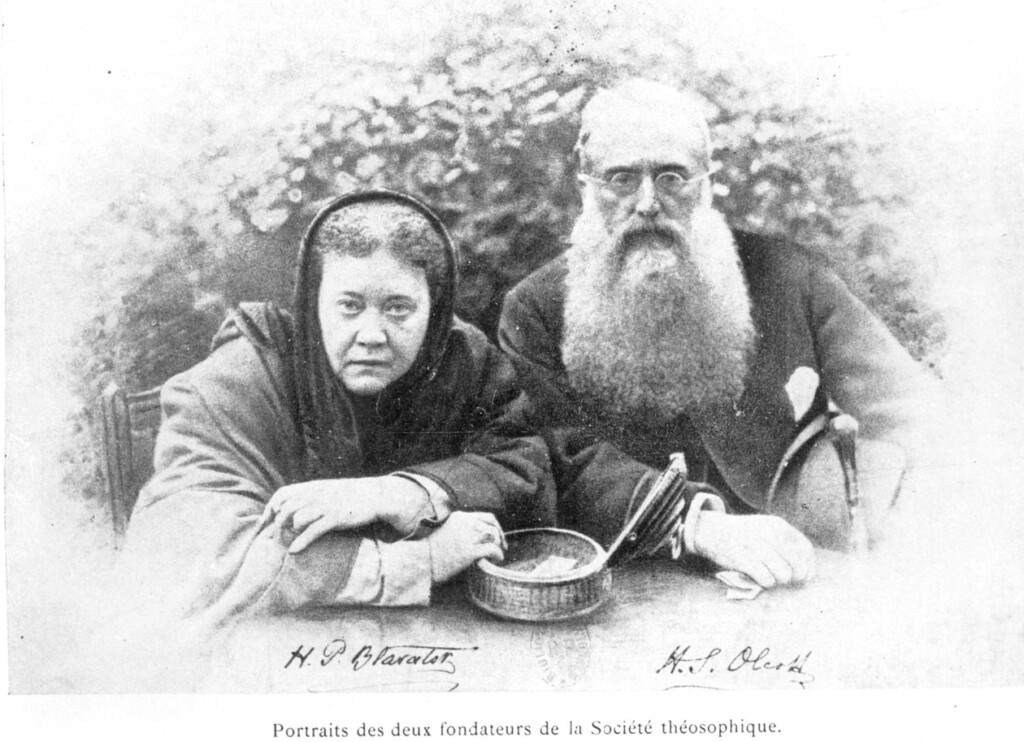
It was here that he met Helena Blavatsky, a woman who carried inside her what seemed like several centuries of disreputable knowledge and who recognized in Olcott something useful: a man who had already decided, on the basis of evidence accumulated across a career of institutional exposure, that official Western reality was itself a construction, and not necessarily the most honest one available.

Buddhism Before Buddhism Was Cool
To understand how strange it was, you have to place yourself in a drawing room in New York or London sometime in the early 1870s and imagine announcing, with complete seriousness, that you intended to become a Buddhist. The reaction would not have been hostility exactly. It would have been something closer to the look people reserve for a man who claims the weather speaks to him. Polite, slightly worried, and absolutely certain of its own sanity.
The West had Buddhism, in those years, but only as a concept. It had Friedrich Max Müller, who had devoted his scholarly life to translating the sacred texts of the East and whose Sacred Books of the East series would eventually run to fifty volumes, beginning in 1879, and who treated Buddhism the way a botanist treats a rare specimen — with genuine fascination and absolute clinical distance. It had Schopenhauer, who had absorbed the Upanishads and the early Buddhist texts into his own architecture of pessimism, bending the doctrine of suffering toward his own European despair, making the Buddha a kind of proto-Schopenhauer rather than anything the tradition would have recognized as itself. What the West did not have was anyone willing to stand inside it, to inhabit it as a living practice rather than an intellectual acquisition.
The dominant reading was nihilism. Educated Europeans looked at the concept of nirvana and saw annihilation, the extinction of the self, which to a civilization built on the immortal soul and the progress of the individual will seemed like a philosophy of defeat. Even those who found it intellectually interesting — and there were serious thinkers who did — tended to admire it the way one admires a beautifully engineered trap: intricate, coherent, and leading nowhere a reasonable person would want to go.
Meanwhile, in Ceylon, Buddhism was not an intellectual position but a suppressed way of life. The Portuguese had arrived on the island in the sixteenth century and begun a systematic dismantling of Buddhist institutional life that the Dutch and then the British continued with varying degrees of deliberateness. Temples were stripped of legal standing. The higher ordination lineage, the upasampada, had been so thoroughly broken that by the eighteenth century there were not enough qualified monks on the island to reconstitute it, and a delegation had to travel to Siam in 1753 to restore the succession. By the time Olcott arrived in 1880, three centuries of colonial pressure had produced a Buddhism that existed in the villages and in the private devotion of ordinary people but had been largely excluded from public life, education, and cultural authority.
He arrived not as a man on vacation from his own civilization but as someone who had already, five years earlier in New York, co-founded the Theosophical Society with Helena Petrovna Blavatsky — an organization dedicated to the proposition that ancient wisdom traditions contained something that modern Western materialism had catastrophically discarded. He had already been moving toward this shore for years, following a current that mixed genuine spiritual hunger with the Victorian appetite for hidden knowledge. What happened in Ceylon was not a conversion so much as a landing.
The Buddhist Catechism he published in 1881 went through more than forty editions in his lifetime and was translated into twenty languages. It was also, inescapably, a translation of a different kind — a rendering of Theravada doctrine into the question-and-answer format of Christian religious instruction, which was exactly the form a colonized population could use to build schools and curricula that the British colonial apparatus would recognize as legitimate. The irony was structural and complete: to survive the machinery of Christian colonialism, Buddhism borrowed its pedagogical form.
What Olcott never fully resolved, and perhaps never fully saw, was the degree to which the recovery he was helping to engineer was also a rewriting. His Buddhism was coherent, activist, and deeply felt. It was also filtered through a mind shaped by New York rationalism, Theosophical universalism, and a century of European philology that had already decided, before anyone asked the monks, what the essential Buddhism really was.
The Colonizer Who Fought Colonialism

There is a particular kind of man who arrives in a country he has no right to govern, speaks a language not his own with the confident accent of someone who has never doubted his presence, and proceeds to defend the people there against the very system that made his arrival possible. The logic is maddening. The gratitude it produces is real. Both facts resist resolution.
Olcott arrived in Ceylon in 1880 carrying the assumptions of his century in his bones, as all of us carry ours, invisibly and without apology. He had grown up in a culture that parsed the world through Protestant categories: the individual conscience, the rational text, the institutional organization, the clean separation between superstition and true religion. When he looked at the Buddhism he encountered, he saw those categories reflected back at him and loved what he saw. He could not have done otherwise. No man sees outside the grammar of his formation, and Olcott’s grammar was New England rationalism dressed in the robes of Victorian progress.
And yet. He founded more than three hundred Buddhist schools across Ceylon at a time when British missionary education was systematically dismantling the cultural transmission of an entire civilization. He lobbied colonial authorities with the precise, bureaucratic tenacity of someone who knew how power worked from the inside, because he did. He secured the recognition of Vesak as a public holiday in 1885, which sounds like a modest administrative victory until you understand what it meant to a population that had been told for decades that its sacred calendar was primitive and its festivals were obstacles to civilization. He created the Buddhist flag in 1885, six horizontal stripes in five colors drawn from the aura said to radiate from the Buddha at his enlightenment, a flag that now flies at temples from Sri Lanka to Los Angeles. A white American colonel gave Buddhism a flag. Sit with the strangeness of that for a moment before deciding what it means.
Frantz Fanon understood the particular violence of spiritual dispossession better than almost anyone. In The Wretched of the Earth, published in 1961, he described how colonized peoples do not merely lose land and political sovereignty but absorb the colonizer’s framework for understanding reality itself, come to see their own traditions through the colonizer’s contemptuous eyes, and measure their spiritual life against a foreign standard they can never fully meet. What Olcott did, at his best, was interrupt that process. He stood inside the colonial apparatus and used its language, its procedural logic, its networks of influence, to insist that Buddhist civilization was not inferior. This was not nothing. It was, in the conditions of 1880 Ceylon, genuinely radical.
But Edward Said’s analysis in Orientalism, published in 1978, presses on a wound that does not close. Said demonstrated that Western engagement with Eastern traditions has never been simply neutral admiration. It constructs its object. It selects the elements that confirm what the Western observer already wants to find, the rational, the universal, the philosophically respectable, and quietly edits out what does not fit. Olcott’s Buddhism was legible to Victorian audiences precisely because he had already performed this translation. The Buddhism he championed was stripped of its village complexity, its ritual ambiguity, its devotional texture that did not map cleanly onto Protestant categories of authentic religious experience. He gave Buddhism a flag and a syllabus and a defense against missionaries, and in doing so, he also gave it a shape that his own cultural formation had largely determined.
A man walks into a burning building to carry someone out. The fact that he helped build the building does not cancel the rescue. The rescue does not cancel the building. These are not two sides of a scale that balance. They are two truths that coexist in the same body, the same history, the same flag still hanging in temples where Olcott’s name is spoken with something approaching reverence by people whose ancestors he never fully understood.
The Catechism and the Mirror
There is a moment that happens in certain classrooms, in certain families, in certain countries where a colonized people have been educated by their colonizers — a moment when someone picks up the master’s tool and uses it to describe a world the master never intended to illuminate. It is not a metaphor. It is a physical act, banal and ordinary on its surface: a boy sits down with a book, reads a question, reads an answer, reads another question. The format is familiar. It is the catechism form, call and response, the pedagogical rhythm the Catholic Church had refined over centuries to install doctrine into minds that were still malleable, still open, still young enough to be shaped before they could resist shaping. The Jesuits had carried this form to Asia. The missionaries had used it to explain to Ceylonese children why their gods were false and their rituals were darkness. And now here was the same form, the same architecture of question and answer, but pointed in the opposite direction entirely.
Henry Steel Olcott published his Buddhist Catechism in 1881, and it ran to forty editions in his lifetime, translated into more than twenty languages. He had constructed it carefully, almost scientifically, attempting to distill what he believed was the rational, universal core of Buddhist teaching — the Four Noble Truths, the Eightfold Path, dependent origination, the rejection of a permanent self — into a format that any literate person, anywhere in the world, could pick up and work through alone. The irony was structural and total. Claude Lévi-Strauss spent much of his career demonstrating that mythic structures travel, that the same narrative architecture appears across cultures carrying radically different content, that the form itself is not neutral but carries its own logic, its own grammar of meaning. When you pour new content into an old form, the form pushes back. It selects, it emphasizes, it silences. The catechism, by its very nature, insists on doctrine. It insists on correct answers. It insists on the possibility that religion can be summarized, tested, verified. And Buddhism, in many of its most serious formulations, insists on precisely the opposite — on the inadequacy of propositions, on the finger pointing at the moon being confused for the moon itself.
Simone Weil wrote about attention as the highest form of spiritual practice, a quality of consciousness that does not grasp, does not reduce, does not demand that experience conform to a prior category. She was writing primarily about prayer, but the insight applies here with uncomfortable precision. What the catechism form structurally cannot do is teach attention. It can teach facts about attention. It can describe the meditation traditions that cultivate attention. But the moment you render a spiritual practice into a question with a correct answer, you have already moved away from the practice itself and toward its representation. Olcott knew this, at some level. He was not a simple man. But he also knew that a tradition being actively dismantled by colonial education policy needed, before anything else, to survive. Survival required legibility. Legibility required the master’s tools.
A teenager in Colombo named David Hewavitarne read the Catechism and felt something shift in his chest that did not shift back. He would rename himself Anagarika Dharmapala, dedicate his life to Buddhist revival across Asia and in the West, found institutions, deliver speeches, radicalize movements, and become arguably the most consequential Buddhist reformer of the twentieth century. He later grew beyond Olcott, disputed him, accused him of misunderstanding the very tradition he had tried to codify. But the book produced the man. The mirror that Olcott held up — imperfect, slightly warped by his own Western projections — reflected something back to a colonized people that they recognized as their own, even if the recognition was partial, even if the reflection was not quite true. Sometimes a flawed mirror is the only mirror available. And sometimes seeing yourself in any mirror at all, after years of being told you have no face worth seeing, is the beginning of everything.
A vision curated by a filmmaker, not an algorithm
In this video I explain our vision
What the West Was Looking For
There is a particular kind of person who discovers meditation in their late thirties, buys three books, downloads an app, and sits for eleven minutes each morning before the children wake up. They will tell you, with complete sincerity, that it has changed everything. They are not lying. Something has shifted in them, something real and worth protecting. But watch closely what has not shifted: the career, the mortgage, the ambient dread of being insufficiently productive, the basic architecture of a life organized around accumulation and performance. The practice floats above all of that like a lily on a pond that is slowly being drained. This is not a criticism of that person. It is a description of what happens when a tradition that originally demanded everything — renunciation, community, ethical transformation at the cellular level — passes through a particular historical filter and arrives, softened, portable, and pre-approved.
That filter has a name, and it begins, in its modern Western form, with Olcott.
The lineage is traceable with almost uncomfortable precision. Olcott’s work in Ceylon directly shaped Anagarika Dharmapala, who carried a reformed, rationalized, universally accessible Buddhism to the World’s Parliament of Religions in Chicago in 1893, where it entered the American imagination as a philosophy of liberation compatible with science and democracy. Dharmapala’s formulations reached Daisetz Teitaro Suzuki, who spent decades translating and repackaging Zen for Western consumption, whose books landed on the desks of Carl Jung, Thomas Merton, John Cage, and eventually a young Alan Watts, who transformed them into something the counterculture could metabolize whole. By the time the 1960s Buddhist wave broke across California, it had traveled from a colonial railway carriage in Colombo through a chain of extraordinary intermediaries, each one compressing the tradition further, making it lighter, making it fit. The compression was not always distortion. But it was always selection.
Jung understood something about this dynamic that he could not quite bring himself to state directly. In his 1939 commentary on the Tibetan Book of the Great Liberation, he warned Western readers against what he called the “imitation of the East,” arguing that the Western psyche had a different shadow, a different wound, and that adopting Eastern forms without confronting that wound would produce not liberation but a new form of evasion. The shadow, in Jung’s framework, is not simply the dark side of the personality. It is everything the conscious self has refused to integrate, everything cast off in the construction of the acceptable, functioning identity. Western modernity cast off an enormous amount: the body, the sacred, the irreducible mystery of death, the belonging that comes only from genuine community. What it cast off, Jung suggested, it would seek to recover in disguised forms, and the disguise would always resemble whatever was most fashionably available from the outside.
Peter Berger, writing in 1967, gave this dynamic a sociological architecture. The sacred canopy — his term for the symbolic framework that makes a culture’s world feel coherent, meaningful, protected from chaos — had torn in the West over the course of two centuries of secularization, and what remained was a landscape of competing belief systems, none of them capable of providing the old totalizing shelter. What people did in that landscape, Berger observed, was shop. They assembled meaning from fragments, tried combinations, moved on. The spiritual marketplace was not a sign of freedom. It was a sign of homelessness.
Olcott was not responsible for the marketplace. But he was one of its architects, perhaps its most idealistic one, genuinely convinced that beneath all the fragments lay a single perennial truth that could heal the wound. He was mapping something real when he mapped that hunger. The question that remains, and that his entire project ultimately produces, is whether what the West encountered in Buddhism was Buddhism at all — or whether it encountered, in that ancient and exacting mirror, only the precise shape of its own absence, its own need, dressed in saffron, asking nothing back.
🌀 Where East Meets West: Paths of Spiritual Awakening
Henry Steel Olcott’s journey from American journalist to Buddhist reformer is inseparable from the broader web of esoteric movements that reshaped Western spirituality in the nineteenth and twentieth centuries. His story intersects with visionary thinkers, secret doctrines, and radical organizations that dared to challenge the materialist consensus. These articles trace the living labyrinth of ideas that Olcott helped set in motion.
Helena Blavatsky and Theosophy: the Woman Who Revolutionized Esoteric Thought
Without Helena Petrovna Blavatsky, there would have been no Theosophical Society and no Colonel Olcott standing beside her. This article explores how Blavatsky synthesized Eastern philosophy, occultism, and Western esotericism into a revolutionary worldview that permanently altered the spiritual landscape of the modern world. Understanding her is essential to understanding the movement Olcott co-founded and championed throughout his life.
GO TO THE SELECTION: Helena Blavatsky and Theosophy: the Woman Who Revolutionized Esoteric Thought
The Theosophical Society: History, Principles and Influence on Western Culture
The Theosophical Society was the institutional vessel that carried Olcott’s dreams of spiritual brotherhood across continents and decades. This article provides a comprehensive history of its founding principles, internal conflicts, and lasting influence on everything from New Age spirituality to the independence movements of Asia. It is the indispensable map for anyone wishing to navigate the world Olcott helped build.
GO TO THE SELECTION: The Theosophical Society: History, Principles and Influence on Western Culture
Annie Besant: From Socialist Activism to Theosophical Leadership
Annie Besant inherited the Theosophical Society’s leadership and transformed it with the same fierce conviction she had once devoted to socialist causes in Victorian England. Her trajectory from radical activist to spiritual authority mirrors in many ways Olcott’s own improbable reinvention as a Buddhist ambassador to the world. This article traces her remarkable path and her deep imprint on the movement.
GO TO THE SELECTION: Annie Besant: From Socialist Activism to Theosophical Leadership
Buddhism and 3 Documentaries to Understand it
Olcott’s embrace of Buddhism was not merely symbolic: he wrote a Buddhist catechism that is still used today and played a pivotal role in the modern revival of the religion in Sri Lanka. This article and its accompanying documentaries offer an accessible entry point into the core teachings and historical sweep of Buddhism that so captured Olcott’s imagination. It provides essential context for understanding why a nineteenth-century American colonel found liberation in the Dharma.
GO TO THE SELECTION: Buddhism and 3 Documentaries to Understand it
Explore the Infinite Maze on Indiecinema
These spiritual labyrinths extend far beyond the written word, and Indiecinema streaming is your portal to the films that dare to explore them. From mystical documentaries to visionary fiction, our catalog is curated for curious minds who refuse to stop at the surface. Join us and let independent cinema take you deeper into the questions that matter most.
👉 EXPLORE THE CATALOG: Watch Indie Films in Streaming
A vision curated by a filmmaker, not an algorithm
In this video I explain our vision

