
The Uncomfortable Guest at Every Dinner Table
You already know this table. You have sat at it a hundred times. The good china comes out for certain guests and stays locked away for others, and no one explains why because no explanation is necessary — the hierarchy is older than language, older than anyone sitting there. Your grandmother moves with the efficiency of someone who has rehearsed this staging for fifty years: the patriarch at the head, the women appearing from the kitchen at intervals that feel choreographed, the children arranged by age or gender or some obscure combination of merit and expectation that you absorbed before you could name it. There is a dish that only appears on this occasion. Its presence means something. Its absence would mean something worse.

Watch what happens when someone sits in the wrong chair. Not the wrong chair by any written law, but the wrong chair by the deep grammar of the room. The conversation does not stop. It barely flickers. But something tightens — a micro-adjustment in posture, a rerouting of eye contact, a joke that lands slightly differently than it would have if the geometry of bodies had been correct. Nobody will say anything. The offense is too structural to be addressed directly, which is precisely what makes it an offense rather than a mistake.
This is not sentimentality about family. This is a description of a system, and what distinguishes a system from a collection of habits is that its rules generate meaning regardless of whether anyone consciously intends them. The roast at the center of the table is not just food. The prayer before eating is not just gratitude. The sequence in which people are served is not just logistics. Each of these elements is a term in a syntax, and the sentence they compose together says something about who belongs, who is powerful, who is sacred, and who is tolerated. You were reading this sentence fluently before you learned to read anything else.
Into this room — and the thousands of rooms like it from the Amazon basin to the highlands of Papua New Guinea to the apartments of mid-century Paris — walked a man constitutionally incapable of experiencing social ritual as anything other than sign. Claude Lévi-Strauss, born in Brussels in 1908 to a family of Alsatian Jewish intellectuals, trained in philosophy and law, radicalized by a single decisive encounter with ethnography in Brazil in 1935, would spend the next seven decades treating the dinner table exactly as it deserves to be treated: as a document. Not a warm one. Not one that confirmed the specialness of any particular tradition. A document like any other, decipherable by the same structural logic that governs language, kinship, myth, and the organization of raw and cooked ingredients across every human culture that has ever built a fire.
The discomfort he produces is not the discomfort of pessimism or nihilism. It is something more precise and more unsettling. He does not tell you that your rituals are meaningless. He tells you that they are meaningful in the same way that everyone else’s rituals are meaningful — that the grammar underlying your grandmother’s tablecloth and the grammar underlying a Bororo feast in central Brazil are, at a sufficient level of abstraction, the same grammar. The content differs. The structure does not. And if the structure does not differ, then the feeling of absolute rightness you carry about your own rituals — the sense that this is simply how things are done, how they must be done — is itself a product of the system, not evidence of the system’s truth.
This is what structural anthropology does to you if you let it. It does not take the meaning away. It shows you that meaning is manufactured, which is both more extraordinary and more disturbing than the alternative.
Venetian Arcanum
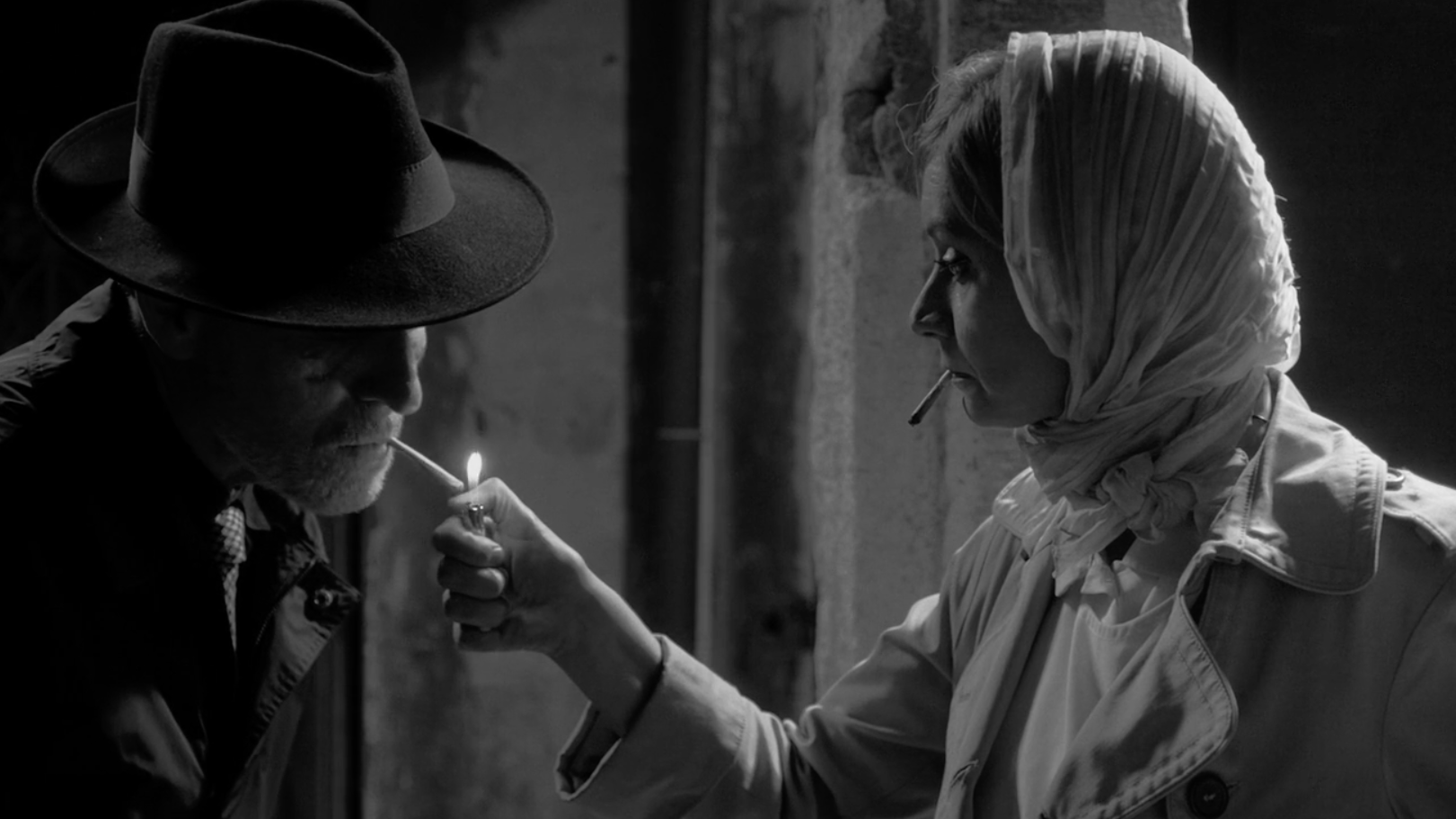
Thriller, by Serge Turgeon, Italy, 2025.
In Venice, a mysterious presence appears once every century or two, haunting the canals and hidden corners of the city. Driven by a sense of destiny, a woman decides to search for it. Following its elusive traces, she is drawn deeper and deeper into the city’s arcane secrets. Reality and myth begin to blur, and Venice itself transforms into a labyrinth of dangers.
LANGUAGE: Italian
SUBTITLES: English
A Man Shaped by Dislocation
There is a particular kind of person who only becomes themselves by leaving. Not the traveler who returns enriched, who brings back souvenirs and anecdotes to decorate an essentially unchanged life. Something more radical than that. The person for whom departure is not an episode but a structure, for whom every arrival is already the anticipation of another rupture, for whom home is a concept that applies only to other people.
Claude Lévi-Strauss was this kind of person, though it would take decades and continents and a world war before he understood it as such.
He was born in Brussels in 1908, raised in Paris, the son of a portrait painter whose artistic vocation gave the household a certain cultivated fragility, the sense of a life assembled from aesthetic choices rather than inherited certainties. He studied philosophy and law, the twin disciplines of the French educated class, learning to argue from principles, to derive conclusions from premises, to trust the architecture of reason. He was trained, in other words, to believe that the mind is the most reliable instrument for understanding the world. Then Brazil happened.
In 1935 he accepted a position at the newly founded University of São Paulo, and within a year he was in the Mato Grosso, moving among the Nambikwara and the Bororo peoples, sleeping on the ground, watching social structures operate that no European philosophy had prepared him to decode. The Nambikwara in particular left a permanent mark on him. He described them in Tristes Tropiques, published in 1955, as people who had apparently stripped social life down to its irreducible minimum, and yet within that minimum he found not poverty but a kind of proof: that even at the apparent zero degree of civilization, there was structure, there was exchange, there were rules governing who could speak to whom and who could touch whom and who owned the right to name things. The European assumption that complexity was the property of Europe and simplicity was the property of elsewhere collapsed in the face of this. What he found was not simplicity. What he found was a different complexity, one that his training had given him no tools to recognize.
This is what fieldwork does when it works honestly. It does not confirm what you came to find. It destroys the question you arrived with and forces you to construct a different one.
Then the war came, and displacement became not a chosen method but a condition of survival. Lévi-Strauss was Jewish, a fact the Vichy regime converted into legal vulnerability. He escaped to New York in 1941, part of that extraordinary dispersal of European intellect that the catastrophe of fascism scattered across the Atlantic. In New York, at the New School for Social Research, he encountered Roman Jakobson, the Russian linguist who had himself been dislocated by history, driven from Moscow to Prague to New York in a series of forced relocations that paradoxically produced some of the twentieth century’s most precise thinking about language. The two men recognized in each other a shared intuition: that beneath the infinite surface variation of human phenomena, there were underlying structures that organized meaning, and that these structures could be analyzed with something approaching scientific rigor. Jakobson’s phonology, his insight that languages distinguish sounds not through infinite gradation but through binary oppositions — voiced against unvoiced, nasal against oral — gave Lévi-Strauss the conceptual instrument he had been searching for without knowing its name.
What is remarkable, in retrospect, is how thoroughly the method mirrors the life. A mind that has been repeatedly uprooted develops a particular sensitivity to what persists across uprootings, to what survives the loss of context. Lévi-Strauss spent his career asking what remains when everything contingent is stripped away. It is not an abstract question when you have already lost everything contingent at least twice.

What the Raw Meat Already Knows
Your mother never learned to cook. She was taught, and the difference between those two verbs contains an entire civilization. Watch her hands move over the cutting board — the way she separates certain foods from others, the way she would never combine this with that, the way the fire is managed with a precision that has nothing to do with thermometers and everything to do with inheritance. She cannot explain why. She would say, if pressed, that it is simply how it is done. And she would be exactly right, though not in the way she thinks.
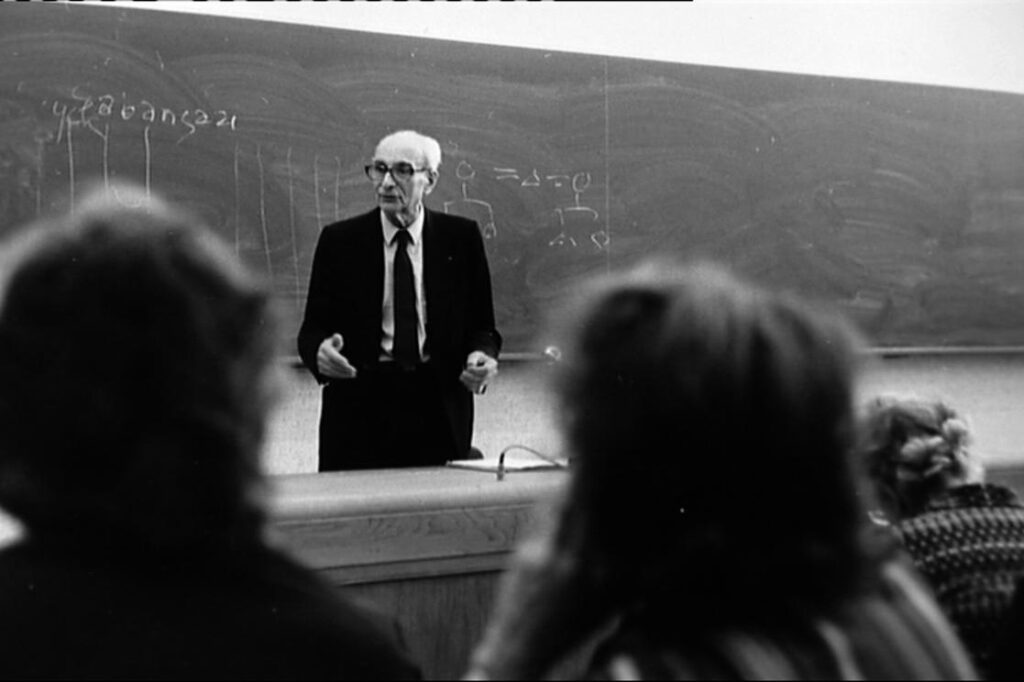
Claude Lévi-Strauss spent a decade in the myths of South American indigenous peoples and emerged in 1964 with a book that most people could not finish and almost no one could ignore. The first volume of Mythologiques opens with a question so simple it sounds naive: why do human beings cook their food? Not how, not since when, but why — as if the act itself demanded philosophical justification before it demanded a recipe. The answer he builds across hundreds of pages is one of the most disorienting propositions in twentieth-century thought: cooking is not something humans do after becoming cultural creatures. Cooking is how they became cultural creatures at all.
The raw and the cooked are not merely states of meat. They are the poles of a fundamental opposition that every human society has used to map the boundary between what belongs to nature and what belongs to the world that humans have made and imposed on nature. The raw is what exists before the human intervention. The cooked is what has passed through it. And between them, mediating silently, sits the rotted — the transformation that happens without human agency, the reminder that nature will complete its processes with or without you. These three terms form a triangle that Lévi-Strauss treats as a kind of universal grammar, a deep structure underlying not just culinary practice but music, kinship, cosmology, the organization of space and time.
This might sound like elegant abstraction until you sit in that kitchen and watch the hands. The woman preparing food according to rules she has never questioned is not being irrational. She is performing a text she did not write. Every dietary prohibition — the animal that cannot be eaten, the combination that is forbidden, the method that would be a desecration — encodes a statement about where the boundaries of the human lie. The anthropologist Mary Douglas understood this when she argued in Purity and Danger, published just two years after Lévi-Strauss’s first Mythologiques volume, that pollution and taboo are systems of classification before they are systems of hygiene. The disgust you feel is not instinctive. It is cultural memory operating at the level of the stomach.
There is a man who once watched a meal being prepared in a village where fire was managed with a reverence that looked, to his foreign eyes, almost religious. The wood had to be of a certain kind. The cooking could not begin before a particular moment. The person who cooked could not be just anyone. He understood, standing there, that he was not watching food preparation. He was watching a society reproduce its own logic through the bodies and hands of people who had never read a line of structural anthropology and had no need to. The knowledge was already in the gestures.
Lévi-Strauss’s radical claim is that the human mind, everywhere and always, works by making distinctions. Binary oppositions — raw and cooked, nature and culture, inside and outside, sacred and profane — are not Western philosophical inventions. They are the operating system. What differs between societies is not the capacity for this kind of thought but the specific distinctions chosen, the particular lines drawn, and what is placed on either side of them.
Your mother’s kitchen is already doing philosophy. She just doesn’t call it that.
The Myth That Thinks Itself Through Us
You are telling a story you have told a hundred times — the one about the uncle who disappeared, the inheritance that caused a rupture, the woman who chose silence over justice — and somewhere in the middle of the third or fourth sentence you stop. Not because you have forgotten it. Because you have suddenly heard it. Your grandmother told this story. Not a similar one. This one. With a different uncle, a different sum of money, a different village on a different hillside, but with the same structure, the same moral gravity, the same moment where the woman goes quiet and the men pretend not to notice. And her grandmother told it too. You know this without being able to prove it, the way you know certain things about your own body before any doctor confirms them.
This is precisely the moment that interested Lévi-Strauss more than any other. Not the content of the myth. The skeleton underneath it.
In his 1955 essay published in the Journal of American Folklore, “The Structural Study of Myth,” he made a claim so counterintuitive it still unsettles most readers who encounter it without preparation: myths are not stories that humans tell. They are structures that think themselves through human minds. The human being is the medium, not the author. You do not create the myth any more than your lungs create oxygen. You are the passage through which it moves.
The proof, for Lévi-Strauss, was in the variations. He had spent years cataloguing hundreds of versions of the same mythological narratives across entirely unconnected cultures — the Oedipus cycle, the creation myths of the Americas, the trickster figures that appear independently on every inhabited continent. What struck him was not the differences, which any cultural relativist could have predicted, but the obsessive persistence of the underlying architecture. The same binary oppositions. The same logical operations. Nature against culture. The raw against the cooked. Life against death. Generation against destruction. Change the names, change the geography, translate the drama from Greek hillside to Amazonian rainforest, and the bones remain identical.
He called these bones “mythemes” — the minimal constituent units of mythological thought, analogous to the phonemes that linguists use to describe the smallest meaningful units of spoken language. The insight he borrowed from Ferdinand de Saussure and developed through Roman Jakobson was this: meaning does not reside in individual elements but in the relationships between them. A word means nothing in isolation. A mytheme means nothing in isolation. It is the opposition, the tension, the structural relationship that generates sense.
This had a consequence that most people absorb too quickly and therefore do not absorb at all. If myths operate at the level of structure rather than content, then no individual telling of a myth is the original or the authentic version. They are all equally valid, equally partial, equally symptoms of the same underlying logic. Lévi-Strauss put it with characteristic precision: a myth consists of all its versions. Freud’s interpretation of Oedipus is not less mythological than Sophocles’. It is one more iteration of the same structure thinking itself through a different historical moment.
There is a man who has spent his life convinced he is someone who does not repeat the past. He left the hometown, changed his name in practice if not on paper, built a life that looks nothing like his father’s. And then one evening he is sitting across from his daughter and he hears himself saying something — a sentence, a judgment, a particular silence after a particular kind of question — and he recognizes it with a cold precision. He did not invent that sentence. He received it. The structure moved through his father and arrived, intact, in his own mouth.
This is not metaphor. This is what Lévi-Strauss meant. You are not the one thinking the myth.
The Primitive Is a Mirror, Not a Fossil
You arrive with your notebooks and your tape recorder and your quiet sense of mission, and somewhere in the third week you notice that the elders have been watching you with an expression you cannot quite name. It is not hostility. It is not curiosity. It is something closer to the measured patience of someone who has already understood the situation more completely than you have, and is waiting, without urgency, for you to catch up. The studied observer becomes, without ceremony, the studied subject. The hierarchy you carried in your luggage dissolves before you have even opened it.
This is the central wound that Lévi-Strauss inflicted on Western self-understanding, and it has never fully healed. Published in 1955, Tristes Tropiques is many things simultaneously — travel memoir, philosophical autobiography, ethnographic confession, sustained polemic — but its deepest operation is this: it forces the Western reader to occupy the position of the primitive. Not as an insult. As a correction. The book does not argue that so-called primitive societies are noble or innocent or superior. It argues something far more unsettling, which is that the entire vertical axis we use to rank civilizations is a fiction we constructed to avoid a horizontal truth.
The evolutionist framework that dominated anthropology through most of the nineteenth century was not simply an intellectual error. It was a moral convenience. Lewis Henry Morgan’s 1877 schema of savagery, barbarism, and civilization — adopted and adapted by Engels, rehearsed in colonial classrooms across four continents — offered a picture of human history as a single escalator, with the industrialized West standing at the top. Every society that did not resemble Victorian England or Haussmann’s Paris was simply further down the same staircase, on its way, given time and guidance, to becoming what Europe already was. The condescension was structural. It was built into the grammar of the comparison.
What Lévi-Strauss demonstrated, through decades of fieldwork and through the architectonic argument of the four-volume Mythologiques completed between 1964 and 1971, is that so-called primitive thought is not a failure to reach scientific rationality. It is a different mode of rationality, operating on different materials with different instruments but achieving comparable intellectual complexity. He called it the science of the concrete. Where the engineer begins with a blueprint and acquires the materials to execute it, the bricoleur begins with a finite set of materials already at hand and constructs from what is available. Neither method is superior. Each is a response to different constraints, and each produces coherent, intricate, functional systems of meaning.
The distinction between bricolage and engineering is not a romantic rehabilitation of the primitive. It is a structural observation about how minds work when they work differently. Myth-making is bricolage. It rearranges a closed set of inherited elements — animals, seasons, kinship relations, bodily experiences — into configurations that think through contradictions the society cannot resolve otherwise. The Oedipus myth does not explain anything in the scientific sense. It holds a tension in a form that makes it livable. This is not lesser than a differential equation. It is answering a different question.
What collapses here is not just the hierarchy but the very idea of a single destination toward which human cultures are traveling. Lévi-Strauss was reading Rousseau carefully, and he understood what Rousseau had actually meant — not that savages are happy and civilization corrupt, but that the comparison itself is the problem, that the moment you rank you have already stopped seeing. The man with the notebook and the tape recorder, so convinced he has come to observe, does not realize that what the elders are studying in him is a kind of elaborate mythology — the myth of progress, worn on the body like ceremonial paint, invisible to the one wearing it.
A vision curated by a filmmaker, not an algorithm
In this video I explain our vision
Structuralism as a Way of Seeing You Have Always Used Without Knowing

You have done it your whole life without once calling it by a name. The moment someone walks into a room and you feel, before any thought has formed, that there is something wrong with them — something in the way they laugh too easily, something in the confidence that seems unearned, something in the way they take up space as though space were simply theirs to take — you are not perceiving a person. You are operating a machine. The machine sorts the world into pairs: authentic and performed, earned and appropriated, restrained and excessive. You did not build this machine consciously. It was assembled in you, piece by piece, through every meal at your family’s table, every classroom that punished certain kinds of loudness and rewarded others, every story that told you what a hero looked like and what a fool looked like and why the difference mattered.
Ferdinand de Saussure understood this mechanism at the level of language itself. In his Cours de linguistique générale, reconstructed from student notes and published posthumously in 1916, he argued that words carry no meaning in themselves — that the sign “tree” does not contain treeness, does not resemble a tree, has no natural connection to the object it names. Meaning is purely relational. “Tree” means something only because it is not “bush,” not “rock,” not “river.” The system of differences is the system of meaning. Remove the contrasts and you remove the content. This was not a theory about language. It was a theory about how minds produce reality.
Lévi-Strauss saw immediately that Saussure had handed him a weapon. If meaning in language works through oppositions rather than essences, then meaning in culture works the same way. Raw and cooked. Nature and culture. The sacred and the profane. These are not descriptions of things that exist independently in the world. They are the infrastructure through which human groups think at all. In Anthropologie structurale, published in 1958, and then across the four volumes of Mythologiques that followed through the 1960s and into 1971, he demonstrated that myths from cultures with no contact, no shared history, no common language, were nevertheless solving identical logical problems using structurally identical operations. The surface content changed. The deep grammar did not. Human minds were not expressing different truths. They were running the same program.
And here is where the lived experience cuts through the theory like something sharp. There is a scene — not from any book, not from any lecture — that belongs to the category of moments people remember for years without understanding why. A man sits across a table from someone he has described, privately, as arrogant. He has described this person’s certainty, their refusal to second-guess themselves, the way they speak as though the question of their own adequacy simply never arises. And then, midway through the conversation, something shifts. Not in the other person. In him. In the quality of attention he is paying. Because what he is describing with such precision, with such intimate familiarity, is not the other person’s interior life. It is his own suppressed ambition, the self-assurance he was taught was dangerous to display, the permission he never gave himself. The structure was never about the other man. The other man was just the negative space in which the shape of his own refusal became visible.
This is what Lévi-Strauss meant by the unconscious structure. Not Freud’s unconscious, not a chamber of repressed desires, but a logical architecture that operates below the level of awareness, sorting experience into binary pairs before consciousness has time to intervene. You do not decide to think in oppositions. The oppositions think you. The system was running long before you sat down at this table, long before you decided you knew what kind of person you were looking at.
The Violence Hidden in the Gift
There is a moment at every wedding reception — you have been there, you know it — when the two fathers stand together for a photograph, flanking the couple, and something in their posture is just slightly wrong. Not hostile, not false, but too satisfied. A transaction has closed. The handshake between them holds a fraction too long, the smiles carry the particular warmth of men who have reached an agreement they both consider favorable. The bride moves between them like a clause in a contract that has finally been signed, and the flowers and the champagne and the string quartet are not decorations so much as they are the ceremonial wrapping of something far older and far less sentimental than love.
Marcel Mauss saw this mechanism clearly in 1925, in his Essai sur le don, though he was looking at it through kula rings in Melanesia and potlatch ceremonies among the Kwakwaka’wakw peoples of the Pacific Northwest. His argument was deceptively simple: gifts are never free. Every act of giving creates an obligation to return, and that obligation is what binds societies together. The gift is generosity wearing the mask of power. What appears to be an offering is always also a claim.
Lévi-Strauss took Mauss’s insight and drove it somewhere Mauss had not fully gone. In Les Structures élémentaires de la parenté, published in 1949, he argued that the most fundamental gift exchanged between human groups was not food, not objects, not territory. It was women. The prohibition of incest — which every known human culture observes in some form — was not merely a moral rule or a biological instinct. It was, structurally, a forced opening outward. By forbidding men to keep women within their own group, the incest taboo compelled exchange between groups, and that exchange was the founding act of human society itself. Alliance, not blood. Circulation, not possession. The social order emerged not from what people kept but from what they gave away — or more precisely, from what was given away on their behalf.
The elegance of this is almost brutal. Lévi-Strauss was not describing something that happened once, in some prehistoric clearing. He was describing the deep grammar beneath every kinship system on earth, a grammar that operates whether anyone acknowledges it or not. The bride at the reception, radiant, autonomous, choosing — is also, in a structural sense that runs beneath her choosing, a sign being exchanged between two groups of men. She circulates. The system requires it.
Simone de Beauvoir, who published Le Deuxième Sexe that same year, 1949, could not let this stand without friction, and the friction she applied was not merely political but philosophical. Her objection was not that Lévi-Strauss was wrong about the structure. It was that he had described the mechanism with a serenity that amounted to complicity. To map the subordination of women as a logical necessity of social order — to make it elegantly structural — is already to normalize it, to grant it the authority of a natural law when it is in fact a historical violence that has been systematized and then forgotten as violence. The woman who is exchanged, de Beauvoir insisted, is not simply a term in an equation. She is a subject who has been reduced to an object, and no amount of structural necessity dissolves that reduction into something neutral.
Lévi-Strauss never fully answered this. He retreated into the claim that he was describing, not endorsing, that the anthropologist’s task was comprehension rather than judgment. But de Beauvoir understood something he could not quite see from where he stood: that a description this total, this architecturally beautiful, this presented as the necessary foundation of all human sociality, does not merely reflect the world. It participates in holding it in place.
After the Structure, the Silence
You return to a city you left thirty years ago, and the street is there, the same proportions, the same angle of light in the afternoon, but the bakery is a phone repair shop and the woman who used to lean from the second-floor window has been replaced by a satellite dish. You walk the bones of a place you loved. The skeleton is intact. Everything that filled it has been substituted. And you are not sure whether to call this continuity or loss.
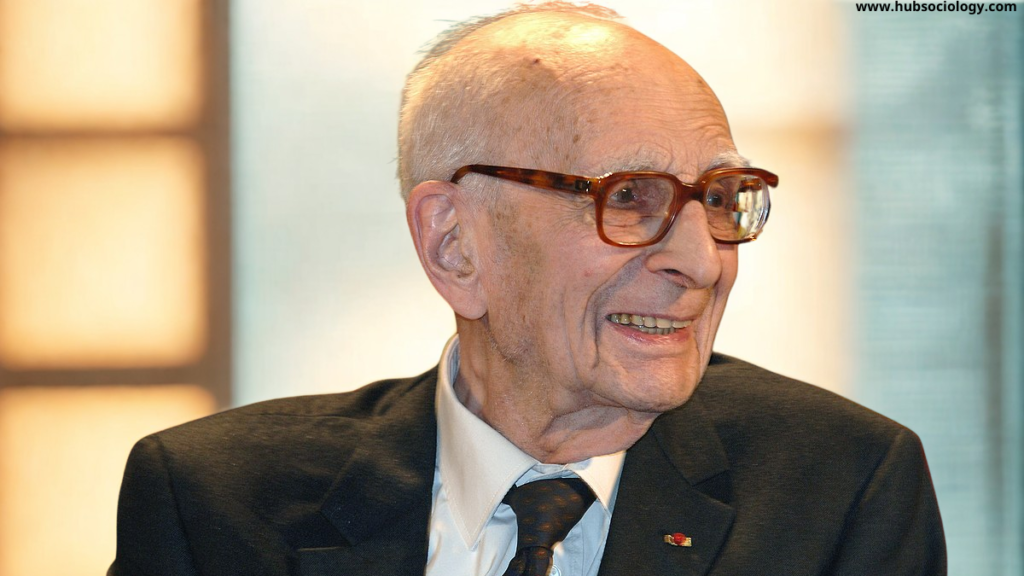
Claude Lévi-Strauss lived to one hundred years, dying in October 2009, and in that longevity he was granted something rare and terrible: he watched the entire arc of his own intellectual legacy. He saw structuralism become, through the 1960s, the dominant grammar of French intellectual life, the method that promised to unlock myth, kinship, language, and cuisine with the same analytical key. He watched Roland Barthes apply its instruments to fashion and advertising. He watched Jacques Lacan bend it toward the unconscious. And then he watched Jacques Derrida stand up at a conference in Baltimore in 1966 and announce, with surgical precision, that the very concept of structure depended on a center that was itself outside the structure — that the whole edifice rested on a concealed metaphysics. Foucault, from a different angle, was already dismantling the human subject that structuralism had displaced but never fully abolished. The postcolonial critics who followed pointed to the political silences embedded in the method: who was doing the observing, who was being observed, and what power relation had been quietly naturalized as scientific distance.
Lévi-Strauss did not capitulate to these critiques, nor did he engage them with the eagerness of someone defending territory. He continued writing. The four volumes of Mythologiques, completed in 1971, amount to nearly three thousand pages of sustained mythological analysis, an intellectual project of almost geological ambition. In his late interviews he seemed less interested in winning arguments than in sitting quietly with a paradox he had always known was there. He had written in Tristes Tropiques, as early as 1955, that the self is perhaps nothing more than a place where processes converge — not an origin but a junction. He never pretended otherwise.
The question his work leaves behind is not comfortable. If the myths think themselves through human beings, if the structures that organize kinship and prohibition and narrative are older and more durable than any individual who carries them, then what exactly are you doing when you believe you are choosing? Ernest Becker, writing in The Denial of Death in 1973, argued that human consciousness is constituted by the terror of its own contingency, that everything we build — culture, meaning, identity — is a defense against knowing how little ground we stand on. Lévi-Strauss would not have used Becker’s vocabulary, but the structural echo is unmistakable: both men arrived at the same unsettling landing, from different directions, by different staircases.
There is a moment, in a life or in a civilization, when you realize that the most intimate thing about you — the way you grieve, the way you desire, the way you organize the dead and the living, the way you tell stories to make the darkness bearable — was already there before you arrived. The structure preceded you. You inherited the grammar. What you call your voice is a particular inflection of a language you did not invent and will not outlast.
And yet you are reading this. Something in you resists the conclusion even as the argument closes around it. That resistance — that insistence on the irreducible singular, on the choice that feels like yours alone — is either the one thing the structure cannot account for, or it is the most elegant proof that the structure is still working, still thinking through you, still dreaming itself in the borrowed theater of your certainty.
🌿 Myths, Structures, and the Hidden Grammar of Culture
Claude Lévi-Strauss spent his life uncovering the invisible architectures that govern human thought, from myth and kinship to ritual and symbol. His structuralist method invites us to look beneath the surface of culture and find patterns that connect the most distant civilizations. The articles below trace the intellectual landscape surrounding his work.
Jan Assmann and Cultural Memory
Jan Assmann‘s concept of cultural memory explores how societies encode their collective past in texts, rituals, and monuments, creating a shared identity across generations. Much like Lévi-Strauss, Assmann was interested in the deep structures that hold communities together beneath the flux of historical change. His work offers a powerful complement to structuralist anthropology by grounding symbolic analysis in the dynamics of memory and transmission.
GO TO THE SELECTION: Jan Assmann and Cultural Memory
Jungian Individuation and the Great Work
Carl Gustav Jung‘s theory of individuation and its relationship to the alchemical Great Work reveals how symbolic systems can map the deepest layers of the human psyche. Like Lévi-Strauss, Jung believed that myths and symbols are not arbitrary but reflect universal structures of the mind shared across cultures and epochs. This intersection of psychology and mythology offers a fascinating parallel to the structuralist reading of human thought.
GO TO THE SELECTION: Jungian Individuation and the Great Work
Philosophy of Nature: From Aristotle to Today
The philosophy of nature, from Aristotle to the present day, has long grappled with the question of how human beings situate themselves within the living world. Lévi-Strauss’s own fieldwork among Amazonian peoples was deeply shaped by his attention to the way indigenous cosmologies structure the relationship between nature and culture. Tracing this philosophical lineage illuminates the broader intellectual context in which structural anthropology emerged.
GO TO THE SELECTION: Philosophy of Nature: From Aristotle to Today
Universal Consciousness
The idea of universal consciousness asks whether there exists a shared substrate of mind that underlies all human experience and cultural diversity. This question resonates profoundly with Lévi-Strauss’s structuralist hypothesis that the same fundamental mental operations generate the extraordinary variety of myths and social systems found across the globe. Exploring this concept opens a dialogue between anthropology, philosophy, and the mystical traditions of both East and West.
GO TO THE SELECTION: Universal Consciousness
Discover the Cinema That Thinks
If the thought of Lévi-Strauss has sparked your curiosity about the deeper structures of human experience, Indiecinema is the streaming platform where cinema meets philosophy, anthropology, and myth. Explore a curated selection of independent and documentary films that dare to ask the questions that matter most.
👉 EXPLORE THE CATALOG: Watch Indie Films in Streaming
A vision curated by a filmmaker, not an algorithm
In this video I explain our vision

