
The Senate Floor as Political Laboratory
You are standing in the Theatre of Pompey on the Ides of March, 44 BC, and your hands are already moving before your mind has caught up with what your hands are doing. The blade is not a metaphor. The man in front of you has been your patron, your creditor, your conqueror, and now he is simply a body that has not yet understood what it is about to become. You strike not from hatred — that is the lie history will tell on your behalf — but from something far more difficult to name, a species of conviction so complete it has colonized the space where doubt is supposed to live. There are twenty-three wounds when the physicians count them later. Twenty-three men, each certain he was the last resort of the republic. Each certain the others would understand.

What happened in that hall on March 15 has never stopped happening. Not because history repeats itself in the mechanical, lazy sense that commentators invoke when they want to sound serious without doing the work of precision, but because the structure of that moment — the gap between what a conspiracy believes it is doing and what it actually sets in motion — is something the political imagination has never successfully updated its operating system to process. The senators who gathered under the fiction of a petition, who had rehearsed their positions like actors marking blocking, were not irrational men. Brutus had read Plato. Cassius understood logistics with a general’s clarity. Cicero, who knew but was excluded from the act itself, had spent decades theorizing the relationship between law and legitimate force in his De Re Publica. These were men swimming in political theory. They drowned in political consequence.
The first fact that should destabilize you is this: Julius Caesar was not the dictator the conspiracy’s propaganda required him to be. He had been appointed dictator perpetuo — dictator in perpetuity — only weeks before his death, a title with a specific constitutional mechanism behind it, not simply a seizure of power from a vacuum. The Senate had voted it. Many of the same senators whose daggers would find him on March 15 had participated in that vote, some enthusiastically. What they were killing was partly their own previous decision, and that psychological contortion — the need to retroactively transform compliance into oppression in order to make resistance heroic — is one of the more precise mechanisms by which political violence launders itself into political virtue.
Suetonius records that Caesar had been warned. The soothsayer Spurinna had urged him months earlier to beware the Ides of March, and on that morning, encountering Spurinna in the crowd, Caesar reportedly remarked that the Ides had come. Spurinna answered that they had come but not yet gone. This exchange has been mythologized into portent, but strip the omen away and what remains is a man who had received credible intelligence about a threat to his life and chose to ignore it. Not from stupidity — Caesar’s cognitive record does not support stupidity as an explanation — but from a political calculation about what it would cost him to appear afraid. Vulnerability, in the Roman conception of dignitas, was not merely unfortunate; it was disqualifying. He walked into the theatre knowing the room was hostile and wagered that his presence alone would be sufficient armor.
That wager is the laboratory result this essay is interested in. Not the assassination as crime or as liberation, not the body count of the civil wars that followed — and they were catastrophic, consuming the republic far more thoroughly than Caesar’s lifetime had — but the specific intellectual failure of men who were sophisticated enough to plan a political act and catastrophically naive about what political acts do once they leave the hands of the people who planned them.
Bruto
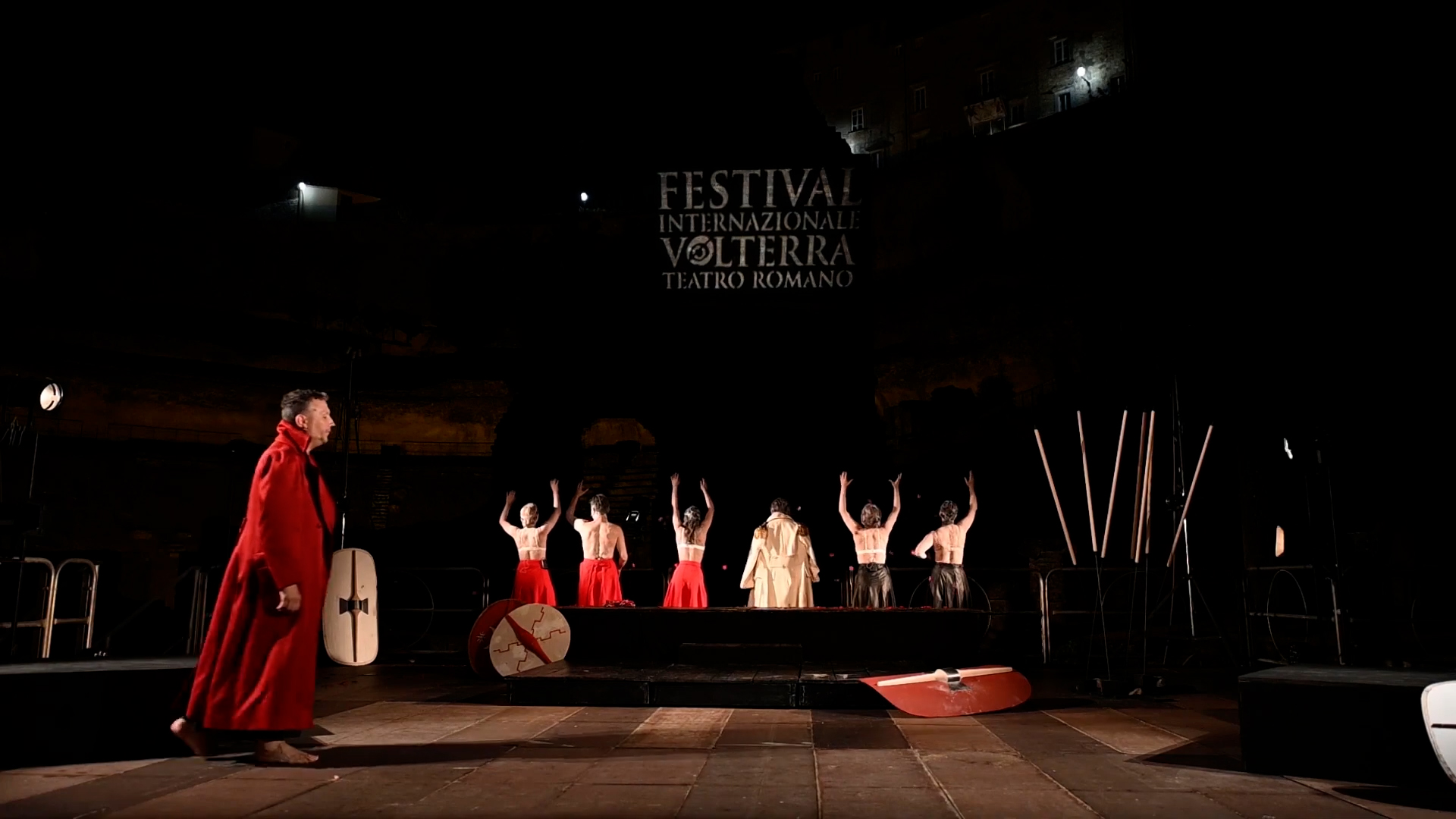
Theatrical show, by Nicola Fano e Simon Domenico Migliorini, Italy, 2022
The protagonist is Brutus, the celebrated instigator, along with Cassius, of the conspiracy of the Ides of March in 44 B.C., the assassin of Caesar. He enters the stage calling loudly for Cassius, his alter ego: we find ourselves in Philippi, where both conspirators have already fought and lost against the troops of Marcus Antonius, who has become the guarantor of justice towards Caesar and Rome. The story written in books materializes on stage with the words of Shakespeare, infinite, immortal, eternal words. The spectator listens, a symbolic battlefield and dead bodies appear before him, on which Brutus, defeated, wounded, almost dying, crawls and invokes and looks around bewildered, shocked at the appearance of the ghost of Caesar.
Brutus is Simone Migliorini, who speaks, moans, shouts, modulates those phrases of Shakespearean tragedy and makes them his own, as they have been generated, also in the adaptation from Shakespeare's "Julius Caesar" by the playwright Nicola Fano, who worked on the text focusing on the most controversial figure, that of the leader of the conspirators, the assassin of Caesar, specifically for Migliorini, who has studied and deepened the text and characters. But here Brutus, as the show unfolds, also becomes Macbeth, also Henry V, both tyrants, both assassins, soldiers, courageous or cowardly, great or infamous, in a flow of words and famous phrases, spoken, planted, recited, whispered, shouted by Simone Migliorini who with this performance confirms himself as a high-level interpreter. What strikes is the protagonist's ability to transform himself, from time to time, from Brutus into other characters, even into Marcus Antonius. A change of costume is enough for him, on stage. And it is here that Brutus looks into Antony's eyes and Antony scrutinizes Brutus, doubled by the same actor in a virtuosity that is extremely congenial to him. The actor is capable of being, at the same time, the one who kills and the one who exalts the killed; the one who is prey to doubts and remorse but is proud of his love for Rome and its freedom, and the one who exalts and celebrates the slain Caesar before the people, holding his will in his hand, in the famous Oration that has always been the flagship of the greatest actors.
LANGUAGE: Italian
SUBTITLES: English, Spanish, French, German, Portuguese
Conspiracy as a Technology of Power
You are sitting across from someone who has just explained, with complete calm and perfect logic, exactly why what they are about to do is necessary. Every word makes sense. The reasoning is airtight. And yet something in the room has already shifted, because the act they are describing has nothing to do with the reasons they are giving you.
The men who gathered in the Theatre of Pompey on the fifteenth of March, 44 BCE were not desperate. That is the first lie the historical record quietly encourages. Desperation leaves traces — erratic behavior, broken alliances, last-minute improvisation. What the liberatores left behind was something far more deliberate: a coordinated action involving somewhere between twenty-three and sixty conspirators, maintained in secrecy for weeks, timed to a moment when Caesar would be unguarded and the Senate in session. Cassius had been recruiting since the previous autumn. The daggers were concealed in writing tablets carried openly into the chamber. This was not the trembling hand of a man with nothing left to lose. This was engineering.
Hannah Arendt, writing in 1951 in The Origins of Totalitarianism, drew a distinction that most political actors — ancient and modern alike — spend their entire careers failing to understand. Power, she argued, is what emerges when people act together in concert; it is relational, generative, and it exists only as long as the group that produces it remains assembled. Violence, by contrast, is instrumental and solitary in its logic — it can destroy power but it cannot create it. The conspirators on the Ides of March believed they were wielding power. What they were actually wielding was a knife. The difference would unravel the Republic within eighteen months.
Brutus understood this error only partially, and only after the fact. His instinct to prevent Mark Antony‘s death was not mercy — it was a recognition, however dim, that killing Caesar without controlling the narrative of killing Caesar was strategically incomplete. But Arendt’s point cuts deeper than strategy: the conspirators had no collective project beyond the assassination itself. They had coordinated violence without constructing the political body that could have converted that violence into a new order. The moment Caesar fell, the group that had been the conspiracy ceased to exist as a coherent force. What remained were individual men with bloodied hands and irreconcilable ambitions.
Rome in 44 BCE was a city of roughly one million people governed by institutions built for a city-state of perhaps thirty thousand. The Senate that the liberatores invoked as their legitimating authority had been structurally hollowed out for decades — by Sulla’s proscriptions in the 80s BCE, by the back-channel arrangements of the First Triumvirate in 60 BCE, by Caesar’s own appointment of senators through administrative decree. To kill one man and expect the Senate to reassert republican governance was to mistake a symbol for a functioning mechanism. Cicero, who had not been included in the plot and who would later write his Philippics as if oratory alone could hold back what was already moving, understood the Senate’s rhetorical power while catastrophically overestimating its institutional one.
What made the conspiracy a technology of power rather than merely an act of violence was its dependence on a theory — the theory that Caesar’s body was the problem. Remove the body, restore the body politic. This logic has a seductive geometric clarity that recurs across centuries of political thought, from Hobbes describing the sovereign as the artificial soul of the commonwealth in Leviathan, to the regicide debates of the English Civil War, to every coup that has ever promised liberation and delivered a different arrangement of the same pressures. The body at the center of the system is never simply a body. It is the crystallized form of conditions that existed before it and will continue to exist after it is gone, reorganizing themselves around whatever fills the space.
The conspirators killed a man. The conditions that had made that man possible were already looking for another host.

The Republican Myth and Its Manufactured Nostalgia
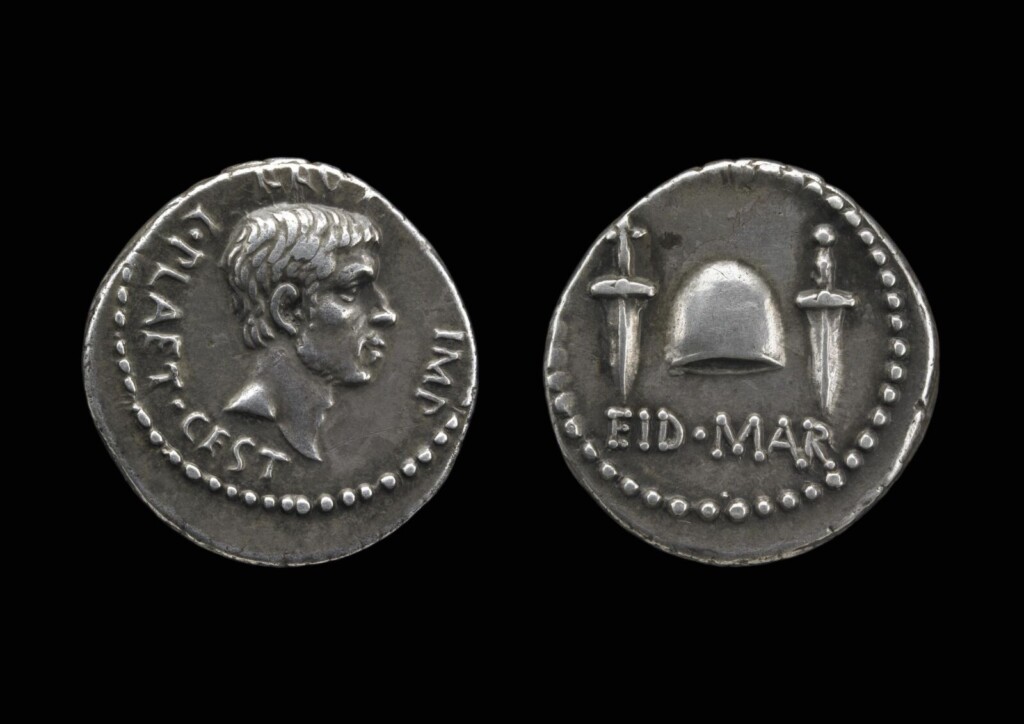
You have memorized the speech. Not from a classroom, but from the part of you that still believes institutions are worth dying for — that somewhere behind the corruption, the compromise, the inherited power dressed in procedural language, there is a real thing worth protecting. Brutus believed it too. That is precisely what makes him not a hero but a warning.
The republic Brutus and Cassius claimed to defend had not existed in any meaningful sense for at least a century before the blade entered Caesar’s body. Ronald Syme, writing in 1939 with the particular clarity of a man watching European democracies hollow themselves out in real time, documented this with the precision of a surgeon in “The Roman Revolution.” What he found was not a republic betrayed by one ambitious man but a system that had long been a stage — elaborate, ritually maintained, procedurally intact — behind which a few dozen aristocratic families rotated power among themselves like a cartel managing supply. The Senate was not a deliberative body. It was a room where men who had already decided things came to perform deciding them.
The Roman constitution had no written text, no founding document in the Jeffersonian sense. It was a cluster of customs, precedents, and informal understandings that the Roman governing class called the mos maiorum — the way of the ancestors. This phrase is itself a kind of ideological weapon, because it converts an arrangement that benefits the current generation into the presumed wisdom of the dead. When Cicero invoked ancestral tradition, he was not appealing to history; he was using history’s costume to freeze a distribution of power that happened, conveniently, to place men like him near the top of it. The mos maiorum was nostalgia as governance, and it had been fracturing under its own contradictions since at least the Gracchi in the 130s BCE, when Tiberius Gracchus attempted land reforms that would have redistributed ager publicus — public land held overwhelmingly by the senatorial elite — to landless citizens, and was beaten to death on the Capitoline Hill by senators wielding broken furniture.
What Syme understood, and what the conspirators either refused or were constitutionally unable to understand, was that the late republic had already produced the conditions for its own transformation long before Caesar arrived to accelerate them. The Social War of 91 to 87 BCE had extended Roman citizenship to most of Italy, creating a politically enfranchised mass whose interests the Senate was structurally incapable of representing. The slave economy had concentrated land and wealth at a scale that made the old citizen-farmer class — the very demographic the republic’s mythology depended on — functionally extinct. Marius had already professionalized the legions, making them loyal to commanders rather than to the state, a change so structurally catastrophic that no subsequent constitutional arrangement could survive it. By the time Caesar crossed the Rubicon in January of 49 BCE, the republic the conspirators were defending existed primarily as a memory that powerful men had decided to treat as a fact.
This is where the murder becomes something stranger than political violence. When Brutus draws the knife, he is not protecting a living institution but performing a rite for a dead one — an act of ritual conservation masquerading as resistance. The Senate house becomes a temple to something that had already been interred, and the blood on the floor is an offering to an absence. The conspirators did not know this, or perhaps more accurately, they knew it and looked away, because to acknowledge it would have required them to ask what they were actually defending — not the republic as a functional structure serving the Roman people, but the republic as a set of arrangements that guaranteed their own dominance would continue under the label of collective governance.
And that question, once genuinely asked, does not stay inside the marble walls of 44 BCE.
What Tyrannicide Actually Produces
You believe the surgery was successful because the patient is dead. That is the precise logic by which forty-one men walked out of the Theatre of Pompey on the Ides of March, 44 BCE, convinced they had saved the Roman Republic — and that logic is precisely what makes their failure so devastating to witness across the centuries.
The conspirators had no plan for the morning after. This was not an oversight born of haste; it was structural. Their entire moral architecture rested on the idea that tyranny was a property of one man, that it lived in Caesar’s body and would die with it. Brutus, whose self-image was inseparable from his ancestor Lucius Junius Brutus — the man who expelled the last Roman king in 509 BCE — believed that political freedom was something you restored by cutting, the way a surgeon removes a tumor and the body heals itself. What he could not perceive, because the belief was too foundational to examine, was that Caesar had not installed the conditions that made him possible. He had merely occupied them.
Cicero, who knew nothing of the plot in advance and wept with something close to joy when he heard the news, wrote to Atticus within days that the conspirators had the courage of men but the reasoning of children — “they had the hearts of heroes and the plans of infants.” He was right, and he was also describing himself, because within eighteen months he too had staked everything on a similar fantasy: that Mark Antony could be constitutionally restrained, that the Senate still possessed the institutional gravity to hold power accountable. His fourteen Philippic orations, delivered between September 44 and April 43 BCE, are among the most brilliant pieces of political invective ever written, and they were as effective as throwing parchment at a fire.
What followed the assassination was not the restoration of republican norms but their terminal collapse, accelerated precisely by the vacuum the conspirators had created. The Second Triumvirate — Octavian, Antony, and Lepidus — was formalized in October 43 BCE not as an informal power-sharing arrangement but as an official magistracy, the tresviri rei publicae constituendae, an extraordinary commission to reconstruct the state. The Republic was not overthrown by this moment. It was replaced by something that wore the Republic’s vocabulary while gutting its substance, and the Senate voted it into existence. Within weeks, the proscriptions began. The numbers are not abstractions: more than 2,000 equestrians and approximately 300 senators were listed, their property confiscated, their killers rewarded. Cicero’s name appeared on the first list. His head and hands were nailed to the Rostra in the Forum — the very platform from which he had spoken — because Antony wanted the specific body parts that had produced the Philippics destroyed publicly.
The mechanism here is one that the sociologist Charles Tilly described across very different historical contexts: the removal of a broker figure in a political network does not dissolve the network’s underlying coercive logic, it simply eliminates the node that was absorbing and channeling that violence. Caesar, whatever his autocratic ambitions, had been constraining the competitive violence of the Roman elite for years, absorbing factional energy into a single locus of power. His death released it. The civil wars that followed — from the campaigns against the liberators at Philippi in 42 BCE to the final confrontation between Octavian and Antony at Actium in 31 BCE — killed far more Romans than Caesar’s dictatorship ever did or plausibly would have.
Octavian, who became Augustus, was careful never to repeat Caesar’s mistakes of visibility. He kept the forms of republican governance intact, held the consulship, deferred to the Senate in language and ceremony, and built an autocracy so structurally embedded that no single assassination could dislodge it — because he had understood, watching from a distance at seventeen years old, exactly what the liberators had failed to see.
The Structural Role of the Martyr-Villain
You have stood in a crowd that turned on someone, maybe a colleague publicly humiliated in a meeting, maybe a figure pilloried online, and you have felt the strange warmth of collective consensus, the relief of unified direction, the sense that something impure has been expelled and the air is cleaner now. What you felt was ancient. René Girard spent the better part of his intellectual career, from “Violence and the Sacred” in 1972 through “The Scapegoat” in 1982, arguing that human communities have always required a sacrificial mechanism to discharge internal tension — not metaphorically, but structurally, as a kind of social physics. The victim must be guilty enough to deserve elimination and innocent enough to generate retrospective grief, because only that combination produces the sacred. Caesar, in dying, became the most complete instantiation of this mechanism in Western political history.
The conspirators understood themselves as surgeons. Brutus, whose philosophical commitments ran toward Stoic self-abnegation, believed the act could be clinical, republican, restorative. Cassius understood it as theater but calculated the audience incorrectly. What neither of them grasped, because Girard had not yet written his books and the mechanism was invisible to its own participants, is that the moment you expel the singular figure who has concentrated the community’s ambivalence, you do not dissolve the concentration — you crystallize it into something permanent. The assassination on the Ides of March, 44 BCE, did not end Caesar’s power. It began the vertical phase of it.
Within weeks, a comet appeared over Rome during the games held in Caesar’s honor. The Romans called it the sidus Iulium — Julius’s star — and the interpretation required no official prompting: the soul of the murdered man had ascended. Octavian, Caesar’s adopted heir, understood immediately that the comet was not a celestial event to be managed but a political resource to be spent. He placed the star on Caesar’s statues. He had Caesar formally deified by the Senate in 42 BCE. The men who killed Caesar to prevent monarchy handed his successor a god to campaign on. There is no more precise demonstration anywhere in recorded history of Girard’s core proposition: the killing creates the cult.
What makes this psychologically vertiginous is that the conspirators were not stupid men. Brutus was among the most educated Romans of his generation, steeped in Greek philosophy, genuinely committed to the res publica as a living institution rather than a rhetorical habit. The failure was not one of intelligence but of category. They believed they were operating in a political register — removing a man from power — when they were in fact operating in a ritual register, producing a martyr. The distinction only becomes visible after the fact, which is precisely why Girard insisted the scapegoat mechanism depends on the unanimous ignorance of its participants. Awareness dissolves efficacy.
Mark Antony‘s funeral oration, whatever its historical distortions through the centuries of retelling, functioned as the precise moment the mechanism completed its circuit. He did not argue for Caesar’s innocence in legal terms. He displayed the body. He named the wounds. He let the crowd see the torn toga. He converted political murder into sacred spectacle in real time, and the crowd that had been uncertain the morning of March 15th became a mob by the afternoon of the 20th, burning through the city with improvised torches. The conspirators had to flee Rome not because their argument was wrong but because argument was now structurally irrelevant. The body had spoken in the only language that outranks reason — the language of visible suffering interpreted as sacrifice.
Octavian then did something of terrifying political genius: he never stopped pointing at the wounds.
A vision curated by a filmmaker, not an algorithm
In this video I explain our vision
Shakespeare's Caesar and the Inversion of Historical Memory

You have read the assassination wrong your entire life, and the version lodged in your memory was placed there by a man who was born fifteen centuries after the blood dried on the Senate floor.
William Shakespeare composed Julius Caesar in 1599, almost certainly for the newly opened Globe Theatre, and what he produced was not a historical reconstruction but a philosophical trap — one that has been sprung on every educated reader in the Western world ever since. The play reaches the forty-fourth year before the common era and finds there not a document but a mirror, one angled so precisely that every subsequent generation has seen its own political anxieties reflected back as ancient Roman truth. Shakespeare drew heavily from Thomas North’s 1579 English translation of Plutarch’s Lives, which was itself a Greek text written over a century after the events it described, meaning the chain of mediation between the murder and the myth was already grotesquely long before a single word of iambic pentameter was composed. What Shakespeare received was an interpretation of an interpretation, and what he transmitted was something more potent than either: a moral architecture so structurally elegant that it displaced the messier record entirely.
The mechanism of displacement operates through Brutus. In the play, Marcus Junius Brutus becomes the conscience of the conspiracy, a man tormented by love for Caesar and loyalty to Rome, sleepless in his garden, genuinely agonized by the weight of political murder. This characterization is not simply sympathetic — it is canonizing. Brutus speaks in the vocabulary of republican virtue, and Shakespeare gives him the kind of interiority that Caesar himself is largely denied. The historical Brutus was a creditor of such ruthlessness that Cicero wrote to Atticus complaining about the usurious interest rates Brutus charged the people of Salamis through proxy agents, a detail that does not survive the theatrical transformation into tragic nobility. By granting Brutus the soliloquy and the anguish, Shakespeare made the assassin the moral center of the story, which meant that every political killing conducted in the name of liberty would thereafter reach instinctively for his template.
The consequences were not metaphorical. John Wilkes Booth shouted “Sic semper tyrannis” from the stage of Ford’s Theatre on April 14, 1865, immediately after shooting Abraham Lincoln, and the phrase — Virginia’s state motto, meaning “thus always to tyrants” — was drawn from the same Shakespearean-Roman circuit of legitimation. Booth had in fact performed in Julius Caesar three years earlier alongside his brothers Edwin and Junius Brutus Booth, playing Mark Antony to a packed New York audience. He was not invoking Roman history; he was invoking the play’s emotional logic, the idea that killing a popular and powerful leader could be redeemed by the assassin’s selfless grief. The literary myth had become operational, a script available for deployment by anyone willing to cast themselves as Brutus and their target as an ambiguous Caesar.
What Shakespeare also accomplished, perhaps more durably than the Brutus problem, was the conversion of Caesar himself into a question mark. The historical Caesar had accumulated dictatorial power through means that were legally unprecedented and constitutionally destabilizing, but he had also canceled debts, extended citizenship, reformed the calendar, and maintained genuine popular support among the Roman urban poor. Shakespeare preserves this complexity without resolving it, which is artistically sophisticated and politically devastating, because an ambiguous Caesar is infinitely more useful to subsequent political violence than a clear tyrant would be. If Caesar might be a threat, then the conspiracy might be justified, and if the conspiracy might be justified, then the mimetic door is open to any future actor who feels that the leader before them carries a similar ambiguity. The play does not argue for assassination — it does something far more dangerous by refusing to argue against it while making the assassin beautiful.
The Ides in Modern Political Imagination
You are standing in a parliamentary chamber somewhere in the early hours of a February morning, watching a man you once called an ally sign a document that removes you from office, and the strange thing is not the betrayal itself but the calendar on the wall behind him, the way the month is turning, the way certain dates seem to arrive already loaded with someone else’s decision.
The Roman assassination of 44 BC did not die with Caesar or with Brutus at Philippi in 42 BC. It became instead a kind of grammatical resource for subsequent generations who needed a respectable precedent for what they were about to do. When the Jacobins moved against the Girondins in the spring of 1793, the rhetoric circulating in the Parisian clubs was saturated with classical allusion, the tyrannicides of antiquity summoned as moral sponsors for purges that had nothing to do with republicanism and everything to do with faction survival. The date on the Roman calendar became a floating justification, detached from its original event, available for reassignment. This is what Georges Sorel, writing in his Reflections on Violence in 1908, would recognize as the political myth in its most functional form: not a story believed to be literally true, but a story whose emotional architecture mobilizes action that reason alone cannot authorize.
Nineteenth-century revolutionary nationalism was particularly hungry for this architecture. The Italian Carbonari, the Polish insurrectionary movements of 1830 and 1863, the various conspiratorial cells that dotted the Habsburg margins — all of them maintained a cult of the decisive act, the surgical removal of the corrupted head, and all of them borrowed the moral grammar of the Ides without naming it directly. The date March 15 acquired a specific weight in the Hungarian revolutionary calendar of 1848, when Sándor Petőfi read his National Song in the streets of Pest and the revolution ignited. That the date was felt rather than chosen, that March 15 arrived already vibrating with the residue of older violence, is precisely the mechanism by which historical symbolism operates below the threshold of conscious citation.
What the twentieth century added was industrialization of the impulse. When Stalin conducted the Great Purge between 1936 and 1938, eliminating approximately 750,000 people by execution alone, the internal Bolshevik justification depended on a logic of preemptive tyrannicide: the traitors had to be removed before they could act, the conspiracy had to be dissolved before it could materialize. The paranoid structure requires a founding myth of betrayal, and nothing in Western political memory supplies that myth more efficiently than the image of collaborators turning on their leader with concealed weapons. The Ides provided a template for understanding political elimination as a righteous and historically validated act, which is why authoritarian regimes consistently reach for it even when they are themselves the force being described.
Hannah Arendt observed in The Origins of Totalitarianism, published in 1951, that the most dangerous political fictions are not the ones that deny reality but the ones that restructure it around an emotionally coherent narrative of threat and response. A date that signifies betrayal and necessary violence does exactly this: it pre-authorizes the act by inserting it into a sequence that feels inevitable in retrospect. March 15 does not need to be the actual date of a modern coup for its symbolic weight to function. It only needs to exist in the political imagination as proof that such acts have precedent, that history has already ruled them permissible, that the senators who drew their blades were not criminals but men responding to a structural necessity that transcended personal loyalty.
The permission structure is the point. Once a date carries the accumulated authority of a celebrated act, it stops being a date and becomes a kind of standing verdict on what political life sometimes requires, waiting to be cited by whoever reaches it first.
Ambition as a Diagnostic Category
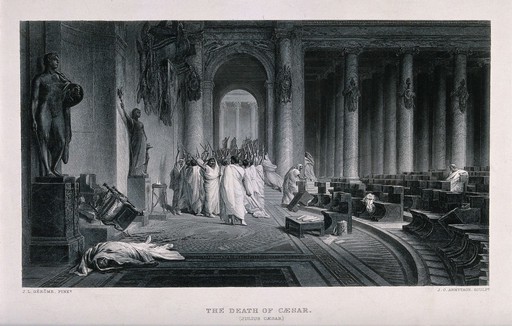
You have been called ambitious before. Not as a compliment — as a verdict. The word arrived with a particular cadence, half-concerned, half-accusatory, from someone who needed you smaller and found a moral vocabulary to justify the need. What made it effective was not its falseness but its unfalsifiability: ambition, like arrogance or pride, names a condition that the accused can neither confirm nor deny without the denial itself becoming evidence.
Tacitus understood this mechanism with surgical clarity. Writing the Annals in the early second century, he was not interested in moralizing about the emperors he catalogued — Tiberius, Claudius, Nero — but in exposing how the Senate deployed the language of virtue as a precision instrument. When a man became inconvenient, his supporters did not argue against his policies. They questioned his motives. They introduced, quietly and with apparent reluctance, the suggestion that he wanted too much. The accusation of ambition in the Roman world functioned as a pre-emptive strike against merit: it transformed competence itself into a symptom of dangerous appetite. What Tacitus traced across the Annals was not a series of tyrants but a recurring grammar — the grammar by which powerful institutions inoculate themselves against the people who outgrow them.
Caesar’s ambition is the oldest entry in this grammar. It has been repeated so consistently across two millennia that it no longer requires argument; it circulates as self-evident, the way popular beliefs do when they have been institutionalized long enough to shed their origins. But the diagnosis was authored by men who had voted him extraordinary powers, accepted his gifts, and then found themselves on the wrong side of a permanent shift in Roman authority. Cicero, who was not present at the assassination on the Ides of March in 44 BCE and who privately expressed ambivalence about whether it would accomplish anything lasting, nonetheless constructed in his Philippics the rhetorical architecture that made Caesar’s ambition the fulcrum of the entire story. The murder needed a justification that preceded it, and ambition, being internal and unprovable, was a charge no corpse could contest.
What makes the diagnosis so durable is its elegant reversibility. The men who killed Caesar were themselves spectacularly ambitious — Brutus cultivated a public persona with meticulous attention, and Cassius had nursed a grievance about preferment and status for years. But ambition attached to the act of killing reads as sacrifice, as the subordination of self to republic. Ambition attached to the man killed reads as contamination, as the threat that justified the surgery. The same psychological content receives opposite moral valuations depending on which side of power the subject occupies. René Girard, writing in Violence and the Sacred in 1972, described how sacrificial logic requires that the victim be marked as different, polluted, carrying something the community must expel — and the marking always occurs after the selection, never before it.
Institutions still administer this diagnosis. Performance reviews that note an employee’s “difficulty taking direction.” Academic committees that find a candidate’s research agenda “overly individualistic.” Political parties that describe a member’s ambitions as “divisive.” The vocabulary has been laundered through professionalism, but the structure is identical: a body that controls access deploys virtue-language to neutralize whoever it cannot absorb or outpace. The charge of ambition never arrives from below. It descends.
What history actually records in Caesar is not a man consumed by appetite but a man who accelerated a transformation that Roman institutions had already made inevitable through their own rigidity and corruption. The Ides of March did not prevent the principate — Augustus arrived within fifteen years and built everything the conspirators claimed to fear, more thoroughly and more permanently than Caesar had. The assassination was not a defense of the republic. It was the republic’s last performance of itself, spectacular and hollow, staged for an audience that had already stopped believing in the script — and the word ambition was the curtain they pulled down over what they had done.
🗡️ Power, Betrayal, and the Knife of History
The Ides of March carries with it centuries of meaning: conspiracy, political ambition, the fragile line between loyalty and treachery. These related articles trace the deep cultural roots of power and its shadow, from ancient myth to modern political thought.
Niccolò Machiavelli: Life and Political Thought
Niccolò Machiavelli remains the essential thinker for anyone seeking to understand how power operates beneath the surface of history. His analysis of political action, loyalty, and the necessity of force illuminates the world of Julius Caesar and his assassins with disturbing clarity. To read Machiavelli is to understand why the Ides of March was not an accident but an inevitable consequence of Roman political logic.
GO TO THE SELECTION: Niccolò Machiavelli: Life and Political Thought
Machiavelli’s The Prince: Meaning and Analysis
The Prince is arguably the most influential political treatise ever written, dissecting with surgical precision the mechanisms by which rulers rise, consolidate power, and fall. Its lessons resonate directly with the conspiracy against Caesar, where idealism and realpolitik collided on the Senate floor. Machiavelli would have recognized every actor in that ancient drama.
GO TO THE SELECTION: Machiavelli’s The Prince: Meaning and Analysis
Shakespeare’s Richard III: Meaning and Analysis
Shakespeare’s Richard III is one of literature’s most penetrating explorations of political ambition, conspiracy, and the psychology of those who crave power above all else. The play echoes the world of Caesar’s Rome, where rhetoric and manipulation shaped the fate of empires. Shakespeare understood that the Ides of March was not merely history but an eternal human story.
GO TO THE SELECTION: Shakespeare’s Richard III: Meaning and Analysis
Betrayal as a Theme in World Literature
Betrayal as a literary and cultural theme cuts across every civilization and every era, from Brutus stabbing Caesar to Judas in the garden. This article traces how the act of betrayal has been interpreted, mythologized, and transformed into one of the most powerful archetypes in world literature. Understanding betrayal as a theme is essential to grasping the full moral weight of the Ides of March conspiracy.
GO TO THE SELECTION: Betrayal as a Theme in World Literature
Discover the Cinema of Ideas on Indiecinema
If these themes of power, conspiracy, and historical meaning stir something in you, Indiecinema is the streaming platform where cinema meets thought. Explore our curated selection of independent and visionary films that dare to ask the questions history leaves unanswered.
👉 EXPLORE THE CATALOG: Watch Indie Films in Streaming
A vision curated by a filmmaker, not an algorithm
In this video I explain our vision

