
The Weight of a Crown Nobody Asked For
You are standing at the edge of a decision you have already made. You know this because your hands are steady — and that stillness is the giveaway, the sign that something inside you has already crossed a threshold your conscious mind hasn’t admitted to yet. The body knows before the will confesses. You tell yourself you are still deliberating, still weighing, still the kind of person who pauses before acting. But the pause is theater. The verdict came in quietly, hours ago, in a room inside you that you don’t visit in daylight.

This is the moment Shakespeare understood better than almost any writer who followed him. Not the crime. Not the guilt. The interval between wanting and doing, that narrow corridor where a person discovers they are capable of something they never scheduled into their identity. Macbeth is not a portrait of a villain. It is a portrait of a man watching himself become one in real time, astonished, and proceeding anyway.
The play opens in 1606, in the reign of James I, a king famously obsessed with witchcraft and the metaphysics of sovereignty. Shakespeare was writing for a court that believed in the divine right of kings as a literal, theological proposition — not a political metaphor. To kill a king was not merely regicide; it was a rupture in the cosmic order, an act that would derange nature itself. The strange weather in the play, the horses eating each other, the falcon killed by a mousing owl, are not literary ornament. They are the Elizabethan and Jacobean audience’s honest physics. When Macbeth murders Duncan, the world should break. And it does.
But what interests the play far more than cosmological consequence is psychological mechanism. The German philosopher G.W.F. Hegel, writing in his Lectures on Aesthetics in the 1820s, described tragic collision as a conflict between two legitimate but incompatible ethical claims — neither side purely wrong, the catastrophe emerging from the structure of their opposition. Macbeth is something darker than that. There is no second legitimate claim here. There is only desire wearing the costume of fate. The witches do not compel Macbeth; they simply tell him something he wanted to hear, and he does the rest. He manufactures necessity out of appetite, and then mistakes the manufacture for destiny.
This is the self-betrayal that the play is actually anatomizing — not the betrayal of Duncan, not the betrayal of Scotland, but the betrayal of the self’s own capacity to know what it wants and why. The contemporary psychologist Roy Baumeister, in his 1997 work Evil: Inside Human Violence and Cruelty, traced how ordinary people rationalize extraordinary harm not through ideology alone but through incremental self-deception, each small redefinition of one’s own values making the next redefinition easier. Macbeth compresses this process into the span of a single play. By the time he orders the murder of Banquo, he barely consults his conscience. The machinery of justification is already running on its own.
Lady Macbeth understands this before her husband does. Her famous invocation — “unsex me here,” she demands of whatever spirits govern human darkness — is not a request for cruelty. It is a request for the suspension of the internal witness, the part of the self that watches the self and flinches. She wants the capacity for self-betrayal without the pain of watching it happen. She gets what she asks for, temporarily, and it destroys her from the inside on a delay, emerging later as sleepwalking, compulsive handwashing, the body’s insistence on enacting the guilt the mind refused to register.
What neither of them anticipates is that the architecture of self-betrayal, once erected, does not stay still. It demands maintenance. Every subsequent act is not a choice but a structural necessity generated by the previous one.
Bruto
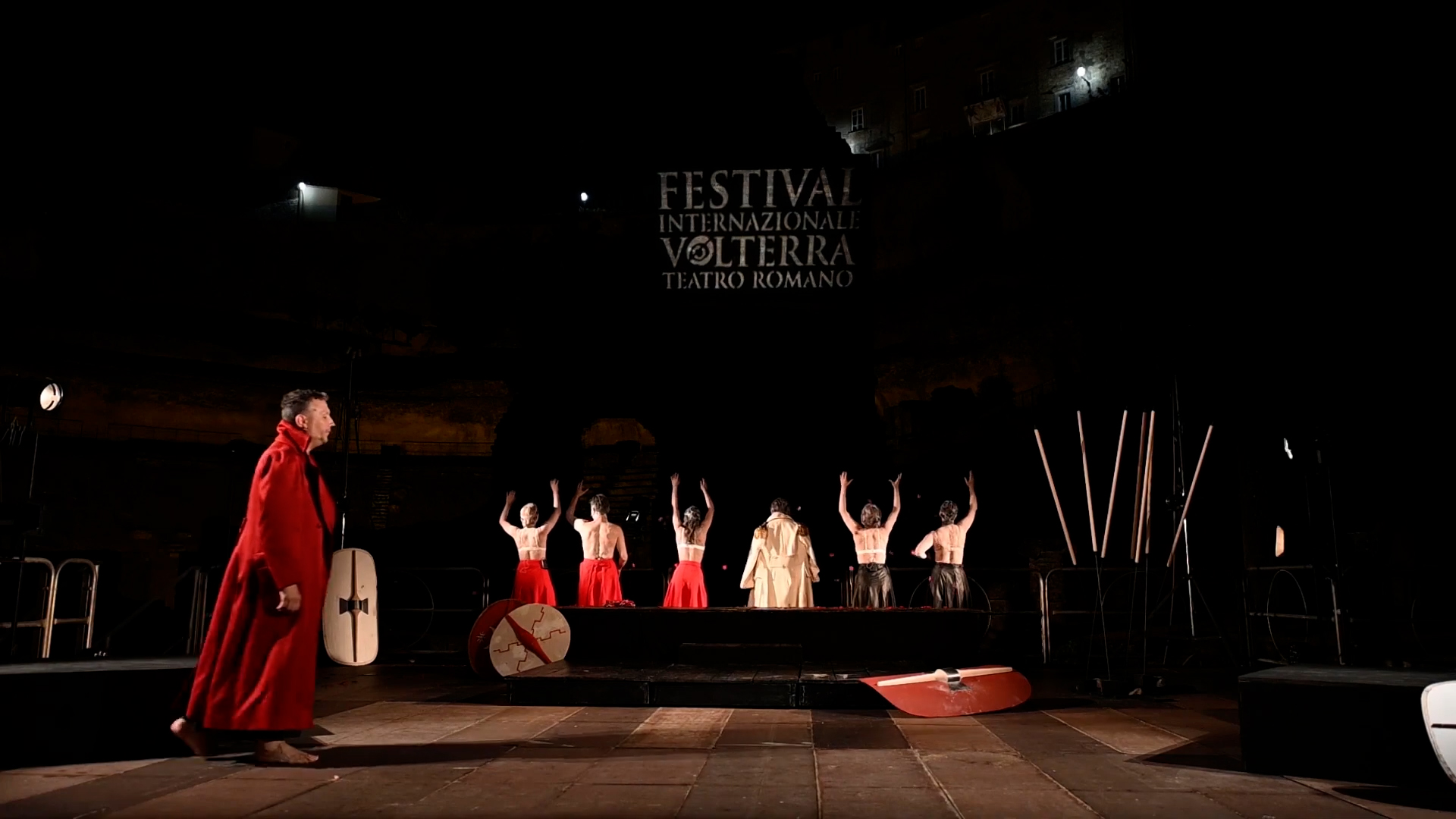
Theatrical show, by Nicola Fano e Simon Domenico Migliorini, Italy, 2022
The protagonist is Brutus, the celebrated instigator, along with Cassius, of the conspiracy of the Ides of March in 44 B.C., the assassin of Caesar. He enters the stage calling loudly for Cassius, his alter ego: we find ourselves in Philippi, where both conspirators have already fought and lost against the troops of Marcus Antonius, who has become the guarantor of justice towards Caesar and Rome. The story written in books materializes on stage with the words of Shakespeare, infinite, immortal, eternal words. The spectator listens, a symbolic battlefield and dead bodies appear before him, on which Brutus, defeated, wounded, almost dying, crawls and invokes and looks around bewildered, shocked at the appearance of the ghost of Caesar.
Brutus is Simone Migliorini, who speaks, moans, shouts, modulates those phrases of Shakespearean tragedy and makes them his own, as they have been generated, also in the adaptation from Shakespeare's "Julius Caesar" by the playwright Nicola Fano, who worked on the text focusing on the most controversial figure, that of the leader of the conspirators, the assassin of Caesar, specifically for Migliorini, who has studied and deepened the text and characters. But here Brutus, as the show unfolds, also becomes Macbeth, also Henry V, both tyrants, both assassins, soldiers, courageous or cowardly, great or infamous, in a flow of words and famous phrases, spoken, planted, recited, whispered, shouted by Simone Migliorini who with this performance confirms himself as a high-level interpreter. What strikes is the protagonist's ability to transform himself, from time to time, from Brutus into other characters, even into Marcus Antonius. A change of costume is enough for him, on stage. And it is here that Brutus looks into Antony's eyes and Antony scrutinizes Brutus, doubled by the same actor in a virtuosity that is extremely congenial to him. The actor is capable of being, at the same time, the one who kills and the one who exalts the killed; the one who is prey to doubts and remorse but is proud of his love for Rome and its freedom, and the one who exalts and celebrates the slain Caesar before the people, holding his will in his hand, in the famous Oration that has always been the flagship of the greatest actors.
LANGUAGE: Italian
SUBTITLES: English, Spanish, French, German, Portuguese
Prophecy as Social Permission
You have already decided before the voice speaks. That is the uncomfortable truth the play buries in spectacle — the thunder, the cauldron, the three figures on the heath — because spectacle gives the audience somewhere else to look while the real mechanism operates in plain sight. Macbeth meets the witches and they tell him he will be king. He does not argue. He does not dismiss them. He goes quiet, and in that silence, which Shakespeare renders as an aside lasting barely four lines, an entire psychology is exposed: the prophecy does not plant a new thought. It recognizes one that has been growing in the dark for longer than the play has existed.
René Girard spent the better part of four decades arguing, across works from Deceit, Desire and the Novel in 1961 through to I See Satan Fall Like Lightning in 1999, that human beings do not desire autonomously. They desire according to models, through triangulation, by watching what others want and calibrating their own hunger accordingly. The self, in Girard’s architecture, is never the origin of its own appetite — it is always a receiver, a relay station for culturally transmitted signals about what is worth wanting. Macbeth, a general at the apex of martial Scotland, exists inside a social world that has only one currency of ultimate value: the throne. Duncan sits on it. Every man in the room is oriented toward it. The witches do not introduce a foreign object into Macbeth’s mind. They formalize what the entire social structure has been broadcasting continuously.
What prophecy does, in this reading, is perform a specific cultural function that has nothing mystical about it. It grants permission. The word “permission” sounds too mild for what is actually happening, but precision matters here: the prophecy converts a desire that Macbeth cannot consciously own — because owning it openly would mark him as a traitor, a monster, a man without loyalty — into a desire that has been, in some sense, authorized. The universe has spoken. The future has already declared itself. The ethical weight of choosing shifts, in Macbeth’s internal accounting, from his shoulders onto the fabric of fate itself. This is not a supernatural trick. It is a recognizable psychological move that human beings have executed across every era and institution, whenever they needed to act on something they could not admit wanting.
The structure repeats, more nakedly, in the second round of prophecies in Act Four, where Macbeth actively seeks the witches out. By this point the pretense of passivity has collapsed. He is not a man receiving unsolicited news — he is a man demanding confirmation. He has already become the thing the first prophecy named, and now he needs the apparatus of prophecy to underwrite his continued reign, to absorb the moral cost of what comes next. The witches oblige, as mirrors always do, offering him the images his hunger has already shaped: no man born of woman shall harm him, Birnam Wood shall not come to Dunsinane. These are not predictions. They are the specific formulations of invincibility that a man in his particular terror, with his particular crimes behind him, would need to believe. The prophecy fits him too perfectly to have come from outside him.
What Shakespeare understood, and what makes the play structurally merciless rather than merely tragic, is that the mechanism of externalization — the insistence that the desire came from elsewhere, from the witches, from fate, from Lady Macbeth’s ambition — is itself the crime’s truest engine. The murder of Duncan is almost secondary to the prior act of self-deception: the decision to locate the source of the hunger anywhere but in the one place it actually lives.

Lady Macbeth and the Gendered Economy of Ruthlessness
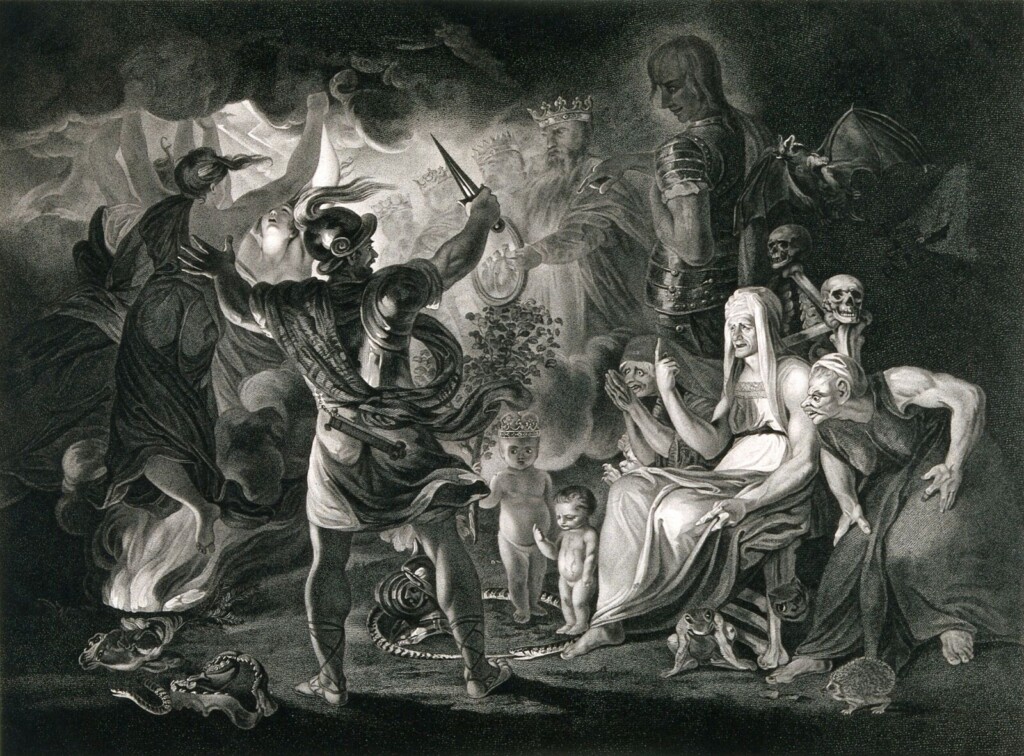
You have watched someone perform their own erasure and called it strength. Lady Macbeth stands alone on stage and asks the spirits to “unsex me here,” to take from her everything the culture has assigned to her sex — tenderness, remorse, the capacity to hesitate — and the request lands not as transgression but as capitulation. She is not seizing power on her own terms. She is applying for admission to a system that was never designed to hold her, and she knows the price of the application is herself.
The speech is dated to a play written approximately between 1603 and 1606, during a reign in which Elizabeth I had already demonstrated that a woman could govern England for forty-five years — and yet Elizabethan political theory had spent those same decades contorting itself to explain why that governance was an exception, a miracle, a divine anomaly rather than a proof of anything. John Knox had published his “First Blast of the Trumpet Against the Monstrous Regiment of Women” in 1558, arguing from scripture that female rule was an offense against nature and God. Elizabeth herself reportedly called it “seditious.” But the anxiety Knox named did not dissolve under her reign; it calcified. The culture maintained its architecture even as one woman occupied its highest room. What Lady Macbeth reveals is how that architecture felt from the inside.
What she is performing in that invocation is not power — it is the grammar lesson that power requires of anyone who does not already own the language. Simone de Beauvoir, writing in 1949 in “The Second Sex,” described how women under patriarchal structures are forced to internalize masculine standards as the universal, so that their own desires, when they surface, arrive pre-labeled as deviant or insufficient. Lady Macbeth has absorbed this taxonomy so completely that she does not ask to be valued as she is; she asks to be unmade and remade in the image of what she admires in her husband, and finds deficient. She calls him “too full o’ the milk of human kindness” — and milk here is not accidental. It is a nursing image. She is locating softness in the language of the maternal and then positioning it as an obstacle. She is, in that single metaphor, condemning the very capacity that her culture assigns to her as her highest virtue.
The trap this constructs is perfect and self-sealing. Agency in the play’s world is coded masculine: it requires the willingness to wound, to suppress feeling, to treat the future as a territory to be seized rather than a duration to be endured. Lady Macbeth desires that agency and she pursues it — but in pursuing it, she must dismantle the only identity available to her, and there is nothing waiting on the other side of that dismantling. She does not become powerful. She becomes instrumental. She choreographs the murder, manages her husband’s collapse, and then disappears from the plot’s moral accounting in the same way a stage manager disappears once the play has begun. The credit and the consequences flow exclusively toward Macbeth.
Erving Goffman’s later sociological concept of “face” — the social image a person actively constructs and defends in interaction, developed in his 1959 work “The Presentation of Self in Everyday Life” — illuminates what the sleepwalking scene finally records. Lady Macbeth’s dissolution in act five is not madness in any clinical sense; it is the structural consequence of having dismantled every internal architecture to serve an external project, then finding that the project consumed her without incorporating her. She washes hands that are already clean. The stain she cannot remove is not guilt exactly — it is the residue of having traded her coherent self for access to a game that never acknowledged her as a player.
Duncan's Blood and the Myth of Clean Hands
You wash your hands and the water runs clear, but you already know it changes nothing. Lady Macbeth, scrubbing in the dark at skin that appears perfectly clean to every eye but her own, is not suffering a nervous breakdown in any clinical sense — she is suffering the irreversibility of having acted. The stain she cannot remove is not biological. It is ontological.
Hannah Arendt argued in The Human Condition, published in 1958, that action is the most dangerous of all human capacities precisely because it is irreversible. Unlike labor, which produces consumable goods, or work, which creates durable objects, action sets chains of consequence into motion that no actor can fully control or later rescind. You release something into the world and it propagates outward through other people, other events, other decisions you did not make and cannot unmake. The only remedy Arendt identified was forgiveness — not as moral absolution, but as the practical human mechanism for interrupting the chain, allowing history to continue rather than stall inside a single irrevocable moment. Macbeth and his wife never forgive and are never forgiven, which means they are not merely guilty in the ethical sense but trapped in the temporal sense, sealed inside the night of the murder as though no subsequent hour can fully arrive.
Shakespeare’s use of blood in the play is not gothic decoration, not the crude visual language of the revenge tragedies that preceded him. It operates as a philosophical argument: that power exercised against a body cannot be separated from the body that exercised it. When Macbeth sees the dagger leading him toward Duncan’s chamber, the blood already appearing on its blade before any wound has been made, the drama is not about hallucination. It is about the collapse of the distinction between intention and act. The moment you reach for the instrument, you have already become the person who used it. The blood precedes the murder because moral contamination precedes the physical event — the decision is already a kind of killing.
What makes this more than theatrical metaphor is that it accurately describes how institutional power functions at scale. Political leaders who authorize violence at a distance — through signed orders, through policies expressed in bureaucratic language, through the delegation of enforcement to hands they will never shake — have always relied on spatial and procedural distance to maintain the fiction of clean hands. The Roman practice of consecratio bonorum, the confiscation of an enemy’s property and person as a juridical act, was precisely this: violence laundered through legal form until it no longer resembled violence to the people performing it. Shakespeare, writing in a period when the English crown had just spent decades executing subjects under the cover of attainder and heresy law, understood that the machinery of legitimacy was itself a form of contamination management. Macbeth simply bypasses the machinery and kills the king directly — which is not more barbaric than what courts routinely accomplished, only more honest about what is actually happening.
This is what makes him intolerable to the social order and to himself simultaneously. He has committed the same act that power always commits, but without the ceremonial laundering that transforms murder into governance. The guilt he cannot shed is partly the guilt of having revealed the mechanism, of having made visible what the institution keeps invisible. His court becomes a mirror held up to every court, and no one in it can look comfortably at the reflection. When he says that he has murdered sleep, he is not speaking only of his own insomnia — he is identifying what happens to a social body when the violence at its foundation becomes legible, when the blood refuses to stay in the subbasement where every stable political arrangement has learned to keep it hidden.
The Collapse of Linear Time After Regicide
You are already awake before the room gives you permission to be. The darkness holds its shape, and something in your chest knows — without any clock, without any sound — that the thing you did will not stay in the past where you put it.
Macbeth does not lose his mind gradually. He loses his grip on sequence. The murder of Duncan is not, for him, a completed act that recedes into the fixed territory of the past; it becomes instead a permanent present tense, a wound in time that keeps opening. When he sees the dagger floating before him in Act II, the hallucination is not a symptom of weakness — it is the mind’s first honest report that causality has been severed. He has done something that cannot be undone, and the psyche, unable to tolerate irreversibility, responds by collapsing the distinction between what happened and what is happening.
Bessel van der Kolk’s clinical research, assembled in his 2014 work on traumatic memory, demonstrated that extreme violence and guilt do not produce linear narrative recollection. The brain encodes overwhelming events through sensory fragments — images, sounds, bodily sensations — that are not filed under the past but remain permanently active in the nervous system’s present. What looks, from the outside, like madness is actually a failure of temporal encoding: the traumatized mind cannot place the event behind it because the event never fully registered as finished. Macbeth’s sleeplessness is clinically precise in a way Shakespeare could not have named but clearly understood. Sleep is the biological mechanism by which the day becomes the past. Deny sleep and you deny the very architecture that separates now from then.
The ghost of Banquo arrives at a banquet — deliberately, in a room full of witnesses who see nothing. Its appearance is not evidence of the supernatural; it is evidence of how guilt fractures shared time. Everyone else in that hall inhabits a linear, social present: they are drinking, speaking, performing the ordinary rituals of the living. Macbeth is elsewhere. He occupies a moment that has folded back on itself, where the dead man he made dead will not remain in the tense assigned to him. The philosophical tradition that locates personal identity in continuous memory — traced through John Locke‘s Essay Concerning Human Understanding in 1689 — implies something Locke never intended: that to lose control of your memory is to lose the coherence of selfhood. Macbeth’s self is disintegrating not because he is evil but because his consciousness can no longer maintain the fiction that time moves in only one direction.
Lady Macbeth’s collapse arrives differently, and later. Her sleepwalking scenes in Act V stage what the psychiatrist Pierre Janet, writing in the 1880s, would eventually call a dissociative re-enactment: the body rehearses the traumatic action without the conscious mind’s consent. She rubs her hands in the dark, trying to clean something that the waking world has ruled already clean. Her famous line about the spot — the damned spot that will not come out — is not melodrama. It is a precise description of the way guilt operates as sensory memory, embedding itself in the hands that did the work, refusing to be metabolized into the abstraction of a historical event.
What the play insists on, with structural cruelty, is that Macbeth’s disintegration accelerates with each additional act of violence. He orders Banquo’s death hoping to close the wound. He orders the slaughter of Macduff’s family hoping to recover the feeling of decisive action. Each act does the opposite. Every new murder adds another layer of unprocessed present to a psyche already overwhelmed. The progression is not moral descent — it is temporal accumulation without release, a consciousness drowning not in evil but in an unmanageable surplus of moments that refuse to become the past.
A vision curated by a filmmaker, not an algorithm
In this video I explain our vision
Sovereignty, Legitimacy, and the Divine Right Trap

You are watching a king be crowned in a ceremony that has not changed in a thousand years, and somewhere in the ritual — the oil, the oath, the ancient words — you feel the faint pull of something that wants to be believed. That pull is not accidental. It was engineered.
When James VI of Scotland became James I of England in 1603, he brought with him a political theology he had written down himself. Basilikon Doron, composed in 1598 as instruction for his son, argued that kings answer to God alone, that their authority descends vertically from heaven, and that resistance to the monarch is therefore not merely treason but sacrilege. Shakespeare staged Macbeth within three years of that accession, almost certainly performed before the king himself, and the critical reflex has long been to read the play as flattery — a Scottish tragedy for a Scottish king, witches included to honor James’s own obsession with demonology, which he had codified in his 1597 treatise Daemonologie. But flattery would have been cheaper to write, and Shakespeare was not a cheap writer.
The real operation of the play is forensic. Divine right monarchy rests on a logical structure that Macbeth dismantles simply by taking it seriously. If the king is sacred because God has chosen him, the question the play refuses to stop asking is: how do you know God has chosen him? The answer offered by divine right theorists is circular to the point of vertigo — the king is legitimate because he rules, and he rules because he is legitimate. Duncan is sacred. Then Macbeth kills Duncan and rules, and suddenly the sacred category migrates to Macbeth. The cosmos does not intervene. The sun does not refuse to rise. The murder happens, and the administration of Scotland continues, and for a significant stretch of the play, Macbeth is simply the king, which under divine right logic means he is simply the Lord’s anointed.
What Macbeth’s regime produces is not a theological rupture but a political one — the disruption is social, relational, measured in the fear of thanes and the flight of Malcolm. Jean Bodin, writing in Les Six livres de la République in 1576, had already formalized sovereignty as the absolute and perpetual power of a commonwealth, indivisible and self-authorizing. What Bodin could not resolve, and what Shakespeare stages with surgical patience, is that this indivisibility makes the system immune to its own corruption. If sovereignty cannot be divided, it cannot be questioned from within — which means the only available critique of a bad king is a successful coup, which then becomes the new sovereignty, which then becomes the new sacred. Macbeth does not break the logic of divine right. He completes it.
The witches are doing something more precise than prophecy. They are modeling the mechanism. They tell Macbeth he will be king, and the statement functions not as prediction but as ignition — it activates a desire that reorganizes every subsequent event around itself. By 1603, James had already argued in Basilikon Doron that a king must above all master his own passions, that self-sovereignty precedes political sovereignty. Macbeth is the thought experiment James did not want performed: a man who reaches for the crown precisely because he has been told it belongs to him, and who discovers that the claim of destiny is indistinguishable from the claim of murder. The divine sanction and the criminal act use exactly the same grammar.
What the play leaves structurally intact, and this is the genuine wound it opens, is the institution itself. Malcolm ascends. Order is restored. The language of sacred kingship returns, cleansed. And the audience, having watched the entire mechanism exposed gear by gear, is invited to feel relief at the restoration of the very logic that made Macbeth possible.
Malcolm's Restoration as the Play's Darkest Irony
You are told, at the end, that the good man has won. The stage clears of its monsters, the tyrant’s head is severed and carried in like proof of arithmetic, and a voice announces the restoration of rightful order. You feel, or you are supposed to feel, something settle. But watch what actually happened to get there: an army of ten thousand soldiers marched from England under a nobleman who secured foreign military backing, entered Scotland by force, and decapitated the sitting head of state. The mechanism is identical to the one the play spent five acts condemning.
Malcolm’s legitimacy rests on one thing only — the claim that his father held the crown before Macbeth took it. But Duncan himself received the play’s very first act of loyalty from a battlefield, and rewarded it by executing a Thane and redistributing his title. The crown in this world has never been above violence; it has always been made of it. What shifts in the final scene is not the underlying logic but the direction of sympathy the audience is invited to extend. Shakespeare understood, writing in 1606 under a king who had himself survived an assassination plot the previous year, that the question of who gets to call themselves legitimate is always a retrospective judgment made by whoever controls the narrative after the killing is done.
There is a figure in political theology that Ernst Kantorowicz traced with extraordinary precision in The King’s Two Bodies, published in 1957 — the idea that the monarch carries a body natural subject to death and a body politic that cannot die, passing seamlessly from one vessel to the next. Malcolm’s coronation scene performs exactly this theology: the politic body of Scotland migrates out of Macbeth and into Malcolm, and the audience is asked to experience this migration as healing rather than as another transfer of concentrated violence. What Kantorowicz’s framework exposes, without quite saying so, is that the doctrine is a piece of political technology designed to make succession look metaphysical when it is entirely material.
Malcolm is not, in the text, an innocent. In Act Four he spends forty lines cataloguing his own vices to Macduff — claiming lust, avarice, and a capacity for violence that would make Macbeth look mild — before retracting the confession and explaining it was a test. The moment is routinely read as a demonstration of his political cunning, his fitness to rule, his superiority over the credulous Macbeth who believed what witches told him. But read the machinery of that scene from the inside: a man in a position of absolute informational advantage fabricates an extreme self-portrait to observe how his interlocutor responds, then uses that data to assess loyalty. This is not wisdom. It is surveillance. The scene gives us a ruler who already knows that power requires the management of other people’s perceptions, who has already separated his public self from his private calculations, who has already learned that the distance between what you are and what you perform is not a corruption of leadership but its precondition.
René Girard argued in A Theater of Envy, his 1991 study of Shakespeare, that mimetic desire and sacrificial violence form the deep grammar of these plays — that communities achieve temporary cohesion by expelling a figure onto whom all contamination has been projected, and that this expulsion is then ritually misread as purification. Macbeth functions as that figure in the play’s final movement. His death is not justice in any philosophically stable sense; it is a sacrifice that allows the surviving political order to look clean by contrast. The cleanliness is not real. It is the cleanliness of a room where someone has hidden the mess rather than removed it, and Malcolm, standing in that room calling it restored, is not the opposite of what came before him — he is what came before him, wearing a different face and a better story.
The Ordinary Face of Catastrophic Ambition
You have probably sat in a meeting where a decision was made that everyone in the room knew was wrong, and said nothing. Not because you were afraid, exactly, but because the situation had already arranged itself into a shape that made silence feel like the only natural move — the career, the relationship, the hierarchy, the unspoken calculus of belonging. You told yourself it was pragmatism. You may still believe that.
Philip Zimbardo spent decades after his 1971 Stanford Prison Experiment trying to explain what he had actually discovered, and the explanation kept making people uncomfortable in the same specific way. His argument in “The Lucifer Effect,” published in 2007, was not that bad people do bad things — that is the story we prefer — but that ordinary people, inserted into systems that reward cruelty and punish resistance, will enact that cruelty with surprising efficiency and without meaningful internal resistance. The situation, not the character, is the primary engine of behavior. This is a finding most people intellectually accept and personally exempt themselves from, which is precisely the cognitive move that leaves them vulnerable to it.
Stanley Milgram’s obedience experiments at Yale between 1961 and 1963 pushed this further into something almost unbearable. Sixty-five percent of participants administered what they believed were lethal electric shocks to strangers when instructed by an authority figure, not because they were sadists, but because the structure of the experiment had distributed moral responsibility across so many small decisions that no single moment ever felt like the moment. Each step was only slightly worse than the last. The escalation was gradual enough to be survivable, psychologically, until survival required crossing a line that had stopped feeling like a line.
Macbeth moves by exactly this mechanism. The first murder is the hardest, and Shakespeare shows us every convulsion of that difficulty — the daggers he sees in the air, the voice he thinks he hears, the hands he cannot look at. But by the time he orders the massacre of Macduff’s family, including children, he does not appear in the scene at all. He has become someone who issues instructions and does not need to watch. This is not the trajectory of a monster discovering its nature. It is the trajectory of a man who has learned to delegate his horror, which is a skill most institutions will reward you for developing.
What makes the play’s construction genuinely difficult to sit with is that Shakespeare gives Macbeth too much interiority for the audience to maintain the comfortable distance that a villain would allow. A villain is a category. A man who knows what he is doing, who describes his own moral disintegration with the precision of a witness, who watches himself become someone he would have once found contemptible — that is something else. Hannah Arendt‘s phrase about the banality of evil was coined in 1963 in response to the Eichmann trial, but the concept it names is older than the century that produced its most systematic evidence. Shakespeare dramatized it in 1606 in a figure who commits atrocities while remaining, at the level of consciousness, entirely lucid about them.
The play refuses to resolve this into tragedy in the comfortable sense — the sense in which a flaw explains a fall and the fall explains everything, leaving the audience safely outside the arc. Macbeth’s flaw, if you insist on locating one, is his capacity for imagination: he sees consequences before they arrive, feels guilt before the act, understands what he is losing at the exact moment he chooses to lose it. These are not the attributes of a man who could not have done otherwise. They are the attributes of someone disturbingly like the people watching him, which is why the play has never stopped being performed, and why audiences have never stopped finding reasons to believe the story is about someone else.
⚔️ Power, Ambition, and the Darkness of the Soul
Shakespeare’s Macbeth explores the fatal consequences of unchecked ambition, moral corruption, and the psychology of evil. These selections trace the same dark corridors of power, conscience, and tragic downfall across literature, philosophy, and political thought.
Shakespeare’s Richard III: Meaning and Analysis
Shakespeare’s Richard III presents another of literature’s most iconic power-hungry villains, a figure who manipulates, deceives, and murders his way to the throne with cold calculation. Like Macbeth, Richard embodies the terrifying logic of political ambition stripped of all moral restraint. Reading the two plays together reveals Shakespeare’s profound meditation on how the lust for power corrodes the human soul.
GO TO THE SELECTION: Shakespeare’s Richard III: Meaning and Analysis
Machiavelli’s The Prince: Meaning and Analysis
Machiavelli's The Prince is the foundational text of political realism, arguing that power demands ruthlessness and that moral considerations must often yield to strategic necessity. Its cold examination of how rulers gain and maintain power resonates deeply with the world Macbeth inhabits, where every act of loyalty and betrayal carries political weight. Together, Machiavelli and Shakespeare map the terrain where ambition and ethics collide.
GO TO THE SELECTION: Machiavelli’s The Prince: Meaning and Analysis
The Psychology of Evil: Why People Commit Violent Acts
The psychology of evil asks a question Macbeth forces upon its audience: how does an ordinary person become capable of terrible acts? Modern psychology explores the cognitive distortions, rationalizations, and emotional fractures that lead individuals down paths of violence and cruelty. Understanding this framework enriches our reading of Macbeth’s moral disintegration as something deeply, disturbingly human.
GO TO THE SELECTION: The Psychology of Evil: Why People Commit Violent Acts
The Pact with the Devil in Literature: History and Symbolism
The pact with the devil is one of Western literature’s most enduring archetypes, in which a protagonist sacrifices their soul in exchange for power, knowledge, or glory. Macbeth’s encounter with the witches can be read as a variation of this infernal bargain, where prophecy becomes the seductive voice of damnation. Tracing this theme across centuries of literature reveals the timeless fear of those who pursue greatness at any moral cost.
GO TO THE SELECTION: The Pact with the Devil in Literature: History and Symbolism
Discover the Dark Side of the Human Story on Indiecinema
If the shadows of Macbeth have stirred something in you, Indiecinema is the streaming platform where cinema dares to look into the same darkness. Discover independent and auteur films that explore power, guilt, and the fragile border between ambition and destruction — stories that, like Shakespeare, refuse easy answers.
👉 EXPLORE THE CATALOG: Watch Indie Films in Streaming
A vision curated by a filmmaker, not an algorithm
In this video I explain our vision

