
The Moment You Sign
You already know what you are about to do. Your hand is steady — that is the disturbing part. There is no trembling, no cold sweat pooling at the base of your spine. You expected the moment to feel monstrous, to carry some atmospheric weight that would at least announce itself as transgression. Instead, the room is ordinary. The light is flat. Whatever you are about to surrender, you have already decided it is worth less than what you will receive, and that calculation happened so quietly inside you that you missed the exact second it became irrevocable.

This is the architecture of the pact. Not the quill dipped in blood, not the sulfurous stench borrowed from medieval imagination, not the crossroads at midnight that folklore insists upon. The real structure of the bargain is the prior consent — the moment before the moment, the internal negotiation you conducted with yourself in which you decided that something you were born with, or something you were promised, or something you simply are, could be traded for something you want more urgently. By the time any external figure appears to ratify the agreement, you have already signed. The Devil, in every version of this story, is simply the notary.
What makes the diabolical pact so durable as a human symbol is not its theology but its psychology. It maps something recognizable in the structure of desire itself — the way wanting something badly enough always involves a secret willingness to pay a price you have not yet named aloud. You want the talent without the discipline. The power without the accountability. The knowledge without the suffering that ordinarily produces it. The pact offers you the shortcut and then spends the rest of your life showing you that the shortcut was the longest route imaginable, measured not in miles but in what you became while taking it.
The figure of the Devil as contractual partner rather than mere adversary is a surprisingly late and specifically legalistic invention. It required a culture that already thought in terms of binding agreements, property transfer, and enforceable terms. The early desert fathers who wrote of demonic temptation in the third and fourth centuries were not imagining a document. They were imagining a seduction — something atmospheric and corrupting, closer to addiction than to commerce. The contract arrives later, in the high medieval period, when European legal culture had sophisticated enough machinery to imagine sin itself as a transaction with enforceable consequences. Damnation became, in this framework, not punishment but the natural fulfillment of agreed-upon terms.
What the contractual framing did was something philosophically radical: it relocated moral responsibility entirely within the human will. If you signed, you chose. If you chose, you cannot claim victimhood. The pact story is structurally allergic to innocence — which is precisely why it has survived every century that tried to move past it. It keeps answering a question that secular modernity has never managed to fully suppress: what do you do with the knowledge that some people seem to receive, without apparent labor or virtue, precisely what others spend lifetimes pursuing through legitimate means? The pact is the narrative society tells itself to make that inequality morally coherent. Someone paid. You just do not know who, or when, or in what currency.
There is a man you will encounter later in this story — not yet, but soon — who sat at a desk in a city that still carried the psychological rubble of a destroyed world, and who wrote about this bargain with a precision that made readers in 1947 feel that he had described not fiction but mechanism. He understood that the pact was never primarily about the Devil. It was about the moment a person decides that what they are is insufficient, and that the gap between what they are and what they need to become is too wide to cross by ordinary human means.
Altin in the City

Drama, thriller, by Fabio Del Greco, Italy 2017.
Altin, aspiring Albanian writer arrived in Italy aboard a large ferry in the 90‘s, works in a butcher shop when he’s selected to audition for a reality of writers and finally sees a chance to be successful with his book “the journey of Ismail.” Unfortunately, this is the begin of the adventures which will lead him to learn about revenge, loneliness and extreme poverty, to the dark side of wealth and success.
The theme of Altin in the City should not lead to the assumption that it is merely the story of a young immigrant trying to integrate. In reality, it is a tale where greed, thirst for power and success, cynicism, and ambition intertwine, creating a sort of modern-day Faust and a new "pact with the devil" belonging to the 22nd century, which we could summarize as: show business. The reality show becomes the Mecca, the keystone, and the springboard for those who wish to achieve success without effort. Del Greco presents this world with subtle irony, characterized by kitsch nuances and parodic tones. However, success without effort comes at a price: Altin has sold his soul to the devil and, from being an easy prey of television showbiz, will soon become a victim of himself.
LANGUAGE: Italian
SUBTITLES: English, French, Spanish, German.
The Devil Was Always a Mirror
You sign the contract not with ink but with the part of yourself you were always afraid to use. The quill moves, and what you feel is not dread — it is relief. Something that has been pressing against the inside of your chest for years finally has a name, a clause, a term of agreement. The devil, standing across the table, is almost irrelevant. He is furniture. The room is you.
This is what Christopher Marlowe understood in 1592 when he put Faustus on stage and gave him not a tempter but a mirror. The Mephistopheles of Doctor Faustus is strikingly reluctant to seduce — he warns Faustus, describes hell with exhausted precision, makes no theatrical effort to deceive. It is Faustus who pursues the bargain, Faustus who dismisses every theological caution, Faustus who manufactures his own damnation with the vigor of a man finally permitted to want something. Marlowe, writing in an England where intellectual ambition carried genuine theological risk, embedded into the play a scandalous proposition: the devil does not corrupt us. He ratifies what we have already decided.
The theological architecture that produced this figure was never quite as simple as the church needed it to be. The Hebrew term satan, before it hardened into a proper noun, meant adversary or accuser — a prosecutorial function, not a rebellious throne. The Book of Job presents this figure not as God’s enemy but as a member of the divine court, operating within sanctioned limits, testing rather than destroying. What converted this procedural role into a sovereign of evil was a centuries-long process of narrative pressure, as early Christian communities needed a figure capacious enough to explain suffering, heresy, and the disturbing persistence of human appetite. By the time Augustine of Hippo was writing his Confessions in 397 CE, the devil had become interior — not a creature prowling outside the walls but a metaphor for the will’s tendency to choose against its own highest knowledge. Augustine’s famous lament, “Lord, grant me chastity — but not yet,” is not addressed to a tempter. It is addressed to himself.
What literature inherited from this tradition was not a monster but a mechanism — a way of externalizing the inexternalizable. The Faust narrative that spread across German-speaking territories through the Historia von D. Johann Fausten, published by Johann Spies in 1587, drew on real rumors surrounding a historical magician named Georg Faustus, who reportedly wandered through early sixteenth-century Germany boasting of supernatural powers. The proximity to actual cultural anxiety was precise: this was a period when humanism was expanding the sense of what a single educated mind might grasp, and Protestantism had simultaneously removed the institutional mediations between that mind and its God. The individual was suddenly exposed. The pact became literature’s way of mapping that exposure — of asking what a person does with freedom when the scaffolding of inherited authority has been pulled away.
What followed across three centuries of European literary culture was not a stable archetype but a figure that kept bending to accommodate the desires of whatever age was reading it. The devil in these texts is almost never frightening in the way theology intended. He is, instead, knowledgeable, aesthetically refined, often the most intelligent presence in the room — which is precisely where the danger lives. Not in his power to destroy, but in his ability to articulate what the protagonist has been unable to say. He speaks the repressed thought aloud. He makes the forbidden desire sound reasonable, because it is reasonable — that is the trap the literature keeps laying. The contract is seductive not because the devil lies, but because, in most of these texts, he tells an uncomfortable and partial truth, and partial truths offered at the right moment have always been the most effective instrument of whatever we choose to call evil.

Faust and the Grammar of Ambition
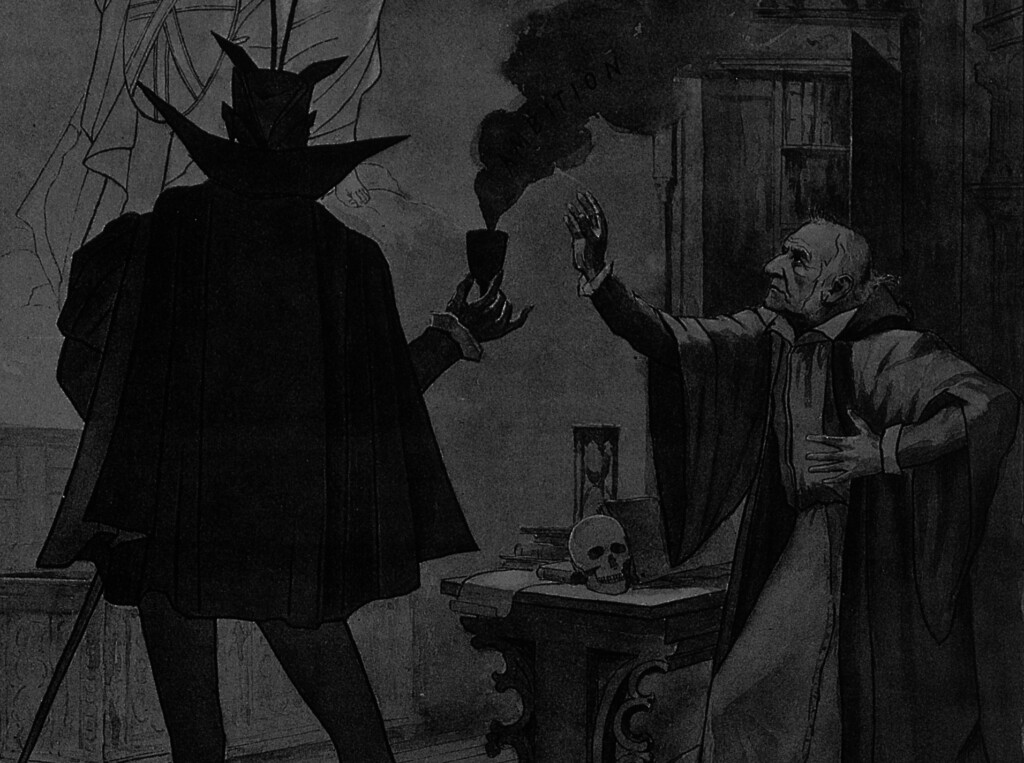
You have rehearsed this negotiation your entire life without knowing its name. The terms were never written down, but you accepted them anyway: that your hunger for more — more knowledge, more power, more experience, more self — was not a character flaw but a moral engine, the very proof of your seriousness as a human being. Ambition, in the culture you inherited, is not one value among many. It is the grammar through which personhood is demonstrated at all.
When Goethe published Faust: Part One in 1808, he did something far more dangerous than retell a cautionary tale about a scholar who sells his soul. He restructured the moral architecture of the story entirely. The original Faustbuch of 1587 — the chapbook printed by Johann Spies that launched the myth into European consciousness — was an unambiguous morality play. Faust sinned, Faust burned. The theological accounting was clean. Goethe's Faust, by contrast, opens with God and Mephistopheles making a wager in heaven, and God himself frames Faust’s restlessness not as corruption but as vitality. “A good man in his darkest yearning,” the Lord declares, “is still aware of the right path.” The damnation has been quietly replaced by a developmental logic: striving is sacred, even when it destroys.
This is the pivot on which an entire civilization turns. Marshall Berman, in All That Is Solid Melts Into Air published in 1982, identified this moment with surgical clarity: Goethe's Faust is not a medieval sinner but the first modern man, and what makes him modern is precisely his incapacity for satisfaction. Faust does not want any particular thing. He wants the feeling of wanting, the expansion itself, the perpetual threshold. Berman reads the second part of Goethe’s drama — where Faust drains swamps, displaces peasant communities, and commands labor at industrial scale — as the prehistory of capitalist development, not as metaphor but as structural blueprint. The Faustian bargain is not an individual spiritual crisis. It is the operating system of a civilization that has decided that the will to transform supersedes the ethics of what is being transformed.
What makes this so difficult to see from the inside is that the grammar has become invisible through sheer ubiquity. The vocabulary of self-improvement, of disruption, of scaling, of maximizing potential — every phrase in this lexicon carries the Faustian assumption that the proper relationship between a person and the world is one of conquest and expansion. Even the language of personal growth, which presents itself as gentle and inward, encodes the same logic: you are a project, always incomplete, always requiring more investment, more intervention, more becoming. The soul, in this framework, is not something to be tended but something to be optimized, which is to say, it has already been handed over before you noticed you were holding it.
The devil in Goethe is not a tempter in any traditional sense. Mephistopheles explicitly identifies himself as “the spirit that eternally denies,” the force of negation, of limits, of finitude. What he offers Faust is precisely the removal of that finitude — the suspension of the moment, the refusal of stillness. And Faust accepts not because he is weak but because, within the moral world Goethe has constructed, accepting is the only coherent response for a man of genuine seriousness. To refuse the pact would be to accept limitation, which in modernity reads as a failure of nerve rather than a form of wisdom.
The bargain, then, was never really between a man and a demon. It was between a culture and its own appetite, formalized in language elegant enough to feel like philosophy, heroic enough to feel like virtue. And the most insidious clause in the contract is the one that convinces the signatory that the pen was always in their own hand.
The Social Contract as Devil’s Pact
You sign the document without reading it. Not because you are careless, but because the alternative — the blank space before the signature, the life lived outside the agreement — has been made to seem so monstrous that the pen moves almost involuntarily. This is not a metaphor for something else. This is the founding gesture of modern political life, and it was theorized with extraordinary precision long before anyone admitted what it resembled.
Thomas Hobbes, writing in 1651 in Leviathan, was honest in the way that only truly cold minds can be honest. He did not pretend that the state existed to liberate you. He said plainly that without sovereign authority, human existence is solitary, poor, nasty, brutish, and short — and that you surrender your natural freedom not because the sovereign deserves it, but because the alternative is a war of all against all that no one survives intact. The bargain is explicit: give up your autonomy, receive protection. What Hobbes did not say, but what the structure of his argument makes unavoidable, is that this exchange has no exit clause. Once the Leviathan has absorbed your sovereign will, you cannot reclaim it without dissolving back into the chaos you fled. The contract is irrevocable by design. The soul sold is not returned at dawn.
Jean-Jacques Rousseau tried to redeem this structure by insisting, in The Social Contract of 1762, that the general will — the collective moral intelligence of a free people — was what you submitted to, not a monarch, not a tyrant. But Rousseau’s version carries a more insidious clause: it requires that you become legible. To participate in the general will, you must translate yourself into a form the collective can recognize and count. Your particularities, your deviances, your unclassifiable desires — these do not enter the contract. They are the price of entry, surrendered at the threshold. James C. Scott, in Seeing Like a State published in 1998, documented in forensic detail how modern states have systematically destroyed local knowledge, irregular land tenure, vernacular languages, and informal economies precisely because illegibility is ungovernable. The devil, in every version of the pact, needs to know your name.
What neither philosopher confronted directly is the theological grammar they were inheriting. The diabolical pact in its literary and theological tradition is not fundamentally about evil — it is about the exchange of something infinite and unquantifiable for something finite and guaranteed. Faust does not sell his soul because he is wicked. He sells it because he is impatient with everything that cannot be secured, measured, or delivered. The Enlightenment social contract performs the same operation on the political subject: it converts the wild, ungovernable fact of a human life into a citizen, a unit, a bearer of rights — which is also to say, a bearer of obligations that precede any choice you actually made. You were born into the contract. The signature was retroactive.
Giorgio Agamben spent much of his career, particularly in Homo Sacer published in 1995, tracing the line between the citizen who is protected by sovereign power and the bare life that is exposed to it — the person who has, in some legal or political sense, fallen outside the pact and can therefore be harmed without consequence. This is not an aberration of the social contract. It is its load-bearing wall. Every agreement that promises protection to those inside it generates, necessarily, an outside. The devil’s bargain always includes a clause about who is not covered, written in the smallest possible print, on the page you never reached.
What remains genuinely strange is that this structural resemblance has never produced a serious political crisis of legitimacy. Societies continue to celebrate the Enlightenment contract as emancipation while living inside an arrangement that Faust would have recognized at a glance — and perhaps envied for its efficiency.
What You Give Is Never Named Clearly
You sign the form without reading it. Everyone does. The stack of pages arrives with a tab marking where your signature goes, and you press the pen down because the room is waiting and the fluorescent light is unflattering and the person across the desk has already moved on to the next thought. What you have surrendered in that moment — what clauses you have ratified, what rights you have transferred, what future behaviors you have pre-authorized — remains genuinely unknown to you. Not because you lacked the intelligence to read. Because the language was written to resist being read.
This is not a modern pathology. Stith Thompson, whose six-volume Motif-Index of Folk-Literature catalogued thousands of recurring tale patterns across cultures between 1932 and 1936, identified a cluster of folkloric structures in which a supernatural entity obtains something from a mortal through deliberately imprecise language. The thing exchanged is never the thing the mortal believes they are exchanging. A man promises “what stands beneath the oak when I return home” — not realizing his daughter has fallen asleep there. A woman pledges “the first living thing to cross my threshold” and watches her dog slip out ahead of her newborn. The vagueness is not accidental. It is the mechanism. The ambiguity is the contract’s operating system, and the taker always knows exactly what they are taking while the giver remains architecturally excluded from that knowledge.
What makes this pattern so durable is not the supernatural predator but the structure of desire itself. When a person wants something badly enough, they develop a motivated incapacity to interrogate the terms of its arrival. The psychoanalytic literature on this is blunt: Melanie Klein, in her 1946 paper on projective identification, described how intense wanting creates a kind of internal evacuation — the parts of the self that might register danger or contradiction get disowned, projected outward, made unavailable for use precisely when they are most needed. The person who needs the deal most is the person least equipped to see what the deal actually says. The devil does not need to lie. He needs only to wait for the wanting to reach the right temperature.
There is a particular kind of conversation that happens between two people when one of them has something the other desperately needs and both of them know it and neither of them names it directly. It happens in offices and in kitchens and in the spaces between what is said at dinner tables. One person extends a form of help — a loan, a recommendation, a silence kept on someone’s behalf — and the other accepts it with genuine gratitude, and somewhere in the texture of that exchange a debt is created that was never verbalized and will never be verbalized until the moment it is collected. The collection comes later, casually, as if the original transaction had always included this clause. The debtor discovers they knew this. Some part of them always knew this. They had simply agreed not to know it.
Medieval theologians who wrote about demonic pacts, including Jean Bodin in his 1580 Démonomanie des Sorciers, were genuinely preoccupied with the question of consent. Could a compact be binding if one party did not understand its full scope? The theological answer was, uncomfortably, yes — because the willingness to enter an unread agreement was itself a form of moral negligence, a sin of incuriosity. The soul was not stolen. It was relinquished through a failure of attention that the sinner had, at some level, chosen. This is a harder verdict than victimhood, and it remains hard today. The price was always there in the language. The language was always available to be read. The question the pact keeps asking, across centuries and genres and legal jurisdictions, is not whether the terms were hidden but why the person reaching for the prize so reliably preferred not to look.
A vision curated by a filmmaker, not an algorithm
In this video I explain our vision
The Feminine Pact and the Erased Bargain

You have watched a woman burn for wanting something. Not in the past, not in allegory — in the architecture of every story you were told about women who reached too far. The fire is the point. The reaching is the crime. And what gets systematically erased in the retelling is that she never got to name what she wanted in the first place.
The pact with the devil, as a literary and theological structure, is built on the premise of sovereign desire. You want something badly enough to sell your soul for it. Faust wants knowledge, then pleasure, then the conquest of nature itself — Goethe’s 1808 text gives him two volumes to elaborate his hunger. Marlowe’s Faustus wants to “be on earth as Jove is in the sky,” and the grandiosity is treated as tragic, even dignified. The man names his desire with the full weight of subjectivity. The bargain is between two parties who recognize each other as agents. This is the formal structure of the pact as Western literature inherited and celebrated it.
Gretchen in the same Goethean universe never makes a pact. She is the consequence of one. Her suffering — seduction, pregnancy, infanticide, madness, execution — is the collateral damage of Faust’s transaction, and yet her final salvation is invoked as the text’s redemptive gesture, as though being instrumentalized and destroyed were a form of spiritual distinction. She wants nothing that the narrative permits her to name. Her desire, to the extent it exists, is managed through her love for Faust, which is itself a product of Mephistopheles’ engineering. She is acted upon. The devil works through her body to access the man.
Lyndal Roper’s Witch Craze, published in 2004, tears the romantic abstraction off early modern witch trials and replaces it with bodies, testimony, and the specific texture of village life in sixteenth and seventeenth century Germany. What Roper finds is not a rebellion of female desire but its systematic misreading. The women accused of diabolical pacts were overwhelmingly poor, old, widowed, or marginal — women whose survival depended on neighborhood networks of exchange and obligation. When those networks broke down, when a cow died after a quarrel or a child fell ill after a refusal, the accusation followed the fault line of social debt. The pact they were said to have made was not with an equal. It was with a master who gave them grease, flight, and sabbath orgies — all projections of what men feared women might want if left unsupervised. Their confessions, extracted under torture, described desires they did not choose and pleasures they did not experience.
What the witch-pact tradition reveals is not female agency but its annihilation dressed in the language of excess. The woman was said to have wanted too much and gone to the devil for it — but the content of her wanting was always authored by her accusers. She could not even possess her own transgression. The bargain was mediated: by male fear, by theological projection, by the social logic of communities that needed a body to carry their accumulated guilt. Even in apostasy she was denied interiority.
Modernity Outsourced the Devil
You sign the terms of service without reading them. Everyone does. The document runs to forty-seven pages of subordinate clauses, liability waivers, and data-usage provisions that you could not parse in an afternoon even if you wanted to, and the button at the bottom says “I Agree” in the same cheerful font used to sell you the product in the first place. Something is extracted in that moment — not your soul in any metaphysical sense, but something functionally equivalent: your behavioral profile, your attention patterns, your future purchasing decisions, your political susceptibility. The transaction is complete before you have closed the tab.
What the old pact narratives understood, and what we have systematically forgotten, is that the exchange always requires a signature. The devil needed consent. He could not simply take — he had to be invited, contracted, bound by the formal architecture of agreement. This was not a theological nicety. It was the structural condition that made the arrangement legible as a moral event. When Max Weber, writing in 1905 in The Protestant Ethic and the Spirit of Capitalism, described the iron cage of rationalized modernity, he was identifying something the folklore already knew: that enchantment does not disappear when bureaucracy arrives. It gets administered. The supernatural does not evacuate the modern world; it incorporates, registers as a limited liability entity, and begins issuing quarterly reports.
The genius of late capitalism as a system of extraction is precisely that it has made the pact horizontal and anonymous. There is no single counterparty, no hooved figure demanding your name in blood. Instead the extraction is distributed across a thousand micro-agreements — employment contracts that assign intellectual ownership of anything you produce, mortgage instruments designed to be refinanced before they are understood, loyalty programs that trade accumulated data for the illusion of reward. Guy Debord recognized in 1967, in The Society of the Spectacle, that the image had replaced the lived, but the deeper implication of his argument is that the spectacle does not merely distract — it substitutes. You are not watching life instead of living it. You are being convinced that watching is the living, and that the feeling of participation constitutes the thing participated in. The soul, functionally defined as the irreducible private interior that capitalism cannot monetize, is exactly what the spectacle is designed to dissolve.
What disappears in this arrangement is accountability — specifically, the accountability of the one doing the extracting. The traditional devil was at least a coherent villain. He had desires, a face, a name, a history of defeat that implied the possibility of resistance. Algorithms have no desires. They have optimization functions, which is a different thing entirely, because optimization cannot be bargained with, shamed, or outwitted by cleverness. The young lawyer who once might have sold his conscience to a powerful patron now sells it incrementally across a twenty-year partnership track, each compromise too small to constitute a recognizable moment of damnation, the aggregate cost only visible in retrospect from a life that no longer resembles the one he thought he was building.
This is the sophistication of the distributed pact: it forecloses the dramatic recognition scene. In every version of the Faust story from Marlowe’s 1592 Doctor Faustus forward, there is a moment when the protagonist understands what he has become. The horror is partly aesthetic — he sees himself clearly, often for the first time. Contemporary extraction systems are specifically engineered to prevent that moment. The interface is frictionless, the feedback positive, the metrics reassuring. You are always growing, always optimizing, always one upgrade away from the version of yourself the platform has already decided you should want to be. The question the old narratives were really asking — what would you trade for power, and would you recognize the trade when it happened — has not become irrelevant.
The Price Has Already Been Paid
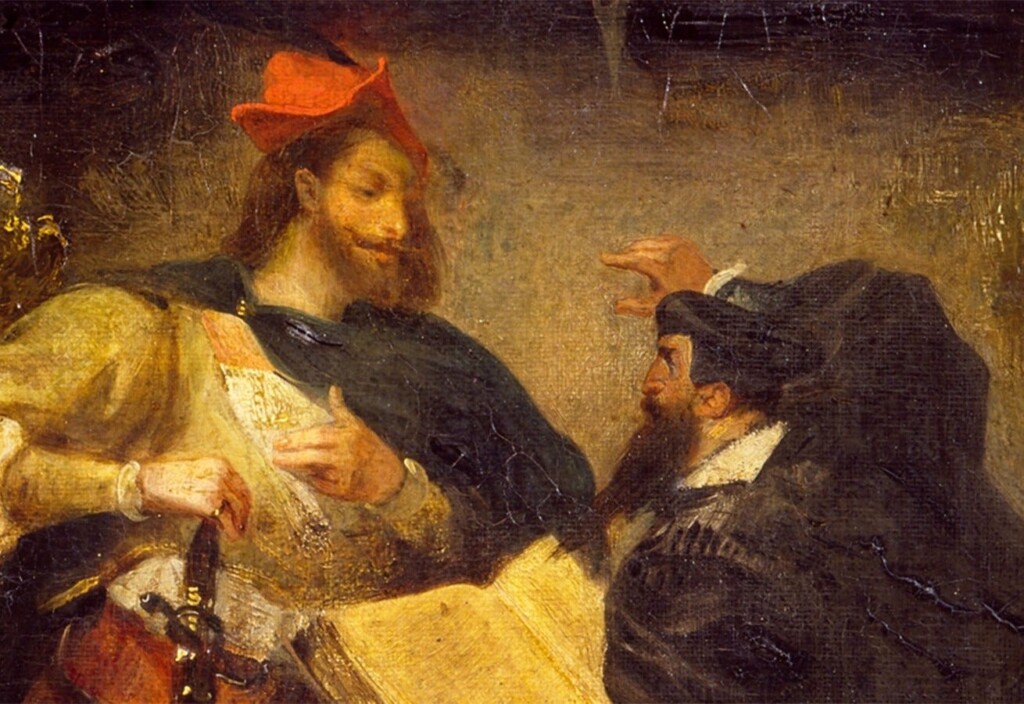
You sign it before you know what you are signing away. That is the only version of the pact that has ever existed, in literature or anywhere else. The soul offered at the crossroads, the name written in blood, the whispered agreement in the dark — none of these happen in full knowledge of what the future self will become, what it will need, what it will grieve the absence of. The transaction is always conducted between a present self drunk on desire and a future self who will pay without having been consulted. Every version of this story, from the medieval Theophilus legend of the sixth century to the Romantic elaborations that followed, encodes this asymmetry not as a dramatic device but as its actual subject.
The philosopher Derek Parfit spent much of his 1984 work Reasons and Persons interrogating the question of whether the person who suffers the consequences of a choice is meaningfully the same person who made it. His answer, unsettling and largely ignored in popular discourse, was that personal identity across time is far thinner than we assume — that the self which reaps what an earlier self has sown has a weaker claim to continuity with that earlier self than our moral frameworks require. Literature about the pact has always dramatized exactly this rupture. Faust at the moment of his agreement with Mephistopheles is not the Faust who will eventually confront what he has lost; Goethe understood this, which is why the tragedy does not hinge on villainy but on the simple, devastating distance between who we are when we want something and who we become once we have had it.
What makes this formally interesting is the direction of the deception. We tend to read the devil as the deceiver, the one who obscures the terms, who hides the cost inside the gift. But the more precise reading is that the person signing deceives themselves — not by misunderstanding the contract, but by refusing to imagine the self who will one day inhabit its consequences. Oscar Wilde understood this structurally when he constructed a portrait that ages while its subject remains untouched; the horror in that novel is not supernatural, it is the horror of recognizing that the man who made the original choice and the man who must live inside it are tragically misaligned, strangers to each other across time.
The literature that carries this theme has always been available for two readings. One is the reading of fiction: the story of an exceptional figure, a Faust, a Dorian, a man willing to transgress where ordinary people would not. This reading is comfortable because it places the mechanism at a safe distance. The other reading — the one the texts have always permitted but never insisted upon — is autobiographical. Every significant commitment made before full self-knowledge, every identity constructed around a desire that the future self will outgrow, every sacrifice offered to a version of success or love or safety that later reveals itself as a prison: these are not metaphors for the pact. They are the pact. The devil in these stories is not a figure of theology but a figure of timing — the embodiment of the gap between when we choose and when we understand what we have chosen.
What literature has preserved across centuries of retelling is not a warning and not a morality tale. It is something stranger and more honest: a record of the species’ recurring encounter with its own temporal blindness, dressed in the costume of the supernatural so that it could be read, passed down, staged, printed, and consumed by millions of people who recognized something in it they could not quite name, and who closed the book afterward and went on living exactly as before.
🔥 Shadows of the Soul: Pacts, Devils, and Forbidden Knowledge
The pact with the devil is one of literature’s most enduring and haunting archetypes, weaving together ambition, temptation, and the eternal struggle between the sacred and the profane. These related articles trace the symbolic roots and cultural echoes of this theme across philosophy, myth, and literary imagination.
Goethe’s Faust: Meaning and Analysis
Goethe's Faust stands as the supreme literary treatment of the diabolic pact, in which the aging scholar Faust sells his soul to Mephistopheles in exchange for boundless knowledge and earthly pleasure. The work transforms the medieval legend into a profound meditation on human desire, the limits of reason, and the possibility of redemption. Reading it alongside the history of the pact motif reveals how deeply Goethe reshaped the symbolic grammar of an entire tradition.
GO TO THE SELECTION: Goethe’s Faust: Meaning and Analysis
Alchemy in Literature: From Dante to Goethe
Alchemy in literature, from Dante to Goethe, provides an essential parallel tradition to the pact narrative, one in which forbidden knowledge is pursued not through demonic bargain but through secret transformation. The alchemist and the Faustian sorcerer share the same obsessive hunger for power over nature and the hidden laws of existence. Tracing this lineage illuminates how the figure of the devil often served as a mythological stand-in for the dangerous allure of esoteric mastery.
GO TO THE SELECTION: Alchemy in Literature: From Dante to Goethe
Eliade’s The Myth of the Eternal Return: Analysis
Eliade’s analysis of the myth of the eternal return offers a key to understanding why the diabolic pact carries such enduring symbolic weight across cultures and centuries. The pact ritual enacts a profane inversion of sacred cosmogony, replacing divine grace with infernal contract and cyclical renewal with irreversible damnation. Eliade’s framework helps decode the deep structure of the legend as a myth about the terror of linear, unredeemable time.
GO TO THE SELECTION: Eliade’s The Myth of the Eternal Return: Analysis
The Labyrinth of Knossos: History and Myth of the Minotaur
The Labyrinth of Knossos and the myth of the Minotaur offer a rich mythological counterpart to the pact narrative, centering on a monstrous secret hidden at the heart of a constructed deception. Both the labyrinth and the diabolic covenant represent spaces where human transgression is enclosed, concealed, and ultimately confronted. Exploring this mythic parallel deepens our understanding of how Western culture has long encoded its darkest bargains in the language of monsters and mazes.
GO TO THE SELECTION: The Labyrinth of Knossos: History and Myth of the Minotaur
Discover the Cinema of the Forbidden on Indiecinema
If these themes of temptation, hidden knowledge, and the price of ambition speak to you, Indiecinema’s streaming catalog offers a curated selection of independent films that dare to explore the darkest corners of the human soul. From visionary auteur works to rare international productions, you will find stories that go where mainstream cinema fears to tread. Join Indiecinema and let the labyrinth guide you deeper.
👉 EXPLORE THE CATALOG: Watch Indie Films in Streaming
A vision curated by a filmmaker, not an algorithm
In this video I explain our vision

