
The Last Lamp in a Burning City
You are sitting in a room that smells of dust and scorched wood, and outside the walls of the haveli the British artillery has been speaking in its blunt, grammatical way for weeks. The year is 1857. Delhi is not falling — it has already fallen, repeatedly, in the way that cities fall before the final decree arrives, one neighborhood going quiet at a time, one minaret losing its call, one family disappearing into the logic of conquest. You have ink. You have paper. You are Mirza Asadullah Baig Khan, known to the world that still cares about such things as Ghalib, and you are writing verse not because it will save anything but because the alternative — silence — feels like a collaboration with erasure.

This is not the romanticized image of the suffering artist that the nineteenth century loved to manufacture. The Mughal court at Delhi, the Red Fort, the entire civilizational infrastructure that had given Urdu and Persian poetry their social oxygen, was being dismantled with administrative precision by the East India Company, an entity that began as a commercial ledger and ended as an empire. Bahadur Shah Zafar, the last Mughal emperor and himself a poet of genuine anguish, was imprisoned after 1857 and exiled to Rangoon, where he died in 1862 with the famous couplet attributed to him about dying in a foreign land without even two yards of earth from his beloved homeland to cover him. The world Ghalib had lived inside, the world that had made his sophistication legible, was not in decline. It was in demolition.
What makes Ghalib philosophically startling rather than merely historically interesting is that he understood this clearly and refused to perform the grief in any conventional register. His Urdu Diwan, compiled and revised across decades, contains ghazals that treat despair not as a wound requiring consolation but as an epistemological condition — a way of knowing that comfortable people are structurally prevented from accessing. The ghazal form itself, with its tradition of the maqta, the closing couplet in which the poet addresses himself by his pen name, forced Ghalib into a peculiar self-reflexive violence: he had to watch himself suffer from a slight aesthetic distance, turn his own dissolution into a formal problem with a solution, and then sign it.
There is something in this that the German philosopher Friedrich Nietzsche, writing in The Birth of Tragedy in 1872, would have recognized as the Apollonian mask worn over Dionysian terror — the imposition of beautiful form onto the experience of annihilation, not to deny the annihilation but to make it survivable as art without making it comfortable as life. Ghalib was doing this decades before Nietzsche theorized it, in a language Nietzsche never learned, in a city Nietzsche never visited, under historical pressures that European aesthetic theory was almost entirely designed to ignore.
His letters — and Ghalib’s prose correspondence, particularly the Urdu letters collected in volumes like Ud-e Hindi, represents one of the most extraordinary epistolary archives in any literature — record mundane catastrophes alongside cosmic ones with a flatness that is itself a kind of argument. A pension delayed. A nephew dead. A bottle of wine unavailable. A civilization ending. He lists these things in proximity, and the proximity is the philosophy. He was not making peace with the small losses to cope with the large ones. He was insisting that the scale we use to measure suffering is itself a social construction, and that a man sufficiently awake to his own situation will find the bureaucratic insult and the imperial massacre equally revealing about the nature of power.
What survives in his verse is not wisdom in any teachable sense.
Thirsty
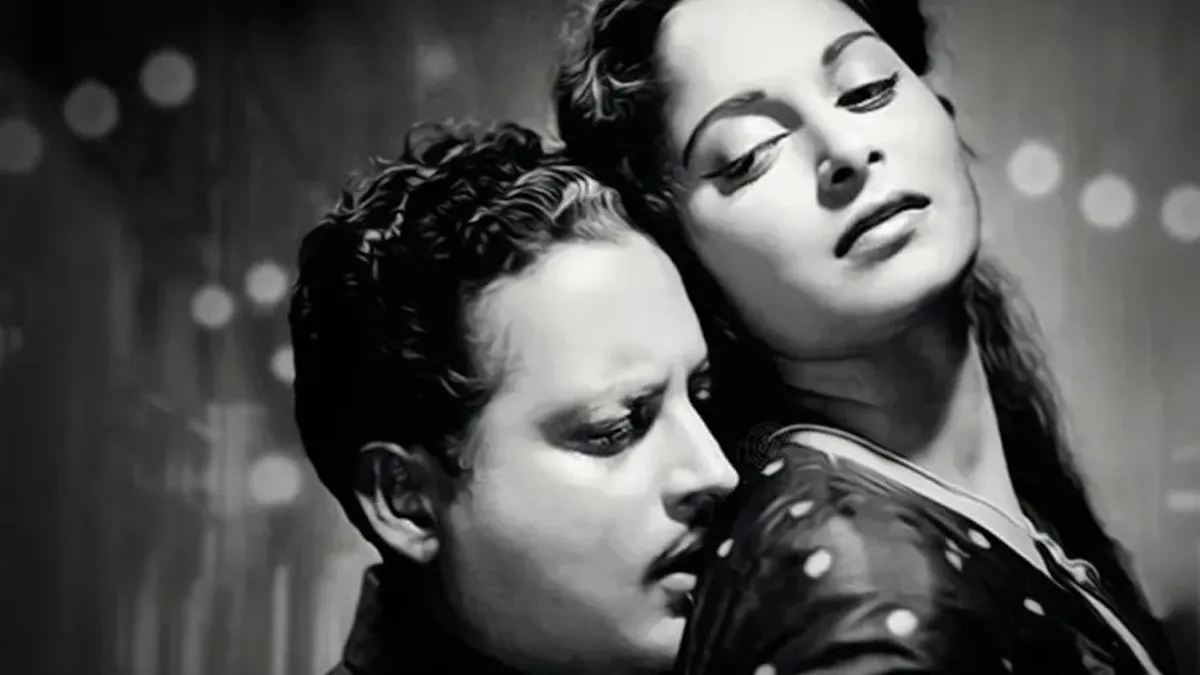
Drama, musical, by Guru Dutt, India, 1957
Thirsty is the heartbreaking story of Vijay, a young poet living in Calcutta who dreams of giving voice to the suffering and injustice of the world through his verses. Idealistic and sensitive, Vijay clashes with a society that despises his art because it is not profitable and does not cater to the tastes of the public. His brothers consider him a failure, the woman he loves leaves him for a marriage of convenience, and his poems are ignored by publishers. Only Gulabo, a prostitute with a pure heart, recognizes the beauty and truth of his words. When a misunderstanding leads everyone to believe Vijay is dead, his name and poetry suddenly become famous, exposing the hypocrisy of those who had previously rejected him.
Watching Thirsty means immersing oneself in a work that goes beyond melodrama, blending poetry, music, and imagery into a profound reflection on the human soul and the value of art. Guru Dutt, director and protagonist, creates one of the most intense and poetic films in world cinema, where black-and-white cinematography, expressive framing, and evocative lyrics produce an atmosphere of poignant melancholy. It is a film about the misunderstanding of the artist, pure love, and society’s hypocrisy, but also a universal critique of materialism and opportunism. Even today, Thirsty moves and provokes thought because it sincerely tells the story of the need to remain true to oneself in a world that measures people’s worth solely by their success.
LANGUAGE: Hindi
SUBTITLES: English, Spanish, French, German, Portuguese
What the Ghazal Actually Is — And Why You Were Lied To
You have been told, in some college survey course or airport bookshop blurb, that Urdu poetry is about longing. About the beloved who does not return. About wine and roses and the nightingale pressing itself against the thorn. This is not wrong the way a lie is wrong — it is wrong the way a map is wrong when it shows you the border and not the terrain.
The ghazal is a formal structure of extraordinary philosophical violence. It does not merely contain feeling; it engineers a particular crisis of meaning through the relationship between its parts. Each couplet — the sher — is semantically autonomous. It does not build on the one before it. It does not require the next one to complete its sense. A ghazal of seven couplets is, by design, seven separate worlds placed in a room together without introduction. The reader moves between them the way consciousness actually moves between states: abruptly, without transition, with the unsettling sense that coherence is being performed rather than achieved. Agha Shahid Ali, the Kashmiri-American poet who spent a significant portion of his career arguing this in both practice and essay — most urgently in his 2000 anthology Ravishing DisUnities — insisted that the ghazal’s defining feature is not its lyricism but its fracture. The form is not unified by argument or narrative. It is held together by two technical elements alone: the radif, a refrain of one or more words that closes each couplet, and the qafia, the rhyme that precedes it. The whole architecture rests on repetition at the end, not continuity in the middle. What you feel as emotional coherence when you read a great ghazal is not the poem’s gift to you — it is your mind’s desperate attempt to suture wounds the poem has deliberately opened.
The maqta is where this becomes almost unbearable in its implications. The final couplet of a ghazal traditionally requires the poet to address themselves by name — not as confession, not as signature, but as rupture. Ghalib steps into his own poem as a character, speaks of himself in the third person or sometimes with a shattering directness, and in doing so collapses the fiction that a lyric poem has a stable speaking subject at all. The self that has been emoting for six couplets is revealed, in the seventh, to be a persona watched by its own author. This is not a modernist innovation. This is a convention that predates Wordsworth’s Prelude by centuries, predates the Romantic myth of sincere self-expression entirely, and it operates through a tradition that Western literary criticism spent most of the twentieth century failing to recognize as philosophy because it arrived wearing jewelry.
There is a particular colonial convenience in calling something decorative. When the British administered India and required a framework for local culture that confirmed their own civilizational hierarchy, Urdu poetry became exquisite but ornamental — proof of a refined sensibility that lacked systematic thought. This reading required ignoring that the ghazal was, for centuries, also the medium in which Sufi metaphysics traveled. That the beloved — the maashooq — was simultaneously a human figure, a divine address, and a philosophical category for the object of any absolute desire. Ibn Arabi’s doctrine of the unity of being, which transformed Islamic theology in the thirteenth century, moved through Persian and Urdu verse before it reached any prose treatise accessible to ordinary readers. Poetry was not the decoration on the theology. Poetry was the transmission system.
When Ghalib wrote in one of his most discussed Urdu couplets that the difficulty of existence is that even God requires a witness — that even the divine is incomplete without an eye that sees it — he was not being metaphorical in the way a greeting card is metaphorical. He was advancing a claim about consciousness, about the mutual dependence of the observer and the observed, that Hegel was working toward in the Phenomenology of Spirit published in 1807, while Ghalib was still a teenager in Agra learning to be astonished by his own mind.

A Man Perpetually in Debt to Everyone Including God
You wake one morning and realize the world has been keeping a ledger on you that you never signed. Every debt entered without your consent, every obligation accrued before you understood the terms, the whole architecture of obligation simply handed to you like a inheritance of stone.
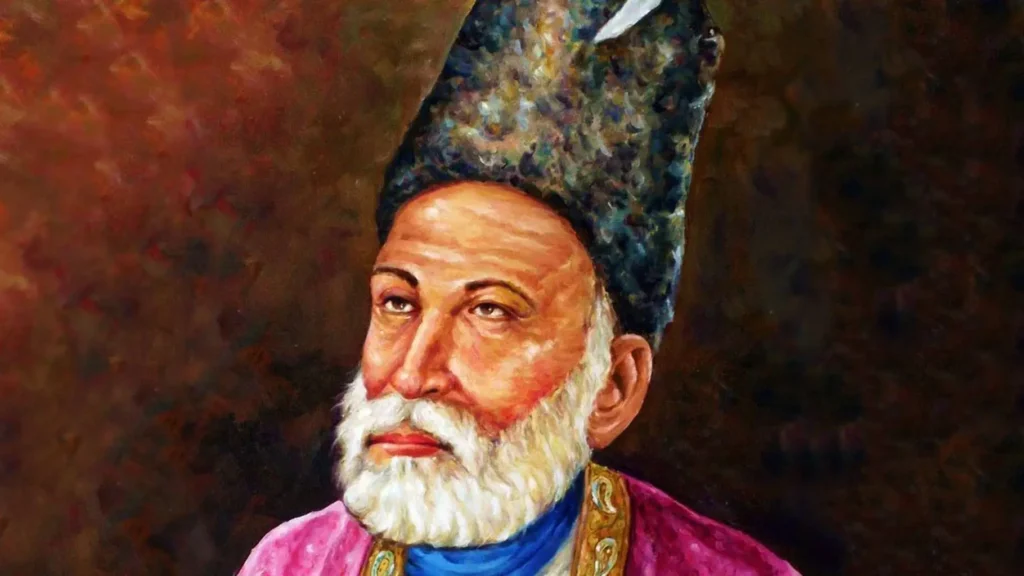
Mirza Asadullah Baig Khan — who would insist on the pen name Ghalib, meaning “dominant,” with the particular irony of a man who dominated nothing so much as his own capacity for ruin — lived inside that ledger for nearly all of his seventy-two years. Born in Agra in 1797 to a military family whose fortunes collapsed early, he was married at thirteen to a household he did not choose, in a city he did not prefer, bound to ceremonies of respectability that his entire sensibility found airless. The pension his family had received from the Mughal court passed through layers of colonial administration until the British, consolidating their grip on the subcontinent, simply declined to honor it. He spent years petitioning, traveling to Calcutta in 1827 to press his case in person before the East India Company’s courts, sitting in the antechambers of men who processed his claim as an administrative inconvenience. The pension was reduced, then contested, then partially restored, then reduced again. He died still arguing with an empire over money he believed was owed to him, and the empire was not wrong to be unmoved because empires are not built on the acknowledgment of what they owe.
What is philosophically interesting is not the poverty itself but his refusal to interpret it as a verdict. William James, in The Varieties of Religious Experience published in 1902, distinguished between what he called the “healthy-minded” soul that constitutes happiness through selective attention and the “sick soul” that cannot perform this selection, for whom the darkness is not an obstacle but a permanent datum of consciousness. Ghalib was neither. He gambled compulsively on cards and dice in a culture that offered this particular vice with one hand and condemnation with the other, was imprisoned briefly in 1847 for running a gambling den — a detail biographers tend to soften — and continued gambling afterward with the serene consistency of a man who has already located the joke at the center of the universe and found it less threatening than the earnestness surrounding it.
Eleven children were born to his household. All eleven died in infancy. This figure tends to arrest readers, and the arrest itself is worth examining, because pity is a form of distance. To pity Ghalib for these eleven deaths is to place the experience behind glass, to make it a spectacle of suffering that confirms your own relative fortune. What his ghazals actually do with this knowledge is more disturbing than grief: they refuse to organize it. There is no elegy, no monument, no five stages. There is instead a poetry in which annihilation is simply continuous, in which the question of what was lost has been replaced by the question of whether possession was ever the appropriate framework.
The theologian Paul Tillich wrote in The Courage to Be, in 1952, that the deepest anxiety is not death but meaninglessness — not the end of existence but the possibility that existence produces no coherent answer to itself. Ghalib did not need Tillich because he had already burned the question from the inside. His verse does not argue that suffering has meaning, does not argue that it is meaningless, does not perform the noble stoicism that European philosophical traditions tend to reward. It does something stranger: it makes suffering the medium of a continuing conversation, the way water is the medium of a current — not the content, not the message, not the conclusion, but the element in which thought moves at all.
A man who cannot be consoled is not the same as a man who is broken. The difference is that the broken man still wants the consolation and cannot have it, while the inconsolable man has stepped outside the entire economy of comfort and found the view from there oddly clarifying.
The Theology of Complaint
You have said your prayers correctly, in the right posture, facing the right direction, and you have never once meant a single word of it. Not because you are a hypocrite in any conscious sense, but because the grammar of devotion that was handed to you left no room for what you actually felt standing there — which was not gratitude, not surrender, not peace, but something closer to fury at an arrangement you never agreed to.
Ghalib understood this before most traditions had language for it. His Urdu and Persian verses, gathered across decades into the diwan that circulated through nineteenth-century Delhi and Lucknow, did not treat God as a destination or a comfort. They treated him as a defendant. The mystic tradition he inherited from Rumi and the Sufi poets of the thirteenth and fourteenth centuries had always used the language of lover and beloved to describe the soul’s approach to the divine — a melting, an annihilation, a fana in which the self dissolves into the absolute like salt into an ocean. Ghalib kept the vocabulary and reversed the physics. His speaker does not dissolve. He stands there demanding answers. In one of his most destabilizing couplets, he accuses God of negligence toward his own creation with the cool precision of a creditor presenting an overdue account. The relationship is not broken by this accusation — it is deepened by it. Argument is intimacy. Silence would be indifference.
What makes this theologically radical rather than merely temperamentally irreverent is that Ghalib was not rejecting the divine. Rejection would have been easy, would have required nothing. He was insisting on a God serious enough to withstand grievance — a God whose existence meant something precisely because it could be held to account. The devotee who praises unconditionally asks nothing of the relationship. He confirms a hierarchy and calls it love. Ghalib’s complaint, by contrast, carries within it an extraordinary act of faith: you can only accuse someone you believe is actually there and actually capable of having done otherwise.
Walter Kaufmann, in his 1958 Critique of Religion and Philosophy, drew a distinction that cuts directly to what Ghalib was practicing a century earlier. Kaufmann argued that the dominant mode of Western religious behavior was not genuine confrontation with the divine but social performance — faith as conformity, prayer as the rehearsal of acceptable sentiment, theology as a machinery for producing comfort rather than truth. Honest religion, in Kaufmann’s framing, would require something violent: the willingness to bring one’s actual experience, including its most corrosive doubts and its most embarrassing rages, into the presence of the question of God. The person who kneels with curated emotions is not praying — they are managing their reputation before an audience that includes, uncomfortably, themselves.
Ghalib could not have read Kaufmann, but his poetry is the living archive of exactly this confrontation. Delhi in the mid-nineteenth century was a city being dismantled in slow motion — Mughal power hollowing out from within while the East India Company tightened its administrative grip, the catastrophe of 1857 still ahead but already palpable in the economic and cultural diminishment of everything Ghalib had known. Grief was not metaphorical for him. It was the texture of daily existence: debt, the death of friends, the erosion of patronage, the sense of being a remnant of a civilization whose vocabulary no longer had anywhere to land. And into that grief, he did not bring consolation theology. He brought the argument. He brought the poem as an instrument of cross-examination.
The distinction matters because consolation theology is ultimately a form of abandonment dressed as comfort — it asks you to receive your suffering as meaningful without requiring the universe to demonstrate that meaning. Ghalib refused the transaction. He wanted the demonstration, or he wanted the silence to be named honestly as silence, which is its own form of demanding that the truth show its face.
Colonial Modernity and the Poet Who Refused to Be a Bridge
You receive an invitation to a banquet hosted by a man who burned your city. The tablecloth is white. The silverware is British. Your host speaks of progress while the ashes of the Red Fort are still warm outside the window. Ghalib received precisely this kind of invitation — not metaphorically, but in the material reality of post-1857 Delhi, when the British reorganized the city’s intellectual life with the same administrative efficiency they applied to tax collection. He attended some of these gatherings. He ate the food. He wrote, afterward, letters so corrosive with private contempt that his correspondents must have felt the paper burn between their fingers.
His letters — the Urdu collection known as Ud-i Hindi and the Persian Khutut-i Ghalib — constitute one of the most psychologically unusual documents of the nineteenth century precisely because they refuse the role history seemed to be scripting for him. The colonized intellectual, in almost every era, is eventually pressured into becoming a bridge: someone who translates one civilization to another, who softens the violence of contact by rendering it legible, who earns survival through usefulness. Ghalib would not perform this function. He mocked the Mughal court’s ceremonies as theater without an audience. He described British officials with the kind of politeness that is indistinguishable from contempt when read carefully. He accepted a pension from the court, then watched the court dissolve, then negotiated awkwardly for its continuation under new management — not with any ideological consistency, but with the stubborn, unglamorous pragmatism of a man who needed money and refused to pretend otherwise.
Frantz Fanon, writing in The Wretched of the Earth in 1961, described the colonized intellectual as someone who faces a peculiar paralysis: the colonial culture has been absorbed deeply enough to destabilize native frameworks, yet the colonizer’s world remains permanently closed to genuine entry. The intellectual oscillates, finding that both worlds reject authenticity, that both demand performance. What Fanon understood, and what makes his analysis fit Ghalib with uncomfortable precision, is that this position does not produce neutrality — it produces a particular kind of rage that has nowhere to go except inward, or into art. Ghalib’s ghazals are saturated with a helplessness that critics frequently read as spiritual longing, but which also reads, under different light, as the specific exhaustion of someone who watched two legitimacies collapse simultaneously and found neither worth mourning without irony.
His choice to write in both Persian and Urdu was not merely aesthetic. Persian had been the administrative and literary prestige language of the Mughal world — to write in it was to claim membership in a civilization that British rule was actively rendering obsolete. Urdu was vernacular, alive in the bazaars, fluid, newer in its literary ambitions. Ghalib famously considered his Persian work superior, wrote thousands of Persian verses that received far less attention than his Urdu ghazals, and experienced this asymmetry as a kind of insult from history. He was not choosing between two languages so much as watching one world die while another formed without asking his permission, and insisting, with exquisite stubbornness, on writing in both directions at once.
What the colonial archive almost always erases is the comedian. Ghalib was genuinely, deliberately, structurally funny — and this remains the least comfortable fact about him for any reading that wants to make him purely tragic. His wit was not decoration. It was epistemology. When he wrote that he knew the truth of paradise but that credit was unavailable there, he was not simply being clever about wine. He was naming the precise absurdity of a world in which metaphysical promises had multiplied while material conditions had become catastrophic, in which the poetry of transcendence continued to be recited in courts that could no longer pay their poets, in which the language of eternity was being delivered by men who were not certain they could afford tomorrow’s meal, and who knew it, and who chose to say so in verse rather than in the silence that history generally assigns to the defeated.
A vision curated by a filmmaker, not an algorithm
In this video I explain our vision
The Second Scene: Someone Reads Ghalib at 3 A.M. and Feels Accused

You are alone in a city that doesn’t know your name, and the screen light is the only thing proving you exist. It’s three in the morning, the particular hour that strips away every identity you performed during the day, and you find yourself reading a couplet by a man who died in 1869: “I am not without sin, but what of mercy — where is the judge who has never erred?” You read it once. Then you read it again, not because you didn’t understand it the first time, but because something in it understood you first, and that is an entirely different kind of shock.
The phenomenon has a name in phenomenology, though Husserl never applied it to poetry. Edmund Husserl‘s concept of intentionality, developed in his Logical Investigations of 1900, describes consciousness as always directed toward something — but he never accounted for the reverse possibility, the moment when the object of consciousness turns and directs itself back at you with uncanny precision. What happens at three in the morning with a Ghalib couplet is not interpretation. It is interception. The language arrives before your defenses do, before the waking mind has assembled its alibis, and it names something you have spent considerable energy not naming.
This is not the experience of recognizing a beautiful thought. Recognition implies you already held the thing and the poem simply reminded you. What Ghalib performs is more violent than that — it is revelation of something you actively concealed, first from others, then from yourself. The psychological literature calls this dissociation, the way the psyche cordons off its most unbearable knowledge. Bessel van der Kolk documented in his 2014 work on trauma how the body stores what the conscious mind refuses, how the language of that stored material is fragmented, non-narrative, closer to sensation than to sentence. What Ghalib somehow does, across one hundred and fifty years and a translation and three time zones, is speak that pre-verbal language in a form the rational mind can finally receive.
The philosopher Paul Ricoeur argued in his 1975 study of metaphor that the poetic image doesn’t describe reality — it re-describes it, shattering an existing configuration of meaning to allow a new one to form in its place. But Ricoeur was still thinking of metaphor as something you encounter. The stranger thing about the Ghalib experience is that it happens in reverse sequence: you feel the shattering before you understand the structure that was shattered. Something in you breaks open slightly, and only afterward does your mind catch up with the grammatical content of the line that caused it.
What you are being accused of, though you would resist the word, is your own withholding. Not from others — that withholding is socially understandable, even pragmatic — but from yourself, the private theater of the self in which you have agreed to play only certain roles and to leave others unauditioned. Ghalib’s couplets operate on this interior suppression with surgical indifference to your comfort. He does not offer the accusation with compassion or with contempt. He offers it with the absolute neutrality of someone who has already passed through that same interior weather and has nothing left to protect.
This is what separates his voice from the consolatory tradition of poetry, from the long line of verse that reaches toward the suffering reader with open arms and says: you are not alone, you will endure. Ghalib’s couplets do not reach toward you. They are already inside the room when you arrive, sitting in the dark, familiar with every corner. The poem does not comfort you by reflecting your pain back at you softened and made beautiful. It confronts you with the fact that your pain was already known, already articulated, already lived through by someone who found no resolution in it and chose not to pretend otherwise.
Grief as Epistemology, Not Emotion
You have sat across from someone who had just lost everything — a child, a marriage, a country — and you noticed, before you could stop yourself, a faint impatience rising in you, a desire for them to move forward, to process, to arrive somewhere manageable. That impatience is not cruelty. It is the defense mechanism of a person who has been taught, at a cellular level, that grief is a temporary malfunction rather than a form of intelligence.
Paul Ricoeur, in The Symbolism of Evil published in 1960, made a distinction that Western therapeutic culture has spent the subsequent decades actively burying: he argued that certain modes of suffering are not obstacles to understanding but the very medium through which understanding becomes possible. The symbols that emerge from defilement, guilt, and what he called “the servile will” are not metaphors for something that could be stated plainly — they are epistemological events, moments where consciousness gains access to dimensions of reality that are structurally inaccessible to the undisturbed mind. Ricoeur was writing about theological anthropology, but he was also, without knowing it, writing a key to Ghalib.
What Ghalib practiced under the name of matam — lamentation in its most formal, almost ritualized Urdu sense — was not the expression of sadness. It was a cognitive discipline. When he wrote in the Diwan-e-Ghalib that the wound is its own kind of eye, he was not being poetically extravagant. He was making a claim about perception: that the self stripped of its protective certainties, the self rendered raw by loss, sees the structure of things that the comfortable self has every interest in not seeing. The machinery of attachment, for instance — the way human beings construct permanence out of inherently temporary arrangements and then treat the construction as if it were the thing itself.
Every sustained relationship requires a shared fiction of continuity. You do not experience your partner as a stranger each morning; you experience them as the accumulation of every prior morning. This is not love — it is architecture. And the architecture works precisely because it is never examined. Ghalib lost his children, his patrons, his city, and his empire in a single compressed historical catastrophe — the 1857 uprising and its brutal suppression by the British, which he witnessed at seventy years old from inside a Delhi that was being systematically emptied of everything that had given his life its coordinates. What that kind of loss does is not damage the self. It demolishes the scaffolding that the self had mistaken for its own substance.
The sociologist Erving Goffman spent much of The Presentation of Self in Everyday Life, published in 1956, demonstrating that social life is an uninterrupted performance — that what we call personality is largely a set of managed impressions designed to sustain a coherent narrative in the eyes of others. Ghalib already knew this, but he knew it from the inside of its collapse. When the audience disappears, when the Mughal court that had been the stage for an entire civilization simply ceases to exist, the performer is left holding a costume with nowhere to wear it. That experience does not produce grief in the therapeutic sense. It produces clarity — a brutal, unwelcome clarity about how much of what one called the self was always already a social contract.
The lie of permanence is not something you learn abstractly. It is something that becomes visible only when the permanent thing dissolves, and what you feel in that moment — if you do not immediately reach for comfort, narrative, or the forward momentum of recovery — is not pain exactly. It is the sensation of seeing without the filter that made seeing bearable. Ghalib refused the filter. He sat inside the dissolution and wrote from it, and what he produced was not a record of suffering but a cartography of what suffering exposes when you stop trying to survive it and start trying to read it.
The Untranslatable and What That Costs You
You have read Ghalib. You have felt something. Maybe you underlined a couplet, shared it, let it sit in your chest for a day or two like a stone that somehow also vibrated. And none of that was false. But it was not Ghalib.
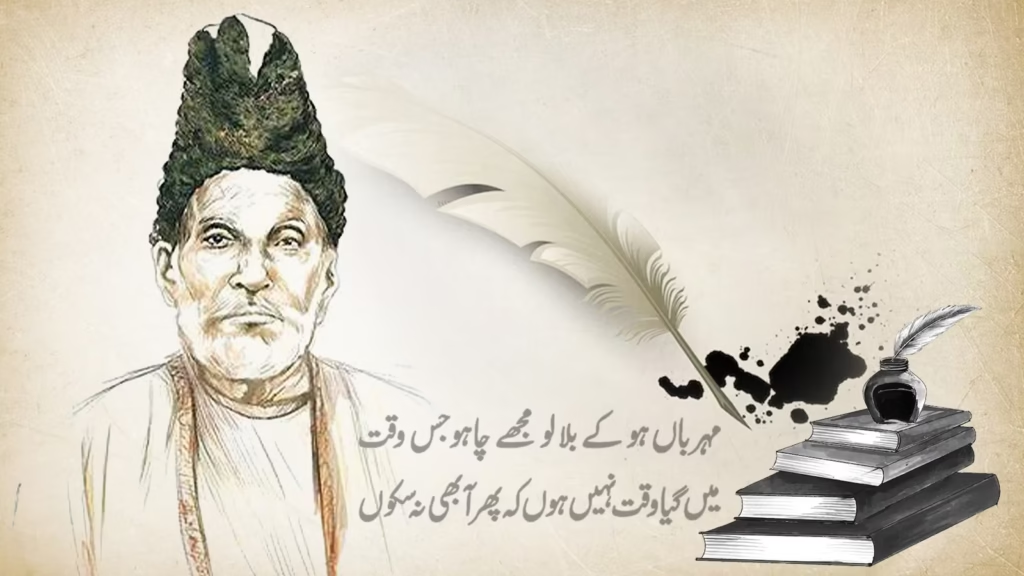
Rekhta — the poetic dialect Ghalib chose and weaponized — is not simply Urdu with extra ornamentation. It is a grammatical world in which the masculine and feminine coexist inside single lines, sometimes inside single words, creating a sliding instability of address that English cannot structurally hold. When Ghalib wrote to the beloved, the pronoun was not fixed. The speaker’s gender was not fixed. The beloved’s gender was not fixed. This was not ambiguity in the Western literary sense — not an artistic choice to suggest multiple meanings simultaneously. It was the actual texture of the language, a texture that made the erotic and the devotional genuinely indistinguishable because the grammar refused to separate them. Every English rendering must choose. Male speaker, female beloved, or some contemporary adjustment that signals awareness of the instability without reproducing it. The moment that choice is made, a whole chamber of the poem collapses. What reaches you is the furniture of the original arranged in a different room entirely.
Jacques Derrida, in The Ear of the Other, his 1982 collection of lectures and interviews on translation and autobiography, argued that every act of translation is fundamentally an act of appropriation — that the receiving language does not open itself to the original but instead absorbs it, digests it, makes it serve the rhetorical and cultural needs of its own tradition. Translation, in this framework, is never hospitality. It is conquest wearing the clothes of hospitality. What the target culture cannot absorb, it quietly removes. What destabilizes its own categories of meaning gets smoothed into something the reader can process without friction. The surviving text is not a bridge. It is a trophy.
The specific cost with Ghalib is this: the instability of the gendered address was not decorative. It was the argument. The entire philosophical weight of his Sufi-inflected skepticism — the idea that the self who loves cannot be securely located, that God and the beloved and the wine and the wound are not four things but one thing seen from four angles of a dissolving ego — lived inside the grammatical shimmer of rekhta. Strip the grammatical shimmer and you have beautiful aphorisms about love and loss and God’s indifference. Profound, moving, quotable. And philosophically inert. The blade has been removed and you are holding the handle, admiring its craftsmanship.
Between 1797 and 1869, Ghalib lived through the collapse of Mughal Delhi, the catastrophe of 1857, the slow erasure of an entire civilization’s self-understanding. He wrote in a form — the ghazal — whose structural law is fragmentation, each couplet an autonomous world that refuses to cohere into a single narrative argument. That structural refusal was not aesthetic preference. It was epistemological honesty about a world that no longer cohered. The English translations that circulate most widely flatten the fragmentary structure into something that reads more like a lyric meditation, giving the poems a through-line Ghalib architecturally denied them.
What you have been consuming, when you read Ghalib in English and felt moved, is a version of grief that has already been made survivable for you. The translation performed triage before the poem reached your hands — removed the grammatical vertigo, steadied the fragmented structure, resolved the gendered instability into something your syntax could hold. You received the emotion with the danger extracted, the way a song can be recorded at a volume that will never damage your hearing no matter how loud you play it. The real thing was designed to damage something in you, to dislodge a certainty, to make the ground of the self briefly unreliable — and the translation protected you from that, thoroughly and without your consent.
🌹 When Souls Speak Through Verse and Silence
Mirza Ghalib poured the ache of existence into the ghazal, making grief and divine longing inseparable. These four articles explore the same territory — where poetry, suffering, and the search for transcendence converge into a single cry.
Tagore’s Gitanjali: Analysis
Rabindranath Tagore‘s Gitanjali, like Ghalib’s ghazals, is a sustained offering to the infinite — a poetic dialogue between the mortal self and something vast and nameless beyond it. Tagore’s Bengali mysticism and Ghalib’s Urdu grief share a common grammar: the beloved as God, longing as prayer, and the poem as the only honest vessel for what cannot be said in prose. Reading the two together reveals how the Indian subcontinent has always treated poetry as the most serious form of philosophy.
GO TO THE SELECTION: Tagore’s Gitanjali: Analysis
Octavio Paz: Life and Thought
Octavio Paz, like Ghalib, understood that the poet stands at the intersection of erotic desire, political wound, and metaphysical vertigo. His essays on solitude and Mexican identity mirror Ghalib’s preoccupation with the self as a broken mirror reflecting an infinite cosmos. Both poets transformed personal desolation into cultural monuments, making the lyric voice a site of civilizational memory.
GO TO THE SELECTION: Octavio Paz: Life and Thought
Shelley and the Defence of Poetry: Poets as Legislators
Percy Bysshe Shelley‘s Defence of Poetry argued that poets are the unacknowledged legislators of the world — a claim Ghalib would have understood deeply, writing in a Delhi crumbling under colonial pressure. Shelley saw poetry as the highest form of knowledge because it alone could hold beauty and suffering simultaneously without resolving them, which is precisely what Ghalib’s best couplets achieve. Both poets believed that verse was not decoration but diagnosis of the human condition.
GO TO THE SELECTION: Shelley and the Defence of Poetry: Poets as Legislators
Joan Didion and Loss: The Year of Magical Thinking
Joan Didion‘s Year of Magical Thinking is, in its own way, a modern ghazal — a sustained meditation on grief that refuses consolation and insists on the presence of the absent. Like Ghalib, who continued to write through personal loss, plague, and the fall of a civilization, Didion demonstrates that language about loss is never merely about loss but about the nature of consciousness itself. Both writers transform mourning into a form of radical attention to what it means to be alive.
GO TO THE SELECTION: Joan Didion and Loss: The Year of Magical Thinking
Discover Poetry, Grief, and Transcendence on Indiecinema
If these voices of longing and loss have moved you, Indiecinema’s streaming platform gathers films that speak the same language — independent and world cinema where silence carries weight, beauty aches, and every image feels like a verse. Explore our curated catalog and let cinema do what Ghalib asked of poetry: break you open, then quietly put you back together.
👉 EXPLORE THE CATALOG: Watch Indie Films in Streaming
A vision curated by a filmmaker, not an algorithm
In this video I explain our vision

