
The Body Before the Mind Arrives
You are standing in a room — it could be any room — when a sound enters you without asking permission. Not through the ears exactly, or not only through the ears, but through the sternum, the jaw, the soft tissue behind the knees. Something locks and releases simultaneously in the chest. Your throat tightens for no reason you can name. You have not yet decided how you feel about what you are hearing. You have not yet had time to decide. The decision, it turns out, was never yours to make.

This is the first embarrassing fact about music: it acts on the body before the mind has filed any paperwork. The response is already underway — heart rate shifting, skin conductance rising, the postural muscles making small unconscious adjustments — while the intellect is still reaching for its reading glasses, still trying to categorize, contextualize, approve or dismiss. Neuroscientist Stefan Koelsch, in his 2012 work Brain and Music, documented the speed at which subcortical structures process musical input, showing that emotional responses to sound are generated in regions of the brain that predate language, predate culture, predate the particular story you tell yourself about who you are and what moves you. The amygdala does not care about your taste. It was there long before taste existed as a concept.
What makes this unsettling rather than merely interesting is what it implies about the border you believe you maintain between yourself and the world. Most of the time, adults in literate, self-conscious cultures operate with a working assumption: that experience enters through the senses, is processed by the mind, and then — only then — produces a feeling. This sequence feels like dignity. It feels like agency. Music abolishes it without ceremony. The feeling is already happening while the mind is still walking down the corridor. Cognition arrives to find the furniture rearranged.
The philosopher Susanne Langer, writing in Philosophy in a New Key in 1942, argued that music does not express emotions the way a letter expresses an opinion — it presents the logical form of feeling itself, the shape of how affect moves through time, its tensions and resolutions, its collapses and surges. She was pointing at something that rational aesthetics had consistently avoided: music does not communicate about inner life from a safe distance. It temporarily becomes the structure of your inner life, from the inside. You do not observe a musical phrase building toward resolution. You are, briefly and without consent, a creature that needs that resolution the way you need to exhale.
This is why music has been treated with suspicion by every social order that depends on the management of inner life. Plato’s Republic, written in the fourth century BCE, proposed strict state censorship of musical modes, not because Plato was a philistine but because he understood precisely what music does — that certain scales and rhythms produced psychological states in citizens that were ungovernable, that loosened the architecture of the self that civic order required to be kept tight. The Dorian mode could stay. The Lydian and Mixolydian modes, which induced softness and lamentation, had to go. He was not wrong about the mechanism. He was only wrong to be afraid.
Because what music reaches, in that gap before thought arrives, is not chaos. It is something more accurately described as the unedited self — the one that existed before you learned which emotions were appropriate to display in which rooms, before you internalized the specific emotional grammar of your class, your culture, your family’s particular silence on certain subjects. The body receiving music does not yet know it is supposed to be composed.
Irene
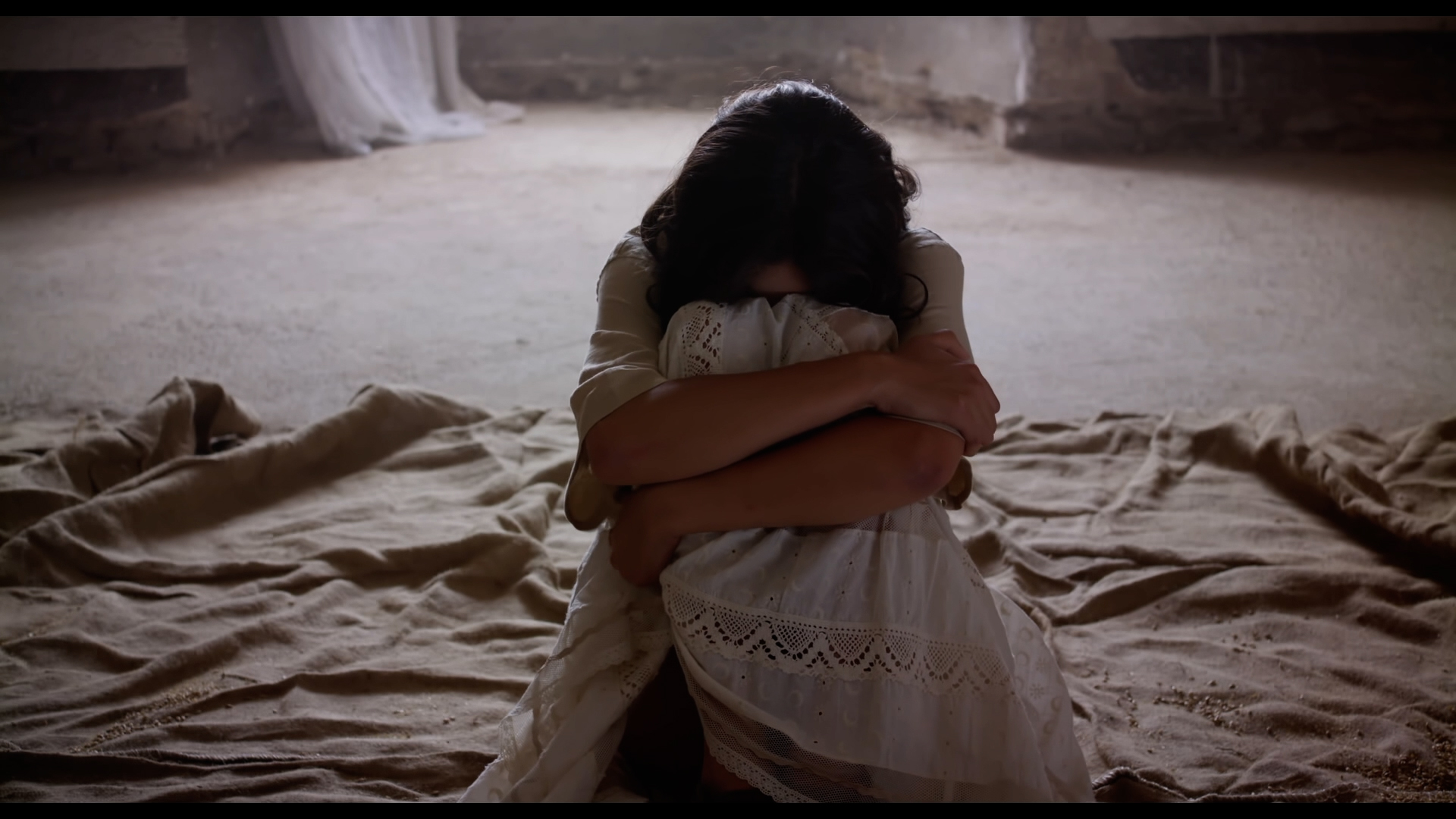
Drama, by Valerio Pampaglini, Italy, 2023.
Irene is trapped within her own unconscious, empty and ruined like an abandoned house. Through broken glass and shady figures dressed in black, a song awakens something long forgotten inside her. The film, written and directed by Valerio Pampaglini, is supported by the Rome Film Academy. It was shot in the summer of 2022 in the province of Perugia, in the municipality of Todi and at the Montenero castle.
LANGUAGE: Italian
SUBTITLES: English
What the Enlightenment Refused to Hear

You are sitting in a concert hall built in 1871, the year the Paris Commune was crushed and bourgeois Europe exhaled with relief. The seats are upholstered in red velvet. The lighting is calibrated to direct your gaze forward and slightly upward, toward the stage where music will be performed at you, for you, in exchange for a ticket purchased at a fixed price. Everything about the architecture insists that you receive rather than participate, that you appreciate rather than be undone. The hall was not designed to make you lose yourself. It was designed to confirm that you have a self worth keeping.
The Enlightenment did not simply produce new ideas about reason. It produced a new relationship between the human being and experience, one in which every sensory encounter had to be filtered, classified, and ultimately rendered safe for the sovereign individual. Kant’s third Critique, published in 1790, attempted to codify aesthetic experience as a form of disinterested judgment, pleasure evacuated of desire, perception cleansed of consequence. Music, in this framework, became an object to be assessed rather than a force to be survived. The listener was positioned above the sound, evaluating it, rather than inside it, being altered by it. This was not a neutral philosophical move. It was a quarantine.
What Theodor Adorno identified in 1941, in his essay on popular music written with Max Horkheimer’s Frankfurt circle pressing at his back, was something more specific and more brutal than aesthetic decline. He traced the mechanism by which music had been industrially standardized into a commodity that produced the sensation of recognition without the experience of encounter. The hook, the chorus, the predictable resolution — these were not failures of creativity but successful technologies of psychological management. Music that never surprises cannot destabilize. And music that cannot destabilize cannot reach the place in the listener where genuine psychological movement becomes possible. The product was not entertainment. The product was a listener trained to expect confirmation.
This training has a history that runs deeper than the recording industry. Medieval European musical tradition operated under a classification that modern listeners find baffling: certain intervals were designated musica diabolica, literally the devil’s music, not because of lyrical content but because of the cognitive and physiological response they provoked. The tritone, the augmented fourth, was banned from liturgical composition across significant stretches of church history precisely because it produced in listeners something that could not be controlled or predicted. The Church understood, at an institutional level, what the Enlightenment would later systematically deny: that specific combinations of sound could bypass rational cognition entirely and produce states that resembled possession more than appreciation.
What modernity inherited from this suppression was not the Church’s theology but its fundamental anxiety, repackaged as aesthetic theory. The fear was never really about Satan. It was about the listener who could no longer be trusted to remain a legible social subject after the music had passed through them. A person destabilized by sound is harder to govern, harder to sell to, harder to conscript into the shared fiction of coherent identity that organized Western social life required. Rationalized aesthetics solved this problem elegantly: it told you that the highest form of musical engagement was calm, reflective appreciation, that to be visibly moved was somewhat embarrassing, that transcendence and transport were the province of the uneducated or the primitive.
The sophistication of this maneuver lies in how thoroughly it was internalized. By the twentieth century, listeners did not need critics to police their responses. They policed themselves, describing their own most disorienting musical encounters in the cautious language of preference and taste, as though the nervous system were simply offering a product review rather than reporting the temporary dissolution of its own organizing structures.

The Unconscious Has Always Had Its Own Frequency
You are sitting in a concert hall, or maybe a field, or maybe just a car with the windows cracked, and something in the music shifts — not the melody, not the key, but something underneath all of that — and your chest tightens in a way that has nothing to do with memory, nothing to do with the lyrics, nothing to do with anything you could point to on a map of your own life. You have not been here before. The feeling has.
Carl Jung spent decades trying to articulate the difference between what an individual inherits biographically and what the species carries structurally, and in his 1959 work “The Archetypes and the Collective Unconscious” he argued that beneath the personal layer of psychic life runs a deeper stratum that no single human life deposited there. He called it the collective unconscious, and he was careful — more careful than most of his popularizers — to insist it was not mysticism but structural inheritance, the psychic equivalent of having a liver. You did not choose to have one. You did not learn how to use it. It simply operates. The archetypes he mapped — the shadow, the anima, the Self — were not symbols invented by poets but recurring configurations of experience so old they predate any cultural record we possess, surfacing in dreams, in ritual, in the images that appear when conscious control loosens its grip.
What Jung never fully pressed was the question of what medium carries this inherited content before image, before narrative, before the symbolic register of dreams even has a chance to organize. John Blacking, the ethnomusicologist who spent years living with the Venda people of southern Africa before publishing “How Musical Is Man” in 1973, pushed precisely into that gap. His argument was empirical and quietly devastating: musicality is not a cultural acquisition but a biological endowment, and the Venda children he observed were not taught rhythm in the way Western children are taught to read — they absorbed it through the body before cognition had a vocabulary to interfere. Rhythm was not a skill. It was a recognition. The body knew the pattern the way it knows to flinch before the mind registers the threat.
Blacking’s findings reframe what we think we are doing when music moves us. We imagine we are appreciating something external, a craft constructed by another person that our educated sensibility has learned to receive. But if rhythmic and tonal structure activates pre-linguistic pathways — and the neuroscience emerging in the decades after Blacking, including Stefan Koelsch’s work on the emotional processing of harmony published in Nature Reviews Neuroscience in 2014, confirms that music engages subcortical structures that predate the neocortex — then the transaction is closer to recognition than reception. You are not learning something when a minor progression opens something in you. You are being reminded of something for which you have no words because words came later, much later, than the frequency itself.
This matters because it means the unconscious has always had its own infrastructure for communication, one that bypasses the editorial control of conscious interpretation entirely. Language can lie with perfect fluency. It can withhold, distort, perform. A person can tell you they are fine in grammatically impeccable sentences while their body broadcasts a completely different signal. But when music operates below the threshold of lyrical meaning — when it is pure duration and vibration and the mathematics of interval — it reaches the layer that does not know how to perform. The body’s response to a drone, to a rhythmic pulse locked at a certain tempo, to a chord that refuses resolution, is not aesthetic judgment. It is disclosure. Something in the structure is recognized by something in you that you did not consciously choose to bring into the room.
Industry as Sedation

You are sitting in a coffee shop, and the music is doing nothing to you. That is not an accident. The playlist threading through the ceiling speakers has been algorithmically assembled to maintain a precise emotional neutrality — stimulating enough to prevent irritation, bland enough to prevent attention. You do not notice it, which is exactly the outcome its architects intended.
The postwar recording industry inherited a world already primed for standardization. In 1955, the International Organization for Standardization formalized the concert pitch at 440 Hz, cementing a tuning frequency that had been contested for decades across European orchestral traditions, where pitches ranged anywhere from 432 to 435 Hz depending on region and era. The ISO decision was not made by composers or acoustic researchers pursuing some natural harmonic ideal — it was a commercial and logistical agreement, driven by the need for interoperability between instruments, broadcasters, and record manufacturers scaling their operations globally. What had been a living negotiation between human bodies and resonant space became a fixed coordinate on an industrial map. The philosopher of technology Lewis Mumford, writing in his 1934 work Technics and Civilization, had already named this process before it reached music: the subordination of organic rhythm to mechanical time, the replacement of variable, situated experience with reproducible, transferable units. The 440 Hz standard was Mumford’s argument made audible.
What followed was not a single act of suppression but a slow narrowing, measurable in the engineering decisions that accumulated over seventy years. Dynamic range — the distance between the quietest and loudest moment in a piece of recorded music — began contracting visibly in the 1990s with the onset of what mastering engineers themselves came to call the Loudness War. The logic was straightforward and catastrophic: louder tracks registered as more impactful on radio and early digital platforms, so engineers applied compression and limiting to raise average volume levels, crushing the peaks and silences that had previously given music its sense of breath. By 2008, albums were being mastered at dynamic range values of four or five decibels, down from the fourteen or fifteen that characterized recordings from the 1970s. The silences were not simply removed — silence in music is not neutral, it is where the body reorganizes itself around what it has just received. Removing it is equivalent to removing the pause between a stimulus and a response, foreclosing the unconscious processing that transforms sensation into meaning.
Streaming platforms then completed the architecture. Spotify’s loudness normalization, introduced in 2013, leveled all tracks to a target of negative fourteen LUFS — a technical standard that discouraged dynamic variation because peaks would be penalized by the normalization algorithm. The incentive structure rewarded flatness. Combined with the playlist format, which shuffles between artists and genres without silence or transition, the listener is submerged in a continuous sonic bath that never demands orientation, never produces the disorientation that precedes genuine hearing. The neuroscientist Stefan Koelsch, in his 2012 volume Brain and Music, documented that emotionally significant musical moments activate limbic and paralimbic structures including the amygdala and the hippocampus — precisely the regions implicated in memory consolidation, threat detection, and deep affective processing. These structures respond to contrast, to surprise, to the violation of expectation. An auditory environment engineered for consistency does not reach them.
What the industry monetizes, then, is not music in any sense that would have been recognizable before the mid-twentieth century. It monetizes the sensation of music — the timbral texture, the rhythmic pulse, the social signaling of genre affiliation — while evacuating the conditions under which music actually does something to the organism. The product is consumable precisely because it has been rendered inert.
When the Wall Between Self and Sound Dissolves
There is a man sitting in a hospital cafeteria in the early 1990s, eating alone, when a melody comes through a small speaker mounted near the ceiling — something unremarkable, a fragment of orchestral music from decades before his birth. He does not recognize it consciously. But within seconds he is weeping in a way he cannot control, not from sadness exactly, but from something that has no name in the emotional vocabulary he was given, something closer to the sensation of a seam being torn open along a line he never knew existed in him. He does not choose this. He does not want it. He leaves his food on the table and walks outside into the cold, shaking, with the specific bewilderment of someone who has just discovered that a room exists inside them they were never given a key to.
Oliver Sacks, in his 2007 study Musicophilia: Tales of Music and the Brain, documents cases that make that experience structurally legible without making it less strange. What Sacks found — across patients with temporal lobe epilepsy, profound amnesia, and acquired musical hallucination — is that music operates on neural pathways that are largely immune to the kind of damage that erases language, face recognition, and autobiographical memory. A man who cannot remember his own name will nonetheless remember the complete lyrics and melody of a song he heard at nineteen. The implications of this are not primarily neurological. They are ontological. If music survives the destruction of the self, then music was never stored inside the self the way we imagine our memories to be stored — as possessions, as contents of an interior cabinet. It was woven into the architecture of the organism at a level below the threshold of personal identity.
This is why the rupture in the cafeteria feels like a violation and not a recollection. The man is not remembering something he forgot. He is being contacted by a version of his own nervous system that never agreed to be managed, to be civilized, to be made into a coherent social person with a consistent name and a predictable set of reactions. Music does not remind him of who he was. It demonstrates, briefly and without asking permission, who he also is.
Western modernity has spent roughly three centuries constructing an account of the self as sovereign — as the author of its own attention, the proprietor of its own interior life. Descartes placed the thinking subject at the center of reality in 1637, and the entire subsequent architecture of liberal individualism rests on that foundation: you are the one who decides what enters you, what moves you, what you become. Music dismantles this with a brutality that philosophy rarely achieves. The four-hundred-millisecond delay that neuroscientist Benjamin Libet measured between neural preparation and conscious decision — published in Brain in 1983 — already suggested that intention arrives after the fact, as a story the mind tells about what the body has already done. Music makes this visible in real time. The shiver along the spine, the sudden constriction in the throat, the involuntary slowing of breath: none of it waits for your authorization.
What dissolves in those moments is not the self, exactly, but the self’s claim to have been the point all along. The music does not come from outside to fill an empty vessel. It activates something that was always present but structurally suppressed — the organism’s capacity for states that have no utility, no social function, no narrative resolution, states that exist only as pure intensity, as an encounter with duration itself stripped of its usual furniture. Sacks noted that even patients in advanced neurological decline could be returned, temporarily, to something resembling full presence through music — not to memory, not to language, but to a quality of aliveness that the illness had buried but had not destroyed.
That aliveness does not belong to culture, or to history, or to the story any of us have been told about what we are.
A vision curated by a filmmaker, not an algorithm
In this video I explain our vision
🎵 When Sound Opens the Gates of the Soul
Music has always been more than entertainment — it is a language spoken directly to the unconscious, bypassing reason and touching something primal. From ancient ragas to psychedelic sound journeys, the relationship between music and the hidden layers of the psyche has fascinated artists, philosophers, and mystics alike. These articles explore the depths where sound and inner life converge.
Raga in Indian Music: When Sound Touches the Soul
The raga is not merely a musical scale but a living emotional architecture designed to awaken specific states of consciousness in both performer and listener. Rooted in millennia of Indian philosophical thought, each raga corresponds to a time of day, a season, and a mood that resonates with the deepest layers of the human soul. To enter a raga is to undergo a carefully structured journey into the unconscious through sound.
GO TO THE SELECTION: Raga in Indian Music: When Sound Touches the Soul
Indian Classical Music: A Journey Into Infinite Sound
Indian classical music is one of humanity’s oldest systems for inducing altered states of awareness through organized sound. Its structures — built on drone, improvisation, and rhythmic cycles — create conditions in which the listener can dissolve ordinary mental boundaries and access deeper psychic material. Understanding this tradition illuminates why music has been considered a spiritual technology across cultures and centuries.
GO TO THE SELECTION: Indian Classical Music: A Journey Into Infinite Sound
Roland Barthes and Listening: The Grain of the Voice
Roland Barthes‘s concept of the ‘grain of the voice’ points to something in music that exceeds technical execution — a bodily, almost erotic residue that speaks directly to unconscious desire. Barthes argued that what moves us in a voice is not its formal beauty but its material texture, its friction against language and meaning. This insight bridges aesthetics and depth psychology in a uniquely powerful way.
GO TO THE SELECTION: Roland Barthes and Listening: The Grain of the Voice
Huxley’s The Doors of Perception: Analysis
Aldous Huxley‘s account of his mescaline experience revealed how chemically altered perception could transform even ordinary sounds into vast landscapes of unconscious meaning. Music heard under such conditions ceased to be entertainment and became a force that restructured inner reality, dissolving the ego’s defenses with extraordinary precision. Huxley’s reflections remain one of the most lucid Western explorations of sound as a doorway to the unconscious.
GO TO THE SELECTION: Huxley’s The Doors of Perception: Analysis
Discover Cinema That Listens to What Cannot Be Said
If these themes of music, consciousness, and inner awakening resonate with you, Indiecinema is the streaming platform where independent cinema dares to explore what mainstream culture leaves in silence. From visionary documentaries to experimental films that use sound as a narrative soul, Indiecinema invites you to watch differently — and to listen more deeply.
👉 EXPLORE THE CATALOG: Watch Indie Films in Streaming
A vision curated by a filmmaker, not an algorithm
In this video I explain our vision

