
The Body That Reads
You are reading a sentence right now, and something in you is already deciding what it means before it ends. That decision happens faster than thought — faster than you can catch it happening — and by the time you reach the period, the meaning feels inevitable, as though the words could not have meant anything else. But sit with that sentence a moment longer than you normally would. Read it again. Notice how the certainty begins to loosen at the edges, how the word “reading” starts to feel strange in your mouth, how the very act of paying attention to the mechanism of interpretation causes the mechanism to stutter and expose itself. You are not finding meaning in the text. You are producing it, right now, from everything you have ever been.

This is the moment — not of enlightenment, but of vertigo. The reader who arrives at it for the first time does not feel expanded. They feel caught. Because the uncomfortable discovery is not that language is slippery or that words are ambiguous; those are familiar complaints, the kind one files and forgets. The real discovery is structural and personal simultaneously: that what you bring to a text is not a neutral instrument of comprehension but an entire history — class, desire, education, fear, the specific culture that shaped what counts as obvious and what counts as strange. The text does not open to you. You open to it, and it reaches in.
There is a French intellectual tradition, born roughly between the two World Wars and reaching full force by the 1950s and 60s, that took this vertigo seriously as a philosophical problem rather than a literary curiosity. It asked: if meaning is produced rather than found, if the reader is not a transparent receiver but a dense site of cultural inscription, then what is an author? What is a text? What is the relationship between the sentence on the page and the ideology that made it feel natural? These were not academic puzzles. They were questions about power — about who gets to fix meaning in place, who benefits from the illusion that certain interpretations are simply correct, and who is silenced when that illusion holds.
Roland Barthes, born in Cherbourg in 1915, grew up with a kind of double exposure to the world: the bourgeois surface of French provincial life and, beneath it, a persistent awareness of what that surface was concealing. His father died in naval combat in 1916 when Barthes was less than a year old, and his early life was shaped by a genteel poverty that sat awkwardly alongside the cultural aspirations his mother nurtured in him. He contracted tuberculosis as a young man, spending significant periods between 1934 and 1947 in sanatoria — those strange suspended institutions where time slows and one reads, thinks, and observes with unusual intensity because there is little else available to do. Whatever else that enforced stillness cost him, it produced a reader of exceptional precision.
His first major work, Writing Degree Zero, published in 1953, announced immediately that he was not interested in literature as aesthetic decoration but as a socially produced object — a system in which choices of style and form carry ideological weight whether or not the writer intends them to. He borrowed the structural linguistics of Ferdinand de Saussure not as a methodology to be applied from a safe distance but as a scalpel to be pressed directly into the body of cultural life. What he found inside was not chaos but convention — meaning secured not by truth but by repetition, by the slow accumulation of uses that make certain readings feel natural and render others invisible.
The reader who feels unsettled by this has already understood something. The one who feels nothing yet is still a few pages away from the moment when the text turns around and regards them steadily, without blinking.
A Better Life
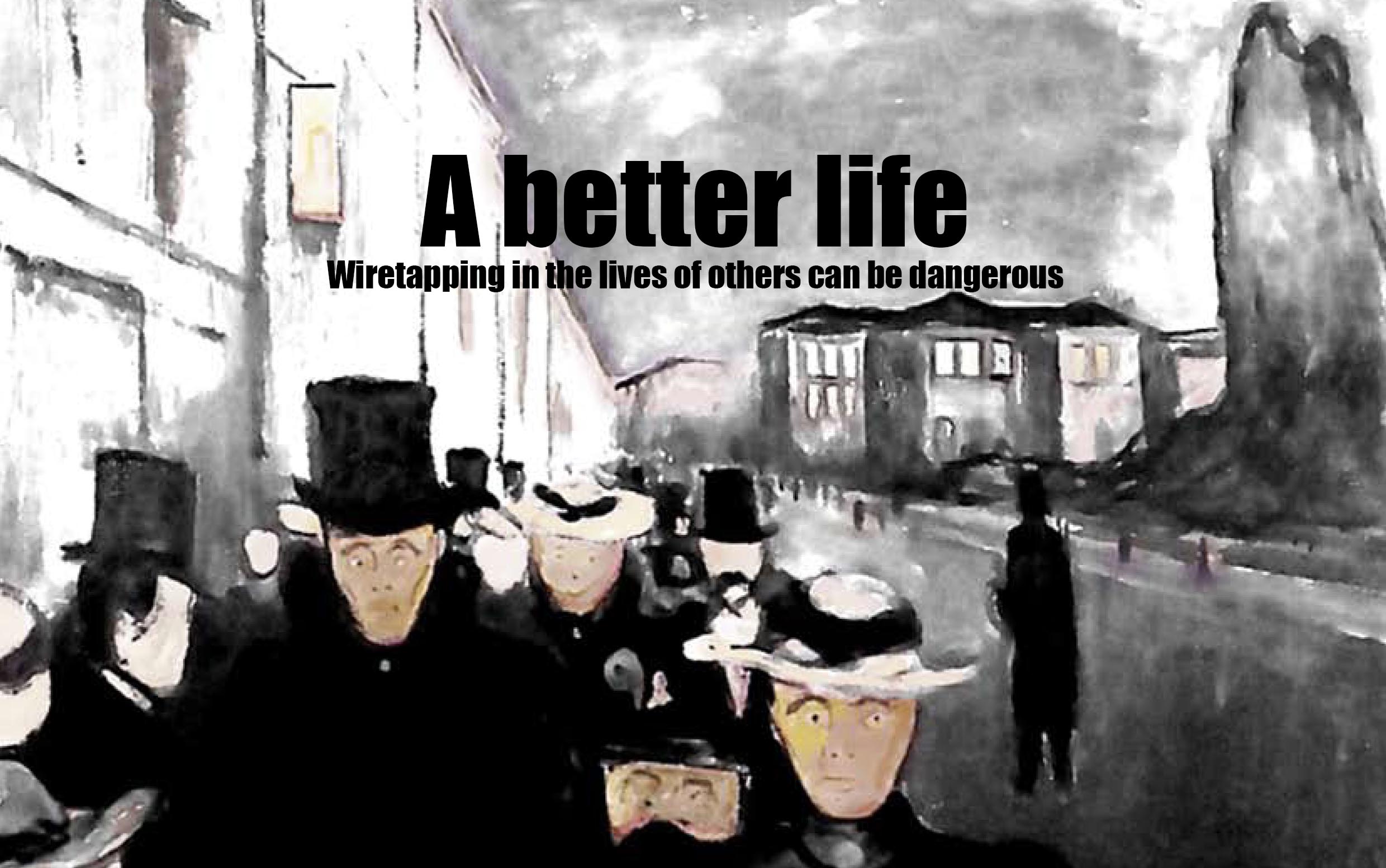
Drama, thriller, by Fabio Del Greco, Italy, 2007.
Rome: Andrea Casadei is a young investigator specializing in audio wiretapping who conducts investigations commissioned by husbands betrayed by their wives, or by parents worried about what their children are doing outside the home. But what interests him most is understanding the human soul, listening to casual conversations in the streets, knowing what people think. He often meets in Piazza Navona with his friend Gigi, a frustrated street artist obsessed with success at all costs, with whom he shares a passion for wiretapping. Shocked by the mystery of the disappearance of Ciccio Simpatia, another street artist common friend, Andrea decides to abandon the commissioned works to seek a better life and reflect on his own and others' existence. He will meet the actress Marina and with a bug he will slowly enter her life until he discovers her most unthinkable secrets. The film deals with an important theme of contemporary Western society: the lack of love. The mysterious and tormented figure of Marina is reflected in a gloomy and soulless Rome.
Director Fabio Del Greco declared about his film: "Perhaps this film is a reflection on the art of observing, of listening, in short, of what one does when one leaves the real world to tell about it. Perhaps he wants to talk about the subtle relationship between the mirages of success touted by today's society, power and the most authentic human relationships.A 'dark cloud' hangs over the city: it is engulfing everyone in a sort of indistinct, uniform mass, where everyone thinks the same things, where everyone they are more alone. Where is the truest part that makes us unique? Maybe you can try to intercept it only secretly."
LANGUAGE: Italian
SUBTITLES: English, Spanish, French, German, Portuguese, Dutch.
A Life Lived Against the Grain
You sit with a diagnosis at twenty-two and watch the decade ahead dissolve. Not metaphorically — literally: the plans, the examinations, the agrégation, the normalized ascent through French academic life, all of it suddenly inaccessible, replaced by a sanatorium bed in Leysin, Switzerland, where Roland Barthes would spend years watching his own lungs become the subject of a clinical narrative he could not author. Tuberculosis in 1934 was not merely an illness; it was a social sentence. It removed you from the competitive formation that produced French intellectual careers, from the grandes écoles, from the certification rituals that separated those who would be taken seriously from those who would always be slightly suspect.
What the disease took in terms of institutional legitimacy, it returned in something stranger and harder to name: time outside the machine. The sanatorium years, stretching across more than a decade with recurring relapses, gave Barthes an education conducted entirely through reading rather than examined performance. He encountered Marx, Sartre, Michelet — not as syllabus items but as private obsessions. The enforced marginality became a kind of epistemological position, a way of seeing institutions from a position that was never fully inside them. When he eventually secured teaching posts, they were in Bucharest, Alexandria, minor appointments that the French academic system would not have considered serious placements. His entry into the Centre National de la Recherche Scientifique came only in 1952, nearly two decades after his peers had been credentialed and settled. The delay left a residue: a permanent slight suspicion toward systems of consecration, toward the apparatus that decides what counts as knowledge.
French society in the 1950s had an elaborate public silence around homosexuality, which is different from saying it did not exist — it means rather that it existed as something you performed around, managed, displaced into other registers. Barthes never came out in any declaration; he operated instead through what might be called a lateral honesty, encoding desire into the vocabulary of aesthetics, into his writing on photography, on the body in performance, on what he would later call in his 1977 lectures at the Collège de France the neutral, that refusal of the binary forced choice. His homosexuality was not a secret exactly, but it was also never given the dignity of public language during the years when it most shaped how he moved through the world — the years of professional formation, of social risk, of the casual violence that attaches to men who do not organize themselves along expected lines.
His mother Henriette Barthes was not a biographical footnote. She was, by every account Barthes himself left, the organizing center of his private life. They lived together for most of his adult years. She appears in his 1980 book Camera Lucida not by name but as the structuring absence — he searches through photographs of her after her death in October 1977, looking for the image that captures what she actually was to him, and what he finds instead is the theoretical heart of the entire text: the punctum, the detail that wounds. Her death at eighty-four unmade him in ways that colleagues and readers found excessive by the standards of public intellectual composure. He wrote in his journals about grief with a directness that the French critical establishment was not entirely prepared to receive from a semiotician. The grief was not performed; it was the kind that erodes the scaffolding you have built your productive life upon.
What the sanatorium years and the institutional margins and the hidden desire and the late grief share is not a narrative of victimhood but something more precise: they produced a thinker constitutionally unable to trust the categories that societies hand you, because every category he had been offered had already failed to hold him.

Mythologies and the Violence of the Obvious

You are standing in a French supermarket in 1955, and the steak on the shelf in front of you is not a piece of meat. You have not registered this yet. You are reaching for it the way you reach for anything inevitable.
What Roland Barthes published in 1957 was not a collection of cultural criticism in any sense the academic world had previously authorized. Mythologies arrived as a kind of intellectual ambush — fifty-four short essays written between 1954 and 1956 for the magazine Les Lettres nouvelles, followed by a theoretical epilogue that retrospectively detonated everything before it. The target was not ideology in its visible, declared form. The target was the opposite: the perfectly natural, the taken-for-granted, the thing that needs no explanation precisely because it has been made to feel eternal. Barthes understood that power does not announce itself. It exhales.
The method he employed was semiological, inherited and sharpened from Ferdinand de Saussure’s structural linguistics — the distinction between signifier and signified — but Barthes added a second tier, a parasitic layer in which an existing sign becomes the signifier for a new, ideologically freighted signified. This is what he called myth: not a lie, not a fantasy, but a form of speech that empties history out of a sign and replaces it with nature. The wrestling match he analyzes is not about sport. The excessive, theatrical suffering of the loser — that outstretched arm, that grimace held one beat too long — functions as a moral spectacle, staging justice as a physical and legible event for an audience that requires the world to be decipherable in its body. The working-class crowd watching the match is not being deceived; it is being given a grammar of the universe that confirms its own subordination as cosmically correct.
The new Citroën DS — presented at the Paris Motor Show in October 1955, where it attracted one and a half million visitors in eleven days — was, for Barthes, a supernatural object. He described it as fallen from the sky, its body seamless, its interior suggesting the comfort of a household rather than the aggression of velocity. The DS was not merely a car. It was a projection of what French postwar society wanted to believe about itself: that modernity was smooth, prosperous, and arrived without rupture. The violence of the Liberation, the collaboration, the colonial wars already grinding away in Indochina and beginning in Algeria — none of this needed to be visible inside a vehicle that looked like a visitation from a more perfect civilization. The object performed amnesia with the elegance of design.
What makes Mythologies genuinely disturbing, even now, is not the examples but the underlying diagnosis. Barthes was arguing that bourgeois culture is distinguished by its refusal to name itself. The aristocracy had no difficulty declaring its values as values — they were frankly hierarchical, openly exclusive. The bourgeoisie performs a different operation: it presents its particular historical arrangements as universal human nature, its tastes as common sense, its comfort as decency. In 1957, this was a philosophical provocation. In the decades since, it has become the operating system of every algorithm that tells you what people like you tend to enjoy.
His essay on steak and chips reads today as an almost tenderly savage autopsy. The redness of the steak is not a culinary preference — it is a blood contract with virility, nationality, and a particular idea of the real. To eat the steak rare is to participate in a theater of authenticity so thoroughly rehearsed that no one in the dining room suspects they are performing. The chips beside it carry their own freight: popular, loyal, French, without pretension. Together they compose a sentence in a language nobody admits to speaking, about who belongs and who does not, about what counts as honest appetite and what counts as decadence.
The violence Barthes committed was not against any individual belief. It was against the sensation of obviousness itself — that warm, sedating certainty that some things simply are what they are.
The Structuralist Moment and Its Betrayal
You are handed a map of the entire territory of human meaning — every sign, every code, every myth organized into clean taxonomies — and for a moment you believe that the world has finally consented to be understood.
This was the intoxication of Paris in the early 1960s, and it was genuine. Claude Lévi-Strauss had already demonstrated, in his 1958 Structural Anthropology, that the kinship systems of so-called primitive societies operated according to the same combinatory logic as phonology — that beneath the surface noise of culture lay a grammar, silent and universal, indifferent to history. Roman Jakobson was mapping the binary oppositions structuring poetic language. Algirdas Julien Greimas was constructing his actantial model, a geometric diagram capable of reducing every narrative ever told to six positions and their relations. The ambition was total: not merely to describe culture but to formalize it, to produce a science of signs that would do for human meaning what Newton had done for motion. Roland Barthes entered this constellation at precisely the right moment — and then proceeded, with a slowness that looked like participation, to hollow it out from within.
Elements of Semiology, published in 1964, reads at first like a rigorous act of disciplinary loyalty. Barthes systematizes Ferdinand de Saussure’s distinctions — langue and parole, signifier and signified, syntagm and paradigm — extends them into domains Saussure never entered, and offers the reader the impression of a coherent theoretical instrument. But something is already wrong with the instrument, and the wrongness is deliberate. Barthes takes Saussure’s foundational claim that linguistics is merely one branch of a future general science of signs, then quietly inverts it: semiology, he proposes, is actually a branch of linguistics. The reversal is not a footnote. It means that every system of signs — fashion, food, architecture, traffic codes — is always already traversed by language, contaminated by its instabilities, its historical sediment, its capacity to mean obliquely and against itself. A science built on that foundation cannot remain a science for long.
What Barthes understood, and what many of his contemporaries were determined not to understand, is that structuralism carried within itself a theological temptation — the fantasy of the view from nowhere, the analyst who stands outside the system and deciphers it without being touched by it. Lévi-Strauss believed, with genuine conviction, that the structures he uncovered were features of the human mind itself, transhistorical and impersonal. Barthes found this belief not wrong exactly, but dangerous in its comfort. The analyst is always inside the codes they are reading. Their very categories are inherited from a specific language, a specific moment, a specific class — which is to say they are ideological before they are scientific, and calling them scientific is itself an ideological gesture of the most consequential kind.
This is why Barthes never founded a school, despite occupying a position — at the École Pratique des Hautes Études from 1960 onward — that would have made institutional consolidation easy and professionally rewarding. Schools require doctrines. Doctrines require the suppression of the doubt that generated them. He had watched Sartrean existentialism calcify into a moral posture, watched Marxist literary criticism harden into a tribunal, and he had no appetite for repeating the pattern with semiological categories that he himself had done more than anyone to popularize. The system was a tool. The mistake was mistaking the tool for the truth it was meant to locate.
By the mid-1960s, Barthes was already writing criticism that the Elements could not account for — criticism that attended to pleasure, to the grain of a voice, to the way a text touches before it signifies. The categories were still present but they were being asked to bear a weight they were never designed to carry, and under that weight they were beginning, very productively,
The Death of the Author as an Act of Liberation and Terror
You are reading this sentence, and whatever Barthes intended when he arranged his words in 1967 means nothing about what is happening to you right now. That is the provocation — not as metaphor, but as literal claim. In his essay “The Death of the Author,” published in the American journal Aspen, Barthes declared that the moment writing begins, the author vanishes. The hand that moves is severed from the voice that might explain it. What remains is not communication but a space into which the reader pours themselves, endlessly, without a floor.
The political weight of this is not immediately obvious, and that is precisely where the trap springs. In 1967, France was approximately eighteen months away from May ’68, and the intellectual atmosphere was saturated with the project of dismantling authority in every form — paternal, institutional, interpretive. Barthes was not making a mild observation about literary hermeneutics. He was detonating the figure of the Author as a bourgeois construction, a capitalist anchor that tied meaning to ownership, to a named individual whose intentions could be verified, purchased, copyrighted, and controlled. The Author, in his analysis, was not a person but a property regime. Killing the author meant expropriating the text — returning it to what he called “that neutral, composite, oblique space where our subject slips away, the negative where all identity is lost.”
What sounds like emancipation contains something structurally identical to abandonment. If no singular intention governs a text, then no misreading is possible — which sounds thrilling until you realize it also means no accountability is possible. Every manipulative reading, every weaponized excerpt, every deliberately decontextualized quotation becomes theoretically legitimate the moment authorial intention is removed as a corrective measure. The text about racial justice can be mined for a sentence that appears to justify hierarchy. The novel written against war can be recruited to celebrate it. Without the author as witness, the reader becomes not liberated but sovereign — and sovereignty without restraint is simply power.
Michel Foucault, responding directly to Barthes in his 1969 lecture “What Is an Author?”, saw this clearly enough to sharpen it into something almost clinical. He proposed the “author-function” — not the author as person but as a regulatory principle that governs how texts are received, classified, and contained. Removing the human author did not dissolve this function; it simply made it invisible. The question was never who wrote the text but what social apparatus was deciding what the text could mean. Barthes had killed the wrong figure. The one doing the real work of meaning-control was not the novelist or the essayist but the institution — the publisher, the curriculum committee, the critic, the algorithm.
What Barthes could not have anticipated in 1967, or perhaps what he could see only in outline, is that the death of the author scales. A single essay in an avant-garde American arts magazine remained a conceptual event. But a world built on networked distribution, on content severed from origin, on text that travels without its body — that world has enacted the death of the author at industrial speed and without any of the liberatory intent. Anonymity was supposed to dissolve the tyranny of the proper name. Instead it produced the condition in which fabricated quotations attributed to real thinkers circulate through millions of feeds, in which synthetic text carries no author-function at all, in which the “scripter” Barthes offered as replacement for the Author — a figure who merely combines and redistributes existing signs — has become literally mechanical.
There is something vertiginous about realizing that the most radical gesture of a mid-century French intellectual critic has been perfected not by readers finally freed to produce their own meanings, but by systems that produce meaning with no interiority whatsoever, no body, no history, no
A vision curated by a filmmaker, not an algorithm
In this video I explain our vision
The Pleasure and the Rupture

You are reading and something tears. Not metaphorically — something in the tissue of your attention gives way, and you find yourself on the other side of a sentence without knowing how you crossed it. This is not pleasure in any comfortable sense. This is what Roland Barthes, in Le Plaisir du texte published in 1973, was trying to name when he reached for the French word jouissance, a term that resists translation precisely because English wants to domesticate it into satisfaction or enjoyment, when what Barthes meant was closer to a kind of productive devastation.
The distinction he draws is not casual. Plaisir — pleasure — is the text that confirms, that fulfills expectation, that allows the reader to consume culture while remaining intact. It is the readerly experience as a form of self-recognition: you find the book agreeable because it gives you back a version of yourself you already approve of. Jouissance is something else entirely. It is the text that imposes a loss, that unsettles the reader’s historical, cultural, and psychological assumptions, that produces not comfort but a fissure. Barthes describes it as a crisis of language, a moment where meaning does not arrive but collapses — and this collapse, counterintuitively, is the more honest literary event. He was describing, in 1973, what criticism had spent decades trying to prevent.
The pedagogical tradition of literature — from the lycée to the university seminar — operates on the premise that texts teach, that reading elevates, that engagement with canonical works produces a better, more enlightened subject. This model is not innocent. It ties the experience of literature to a social function: the production of cultured citizens capable of participating in a shared discourse. Barthes had already spent years dismantling the mythology embedded in everyday French culture, and in Le Plaisir du texte he turns that same pressure inward, onto the act of reading itself, exposing it as yet another site where ideology performs its disappearing act. The text that emancipates you is also the text that tells you what emancipation looks like.
What jouissance refuses is precisely this contract. A text that disorients cannot also instruct, because instruction requires a stable position from which knowledge flows toward the reader. The violating text — Barthes uses the language of bodies throughout, deliberately — has no interest in the reader’s improvement. It has no interest in the reader at all, in any functional sense. This is why he connects the experience to Freudian drives rather than to aesthetic judgment: he is pointing at something that bypasses the critical apparatus, that happens before evaluation, that arrives as sensation before it arrives as meaning. Georges Bataille‘s writings, which Barthes engages obliquely, had already staked out this territory — the idea that transgression is not a violation of culture from outside but a force culture generates and then fears within itself.
By 1973, the revolutionary optimism of May 1968 had calcified into institutional compromise or bitter disillusionment. The idea that literature or semiotics or structuralism could function as tools of collective liberation had not survived contact with the decade that followed. Barthes was not mourning this failure so much as anatomizing why it was structurally inevitable. Any model that assigns literature a redemptive social role is already recapturing the text within a logic of use, of purpose, of directed meaning — and it is precisely that logic which jouissance refuses to serve. The emancipatory text is still a text with a mission, and missions, however radical, are forms of discipline.
What he leaves the reader with is not a method but an exposure: the recognition that the most honest encounter with language is one that leaves you slightly less coherent than before, that the text worth reading in his sense is the one that has no stake in your wholeness, that cuts through the self the way a question cuts through a certainty it was never designed to answer.
A Lover’s Discourse and the Unspeakable Ordinary
You have said it before, many times, probably in the dark, probably to someone who did not fully hear it: I don’t know how to say what I feel. And you blamed yourself for it — your inarticulate tongue, your emotional poverty, your failure to find the right words at the right moment. But the failure was never yours. The language was already broken before you opened your mouth.
In 1977, a book appeared in France that had no plot, no protagonist in any conventional sense, no arc of tension and release. It was organized into eighty fragments, arranged alphabetically by keyword — attente, angoisse, corps, dépense — each one naming a figure, a gesture, a posture that the lover adopts without choosing to. Roland Barthes called these fragments “figures” deliberately, borrowing the rhetorical term for a movement of language, a turn, a posture the body of speech assumes when pressed into extreme states. The lover does not speak freely. The lover performs, always, a script that precedes them by centuries.
What makes the book structurally radical is precisely what readers sometimes experience as its frustrating incompleteness. There is no story because love, as Barthes insists, does not produce a story from inside itself. It produces only a series of moments, each total, each absolute, each isolated from the others. The narrative shape imposed afterward — beginning, middle, end, recovery, growth — is the retrospective falsification that culture requires in order to make the lover’s ordeal legible and therefore manageable. The real experience happens in a continuous present tense of devastation.
Barthes was drawing on a tradition that stretches at least as far back as Goethe’s The Sorrows of Young Werther (1774), where the epistolary form enacts the same trap: the lover writes obsessively, to fill a silence, to produce presence where there is absence, knowing the whole time that writing substitutes for the thing it cannot recover. By the time Barthes sits with this inheritance, it has also passed through Freud’s 1914 essay “On Narcissism,” where the investment in the love object is shown to be inseparable from the structure of the ego itself — meaning that what the lover mourns when abandoned is not only the other person but the portion of selfhood that was loaned out and has not returned.
The most destabilizing argument in the book is almost casual in its phrasing: the lover’s discourse is the discourse most abandoned by surrounding language. Every other register of speech has been claimed, analyzed, ironized. Political speech, scientific speech, even neurotic speech have their interpreters, their critics, their codes of suspicion. But the lover who says I am devastated, I cannot sleep, I keep reading your last message — this lover speaks in a language that contemporary culture treats as simultaneously sacred and embarrassing, too private for public examination and too common for serious attention. The result is a radical solitude that is not about being alone but about speaking in a tongue that has no adequate listener.
What borrows from Plato’s Symposium, from mystical literature, from nineteenth-century novels becomes in the lover’s actual mouth neither classical nor literary but raw and absurd. You reach for a phrase — you complete me, I can’t live without you, there’s no one else — and even as it leaves you, you know it is a citation, something worn smooth by millions of prior usages, carrying other people’s intensities inside it like sediment. This is not a metaphor for inauthenticity. It is the structural condition of emotional speech: you cannot express a feeling that has not already been expressed, and in expressing it again you inevitably inhabit someone else’s form, wear their clothes, arrive at the beloved’s door in a costume you did not choose.
Barthes does not offer an escape from this condition because there is none to offer, and he knew that any gesture toward resolution would be its own kind of falsification — one more borrowed ending attached to a feeling that refuses to end on anyone’s schedule but its own.
Camera Lucida and the Wound That Cannot Be Named
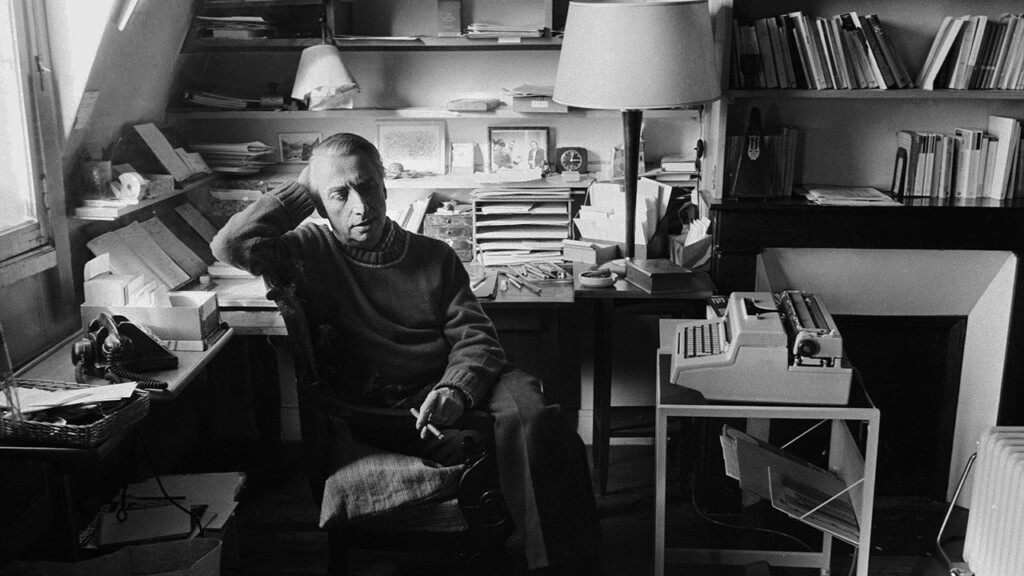
You are standing in a room you recognize, looking at a photograph of someone who no longer exists, and the strange cruelty of the image is that it does not mourn — it simply shows. The person is there, fully there, with all their particular weight and light, and yet the photograph was always already a death certificate, proof that what it captures is on its way to disappearing. Roland Barthes understood this not as a metaphor but as a structural fact, and when his mother Henriette died in October 1977, the intellectual apparatus he had spent decades constructing met something it could not process, could not encode, could not turn into a system.
Camera Lucida, published in 1980 just weeks before Barthes himself was killed by a laundry van on a Paris street, is one of the most peculiar theoretical texts ever written precisely because it dismantles its own ambitions from the inside. He begins by wanting to identify what photography is — its essence, its ontological signature — and instead arrives at a private image he refuses to reproduce. The Winter Garden Photograph, showing his mother as a child of five in 1898, is described with extraordinary care and then withheld from the reader. He will not show it. He knows it would mean nothing to anyone else, and this is exactly his point: the wound a photograph opens is non-transferable, which makes it the most anti-theoretical object imaginable.
The concept he builds to hold this experience is the punctum — a Latin word for wound, prick, the mark made by a pointed instrument. It is not the same as the studium, which is the field of cultural interest, the readable zone of an image, what you can discuss over dinner. The punctum is what catches you without your consent, the detail that was not meant to be significant: a necklace, a posture, the texture of a shoe. Georges Bataille had written in 1957 in Erotism that transgression does not abolish the limit but exceeds and completes it; Barthes is doing something adjacent — the punctum does not destroy meaning but punctures through it, into something that meaning cannot follow.
What makes Camera Lucida something more than a theory of photography is that Barthes is simultaneously writing a grief diary he refuses to call a grief diary. He had kept a separate, more naked journal of mourning after his mother’s death, published posthumously as Mourning Diary in 2009, where the entries are raw and brief and undefended. But in Camera Lucida he smuggles that rawness into philosophy, uses the vocabulary of semiology to approach something semiology was designed to avoid — the singular, the irreducible, the person who was this person and no other. His entire career had been devoted to showing that meaning is constructed, that the self is a function of language, that the author is already dead before the reader arrives. Now he needed a theory that could account for the fact that his mother was not a sign.
Susan Sontag, reviewing the book in the early 1980s, noted its strange doubling: a book about photography that is really about time, really about love, really about the particular terror of images that survive their subjects. But even this framing misses the depth of the retreat. Barthes does not arrive at a new theory. He arrives at the edge of what theory can do and stands there, looking at a photograph of a child in a winter garden who would one day be the person who taught him what it meant to be cared for, and he understands that some wounds generate no knowledge — only presence, only the mute and devastating fact of what has been, the ache of a world that carries forward without her in it.
🔤 Signs, Texts, and the Labyrinth of Meaning
Roland Barthes transformed the way we read culture, language, and the image of the author himself. His work resonates across semiotics, literary theory, and critical thought, opening doors to a vast network of ideas about how meaning is constructed and contested. These related articles trace the intellectual landscapes that shaped and were shaped by his extraordinary legacy.
Roland Barthes and Listening: The Grain of the Voice
Roland Barthes devoted significant attention to sound and listening, arguing that the voice carries a material, bodily dimension he called the ‘grain.’ This article explores how his concept of the grain of the voice challenged purely linguistic approaches to music and speech, insisting on the sensory pleasure embedded in vocal texture. It is an essential companion piece for anyone seeking to understand Barthes’s broader aesthetic and semiotic project.
GO TO THE SELECTION: Roland Barthes and Listening: The Grain of the Voice
Jorge Luis Borges and the Labyrinth of Identity
Like Barthes, Jorge Luis Borges was fascinated by the way texts, signs, and structures entrap and multiply identity. This article examines how Borges constructed the labyrinth as a philosophical metaphor for the infinite regress of selfhood and interpretation. Reading Borges alongside Barthes illuminates the shared postmodern intuition that the self, like the text, has no stable center or final meaning.
GO TO THE SELECTION: Jorge Luis Borges and the Labyrinth of Identity
Kafka and Bureaucracy: The Trial and The Castle
Franz Kafka‘s novels of bureaucracy and opaque authority offer a striking parallel to Barthes’s meditations on institutional language and the power of discourse to shape and suffocate the subject. This article analyses how The Trial and The Castle dramatize systems of signification that overwhelm and erase the individual, a theme central to Barthes’s own critique of bourgeois mythology. Both thinkers expose the violence hidden within the seemingly neutral structures of modern life.
GO TO THE SELECTION: Kafka and Bureaucracy: The Trial and The Castle
Umberto Eco: Life and Works
Umberto Eco, like Barthes, was a semiotician who moved fluidly between rigorous theory and popular narrative, exploring how signs, codes, and interpretive communities generate meaning. This article surveys Eco’s life and works, tracing his debt to and dialogue with Barthesian semiotics throughout his intellectual career. Understanding Eco’s project deepens appreciation for the broader European tradition of sign theory in which Barthes was a towering figure.
GO TO THE SELECTION: Umberto Eco: Life and Works
Discover Cinema That Thinks Beyond the Frame
If these ideas about language, meaning, and the hidden codes of culture inspire you, Indiecinema streaming is the place to take the journey further. On Indiecinema you will find independent and auteur films that challenge conventions, deconstruct narratives, and explore the world with the same restless intellectual curiosity that defined Roland Barthes. Step into a cinema that reads the world as a text — and invites you to write back.
👉 EXPLORE THE CATALOG: Watch Indie Films in Streaming
A vision curated by a filmmaker, not an algorithm
In this video I explain our vision

