
The Voice Before the Words
You are in a room you do not belong to, at a gathering where the language spoken around you is not yours, and someone across the table begins to tell a story. You do not understand a single word. But something happens anyway. The voice rises and then drops with a precision that feels almost surgical, and you find your chest tightening in response, your breath adjusting itself without your permission. The room has not changed. The words mean nothing to you. Yet you are moved, genuinely moved, in the way that matters — not intellectually but somewhere lower, somewhere older, in the region of the body that responds before the brain can intervene and ruin everything with its interpretation.

This is the scandal that semiotics spent most of the twentieth century trying to ignore. Language was supposed to be a system of differences, a network of signs in which meaning emerged not from the substance of sound but from its relational position within a structure. Ferdinand de Saussure, whose 1916 Cours de linguistique générale became the foundational text for nearly every school of thought that followed, was explicit about this: the acoustic image that constitutes the signifier has no natural or intrinsic bond to what it signifies. The word is arbitrary. The sound is a vehicle, nothing more. What matters is the code, not the carrier.
And yet the carrier keeps doing things to us that the code cannot account for. There is a frequency in certain voices that arrives in the sternum before it arrives in the cortex. There is a quality of breath, of grain, of pressure behind the consonants that communicates something which has no address in the dictionary. Neuroscience has begun to catch up with what bodies have always known: the prosodic features of speech — its rhythm, its timbre, its pitch contour — are processed along pathways that predate language itself, traveling through the limbic system and the brainstem, structures that were ancient before Homo sapiens learned to attach meaning to sound. The infant, weeks before it understands a syllable, already distinguishes the emotional valence of a voice with startling precision. The mother tongue is learned first as music, not as lexicon.
Roland Barthes arrived at this problem obliquely, as he arrived at most problems that interested him — through pleasure, through the body, through an irritation with his own discipline that he was too honest to suppress. Writing in 1972, in an essay that would later appear in the collection L’Obvie et l’Obtus translated into English as The Responsibility of Forms, he coined the phrase that would haunt everything he subsequently wrote about music and voice: le grain de la voix, the grain of the voice. He was listening to two singers performing the same repertoire of German lieder. One sang with what he called the lungs, with breath and technique and the smooth delivery of emotion as message. The other sang from somewhere else entirely, somewhere Barthes located not in the respiration but in the throat, in the articulation of the language against the teeth and the tongue, in the body’s friction with the text. The first singer communicated. The second did something to Barthes that communication cannot do: he produced in the listener an encounter with the materiality of a human being.
The distinction Barthes was drawing was not aesthetic preference dressed up in theory. It was a genuine epistemological claim: that voice carries two simultaneous signals, and that the one which escapes meaning is not the lesser of the two. The semantic content of a song, a speech, a confession can be transcribed, paraphrased, translated, transmitted across centuries without losing much. But the grain — the specific pressure of one irreplaceable body against language — disappears the moment the voice stops. It cannot be archived. It can only be received, in real time, by a body capable of being undone.
Irene
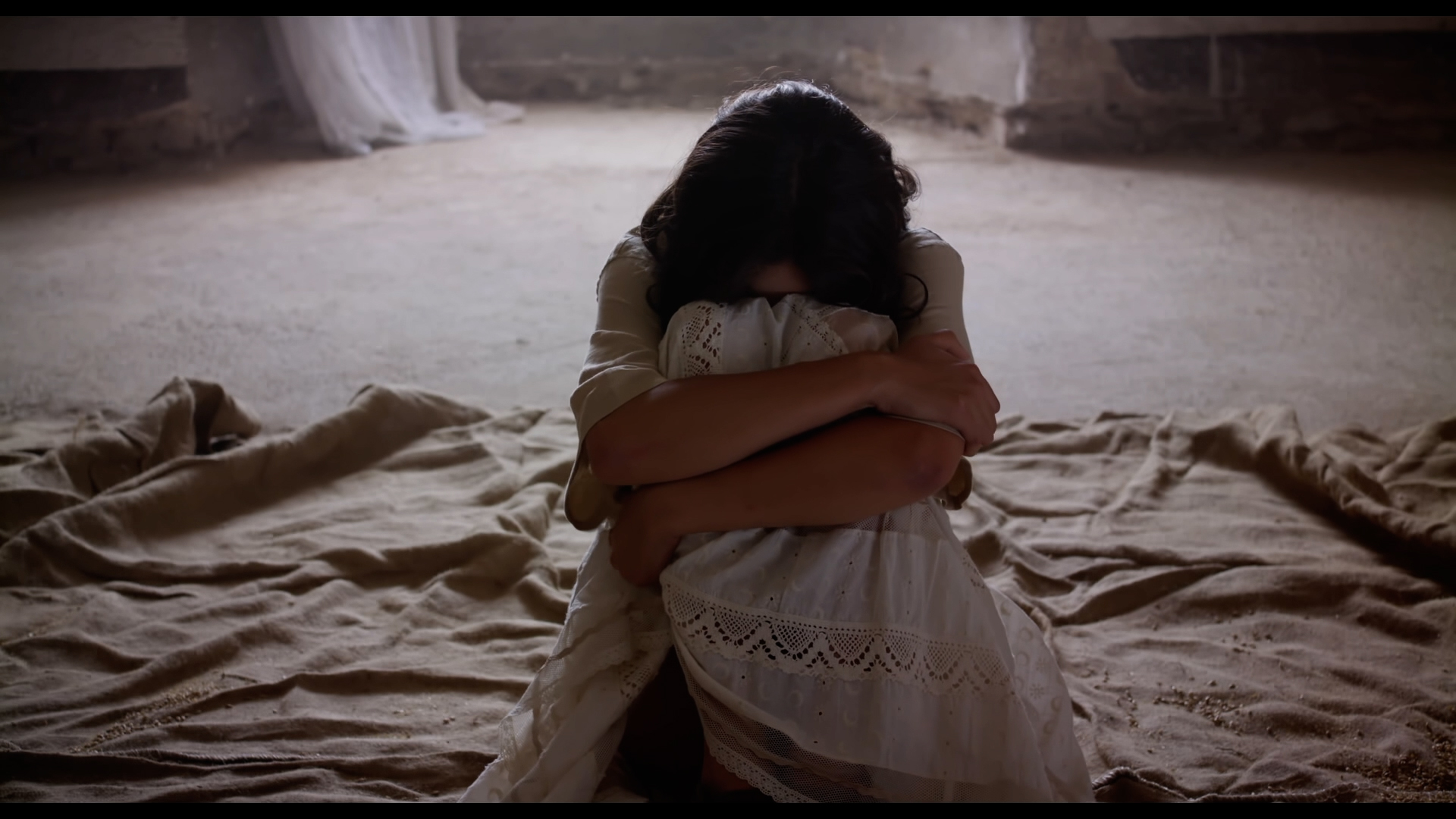
Drama, by Valerio Pampaglini, Italy, 2023.
Irene is trapped within her own unconscious, empty and ruined like an abandoned house. Through broken glass and shady figures dressed in black, a song awakens something long forgotten inside her. The film, written and directed by Valerio Pampaglini, is supported by the Rome Film Academy. It was shot in the summer of 2022 in the province of Perugia, in the municipality of Todi and at the Montenero castle.
LANGUAGE: Italian
SUBTITLES: English
Barthes and the Grain
The essay he published that year, later collected in Image-Music-Text, is short by the standards of serious theoretical work — barely twelve pages — and yet it dismantles something most music criticism had been quietly assuming for centuries: that what matters in a singing voice is its technical execution of the musical text. Barthes called this the pheno-song, the layer of performance that demonstrates culture, that proves the singer has learned, trained, mastered, submitted. The pheno-song is the part that earns applause, that critics can describe, that conservatories can evaluate. It is the dimension of the voice that belongs entirely to legibility.
Against this he placed something that has no comfortable home in the vocabulary of musical appreciation. The geno-song is not a technique. It is not a quality a teacher can cultivate or a student can rehearse toward. It is the body of the singer erupting through the material it has been given to perform — not despite the text but in irreducible friction with it. The voice here is not a vehicle for meaning. It is flesh encountering language and leaving marks on that encounter that no notation could have predicted and no score could have demanded. Barthes reached for the Russian word signifiance to describe what this produces: not significance in the sense of decoded content, but a kind of resonance that operates below the threshold where interpretation becomes possible.
The grain is not beauty in any conventional sense. It is not warmth, not richness, not the qualities reviewers reach for when they want to describe a voice they love. It is closer to resistance — the place where the body refuses to become purely functional, where it insists on its own materiality at the moment it is supposed to dissolve into art. And what Barthes recognized, though he stated it with characteristic obliqueness, is that this resistance is not a flaw in communication. It is the only honest form of it.

What Culture Has Trained You to Hear
You are sitting in a concert hall, and without realizing it, you are working. Your ears are scanning for resolution, for the dominant returning home, for the phrase that justifies the one before it. You are not listening — you are auditing. The body is still, the spine aligned with institutional posture, and somewhere behind the sternum there is a faint hum of effort that has nothing to do with pleasure and everything to do with assessment. This is not a failure of attention. It is the result of several centuries of very deliberate training.
The Enlightenment did not simply reorganize political life and scientific method. It reorganized the senses. Reason was elevated not merely as a tool but as the criterion of legitimate experience, which meant that anything the body registered without the mediation of cognition became epistemologically suspicious. What you felt in your chest when a low cello note held too long had no standing in the court of knowledge. What mattered was what the note meant, what it represented, how it functioned within a system of musical grammar that could be articulated, judged, and reproduced in language. The logos — that ancient Greek term that Enlightenment thinkers quietly annexed and weaponized — became the only channel through which experience could achieve respectability. The somatic register was not destroyed. It was demoted.
By the nineteenth century, this demotion had acquired institutional infrastructure. Music criticism emerged as a formal discipline during this period, and its founding gesture was to transform listening into a professional act of evaluation. Eduard Hanslick, whose 1854 treatise Vom Musikalisch-Schönen became one of the most influential documents in the history of musical aesthetics, argued explicitly that the proper object of musical attention was form — the dynamic interplay of tones — and that emotional or physical responses were merely the residue of undisciplined perception. His was not a marginal position. It became the grammatical air that music education breathed for generations. To know music was to analyze it. To feel it in the body without being able to name what you felt was to be, in some fundamental sense, musically illiterate.
What followed was an educational apparatus built entirely around this premise. Conservatories taught students to hear harmonically and structurally. Critics were trained to render judgment in prose, and that prose carried the implicit promise that language could be adequate to sound — that what the voice or the instrument was doing could be fully captured in the net of verbal description. The vocabulary that accumulated around Western art music — legato, rubato, phrasing, attack — was always ostensibly descriptive but functionally evaluative, a system of marks awarded to performers for their proximity to an ideal that existed on paper before it existed in the air. The listener who said simply “something happened to me when she sang that” was gently instructed to go further, to name the harmony, to identify the technique, to translate visceral event into cognitive content.
This is the trap that almost no one recognizes as a trap because it arrives wearing the costume of sophistication. The more you know about music, the argument goes, the more richly you hear it. And there is some truth lodged inside this claim, which is what makes it so effective as a mechanism of suppression. Knowledge does open certain doors. But it also quietly closes others — the ones that lead into the body, into the non-signifying register where a particular roughness in a throat, a catch between one vowel and the next, can split something open in you that has nothing to do with the composer’s intention or the musicologist’s taxonomy. What gets educated out of the listener is not ignorance. It is a specific kind of animal receptivity — the capacity to let sound arrive before meaning does, to be struck before you understand why.
A Better Life
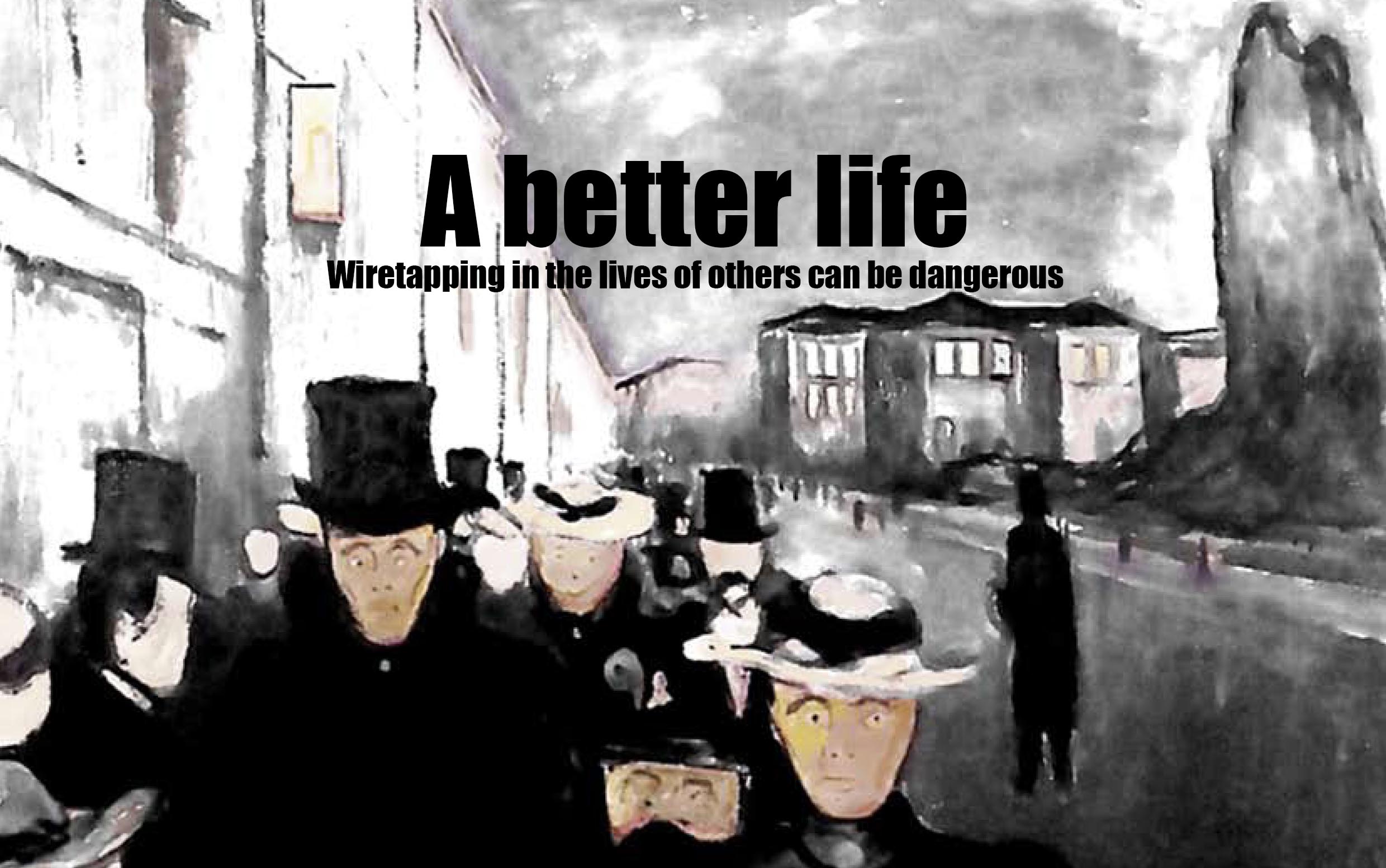
Drama, thriller, by Fabio Del Greco, Italy, 2007.
Rome: Andrea Casadei is a young investigator specializing in audio wiretapping who conducts investigations commissioned by husbands betrayed by their wives, or by parents worried about what their children are doing outside the home. But what interests him most is understanding the human soul, listening to casual conversations in the streets, knowing what people think. He often meets in Piazza Navona with his friend Gigi, a frustrated street artist obsessed with success at all costs, with whom he shares a passion for wiretapping. Shocked by the mystery of the disappearance of Ciccio Simpatia, another street artist common friend, Andrea decides to abandon the commissioned works to seek a better life and reflect on his own and others' existence. He will meet the actress Marina and with a bug he will slowly enter her life until he discovers her most unthinkable secrets. The film deals with an important theme of contemporary Western society: the lack of love. The mysterious and tormented figure of Marina is reflected in a gloomy and soulless Rome.
Director Fabio Del Greco declared about his film: "Perhaps this film is a reflection on the art of observing, of listening, in short, of what one does when one leaves the real world to tell about it. Perhaps he wants to talk about the subtle relationship between the mirages of success touted by today's society, power and the most authentic human relationships.A 'dark cloud' hangs over the city: it is engulfing everyone in a sort of indistinct, uniform mass, where everyone thinks the same things, where everyone they are more alone. Where is the truest part that makes us unique? Maybe you can try to intercept it only secretly."
LANGUAGE: Italian
SUBTITLES: English, Spanish, French, German, Portuguese, Dutch.
The Tyranny of the Polished Voice
You are in a record shop — not one of the cavernous, fluorescent-lit chains that vanished with the early 2000s, but the narrow kind, smelling of cardboard and slight damp, where the owner knows what you bought last time. You pull a sleeve from the rack, and before you have read a single name, before the needle has touched anything, you already know what this voice will sound like. You know its weight, its temperature, its distance from your ear. The industry has trained you to expect this. You did not choose the expectation. It was installed.
The commercial recording revolution did not begin with any particular invention but with a particular decision: that the microphone’s job was to flatter. When Western Electric’s electrical recording process reached the market in 1925, replacing the acoustic horn with condenser microphone technology, it did not simply improve fidelity — it inaugurated a new aesthetic theology. The surface noise was now an enemy. The breath between phrases was now a problem. The slight asymmetry of a human larynx working under effort was now a defect to be corrected in the pressing plant or, later, in the mixing desk. The recorded voice was no longer a document of a body; it became an argument that bodies could be made smooth.
What followed was not gradual refinement but ideological consolidation. By the mid-1950s, the major American and European labels had developed what engineers called the “presence peak” — a deliberate boost in the three-to-five kilohertz range that gave voices an artificial clarity, a sense of nearness that no actual room had ever produced. Frank Sinatra‘s Capitol recordings from 1953 onward were shaped by this logic so thoroughly that his voice became a kind of standard against which all male popular singing would be unconsciously measured for decades. Not a voice, in other words, but a template. The grain — the slight hoarseness that lived in him, the small imprecisions that proved a chest was actually breathing — was present only in controlled quantities, permitted only insofar as it registered as warmth rather than vulnerability.
There is a distinction that needs to be made here that audio engineering has historically refused to make: the difference between noise and information. Psychoacoustics, particularly the work developed through Bell Laboratories in the 1940s and formalized by Harvey Fletcher, treated everything outside the fundamental frequency and its harmonics as interference to be minimized. The paradigm was communicative efficiency — the telephone line’s dream of a voice stripped to its semantic payload. But what gets stripped in that process is precisely the material Barthes understood as the site of genuine encounter: the friction, the saliva, the catch. Strip those away and you have not a clearer message. You have a message with its sender removed.
Digital recording accelerated this evacuation. The introduction of Pro Tools as a professional standard in the early 1990s brought pitch correction and time quantization within reach of ordinary studios, and by the late 1990s Auto-Tune had become not an emergency repair tool but a compositional choice — or rather, a commercial reflex applied before any compositional thought occurred. What this produced was not merely a different sound but a different ontology of the voice: a voice that no longer testified to a body’s presence in time. The corrected pitch had no moment of arrival. It was simply, perfectly, there — the way a geometric point is there, without dimension, without the evidence of travel.
The listener trained on this material does not experience the grain-less voice as an absence. They experience the voice with grain as excessive, unstable, somehow less professional. The aesthetic defect is now located precisely where the body insists on being present. And because the listener has been shaped by a century of engineering decisions they never consented to, they carry the industry’s preference as if it were their own taste.
A Second Scene: The Voice That Should Not Work
There is a recording from 1961, a woman singing in a language most of the people in the room do not speak, her voice already decades past what any conservatory would call its prime. The pitch wavers. The vibrato is not a technique but a tremor. She mispronounces consonants by the standards of the tradition she is working inside. And yet the room goes quiet in a way that is qualitatively different from the quiet produced by technical perfection — not the held breath of admiration but the held breath of exposure, as if everyone present has been caught thinking something private.
What is happening there cannot be explained by the theory of imperfection as charm, that comfortable romantic notion that flaws make art human. That framework still privileges the standard by measuring the deviation from it. It still assumes the ideal performance as the baseline against which the cracked voice is evaluated, found wanting, and then recuperated through a secondary aesthetic category called authenticity. But the woman in that room in 1961 is not being authentic. She is not offering her limitations as a gift. She is simply present in a way that most trained voices are not, and the distinction matters enormously.
Barthes understood this when he drew the line between the pheno-song and the geno-song, two terms borrowed from Julia Kristeva‘s work on language, specifically her 1969 collection Semiotike, where she distinguished between the symbolic, rule-governed dimension of signification and the deeper semiotic layer that precedes and exceeds it. In Barthes’s adaptation, the pheno-song covers everything in a performance that serves communication — the diction, the phrasing, the emotional expressiveness, the craft of conveying a poem’s meaning. The geno-song is what the body does that is not in service of communication, what escapes the intention to mean and simply insists on existing. The grain lives in that second register, and it is not synonymous with roughness or age or damage. A young voice can carry it. A technically flawless instrument can carry it. What it requires is that the body not fully evacuate itself in the act of performance.
This is where the social pressure on singers, speakers, and performers of any kind becomes visible as a form of violence. Training, in virtually every Western vocal tradition, is a process of learning to disappear. The student is taught to remove the idiosyncratic, the uncontrolled, the personally specific, in favor of a tone that the tradition recognizes as correct. By the time a singer has fully mastered the instrument by institutional standards, they have spent years systematically excising precisely what Barthes would identify as their most irreducible material. The voice that emerges is powerful, often beautiful, and thoroughly legible — a vehicle for the composer’s intention, the text’s meaning, the genre’s conventions. What it does not carry is the body that produced it.
The aged woman in that room carries nothing but the body. Her voice is not a vehicle because it does not have the discipline to be one. And this is not failure — it is the accidental preservation of something that training would have eliminated. The grain is not what survives in spite of the body’s inadequacy. It is what survives because the body never learned to suppress itself completely. The room goes quiet not because the performance is moving in the conventional sense, not because the melody is beautiful or the text is poignant, but because something material has entered the space that cannot be aestheticized from a safe distance. You are not moved by the song. You are struck by the fact of a body having been somewhere, having insisted on existing in a particular way, and now insisting again in the act of singing — without asking permission, without performing that insistence, simply as a condition of the voice opening at all.
A vision curated by a filmmaker, not an algorithm
In this video I explain our vision
Desire, Timbre, and the Unnameable

You are in a concert hall, not listening to the music but to the person beside you who leans over to whisper something inconsequential — a comment about the program, a question about the time — and what strikes you is not the words but the specific texture of that voice at close range, the barely-there friction of breath against consonant, and you feel something move in you that has no name and that you would ruin the moment by trying to find one.
Jacques Lacan placed the voice among those objects he called objet petit a — partial objects that are neither fully inside the subject nor fully outside, neither possessed nor absent, always circulating in the gap between desire and its impossible satisfaction. Unlike the gaze, which has received the lion’s share of critical attention, the voice as partial object does something stranger: it enters the body through an aperture we cannot close. We do not have eyelids for our ears. The voice arrives uninvited, bypasses the threshold of consent, and lodges somewhere below language, below intention. What Lacan understood is that this object does not belong to the one who produces it — the speaker is never the master of what their voice does to another body — and it does not belong to the one who receives it either. It hovers in between, which is precisely what makes it the site of desire rather than simply pleasure.
The difference matters enormously. Pleasure can be described, catalogued, repeated by request. Desire, in the Lacanian formulation, is constitutively unsatisfied not because the right object has not yet been found but because desire is structured around a void that no object can fill. When a voice produces that specific disorientation — the grain Barthes located in the encounter between language and the body that produces it — what is activated is not a preference but a wanting that cannot locate its own object clearly enough to pursue it. You want more of the voice, but more of what, exactly? The timbre? The rhythm? The particular way certain vowels open wider than the language strictly requires? You reach for language to answer and find that language is precisely the wrong tool, the way you might try to catch water with a net.
Timbre is where this becomes almost scientifically verifiable and simultaneously most resistant to science. Acousticians can measure formants, harmonic overtones, the resonance frequencies of a particular larynx and vocal tract. They can produce spectrograms that look like fingerprints and are, in fact, more individually distinctive than fingerprints. But the spectogram does not explain why one voice, heard once in a radio documentary, makes a person pull their car to the side of the road without knowing why. The measurement captures the physical signature of what is happening while remaining entirely silent about what the body of the listener is responding to. Science names the object and loses the desire.
This is not mysticism. It is a structural problem of verbalization itself. Roland Barthes, writing in 1977 in Roland Barthes by Roland Barthes, confessed that whenever he tried to explain why he loved something — a text, a photograph, a face — the explanation produced an object slightly different from the thing he had loved. The act of articulation is also an act of substitution. You produce a version of the experience that is communicable, which means you have translated it out of the register in which it occurred. What was felt in the body becomes an idea about the body. What was immediate becomes retrospective. What was yours becomes shareable, which is to say, no longer entirely yours.
The voice, as a desiring object, survives only as long as it remains partially opaque to the person it moves. The moment someone finds the precise vocabulary for what a voice does to them, they have performed a kind of mourning for it — competent, articulate, and irrevocable.
The Social Contract of Listening
You are sitting in a concert hall, third row, and the man beside you shifts in his seat during a pianissimo passage. You feel a flash of irritation so sharp it surprises you — not at the noise exactly, but at the violation of something you had not consciously agreed to but somehow signed. No one handed you a contract at the door. And yet your body enforces one.
The architecture of collective listening has never been neutral. When the Palais Garnier opened in Paris in 1875, its steeply raked seating, its enforced silence, its separation of tiers by ticket price — all of it constituted a pedagogy before a single note was played. The concert hall as we know it is a historical invention, not an acoustic inevitability, and Christopher Small’s 1998 concept of “musicking” cuts through the illusion of pure musical experience by insisting that every performance event is a social occasion that rehearses a particular vision of how the world is and should be organized. You sit still. You face forward. You do not respond audibly. You wait to be moved and then applaud in unison, on cue, the collective shiver converted immediately into a form of approval legible to institutional power.
The church preceded the concert hall and worked the same mechanism more openly. Gregorian chant in its original liturgical context was not meant to be appreciated; it was designed to dissolve the individual listener into a collective body, the voice of the cantor pulling the congregation into a trance of shared vibration that foreclosed private interpretation. The Council of Trent in the sixteenth century didn’t argue about theology alone when it reformed sacred music — it argued about who controls the relationship between sound and the soul, which is another way of asking who controls the body that hears. When the reformers demanded clarity of text over the elaborate polyphony of Josquin, they were disciplining ears, not saving them.
The political rally understands this with a frankness that aesthetic institutions prefer to conceal. Sound at a rally is never merely communicative; it is corporeal. The crowd chanting in unison produces a neurological event: oxytocin rises, the sense of individual boundary softens, and the speaker’s voice becomes something closer to weather than to argument. The psychologist William McNeill described this phenomenon in his 1995 book “Keeping Together in Time” as “muscular bonding,” the way synchronized physical and sonic activity generates solidarity that bypasses rational evaluation entirely. A demagogue does not need a coherent message if the rhythm of the voice is right. The crowd is not listening to what is being said; it is being formatted by how it is being said.
Cinema refined all of this into an interior experience. The darkness of the theater, the enforced passivity of the body, the surround of sound designed by engineers to replicate the acoustic signature of presence — all of it trains the ear to receive a particular kind of authority. The film score exists not to accompany image but to tell the audience how to feel before they know why, resolving the ambiguity of what the eye sees into a single emotional channel. Bernard Herrmann‘s innovations in vertical, non-melodic scoring in the mid-twentieth century were innovations in the control of interpretation, ways of ensuring that what you feel is what you were meant to feel. The horror of the shower scene is inseparable from the sound, and the sound is a form of instruction.
What runs through all of these spaces — the hall, the nave, the rally, the dark room — is not simply power imposing itself on passive ears. It is something more insidious: the training of desire. You come to want to listen in the way you have been taught to listen. You enforce the silence on your neighbor because you have internalized the contract so thoroughly that its violation feels like a wound to your own body, which is precisely how the most effective social architectures work — they make you their agent without your consent, and then persuade you that the enforcement is entirely your own.
What Remains When the Voice Is Gone

You press play, and someone who has been dead for thirty years begins to speak directly into your ear.
There is no preparation for this. The voice arrives with a texture you did not expect — a slight roughness at the edges of certain consonants, a breath taken a half-second too early, a quality of presence so specific and so unrepeatable that the body which produced it seems, for a moment, to reassemble itself in the room. And then you remember. The body is gone. What you are holding, in your hands or your headphones, is the permanent extraction of something that was once continuous with a living organism — breath, saliva, muscle, cartilage — all of it now frozen into a magnetic pattern, a groove, a digital file that will outlast every person who ever knew the voice when it was attached to a face.
Roland Barthes understood something precise about this uncanny condition. His 1972 essay “The Grain of the Voice,” published in Musique en jeu, was not primarily about death, but death was always its silent context. When he described the grain as the body in the voice — the materiality of the singer pressing through the song — he was also describing what a recording preserves that notation cannot: not the composition, not the interpretation in any technical sense, but the evidence of a particular body’s having existed. The grain is, in this sense, biographical in the most intimate and irreducible way. It is the residue of a specific metabolism, a specific history of tension and release, a specific nervous system encountering a specific moment in time.
What this means for recorded sound is ethically stranger than we usually admit. When the Gallo-Roman rhetorician Quintilian wrote in the Institutio Oratoria around 95 CE that the voice was the index of the soul, he was working within a framework in which voice and presence were inseparable — to hear was to be near. The technology of recording shattered that equation permanently, and we have not finished reckoning with what was lost and what was, perhaps more disturbingly, gained. The voice can now be heard by people who were never near, in contexts the speaker never consented to, in emotional registers the speaker never intended. A recorded voice is, in this sense, a voice that has been made permanently available for appropriation.
Jacques Derrida, in his 1967 work Of Grammatology, argued that Western thought had organized itself around a privileged belief in the living voice as the site of authentic presence — what he called phonocentrism. The recording does something Derrida could not have fully theorized: it neither restores that presence nor simply negates it. It creates a third thing, a phantom that is neither alive nor simply dead, a presence that is technically reproducible and therefore, in Walter Benjamin‘s sense from the 1935 essay “The Work of Art in the Age of Mechanical Reproduction,” stripped of its aura — and yet, paradoxically, more haunting than any aura Benjamin described. Because the grain survives the reproduction. The body survives in the signal.
This is the tension that refuses resolution: the grain is the most irreducible proof that a life was lived, that a specific nervous system fired, that breath moved through a specific architecture of bone and tissue at a specific instant that will never return. And the recording is precisely the mechanism by which that proof is detached from its source and made to circulate endlessly, without the body, without the consent of the body’s ending, without any of the mortality that gave the moment its weight. What you hear when you press play is not a memory and not a ghost but something for which no adequate language yet exists — a life’s most intimate residue, travelling through time toward ears the voice never knew it was speaking to.
🌀 Voices, Labyrinths & the Search for Meaning
Roland Barthes‘s concept of the ‘grain of the voice’ invites us to listen beyond language itself, into the body, texture, and hidden depths of expression. This idea resonates powerfully across literature and philosophy, wherever writers have explored identity, time, and the labyrinthine nature of meaning. The articles below trace these thematic corridors through some of the most essential literary works.
Jorge Luis Borges and the Labyrinth of Identity
Jorge Luis Borges constructed labyrinths not merely as physical spaces but as metaphors for identity itself — endlessly forking, never resolving. Much like Barthes’s grain of the voice, Borges insists that meaning is always plural, always slipping away from the one who seeks it. To read Borges on identity is to hear the echo of a voice that refuses to be pinned down.
GO TO THE SELECTION: Jorge Luis Borges and the Labyrinth of Identity
Jorge Luis Borges: Life and Works
Borges’s life and works reveal a writer obsessed with the infinite proliferation of texts, voices, and selves. His literary universe mirrors Barthes’s notion that the voice carries something irreducible, something that escapes pure signification. Understanding Borges’s biography deepens our grasp of how a singular sensibility can generate an inexhaustible labyrinth of meaning.
GO TO THE SELECTION: Jorge Luis Borges: Life and Works
In Search of Lost Time by Proust: Analysis
Proust’s monumental novel is perhaps the greatest literary meditation on the texture of time, memory, and sensory experience. The famous madeleine episode functions almost as an acoustic event — a grain of sensation that unlocks an entire interior world, much as Barthes described the voice unlocking the body of the singer. In Search of Lost Time is a cathedral built from the echoes of lost voices.
GO TO THE SELECTION: In Search of Lost Time by Proust: Analysis
The Journey as a Metaphor in Literature
The journey as metaphor in literature is fundamentally tied to the question of voice: who speaks, from where, and toward what horizon. Like Barthes listening for the materiality beneath the melody, the great literary traveler seeks something beneath the surface of the road — a truth that language alone cannot deliver. This thematic exploration illuminates the deep kinship between movement, listening, and the search for self.
GO TO THE SELECTION: The Journey as a Metaphor in Literature
Discover More on Indiecinema
These literary and philosophical resonances find their natural companion in the world of independent cinema, where filmmakers explore voice, identity, and the labyrinth of the self with bold artistic freedom. Discover films that dare to listen differently — stream independent cinema now on Indiecinema and let the grain of the image speak to you.
👉 EXPLORE THE CATALOG: Watch Indie Films in Streaming
A vision curated by a filmmaker, not an algorithm
In this video I explain our vision

