
The Deferred Adulthood
You refresh the banking app for the third time in an hour, though the number has not changed, could not have changed, since the only pending transaction is the rent that leaves your account on the first and the contract renewal that has not yet arrived by email. You are thirty-four. You know the exact combination of digits that separates you from overdraft the way other people know their own pulse. The renewal will come, probably, because it came the last two times, six months and then six months again, each time with the same clause about organizational needs and budget review, each time signed with something between relief and disgust, because refusing was never really an option, not with the rent, not with the number you just checked for the third time. There is a particular flavor to this waiting, sour and familiar, that has nothing to do with the dramatic uncertainty of youth deciding what to become. You already decided. You have a degree, sometimes two, a set of skills you update on weekends through certifications nobody asked for but that feel like armor. What you do not have is the thing that was promised somewhere between childhood and now, the thing your parents had without ever framing it as an achievement: a Tuesday that resembles the Tuesday five years from now, a mortgage instead of a landlord, a pension statement instead of a vague anxiety about what happens after sixty-five.

The waiting itself has texture. It smells like the specific stress of open browser tabs, one for the job listings you check compulsively, one for the apartment you cannot yet afford but keep in a saved search, one for the news you scroll to avoid thinking about the first two. It has a soundtrack, which is silence, because you have stopped calling your parents to explain the contract situation, since the explanation always mutates into a conversation about how things were different for them, how a temporary job in their memory meant something temporary, a bridge, not a condition. It has its own calendar, which does not run in years but in renewal cycles, in the low hum of anticipation before the notification arrives, in the strange grief of realizing that thirty-four does not feel like the adulthood you rehearsed as a teenager watching your parents pay bills at the kitchen table with an ease that looked, from a child’s vantage point, like solidity itself.
You are not poor, not in the way that shows. You have a phone with a cracked screen you keep meaning to fix, a wardrobe assembled mostly during sales, a social life calibrated to the exact price of a second drink. You are something else, something without a proper name yet in the conversations you have with friends who are doing the same math in their own kitchens, friends who also refresh their own apps, who also sign their own six-month renewals, who also feel the specific vertigo of being adults by every biological and legal measure while remaining suspended in a waiting room whose door never quite opens onto the room they were told was next. The suspension is not a metaphor you reach for later, in reflection. It is what Tuesday feels like. It is what checking the balance for the third time feels like, when the number was never going to change, when the only thing actually in motion is the slow erosion of a future tense you used to speak in without irony, back when you still said in five years I will, instead of the sentence you use now, the one that trails off, the one that has learned, the hard way, not to finish itself.
Many Pieces Of Something
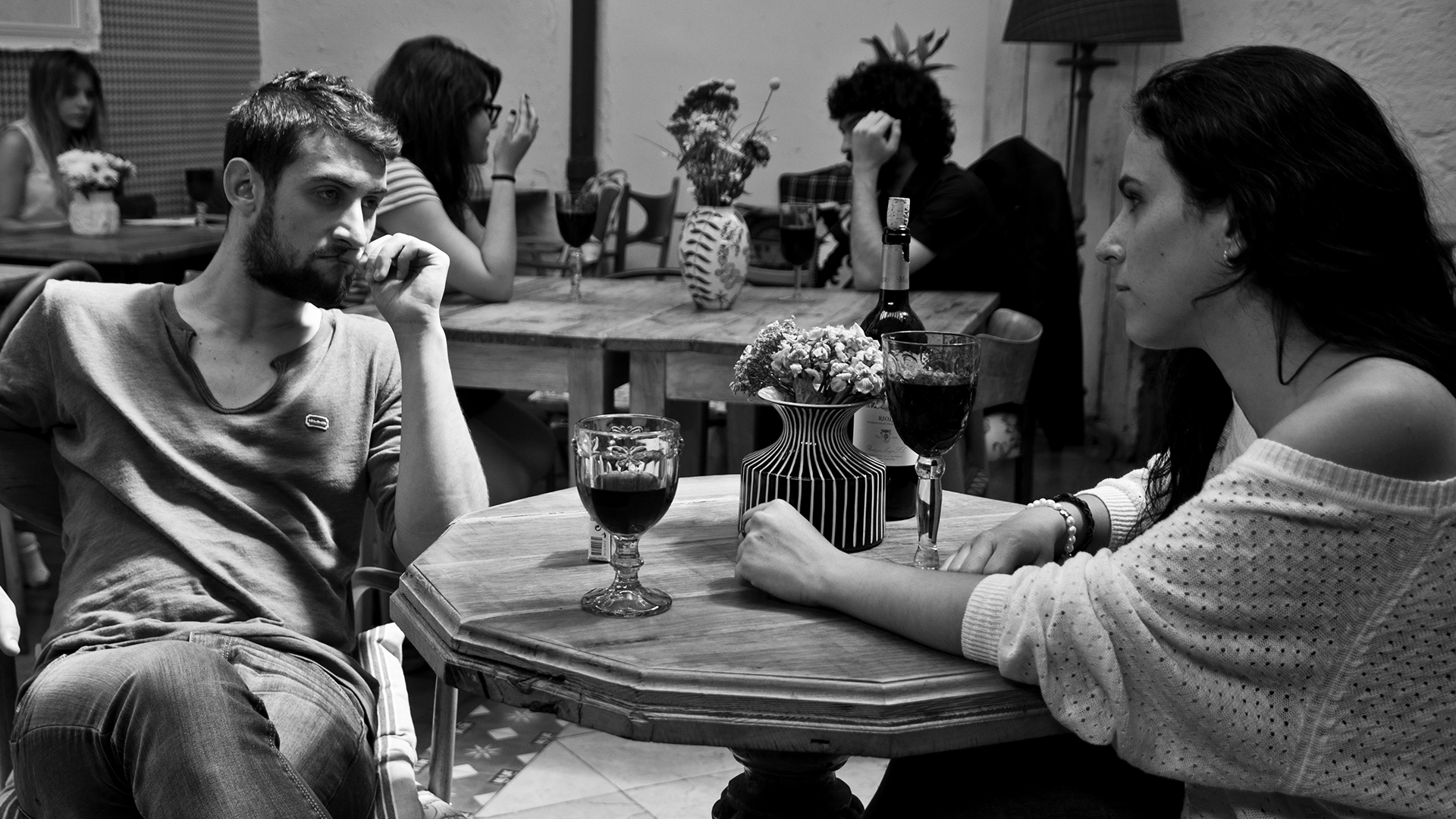
Comedy, drama, by David Yáñez, Spain, 2015.
Hangover after hangover, a group of unemployed friends with no great prospects for the future try to survive the frenzy of their desires and feelings, their existential anguish and rock 'n' roll at a summer music festival, trying to put some order in their hearts and their heads. Doubts, betrayals, jealousies, amorous torments of twenty-year-old Spaniards with no prospect of the future, except that of wanting to love at all costs.
David Yáñez's script is genuine and pure, clearly autobiographical. We are on the side of Linklater's cinema and the transgressions of the editing rules of Godard's Nouvelle Vague. Although Many Pieces of Something is a low budget film, Yáñez takes us into history with a mix of extremely effective styles such as the mockumentary, using the camera by hand, in order not to lose the naturalness of the actors, who often confess their feelings by speaking directly to the camera as if it were the only true friend you can trust. The young director knows how to make the most of the actors, and the fact that they are little known brings more freshness to the story. Víctor Vázquez and Laura Contreras stand out from the group of performers. Victor Vàsquez in particular, an actor with a profile similar to that of Michael Fassbender, surprises with the naturalness he reveals at every moment, while Contreras makes her role as a simple woman extremely captivating, who plays the part of the aggressive to be more intriguing. Many pieces of something is a fascinating first work with a style of truth and experimental cinema, appreciable both for the characters who make the viewer experience the emotions of the loves of the twenties, and for the desire to tell something personal and intimate.
LANGUAGE: Spanish
SUBTITLES: English, French, German, Portuguese
The Myth of the Career Ladder
You are told, at some point, usually by someone older, in a tone that mixes affection with reproach, that your grandfather started at the plant on a Monday and left forty-one years later with a pension and a watch. The story is offered as evidence of a natural order interrupted, as though the ladder had always been there, bolted into the structure of the economy itself, and your generation is simply the first to refuse to climb it. But the ladder was never structural. It was a weather event, localized and brief, and mistaking it for climate is the first deception you inherit before you even enter the workforce.
The stable job, the one with the pension, the seniority raises, the gold watch, belongs almost entirely to a twenty-five-year window stretching roughly from 1945 to the early 1970s in the industrialized West, and even then it described a specific kind of worker in a specific kind of body. In the United States, union density peaked around 1954 at roughly 35 percent of the workforce, a figure that has since collapsed to under 11 percent as of recent Bureau of Labor Statistics reporting, and that peak itself excluded most women, almost all Black workers in the South, and anyone outside the manufacturing corridors of the Midwest and Northeast. The postwar compact between capital and labor, the one your grandfather’s watch commemorates, was built on a narrow demographic isthmus: white, male, unionized, urban or suburban, employed by firms that had just emerged from a war economy still flush with government contracts and a temporarily uncontested position in global manufacturing because Germany and Japan were rebuilding from rubble. That isthmus felt like a continent to the people standing on it. It was never the whole map.
Richard Sennett, writing in 1998 in The Corrosion of Character, gave this collapse a vocabulary before most people had the concept to articulate what they were losing. Sennett’s argument was not simply that jobs had become less secure, but that the psychological architecture built around long-term employment, the ability to narrate a coherent self through decades of accumulated loyalty and craft, was being dismantled by what he called flexible capitalism, a system that prizes short-term transactions over long-term relationships and treats the worker’s adaptability as a virtue precisely because it strips away the worker’s claim to continuity. Sennett interviewed IBM employees and bakers, people whose fathers had built identities around a single trade or a single employer, and found in the children a kind of narrative vertigo, an inability to answer the question of who they were because the institutional scaffolding that used to answer it for them, year by year, raise by raise, had been removed and replaced with short-term contracts, project-based teams, and a demand for constant reinvention that masquerades as opportunity.
What gets lost in the nostalgia for the ladder is that the ladder was always a disciplinary device as much as a reward system, a way of extracting decades of predictable, compliant labor in exchange for a promise redeemable only at the very end, when the worker was too old to spend the pension on anything but medical bills and quiet rooms. The economic historian Louis Hyman, in Temp: How American Work, American Business, and the American Dream Became Temporary, traces how even during the supposed golden age, American corporations were already experimenting with temporary staffing agencies as early as the 1940s and 1950s, treating flexibility not as a late-capitalist innovation but as a suppressed appetite waiting for deregulation and globalization to unleash it fully. The ladder was a labor peace treaty signed under duress after decades of strikes, the Flint sit-down of 1936 and 1937, the violent suppression of organizing efforts throughout the 1930s, not a gift extended out of managerial generosity. Once the conditions that forced that treaty, Cold War competition, a strong domestic manufacturing base, capital that had nowhere faster to run, evaporated, the treaty evaporated with them, and what remains is the story your grandfather tells, true in its details and false in its implication, a single anomalous life mistaken for a universal inheritance that was quietly repossessed before you were ever old enough to be told it was yours.

Waiting as a Social Condition
You check your phone at 8:47 for a message that was promised by end of day, which in the grammar of the person who promised it could mean 6 p.m. or could mean never, and you understand without anyone explaining it to you that this ambiguity is not an accident of their character but a structure you have been placed inside. Pierre Bourdieu, watching Algerian peasants displaced into resettlement camps during the war of independence, noticed something that went beyond economics: the imposition of waiting was itself a technique of subjugation. In his work on Algeria, later folded into his broader theory of practice, he observed that to dominate someone is very often simply to control the tempo of their existence, to force them to live according to a rhythm dictated elsewhere. The bureaucrat who lets you sit in the hallway, the employer who says he will call you back, the algorithm that shows you as pending: all of them exercise the same ancient prerogative of making another person’s time count for less than their own. Bourdieu called this the power to keep waiting, le pouvoir de faire attendre, and he was explicit that it functioned as a form of symbolic violence precisely because it left no bruise, no visible injury, nothing that could be pointed to as an act of aggression.
What makes waiting so effective as an instrument of control is that it disguises itself as neutrality. Nobody is technically doing anything to you. There is no decision being made against you, only the absence of a decision, a suspension that presents itself as circumstance rather than choice. But absence of decision is already a decision, and Reinhart Koselleck, writing in Germany after two world wars had shattered any naive confidence in progress, gave this suspension a name that reaches further than sociology. In his 1979 essay collection later translated as Futures Past, Koselleck distinguished between the space of experience, everything a person or a society has already lived through, and the horizon of expectation, the outer limit of what still seems possible to imagine happening. He argued that modernity itself was defined by a growing gap between these two: experience could no longer reliably predict expectation, because the rate of historical change had outpaced the accumulation of lived precedent. What he was describing at the level of civilizations applies with brutal precision at the level of a single biography. When your space of experience is a decade of internships, temporary contracts, and postponed decisions, your horizon of expectation contracts to match it. You stop expecting the raise, the permanent post, the apartment with your name on the lease, not because you have become wiser but because the horizon itself has been dragged backward, closer to where you stand, until movement toward it barely registers as movement at all.
This is why the language of patience deployed against the young precarious worker is not merely unhelpful but actively misleading. Patience implies a virtue exercised toward a future that is coming, however slowly. But what Bourdieu described in the Algerian camps and what Koselleck described in the aftermath of European catastrophe was not slowness, it was the deliberate manufacture of a future that keeps receding at the same speed you approach it. The philosopher would call this the transformation of time from a resource you inhabit into a resource someone else administers, and administration, unlike nature, always has an administrator. Someone benefits from your suspension. The temp agency profits from your renewability. The platform profits from your permanent availability precisely because you are never granted the status that would let you refuse a shift. Waiting rooms, whether literal or existential, are never empty of power, they are saturated with it, arranged specifically so that the one who waits absorbs the cost of uncertainty while the one who withholds the answer absorbs none of it.
The Second Scene: The Interview Room

She sits with her hands folded on her lap because someone once told her that folded hands read as composed, and composed is what gets hired. Across the table a man in his fifties, tie slightly loose, scans a resume he has already seen twice, and says the word patience the way older generations say the word rain: an inevitability, a weather system she should have dressed for. Two internships, a thesis on urban logistics that won a departmental prize nobody outside the department will ever hear of, four years of tuition that her parents financed by remortgaging a garage they never used. She is twenty-six. He tells her, not unkindly, that everyone has to pay their dues. He says it the way you’d recite a psalm, without checking whether the words still mean anything, and she nods, because nodding is also part of the ritual, the part where the supplicant confirms she understands the terms of her own subordination before she’s even been granted it.
The phrase pay your dues has a history, and the history is the point. It comes from union culture, from apprenticeship guilds, from a world in which dues were literal, a small sum handed over for membership in a body that would, in exchange, protect your wage, your hours, your right to refuse unsafe conditions. The dues bought something. What she is being asked to pay has no such exchange built into it. There is no guild left on the other side of her patience, no seniority ladder with a guaranteed rung, only a market that has learned to describe its own instability as a rite of passage. Richard Sennett, in The Corrosion of Character, published in 1998, described precisely this inversion: institutions stopped offering the long biographical arc — apprentice, journeyman, master — and kept only the vocabulary of the arc, hollowed out, still spoken in job interviews as though it described something real.
The interviewer is not lying to her, exactly. He believes it too. He started at this company twenty-two years ago as a junior analyst and was made partner at thirty-eight, and in his memory this trajectory feels like proof, like evidence that the machine still runs on merit and patience rather than on the specific, unrepeatable economic weather of the decade he came up in. He cannot see that the ladder he climbed has since been dismantled behind him, its rungs sold for parts, and that what he’s offering her is a photograph of a ladder, convincing from a distance, useless to the touch. This is not cruelty. It is worse than cruelty, because cruelty at least knows itself. This is sincerity weaponized by amnesia.
What happens in that room is a transfer of blame disguised as advice. If she doesn’t get the position, or gets it and finds it un-renewed eighteen months later, the explanation already sits pre-loaded in the room’s language: she didn’t wait long enough, didn’t pay enough, didn’t yet deserve it. The structural fact — that the company runs forty percent of its workforce through fixed-term contracts specifically to avoid the obligations attached to permanent ones, a practice documented extensively across OECD labor reports through the 2010s — never enters the sentence. It doesn’t need to. The sentence about patience does the same work more efficiently, because it relocates the entire mechanism into her character, where it can be worked on, apologized for, improved, rather than into the contract structure, where it would have to be challenged.
There is a specific posture that develops in people who sit in enough of these rooms. Erving Goffman called it impression management in The Presentation of Self in Everyday Life, 1959, but what he described was still a negotiation between two parties with something at stake on both sides. What she performs now has only one party with anything at stake. She has learned to laugh slightly at the right moment, to describe her unpaid internship as formative rather than extractive, to say flexible instead of precarious, adaptable instead of unprotected. The vocabulary she’s been handed to describe her own condition contains no words for the condition itself.
Dreams as Collateral
She keeps a folder on her desktop labeled someday, filled with course certificates she cannot afford to finish, a business plan for a bakery she has priced out three times, screenshots of apartments in cities she has never visited. She does not open it often. When she does, she feels something close to nourishment, the way a starving body responds to the memory of food. This is not delusion. This is design.
Lauren Berlant named this arrangement cruel optimism in 2011, and the phrase has since become almost too comfortable to invoke, worn smooth from citation, which is itself a betrayal of what she meant. Berlant was not describing naive hope that fails to materialize. She was describing an attachment that actively damages the person who holds it, a fantasy of the good life, stable work, upward mobility, romantic completion, that continues to organize someone’s behavior precisely because its object has become unreachable. The attachment survives the collapse of its conditions. You keep orienting yourself toward a future that the present has already foreclosed, and the orientation itself, not the future, becomes your life. Berlant was writing about post-Fordist subjects clinging to the promise of the American Dream after the material infrastructure that once made it plausible, stable manufacturing jobs, single-income homeownership, pensions, had been dismantled. The dream did not update. It became cruel precisely because it refused to die alongside its own conditions of possibility.
What makes this arrangement so durable is that it does not require deception in the crude sense. Nobody hands you a false promise and demands belief. Instead the system offers you a structure flexible enough to accommodate your hope indefinitely, without ever confirming or denying it. The unpaid internship extended for a fourth time is not lying to you. It exists in a permanent condition of almost. The freelance gig economy does not tell you that visibility will convert into security; it simply keeps the door open a crack, wide enough that closing it would feel like your own failure rather than the system’s design. Byung-Chul Han, in The Burnout Society, published in German in 2010, describes a parallel mechanism operating at the level of the psyche itself. Han argues that disciplinary power, the power that once ruled through prohibition and external command, has been replaced by a regime of positivity, one that rules through the imperative to achieve. The subject of late modernity is not told no. The subject is told yes, endlessly, and internalizes the command until exploiter and exploited occupy the same body. You do not need a boss standing over you when you have already appointed yourself the most relentless supervisor you will ever answer to. Burnout, for Han, is not the result of external oppression but of a freedom that has curdled into self-imposed compulsion, the depressive exhaustion of a subject who believes every unmet goal is evidence of personal insufficiency rather than structural arrangement.
Put these two frameworks beside each other and something clarifies. The aspiration is not incidental to the exploitation; it is the mechanism through which exploitation renews itself without needing to justify its terms. A workforce that still wants something is a workforce that will absorb another six months of underpayment, another degree, another unpaid trial period, another year of telling itself that visibility is currency. Want, in this configuration, functions less like a private interior feeling and more like a lubricant, keeping the machinery from seizing under the friction of its own demands. Companies do not need to manufacture your dream. They only need to leave it just barely alive, tethered to conditions that never quite arrive, because a hope kept on life support is more productive than a hope allowed to die and be replaced by something else, something with different demands, something less patient.
What happens to a person who finally closes the folder, not from despair but from something more like arithmetic, and finds that nothing rises to take its place, no rage, no plan, no replacement fantasy, only the flat, unclaimed hours of a life that was supposed to be building toward something?
A vision curated by a filmmaker, not an algorithm
In this video I explain our vision
⏳ Trapped in the Waiting Room of Life
A generation raised on promises now finds itself suspended between ambition and precarity, waiting for a future that keeps receding. These stories and studies explore what it means to live on hold, chasing dreams while the ground beneath keeps shifting.
Guy Standing’s The Precariat: Analysis
Guy Standing‘s landmark analysis of the precariat gives a name and a structure to the anxieties of an entire generation caught between temporary contracts and vanishing security. His work is essential for understanding how economic instability reshapes identity, ambition, and the very idea of a future worth planning for. Reading it alongside stories of stalled careers reveals just how systemic this waiting truly is.
GO TO THE SELECTION: Guy Standing’s The Precariat: Analysis
Business failure: psychology and paths to rebirth
Business failure and the psychology of starting over speak directly to the fear that haunts a generation unable to take risks without a safety net. This exploration of rebirth after collapse offers a counter-narrative to paralysis, showing that setbacks, while brutal, are not necessarily endpoints. It’s a vital companion piece to any reflection on dreams deferred by circumstance.
GO TO THE SELECTION: Business failure: psychology and paths to rebirth
Loneliness in Contemporary Society
Loneliness in contemporary society is inseparable from precarious work, as isolation often follows economic instability like a shadow. This piece examines how disconnected labor and fractured routines erode the social bonds that once anchored young adulthood. It contextualizes the emotional cost of a life spent waiting for stability that never quite arrives.
GO TO THE SELECTION: Loneliness in Contemporary Society
Professional Burnout: When Work Becomes a Trap
Professional burnout captures the exhaustion of chasing goals within a system rigged against consistency and reward. This article dissects how work becomes a trap precisely when it promises fulfillment but delivers only precariousness, leaving ambition curdled into fatigue. It’s a sharp lens on the generational toll of dreams perpetually postponed.
GO TO THE SELECTION: Professional Burnout: When Work Becomes a Trap
🎬 Keep Exploring on Indiecinema
If these themes of suspended lives and quiet resilience resonate with you, dive deeper into the human stories independent cinema tells best. Discover a curated selection of thought-provoking films streaming now on Indiecinema, where waiting becomes a narrative worth watching.
👉 EXPLORE THE CATALOG: Watch Indie Films in Streaming
A vision curated by a filmmaker, not an algorithm
In this video I explain our vision

