
The Woman Who Photographed the Invisible
The laboratory is cold and the hour is late, and you are alone with a machine that fires invisible radiation through crystallized matter and catches the shadow of atoms on film. You have spent months calibrating the humidity of the air itself — a detail so precise, so maddeningly technical, that most of your colleagues would not have thought to consider it, let alone master it. You are not guessing. You are not approximating. You are building a method from the ground up, and what emerges from the darkroom that night in the winter of 1952 is an image so sharp, so geometrically unambiguous, that anyone with trained eyes would know immediately what they were looking at. The shape of the molecule that carries the instructions for every living thing on earth, rendered in gradients of black and gray on a small photographic plate, sitting on a table in King’s College London, belonging to you.

Rosalind Franklin did not discover the double helix in spite of her rigor. She discovered it because of it. And this is precisely where the story becomes unbearable, because the rigor was also the trap.
There is a particular kind of excellence that the world punishes rather than rewards, and it tends to be the kind practiced by people whom institutions have never fully decided to let inside. Franklin was admitted to the building, given a laboratory, assigned a problem. What she was not given was the assumption of authority that tends to invisibly accompany scientific work when the person doing it belongs to the right category of human being. She was a physical chemist of extraordinary precision, trained at Cambridge and sharpened further in Paris, where she had spent four formative years at the Laboratoire Central des Services Chimiques de l’État learning X-ray diffraction techniques from some of the finest crystallographers working in postwar Europe. She returned to England in 1951 not as a visitor or an assistant but as a fully independent researcher. The misunderstanding about her role — whether deliberate or merely convenient — began almost immediately.
Hannah Arendt wrote, in a different context but with a phrase that cuts here with surgical accuracy, that one of the cruelest things a society can do to a person is to deny them the right to have rights. Not to persecute them openly, but to arrange conditions such that what they produce is perpetually attributed elsewhere, their standing perpetually uncertain, their contributions perpetually provisional. Franklin was never forbidden from working. She was simply placed in a structure where the work could leave her hands without her permission and arrive in other hands without acknowledgment.
Photo 51 — the X-ray diffraction image she captured with her doctoral student Raymond Gosling in May 1952 — was shown to James Watson without her knowledge or consent, by her colleague Maurice Wilkins. Watson later admitted, in his 1968 memoir, that the moment he saw it he understood immediately that the problem of DNA’s structure was effectively solved. The image gave him the B-form helix, the dimensions, the angles. It gave him everything. Franklin herself had not yet published her conclusions. She was still doing what she always did: being certain before she spoke.
This is the paradox that sits at the center of her life and refuses to be resolved by any comfortable narrative. She saw with a clarity that was almost inhuman in its precision. She looked into the molecular architecture of existence and made the invisible legible. And yet the visibility she created flowed outward, toward others, toward their careers, their Nobel Prizes, their portraits in the histories of science, while she remained in the shadow of her own discovery. The image she made of life’s blueprint became famous. The hands that made it did not.
Eve of the Irises
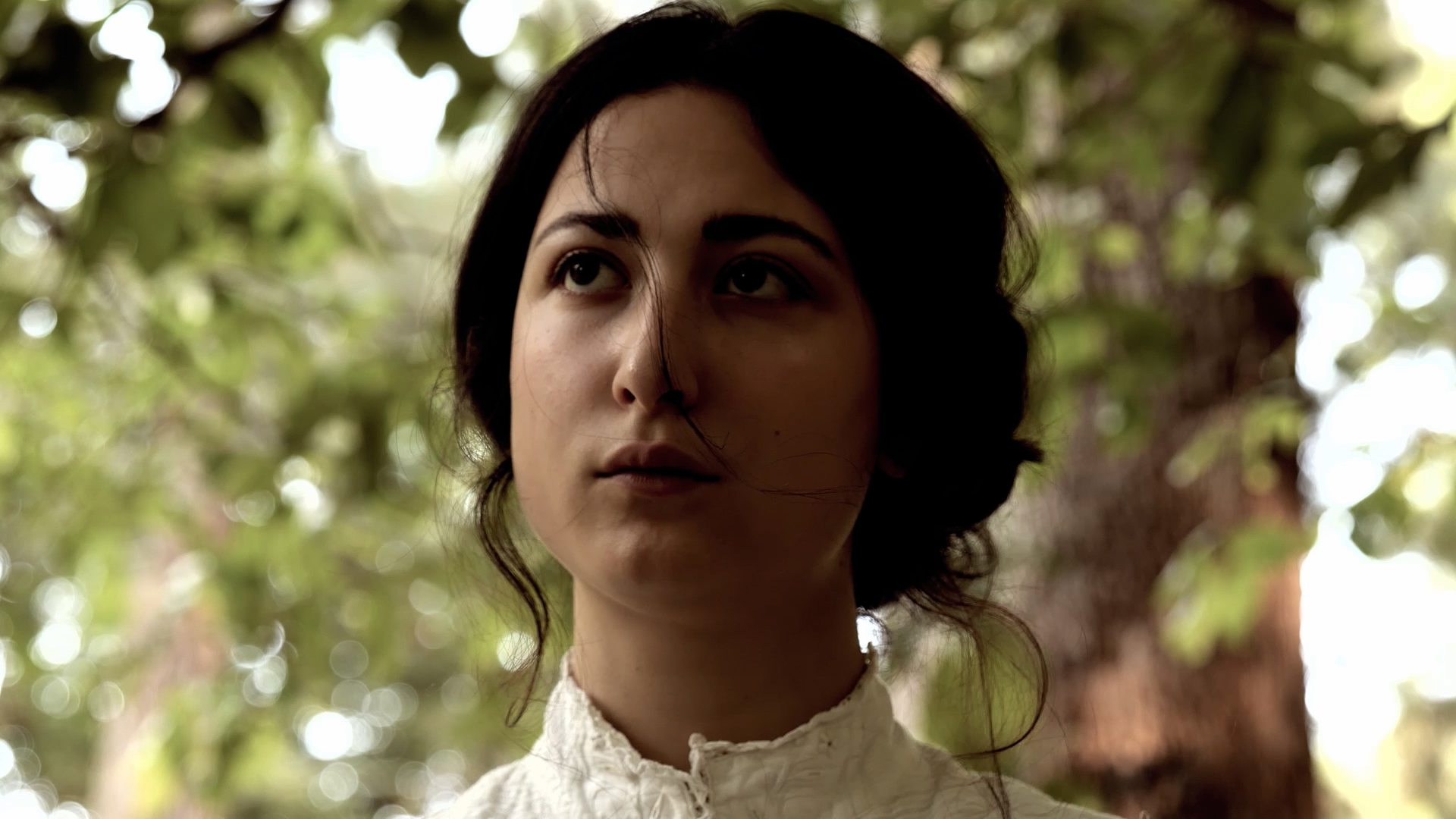
Documentary, by Isabel Russinova, Rodolfo Martinelli Carraresi, Italy, 2026
Eva of the Irises is a historical biographical docu-film about the scientist Eva Mameli Calvino, a botanist and pioneer of environmentalism in Italy, mother of the writer Italo, born in Sassari in 1886. The film, based on a multidisciplinary approach that combines several genres—such as theatre, documentary, cinema, and research—moves between memories, reflections on life, as well as the goals and missions the scholar still wished to achieve.
The multifaceted artistic sensibility of Isabel Russinova is expressed across many fields, from writing to acting, from directing to civic engagement, and finds one of its highest expressions in the docu-film Eva of the Irises, created with Rodolfo Martinelli Carraresi. The film blends scientific rigor and poetic refinement to portray the extraordinary figure of the botanist Eva Mameli Calvino, mother of Italo Calvino but above all an independent protagonist of 20th-century scientific culture. It is told through a combination of archival materials, interviews, and evocative staging capable of elegantly and profoundly conveying her intense human and professional story.
LANGUAGE: Italian
SUBTITLES: English, Spanish, French, Portuguese
What a Laboratory Smells Like When You Are Not Welcome
You arrive somewhere new and the building itself tells you. Not with signs, not with anyone raising their voice. The architecture speaks first. The layout of rooms, the placement of doors, the unspoken geography of who eats where and with whom — all of it transmits a message that has been encoded long before you walked through the entrance. When Rosalind Franklin joined King’s College London in January 1951, she entered a place that had been telling women they were peripheral for centuries, not through malice precisely, but through sediment. Through accumulated assumption hardened into stone and habit.
She was thirty years old, trained in X-ray crystallography at the Laboratoire Central des Services Chimiques de l’État in Paris, where she had spent four years working among colleagues who treated competence as the only relevant currency. Paris had been, by her own account, the place where she felt most professionally herself. Then King’s College. The senior common room — the social and intellectual heartbeat of the institution, where ideas moved between meals and conversations — was closed to women. Not metaphorically. Literally closed. She ate elsewhere. The conversations that happened after lunch, the ones where the real thinking often occurred, happened without her. This is not melodrama. This is the floor plan of a building doing the work that prejudice prefers not to have to do out loud.
Simone de Beauvoir, writing in 1949 in The Second Sex, identified precisely this mechanism: the way that woman is constructed as the Other not through explicit declaration but through the thousand invisible arrangements that surround her before she has spoken a word. De Beauvoir understood that oppression at its most durable does not announce itself. It presents itself as neutral. As simply how things are. The room that excludes you was not designed to exclude you specifically — it was designed for the default human, who happened, by unexamined consensus, not to be you.
Maurice Wilkins had been working at King’s before Franklin arrived. He assumed, on the basis of nothing she had said or done, that she was his assistant. She was not. She had been appointed to lead her own independent research program on DNA using X-ray diffraction. The confusion — if it can be called something so innocent — was never fully resolved between them, and it calcified into a working relationship of sustained mutual incomprehension that would have consequences neither of them could have anticipated. Wilkins reportedly found her difficult. Difficult is a word that accumulates on women who decline to accommodate the expectations of men who have mistaken their own comfort for professional norm.
What Franklin was doing, technically, was extraordinary. X-ray crystallography as applied to biological molecules required a precision that bordered on the obsessive, a patience with invisible structures that demanded you trust mathematics and diffraction patterns before you trusted your own eyes. She was producing images of DNA fibers at a resolution that had not been achieved before, working methodically through the problem of whether DNA existed in one form or two — what she would come to call the A and B forms — understanding that the answer had to come from the data, not from the theory you arrived with.
But the data was gathered in a building that allocated space according to an unspoken hierarchy. The hierarchy did not need to be enforced because it had already been built. De Beauvoir wrote that woman finds herself in a world where men have defined the values, the institutions, the very language of legitimacy. Franklin found herself in a laboratory where the physical space, the social rituals, the assumed chain of authority all predated her presence and had not been reconfigured to include her as an equal. She worked inside a structure that treated her arrival as an anomaly to be managed rather than a reality to be reckoned with.
The photographs she was developing in that unwelcoming building would eventually change everything anyone thought they knew about the shape of life itself.

Precision as Rebellion
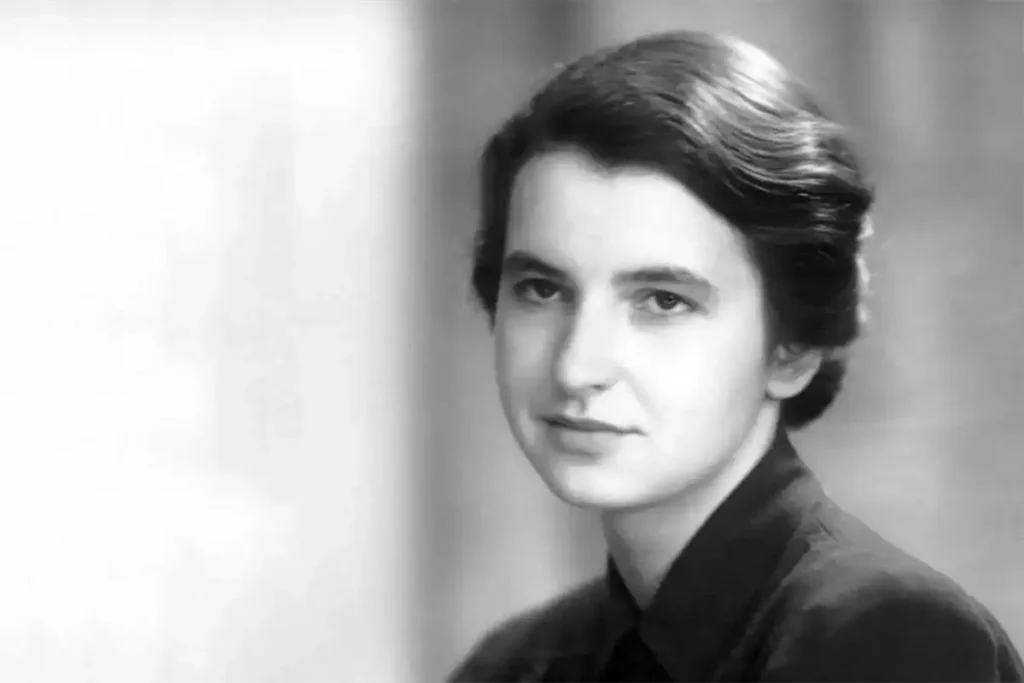
There is a kind of person who, when handed an unclear image, does not squint and guess. They go back to the source. They adjust the instrument, recalibrate the exposure, repeat the process until what they see is not an approximation of truth but truth itself — or as close as human hands can bring it. This is not stubbornness. It is a philosophical position disguised as technique.
Franklin had learned X-ray crystallography during her years in Paris, working under Jacques Mering at the Laboratoire Central des Services Chimiques between 1947 and 1950. What she absorbed there was not merely a method but a discipline of seeing — the capacity to read the invisible architecture of matter through the patterns that X-rays scatter when they pass through a crystalline substance. The technique required patience of an almost monastic intensity: preparing samples, controlling humidity with extraordinary precision, adjusting angles of incidence by fractions of a degree, waiting. Most researchers used it as a tool. Franklin treated it as a language, and she refused to speak it carelessly.
When she arrived at King’s College London in January 1951, she immediately identified something her predecessors had either overlooked or collapsed into ambiguity: DNA did not exist in one form but in two. Under low humidity it contracted into a dense, crystalline structure she designated Form A. Under high humidity it elongated into a more hydrated, paracrystalline configuration she called Form B. These were not minor variations. They were structurally distinct enough to produce radically different diffraction patterns, and conflating them — as had been done — was not a simplification. It was an error. Franklin separated them, studied them independently, and documented the distinction with the kind of methodical thoroughness that makes later observers feel almost embarrassed by the shortcuts taken before her.
Hannah Arendt, writing in The Life of the Mind in 1978, drew a distinction between thinking and cognition — between the restless human need to question appearances and the more practical faculty of acquiring and storing knowledge. What Franklin embodied, in the laboratory rather than the seminar room, was precisely this refusal to stop at cognition. She did not accept that an image was good enough simply because it was good enough for a purpose. She returned to the question even when convention had already moved on.
Photo 51, produced in May 1952 after roughly 100 hours of X-ray exposure, is the result of that return. It is not a beautiful image in any ordinary visual sense. It is a dark cross of diffraction bands against a lighter background, its symmetry speaking a precise geometric vocabulary to those trained to read it. To Franklin it spoke unmistakably: the B form of DNA had a helical structure, its phosphate groups facing outward, its repeating unit measuring 3.4 angstroms along the helix axis. She noted these measurements in her laboratory notebooks with the same composure she brought to everything. She was not triumphant. She was accurate.
What the cultural mythology around scientific discovery consistently fails to reckon with is that this kind of precision is itself a form of power — and that power exercised by the wrong person, at the wrong institution, in the wrong decade, is rarely recognized as such. It is reframed as difficulty. Arendt understood that the life of the mind carries costs in worlds organized around social consensus rather than rigorous truth. The thinker who refuses to settle for the convenient approximation threatens not just a particular claim but the entire social arrangement built on top of it.
Franklin did not think of herself as a rebel. She thought of herself as a scientist doing the work correctly. But in an environment where approximation had been normalized and ambition had been allowed to substitute for evidence, doing the work correctly was already an act of profound defiance — even if she never named it as such, and perhaps especially because she did not.
The Architecture of Erasure
There is a particular kind of theft that leaves no fingerprints because it never touches the object directly. Someone passes through a room, looks at what is on the table, and walks away carrying the knowledge of it. The thing itself remains exactly where it was. Nothing is missing. Everything is gone.
In January 1953, Maurice Wilkins showed a photograph to James Watson. He did not ask Franklin’s permission. It is unclear he even considered that permission might be required. The photograph — a pristine X-ray diffraction image Franklin had captured after months of painstaking refinement of her experimental technique, adjusting humidity levels, exposure times, the geometry of her crystalline samples — revealed with extraordinary clarity the helical structure of DNA in its B form. Watson looked at it. He understood immediately what he was seeing. He later wrote that his pulse began to race. He made no notes in Wilkins’s presence. He did not need to. The image had already moved from the paper into him.
This moment alone would be sufficient to indict. But the architecture was more elaborate than a single glance. Max Perutz, a member of the Medical Research Council committee that had visited King’s College, shared with Watson and Crick a detailed MRC report containing Franklin’s precise measurements of the unit cell dimensions, the water content of DNA, and the spatial coordinates that would become the skeleton of any credible structural model. Perutz later claimed he had not realized the report was confidential. The claim is not impossible. It is also not the point. Whether the door was left open by carelessness or by something less innocent, Watson and Crick walked through it.
Their model of the double helix was published in Nature on April 25, 1953. It is one of the most celebrated pages in the history of science. The paper runs to slightly over nine hundred words. Franklin’s name appears once, in a footnote acknowledging that her work had provided “general support” for the model. Her crystallographic data — without which the specific dimensions of the helix could not have been confirmed — was attributed to her in a separate paper published in the same issue, as though her contribution were parallel and independent rather than foundational. The arrangement was elegant in its dishonesty. It preserved the appearance of proper attribution while ensuring that no reader would understand what had actually flowed from whom to whom.
The sociologist Robert K. Merton named this mechanism in 1968, writing in Science about what he called the Matthew Effect, borrowing from the Gospel of Matthew: “For unto every one that hath shall be given, and he shall have abundance: but from him that hath not shall be taken away even that which he hath.” Merton documented systematically how scientific credit accumulates disproportionately among already-celebrated researchers, while the contributions of the less prominent — regardless of their actual scientific weight — are absorbed, diluted, or simply forgotten. The effect is not primarily the result of conscious fraud. It operates through institutional habit, through the way attribution flows along lines of visibility, reputation, and social legibility. Watson and Crick were already connected, already embedded in the networks where recognition circulates. Franklin was a woman working in a laboratory where she was barely tolerated, producing results that her colleagues accessed without her awareness. The Matthew Effect does not require malice. It requires only a structure that nobody thinks to question.
What happened to Photo 51 is not an anomaly in the history of science. It is the history of science, compressed into a single image passed between two men in a corridor, neither of whom paused to ask whether they had the right.
A Face Pressed Against the Glass of History
You know exactly what you did. You were there for every hour of it — the preparation of the samples, the painstaking adjustments to humidity levels that took months to calibrate, the stillness required to capture an image so precise it would later be described as among the most important photographs ever taken in the history of science. You know the labor that lived in your hands. And then one morning, without your knowledge, without your permission, without even the courtesy of a glance in your direction, someone else walks into a room and shows your work to the people who will change the world with it.
The sensation is not quite anger. It arrives before anger. It is something more vertiginous — the sudden instability of a floor you believed solid. You watch your own evidence become someone else’s revelation. You watch the architecture of your thought become the foundation of their monument. And the cruelest part is that no one in the room where it happens finds this unusual. The system does not malfunction when your work is taken. The system is functioning exactly as it was designed to.
There is a woman who spends years building an estate she will never be allowed to enter through the front door. She measures the rooms, she selects the materials, she understands every structural tension in the walls. The men who will live there learn her blueprints so thoroughly they begin to believe they drew them. She is not absent from the building. She is inside every wall, every joint, every calculated angle. But when the guests arrive, she is not introduced. This is not an accident of memory. It is an architecture of erasure so old it has become invisible to those who benefit from it.
Erving Goffman wrote in 1963 that stigma is not a property of a person but a relationship between an attribute and a stereotype, a gap between what he called virtual social identity — what others expect — and actual social identity — what the person is. For Rosalind Franklin, the gap was not incidental. It was institutional. She was a woman in a discipline that had already decided what a woman’s contribution looked like: supportive, secondary, technical. Her X-ray diffraction images, particularly Photo 51 captured in 1952, represented not merely technical skill but profound scientific reasoning — the selection of the B-form of DNA, the understanding of the water content, the spatial interpretation of a diffraction pattern that others could not yet read. But the frame through which her colleagues perceived her had already been constructed before she arrived. Goffman’s point was precisely this: stigma functions as a kind of perceptual pre-sorting that makes certain truths about a person literally unregistrable to those looking at them.
Think of a man who spends an entire life translating the language of a culture for people who then publish the translations under their own names. He corrects their errors. He provides the context they lack. He is thanked in footnotes, when he is thanked at all. The footnote is not acknowledgment. The footnote is the place where institutions store what they have taken without calling it theft.
What makes institutional theft so durable is precisely that it requires no malice to function. The men who took Franklin’s work did not necessarily think of themselves as thieves. They thought of themselves as scientists in pursuit of a discovery. The discovery, to their minds, needed a certain kind of author — credentialed in the right institutions, socialized in the right networks, legible within the existing grammar of scientific authority. Franklin was illegible to them in the ways that mattered for credit, even as she was entirely visible in the ways that mattered for labor.
You stand at the glass and watch them celebrate inside the room your work built.
A vision curated by a filmmaker, not an algorithm
In this video I explain our vision
What Watson Actually Wrote

There is a book that has been assigned in university biology courses for decades, a memoir that professors hand to students as an intimate window into how science really works, how discoveries are made in the small hours, how genius operates under pressure. It is described as candid, irreverent, human. What it actually is, if you read it with the lights fully on, is one of the most efficient acts of character assassination ever disguised as autobiography.
He calls her Rosy. Not Rosalind, not Dr. Franklin, not even the professional courtesy of a surname. Rosy, a nickname she never used, a name that infantilizes and domesticates simultaneously, that takes a woman of formidable precision and shrinks her into something manageable. He describes her without spectacles, notes with evident surprise that she might have been attractive if she had tried, records her manner as aggressive, her refusal to be supervised as obstinacy. The portrait is so consistent in its contempt, so unrelenting in its reduction of a scientist to her physical presentation and her emotional temperature, that it reads less like memory and more like construction. A deliberate architecture of diminishment built to last.
What makes this not merely unpleasant but philosophically significant is the mechanism Roland Barthes identified in his 1957 Mythologies: the process by which ideology naturalizes itself, how the contingent and the constructed come to appear inevitable and given. When a story is told often enough, when it accumulates the authority of print and institution and citation, it stops being a version of events and becomes the events themselves. The mythology of the double helix discovery, as it was written by one of its principal actors, did not simply exclude Franklin. It installed her exclusion as natural, as something that required no justification because it was presented as description rather than argument. She was difficult, she was hostile, she refused to collaborate. The mythology does not need to argue that she therefore deserved what happened to her. It simply shows you who she was, and trusts you to draw the conclusion it has already prepared for you.
He admits, almost in passing, buried in the texture of his self-celebration, that she did not know. That the critical data from her laboratory, the measurements that gave the helix its precise dimensions, were shown to him without her knowledge or consent. He writes this without apparent discomfort, which is perhaps the most telling detail of all, because discomfort would have acknowledged a moral category that the entire narrative works to suspend. The admission sits there in the text like a window left accidentally open, through which you can see the actual structure of what happened, before the curtain of retrospective justification is drawn back across it.
Walter Benjamin wrote, in his 1940 theses on the philosophy of history, that there is no document of civilization that is not at the same time a document of barbarism. He was not speaking metaphorically. He meant that the great works, the monuments, the texts we pass down as the inheritance of human achievement, were produced inside systems of power that required the suppression of other lives to function. The Double Helix is a document of civilization. It is taught, quoted, celebrated, shelved beside the Nobel lectures and the biographies of the great. It is also, structurally and demonstrably, a document of barbarism, a record of how the victors of a scientific competition consolidated their victory by controlling the narrative of the competition itself.
This is the final instrument of erasure, and the most durable. You can dispute a priority claim, contest a patent, reattribute a footnote. But when one person holds the pen and writes the history while the subject of that history is no longer alive to answer, the violence becomes architectural. It gets built into the walls of how the story is remembered, so that every retelling, even the sympathetic ones, must begin by dismantling a structure designed to resist dismantling.
Coal, Viruses, and a Life That Did Not Wait for Vindication
There is a particular kind of erasure that works not by deletion but by reduction — by taking a life of extraordinary breadth and collapsing it into a single grievance, a single corridor, a single stolen image. What gets lost in that compression is not merely credit. What gets lost is the actual texture of a scientific mind at work across years and disciplines, moving through problems with the same rigorous hunger that characterized everything Franklin touched, long before and long after the helix became the story the world decided to tell about her.
She had arrived in Paris in 1947 at the Laboratoire Central des Services Chimiques de l’État, working under Jacques Mering, and what she did there between 1947 and 1950 constitutes some of the most technically demanding materials science of the postwar decade. Her subject was coal — unglamorous, industrial, seemingly inert — and her method was X-ray diffraction applied with a precision that allowed her to distinguish between different microstructural configurations within carbonaceous materials that had previously been treated as effectively homogeneous. She demonstrated that coals could be classified according to whether they were graphitizing or non-graphitizing when subjected to high temperatures, a distinction with immediate practical implications for industry and a theoretical elegance that the field had not anticipated. She published five papers from this period that were cited extensively for decades afterward, work that earned her genuine respect in the European physical chemistry community entirely on its own terms, before anyone had reason to connect her name to a double helix.
This is the life Charles Taylor would recognize when he writes, in his 1992 work The Politics of Recognition, that identity is not something granted from outside but something constituted through the act of being seen in the fullness of one’s activity. The tragedy Taylor describes is not simply invisibility — it is misrecognition, being seen through a distorting lens that registers only a fraction of what is actually there. Franklin was not misrecognized by history as someone who contributed nothing. She was misrecognized as someone who contributed one thing, one moment, one photograph, and then became a footnote to other people’s insight. The full architecture of her intellectual life was left unread.
Because what followed the coal years and the DNA years was not diminishment. When she moved to J.D. Bernal’s laboratory at Birkbeck College in 1953, she began working on the tobacco mosaic virus with a combination of crystallographic technique and structural intuition that produced, across five years, some of the most significant virus research of the era. She established that the RNA of the tobacco mosaic virus was embedded within the protein subunits rather than running through an interior channel — a finding with profound implications for understanding how genetic material is protected and expressed in viral structures. She then turned toward the polio virus, and her group’s work on its structure was advancing with the same methodical brilliance when she was diagnosed with ovarian cancer in 1956. She worked through treatment. She worked between hospitalizations. Her 1958 papers on virus structure appeared in print as she was dying at thirty-seven, and they appeared not as the desperate output of someone racing against time but as the composed, precise contributions of someone who had not yet finished what she intended to do.
The philosopher Simone Weil once wrote that attention is the rarest and purest form of generosity. Franklin gave that attention to coal, to viruses, to the molecular architecture of living and non-living matter alike, with a consistency that had nothing to do with recognition and everything to do with the intrinsic demands of the work itself. She did not live waiting for vindication. She lived producing. The vindication was a posthumous arrangement made by a world that needed her story to be about something it could easily feel guilty about, which is a far simpler thing than what her story actually was.
The Nobel Prize That Was Never Hers to Lose
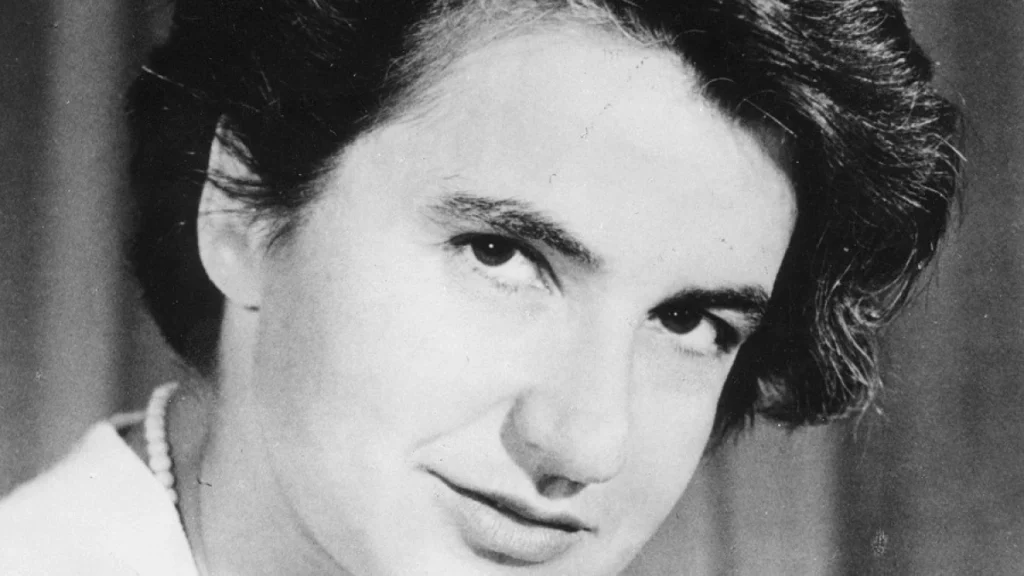
You probably assume, somewhere in the back of your mind, that prizes go to the people who deserve them. Not always, not perfectly, but roughly, approximately, with the kind of error margin that systems are supposed to correct over time. The 1962 Nobel Prize in Physiology or Medicine is not a story about that margin failing. It is a story about the margin working.
Watson, Crick, and Wilkins received the prize in October 1962. Franklin had died of ovarian cancer in April 1958, at thirty-seven. The Nobel Committee does not award prizes posthumously — a rule formalized explicitly in 1974, though already operative as convention well before that. So there was no violation. No rule bent, no procedure circumvented, no institution behaving outside its own logic. Every gear turned exactly as it was built to turn. This is what makes the silence around her name not scandalous but structural, and therefore far harder to confront.
The philosopher Miranda Fricker, in her 2007 work Epistemic Injustice, distinguishes between what she calls testimonial injustice — the deflation of a speaker’s credibility due to identity prejudice — and hermeneutical injustice, the deeper condition in which the very conceptual tools needed to understand an experience do not yet exist in the shared vocabulary. Franklin suffered both, but it is the second that haunts the prize ceremony most acutely. There was no language in 1962, no category, no committee mandate, that would have required anyone to ask where the foundational X-ray data had come from. The question literally did not exist as an official question.
Watson’s own memoir, published in 1968, initially described Franklin in terms that her colleagues found so demeaning that the book’s original American publisher, Harvard University Press, withdrew from the project after objections from Crick and Wilkins themselves. When The Double Helix finally appeared through Atheneum, it reached a vast popular audience before any correction to the record could settle into public consciousness. By then, the image of Franklin as an obstacle rather than an architect had already been planted in the reader’s imagination — and images, as the psychologist Daniel Kahneman spent a career demonstrating, outlast the corrections that follow them.
What is genuinely unsettling is not that the prize went to three men while the woman who produced the critical data was absent. What is unsettling is that the Nobel Committee has never been formally asked to account for this, because accountability would require admitting that the system’s neutrality is itself a position. A committee that does not award posthumous prizes is not simply following a neutral administrative rule. It is making a claim about whose contributions are visible in time, about whose work accumulates credit fast enough to be recognized before death interrupts. Franklin’s data entered the double helix before her name could follow it into institutional memory.
Think of a man standing at a podium in Stockholm, thanking colleagues and institutions, his voice carrying the particular warmth of someone who knows the story he is telling is incomplete but has decided, long ago, that incompleteness is not the same as wrongness. The room applauds. The cameras record. The archive seals.
The question that no prize committee has ever been formally asked to answer is not whether Rosalind Franklin deserved the Nobel Prize. It is whether a system that produced this outcome without breaking a single rule should continue to trust its own rules as sufficient evidence of its fairness. That question has no ceremony attached to it, no medal, no podium in Stockholm. It lives in the gap between what institutions call procedure and what history eventually calls by its proper name.
🔬 Science, Discovery, and the Lives Behind the Breakthroughs
Rosalind Franklin’s story is inseparable from the broader history of scientific inquiry — a history shaped by curious minds, careful observation, and the courage to challenge prevailing assumptions. Exploring the lives of other pioneering scientists illuminates the context in which Franklin worked and reveals the enduring human dimensions of discovery.
Gregor Mendel: Life and Works
Like Franklin, Gregor Mendel was a scientist whose groundbreaking work was not fully recognized during his own lifetime. His meticulous experiments with pea plants laid the foundation for the science of genetics, the very field that DNA research would later transform. Exploring Mendel’s story offers essential context for understanding the biological revolution Franklin helped to advance.
GO TO THE SELECTION: Gregor Mendel: Life and Works
Rachel Carson: Life and Works
Rachel Carson was among the most influential scientists of the twentieth century, using rigorous research to challenge powerful institutions and change public consciousness. Her life, like Franklin’s, demonstrates the unique obstacles faced by women who dared to occupy space in male-dominated scientific fields. Carson’s courage in speaking truth to power echoes the quiet determination that defined Franklin’s own career.
GO TO THE SELECTION: Rachel Carson: Life and Works
Charles Darwin: Life and Works
Charles Darwin‘s life is one of the great narratives of modern science — a story of patient observation, intellectual daring, and the willingness to follow evidence wherever it leads. Franklin, too, was a meticulous empiricist whose X-ray crystallography work demanded extraordinary precision and discipline. Understanding Darwin’s journey enriches our appreciation of the scientific temperament that Franklin embodied so fully.
GO TO THE SELECTION: Charles Darwin: Life and Works
Nikola Tesla: the Genius That Power Could Not Afford
Nikola Tesla‘s story is a compelling reminder that visionary scientists are not always celebrated in their own time, and that credit and recognition can be cruelly misallocated. Much like Franklin, Tesla’s contributions were overshadowed by more famous contemporaries who received the accolades his work had made possible. His legacy invites us to reconsider who we remember from history — and who we have forgotten.
GO TO THE SELECTION: Nikola Tesla: the Genius That Power Could Not Afford
Discover More Stories of Science and the Human Spirit on Indiecinema
If these stories of scientific courage and intellectual passion have moved you, Indiecinema streaming is the place to continue your journey. Our curated selection of independent documentaries and thought-provoking films brings to life the minds that changed the world — from laboratories to lecture halls and beyond. Join us and explore cinema that dares to ask the deepest questions.
👉 EXPLORE THE CATALOG: Watch Indie Films in Streaming
A vision curated by a filmmaker, not an algorithm
In this video I explain our vision

