
The Kitchen Table and the Alembic
There is a moment most people know but rarely speak about — the early morning, the kitchen still dark, the coffee being stirred in slow circles while something unnamed moves through you. Not thought exactly, not feeling exactly. A kind of internal weather. The spoon makes its rounds and you watch the liquid shift from opaque to something almost luminous at the edges, a tiny vortex forming at the center, and for a few seconds you are neither asleep nor awake but suspended in a state that has no word in ordinary language. Most people let it pass. They drain the cup, check their phone, step back into the ordinary architecture of the day. But something happened in that kitchen, at that table, with that small rotating darkness in the cup — something that the Hermetic tradition would have recognized immediately and named with a precision that our contemporary vocabulary entirely lacks.

The name it would have given was Philosophical Mercury. Not mercury the metal, not the silver liquid that rolls around a broken thermometer, though those physical properties were never entirely beside the point. Philosophical Mercury — Mercurius Philosophorum — is one of the most persistently misread concepts in the history of Western thought, buried under centuries of mockery aimed at alchemists who were supposedly trying to transmute base metals into gold, as if an entire tradition of rigorous inquiry could be reduced to a kind of proto-chemistry conducted by deluded men in smoky rooms. The mockery was deliberate. It was protective, actually. The smoke was real, and the laboratories were real, but the operations being encoded in the language of sulfur and salt and mercury were never primarily about what was sitting in the crucible.
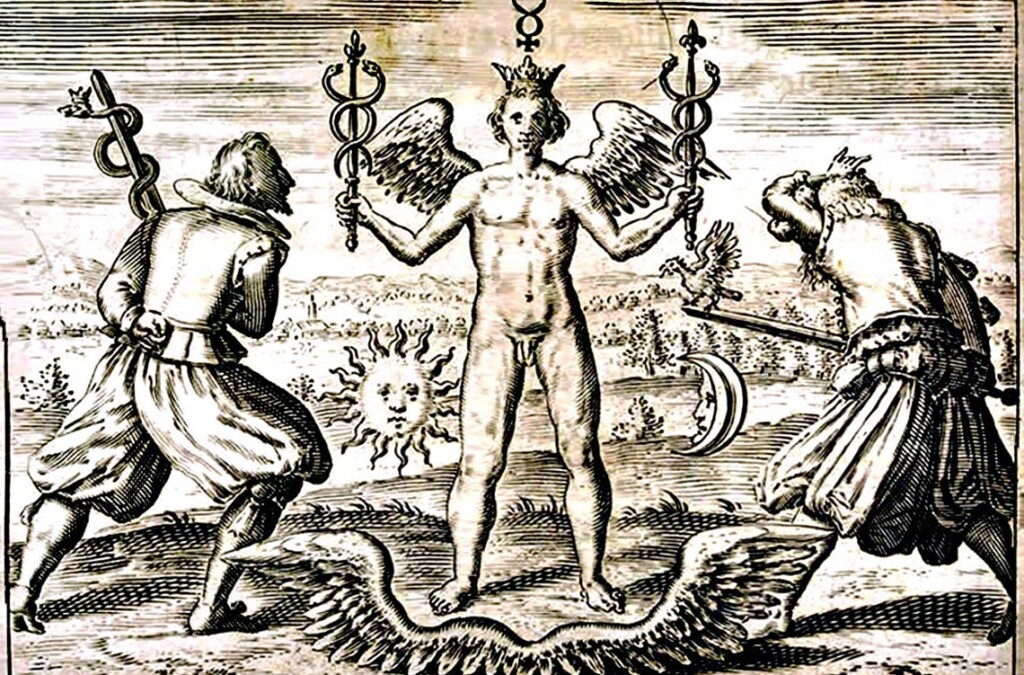
The historical record makes this impossible to dismiss. By the early seventeenth century, texts like Michael Maier‘s Atalanta Fugiens, published in 1617, or the Rosarium Philosophorum, which had been circulating in manuscript form since at least the fourteenth century, were constructing an elaborate parallel language in which every external chemical operation corresponded precisely to an internal psychological one. The calcination of metals described the burning away of fixed identity. The process of solve et coagula — dissolve and coagulate — mapped the alternating rhythm of ego dissolution and reformation. These were not metaphors added afterward to make the chemistry seem profound. They were the primary content, and the chemistry was the metaphor. Maier was a physician, a counselor to Emperor Rudolf II, a man operating at the highest levels of European intellectual culture. He was not confused about what gold was.
What he was doing, and what the tradition he was transmitting had always been doing, was working with a particular quality of human attention that activates when the ordinary categories of experience stop holding. The philosophical traditions that converge in Hermeticism — Neoplatonism, Gnosticism, strands of Kabbalah, the remnants of Egyptian cosmological thinking that survived in Greek translation — all shared a conviction that human consciousness contains within itself a principle of transformation that is normally dormant. Not repressed in the Freudian sense exactly, though Carl Jung spent decades demonstrating in Psychology and Alchemy, published in 1944, that the symbolic structure of alchemical literature mapped almost perfectly onto the individuation process he was tracking in his patients’ dreams. Dormant in a different sense: present but unactivated, like a catalyst waiting for the right conditions to begin its work.
That catalyst was Philosophical Mercury. And the right conditions were precisely the kind of threshold moment that happens at a kitchen table before the day has hardened into its familiar shapes, when something moves through you that you cannot name and you almost — almost — pay attention to it.
What the Smoke Concealed
He stood at the window long after the conversation had ended, watching his own face emerge from the darkness outside. Not recognizing it, exactly. Recognizing something behind it, some older arrangement of features that predated everything he thought he had become. The glass gave back a version of him he had not consented to. This is the experience the alchemists were mapping when they wrote about vulgar quicksilver, the common mercury that scatters across every surface it touches, that takes the shape of whatever contains it without ever becoming anything, that moves with brilliant, lethal restlessness and cannot hold its own form for a single sustained moment. They were not describing a metal. They were describing a mind that has never been still long enough to see itself.
She burned the letters on a Tuesday evening, in the garden, watching the smoke rise and disappear into a sky that was indifferent to what she was trying to undo. There was something almost ceremonial about it, the way she fed each page deliberately, as though performing something she had read about in a dream. But the burning did not bring the relief she had expected. The smoke carried nothing away. What she had wanted to dissolve was not in the paper. It was in the mechanism of her own attention, in the way her mind kept reconstructing, from pure habit, the precise architecture of everything she was trying to leave behind. This is what the Hermetic texts named with terrible accuracy: the vulgar mercury is not external. It is the mind’s own compulsive mobility, its refusal to remain with a single thing long enough for transformation to occur.
C.G. Jung spent decades establishing precisely this correspondence. In his 1944 Psychology and Alchemy, he tracked the figure of Mercurius through the entire Western esoteric tradition and arrived at a conclusion that should have been obvious but never quite is: that Mercury, in the alchemical imagination, is the unconscious itself. Not a symbol for it. Not a metaphor standing politely beside it. The substance. Jung identified Mercurius as the trickster-transformer, the figure who appears at the threshold of every genuine psychological shift, who is simultaneously the poison and the medicine, the agent of dissolution and the principle of cohesion. He is the part of the mind that cannot be reasoned with, cannot be argued into stillness, can only be worked with alchemically, which is to say through a process so indirect it barely resembles intention at all.
The Hermetic distinction that matters here is precise. Common mercury, quicksilver in its raw state, is what most people mean when they think they are thinking. It is reaction, association, the unexamined reflex dressed as judgment. Philosophical Mercury is something else entirely: it is that same volatile substance after it has been subjected to the alchemical process of purification, after the impurities have been burned away through repeated operations the texts call sublimation, calcination, dissolution. What remains is not docile. Philosophical Mercury does not become quiet or manageable. It becomes coherent. It becomes capable of penetrating fixed matter, of dissolving what has hardened into something that was never meant to be permanent, of making transformation possible precisely because it is no longer scattered.
The man at the window saw something in his reflection that night that his daylight mind consistently refused to acknowledge. This is what Jung meant when he wrote that the encounter with the unconscious begins not in the consulting room but in the ordinary catastrophe of self-recognition, in the moment when the scattered mind accidentally holds still long enough to see what it has been circling.

The Lie We Call Solid
There is a particular moment, familiar to almost anyone who has lived long enough, when you look at the architecture of your own life — the career, the marriage, the ideology, the faith — and realize with a vertigo that has no clean name that none of it was chosen. It was accumulated. Deposited, layer by layer, the way sediment forms at the bottom of still water, and you mistook the sediment for bedrock.
The historians of science have performed a similar trick on alchemy. They fixed it in place, labeled it, and moved on. The standard narrative, inherited largely from the positivist enthusiasm of the nineteenth century, cast the alchemical tradition as a kind of intellectual childhood — fumbling, superstitious, occasionally useful by accident, but fundamentally waiting to be superseded by Lavoisier, by Dalton, by the periodic table. Chemistry arrived and alchemy was revealed as what it had always been: a mistake. This is among the more confident falsifications in the history of ideas, and it has the particular cruelty of all falsifications that flatter the present at the expense of the past.
Mircea Eliade, writing in 1956 in what remains one of the most quietly devastating works of comparative religious history, traced the symbolic logic of metallurgical transformation across cultures spanning from sub-Saharan Africa to Vedic India to pre-Columbian Mesoamerica. What he found was not primitive chemistry. What he found was a consistent, cross-cultural grammar of sacred becoming, in which the smelting of ore, the tempering of iron, the dissolution of metals in acid was always simultaneously an operation performed on the inner life of the operator. The forge was never merely a forge. The smith was never merely a craftsman. Eliade demonstrated that cultures separated by oceans and millennia had independently arrived at the same metaphysical intuition: that matter and psyche obey analogous laws, that to transform one is to invoke the possibility of transforming the other.
Paracelsus understood this with a directness that his contemporaries found unsettling and his successors found inconvenient. He did not separate the physician’s knowledge of minerals from the physician’s knowledge of the soul’s diseases. For Paracelsus, the same mercury that moved through metallic compounds moved through human consciousness, and its function in both domains was identical: to refuse fixity, to keep open what habit and fear and doctrine had sealed shut. Gerhard Dorn, working in the latter half of the sixteenth century and engaging Paracelsus’s legacy with rigorous philosophical intensity, made explicit what his predecessor had left suggestive. The great work was not the production of gold. The great work was the production of a human being capable of sustaining transformation without disintegrating — capable of remaining liquid, in the precise alchemical sense, while everything around them demanded calcification.
Michael Maier‘s Atalanta Fugiens, published in 1617, encoded this understanding in a form so layered it was almost playful about its own concealment — fifty emblems, each accompanied by a fugue, a poem, and an image, each one a different angle on the same central proposition: that what appears most solid is most urgently in need of dissolution. A man sits at a table surrounded by the evidence of his accomplishments, his certainties stacked like books, his convictions framed like portraits, and somewhere beneath all of it, sealed under decades of accumulation, is the original question he stopped asking because the answer was too expensive. Philosophical Mercury was the name the tradition gave to the solvent capable of reaching that question. Not a chemical. Not a metaphor, exactly. Something closer to what happens in the body when a long-held belief suddenly fails — that nauseating, clarifying liquefaction that feels simultaneously like loss and like the first honest breath in years.
Mercury Moves and Cannot Be Held
There is a particular kind of silence that exists only in hospital corridors at two in the morning. Not the silence of absence, but of suspension — the fluorescent hum overhead, the occasional soft collision of rubber wheels against linoleum, and in between those sounds, a person sitting in a plastic chair discovering, with no ceremony whatsoever, that they have no idea who they are. The roles have been stripped away by exhaustion and emergency. No one here needs them to be competent, or funny, or strong. And in that vacancy, instead of peace, there is something closer to vertigo. What remains when the performing stops? The question does not feel philosophical. It feels like falling.
The Rosarium Philosophorum, assembled in 1550 from older alchemical streams and later to fascinate Carl Jung sufficiently to anchor his 1946 essay on transference, describes Mercury in terms that initially read as contradiction piled on contradiction. Mercury is the beginning of the Work and its end. It is the solvent that dissolves all metals and the metal that cannot itself be dissolved by ordinary means. It is feminine in its receptivity and masculine in its penetrating action. It is called both poison and universal medicine, both serpent and the cure for the serpent’s bite. Medieval readers who expected a chemical recipe found instead a riddle that doubled back on itself. But the riddle was not obscuring a simpler truth. The riddle was the truth.
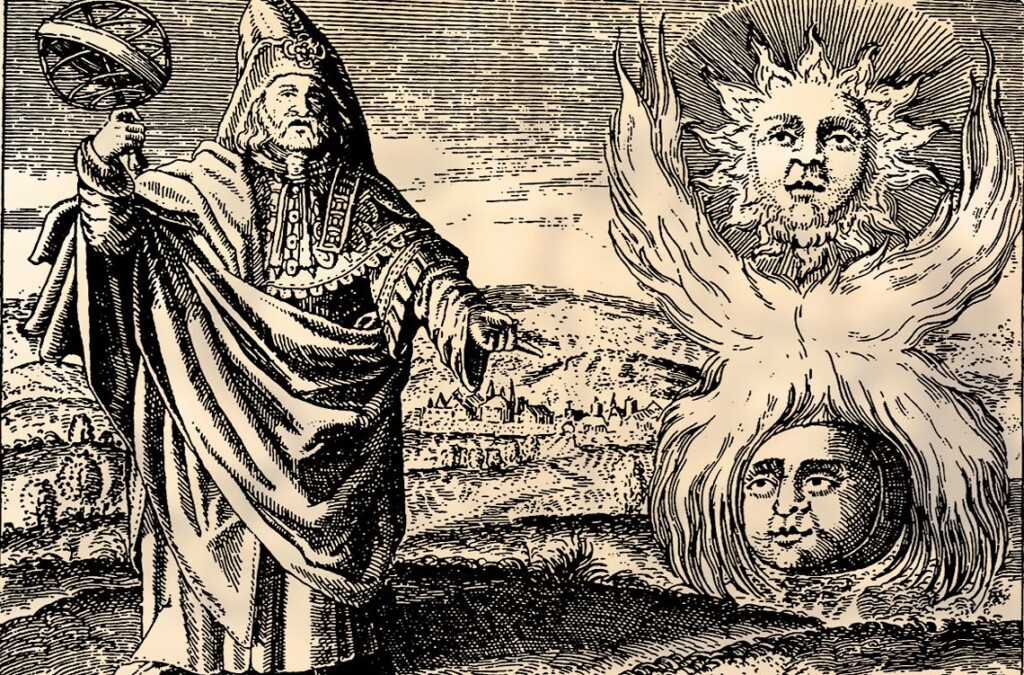
Heinrich Khunrath, writing in his Amphitheatrum Sapientiae Aeternae in 1595, pushed this further into the domain of consciousness itself. For Khunrath, Mercury was not a substance to be manipulated by the adept but a principle that manipulated the adept, a living intelligence moving through the psyche in the same way quicksilver moved through the body — touching everything, bonding with everything, belonging to nothing. The Mercurial principle refused categorization because categorization was precisely what it dissolved. To hold it was to lose it. To name it finally was to find that the name had already become a shell.
James Hillman, writing in Re-Visioning Psychology in 1975, had no interest in defending alchemy as proto-chemistry. What interested him was something more unsettling: that the alchemists had mapped, with considerable precision, a psychological process that modern ego-psychology was structurally prevented from seeing. Hillman’s argument was that the soul — what he called psyche — did not grow by accumulation or reinforcement of identity but by dissolution of it. Soul-making, his term borrowed from Keats, required exactly this Mercurial movement: the willingness to let fixed categories collapse, to endure the experience of not knowing which part of oneself was speaking, or to whom. The ego, in Hillman’s framework, was not the goal of psychological development but an obstacle to it — a Roman fort built on ground that the soul needed to remain open.
The person in the corridor understands this without having read a word of it. They understand it in the body, in the specific texture of not being able to locate the self when the social scaffolding falls away. What the Hermetic texts were describing was not a laboratory phenomenon and not a mystical exception. It was this: the ordinary terror of consciousness encountering its own fluidity. Mercury’s paradox — male and female, poison and cure, first and last — is not a theological puzzle. It is a phenomenological report. The self, observed closely enough, has always been moving. The categories were never airtight. They were agreements, performed with enough consistency to feel like facts, until a hospital corridor at two in the morning makes the performance impossible to continue.
The Temperature Required
There is a moment, known to anyone who has moved through serious grief, when you walk down a corridor in your own home and do not recognize it. Not because anything has changed in the physical arrangement of walls or light, but because the person who used to live in this corridor no longer exists in quite the same configuration, and the corridor has not been informed. The furniture holds its position with a kind of indifference that feels almost aggressive. You stand there, hand perhaps trailing along the wall, and something in you searches for the thread back to the self that used to move through this space without thinking, and finds nothing to grip.
This is not metaphor. This is the regimen at work.
The alchemical regimen was the precise science of temperature management across the stages of the Great Work — not a single sustained heat, but a graduated, almost musical sequence of warmth applied to matter at exactly the right moment and in exactly the right degree. Too much fire too soon, and the substance calcifies in resistance or burns to ash before it can open. Too little, and nothing moves, nothing dissolves, the matter sits inert inside its own hardness. The alchemists understood something that modern psychology has spent a century slowly rediscovering: that transformation is not a destination you arrive at through sufficient willpower, but a thermodynamic process with its own internal logic, its own timing, its own refusal to be rushed.
Gaston Bachelard, writing in 1938 in his strange and luminous study of fire’s psychological depths, argued that fire is the first phenomenon that demanded a human explanation — that before any other element, fire forced the imagination to think. It is both intimate and universal, both destructive and purifying, and what makes it philosophically treacherous is that we cannot be neutral in its presence. We either control it or we are consumed by it, and sometimes the line between those two conditions is invisible until it has already been crossed. Bachelard understood that our relationship to fire is not rational but libidinal — we are drawn toward it, we project into it, we see in its movement something we recognize from our own interior life.
The Hermetic axiom Solve et Coagula — dissolve and coagulate, separate and recombine — is sometimes presented as a sequence, a before and after, as if dissolution is simply the unpleasant preliminary to the real work of reconstruction. But the more honest reading is that they are not stages at all. They are simultaneous. The self does not finish dissolving before it begins to reform. It is always, at every moment, both coming apart and pulling together, and the question of which force is dominant at any given time is precisely what the regimen is designed to manage. The grief you walk through in that corridor is not separate from the person you are becoming. It is the medium of the becoming.
What no one tells you — what the tradition hints at but rarely states plainly — is that the self which emerges from genuine dissolution is not a restored version of the one that entered. The Philosophical Mercury does not return to its original vessel. It moves through the process and arrives somewhere genuinely new, carrying traces of the former configuration the way scar tissue carries the memory of a wound without being the wound itself. This is either the most hopeful thing in the entire tradition or the most terrifying, depending on how tightly you are holding the thread of who you believed yourself to be, and whether you can find it in yourself to wonder, even briefly, whether the one who entered the fire was already asking to be changed.
A vision curated by a filmmaker, not an algorithm
In this video I explain our vision
🜍 The Hidden Language of Hermetic Transformation
Philosophical Mercury stands at the very heart of Hermetic alchemy, representing not a physical substance but the living spirit of transformation that unites opposites and dissolves fixed forms. To understand its role, one must journey through the broader landscape of Hermetic thought, where symbols, cosmic correspondences, and inner metamorphosis converge into a single, boundless vision of reality.
The Corpus Hermeticum: Guide to Esoteric Reading
The Corpus Hermeticum forms the foundational textual universe from which the concept of Philosophical Mercury draws its deepest meaning. Reading these esoteric texts reveals how Mercury was understood as the divine intermediary between spirit and matter, a principle of fluidity and mediation woven into the very fabric of Hermetic cosmology.
GO TO THE SELECTION: The Corpus Hermeticum: Guide to Esoteric Reading
Tabula Smaragdina: Text Meaning and Interpretation
The Tabula Smaragdina, or Emerald Tablet, is arguably the most concentrated expression of the alchemical worldview in which Philosophical Mercury plays a central transformative role. Its famous axiom ‘as above, so below’ encapsulates the mercurial principle of correspondence that links the macrocosmic and microcosmic dimensions of alchemical work.
GO TO THE SELECTION: Tabula Smaragdina: Text Meaning and Interpretation
Spiritual Alchemy: Inner Transformation and Symbolism
Spiritual alchemy reframes the entire mercurial process as an inner journey of dissolution and reintegration, where the practitioner becomes both the laboratory and the substance being refined. The symbolism of Philosophical Mercury here maps directly onto the dissolution of the ego and the emergence of a more luminous, unified self.
GO TO THE SELECTION: Spiritual Alchemy: Inner Transformation and Symbolism
Giordano Bruno and the Hermetic Tradition
Giordano Bruno‘s engagement with the Hermetic tradition brought the mercurial principle into the realm of memory, cosmology, and infinite worlds, extending alchemy far beyond the crucible into philosophy itself. His radical vision of an animate, interconnected universe resonates profoundly with the role of Mercury as the spirit that permeates and connects all things.
GO TO THE SELECTION: Giordano Bruno and the Hermetic Tradition
Discover the Alchemy of Cinema on Indiecinema
If these labyrinthine ideas stir something within you, Indiecinema streaming is your gateway to independent films that dare to explore transformation, hidden knowledge, and the mysteries of consciousness. Step beyond the mainstream and let independent cinema be your Philosophical Mercury — the fluid, luminous medium that transmutes the ordinary into the profound.
👉 EXPLORE THE CATALOG: Watch Indie Films in Streaming
A vision curated by a filmmaker, not an algorithm
In this video I explain our vision

