
The Kitchen Table at Dawn
There is a particular kind of silence that belongs only to the hour before anyone else in the house has stirred. The coffee grows cold because you forget to drink it. The light above the table is the only light in the world. You found the text somewhere — a translated appendix in a book borrowed and never returned, a photocopy folded into thirds and kept in a drawer for years, something downloaded at midnight during an insomnia that felt meaningful. And now you are reading it again, the way you only read things that disturb you at the level below thought.

The words are short. The sentences arrive like blows. That is what stops you first — not the obscurity of the language, not the antiquity of the ideas, but the brevity. You were expecting something that would require effort to enter, some dense corridor of archaic syntax, and instead you find something that fits on a single page and yet somehow does not fit inside your mind. You read it through once and understand nothing with precision. You read it through a second time and feel, without being able to explain why, that you have understood everything. This is the first paradox the text gives you, before it has even begun to explain itself.
Hermes Trismegistus, the legendary figure to whom this document has been attributed for at least fourteen centuries, was never a single man. He was a cultural collision — the Greek Hermes, messenger and trickster and guide of souls, fused with the Egyptian Thoth, god of writing and wisdom and the measurement of time. Out of that collision came a vast body of literature, the Hermetica, produced roughly between the first and third centuries of the common era, though the tradition claimed origins far older than any manuscript could verify. The text in your hands, the one you keep returning to, is the densest and most condensed fragment of that entire tradition — a crystallization so compressed that scholars have spent twelve centuries trying to decompress it without consensus.
The Latin versions that circulated through medieval Europe were translations of Arabic translations of a Syriac text, itself derived from Greek, itself possibly derived from something older still. The first Arabic manuscript known to contain the full text appears in a work called the Book of the Secret of Creation, attributed to Apollonius of Tyana, produced somewhere around the eighth century. When it arrived in the Latin West, translated by scholars working in Toledo during the great translation movement of the twelfth century, it landed in a philosophical world desperately hungry for exactly this kind of thing — a short, authoritative, ancient-sounding document that promised to explain the relationship between the heavens and the earth, between the invisible and the visible, between what is above and what is below.
But sitting at your kitchen table at this hour, none of that history is what arrests you. What arrests you is the sensation — and it is a sensation, almost physical — that the text is not giving you information. It is doing something else. It is performing something. The sentences do not describe a cosmology; they enact one. They move in the way they claim the cosmos moves. And this, you begin to realize, is why every attempt to translate it produces a different document. Not because the translators disagree about the words. Because the text is not made of words in the way that normal texts are made of words.
The coffee is completely cold now. Outside, a bird has started. The kitchen is beginning to lose its private darkness, the walls reasserting their ordinary daytime shapes. And you are sitting with something that is older than any certain date anyone can assign to it, shorter than almost any text that has ever claimed this much, and stranger than it has any right to be.
What the Text Actually Says
Someone reads it for the first time and expects thunder. What arrives instead is something closer to a whisper — fourteen verses, compact enough to fit on a single page, spare enough to feel almost incomplete. The language does not roar. It hums. And that hum, it turns out, is precisely the problem for anyone hoping to extract a clean, unambiguous meaning from it.
The text opens with a declaration of its own authority: “It is true, without falsehood, certain and most true.” Before it says anything about the nature of reality, it announces that what follows can be trusted. This is not argument. It is proclamation — the rhetorical posture of a sacred text rather than a philosophical treatise. And then, almost immediately, comes the sentence that has escaped its context and colonized an entire civilization of esoteric thought: “That which is below is like that which is above, and that which is above is like that which is below, to accomplish the miracle of the one thing.” Read in isolation, those words seem to describe a mystical correspondence between heaven and earth, between the cosmic and the intimate. Read inside the text, they are doing something more specific: they are describing a process. The miracle of the one thing — the unum — is not a metaphysical proposition. It is an operational claim about transformation, about what happens when opposing principles are brought into relationship.
The text then moves through a compressed cosmology. The sun is the father, the moon the mother, the wind carries it in its belly, the earth nurses it. These are not metaphors chosen for poetry. They are technical terms inherited from a tradition of practical knowledge — metallurgical, pharmacological, agricultural — in which the behavior of materials was understood through the language of generation and family. By the time the text reaches its central instruction — “Separate the earth from the fire, the subtle from the gross, gently and with great ingenuity” — it has already established a world in which matter is alive, processes are relational, and transformation requires both patience and precision.
The earliest traceable source of these words is not ancient Egypt. It is the Kitab Sirr al-Khaliqa, the Book of the Secret of Creation, an Arabic compilation assembled around 800 CE and attributed to a figure called Balinus, who was himself a reworking of the Greek philosopher Apollonius of Tyana. The Tablet appears within that text as a discovered inscription, framed by a story of a sage found sitting in a vault beneath a statue, holding a tablet of green stone. The framing is itself a convention — the literary device of the found text, the revealed wisdom, the artifact that authenticates itself by claiming impossible antiquity. From there the text passed into Latin through twelfth-century translations, proliferating across medieval European alchemical manuscripts until its authority had become so thoroughly assumed that questioning its origins felt almost indecent.
Isaac Newton translated it around 1680, working from a Latin edition, and his version — held now among his unpublished papers at Cambridge — is at once faithful and revealing. Newton was not dabbling. He spent more hours on alchemical research than on the physics that made him famous, and his translation of the Tablet was part of a sustained attempt to read nature’s processes as encrypted scripture. His rendering — “That which is below is like to that which is above” — preserves the grammatical structure of the original while flattening some of its syntactical strangeness. What it cannot flatten is the underlying claim: that the macrocosm and the microcosm mirror each other not as a poetic conceit but as a verifiable, workable fact.
Fourteen verses. One page. Eight centuries of documented history. And still the text refuses to stay where scholarship puts it, keeps slipping back into the register of the uncanny, the not-quite-locatable, the thing that knows something you do not.

The Forgery That Became Scripture
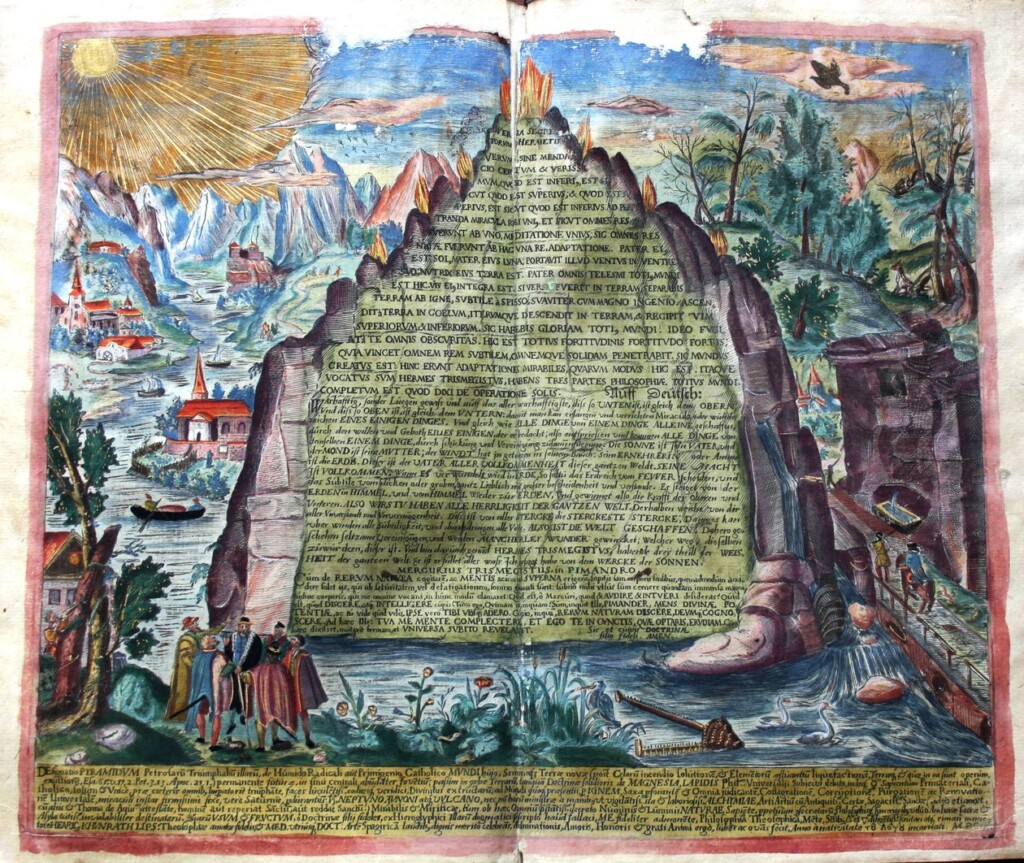
Imagine a man bent over a manuscript in a lamplit room, somewhere in the orbit of Florence, sometime in the 1460s. The parchment before him is old enough to feel authoritative, brittle at the edges, smelling of storage and distance. He cannot know — and perhaps this is the point — that what he holds is not what it claims to be. He reads the words attributed to Hermes Trismegistus, that towering figure of threefold wisdom, and he believes he is touching something ancient beyond measure. He believes he is reading the teacher of Moses, the contemporary of Abraham, a sage so primordial that Plato himself was merely his echo. The manuscript is a forgery. But the belief it generates is entirely real, and that reality will reshape the intellectual architecture of an entire civilization.
The question of when the Emerald Tablet was composed is less dramatic than the question of how thoroughly the wrong answer was accepted for so long. The text as we know it appears with certainty no earlier than the sixth century CE, surfacing in Arabic alchemical literature before making its migration into Latin Europe through twelfth-century translations. The earliest datable source is the Kitab Sirr al-Khaliqa, the Book of the Secret of Creation, attributed to a figure called Apollonius of Tyana but almost certainly compiled during the early Islamic period, likely around 650 CE. There is no credible manuscript trail leading backward into classical antiquity. There is no Greek original. There is no Egyptian temple inscription waiting to be found. The Hermetic literature from which the Tablet draws its authority is itself largely a product of the first through third centuries CE, composed by anonymous Alexandrian writers who synthesized Platonic philosophy, Egyptian religious imagery, and early Gnostic speculation into a body of texts they then attached to the legendary name of Hermes.
Yet the Renaissance did not know this, or rather — and this distinction matters enormously — it chose not to know it. When Cosimo de’ Medici received a collection of Greek manuscripts around 1460, he reportedly instructed his scholar Marsilio Ficino to abandon his translation of Plato and begin immediately on what would become the Corpus Hermeticum. Plato could wait. Hermes could not. Ficino completed the translation in 1463, and the text circulated with a force that its actual age could never have justified on its own. The philosopher Giovanni Pico della Mirandola wove Hermetic ideas through his Oration on the Dignity of Man in 1486, treating Trismegistus as a genuine historical figure whose authority predated and therefore superseded the classical tradition. The forgery had become foundation.
Isaac Casaubon, writing in 1614, was the first scholar to demonstrate through careful philological analysis that the Hermetic texts were not ancient Egyptian but late antique Greek, composed long after Moses, long after Plato, by writers whose sophistication was real even if their chronology was fraudulent. His argument was technically decisive. It was historically ignored. Frances Yates, in her landmark 1964 study Giordano Bruno and the Hermetic Tradition, traced precisely this paradox: that the exposure of the forgery changed almost nothing about the tradition’s momentum, because by that point the tradition had acquired an entirely different kind of authority — not historical but structural, not archival but existential.
This is what forgeries accomplish when they succeed completely. They do not merely deceive. They reorganize the categories through which people understand what is true, what is old, what is sacred. A man in a lamplit room handles a manuscript he cannot date, and in his inability to date it he grants it a power that accuracy could never have provided. The text is not ancient. But his hunger for the ancient is entirely real, and hunger, as anyone who has ever needed something badly enough already knows, rarely stops to verify the menu.
The Alchemy of Meaning Itself
There is a moment in certain kinds of grief when you realize the external world has not changed at all and yet you are completely unrecognizable to yourself. The furniture is the same. The light falls the same way through the same window. And yet something has been transmuted — not destroyed, not replaced, but changed in its essential nature while remaining, structurally, identical. This is not mysticism. This is what the Tablet is actually describing.
The text has been read for centuries as an instruction manual, a recipe whispered in cipher to those with the patience to decode it. But the moment you stop searching for the hidden chemical procedure and begin reading it as a philosophical claim about the architecture of reality, something shifts with an almost audible click. What the Tablet proposes is not a technique but a topology — a map of how the levels of existence correspond to one another, not metaphorically but structurally. The famous formulation is not a poetic ornament. It is a precise statement: that the pattern governing the movement of celestial bodies is the same pattern governing the movement of matter, of psyche, of meaning itself. Not similar. The same.
Gottfried Wilhelm Leibniz, working in the late seventeenth century, arrived at something adjacent when he proposed that the soul and the body do not interact causally but run in parallel, like two clocks set by the same hand. His pre-established harmony is, philosophically speaking, a rigorous version of what the Tablet intuited alchemically — that correspondence is not causation but isomorphism, a shared deep structure expressing itself at different registers of reality. Spinoza had gone further, and earlier, collapsing the distinction entirely: there is one substance, and what we call mind and what we call matter are simply two attributes of the same infinite thing, the way a coastline seen from above and a coastline walked barefoot are the same edge rendered at different scales. The Tablet was already standing in this territory centuries before either of them arrived with their precise instruments.
What Carl Jung understood, in his 1944 work Psychology and Alchemy, was that the alchemical tradition had been doing psychology all along without knowing it — or rather, had been doing something that psychology would eventually need a century of clinical observation to rediscover. The figures that appear in alchemical texts, the processes of nigredo, albedo, rubedo, the death and rebirth of matter in the sealed vessel, are not hallucinations or primitive science. They are projections of interior states onto exterior processes, which means they are maps of something real. A man sits in his laboratory for years, watching substances dissolve and reconstitute themselves, and he is watching himself. He does not know this. The not-knowing is part of the process.
Jung’s contribution was not to reduce alchemy to psychology, as a crude reading of his work suggests, but to recognize that the Tablet’s central claim — that transformation at one level mirrors transformation at every other level — is psychologically verifiable. The individuation process, that long and often violent journey toward integrating the shadow, the anima, the self, follows a structure that is isomorphic with the alchemical sequence. Not because Jung invented the correspondence, but because the correspondence was already there, waiting to be mapped from the inside rather than the outside.
This is where systems theory, arriving in the twentieth century with Norbert Wiener’s cybernetics and later Ludwig von Bertalanffy’s general systems framework, finds itself in unexpected proximity to a text of uncertain ancient origin. The idea that the same organizational principles recur across scales — that feedback, equilibrium, and transformation are not properties of specific domains but of structure itself — is the Tablet’s claim in the language of mathematics rather than mercury.
What the Tablet is doing, then, is proposing that reality is not plural but variational. That what changes is not the pattern but the medium through which it runs.
The Trap of the Literal Reader

He underlined everything. That was the first sign. Not the desperate underlining of someone trying to hold onto a thought, but the surgical underlining of someone who believed the text owed him a direct answer, that meaning was a debt the page had to pay in full. He read the old alchemical writings the way a man reads a lease agreement, looking for the clause that would finally tell him what to do, where to go, what to become. When the text said that fire transforms, he bought a furnace. When it said that the prime matter must be dissolved before it can be reconstituted, he understood this as an instruction about physical substances, about weights and temperatures, about the precise color of smoke above a crucible at dawn. He spent years this way. He was not unintelligent. That was the tragedy of it. A stupid man would have given up sooner. He kept reading because he was certain the answer was in there, one more line away, one more careful reading from yielding itself.
What destroyed him was not the text. The text was doing exactly what it had always done. What destroyed him was his refusal to understand that a symbol is not a code. A code has a key. A symbol has an ecology.
Umberto Eco spent much of his intellectual life drawing this distinction with surgical patience. In his 1990 work “The Limits of Interpretation,” he separated two modes of engaging with a text: use and interpretation. Use treats the text as raw material, extracts from it whatever confirms or serves a pre-existing intention, and discards the rest. Interpretation, by contrast, requires submitting oneself to the internal coherence of the text, following where it leads even when that direction is uncomfortable, even when it refuses to arrive. The literal reader, despite appearing to honor the text by taking every word at face value, is in fact the most violent user of all. He does not follow the text. He arrests it.
The neurological evidence for what happens when a human brain encounters a metaphor has been quietly devastating to the comfortable assumption that meaning is simply retrieved from language like a file from a cabinet. Research in cognitive neuroscience, particularly work emerging from studies on embodied cognition in the early 2000s, demonstrated that when the brain processes a metaphor, it recruits sensorimotor regions, areas associated with physical experience, movement, texture, and spatial orientation. Reading that something “grasps” an idea activates, partially and measurably, the same neural architecture involved in the physical act of grasping. The brain does not decode a metaphor. It partially enacts it. Which means that a reader who strips a metaphor down to its supposed literal referent is not getting closer to the meaning. He is bypassing the very mechanism through which the meaning was designed to arrive.
This is not a poetic preference. It is a structural fact about how minds meet language. The Emerald Tablet, in its compressed and almost violent symbolic density, was never a recipe. It was a map of a territory that could only be entered through a particular quality of attention, the kind of attention that holds two meanings simultaneously without forcing them to collapse into one. The man with the furnace collapsed them. He needed certainty more than he needed truth. And the need for certainty is not a cognitive style. It is a defense against the vertigo that genuine symbolic thought produces, the sensation that the ground of meaning is not solid, not final, not owned.
There is something almost protective in literalism. It keeps the reader safe from the text, which is to say it keeps the reader safe from the encounter the text was built to provoke.
A vision curated by a filmmaker, not an algorithm
In this video I explain our vision
What Newton Knew and Didn’t Say
There is a particular kind of loneliness that belongs to the man who works at night with a dead language and a candle burning lower than he would like. The papers spread across the table are not orderly. They never are. Some are covered in Latin that he wrote himself, some in symbols that resist even his own attempts at recall, and the frustration is not that he cannot understand the text but that he understands it too well and cannot reconcile it with what he believes in daylight. His official life and his secret life have begun to look like two portraits of a stranger.
This is not a metaphor. This is what Isaac Newton actually did, for decades, in a kind of sustained intellectual parallel existence that his contemporaries never fully saw and that his inheritors worked diligently to erase. When John Maynard Keynes acquired a substantial portion of the Portsmouth Collection at auction in 1936, what he found was not the marginalia of a distracted genius but something closer to a second career. Roughly one million words of alchemical manuscripts, many in Newton’s own hand, some of them translations and commentaries on the Emerald Tablet and related Hermetic texts, written with the same forensic attention he gave to the Principia Mathematica. Keynes, who was not a man easily unsettled, declared publicly that Newton was not the first scientist of the modern age but the last of the magicians. The line has been quoted so often it has lost its shock. It should not have.
What Newton was attempting, in those night-hours with his furnaces and his manuscripts, was not a hobby or an embarrassment. He was trying to solve the same problem from two directions simultaneously. The mechanical philosophy he helped establish — the universe as a system of forces operating on inert matter — had always troubled him, because it could not account for what he privately called the active principles within nature. Gravity itself, which he described with mathematical precision no one had achieved before, was for Newton not fully explained by his own equations. He wrote to Richard Bentley in 1693 that action at a distance without a mediating substance was philosophically absurd, yet his own system required it. He believed the Hermetic tradition, and the Tablet in particular, contained an account of that mediating force, the hidden mechanism by which the cosmos enlivened itself.
The Tablet’s declaration that what is above corresponds to what is below was not, for Newton, a poetic sentiment. It was a structural hypothesis. The same force that moved the planets might be the same force that operated in metals, in fermentation, in the body. His alchemical notes show him tracking transformations of matter with the same obsessive patience he applied to celestial mechanics, looking for the underlying grammar. Betty Jo Teeter Dobbs, whose 1975 work The Foundations of Newton’s Alchemy remains the most rigorous scholarly account of this dimension of his thought, argued that alchemy was not peripheral to Newton but central, that it shaped his conception of force and activity in ways that fed directly back into the physics. The two projects were not separate. They were running simultaneously toward the same horizon.
This is the thing that disturbs, really disturbs, when you let it. Not that a great scientist believed strange things, because that is easy to domesticate as eccentricity. What disturbs is that he may have been right to hold both, that the mechanical and the Hermetic were not contradictions to be resolved but two instruments pointed at the same object from incompatible angles, and that eliminating one, as his successors did, as the institutions of knowledge required, meant not purifying the science but amputating something it had not yet finished saying. The man at his night table was not confused. He was attempting a translation that the daylight world had already decided was impossible before he could finish it.
The Social Function of Hermetic Secrecy
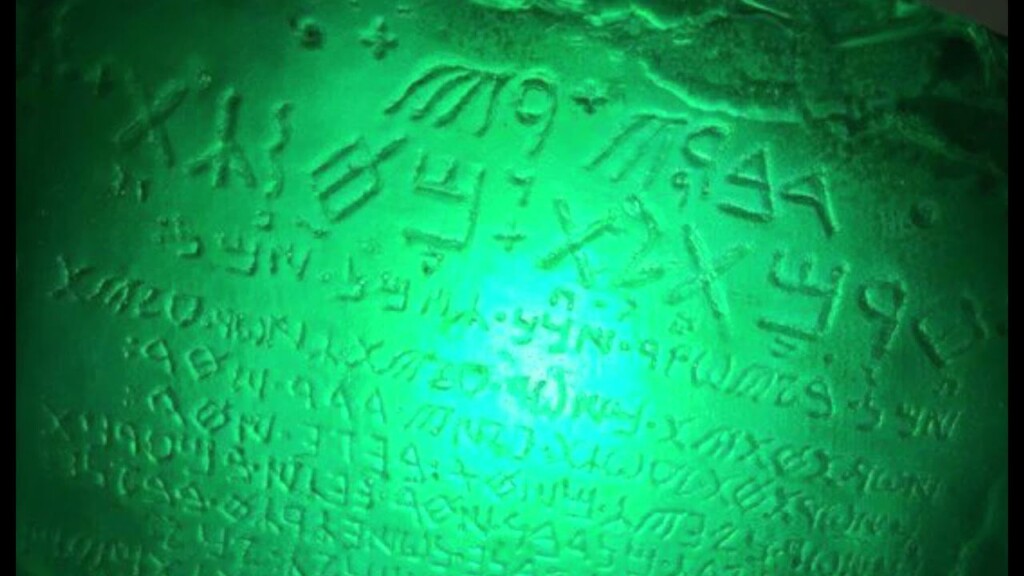
There is a particular kind of silence that falls over a room when someone asks the wrong question. Not an ignorant question, not a rude one — the wrong one. The kind that arrives too directly, that strips away the ceremony and asks for the thing itself rather than its ritual approach. You have seen it happen. Someone at a dinner table, at a workshop, at a gathering of people who share a practice or a lineage or a vocabulary, asks with genuine curiosity what a particular teaching actually means, what it concretely does, what evidence exists that it corresponds to anything real. And the room does not answer. It redistributes itself. Eyes find other eyes. The conversation pivots. The person who asked is not expelled; they are simply no longer quite inside. The boundary was invisible until they walked through it, and now they are on the other side, looking back at a warmth they can no longer reach.
This is not cruelty. It is mechanism. And the Emerald Tablet has survived for more than a millennium partly because it is built from the same mechanism, refined to an almost perfect structural form.
Michel Foucault argued, with the cold precision that made him so difficult to dismiss, that knowledge and power are not merely related but constitutive of one another. In his 1969 work on the archaeology of knowledge and developed further through the lectures collected under the title “Society Must Be Defended,” he demonstrated that what a discourse excludes is as defining as what it includes. Every system of knowledge produces, at its edges, a class of the uninitiated — not accidentally, but necessarily. The boundary between the sayable and the unsayable is not a failure of communication. It is the engine of authority. A teaching that anyone could immediately grasp would confer status on no one. Obscurity is the mechanism by which knowledge becomes property.
The Tablet’s opacity, then, was never a limitation waiting to be corrected by a better translation. It was the text’s primary social function. When a Renaissance academician in Florence, moving through the circles around Marsilio Ficino’s translations of the Corpus Hermeticum in the 1460s, mastered the language of correspondence between above and below, between sulfur and sol, between mercury and mind, he was not merely acquiring a philosophical framework. He was acquiring membership. The knowledge was currency, and like all currency its value depended entirely on its scarcity. Ficino understood this implicitly. The Hermetic tradition he transmitted was presented as a prisca theologia, an ancient wisdom older than Plato, older than Moses — precisely the kind of pedigree that cannot be democratized without ceasing to be itself.
Pierre Bourdieu would have recognized the structure immediately. In his analysis of cultural capital, the value of a form of knowledge is inseparable from the difficulty of its acquisition. The harder the entry, the more the initiated can charge, in social terms, for admission. A text that yields its meaning easily is worth nothing as social currency. A text that requires years of preparation, a teacher, a lineage, a specific vocabulary, a willingness to tolerate sustained incomprehension — that text is priceless, because its difficulty is the price.
This is why the Tablet survived when clearer texts did not. Clarity has no cult. Obscurity generates communities organized around its interpretation, and those communities protect the text because the text protects them. Every era has its version of the initiatory circle: the Renaissance academy, the Rosicrucian lodge, the Theosophical study group, the contemporary wellness retreat where certain lineages are transmitted only in person, only to those who have completed the prerequisite journey. The form is identical across five centuries. Only the vocabulary changes. And at every gathering, somewhere near the edge of the room, someone is asking the wrong question, and the silence that answers them is the oldest social technology we possess.
The Sentence That Will Not Close
There is a moment that happens to almost everyone, though few speak of it directly. You are standing somewhere ordinary — a bathroom, a kitchen, near a window at night — and you catch your own reflection in the dark glass, and for a fraction of a second you do not recognize yourself. Not because something is wrong, but because the face looking back seems to be asking a question you once knew the answer to. The moment passes. You move on. But that flicker of unrecognition is not nothing. It is the mind briefly touching the distance between who you are and what you once believed mattered.
The phrase “as above, so below” is everywhere now. It appears on the inner wrists of people who have never read a line of Neoplatonist philosophy, on motivational slides between photographs of mountain ranges, in the bios of wellness accounts that sell adaptogenic supplements and shadow-work journals. The Emerald Tablet, a text that survived in Arabic translation around the eighth century, carrying a cosmological proposition so compressed it took centuries of commentary to begin unpacking, has been reduced to seven syllables that function primarily as aesthetic punctuation. This is not a complaint. It is an observation about what culture does with depth when depth becomes inconvenient.
Walter Benjamin, writing in 1936 in “The Work of Art in the Age of Mechanical Reproduction,” described the aura of an artwork as its singular existence in a particular place, its embeddedness in tradition and ritual. Reproduction, he argued, detaches the thing from that matrix, liberates it in one sense and empties it in another. What he could not have fully anticipated was the velocity at which digital reproduction would accelerate that emptying — not over decades but over months, sometimes weeks. A symbol passes through irony, through sincerity, through aesthetic recovery, through commercial adoption, and emerges on the other side as a texture rather than a meaning. You wear it the way you wear a pattern on fabric.
And yet. The woman standing at the dark window, trying to remember why something once mattered, is not simply suffering from nostalgia or intellectual vanity. She is touching something real about how meaning works, which is that it does not survive unchanged through its own transmission. The Hermetica, assembled in Alexandria across the first three centuries of the common era, was itself already a metabolization — Greek philosophy filtered through Egyptian priestly tradition, repackaged as revelation. Marsilio Ficino, translating the Corpus Hermeticum into Latin in 1463 at Cosimo de’ Medici’s explicit and urgent request, was transmitting something that had already been transmitted, already been changed, already been separated from whatever original ritual context might have animated it. Every generation that touches the phrase “as above, so below” is doing what every previous generation did: receiving something it cannot fully verify and deciding, largely unconsciously, how much of its original weight to carry forward.
The question that does not resolve itself easily is whether the decorative and the meaningful are as opposed as the instinct for preservation assumes. Giordano Bruno, burned at the Campo de’ Fiori in Rome in February 1600 partly for his investment in Hermetic cosmology, would likely have found the tattoo version incomprehensible. But Bruno’s version was itself a reading, a passionate and idiosyncratic interpretation that his contemporaries largely found either dangerous or confused. The phrase survived him. It survived the Renaissance. It survived the Enlightenment’s dismissal of it as superstition and the nineteenth century’s occult revival and the twentieth century’s counterculture absorption of it into something adjacent to self-help. It keeps surviving, which means something, even if what it means keeps changing, even if the face in the dark window cannot quite say what it recognizes in its own reflection, or whether recognition itself is enough to constitute understanding.
🜂 Pathways Into the Hidden Wisdom of Ages
The Tabula Smaragdina, or Emerald Tablet, stands as one of the most compressed and enigmatic texts in the Western esoteric tradition, encoding principles that ripple through alchemy, Hermeticism, and mystical philosophy. To fully grasp its layered meanings, one must trace the currents of thought that have carried its teachings across centuries and into the modern world. The articles below illuminate the spiritual landscapes most intimately connected to its ancient wisdom.
Aleister Crowley: the Great Beast and the Religion of Will
Aleister Crowley spent a lifetime wrestling with the same Hermetic principles encoded in the Emerald Tablet, translating ‘As above, so below’ into a personal religion of will and magical practice. His work with Thelema drew heavily from alchemical and Kabbalistic streams that trace their roots directly to the Tabula Smaragdina tradition. Understanding Crowley’s system offers a vivid — if controversial — window into how ancient Hermetic axioms can be radically reinterpreted for modern consciousness.
GO TO THE SELECTION: Aleister Crowley: the Great Beast and the Religion of Will
Helena Blavatsky and Theosophy: the Woman Who Revolutionized Esoteric Thought
Helena Blavatsky built Theosophy on many of the same cosmological pillars found in the Emerald Tablet, insisting that a universal secret doctrine underlies all genuine spiritual traditions. Her synthesis of Eastern and Western esotericism gave the Hermetic formula ‘that which is above is as that which is below’ a vast new metaphysical framework. Studying Blavatsky’s thought allows the reader to see the Tabula Smaragdina not as an isolated relic but as a living thread within a global esoteric conversation.
GO TO THE SELECTION: Helena Blavatsky and Theosophy: the Woman Who Revolutionized Esoteric Thought
Neville Goddard: the Mystic Who Turned Imagination into the Law of the Universe
Neville Goddard‘s radical teaching that imagination is the only creative force in the universe resonates deeply with the alchemical worldview of the Emerald Tablet, where inner transformation produces outer reality. His insistence that consciousness is the prima materia — the first matter from which all experience is shaped — mirrors the Hermetic principle of correspondence between mind and world. Reading Goddard alongside the Tabula Smaragdina reveals a surprisingly coherent dialogue across centuries of mystical inquiry.
GO TO THE SELECTION: Neville Goddard: the Mystic Who Turned Imagination into the Law of the Universe
Pyotr Ouspensky: the Mathematician Who Sought the Fourth Dimension of Spirit
Pyotr Ouspensky‘s lifelong search for higher dimensions of consciousness led him to engage with the same Hermetic idea of nested realities that the Emerald Tablet encodes in its famous formula. His mathematical approach to esotericism sought to prove that invisible orders of being interpenetrate and govern the visible world, a notion the ancient alchemists would have recognized immediately. Ouspensky’s work provides a rigorous intellectual companion to the poetic density of the Tabula Smaragdina.
GO TO THE SELECTION: Pyotr Ouspensky: the Mathematician Who Sought the Fourth Dimension of Spirit
Discover the Cinema That Dares to Ask the Deepest Questions
If the mysteries of the Emerald Tablet stir something in you — a hunger for meaning, for hidden connections, for the invisible made visible — then Indiecinema is your next destination. Our streaming platform gathers the boldest works of independent and esoteric cinema, films that dare to explore consciousness, spirit, and the secret architecture of reality. Join us and let the screen become your own Emerald Tablet.
👉 EXPLORE THE CATALOG: Watch Indie Films in Streaming
A vision curated by a filmmaker, not an algorithm
In this video I explain our vision

