
The Laboratory at the Edge of Sleep
There is a particular kind of night that belongs to no one else. The kitchen at two in the morning, the herbs arranged and rearranged on the counter, the small jars lined up in an order that shifts every few minutes — not because you are looking for something, but because the arrangement itself is the thing. The hands keep moving. The mind is elsewhere and precisely here at the same time. You are not cooking. You are not cleaning. You are performing something that has no name in the language available to you, and the silence around it feels ancient.

Michael Maier knew this silence. Not as a metaphor, but as a working condition. A physician and alchemist at the court of Rudolf II in Prague, then a wanderer through the Protestant courts of northern Europe, Maier was a man who spent his life in rooms where the furnace never entirely cooled. He published Atalanta Fugiens in 1617, in Oppenheim, through the press of Johann Theodor de Bry, and the book arrived into a world that was simultaneously burning and building — twelve years before the Thirty Years’ War would reduce much of central Europe to ash, three years after the death of Rudolf, whose court had been the last serious political shelter for the kind of synthetic, boundary-crossing inquiry that Maier embodied. The timing was not accidental. Maier was not a nostalgic man, but he was a precise one, and he understood that he was encoding something before the door closed.
What he encoded was not easily described then, and resists easy description now. Atalanta Fugiens contains fifty emblems, each built from four interlocking components: an engraving produced after Maier’s own designs, a Latin motto, an epigram of six lines, and a discourse of several pages that circles the emblem’s central image without ever quite explaining it. But the element that separates this book from every other emblem collection of the period — and there were many, the emblem book being one of the dominant cultural forms of the sixteenth and seventeenth centuries — is the music. Each emblem comes with a three-voice fugue, composed by Maier himself, in which the three voices enact the mythological chase of the title: Atlanta, the fleet-footed huntress, and the apple that slows her. One voice runs. One pursues. One calls out from a distance that never closes.
To understand what is unusual about this requires understanding what an emblem book normally was. The genre descended from Andrea Alciato’s Emblematum Liber of 1531, which had established the basic tripartite structure of motto, image, and poem as a vehicle for moral instruction. By the early seventeenth century, the form had been refined, politicized, devotionalized, and satirized. Emblems were everywhere, and they were, above all, readable. They moved toward interpretation. They rewarded the patient decoder with a fixed meaning, a lesson extracted and pocketed. Maier built something that moved in the opposite direction. His emblems accumulate rather than resolve. The discourse attached to each one spirals outward into classical mythology, natural philosophy, medical theory, and alchemical procedure, drawing connections that feel urgent and slightly vertiginous, like watching someone assemble a structure in a room where the floor keeps shifting.
Alchemy in 1617 was not what a later century would condescend to call it. It was not superstition dressed in Latin. It was a practice situated precisely at the intersection of what we would now separate into chemistry, medicine, theology, and philosophy, categories that the early modern mind did not yet have the institutional machinery to enforce as distinct. Lawrence Principe’s work, particularly The Secrets of Alchemy published in 2013, has documented with careful historical precision how practicing alchemists of this period were conducting real laboratory experiments, making real observations, and developing a transmissional language that was deliberately resistant to casual comprehension — not because they were mystifying the ignorant, but because the knowledge they were handling was genuinely difficult, genuinely dangerous, and genuinely incomplete.
Maier knew the incompleteness. The fifty emblems of Atalanta Fugiens do not add up to a complete system. They orbit something.
Chasing Atalanta: The Myth Beneath the Metal
There is a particular kind of exhaustion that comes not from running too hard but from running after the wrong thing while knowing it, somewhere below the threshold of admission. You have felt it — the slight nausea of catching what you wanted and finding your hands already reaching past it toward the next object, the next city, the next version of a person who might finally complete the circuit. The golden apple rolls across the path and you bend to pick it up, and by the time you straighten, the thing you were actually chasing has moved three steps further into the distance.
This is not metaphor. This is the structural logic of the myth Maier placed at the center of his 1617 work, the fifty emblems organized around the Greek story of Atalanta and Hippomenes, a huntress who could outrun any man and a suitor who carried three golden apples given to him by Aphrodite. The myth is ancient and the mechanism is surgical: throw the apple, watch her veer, gain ground, repeat. She loses the race not because she is slower but because the apples are more interesting than the finish line. She does not even want to stop running. The apples seduce her into pausing within a contest she would have otherwise won without effort.
Maier read this not as a story about a woman tricked but as a diagram of how desire operates in relation to knowledge. The chase is the point. The apples are not interruptions to the race — they are the race’s hidden content. What Hippomenes throws is not gold but attention, and attention is always the real currency of transformation. There is a man in a film that has never left certain viewers, who spends years reconstructing a dead woman from photographs and descriptions, who dresses a living woman in the clothes of the one he lost, who believes he is pursuing love while actually pursuing the image of completeness he invented to survive a grief he never named. He gets what he wanted. He is more lost than before. The apple is in his hand and the race has already been decided against him.
Carl Gustav Jung, writing in 1944 in Psychology and Alchemy, made the argument that must be understood before any emblem in Maier’s work can be read correctly: the alchemists were not failed chemists. They were something closer to what we might now call depth psychologists operating without the vocabulary, projecting interior processes onto exterior matter, watching their own unconscious transformation reflected in the behavior of sulphur and mercury. The opus alchymicum was, for Jung, a drama of individuation — the gradual integration of shadow, anima, the unacknowledged portions of the self — wearing the costume of metallurgy. Which means that every golden apple in Maier’s emblems is also a complex, a charged fragment of the psyche thrown across the path of the one who is trying to become whole.
The myth of the chase is also the myth of desire as such, and desire has a peculiar relationship to arrival. It requires distance to exist. Stendhal understood this and called it crystallization — the process by which an ordinary branch left in the salt mines of Salzburg emerges covered in brilliant crystals, transformed by projection into something that blinds. The object does not change. The one who looks at it does. And the runner who bends to pick up the apple is not distracted from her goal — she is revealing, for the first time, what her goal actually was, which was never the finish line but the experience of running fast enough that nothing could touch her.
There is a young woman in another story, sitting in a cinema watching herself on the screen, slowly realizing that the life she has built has the architecture of someone else’s dream about her. She is running, has always been running, and the apples she stopped to collect are the markers of every moment she mistook approval for arrival.
Maier knew this. He arranged fifty emblems precisely so that the reader would feel the chase before understanding it — so that the recognition would arrive in the body first.

The Emblem as Cognitive Trap and Liberation Device
There is a moment most people recognize without being able to name it: you are reading something carefully, following each word, and somewhere around the third paragraph you realize you understood nothing. Not because the text was difficult. Because you were certain you understood it, and that certainty was the obstacle.
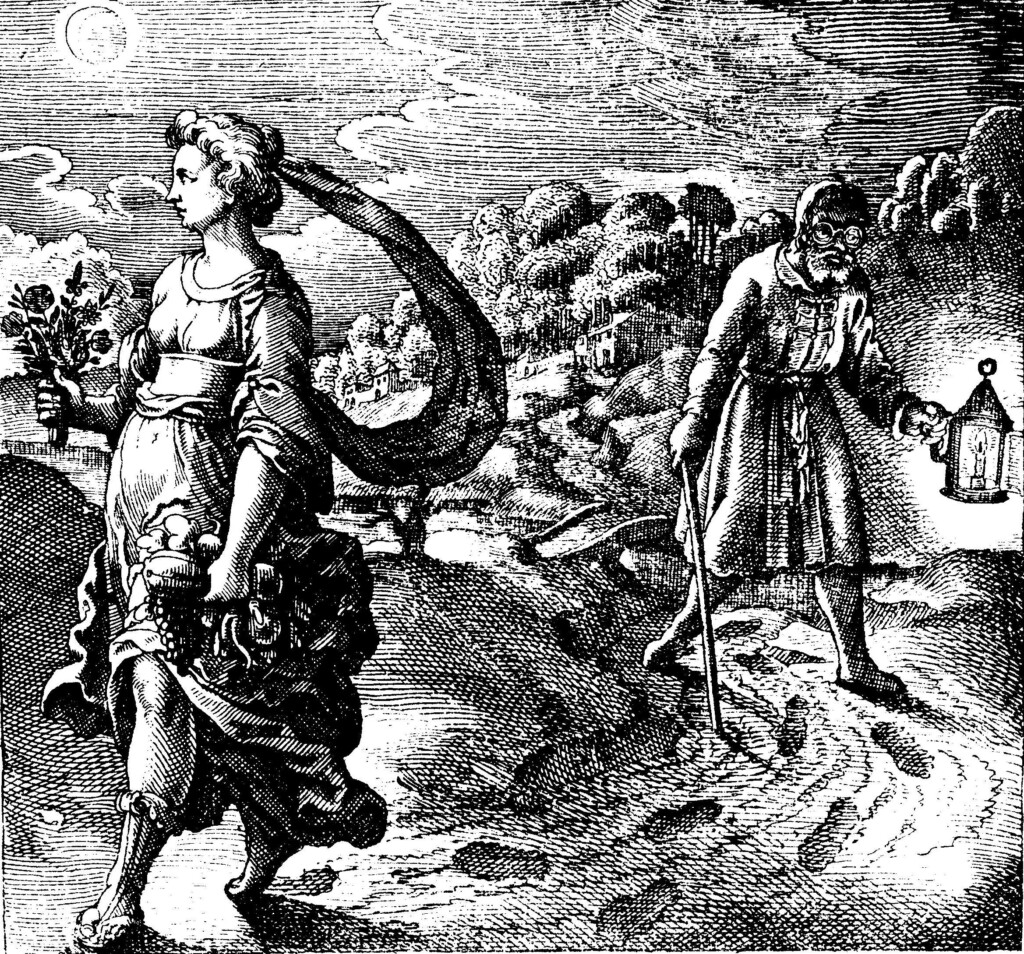
The alchemical emblem functions precisely on this mechanism. In Maier’s Atalanta Fugiens, published in 1617, each of the fifty emblems arrives in four simultaneous registers: a woodcut image, a Latin motto, a short epigram, and an extended prose discourse. The untrained eye moves through these layers as through rooms of a house, expecting to arrive somewhere. The trained reader understands that each room opens onto another corridor, and the house has no exterior wall.
Frances Yates, in The Art of Memory published in 1966, traced the hermetic tradition’s radical investment in the image not as decoration but as cognitive architecture. The trained memory practitioner did not merely visualize; they inhabited a mental space where images functioned as triggers, each one containing a density of meaning that could only be released through sustained contemplative attention. Yates showed how this tradition, flowing from Ficino through Giordano Bruno, understood symbolic images as machines for thinking, not illustrations of thought already completed. What Maier did with the emblem form was to weaponize this architecture. He built not a memory palace but a labyrinth that looks, from the entrance, exactly like a palace.
Walter Benjamin, writing in the Passagen-Werk and in his 1928 study of German tragic drama, developed the concept of the dialectical image: a figure in which historical time collapses, in which past and present collide not in smooth continuity but in a flash of recognition that is also a moment of crisis. For Benjamin, such images do not resolve contradiction; they hold it in suspension, making the contradiction visible as the true content. Maier’s emblems operate identically. The image of Atalanta running with the golden apple does not illustrate the philosophical point beneath it. The image and the text exist in productive tension, each one complicating the other, and the reader who believes they have finally decoded the symbol has only entered the deepest room of the trap.
Think of the man who spends hours reconstructing a conversation from memory, arranging words in their correct sequence, building a timeline, drawing conclusions about motive and intent, and then discovers that the conversation he remembered so precisely was entirely different from what the other person heard. He was not remembering. He was constructing. The interpretation was the event. Something similar happens to a woman who examines a letter with obsessive care, reads the handwriting, measures the emotional distance between sentences, concludes she knows what was meant, and realizes too late that what she read was her own projection, immaculate and invisible. The document was only a surface. She brought the meaning to it, and the meaning she brought was the message she most feared receiving.
This is the epistemological ambush Maier designed. And it matters enormously that he designed it inside Rudolf II’s Prague, a court where Kepler was calculating planetary orbits and Tycho Brahe was measuring the sky with instruments of unprecedented precision, where Johannes Dee had presented his angelic communications and where the boundary between what we now call science and what we now call mysticism had not yet been drawn with the violence of the seventeenth-century philosophical revolution. Maier served Rudolf as personal physician. He moved in a world where symbolic and empirical knowledge shared the same epistemological ground, where a man could believe simultaneously that the movements of planets followed mathematical law and that those same movements encoded messages about the soul’s transformation.
In that world, the emblem was not a curious artifact. It was a legitimate instrument of inquiry, as rigorous in its way as a telescope, and far more honest about what it could not resolve. Kepler himself wrote of harmonies in the cosmos as if music and geometry were dialects of the same language. What Maier built into the emblem’s four-part structure was a mirror of that world’s deepest assumption: that clarity is always provisional, and the moment you think you have arrived is precisely when the ground begins to move.
Sound, Silence, and the Unreasonable Fugue
There is a particular kind of silence that falls in a house where someone has just stopped playing the piano. Not the silence before music begins, which is anticipatory and clean, but the silence after — saturated, still carrying the shape of what was just sounded, the air not yet sure it is allowed to be empty again. You have sat in that silence. You know how it holds something that the playing itself could not quite contain, how the ending of the music is somehow more than the music was.
Michael Maier knew this. In 1617, when he bound together his fifty emblems into Atalanta Fugiens, he made a decision so strange that four centuries of scholarship have not finished reckoning with it. Each emblem — already a compound object carrying an engraved image, a Latin epigram, and a prose discourse — was given also a three-voice musical fugue. Not as accompaniment. Not as decoration. As epistemic structure. The knowledge could not be stated. It had to be chased.
The fugue is, formally, a pursuit. One voice states a subject. A second voice enters and takes up the same subject while the first moves forward into new territory. A third voice enters and takes up the subject again while the other two have already moved elsewhere. No voice ever possesses the theme entirely at the same moment as another. The knowledge — if we agree to call it that — exists only in the chasing, in the interval between statement and response, in the gap that never closes. Maier titled his book after Atalanta, the huntress who could be outrun only by golden apples thrown across her path, and then he built that same structure into every page. The nymph and the youth and the apple all running at once. None of them arriving.
Theodor Adorno, writing in the 1940s on the philosophy of music, argued something that most of his contemporaries found perverse: that the fugue performs a kind of rationality that reason alone cannot achieve. In his view, the fugue does not simply organize sound into logical sequence. It holds contradiction in motion. The voices do not resolve into each other. They remain distinct, pursuing the same subject from positions that never fully coincide, and it is precisely this non-coincidence — this structural refusal of unison — that allows the fugue to carry what a single line of argument must leave out. Adorno saw in counterpoint not the triumph of order but the survival of tension within order, which is a different and more honest thing.
Maier understood this before Adorno had words for it. The alchemical process he was trying to transmit was not a procedure but a relationship — between sulfur and mercury, between fixed and volatile, between the work and the worker who cannot stand outside the work while performing it. You cannot write that relationship down. You can circle it with images, with verses, with arguments in Latin prose. But the image shows a fixed moment. The verse moves in time but remains singular. The prose reasons, but reasoning is a single voice and transformation requires more. So Maier adds the fugue. He adds the second voice that answers and recedes. He adds the third that enters when the first has already changed. And the reader who sits down to sing all three parts — or who merely imagines them sounding simultaneously — undergoes something that reading the discourse alone never produces.
There is a scene that stays with a person. A man sits in one room and a woman in another plays something on a stringed instrument, something slow and not quite resolved, and he cannot ask her what she means by it because the playing is precisely what she is saying instead of what she cannot say. The music crosses the threshold of the door. It enters the room where he is sitting and it does not wait for his understanding. It simply sounds, and in sounding, it changes the quality of the air between them in a way that no sentence they might have exchanged could have changed it. What passes between those two rooms is not information. It is transformation in the only form available to it.
What the Symbols Were Protecting

There is a particular kind of silence that is not absence but architecture. A man lowers his voice not because the room is empty but because it is full — full of the wrong ears, the wrong allegiances, the wrong century. You have seen this silence. You have perhaps practiced it yourself, in an office, at a family table, in any room where the cost of certain words is higher than you can afford to pay.
Michael Maier published Atalanta Fugiens in 1617. The following year, the Defenestration of Prague would throw three men from a castle window and light the fuse of a war that would kill somewhere between four and eight million people across Central Europe over the next three decades. The Rosicrucian manifestos — the Fama Fraternitatis, the Confessio Fraternitatis — had been circulating since 1614 and 1615, unsigned, seditious in their implication that a brotherhood possessed knowledge capable of reforming the whole of human society. Their authors never identified themselves. This was not modesty. This was calculation.
Michel Foucault, in The Archaeology of Knowledge published in 1969, proposed something that still discomforts the orderly: that what a society excludes from legitimate discourse is not necessarily what is false or irrational, but what threatens the existing configuration of power over truth. The excluded is not the wrong — it is the dangerous. What gets forced underground, encrypted, masked in metaphor is not stupidity dressed in ceremony but knowledge that the dominant epistemic order cannot metabolize without restructuring itself. Hermeticism in early seventeenth-century Europe was not pre-science failing to become science. It was a discourse forcibly disqualified, and its obscurity was not confusion — it was consequence.
A woman sits across a table from an interrogator. She knows exactly what he wants. She also knows that if she says it plainly, the conversation ends in a way she cannot survive. So she speaks in partial truths, in stories that could mean two things, in images that carry the weight of what she knows without ever landing directly on it. She is not being evasive for pleasure. She is being precise in the only register that does not cost her everything. The encoding is the intelligence, not the failure of it.
This is what the symbols in Atalanta Fugiens were doing. The fifty emblems with their fugues, their mottoes in Latin, their layered allegorical engravings — they were not obstacles placed between the reader and the meaning. They were the only form the meaning could safely take. Maier was operating inside a network of connections — to Rudolf II’s court in Prague, to Robert Fludd in England, to figures whose proximity to Rosicrucian ideas made them vulnerable to accusations of heresy, of sorcery, of sedition. The symbology was not aesthetic preference. It was a pressure-tested container for ideas that would not survive direct expression.
Foucault’s concept of the episteme — the underlying structure that determines what can be thought and said within a given historical moment — helps clarify what is otherwise misread as mystification. Maier was not confused about chemistry. He was a trained physician, holding a doctorate from Basel, a man of demonstrable learning. When he wrote about the Red King and the White Queen, about sulfur and mercury as cosmic principles, about the philosophical child born from their union, he was encoding within a system of correspondences that his intended readers could navigate — readers who had also learned to speak in two registers simultaneously, one for survival and one for truth.
There is something the comfortable modern reader refuses to see in this: that clarity is a privilege. Transparent discourse belongs to those who cannot be destroyed for it. When persecution is not metaphorical, when the Index Librorum Prohibitorum is real and the Inquisition has territorial jurisdiction, when your patron can be deposed and your manuscripts confiscated — the symbol is not decoration. It is the difference between transmission and silence.
What if obscurity, in certain hands, at certain moments in history, was the most rigorous intellectual act available?
A vision curated by a filmmaker, not an algorithm
In this video I explain our vision
The Unfinished Transformation

The person who stays awake past midnight, surrounded by books and half-filled notebooks, is not waiting for an answer. Something subtler is happening, something that resembles waiting but is actually a form of motion — a circling around a center that keeps shifting. By the time they have read enough, thought enough, the center is no longer where it was. This is not failure. This is the condition itself.
Maier’s fifty emblems do not build toward a climax. They do not accumulate evidence for a final revelation. Each one opens, each one closes, and then the next one opens again — the same chase, differently lit. Atalanta runs. The hero pursues. The golden apple rolls ahead. What looked like progress at emblem twelve looks, by emblem forty, like the beginning of a spiral. The structure is not linear because transformation is not linear. Maier knew this, and he encoded it not in the content of the emblems alone but in their architecture, in the way they refuse to arrive.
Gaston Bachelard, writing in 1938 in his Psychoanalysis of Fire, argued something that alchemical thinkers had intuited for centuries without fully articulating: that fire does not transform matter into something stable, but into something perpetually becoming. The flame is never the same flame twice. It is, he wrote, the ultra-living element, the one that compels daydreaming because it embodies the paradox of being both here and already elsewhere, both substance and its own disappearance. For Bachelard, the fascination with fire was never about what it produces. It was about what it is — a state of unceasing transition that the watching mind recognizes as a mirror of itself.
There is a man who has been walking through the same city for years, recording its sounds, its voices, its silences, trying to assemble from these fragments something that will finally cohere into meaning. He never finishes. The city keeps speaking. The recordings accumulate. What he is building is not a document but a relationship with the impossibility of completion, and somewhere in the middle of this endless project he understands that the project was never about the city at all. It was about the quality of attention itself, the state of radical alertness that only an unfinished task can sustain.
A woman sits across from her dying father, listening to him describe a life she barely recognizes as his. The stories loop. The same afternoon in the same garden returns again and again, slightly altered each time — a detail added, a detail removed, the light changing, the people present shifting. She is not witnessing deterioration. She is witnessing the mind doing what it has always done, what it could not do when survival demanded linearity: circling the moments that mattered, finding in repetition not redundancy but depth.
This is what Maier built. Not a manual. Not a roadmap to the philosopher’s stone. A phenomenology of the transformative process — fifty meditations on what it feels like to be a consciousness engaged with its own becoming. The fugue structures embedded in the emblems, the canons that Schott identified as among the earliest printed musical fugues in history, do not resolve into silence. They pursue themselves. Each voice chases the one before it, and by the time the last voice enters, the first has already moved on. The chase is the music. The music is the chase.
Bachelard wrote that we are transformed by what we contemplate, not by what we conclude. The alchemist who stares into the athanor long enough does not emerge with gold. They emerge different — altered by the sustained attention, by the willingness to watch without forcing, to hold the question without collapsing it into an answer.
So here is what remains, in the small hours, in the light that is neither reading light nor darkness: if you have been pursuing knowledge all this time, running after it the way the hero runs after Atalanta, it may be worth asking not whether you are gaining ground, but what it is you cannot bear to stop chasing — and whether the pursuit itself is the only form in which that thing can exist for you.
🜂 The Hermetic Universe of Alchemical Thought
Atalanta Fugiens stands as one of the most extraordinary alchemical emblematic works ever created, weaving together music, image, and symbolic text into a unified esoteric vision. The emblems of Michael Maier cannot be fully understood without tracing the broader tradition of Hermetic philosophy, mystical symbolism, and Renaissance occult thought. These related explorations deepen the labyrinthine world that Maier so masterfully encoded.
Robert Fludd: Macrocosm Microcosm and Alchemy
Robert Fludd was a contemporary of Michael Maier and shared his passion for encoding cosmic truths within elaborate symbolic systems. His vision of the macrocosm and microcosm mirrors the alchemical principle that the universe and the human body are reflections of each other, a theme central to Atalanta Fugiens. Exploring Fludd’s work illuminates the broader Rosicrucian and Hermetic milieu in which Maier composed his emblems.
GO TO THE SELECTION: Robert Fludd: Macrocosm Microcosm and Alchemy
Magnus Opus: nigredo albedo rubedo
The Magnum Opus — the Great Work of alchemy — is the very backbone of Maier’s emblematic journey in Atalanta Fugiens, whose fugues and images trace the soul’s passage through nigredo, albedo, and rubedo. Each stage of this tripartite process represents a death and rebirth of matter and spirit alike, culminating in the perfection of gold or the philosopher’s stone. Understanding these three phases is essential to decoding the symbolic language Maier employed.
GO TO THE SELECTION: Magnus Opus: nigredo albedo rubedo
Giordano Bruno and the Hermetic Tradition
Giordano Bruno‘s immersion in the Hermetic tradition places him in direct intellectual kinship with Michael Maier, both men circulating through the same currents of Renaissance occultism and natural magic. Bruno’s art of memory and his cosmological mysticism share the same symbolic alphabet that Maier later crystallized into alchemical emblems. Their parallel visions reveal how deeply Hermeticism shaped the imagination of early modern Europe.
GO TO THE SELECTION: Giordano Bruno and the Hermetic Tradition
The Corpus Hermeticum: Guide to Esoteric Reading
The Corpus Hermeticum is the foundational textual wellspring from which Renaissance alchemists like Maier drew their deepest philosophical convictions. Its doctrines of divine mind, cosmic sympathy, and spiritual transformation underpin every emblem in Atalanta Fugiens, giving the images their metaphysical weight. Reading these ancient texts alongside Maier’s work reveals the unbroken thread connecting Egyptian-Greek wisdom to early modern alchemical art.
GO TO THE SELECTION: The Corpus Hermeticum: Guide to Esoteric Reading
Discover the Cinema of the Unseen on Indiecinema
If the hidden dimensions of Hermetic symbolism and alchemical transformation inspire you, Indiecinema streaming is the place where cinema explores those same invisible frontiers. From visionary art films to rare esoteric documentaries, Indiecinema curates moving images that dare to look beyond the surface of reality. Step inside and let the screen become your alchemical vessel.
👉 EXPLORE THE CATALOG: Watch Indie Films in Streaming
A vision curated by a filmmaker, not an algorithm
In this video I explain our vision

