
The Man Who Tilts at Windmills Is Already in Your Office
There is a man in every workplace who sends emails no one asked for, copies in people who have no reason to be there, and signs off with a title that does not quite correspond to anything in the official hierarchy. He speaks in meetings as though the room is listening more carefully than it is. He references past victories with a specificity that suggests he has rehearsed the story many times in private. Everyone around him has developed a particular expression for when he begins — a slight softening of the face, a patience that is not quite kindness, a waiting for it to be over. You know this man. You may have sat next to him for years. You may, on certain mornings, recognize something of him in the mirror.

What makes him difficult to categorize is that the irritation he produces is never clean. It arrives tangled with something else — a discomfort that has no clean name, a recognition that is too uncomfortable to complete. Because what he is doing, stripped of its social awkwardness, is refusing to accept the version of reality that everyone else has quietly agreed to inhabit. He has decided that he is the protagonist of something larger than his actual life. And the most unsettling part is not that he is wrong. It is that the machinery by which he sustains that belief is not so different from the machinery the rest of us use to get through the week.
Miguel de Cervantes published the first part of El ingenioso hidalgo don Quijote de la Mancha in 1605, when he was fifty-seven years old, a man who had lived through captivity in Algiers, financial ruin, and the particular obscurity of talent unrewarded for decades. The book was an immediate popular success — it went through six editions in its first year — but what Cervantes had created was not a satire that would age into a museum piece. He had written a behavioral template so accurate that four centuries have done nothing to make it obsolete. Don Quixote, the aging gentleman from La Mancha who reads so many chivalric romances that he loses the capacity to distinguish them from the world he is living in, is not a figure of the past. He is the structural blueprint for a particular kind of human refusal that shows up in every social environment with a regularity that should, by now, stop surprising us.
The philosopher Miguel de Unamuno, writing about Cervantes in his 1905 essay The Life of Don Quixote and Sancho, argued something that the academic tradition has never quite known what to do with: that Don Quixote was more real than Cervantes himself. What Unamuno meant, stripped of its provocative framing, was that the character had achieved a kind of truth that exceeds biography — that the specific psychology Cervantes assembled had captured something so fundamental about human consciousness that the fictional container became insufficient. We do not read Don Quixote to understand a man in a novel. We read him to understand the man in the next cubicle, the relative at the dinner table who speaks with certainty about a business idea that will never exist, the neighbor who begins every conversation by explaining how things used to be, and by implication, how badly they have since declined.
The emotional texture of watching someone like this is worth dwelling on before moving any further, because it is more complex than the word delusional allows. There is pity, yes. There is the fatigue of witnessing a performance that the performer does not know is a performance. But underneath both of those, for anyone honest enough to locate it, there is something that functions uncomfortably close to envy — a recognition that the man tilting at windmills has chosen, at some cost, to live inside a story that matters to him.
Don Barry: A Quixotic Exploration
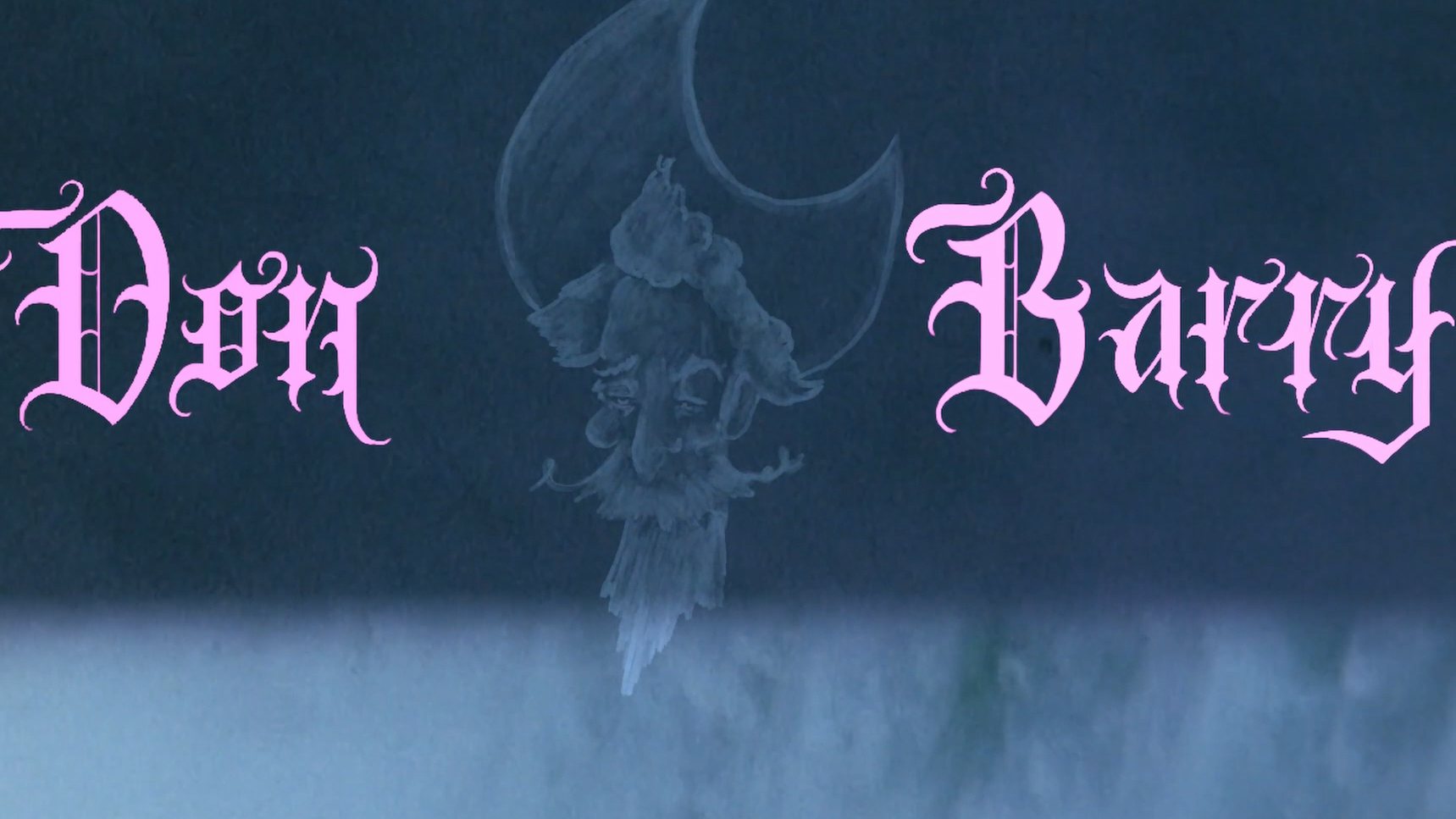
Docufiction, Experimental, by Paul Smart, Mexico, 2026.
Don Barry: A Quixotic Exploration is a debut feature that places the biography of an eighty-year-old experimental filmmaker and artist, Barry Gerson, within the metanarrative of Miguel de Cervantes’ Don Quixote. Don Barry was filmed in the city of Guanajuato during the 51st edition of the Cervantino Festival, as well as during the vibrant Day of the Dead celebrations held in the city’s UNESCO-listed tunnels. The film honors the director’s long friendship with artist Barry Gerson, drawing inspiration from Cervantes’ Don Quixote. Paul Smart’s directorial choices create something new that celebrates life and goes beyond conventional storytelling. A search for magic in our real lives. A moving film about the meaning of life, art, and death. Not to be missed.
Paul Smart is a proud outsider filmmaker with a long history of film screenings. In the 1980s, he emerged in New York’s vibrant youth art scene, working in theater production and later filmmaking, before retreating to rural upstate New York, in the Catskill Mountains, where he made a living writing and screening independent films in old parish halls for rural audiences, many of whom had never seen a film.
LANGUAGE: English
SUBTITLES: Spanish, French, German, Portuguese
Cervantes Wrote in a Prison Cell and Called It a Comedy
There is a specific kind of laughter that comes from a man who has nothing left to lose. Not the laughter of someone carefree, but the laughter of someone who has seen the machinery from underneath, who has pressed his face against the gears and survived, and who finds in that survival something that can only be called absurd. Miguel de Cervantes knew that laughter. He had earned it with his body.
He was twenty-four when he fought at Lepanto in October 1571, one of the largest naval battles in the history of the Mediterranean, a confrontation between the Ottoman fleet and the Holy League that left somewhere between twenty and forty thousand men dead in a single afternoon. Cervantes was already below deck with a fever when the fighting began. He insisted on fighting anyway. He took three gunshot wounds, two in the chest and one that permanently maimed his left hand. For the rest of his life he would joke that he had lost the movement of his left hand for the greater glory of his right. That joke contains everything you need to understand about the man who would write Don Quixote.
Four years later, sailing back toward Spain with letters of recommendation for his military service, Cervantes was captured by Barbary corsairs and taken to Algiers. He spent five years as a slave. Five years during which he attempted escape four times, each time taking full responsibility when the plots were discovered, protecting the others involved. The official Spanish Empire, for whose glory he had sacrificed his hand and his freedom, made no serious effort to ransom him. The letters of recommendation he carried, the documents certifying his valor at Lepanto, were apparently insufficient motivation. His family eventually scraped together enough money through the Trinitarian friars, and he was released in 1580.
He returned to a Spain that had no particular use for him. He tried for an administrative post in the colonies, in the Americas, where a man of his record might have found stable ground. The Council of the Indies denied his application. He worked as a requisitions agent for the Armada, confiscating grain and oil from Andalusian towns, work that earned him excommunication twice and a stint in jail in Seville, possibly in 1597 and again around 1602, for accounting irregularities that were almost certainly not his fault. It is almost certain that Part I of Don Quixote, published in Madrid in January 1605, was at least partially conceived in a cell.
This biographical arc is not background. It is the architecture of the book’s central ambiguity. When Cervantes created a man who reads so many chivalric romances that he loses his mind and rides out into La Mancha convinced he is a knight-errant, he was not simply satirizing a popular literary genre, though he was doing that too. He was constructing a figure who believes passionately in an official narrative, a story about heroism, honor, and the reward of virtue, that the world has no intention of honoring. The gap between what Alonso Quixano reads and what the roads of Spain actually contain is the same gap Cervantes had lived inside for thirty years.
The great question the novel refuses to settle, whether the knight is mad or whether he sees something the sane world has chosen not to see, is not a literary accident or an aesthetic strategy. It is the direct product of a man who had experienced both the grandeur of official heroism and the absolute indifference of official institutions toward anyone who embodied it. He had been the hero the empire needed and the inconvenience the empire discarded. The novel’s irreducible ambiguity is a scar shaped like a question mark.
The joke was also a wound. The comedy was also a testimony.

Chivalry Was a Marketing Campaign
There is a man in your life — maybe you are that man — who has watched enough action films, enough YouTube compilations of special forces raids, enough motivational content about discipline and sacrifice, that he has begun to carry himself differently. He walks into rooms with a particular weight. He talks about honor with a vocabulary that belongs nowhere near his actual circumstances. He is not inventing himself from thin air. He is downloading a self from somewhere, from a vast and available archive of performed masculinity, and the download feels, to him, completely authentic.
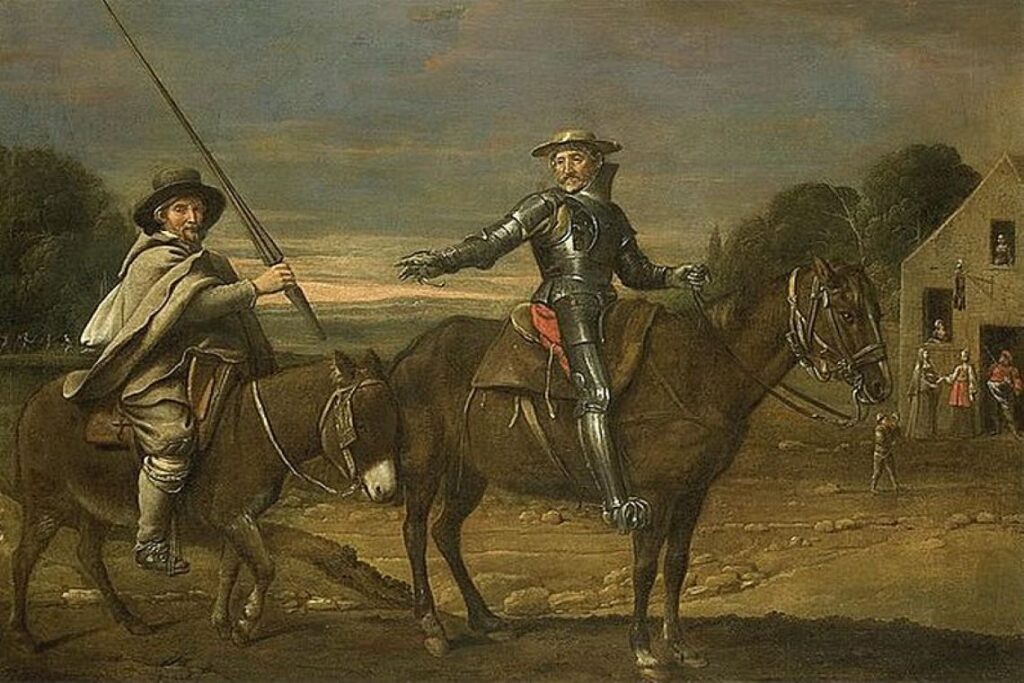
This is precisely what happened to Alonso Quijano, and it is worth sitting with the specifics because the specifics matter. The libros de caballerías — the chivalric romances that consumed him — were not rare manuscripts locked in monastery libraries. They were the mass-market paperbacks of their age, the Netflix series of 16th-century Castile. Amadís de Gaula alone went through at least twenty editions between 1508 and 1586, and that is only counting the printings we can verify. The genre had exploded across Spain with the availability of the printing press in a way that alarmed moralists and delighted publishers, and the alarm and the delight were, as they always are, two faces of the same coin. People consumed these stories compulsively. They knew the characters by name. They argued about which knight was braver, which lady more faithful, which duel more glorious. And in this sense, the madness of Quixote is not an aberration. It is a logical conclusion. He is simply the most devoted consumer in a culture of consumption.
What Cervantes was doing in 1605 was something that required genuine moral courage because it meant laughing at the dreams his own readers were dreaming. The chivalric romance had convinced an entire civilization that nobility was a quality of blood and gesture and beautiful violence, that the world had once been governed by a code of sacred honor, that this code could be recovered by anyone willing to dedicate himself to its performance. None of this was true. Guy Debord, writing in The Society of the Spectacle in 1967, argued that modern life had undergone a total transformation in which authentic social experience had been replaced by its representation — that we no longer live events but watch them, consume them, perform them back to ourselves. He was describing 1960s consumer capitalism, but the mechanism he identified is far older. The chivalric romance was a spectacle machine. It produced images of a life that had never existed and sold them as history, as heritage, as aspiration.
Jean Baudrillard took this further, and in doing so he illuminates Quixote with terrifying precision. In Simulacra and Simulation, published in 1981, Baudrillard describes the simulacrum not as a false copy of something real, but as a copy that has lost its original entirely — a representation that refers only to other representations, that generates its own reality from within. Quixote does not mistake fiction for reality in the way we might mistake a photograph for a painting. He inhabits a simulacrum: a world constructed from texts that were themselves constructions, fantasies about a past that had itself been fantasized. There is no original beneath his delusion. There is only layer upon layer of performed nobility, all the way down.
The tragedy Cervantes identified — and it deserves to be called a tragedy even when it makes us laugh — is that Quixote cannot see the architecture of his own enchantment. He believes he is recovering something ancient and true. He is in fact circling inside a media product. And the reader who finds this ridiculous should perhaps pause before turning the page too quickly, because the architecture of enchantment rarely announces itself. It simply becomes the air inside the room where you are sitting, reading, recognizing yourself in a madman and not entirely sure why.
Sancho Panza Is the Character You Actually Are
There is a man you have seen before. He is not the hero of the story. He is the one standing slightly behind the hero, holding the bags, occasionally muttering something sensible that nobody hears, eating when he can, sleeping when permitted, following someone else’s vision of the world because his own world — the village, the debts, the wife, the ordinary weight of days — offered him nothing large enough to stay for. He is Sancho Panza, and the reason you have not looked at him squarely is precisely because looking at him squarely means looking at yourself.
The critical tradition has been almost criminally comfortable with reading Sancho as comic relief. The fat squire, the glutton, the coward who flinches before windmills. This reading is not wrong so much as it is convenient — it allows the reader to stay safely on the side of Quixote’s madness, admiring it from a romantic distance, without having to account for the fact that their own psychology is far closer to Sancho’s than to the knight’s. Sancho follows Quixote not because he is stupid, but because Quixote offers him something his daily life cannot: the possibility that the world might mean more than it appears to. He negotiates for a governorship he does not truly expect to receive. He believes and disbelieves simultaneously. He is, in other words, the precise structure of human hope operating under economic constraint.
Miguel de Unamuno understood this with an urgency that still feels unfinished. In his 1905 essay Vida de Don Quijote y Sancho, Unamuno argues — against the entire learned tradition of his time — that Sancho is the more dangerous figure of the two, and the more human. Quixote’s madness is a closed system. It is internally consistent, self-referential, almost theological in its completeness. But Sancho’s mind is open and therefore vulnerable. He can be convinced. He can be corrupted. He can govern badly and learn something from it. He can, at the end, grieve his master’s death in a way that suggests he loved him not despite the delusions but because of them — because those delusions were the largest thing that had ever happened to Sancho Panza.
There is a scene — not in any book, but recognizable to anyone who has watched an ordinary man attach himself to an extraordinary or catastrophically mistaken figure — where the follower stands at a window watching his leader prepare for something that will end badly, and he does not leave. He has calculated the odds. He knows. And still he picks up the bags. The loyalty is not blind. It is a choice made in full awareness of the cost, because the alternative is the return to a life that asks nothing of you and therefore gives you nothing back. This is not stupidity. This is the specific gravity of a man who has found, for the first time, that his presence in the world matters to someone who matters to him.
Cervantes gives Sancho an episode — the governorship of Barataria — that functions as a test of exactly this complexity. Installed as governor of a fictional island as part of an elaborate joke by aristocrats who expect him to fail publicly, Sancho instead dispenses justice with an earthy, intuitive wisdom that shames the educated men around him. He does not last. He resigns. He returns to Quixote. But what that episode reveals is that Sancho’s practical intelligence was never the problem. The problem was that a world structured around class, education, and inherited power had no legitimate place for it.
Unamuno’s deeper claim is that Sancho Panza, not Quixote, is Spain — or perhaps humanity — because he contains the contradiction that cannot be resolved: he knows the giants are windmills, and he charges anyway.
The Lost Poet
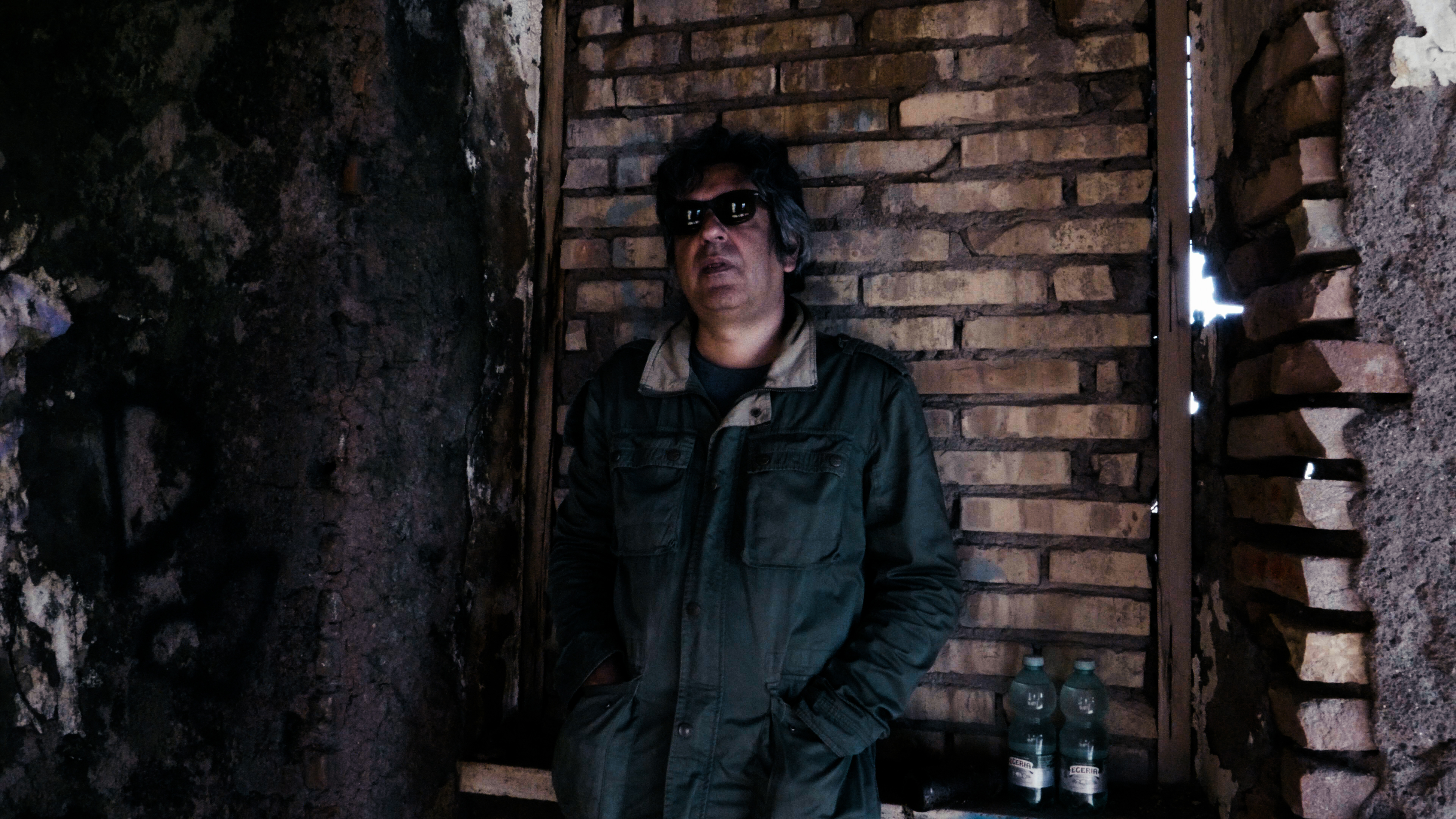
Drama, by Fabio Del Greco, Italy, 2024.
Dante Mezzadri wants to see an old friend, nicknamed the Iguana, whom he has lost sight of for many years, and who has managed to turn their shared youthful passion for poetry into a job, becoming a famous writer and poet. The man escapes from his bourgeois life and his wife to live homeless on the Roman coast, printing and trying to sell his poetry collections. At night he sleeps in a park of old carnival floats, inside a papier-mâché tank, and waits for the opportunity to meet his old friend, who however never shows up for appointments in the places they frequented when they were young, now in ruins. Dante's poetry books do not interest anyone and to support himself he is forced to "change product": he starts selling the infamous "cannibal pill" on behalf of young drug dealers, a new drug that sells like hot cakes and causes sensory and consumerist ecstasy. However, he realizes that this powerful drug is very dangerous for those who take it, he comes into conflict with his ethical conscience and throws all the pills into the sea. However, the dealers want to collect their money.
Shot over a period of 2 years, the film is a reflection on the cultural and artistic rubble of the society in which the protagonist lives, in an increasingly mechanized, consumerist and arid world. Dante Mezzadri is yet another human being who has renounced his inspiration and his creativity, but unlike many he is not willing to give his life to a system that distances him from his true identity. The physical world around him, however, seems constructed in such a way that it seems impossible to escape from this "invisible cage". The enthusiasm of the people he meets is ignited only by sensory gratification, by unreal visions of personal affirmation and success, by "metaverses" that offer an escape into an illusory and destructive reality. The poet's house on the coast, where he met with his friends as a young man, is just a pile of abandoned rubble. What happened to all those who wanted to become poets and ended up becoming something else? Are there internal forces with which that house can be "rebuilt"?
LANGUAGE: Italian
SUBTITLES: English, Spanish, French, German, Portuguese
The Windmills Were Giants — And That Is Not Entirely Wrong

There is a moment most people have experienced but rarely name: you see something in a situation — a threat, a cruelty, a structure of harm operating in plain sight — and everyone around you looks at you with that particular patience reserved for children and the unwell. The windmills are windmills. The mechanism is neutral. The institution is simply how things work. And you stand there with your lance, which is also your argument, which is also your accumulated fury at being asked to pretend you cannot see what you are seeing.
Cervantes gives us this moment and calls it madness. But Walter Benjamin, writing four centuries later in the fragmentary notes that became the Arcades Project, offers a different instrument for reading it. The dialectical image, as Benjamin understood it, is not a metaphor or a symbol. It is the point at which the past and present collide in a flash of recognition — a moment where the hidden violence inside an ordinary object suddenly becomes legible. The windmill is not merely a windmill when you understand what it does to the body of the man who feeds grain into it for twelve hours without rest, when you understand that the mechanism itself is a condensed form of a social arrangement, a frozen argument about who works and who owns the wind.
The peasant crushed in the grinding machinery of feudal agriculture was not, in any philosophically serious sense, entirely safe around those structures. The violence was not metaphorical. It was structural, meaning it was real and distributed across time rather than concentrated in a single blow, which is precisely what makes it invisible to those it does not touch. Henri Lefebvre, in his 1974 Production of Space, argued that the dominant class does not merely occupy space — it produces it, shapes it so that its own interests appear as natural geography. The windmill standing in the landscape of La Mancha does not announce itself as an instrument of extraction. It announces itself as part of the view.
There is a man who moves through a crowded housing project at night, registering the architecture of the place — the narrow stairwells, the single entry points, the way the building itself seems designed to contain rather than shelter — and everyone around him says he is reading danger into what is simply concrete and glass. But the building was designed with those features deliberately, in a city where certain kinds of residents were expected to remain invisible and manageable. He is not wrong about the violence. He is wrong only about its immediacy, about the particular form it will take tonight. This is not a small distinction, but it is not the vindication of pure lucidity either.
The question that Quixote poses, and that no serious reading of the novel can evade, is whether the correction of the delusion actually constitutes an improvement in understanding. The sane observer who sees windmills sees windmills correctly and sees nothing else. The knight who sees giants sees the windmills incorrectly and sees, through the error, something that the sane observer has trained himself not to see. Slavoj Zizek, drawing on Lacan’s concept of the symptom, has argued repeatedly that ideology does not work by hiding the truth from us — it works by offering us a structure within which certain true things become unsayable, unthinkable, invisible even when present. The windmill is that structure. The giant is what the structure contains and will not name.
To insist that Quixote is simply deluded is to take the position of the comfortable observer, the one for whom the mechanism poses no threat, the one who has already accommodated himself to what the grinding does. Lucidity, in this sense, is not a neutral cognitive achievement. It is also a social one. And sometimes what looks like madness from inside the arrangement looks, from a sufficient distance, like the only honest cartography available.
A vision curated by a filmmaker, not an algorithm
In this video I explain our vision
Dulcinea Does Not Exist, and That Is Precisely the Point
She is washing clothes by the river when he decides she is a princess. She does not know this. She will never know this. She wrings water from linen, wipes her forearm across her face, and somewhere in a village not far enough away, a man is constructing a cathedral in her honor, brick by brick, entirely inside his own skull.
Aldonza Lorenzo is a peasant woman from El Toboso, described by those who know her as broad-shouldered and capable of salting pork as well as any man in the region. Cervantes gives us this detail almost tenderly, as if to insist on her realness. And then he shows us what Don Quixote does with that realness: he erases it entirely and replaces it with Dulcinea, a name he invents, a soul he fabricates, a perfection that requires her complete absence to function. He has spoken to her perhaps twice in his life. It does not matter. The machinery of idealization does not run on contact. It runs on distance.
Freud understood something essential about this mechanism when he wrote, in his 1914 essay “On Narcissism,” that idealization is a process that inflates the object without altering its nature — what changes is not the beloved but the lover’s perception, which transfers onto the external figure a quantity of narcissistic libido that properly belongs to the self. The beloved becomes a mirror in which the lover sees what he wishes to be. Aldonza is not transformed into Dulcinea. Quixote is transformed into a knight by the act of transforming her. She is the instrument, not the subject.
But it is Lacan who cuts deeper. In his seventh seminar, delivered between 1959 and 1960 and later published as “The Ethics of Psychoanalysis,” he analyzes the medieval tradition of courtly love not as an elevation of woman but as a highly sophisticated system for maintaining desire through the permanent installation of an obstacle. The lady in courtly love, Lacan argues, is das Ding — the Thing — an empty place around which desire circulates endlessly without ever being satisfied, because satisfaction would destroy the structure entirely. She must remain unreachable. Not because she is divine, but because the moment she becomes available, ordinary, responsive, the entire architecture of longing collapses into the banal. Dulcinea cannot be met. The fantasy requires her non-existence.
There is a scene — a man standing outside an apartment building at night, watching a single lit window on the third floor. He has been watching for months. He knows her schedule, the color of her coat, the hour she returns. He has never spoken to her. Inside his mind, she is already a complete person: generous, melancholy, in need of exactly the kind of love he alone can offer. He has written her a letter he will never send. What he feels is entirely real. What she is, to him, is entirely fictional. When he finally sees her laugh loudly in the street with friends, unselfconsciously, her head thrown back — he feels a stab of something close to betrayal. She has failed to be the person he invented. The obsession does not end because he saw the real woman. It ends because the real woman destroyed the necessary distance.
This is the violence concealed inside idealization. It looks like worship. It functions like erasure. The woman who is idealized is not seen more clearly — she is seen less clearly than anyone else in the world, because a screen of projected meaning stands between her and the one who claims to love her most. Quixote’s devotion to Dulcinea is absolute. His knowledge of Aldonza is nonexistent. And that is not a contradiction in his love. That is the precondition for it.
Part II and the Horror of Being Famous
There is a particular kind of paralysis that arrives the moment you realize someone is watching you do something you have always done alone. You are walking down a street you have walked a thousand times, and suddenly there is a camera, or a face you recognize, or the simple knowledge that this moment will be described to someone else later. The walk changes. The arms move differently. The face assumes a posture it has never needed before, because before, there was no audience to perform for.
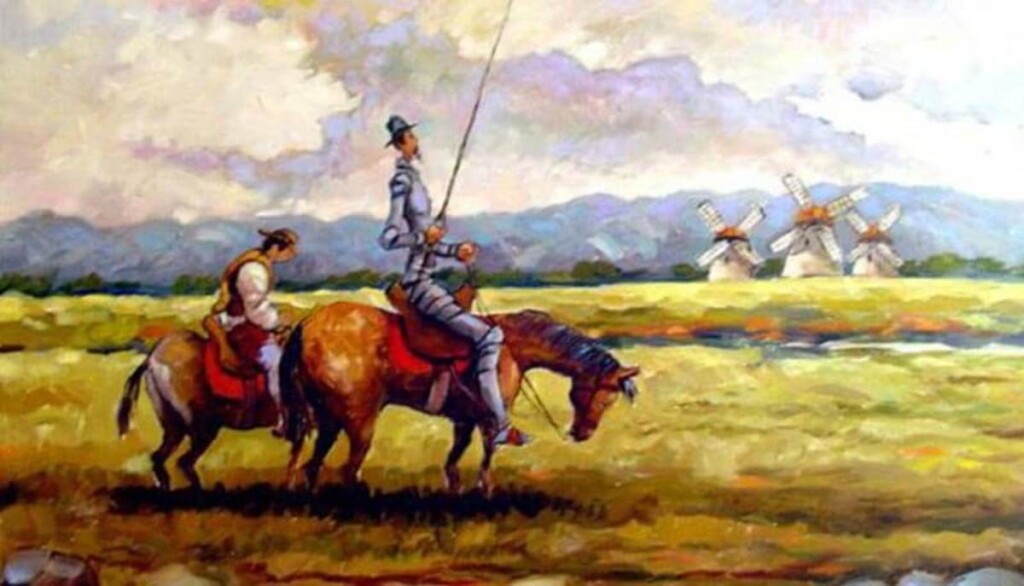
This is precisely the trap that springs shut in the second volume of Cervantes’s great work, published a full decade after the first, in 1615. By the time Quixote and Sancho ride out again, they have become famous. Part I exists within the world of Part II as a published book that people have read, argued over, and formed opinions about. The knight and his squire know this. Other characters know this. And from that knowledge forward, nothing can ever be innocent again, because every gesture is now a gesture made in front of an audience that has already decided what kind of gestures these men are supposed to make.
The Duke and Duchess who receive them represent this mechanism in its most suffocating form. They have read the book. They construct elaborate theatrical scenarios specifically designed to give Quixote what he expects from chivalric romance, not out of cruelty exactly, but out of something perhaps worse — the desire to consume a performance they have already pre-approved. Quixote, who in Part I was at least deluding himself freely, now finds himself in the position of a man who must live up to a version of himself that someone else has already written. The madness becomes a role. The role begins to hollow out whatever was underneath.
Erving Goffman, writing in 1959 in The Presentation of Self in Everyday Life, described social existence as an unceasing theatrical performance in which individuals manage impressions according to the expectations of their audience. He drew on the language of the stage deliberately: front stage, back stage, props, costumes, scripts. What Goffman understood, and what Cervantes understood three and a half centuries before him, is that the self is not a stable entity that then chooses how to present itself. The self is largely constituted by the presentation. When the performance is interrupted or destabilized — when the audience already has the script — the person performing begins to lose access to whatever they were before the curtain went up.
Contemporary research on self-presentation anxiety places the onset of chronic performance self-consciousness in adolescence, but the data increasingly suggest it has migrated across the entire lifespan. By 2023, studies on social media behavior found that a majority of users between eighteen and forty-five reported editing not just their posts but their actual physical behavior in anticipation of how it might be documented. The logic is the same as the Duke’s hall of mirrors: you are watched, therefore you perform; you perform, therefore you are what is performed; and the question of what exists beneath the performance becomes, over time, genuinely unanswerable.
A man is placed in a house where every wall turns out to be a screen. He begins to live for the cameras without knowing there are cameras, and then one day he suspects, and then he knows, and by then the life and the performance have fused so completely that escape means not freedom but annihilation. The self that was never watched is gone. What remains is an actor who has forgotten that acting was ever a choice.
Sancho, interestingly, survives this better than his master. The squire who was never heroic has nothing heroic to protect. But Quixote — Quixote must now be Quixote, and that obligation is a prison more airtight than any enchanted castle.
He Dies Lucid, and That Is the Cruelest Sentence
There is a particular kind of silence that falls over a room when someone who has been loudly, magnificently wrong for years suddenly becomes right. Not the silence of relief. The silence of something irreversible.
Alonso Quijano opens his eyes near the end and sees the world as it is. The windmills were always windmills. The barber’s basin was always a barber’s basin. The woman he called Dulcinea was always a peasant girl from a neighboring village who likely never thought of him at all. He recants his adventures with the clarity of a man who has passed through fever and arrived at cold morning air, and those around him weep — not because he is dying, but because he is finally, undeniably, himself. Cervantes stages this as a mercy. It is worth arguing that it is something far worse.
Camus wrote in The Myth of Sisyphus, published in 1942, that the absurd hero must be imagined happy precisely because he does not surrender to the absurdity of his condition — he revolts against it, perpetually, without hope of resolution. The revolt is not a strategy. It is the only form of dignity available to a consciousness that understands its situation fully. What Camus never fully reckoned with, perhaps because the literary example was too painful to press, is what happens when the revolt ends not through exhaustion but through conversion. When the rebel is not crushed but convinced.
There is a man who spent years building something that everyone told him was impossible — a relationship, a vision, a way of living — and who one morning woke up and agreed with them. He did not fail. He understood. And from that morning forward he was functional, reasonable, socially legible, and entirely gone. The people who loved him said he had finally grown up. What they meant was that he had finally stopped. The project did not collapse; he simply set it down, and without the project, there was nothing underneath to be the person who had carried it.
This is the philosophical horror at the center of Quijano’s deathbed lucidity. The system — the world of sensible men, of proper categories, of agreed-upon reality — did not defeat Don Quixote in the field. It waited. It surrounded him with affection and concern. It brought him home. And at the end, it persuaded him. The most total victory an order can achieve over a rebel is not imprisonment or ridicule but incorporation: the moment the rebel looks around and nods and says, yes, you were right all along, I see it now.
Foucault argued in Madness and Civilization, in 1961, that what modernity calls reason is not a neutral arbiter of truth but a historical construct that confines and defines in equal measure. The madman is not simply wrong; he is the figure that reasonable society requires in order to know itself as reasonable. When Quijano recovers his sanity, he does not escape this logic — he fulfills it. He becomes the proof that the system needed. His final lucidity is not liberation. It is capitulation rendered as wisdom.
And the question that Cervantes leaves open, perhaps without fully intending it, is whether Alonso Quijano without his madness is a person at all in any meaningful sense, or simply a vacancy dressed in familiar clothes. He dies with his name returned to him. He dies known, recognized, undisputed. He dies having renounced the only version of himself that ever made a claim on the world’s imagination. If the madness was not an illness but a method — the only method available to a man who could not bear the flatness of the real — then the sanity that replaced it was not a cure but an erasure, and what was buried in that modest grave was not Don Quixote the madman but the last evidence that another way of inhabiting the world had once, briefly, been attempted.
🌀 The Labyrinth of Meaning: Quests for Truth and Transformation
Don Quixote is one of literature’s greatest meditations on illusion, idealism, and the search for a deeper reality beneath the surface of the ordinary world. Its themes resonate powerfully with esoteric traditions, philosophical rebellion, and the timeless human hunger for transcendence. Explore these related articles to deepen your understanding of the symbolic universe Cervantes built.
Must-See Movies About the Meaning of Life
Like Don Quixote’s relentless pursuit of a world governed by chivalric ideals, the great films about the meaning of life confront us with the absurdity and beauty of existence. These works ask whether the quest itself — however doomed — carries more truth than comfortable resignation. Both Cervantes and these films suggest that the search for meaning is what makes us most human.
GO TO THE SELECTION: Must-See Movies About the Meaning of Life
Deep Movies that Make You Think
Don Quixote is perhaps literature’s first great ‘deep text,’ a novel that operates simultaneously as comedy, tragedy, and philosophical treatise. Like the films gathered here, it rewards those willing to sit with ambiguity and resist easy interpretation. The knight of La Mancha and these cinematic works share a refusal to offer simple answers to the most difficult questions.
GO TO THE SELECTION: Deep Movies that Make You Think
Universal Consciousness
The madness of Don Quixote can be read not as delusion but as an intuition of a higher, unified reality that ordinary perception cannot grasp. This connects his quest to mystical and philosophical ideas about universal consciousness, where the individual mind reaches toward something infinite. Cervantes may have been satirizing idealism, but he was also honoring it.
GO TO THE SELECTION: Universal Consciousness
Mystical Films not to Be Missed
Cervantes imbued Don Quixote with a deeply mystical dimension, where windmills become giants and an inn becomes an enchanted castle through the transformative power of visionary perception. The mystical films collected here operate by the same logic, using image and narrative to pierce the veil of the mundane. Both remind us that reality is always, in part, a matter of the eyes through which it is seen.
GO TO THE SELECTION: Mystical Films not to Be Missed
Discover Independent Cinema on Indiecinema
If Don Quixote’s impossible quest has stirred something in you, Indiecinema is the streaming platform where that feeling finds its cinematic home. From philosophical masterpieces to visionary independent films, our catalog is curated for those who believe that cinema — like great literature — can change the way you see the world. Join us and explore films that dare to tilt at windmills.
👉 EXPLORE THE CATALOG: Watch Indie Films in Streaming
A vision curated by a filmmaker, not an algorithm
In this video I explain our vision

