
The Weight of a Century That Refused to Die Quietly
You open a book that has been sitting on a shelf for longer than you have been alive, and something happens that you were not expecting. Not wonder, not distance — recognition. The sentences move with a kind of exhausted brilliance, a language that seems to be speaking through clenched teeth, saying everything and nothing simultaneously, decorating its wounds with such elaborate ornament that you almost miss the wound entirely. You put the book down. You pick it up again. There is something in it that feels less like the past and more like a mirror held at an uncomfortable angle.

This is what seventeenth-century Spanish literature does to a reader who is paying attention. It does not offer the clean heroism of earlier centuries, nor the optimistic reach of the Renaissance that immediately preceded it. It offers something stranger and more durable: the art of a civilization that knows it is in decline but refuses, absolutely refuses, to admit it out loud. Every sentence is a negotiation. Every metaphor is a small act of survival.
Spain in the 1600s was an empire performing its own magnificence for an audience that was quietly losing faith. The economic catastrophe that had been accumulating since the late sixteenth century — debt crises in 1607, 1627, and 1647, the relentless hemorrhage of silver from the American colonies into the hands of European creditors, the depopulation of Castile through plague, emigration, and expulsion — all of this was unfolding beneath a cultural apparatus of extraordinary, almost hallucinatory, productivity. The reign of Philip IV, which stretched from 1621 to 1665, coincided with what would later be called the Spanish Golden Age in retrospect, a label that contains its own bitter irony. It was golden in output, ruinous in reality.
The Spanish Inquisition, formally established in 1478, had by the seventeenth century become less a mechanism of mass terror and more something perhaps more insidious: a permanent atmospheric pressure. It did not need to burn writers at the stake to control what could be written. It needed only to exist, to be known to exist, to have its indices of prohibited books circulating in the background of every act of composition. Writers learned to speak slant, to bury their most dangerous thoughts inside labyrinths of allegory, paradox, and wit. The style that emerged from this pressure was not decorative in the frivolous sense. It was protective coloration. Extravagance as camouflage.
José Antonio Maravall, in his foundational 1975 work La cultura del Barroco, made the argument that has never quite been refuted: the Baroque was not primarily an aesthetic phenomenon but a political one. It was a directed culture, manufactured and sustained by the ruling classes as a technology of social management. The masses were to be dazzled, disoriented, seduced into passivity by a relentless spectacle of excess — in theater, in architecture, in the contorted syntax of literary prose and poetry. Maravall’s thesis was uncomfortable when it appeared and remains uncomfortable now, because it asks you to look at the greatest literary achievements of the period and see in them not only genius but also function. The genius is real. The function is also real. These two things coexist without canceling each other, and that coexistence is itself very Baroque.
What this means for the literature is that you cannot read it the way you read other centuries. You cannot take the surface at face value, because the surface was designed precisely to be taken at face value, to exhaust your attention with its brilliance and send you away satisfied, untroubled, having understood the decoration and missed the structure. The writers of seventeenth-century Spain were operating inside a system that rewarded eloquence and punished clarity. They became, of necessity, masters of a language that said two things at once, sometimes three, sometimes a fourth thing that you only hear on the third reading, in a quieter room, when you are no longer trying to admire and have started, almost against your will, to listen.
Don Barry: A Quixotic Exploration
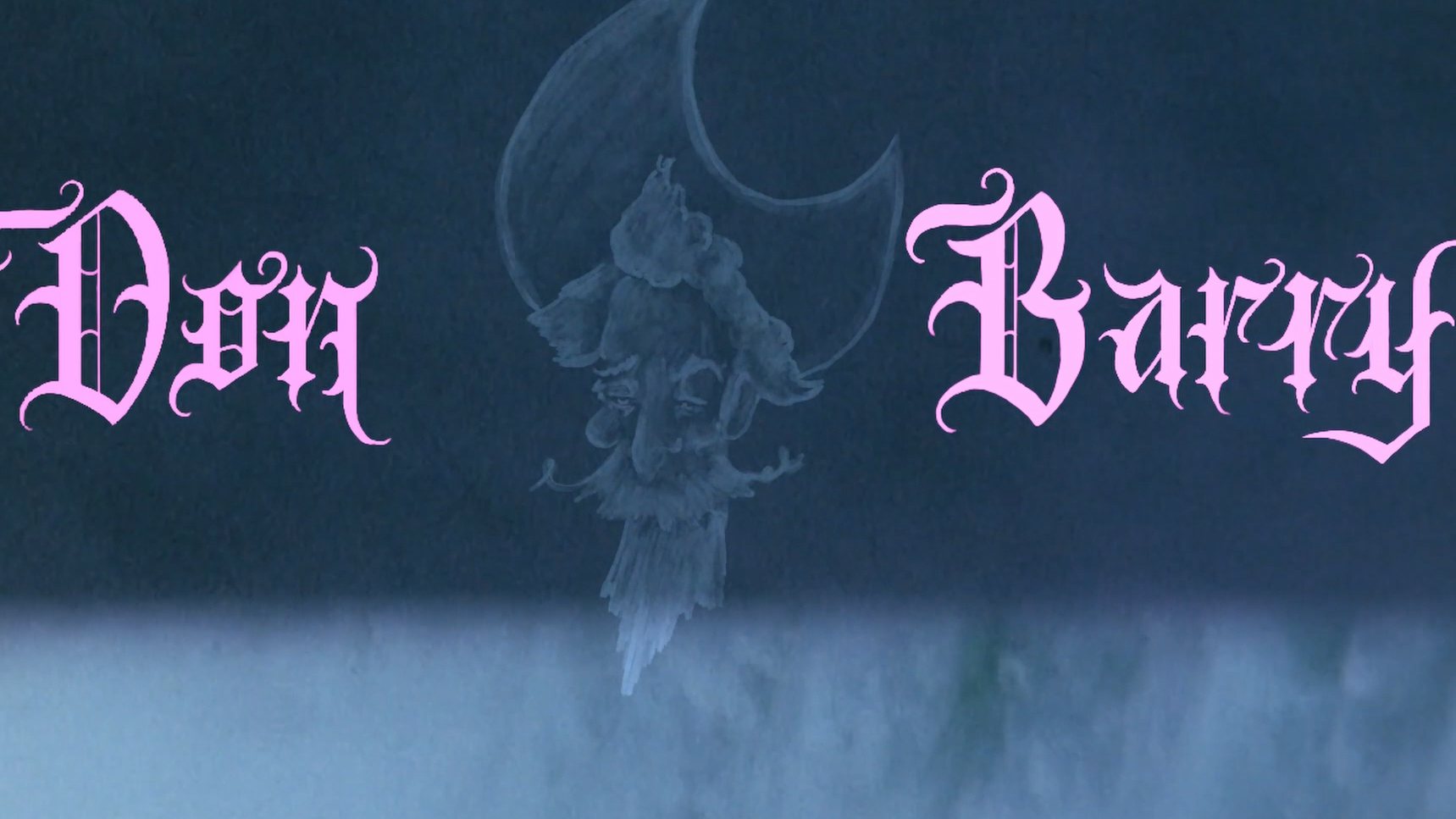
Docufiction, Experimental, by Paul Smart, Mexico, 2026.
Don Barry: A Quixotic Exploration is a debut feature that places the biography of an eighty-year-old experimental filmmaker and artist, Barry Gerson, within the metanarrative of Miguel de Cervantes’ Don Quixote. Don Barry was filmed in the city of Guanajuato during the 51st edition of the Cervantino Festival, as well as during the vibrant Day of the Dead celebrations held in the city’s UNESCO-listed tunnels. The film honors the director’s long friendship with artist Barry Gerson, drawing inspiration from Cervantes’ Don Quixote. Paul Smart’s directorial choices create something new that celebrates life and goes beyond conventional storytelling. A search for magic in our real lives. A moving film about the meaning of life, art, and death. Not to be missed.
Paul Smart is a proud outsider filmmaker with a long history of film screenings. In the 1980s, he emerged in New York’s vibrant youth art scene, working in theater production and later filmmaking, before retreating to rural upstate New York, in the Catskill Mountains, where he made a living writing and screening independent films in old parish halls for rural audiences, many of whom had never seen a film.
LANGUAGE: English
SUBTITLES: Spanish, French, German, Portuguese
Cervantes and the Lie We Call Reality
You have a friend — everyone has this friend — who tells the story of a relationship that ended badly, and every time they tell it, the story has shifted slightly. The ex-partner becomes a little more monstrous, the protagonist a little more reasonable, the warning signs a little more obvious in retrospect. By the fifth retelling, it is a different story entirely, cleaner and more tragic and somehow more bearable. And if you point this out, if you say gently that you remember it differently, they look at you with something close to offense, because for them the revised version is not a revision. It is the truth they have finally managed to see clearly.
This is not delusion in any clinical sense. This is survival. This is the mind doing what minds do, which is to say: constructing a narrative that makes the self coherent, the world legible, and the pain meaningful enough to be carried forward. The question Miguel de Cervantes was asking, in the first decade of the seventeenth century, was not whether this mechanism is pathetic or admirable. He was asking whether there is any alternative to it at all.
Don Quixote arrives in two volumes, the first in 1605 and the second a decade later in 1615, and between those two dates something extraordinary happened that changed the nature of the book itself. In 1614, a writer publishing under the name Alonso Fernández de Avellaneda released an unauthorized continuation of the first volume — a pirated, contemptuous sequel that depicted the knight as simply mad, irredeemably broken, a figure of mockery without remainder. Cervantes, who had been working on his own second part, was forced to accelerate, to respond, to write his ending before someone else’s ending became the definitive one. The pressure of a false version of his own character compelled him to finish the true one. The novel about a man who cannot distinguish fiction from reality was itself shaped by a fictional intrusion into reality. The formal history of the text enacts what the text is about.
Michel Foucault, in The Order of Things published in 1966, reads Don Quixote as the inaugural moment of a fundamental rupture in Western thought — the point at which the medieval certainty that words and things resemble each other, that language mirrors the world, collapses into the modern anxiety that signs are arbitrary, that texts refer only to other texts, that the knight errant wandering La Mancha is searching for resemblances that no longer exist in nature. Quixote is, for Foucault, the first modern man precisely because he is the last man who believed the old order was real. He is not mocked by Cervantes. He is mourned by him, with the specific grief of someone who understands why the belief was necessary.
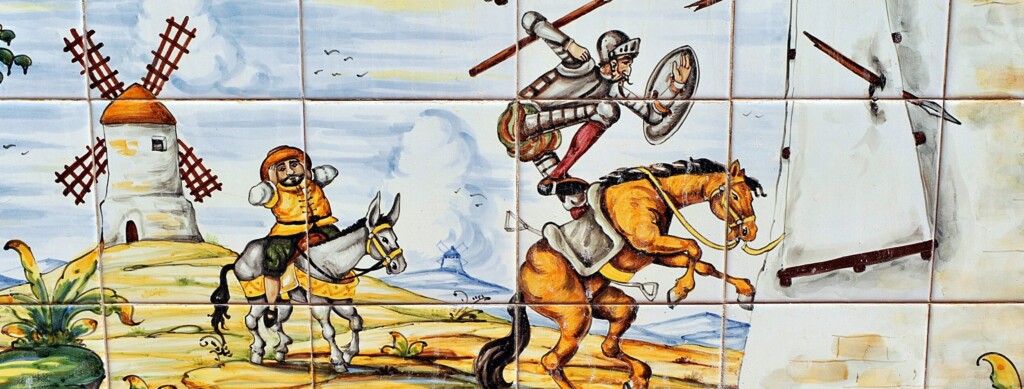
The windmills are not a joke. They are a diagnosis. A man trained entirely on chivalric romances encounters a landscape that offers him no version of itself compatible with those texts, and so he rewrites the landscape. He makes the windmills into giants because giants are what his framework requires, and his framework is the only coherent world he has ever inhabited. When his squire points to what is actually there, the knight does not simply ignore him. He explains the contradiction away with a theory of enchantment — someone has interfered, someone has transformed what was a giant into a windmill in the moment of his approach, specifically to humiliate him. The conspiracy theory is not stupidity. It is the mind’s last defense against the dissolution of its organizing story.
What Cervantes understood, writing in the specific exhaustion of early seventeenth century Spain — a country hemorrhaging resources into imperial overreach, a culture saturated with romance literature promising glorious deeds in a world that had ceased to offer them — is that the man who cannot stop believing is not simply a fool. He is the rest of us, with less armor against the recognition.

Lope de Vega and the Theater as Mass Sedation
The crowd presses in from every side, shoulders and elbows and the smell of bodies that have walked far to be here. For a few hours, nobody is hungry in the way that matters. Nobody remembers the tax collector who came last Thursday, the landlord whose patience runs on a short rope, the son conscripted into a war nobody explained. Something is happening on the wooden platform at the far end of the courtyard, and it is loud and bright and moves quickly, and the people watching it are, briefly, someone else’s problem rather than their own.
This is what Félix Lope de Vega Carpio understood before anyone thought to theorize it. He understood it with his body, the way a carpenter understands load-bearing walls — not through abstraction but through accumulated pressure. In the span of a single lifetime, he produced what scholars conservatively estimate at 1,800 plays, of which roughly 400 have survived the passage of time and human carelessness. The number alone is almost obscene. It suggests not a writer but a factory, not inspiration but something closer to industrial will. And yet the plays worked. They filled the corrales de comedias — those open-air theater courtyards arranged around the inner walls of Madrid’s urban blocks — week after week, season after season, with audiences that crossed every line of class and expectation.
In 1609, Lope formalized what he had already been practicing for decades. His Arte nuevo de hacer comedias en este tiempo is one of the more fascinating documents of self-aware manipulation in literary history. He presents it as a kind of apology to the classical scholars in his audience, acknowledging with elaborate false humility that he knows the ancient rules perfectly well and chooses to ignore them because the people demand otherwise. He writes that he locks away the classical precepts when he sits down to compose, that he chases off Plautus and Terence so that the crowd won’t boo him off the stage. The text performs its own argument: here is a man demonstrating, in the very act of addressing an elite academy, that real power lives somewhere else entirely.
José Antonio Maravall, in his 1975 work La cultura del Barroco, laid out the uncomfortable thesis that all of this — the spectacle, the velocity, the emotional saturation of Baroque culture — was not spontaneous. It was engineered. Maravall argued that the dominant classes of seventeenth-century Spain consciously deployed mass culture as a mechanism of social control, redirecting the energies of a population living through imperial decline, fiscal exhaustion, and deepening inequality. The corral de comedias, in this reading, is not merely entertainment. It is a pressure valve. The honor codes dramatized on those wooden stages, the righteous kings who descend at the last moment to restore order, the peasant heroes who triumph within a system that never actually changes — these are not reflections of social reality. They are substitutes for it.
What makes this almost unbearable to contemplate is the life of the man manufacturing the sedative. Lope de Vega was tried by the Inquisition for libellous verse written against his former lover and her family. He was exiled from Castile. He married twice, kept serial mistresses, fathered children he could not always account for, took holy orders in 1614 and continued his love affairs anyway, buried children and wives and lovers with a frequency that reads less like tragedy and more like the relentless metabolism of someone who could not slow down enough to grieve properly. He was, in other words, precisely the kind of man whose existence violated every norm his plays ceremonially upheld.
And perhaps that is the point that no one quite wants to say plainly. The man who wrote the honor codes lived as though they applied to everyone but himself. The man who engineered collective catharsis never achieved anything resembling his own. He gave the crowd somewhere to put its rage. What he did with his own is a question that three hundred surviving years have not quite answered.
Quevedo’s Rage and the Poetry of Controlled Demolition
There is a kind of person you have met at least once — at a dinner table, in an office corridor, at a gathering where everyone is performing some version of contentment — who makes everyone around them laugh while something behind their eyes is going absolutely dark. They are the sharpest one in the room. Every sentence lands precisely where it was aimed. The wit is so controlled, so devastatingly timed, that you only notice later, driving home, that they never once said anything true about themselves. The armor was the performance, and the performance never cracked.
Francisco de Quevedo spent most of his literary life inside that armor. He wrote with a velocity and venom that remains almost physically shocking to read even now, four centuries later, and beneath every savage line there is a man who understood, with complete lucidity, that the world he was cataloguing was also consuming him. His Sueños, composed across the early decades of the seventeenth century, march doctors, judges, lawyers, poets, and noblemen through a grotesque underworld where every social pretension is stripped to its anatomical absurdity. The satire is not gentle. It is the kind of laughter that leaves a bruise. His picaresque novel, published in 1626, follows Pablos de Segovia through a Spain that operates as a machine for humiliating those foolish enough to believe in the possibility of self-reinvention — a machine Quevedo renders with such precise malice that the comedy becomes indistinguishable from despair.
This is what Baltasar Gracián would theorize in his Agudeza y arte de ingenio of 1642 as the philosophical function of wit: not decoration, not entertainment, but a cognitive instrument for navigating a reality where appearance and substance have been permanently divorced. Gracián understood agudeza as a form of perception, a way of forcing two incompatible realities into collision so that the resulting flash of recognition could illuminate what ordinary language would simply obscure. For Quevedo, conceptismo operated exactly this way — not as ornament layered onto thought, but as the only structure capable of holding contradictions in suspension without resolving them dishonestly. When he compresses an entire social pathology into fourteen lines, the compression is not a stylistic choice. It is an epistemological one. The sonnet form becomes a controlled demolition, each volta a detonation that leaves the landscape clarified and ruined simultaneously.
What makes this more than literary technique is what was happening to Quevedo while he wrote it. He was not an outsider observing power from a safe distance. He moved through courts, served as a political secretary, involved himself in the factional intrigues of a monarchy sliding visibly toward exhaustion. He understood the mechanisms of power from inside them, and that proximity made his satire more dangerous precisely because it was more accurate. In 1639, the armor failed in its most practical function. He was arrested and imprisoned in the monastery of San Marcos in León, on charges that were never made entirely transparent but that amounted, fundamentally, to having said too precisely what was true. He was held for nearly four years. He was already in his sixties. He emerged broken in body, and died in 1645.
What his imprisonment reveals is something that irony, however weaponized, cannot finally protect against: the state does not need to refute you. It only needs to make the conditions of your speech impossible. Michel Foucault, writing centuries later about the relationship between discourse and power in his 1975 Discipline and Punish, described precisely this mechanism — not the suppression of dangerous ideas through argument, but through the management of the bodies that produce them. Quevedo’s conceptismo could expose every contradiction in the Habsburg world. It could not make that exposure safe. The wit was real. The cage was also real. And the question that hangs over the final years of his life, the years after San Marcos, is whether a man who spent decades perfecting the art of saying everything obliquely ever found a way to say, simply and without armor, what the silence had cost him.
Calderón, Sor Juana, and the Theater of the Trapped Mind
There is a moment, familiar to almost anyone who has stopped long enough to feel it, when you look around at the life you are living and understand, with a clarity that borders on nausea, that the walls were not entirely erected by others. You chose the career that satisfied your family’s anxiety rather than your own. You stayed in the city that made you legible to the people whose approval you could not stop needing. You repeated the opinions that kept you safe inside the conversation. The cage was real, and the bars were cold, and yet somewhere in the architecture of your own choices, you had been the one mixing the mortar. The recognition does not liberate you. It simply makes the enclosure more precise.
This is exactly the psychological terrain that Calderón de la Barca inhabited when he wrote, in 1635, the story of Segismundo, a prince who has been imprisoned since birth by a father who feared a prophecy, then briefly freed, then returned to his cell and told that everything he experienced in the outside world was a dream. What Calderón constructed was not primarily a philosophical allegory about the illusory nature of existence, though centuries of literary commentary have been comfortable reducing it to that. It was something far more disturbing: a document of what happens to a mind that has been systematically denied the right to trust its own perception. Segismundo cannot know whether he is awake or asleep, whether his freedom was real or manufactured, whether his actions carry consequence or are simply the theater of someone else’s experiment. This is not metaphysics. This is the lived epistemology of anyone who has been gaslit long enough that the doubt becomes structural, embedded in the architecture of selfhood before they are old enough to name it.
Michel Foucault, writing in Discipline and Punish in 1975, described how power operates most efficiently not through direct coercion but through the internalization of surveillance, how the watched subject eventually watches themselves, making the external warden unnecessary. Calderón reached this insight through drama three centuries earlier, and he reached it with greater psychological precision, because he was not describing institutions but individuals, not systems but the single mind that has absorbed its own imprisonment so thoroughly that freedom, when it briefly arrives, feels less like liberation than like vertigo.
The figure who completes this picture, who extends it and radicalizes it in directions Calderón could not have gone, is a woman writing from the margins of empire and gender simultaneously. She was a nun in colonial Mexico, self-taught to a degree that was considered almost monstrous by the men around her, and in 1692 she finished a poem of extraordinary ambition, a nocturnal philosophical journey of the dreaming mind ascending through the orders of creation, attempting to grasp the totality of knowledge, and failing. The failure is the point. The poem does not end in illumination. It ends in waking, in the ordinary light of morning that erases the dream’s exertion and leaves the mind exactly where it began. What she had built over nearly thousand lines was not a hymn to the human intellect’s power but an honest cartography of its limits, written by someone who knew better than anyone alive what it cost a mind to insist on its own existence.
Octavio Paz, who spent years reconstructing her life and published his biography in 1982, understood that her intellectual radicalism and her personal entrapment were not separate phenomena but the same phenomenon viewed from different angles. She wrote from inside a forced consciousness, to use Simone de Beauvoir’s phrase from The Second Sex, the state of a mind that has been defined as Other by the structures that surround it and must therefore think in two directions simultaneously: toward the ideas it genuinely pursues and toward the constant management of how those ideas will be received by those who hold power over its survival. Beauvoir identified this double consciousness as the specific cognitive burden of women within patriarchal systems, and what Paz’s reconstruction reveals is that she carried this burden with a discipline and a precision that transformed it into literature, which is to say, into something that outlasted every man who tried to silence her.
A vision curated by a filmmaker, not an algorithm
In this video I explain our vision
Gracián and the Art of Never Being Fully Seen
You arrive at the meeting having already decided what you will not say. Not because you are lying — you have no intention of lying — but because you understand, with a precision that requires no conscious effort, that certain truths belong to you alone, and that releasing them into a room full of ambition and evaluation would be a form of recklessness dressed up as honesty. So you calibrate. You offer enough warmth to seem open, enough reserve to seem serious, enough vulnerability to appear human while protecting the exact coordinates of what actually troubles you. You leave having said nothing false and having revealed almost nothing true. You drive home and cannot decide whether to feel clever or diminished.
Baltasar Gracián would have recognized you immediately. Born in 1601 in Belmonte de Calatayud, he entered the Jesuit order and spent his life navigating the extraordinary minefield of Counter-Reformation Spain, where theological conformity, courtly favor, institutional loyalty, and personal survival formed a knot so tight that candor was not merely dangerous but almost philosophically naive. By the time he published El Criticón between 1651 and 1657, he had already produced the Oráculo manual in 1647, a collection of three hundred aphorisms that amount to something both colder and more generous than cynicism: a complete cartography of the social performance required to remain intact in a world where everyone is watching and almost no one is safe.
The Oráculo does not tell you to be dishonest. It tells you something far more disturbing — that you already are performing, that you have always been performing, and that the only question is whether you do so with awareness or with the dangerous innocence of someone who believes their face is simply their face. Erving Goffman, writing in The Presentation of Self in Everyday Life in 1959, arrived at the same territory through sociology rather than theology: the self is not expressed, it is enacted, and every social encounter is a kind of theater in which front-stage behavior bears a calculated relationship to what happens backstage. Goffman named the mechanism; Gracián had weaponized it three centuries earlier, not as a critique but as a survival manual for a civilization that had turned watching into a civic duty.
In El Criticón, two figures travel through the world — Critilo, a man shaped by experience, and Andrenio, one shaped by nature — and what they encounter at every turn is the gap between appearance and interior, between the face a society presents and the machinery running beneath it. The allegory functions as a kind of extended anatomy of collective self-deception, a guided tour through institutions, relationships, and moral categories that reveals each one to be more constructed, more theatrical, more contingent than its guardians would ever admit. Gracián does not offer this as a tragedy. He offers it as education. The world is performance all the way down; the only dignity available is in mastering the performance rather than being mastered by it.
What makes him strange and modern and quietly unbearable is that he refuses the consolation of authenticity. He does not suggest that behind the masks there is a truer self waiting to be liberated. The mask is the self, or at least the self that can survive contact with others. The philosopher José Antonio Maravall, in his landmark 1975 study Culture of the Baroque, argued that seventeenth-century Spanish literature as a whole reflects a society organized around spectacle and control, where the individual learns to exist inside the gaze of power by becoming ungovernable from the inside even while remaining legible from the outside. Gracián is the purest expression of that paradox.
And so you return to the meeting, to the calibrated warmth and the protected coordinates, to the version of yourself you have edited for public circulation. You know what you are doing. Gracián knew what he was doing. The question that neither he nor you has ever quite resolved is whether knowing the name of the cage, and understanding its every hinge and bar with perfect lucidity, means that you are no longer inside it.
📖 Golden Age Words: Spain’s Literary Universe
The seventeenth century in Spain was a period of extraordinary literary ferment, producing some of the most enduring works in Western literature. From the picaresque streets of Seville to the windmills of La Mancha, Spanish writers forged a world of irony, beauty, and existential depth. These related articles illuminate the broader cultural and literary landscape that surrounded and shaped this remarkable century.
Don Quixote: Meaning and Analysis
Don Quixote stands as the undisputed masterpiece of Spanish Golden Age literature, a towering novel that invented modern fiction while laughing at its own invention. Cervantes crafted a hero whose madness reveals deeper truths about reality, idealism, and the power of storytelling. To understand seventeenth-century Spanish literature is, above all, to understand Don Quixote.
GO TO THE SELECTION: Don Quixote: Meaning and Analysis
The Spanish Picaresque Novel: History and Meaning
The picaresque novel was one of the most distinctive and influential genres to emerge from Golden Age Spain, tracing the misadventures of low-born rogues navigating a corrupt and hypocritical society. Works like Lazarillo de Tormes and Guzmán de Alfarache offered a biting satirical portrait of Spanish social hierarchies. This genre deeply influenced the narrative forms and moral tone of the entire seventeenth century.
GO TO THE SELECTION: The Spanish Picaresque Novel: History and Meaning
Alchemy in Literature: From Dante to Goethe
Alchemy in literature was not merely a metaphor but a genuine intellectual current that permeated the European Renaissance and Baroque imagination, including Spanish letters. Writers from Dante to Goethe encoded alchemical symbolism into their works, reflecting a universe where matter and spirit were inseparable. Understanding this tradition enriches the reading of mystical and philosophical currents present in seventeenth-century Spanish writing.
GO TO THE SELECTION: Alchemy in Literature: From Dante to Goethe
Giordano Bruno and the Hermetic Tradition
Giordano Bruno’s Hermetic philosophy circulated widely through European intellectual networks during the late Renaissance, influencing writers, poets, and theologians across the continent including Spain. His vision of an infinite universe animated by spiritual forces resonated with the metaphysical ambitions of Baroque literature. Tracing Bruno’s legacy helps illuminate the esoteric undercurrents that flowed beneath the surface of Golden Age Spanish culture.
GO TO THE SELECTION: Giordano Bruno and the Hermetic Tradition
Discover Independent Cinema on Indiecinema
If the labyrinthine richness of seventeenth-century Spanish literature has stirred your imagination, Indiecinema’s streaming platform invites you to continue the journey through independent and auteur cinema that shares the same spirit of creative daring. Discover films that break conventions, challenge perspectives, and illuminate the human condition with the same fearless vision as the great Spanish writers of the Baroque age.
👉 EXPLORE THE CATALOG: Watch Indie Films in Streaming
A vision curated by a filmmaker, not an algorithm
In this video I explain our vision

