
The Kitchen at Midnight
There is a particular kind of madness that visits people in kitchens after midnight. You have seen it, perhaps lived it: the compulsive rearrangement of spices, the precise measuring of ingredients for something that will never quite become what you imagined, the strange conviction that if you simply find the right combination, the right sequence, the right moment of heat applied to the right vessel, something will change. Not just the food. Something else. Something harder to name. The kitchen becomes a laboratory, the cook becomes an operator of forces they cannot fully see, and the night stretches around them like a permission slip from the rational world.

This is not metaphor. This is a structure of human consciousness so ancient and so persistent that it preceded writing, preceded philosophy, preceded the very categories we use to think about thinking. The Egyptians called it the work. The Greeks called it the art. Medieval Europeans called it the royal art, the sacred science, the great work. We call it alchemy, and we immediately file it under failure, under charlatanism, under the quaint delusions of people who did not yet have access to the periodic table. We are wrong to do so, and literature has known we are wrong for at least seven centuries.
Dante Alighieri completed the Commedia sometime around 1320, the year before his death in Ravenna. Goethe finished the second part of Faust in 1832, the year before his death in Weimar. Between these two terminations, between these two men dying with their great works barely cold on the page, lies an extraordinary continuity: both understood alchemy not as a failed attempt to manufacture gold from base metals, but as the only honest grammar available to describe what happens when a human being is genuinely transformed. Not improved. Not educated. Transformed in the chemical sense, which is to say in the irreversible sense, which is to say in the sense that leaves you unrecognizable to your former self.
Carl Gustav Jung spent decades excavating this recognition from the ruins of scientific contempt. His Psychology and Alchemy, published in 1944, made the argument that alchemical symbolism was not primitive chemistry but a projection of the unconscious mind onto matter, the psyche’s attempt to observe its own processes through the language of physical transformation. Lead becoming gold was never about lead. It was about the prima materia of the self, that dense, undifferentiated, stubborn mass of unprocessed experience that sits at the bottom of every human life, waiting for the right heat, the right pressure, the right symbolic container. Jung was a scientist, careful to frame himself as one, but what he was describing was something that Dante had already dramatized in the architecture of three canticles and one hundred cantos: the self cannot be transformed without passing through something that resembles death.
The person rearranging spices at midnight knows this without knowing they know it. They are not cooking. They are conducting a procedure on themselves. The kitchen is the athanor, the alchemical furnace, and the heat they apply is attention, obsession, the refusal to sleep until something yields. What they are waiting for is the solve et coagula, the dissolution and the reconstitution, which the alchemists considered the central operation of all transformation: you must first unmake the thing before it can become something else. You must reduce it to its most chaotic, most formless, most frightening state. Only then does the new form become possible.
Literature understood this before psychology had a name for it, and the two greatest literary monuments of the Western tradition that engage this grammar are not allegories about chemistry. They are autobiographies of the transforming self, written by men who understood that the only material worth working with was the one they could not put down and walk away from.
The Lost Poet
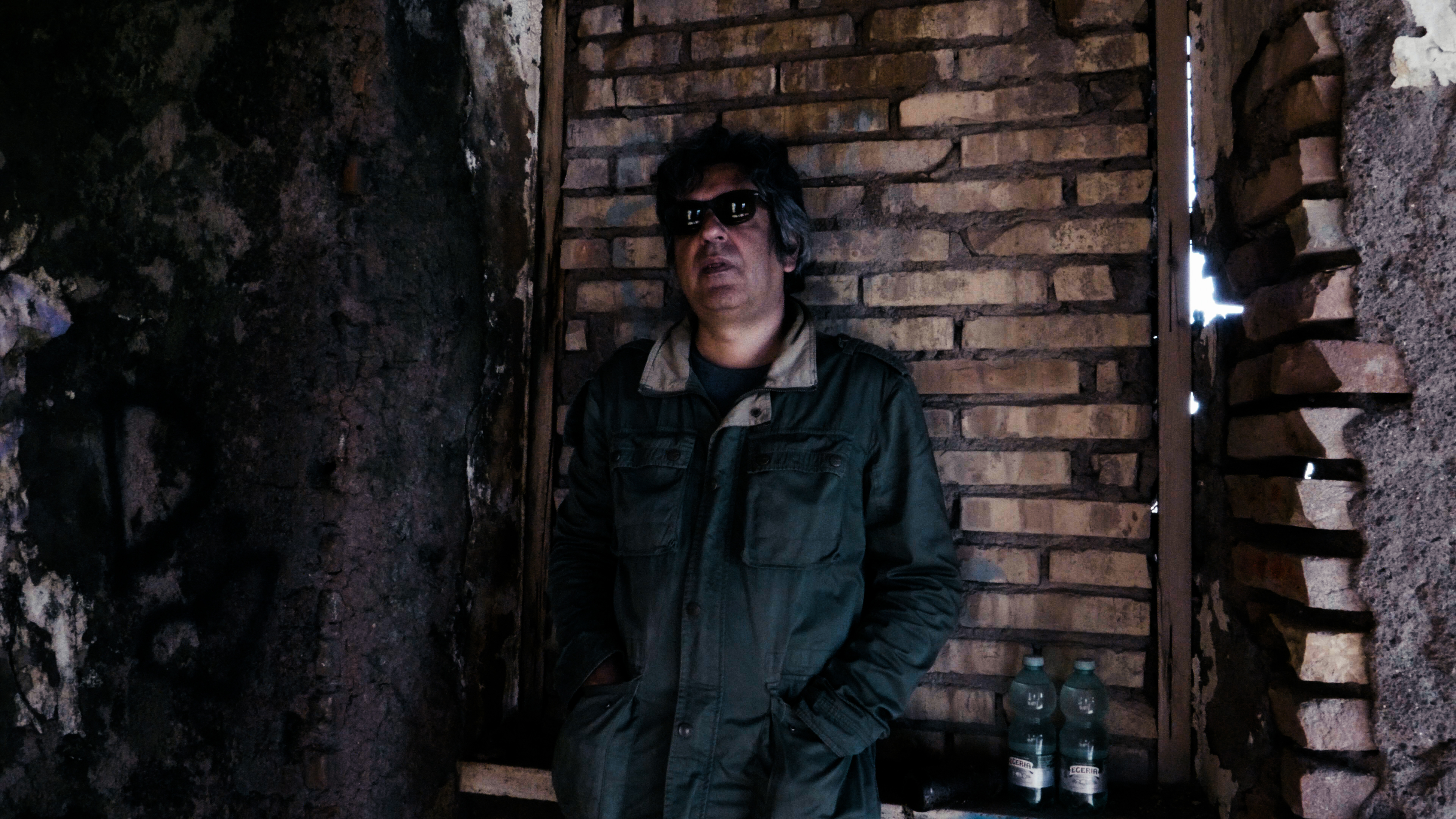
Drama, by Fabio Del Greco, Italy, 2024.
Dante Mezzadri wants to see an old friend, nicknamed the Iguana, whom he has lost sight of for many years, and who has managed to turn their shared youthful passion for poetry into a job, becoming a famous writer and poet. The man escapes from his bourgeois life and his wife to live homeless on the Roman coast, printing and trying to sell his poetry collections. At night he sleeps in a park of old carnival floats, inside a papier-mâché tank, and waits for the opportunity to meet his old friend, who however never shows up for appointments in the places they frequented when they were young, now in ruins. Dante's poetry books do not interest anyone and to support himself he is forced to "change product": he starts selling the infamous "cannibal pill" on behalf of young drug dealers, a new drug that sells like hot cakes and causes sensory and consumerist ecstasy. However, he realizes that this powerful drug is very dangerous for those who take it, he comes into conflict with his ethical conscience and throws all the pills into the sea. However, the dealers want to collect their money.
Shot over a period of 2 years, the film is a reflection on the cultural and artistic rubble of the society in which the protagonist lives, in an increasingly mechanized, consumerist and arid world. Dante Mezzadri is yet another human being who has renounced his inspiration and his creativity, but unlike many he is not willing to give his life to a system that distances him from his true identity. The physical world around him, however, seems constructed in such a way that it seems impossible to escape from this "invisible cage". The enthusiasm of the people he meets is ignited only by sensory gratification, by unreal visions of personal affirmation and success, by "metaverses" that offer an escape into an illusory and destructive reality. The poet's house on the coast, where he met with his friends as a young man, is just a pile of abandoned rubble. What happened to all those who wanted to become poets and ended up becoming something else? Are there internal forces with which that house can be "rebuilt"?
LANGUAGE: Italian
SUBTITLES: English, Spanish, French, German, Portuguese
Dante’s Inferno and the Alchemist’s Sin
There is a particular kind of punishment that reveals more about the crime than any legal sentence ever could. When Dante descends into the Malebolge, the eighth circle of Hell, he finds the falsifiers — the counterfeiters, the impersonators, the corrupters of substance — rotting in a ditch of plague-ridden darkness, their bodies erupting with scabs they tear at compulsively with their own fingernails. Among them are the alchemists. Not sorcerers, not heretics, not murderers. The alchemists. And the question that should stop any careful reader in their tracks is: why here?
Dante was not a careless architect. Every placement in the Commedia is a theological argument disguised as geography. To put the alchemists in the eighth circle, among fraudsters rather than among the merely mistaken or the violently passionate, was a precise philosophical act. The sin Dante assigns them is not delusion — it is falsification. The alchemist does not simply believe something wrong. The alchemist counterfeits. He introduces a lie into the fabric of material reality, attempting to make one substance pass for another, to dress base metal in the mask of gold. This is, for Dante, a crime against nature’s integrity, a forgery of creation itself.
Carl Gustav Jung spent over a decade assembling what became Psychology and Alchemy, published in 1944, and what he ultimately argued was something that retroactively illuminates Dante’s intuition with uncanny precision. Jung’s central thesis was that the alchemical project was never primarily about matter at all. The laboratory was a stage on which the psyche projected its own interior drama — the opus, the great work, was the transformation of the self. The lead that needed transmuting was the unexamined soul. The gold being sought was individuation, the integration of shadow and light into a coherent whole. When an alchemist sat before his furnace, he was, without knowing it, conducting a sustained meditation on his own unconscious.
What Dante intuited — and Jung made legible — is that this process is not innocent. To manipulate the mirror is not the same as decorating a room. When you set out to transform yourself through symbolic labor, when you treat your own psyche as raw material to be refined, you enter a zone where the boundary between discovery and fabrication becomes genuinely treacherous. The alchemist who seeks gold and finds only projection has not simply failed a chemistry experiment. He has committed a kind of fraud against reality, substituting his own desire for the thing as it actually is.
There is a man in that pestilential ditch who had once believed he was working toward perfection. He had built his furnace carefully, observed his retorts with devotion, recorded his failures with the patience of a scholar. He had confused the intensity of his longing with the validity of his method. And that confusion, Dante insists, is not merely pitiable. It is a moral catastrophe.
What makes this placement terrifying rather than simply poignant is that Dante clearly understands alchemy’s power. He does not dismiss it the way one dismisses a village superstition. The punishment is proportional to the danger. The falsifier earns his plague because falsification is contagious — it corrupts the shared world, the common metal, the language everyone needs to trust in order to exchange value at all. The alchemist who transmutes nothing but his own grandiosity has stolen something from the collective. He has weakened the agreement between what things are and what they are called.
Jung would say that this is precisely why the alchemical imagination survived for centuries in the European psyche — because it was touching something real about human longing, even as it systematically lied about the means. Dante placed it in Hell not because it was trivial, but because he recognized how much damage a half-truth with a furnace can do.

The Transmutation of Faust
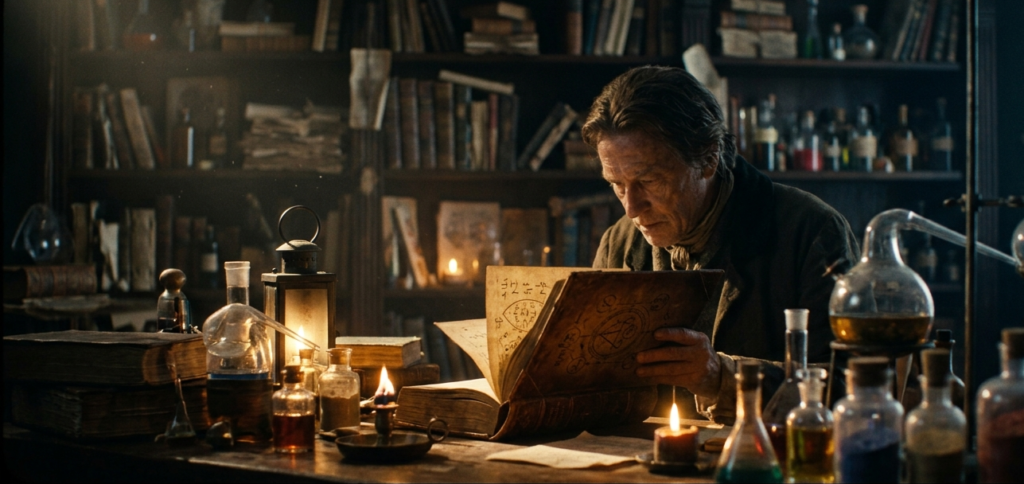
There is a moment, recognizable to almost anyone who has pushed themselves past a certain threshold of ambition, when the thing you most wanted begins to taste like ash. You achieved it, or you are close enough to touch it, and something in you has already moved on, already hungry for something else, something unnamed, something that keeps receding. Goethe spent sixty years writing about this feeling. Not as a symptom of pathology. As the fundamental condition of human consciousness.
Faust, completed in 1832 only weeks before Goethe’s death at eighty-two, is not a cautionary tale about pride. That reading is the comfortable one, the Sunday school version that lets the reader maintain a safe distance. The actual text is far more unsettling, because it refuses to condemn its protagonist. Faust does not fall. He transforms. And the instrument of that transformation is precisely the figure everyone in the story mistakes for the enemy.
Mephistopheles arrives with a wager, and the reader conditioned by centuries of Christian allegory immediately reaches for the familiar template: devil, damnation, sin. But Goethe was steeped in alchemical tradition, had read Paracelsus, had moved in circles where the Rosicrucian texts were not curiosities but living intellectual frameworks. What he constructed in Mephistopheles is something the allegorical reading simply cannot accommodate. He is not the adversary of the soul. He is its darkening. He is the nigredo made flesh and given wit.
The nigredo, in alchemical process, is the necessary first stage: the blackening, the dissolution, the moment when the base material must be broken down completely before any refinement is possible. Paracelsus, writing in the early sixteenth century, had already shifted the entire vocabulary of alchemy inward. The true laboratory, he insisted, is the human body. The true prima materia is not lead or mercury but the self in its unexamined state. Transformation cannot begin until the old form has been destroyed. There is no shortcut. There is no version of the work that skips the blackening.
This is what Faust agrees to when he signs. Not damnation in any theological sense, but the willingness to be unmade. Every comfort he has built, every certainty, every defense against the rawness of experience — Mephistopheles will strip it. The pact is not a transaction for power. It is a consent to dissolution. The terrifying thing about the bargain is not that Faust might lose his soul. It is that he already knows, at some level, that losing the self he currently is may be exactly the cost of becoming something more.
A man watches everything he loved either die or depart. He watches himself do harm he cannot undo. He watches the world refuse to match the enormous appetite he brought to it. And something in him does not break. It transmutes. This is not heroism in any conventional sense. It is alchemy. It is what happens when a person refuses the easier path of contracting back into safety, into smallness, into the management of expectations. The German Romantic tradition understood, as Jung would later articulate in his 1944 study Psychology and Alchemy, that the opus alchymicum was always a map of psychological individuation — the movement from an unconscious, undifferentiated state toward something integrated, singular, real.
But Goethe does not let the process resolve cleanly. He refuses the reader that satisfaction. Because the deepest truth of the alchemical model is that the work is never finished. The albedo follows the nigredo, the whitening follows the blackening, but then the process begins again at a new level. The self that has been transformed is not a final product. It is the new prima materia.
The Literary Tradition Between Darkness and Gold
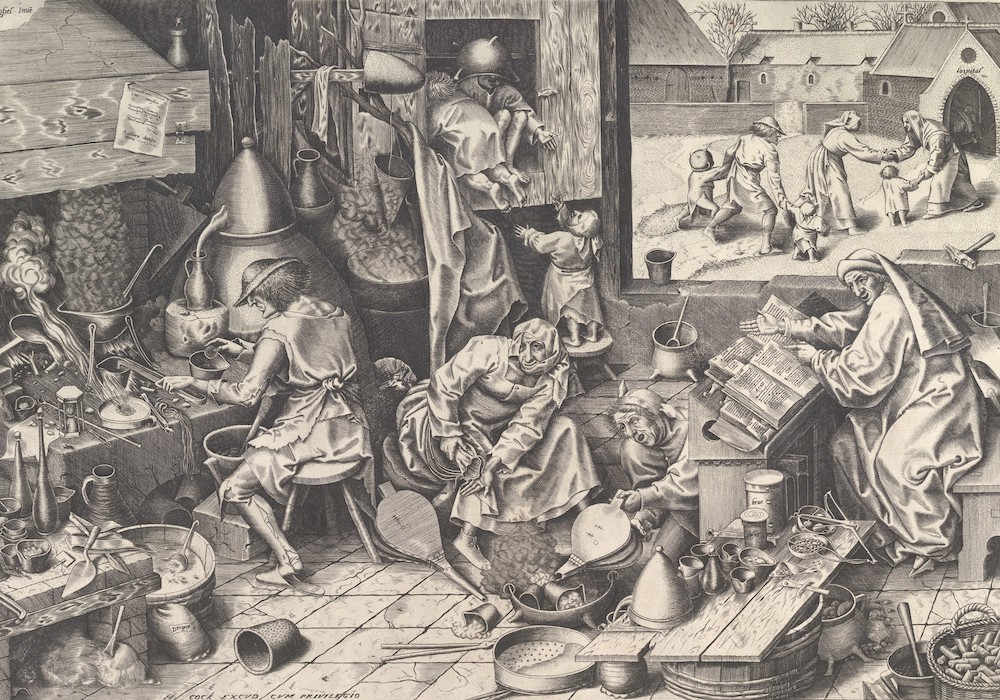
There is a particular kind of survival that happens only underground. Not preservation, not triumph — something more furtive and more stubborn, the way certain seeds require darkness and pressure before they can germinate at all. When the universities of the seventeenth century began consolidating what would become the scientific method, when Robert Boyle published his Sceptical Chymist in 1661 and drew the first serious institutional line between chemistry and its mystical ancestor, alchemical thought did not die. It disappeared into books. And disappearing into books, it became something harder to kill than it had ever been as a laboratory practice.
Ramon Llull had understood this three centuries earlier, almost by instinct. His Ars Magna, completed around 1305, was formally a logical machine, a system of combinatorial wheels meant to demonstrate Christian truth through reason alone — and yet the language threading through it was irreducibly alchemical, full of transmutation, of base matter seeking its highest form, of the soul as a substance undergoing perpetual refinement. Whether Llull himself practiced alchemy in any literal sense remains genuinely contested by historians, but what matters is that his method encoded the alchemical imagination into the structure of thought itself. The opus was no longer something you performed in a furnace. It was something you performed in a sentence.
By 1610, when a London playwright staged a comedy about two con men who exploit a gullible household by pretending to manufacture gold, the alchemical tradition had already accumulated enough cultural weight to sustain an entire satirical architecture. The comedy works — and it works devastatingly — because the audience recognizes the logic being mocked. The language of sulphur and mercury, of the philosopher’s stone and the red tincture, was not exotic to those people. It was the language of hope sold to the desperate, and every person in that theater had either been that desperate or known someone who had. The satire is merciless precisely because it loves what it destroys. Underneath the fraud and the spectacular collapse of the scheme, something genuine flickers — the idea that matter could be redeemed, that the lowest thing could become the highest, that transformation was not fantasy but latent fact. The playwright cannot quite let go of that, and neither can the audience.
The Rosicrucian manifestos published between 1614 and 1616 — the Fama Fraternitatis, the Confessio, the Chemical Wedding — arrived at exactly this moment of cultural ambivalence and exploited it with extraordinary sophistication. Frances Yates, in her landmark 1972 study The Rosicrucian Enlightenment, traced how these documents circulated through over a thousand manuscript copies before any printed edition existed, spreading through the same networks of scholars, courtiers, and religious dissenters who were simultaneously reading Paracelsus and debating Copernicus. The manifestos were literary constructions, not laboratory manuals. The Chemical Wedding in particular — attributed to Johann Valentin Andreae, though he later disavowed it as a youthful game — is a full narrative, a journey, a hero moving through chambers of symbolic ordeal toward something that is never quite named. Jung spent years with that text. He saw in its symbolic grammar the same architecture he had mapped in his patients’ dreams: the descent, the confrontation, the union of opposites, the emergence of something that had not existed before.
What these writers grasped, each in their own way, was the thing that laboratory alchemists could never quite articulate: that the opus magnum was always a story about the person attempting it. The gold was real only insofar as the transformation was real. And transformation, as a concept, has never needed a crucible. It has always needed a narrative.
What We Are Still Trying to Turn Into Gold

There is a woman sitting in a therapist’s office in any city you can name, describing herself as someone “in the process of becoming.” She uses that phrase naturally, without irony, the way people say good morning. She has a journal. She tracks her habits. She speaks about her past self in the third person, with mild contempt, the way a metallurgist might describe impure ore. She is not unusual. She is, in fact, the representative human being of this particular historical moment, and what is striking is not her self-awareness but the absolute antiquity of her grammar.
The language of personal transformation — optimization, growth, breakthrough, becoming — is alchemical language with the sulfur washed off. The crucible has been rebranded as a wellness retreat. The prima materia is now called trauma. The philosopher’s stone is somewhere between a morning routine and a subscription to a meditation application. Mircea Eliade, writing in 1956, saw this coming with the quiet precision of someone who had spent decades studying how sacred operations migrate through history without ever truly disappearing. In The Forge and the Crucible, he argued that the alchemist’s fundamental ambition was not material but soteriological — a project of salvation, of accelerating nature toward its own perfection, of doing violently and deliberately what time does slowly and indifferently. What changes across centuries is not the dream but the vessel in which it is poured.
Marie-Louise von Franz, working in the tradition Jung opened, pushed this further into the psychological interior. She understood the alchemical opus as a map of the unconscious process that happens to people whether they consent to it or not — the nigredo of depression, the albedo of sudden clarity, the rubedo of something she was careful never to romanticize. Her readings of texts like the Rosarium Philosophorum revealed not a primitive science but a precise phenomenology of inner states, a language developed by people who needed to say things that had no other available vocabulary. The danger she identified was not that people engage in transformation but that they confuse the symbol with the substance, that they perform the stages without entering them, that they collect the vocabulary of change as a substitute for the thing itself.
This is the trap that Dante knew and encoded. This is what Goethe's Faust discovers at a cost that cannot be negotiated away. The alchemical tradition in literature is not a celebration of transformation — it is, read carefully, a sustained examination of what it costs and what it does to a person to believe that the self is raw material. Because once you accept that premise, the work is never finished. There is always a further refinement, a purer state, a more complete becoming. The gold keeps receding. And the one doing the transmuting begins to suspect, in their worst moments, that what is being burned away in the crucible is not the impurity but the self itself, the irreducible, unimprovable, unoptimizable fact of a particular human life.
Eliade’s insight cuts deepest here: the smith, the alchemist, the modern self-optimizer all share the belief that they are collaborating with a cosmic process, hastening what would otherwise take geological time. But this belief requires a constant enemy, a substance that is not yet gold, and that substance is always, in the end, the present moment — the self as it actually exists, unimproved, unfinished, stubbornly alive. The literature from Dante to Goethe did not resolve this. It held it open, let it burn at the center of the page, and trusted the reader to stand close enough to feel the heat without pretending it was merely decorative light.
A vision curated by a filmmaker, not an algorithm
In this video I explain our vision
⚗️ The Hidden Fire: Alchemy, Spirit & the Western Imagination
From Dante’s infernal transmutations to Goethe's Faust seeking the secret of all matter, alchemy has never been merely a proto-chemistry — it is a symbolic language woven into the DNA of Western literature and thought. These related articles trace the living roots of that tradition, from its foundational texts to the visionary figures who carried the flame across centuries.
What Is Alchemy: History and Origins
Before alchemy could inspire poets and mystics, it had to exist as a coherent body of practice and belief. This article traces the origins of alchemical thought from Hellenistic Egypt through the Arab world and into medieval Europe, laying the essential groundwork for understanding why Dante and Goethe were so captivated by its imagery. Without knowing what alchemy truly was, the literary echoes it left behind remain half-heard.
GO TO THE SELECTION: What Is Alchemy: History and Origins
Tabula Smaragdina: Text Meaning and Interpretation
The Emerald Tablet — Tabula Smaragdina — is arguably the most quoted and least understood text in all of Western esotericism, condensing an entire cosmology into a handful of cryptic lines. Its famous axiom ‘as above, so below’ became a structural principle not just for alchemists but for poets seeking correspondences between the human soul and the cosmos. Goethe himself drew on this Hermetic vision when constructing the symbolic architecture of Faust.
GO TO THE SELECTION: Tabula Smaragdina: Text Meaning and Interpretation
Paracelsus: Life and Alchemical Thought
Paracelsus stands as one of the most radical thinkers to bridge alchemical science and spiritual philosophy in the Renaissance, influencing generations of writers and natural philosophers who came after him. His insistence that the human being is a microcosm of the universe — a living alembic in which spirit and matter are perpetually transmuted — echoes directly through the literature of the early modern period. Understanding Paracelsus is essential to reading the alchemical subtext in works stretching from Renaissance drama to Romantic poetry.
GO TO THE SELECTION: Paracelsus: Life and Alchemical Thought
Rudolf Steiner and Anthroposophy: A Guide to Modern Esoteric Thought
Rudolf Steiner built an entire spiritual science — Anthroposophy — that owes a profound, if often unacknowledged, debt to the alchemical tradition that runs through Goethe, whose scientific and poetic work Steiner spent years studying and editing. Steiner saw Goethe not merely as a poet but as a genuine initiate, someone who had grasped the living, transformative processes of nature in a way that alchemists had long sought to articulate. Exploring Anthroposophy therefore offers a remarkable lens through which to re-read Goethe’s alchemical imagery with new depth and precision.
GO TO THE SELECTION: Rudolf Steiner and Anthroposophy: A Guide to Modern Esoteric Thought
Discover the Cinema of Inner Transformation on Indiecinema
If these hidden threads of alchemy, literature and esoteric thought have sparked something in you, Indiecinema streaming is the place to follow that fire further. Our curated catalog of independent and art-house films explores the same territories — transformation, symbol, and the quest for hidden meaning — through the unique language of cinema. Join us and let the screen become your alembic.
👉 EXPLORE THE CATALOG: Watch Indie Films in Streaming
A vision curated by a filmmaker, not an algorithm
In this video I explain our vision

