
The Smell Before the Revolution
You step off the subway at Canal Street sometime in 1981 and the first thing that reaches you is not a sight but a smell — something between wet concrete, diesel, and a sweetness that shouldn’t be there, organic and slightly wrong, the kind of smell that cities produce when their systems are quietly failing. The platform lights flicker in a rhythm that suggests not malfunction but exhaustion, as if the infrastructure itself has simply grown tired of pretending. You climb the stairs into a street that looks like it was designed by someone who gave up halfway through, and what you find is not poverty exactly, not danger exactly, but something harder to name — a kind of radical openness, a city-sized wound that has stopped hurting and started breathing.

Lower Manhattan in the early 1980s was not a metaphor. It was a material condition, precise and measurable. New York City had nearly gone bankrupt in 1975, and the aftershocks were still visible in every block south of Houston — in the buildings with no glass in the windows, in the lots that had been empty so long they had developed their own ecosystems, in the walls that belonged to no one and therefore to everyone. The city had shed approximately 820,000 jobs between 1969 and 1977. Whole neighborhoods had been functionally abandoned by capital, by municipal services, by the social contract that usually makes urban life legible. What remained was space. Enormous, cheap, ungoverned, morally uncharged space.
This is the paradox that comfortable histories of creativity almost always suppress: the conditions that produce radical art are rarely the conditions of comfort or patronage. They are the conditions of neglect. Georges Bataille understood something close to this when he wrote about expenditure, about the creative energy that accumulates precisely where the productive economy has withdrawn — where nothing is being optimized, where no return is expected. The SoHo lofts that artists had colonized through the 1970s were cheap because manufacturers had fled. The abandoned piers along the West Side waterfront became spaces of extraordinary social and artistic invention because no civic authority cared enough to police them. CBGB opened in 1973 partly because the Bowery was the last place in Manhattan where a bar could survive on almost no revenue, because its neighbors were missions and flophouses and people who had nowhere else to be. Ruin was not the backdrop to the culture. Ruin was the architecture of it.
A man is painting in a warehouse somewhere between Tribeca and nowhere, working on a canvas that is also the wall, that is also the building, that is also the city, and outside someone is tagging a subway car that will carry that tag through every borough by morning, turning the entire transit system into an involuntary gallery. These were not separate phenomena. They belonged to the same metabolic process, the same way that a city digests its own failure and occasionally produces, in that digestion, something extraordinary and unrepeatable.
Walter Benjamin wrote in his 1936 essay “The Work of Art in the Age of Mechanical Reproduction” about the aura of the original, the singular object in its singular place. What he could not have anticipated is how a broken city could generate precisely that aura across its entire surface — how every wall, every platform, every derelict doorway could become charged with the singularity of a moment that everyone present knew, without being told, would not last. The knowing that it would not last was part of the condition. The temporariness was not a limitation. It was the pressure that produced the form.
Because collapse does not simply destroy. Sometimes it clears. It removes the weight of expectation, the tax of respectability, the long slow rent of maintaining appearances. And in that clearing, before the next wave of capital arrives to redeem and price and rename everything, something gets made that could only have been made exactly there, exactly then, in the brief window between one world ending and another not yet begun.
Don Barry: A Quixotic Exploration

Docufiction, Experimental, by Paul Smart, Mexico, 2026.
Don Barry: A Quixotic Exploration is a debut feature that places the biography of an eighty-year-old experimental filmmaker and artist, Barry Gerson, within the metanarrative of Miguel de Cervantes’ Don Quixote. Don Barry was filmed in the city of Guanajuato during the 51st edition of the Cervantino Festival, as well as during the vibrant Day of the Dead celebrations held in the city’s UNESCO-listed tunnels. The film honors the director’s long friendship with artist Barry Gerson, drawing inspiration from Cervantes’ Don Quixote. Paul Smart’s directorial choices create something new that celebrates life and goes beyond conventional storytelling. A search for magic in our real lives. A moving film about the meaning of life, art, and death. Not to be missed.
Paul Smart is a proud outsider filmmaker with a long history of film screenings. In the 1980s, he emerged in New York’s vibrant youth art scene, working in theater production and later filmmaking, before retreating to rural upstate New York, in the Catskill Mountains, where he made a living writing and screening independent films in old parish halls for rural audiences, many of whom had never seen a film.
LANGUAGE: English
SUBTITLES: Spanish, French, German, Portuguese
What Gets Made When There Is Nothing Left to Lose
You find the apartment because the landlord stopped caring years ago. The lock has been broken since before you moved in, the heat comes and goes like a rumor, and the walls carry the water stains of previous winters like rings inside a tree. You live there because you can afford to, which is to say you live there because the city has already decided this block doesn’t exist. And in that decision, something unexpected happens. The pressure releases. The obligation to perform normalcy, to maintain the fiction that you are building toward something recognizable, dissolves along with the plaster.
This is not a metaphor. In 1975, New York City came within days of defaulting on its debt, a fiscal crisis so complete that President Ford’s refusal to authorize a federal bailout produced one of the most honest newspaper headlines in American history. The city laid off forty thousand municipal workers, closed firehouses, gutted the sanitation department, and effectively withdrew from entire neighborhoods. The South Bronx lost more than two hundred thousand residents between 1970 and 1980. What remained was burned — sometimes by desperate landlords collecting insurance, sometimes by residents heating their homes, sometimes by no one anyone could ever identify. Forty percent of the housing stock in some Bronx neighborhoods simply ceased to exist. You could stand in the rubble and see the sky in four directions.
What happens in that rubble is not what the city planners expected, because they weren’t expecting anything. They had already written the accounting.
Dick Hebdige understood something in 1979 that most cultural institutions would spend the following decade refusing to admit. In Subculture: The Meaning of Style, he argued that marginalized communities do not simply absorb deprivation. They transform it. They take the materials available to them — discarded, broken, ignored — and assemble from those materials a symbolic language that both expresses their position and refuses the terms under which that position was assigned. The style is never merely aesthetic. It is a form of speech addressed to a culture that pretends not to hear you. The subcultural object, Hebdige wrote, is always a kind of interference, a noise introduced into the signal of dominant meaning.
The noise coming out of New York in the late 1970s and early 1980s was extraordinary in its volume and its precision. A young man in the Bronx takes two turntables and a collection of records that cost almost nothing at the Hunts Point flea market, and from that material produces a new architecture of time itself. The break — that isolated percussion moment, stretched and repeated — was not discovered so much as freed from the song that had always contained it. Someone walked into a building that used to be a factory on the far west side of Manhattan, where the city had stopped maintaining the streets and the meatpacking left a particular smell in winter, and painted something on the wall that had no buyer and no gallery context and no frame. The painting was addressed to whoever walked past. It was addressed to no one. It was addressed, most honestly, to the future, with no particular confidence that the future was listening.
There is a figure who appears in this period again and again, not a single person but a recurring type: the artist who arrived in New York with so little that the city’s collapse registered not as catastrophe but as opportunity. The rent in Tribeca in 1977 was negligible. The lofts in the Lower East Side that had been commercial spaces since the Civil War era were suddenly available for almost nothing. Jean Baudrillard, visiting America in 1986 and writing what would become his fractured, maddening travelogue, noted that the American city contained within its ruins something that European cities had lost — a radical presentness, a refusal of historical continuity that looked, from outside, like devastation, but functioned, from inside, like permission.
Permission to begin without precedent. Permission to fail without record. Permission to make something no one had asked for, in a space no one was watching.

Noise as a Language, Chaos as Grammar
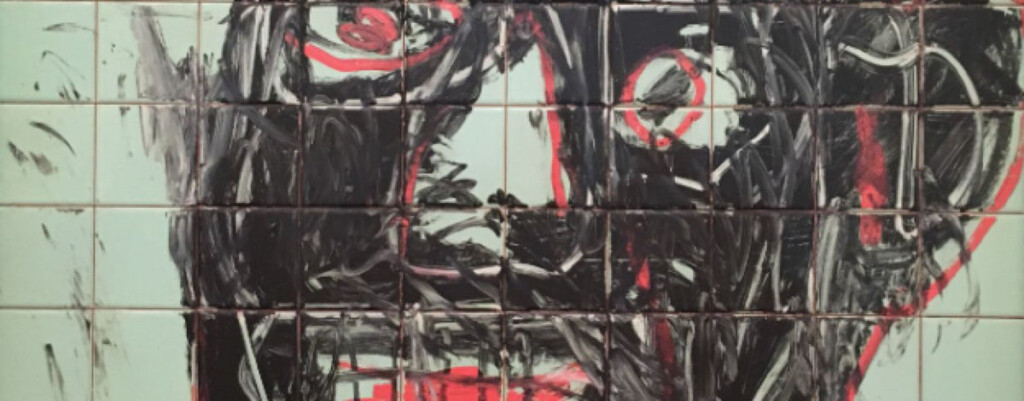
You are walking through a gallery in SoHo sometime around 1981, and the painting in front of you looks, at first, like an accident. Bones and crowns and half-erased words layered over what might be a figure or might be a wall or might be both. Your instinct — the one culture trained into you — is to decide whether it is finished. Whether someone knew what they were doing. That instinct is the trap. The work is not asking for your verdict. It is refusing to submit to the court that would issue one.
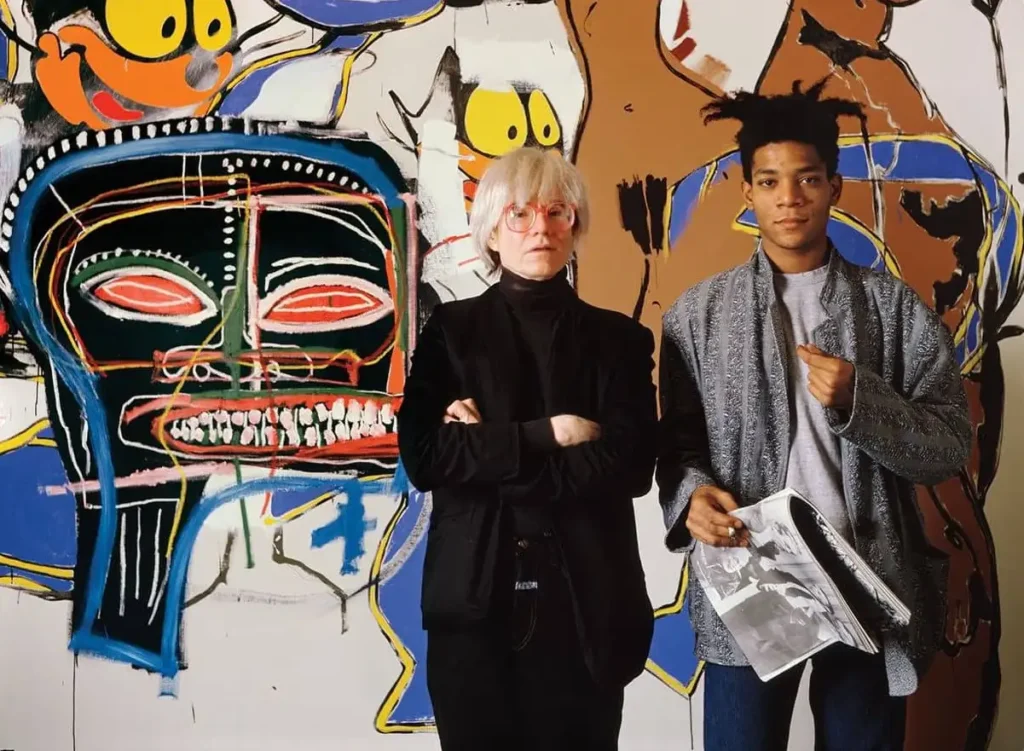
The refusal was not accidental. It was architectural. Jean-Michel Basquiat had spent years writing SAMO© across the Lower East Side, those cryptic dispatches in marker on walls and doorways, and the intelligence behind those tags was not raw or primitive — it was surgical. When the work moved indoors, onto canvas and board and door and whatever surface absorbed the gesture, the illegibility came with it deliberately. Basquiat understood, before he could have theorized it in those terms, what Roland Barthes had argued in 1968: that the death of the author is simultaneously the birth of the reader, and that the reader trained by commodity culture will always try to reduce meaning to a single, consumable message. The crowns and the crossed-out words and the anatomical diagrams were not symbols waiting to be decoded. They were a permanent short-circuit of that decoding impulse.
The same logic ran through the music coming out of the clubs and lofts in those years. A woman picks up a saxophone she has never played and walks onto a stage at CBGB and produces something that no one in the room can categorize. The sound is wrong by every measure of musicianship, and that wrongness is the entire point. No-wave was not incompetence performing as art. It was a formal argument made through sound — the argument that competence itself had become a mechanism of capture. To play well was to play legibly, and to play legibly was to enter the market of meaning, to offer yourself as a product to be evaluated, distributed, and finally neutralized. Lydia Lunch, James Chance, DNA — these were not people who could not play. Several of them had considerable conventional training. What they were doing was closer to what Theodor Adorno described in his 1949 Philosophy of New Music as the logic of dissonance pushed to its limit: the moment when the musical language refuses its own resolution and in refusing it, exposes the violence of every resolution that came before.
There is a scene in which a man sits in a recording studio and is told that what he has just made cannot be released because it does not sound like anything that exists. He takes this as the confirmation he was waiting for. This is the exact coordinates of the underground in that moment — the negative space of commercial viability as the only honest place to work.
The visual and the sonic were not parallel movements politely ignoring each other. They were the same argument in different materials. When Basquiat and Jean-Michel’s collaborators tore through surfaces, they were doing acoustically what the no-wave bands were doing sonically — refusing the smooth finish that signals readiness for consumption. Greil Marcus, writing in Lipstick Traces in 1989, traced this refusal back through the Situationists, through dada, through any moment in Western culture when a group of people decided that the grammar of legibility was not a neutral tool but a political instrument used to determine whose expression counts as expression at all.
What mainstream culture called ugliness was a diagnostic. What it called incompetence was a precisely calibrated withdrawal. The question the work was asking — and never answering, because answering would have been surrender — was whether you could hear the difference between something broken and something that has chosen not to be whole.
The Body as the Last Territory
There is a moment when you realize the room has fewer people in it than it did six months ago. Not dramatically fewer. Just one chair empty at the table. One voice missing from the argument that used to run until three in the morning. You notice it the way you notice a tooth gone — with your tongue, in the dark, before you’ve decided whether to grieve.
By 1981, that tongue-in-the-dark recognition was spreading through downtown Manhattan like something that had no name yet, because for a long time it genuinely didn’t. The CDC’s first clinical report appeared in June of that year, five cases of pneumonia in young men in Los Angeles, a footnote that would become a generation’s obituary. By 1983, the lofts of SoHo and the bars of the West Village and the performance spaces of the East Village were learning a new grammar of absence. Artists who had built their entire practice around the body — who had used flesh as material, as text, as political declaration — were now watching bodies fail in ways that felt almost like punishment for exactly that.
Susan Sontag had already argued, in her 1978 work “Illness as Metaphor,” that diseases acquire the moral weight a society needs them to carry. Cancer, she showed, had become synonymous with a repressed interior life, a failure of emotional honesty. The metaphor was never innocent. It was always a verdict. When she returned to the subject a decade later in “AIDS and Its Metaphors,” published in 1989, she had to confront something even more grotesque: a disease being used as retroactive proof that certain lives deserved extinction. The metaphor had become a weapon of judicial precision. Behavior caused it. Deviance invited it. The body’s collapse was legible as moral sentence, and mainstream America read that sentence with something disturbingly close to satisfaction.
What the underground did in response was not consolation. It was war conducted in aesthetics. A man moves through a hospital corridor carrying two cups of coffee, one for himself, one for someone who will not finish it. He does this with the specificity of someone who has learned that small gestures are the only ones that remain honest. The corridors in this period are long and fluorescent and brutally democratic — everyone equally stripped of the armor that identity usually provides. A woman holds a vigil in an empty lot in the Meatpacking District, not because it is symbolic, but because there is nowhere else to hold it, because the churches and the institutions and the official structures of mourning had made their position clear. She holds it anyway. She holds it furiously.
Fury and elegy had always been separate registers in art. The 1980s AIDS crisis fused them into a single impossible frequency. Jean-Michel Basquiat, who would be dead by 1988 at twenty-seven, had spent years painting bodies marked by systems of power — skulls, anatomical diagrams, figures with exposed musculature that looked simultaneously like medical illustration and like accusation. The body as evidence. Keith Haring was designing his visual language around figures in motion, bodies multiplied and interlocked, a cartography of connection that was already becoming, by the mid-decade, a cartography of loss. His own diagnosis came in 1988. He died in 1990.
The philosopher Giorgio Agamben would later describe “bare life” — the body reduced to its biological minimum, stripped of political identity, existing purely as something that can be killed. The AIDS crisis produced exactly this condition for thousands of people, and the artists who survived, or who were themselves dying, made work that refused that reduction furiously and specifically. They named the bodies. They insisted on the particularity of loss. They understood, in the way that Sontag had understood, that to accept the metaphor was to accept the verdict, and they had not yet decided to accept anything.
Who Gets to Name the Rebellion
There is a specific moment when the danger leaves a room. Not when the music stops or the argument ends, but when someone with the right credentials walks in and says: yes, this is interesting. That sentence — so apparently generous, so apparently open — is the first act of annexation.
By 1982, something was happening in the galleries along West Broadway that would have been unrecognizable to the kids who had spent years writing on subway cars at three in the morning, risking arrest, risking worse, to put their names somewhere permanent on a city that treated them as invisible. The work was suddenly hanging in climate-controlled rooms, lit from above, priced in four figures. The same gesture that a transit authority officer would have photographed as evidence of criminal damage was now described in press releases as raw energy, as urban expressionism, as the authentic voice of the street. The authenticity was, of course, the product being sold.
Thomas Frank, in The Conquest of Cool published in 1997, made the argument with surgical precision: counterculture does not defeat the market. The market watches counterculture the way a patient investor watches a volatile asset — willing to wait, willing to absorb the losses of the early period, certain that the moment of conversion will come. Frank traced this mechanism through the advertising industry of the 1960s, showing how rebellion was not co-opted reluctantly but actively courted, how hip became the primary language of commerce precisely because it appeared to stand outside commerce. What he described was not betrayal. It was the system functioning as designed.
The linguistic operation that happened to graffiti in those years was a masterpiece of that design. The word graffiti itself was quietly retired in serious critical discourse, replaced by neo-expressionism — a term that arrived trailing European legitimacy, references to Basquiat and Haring placed carefully alongside Kiefer and Baselitz in the same critical sentence, the same auction catalogue. The gesture looked like elevation. It was actually translation into a language the market already knew how to price. Once a thing has a category, it has a value. Once it has a value, it has an owner.
The same operation ran through punk’s transformation into new wave. The sonic violence, the deliberate ugliness, the refusal of virtuosity — all of that was the content of the resistance. New wave kept the tempo and discarded the refusal. It kept the haircut and removed the rage. The aesthetic survived the politics like a house after a fire: the walls still standing, everything inside gone. And the music industry, which had initially treated punk as an embarrassing contagion, discovered that new wave moved units in ways that justified the rebrand entirely.
What is most precise in Frank’s analysis is the observation that this process requires the active participation of the artists themselves, or at least their silence in the face of it. The young man who spent years in the subway tunnels and then watched his tag reproduced on a canvas in SoHo was not always unhappy about the transition. Visibility is seductive, especially to someone the city had spent decades refusing to see. The art world offered recognition, and recognition is not nothing. It is, in fact, almost everything to someone who has been systematically told they do not exist.
But recognition extended by an institution is always conditional recognition. It arrives with a frame, and the frame determines what the work means, who it speaks to, who owns its meaning. The name they gave the rebellion was not the rebellion’s name. It was the market’s name for something the market had decided it could use. And once something has been named by power, the original speakers find themselves in the strange position of having to argue for the meaning of their own language — in a room where the acoustics have already been arranged against them.
A vision curated by a filmmaker, not an algorithm
In this video I explain our vision
The Camera as a Wound
The camera shakes because the hand holding it is shaking. That is the first thing you notice when you watch the footage — not the image, but the trembling behind it. Someone is walking through a crowd in a basement somewhere below Houston Street, the light is wrong, the sound is a wall of distortion, and the person holding the camera is not trying to make art. They are trying to prove that this moment existed. There is a difference, and it is the difference between everything.
By 1981, Super 8 film and then consumer-grade video had become the nervous system of a culture that understood, with the particular clarity that comes from being ignored, that no one else was going to document it. The institutional channels — the broadcasters, the film studios, the cultural foundations — had their own ideas about what New York looked like, and those ideas did not include the backrooms, the squats, the hospital corridors filling with men whose illness had no name yet in the mainstream press. So the underground took up the camera the way a drowning person takes up a piece of wood. Not elegantly. Desperately.
What circulated on VHS tapes passed hand to hand was not a film movement in any academic sense. It was a counter-archive. Walter Benjamin, in his 1936 essay “The Work of Art in the Age of Mechanical Reproduction,” argued that technological reproduction destroys the aura of the unique object — but he could not have anticipated what happens when the reproducible image is the only image, when the copy is the only evidence that something real occurred. The tapes were duplicated until they degraded, the image dissolving into noise, and even the noise felt like testimony. Even the static said: we were here.
You see a young man in a bedroom, the camera handheld, the framing accidental, and he is speaking directly into the lens about what it feels like to watch a neighborhood disappear person by person. He is not performing. He is depositing something. The distinction that Susan Sontag drew in “Regarding the Pain of Others” — between the image that aestheticizes suffering and the image that witnesses it — collapses entirely in this footage, because there is no aesthetic apparatus available to aestheticize anything. There is only the fact of the face, the fact of the room, the fact of the light coming through a window onto skin that is visibly changing.
The public access channels were another circuit entirely, stranger and more democratic than anything the art world could have designed deliberately. Manhattan Cable’s public access programming in the early 1980s broadcast things that commercial television would not touch — performances, manifestos, interviews conducted in apartments, footage of demonstrations. The audience was small and geographically limited, but the act of broadcast mattered beyond the numbers. To transmit was to insist on visibility. Michel Foucault’s later lectures on “parrhesia” — the ancient Greek concept of speaking truth at personal risk, elaborated in his 1983-84 lectures at the Collège de France — describe exactly the ethical posture of these filmmakers, though they would never have used the word. They were speaking into an apparatus that might not listen, toward a future they were not certain they would inhabit.
The emergency room appears in more than one tape. The fluorescent light, the waiting, the face of someone who has just received information that reorganizes every fact of their life. The camera keeps running because stopping would feel like abandonment. This is the logic of the underground visual record at its most raw: the camera as a refusal to look away, which is also a refusal to allow the culture at large the comfort of not knowing.
The footage is unstable. The colors shift. Faces blur into motion. And yet the instability itself carries information — it tells you something about the conditions under which this history had to be made.
What the City Was Actually Teaching
The city was not a backdrop. You have to understand this first, before anything else makes sense. The city was the argument itself, the primary text, and the people living inside its collapse were not victims of something they failed to understand — they were reading it more accurately than any economist, any urban planner, any academic who would later arrive to theorize what had already been survived.
David Harvey, writing in 1989 in “The Condition of Postmodernity,” described spatial restructuring not as a neutral economic process but as a form of violence that dismantles the connective tissue of communities while simultaneously generating, in the rubble, an extraordinary density of aesthetic raw material. He was writing about capital’s logic. But he was also, without knowing it entirely, describing the South Bronx in 1977, describing the Lower East Side in 1982, describing every burned-out block and flooded basement and shuttered factory that became, almost immediately, a rehearsal space, a gallery, a place where someone painted something enormous on a wall that was only standing because no one had bothered to demolish it yet.
Harvey’s argument is precise and brutal: when capital withdraws from a space, it does not leave nothing. It leaves a particular kind of wreckage, and that wreckage has a specific shape — the shape of what was optimized away. What gets abandoned first is always what produced the least return. Which means what gets abandoned first is always people. And when you abandon people inside a geography they cannot easily leave, what you produce is not despair alone. You produce a forced intimacy, a compression of experience, a situation in which the distance that normally keeps people from truly seeing each other is simply gone.
There was a man who had stopped sleeping, who walked the same six blocks every night for months, who understood by the third month that he was not sleepless but awake to something the daylight hours kept covered. What he was seeing was the infrastructure of indifference — the specific, measurable, policy-authored decision to let certain bodies occupy certain spaces without heat, without garbage collection, without any institutional acknowledgment that they constituted a public worth serving. This was not metaphor. Between 1970 and 1980, New York City lost more than 800,000 residents and the municipal workforce shrank by roughly 65,000 positions. The cuts were surgical in their targeting and random in their human consequences, which is the precise combination that produces the deepest psychic damage — when you can see the system’s logic but not predict its next move.
What the underground was doing, then, was not escaping this. It was metabolizing it. The graffiti writers who developed an entire visual language inside the transit system were not decorating a city — they were asserting the existence of a self inside a structure designed to make that self invisible. The musicians who built new sonic architectures out of found equipment and stolen electricity were not making art despite their conditions. They were making art that could only have been made from inside those conditions, art whose formal properties were directly determined by scarcity, by improvisation forced rather than chosen, by the knowledge that nothing was guaranteed past the next week.
Michel Foucault argued that power is most visible not in its monuments but in the arrangements it makes for those it excludes. The underground was, among other things, a community that had developed an almost clinical literacy in exactly this — in reading the arrangements, in naming the exclusions, in refusing to let the city’s official self-presentation go uncontested. This was not romanticism. This was diagnosis. The aesthetic was the instrument of analysis, and the analysis was conducted by people who had no choice but to be precise because imprecision, in their circumstances, carried a cost that abstraction never does.
The Thing That Survived and the Thing That Was Lost
What survived fits in a frame. You can buy it at auction, stream it, hang it on a wall in a building where the monthly rent exceeds what an entire floor of artists once paid for a year. The photographs are museum-quality now. The records have been remastered. The names that were spray-painted on the sides of trains have been stenciled onto gallery walls in careful retrospective exhibitions with catered openings and educational programming for schoolchildren. The preservation was total and the preservation was a lie, because what was preserved was never the thing itself. It was the residue. The shed skin. The artifact without the animal.
What made that world possible was not talent. Talent is never scarce. What made it possible was the specific material condition of a city in managed decline, a city that had essentially stopped caring whether you lived or died in certain zip codes, and that indifference — that terrifying, generative indifference — created a vacuum that people filled with everything they had. Walter Benjamin understood something close to this when he wrote about the relationship between destruction and creativity, about how the angel of history sees the wreckage piling at its feet not as catastrophe but as the only real condition under which certain things come into being. The cheap rent was not incidental to the art. The cheap rent was structural. The fear of violence walking home at 3 a.m. was not atmosphere. It was the pressure inside the sealed container that made everything combust.
You cannot recreate that. You can fetishize it, which is what the culture industry has done with extraordinary efficiency. The documented decade has been converted into content, into nostalgia, into a brand identity for neighborhoods that displaced the very people who built their mythology. Sharon Zukin wrote about this process with sociological precision in her 1982 work on loft living in lower Manhattan, tracing exactly how the cultural capital generated by artists was converted, almost immediately, into real estate capital that expelled them. The cycle took less than a generation. By the time the retrospectives began, the subjects were already gone.
What was irretrievable was the anonymity. Not the romantic anonymity of the misunderstood genius, but the practical anonymity of people who were unknown because no infrastructure existed to make them known, and who therefore had no audience to betray, no brand to protect, no future reputation to hedge against. You make different work when failure is invisible. You make different work when there is no platform on which to perform your making. The condition of no stakes, paradoxically, produced the highest stakes anyone in that world ever felt, because what they were risking was not career capital but actual physical and economic survival. The work was made in the same building where the heat sometimes didn’t work, in the same neighborhood where people disappeared, in the same city that was losing hundreds of thousands of residents and couldn’t manage its own debt.
Memory, in this context, becomes something uncomfortable to examine. To remember that decade with reverence is also to use it as an alibi, to position yourself as the inheritor of a tradition without acknowledging that you benefit directly from the conditions that destroyed it. The galleries that now show work in the neighborhoods those artists inhabited are not continuations of that culture. They are its monuments, which is another way of saying its tombs. And the people who visit them, who feel something genuine and generative standing in front of what was made in fear and freedom and absolute material precarity, are feeling something real about art and something false about history.
The honest question, the one that doesn’t resolve into tribute or critique, is what you would have done with that much freedom and that much fear pressing against each other in the same cold room, with no one watching and nothing guaranteed and the whole city burning quietly around you.
🌆 Underground Currents: Art, Rebellion & the City
The New York underground of the 1980s was a crucible of raw creativity, where artists, musicians, and filmmakers forged a culture of radical resistance against mainstream society. To understand its spirit, one must trace the broader currents of counterculture, avant-garde aesthetics, and the restless questioning of established norms that defined an entire generation.
Masterpieces of Rebellion and Counterculture Cinema
The cinema of rebellion has always been the shadow twin of underground cultural movements, and the 1980s New York scene was no exception. Films born from defiance and marginal perspectives captured the gritty poetry of streets, subways, and lofts that defined the era. This collection of masterpieces offers an essential visual archive of what it meant to push against the grain.
GO TO THE SELECTION: Masterpieces of Rebellion and Counterculture Cinema
The Avant-Garde Cinema: Movies to Watch
The avant-garde cinema that flourished alongside New York’s underground art world was not merely experimental—it was a declaration of independence from Hollywood and from conventional storytelling. Filmmakers in downtown Manhattan were breaking narrative form just as Jean-Michel Basquiat was breaking the boundaries of the canvas. This guide traces the cinematic lineage that gave the underground its flickering, irreverent light.
GO TO THE SELECTION: The Avant-Garde Cinema: Movies to Watch
Mass Social Homologation Today
The 1980s New York underground emerged precisely as a counter-response to the rising tide of mass social homologation, consumer culture, and the sanitization of urban identity. Artists and subcultural communities used radical self-expression as a weapon against the flattening forces of conformity that were reshaping American society. Understanding this dynamic of resistance is essential to grasping the deeper meaning of the underground’s legacy.
GO TO THE SELECTION: Mass Social Homologation Today
Deep Movies that Make You Think
The art and culture of 1980s New York underground was never purely aesthetic—it was profoundly philosophical, asking hard questions about survival, identity, race, and what it means to live authentically in a crumbling city. Many of its key figures, from artists to filmmakers to musicians, were driven by a fierce intellectual urgency that still resonates today. These are films and ideas that demand you slow down and think deeply about the world they illuminate.
GO TO THE SELECTION: Deep Movies that Make You Think
Discover the Underground on Indiecinema
If the raw energy and visionary spirit of the New York underground moves you, Indiecinema is your gateway to a vast world of independent and avant-garde cinema that mainstream platforms will never show you. Stream films that challenge, provoke, and inspire—just as the underground always intended.
👉 EXPLORE THE CATALOG: Watch Indie Films in Streaming
A vision curated by a filmmaker, not an algorithm
In this video I explain our vision

