
The Altar You Never Questioned
You walk into the room and you already know what you will find before you see it. The smell reaches you first — copal smoke, the faint sweetness of marigolds cut at the stem, wax that has been burning since before you woke up. Then the colors: orange and yellow petals arranged in a path on the floor, leading toward a table covered in a cloth embroidered with flowers that took someone three months to finish. On the table there are photographs of people whose faces you know better from this annual ritual than from any living memory. There are candles in glass cylinders printed with the image of a saint whose name you could recite but whose history you have never once looked up. There is a ceramic figure that has been in the family longer than anyone can remember, squat and dark and pre-dating every living relative, sitting beside a crucifix without apparent contradiction. There is food arranged as offering — bread shaped like bones, a shot glass of mezcal, the deceased’s favorite cigarettes. You have stood in front of this altar every year of your life and you have never once asked what it is.

Not what it means in the sentimental sense. You know what it means to you. You know the grief and the warmth and the particular texture of collective memory that the ritual holds. What you have never asked is what it actually is — where it comes from, which hands built it across centuries, which violence and which tenderness fused these elements into something that now feels as natural as breathing. You accepted it the way you accept language: as the water you swim in, not as a construction with a history and a politics and a cost.
This is not a failure of intelligence. It is something more structural than that. The anthropologist Pierre Nora, writing in the 1980s about what he called lieux de mémoire — sites of memory — argued that when a community loses the living environment of memory, it begins to crystallize certain practices and objects into monuments to that lost continuity. The altar might be exactly this: not the survival of an ancient practice, but a monument to a rupture so profound that the rupture itself had to be made invisible. What looks like unbroken tradition is often the scar tissue of discontinuity.
Because what sits on that table is not one thing. The marigold — cempasúchil in Nahuatl, the flower of the dead in Aztec ritual, used to guide souls because its scent was believed to travel between worlds — was never planted by any Spanish friar. The copal resin burning in the clay vessel is pre-Hispanic offering smoke, the same that rose in Teotihuacan temples fifteen centuries before a single European ship crossed the Atlantic. But the crucifix is colonial, and the prayer that an elder might murmur over the altar is in Spanish, addressed to a God imported at gunpoint. The sugar skull is somewhere in between, its origins debated, its current form partly tourist artifact, partly genuine popular art, partly the product of a nineteenth-century nationalist invention of tradition. None of this cancels the other. All of it is there, simultaneously, in the same square foot of embroidered cloth.
The discomfort you might feel reading this is not the discovery that the tradition is impure. It is the recognition that you already knew, somewhere below articulation, that it was made of fragments. You just never had to look directly at the seam.
Don Barry: A Quixotic Exploration
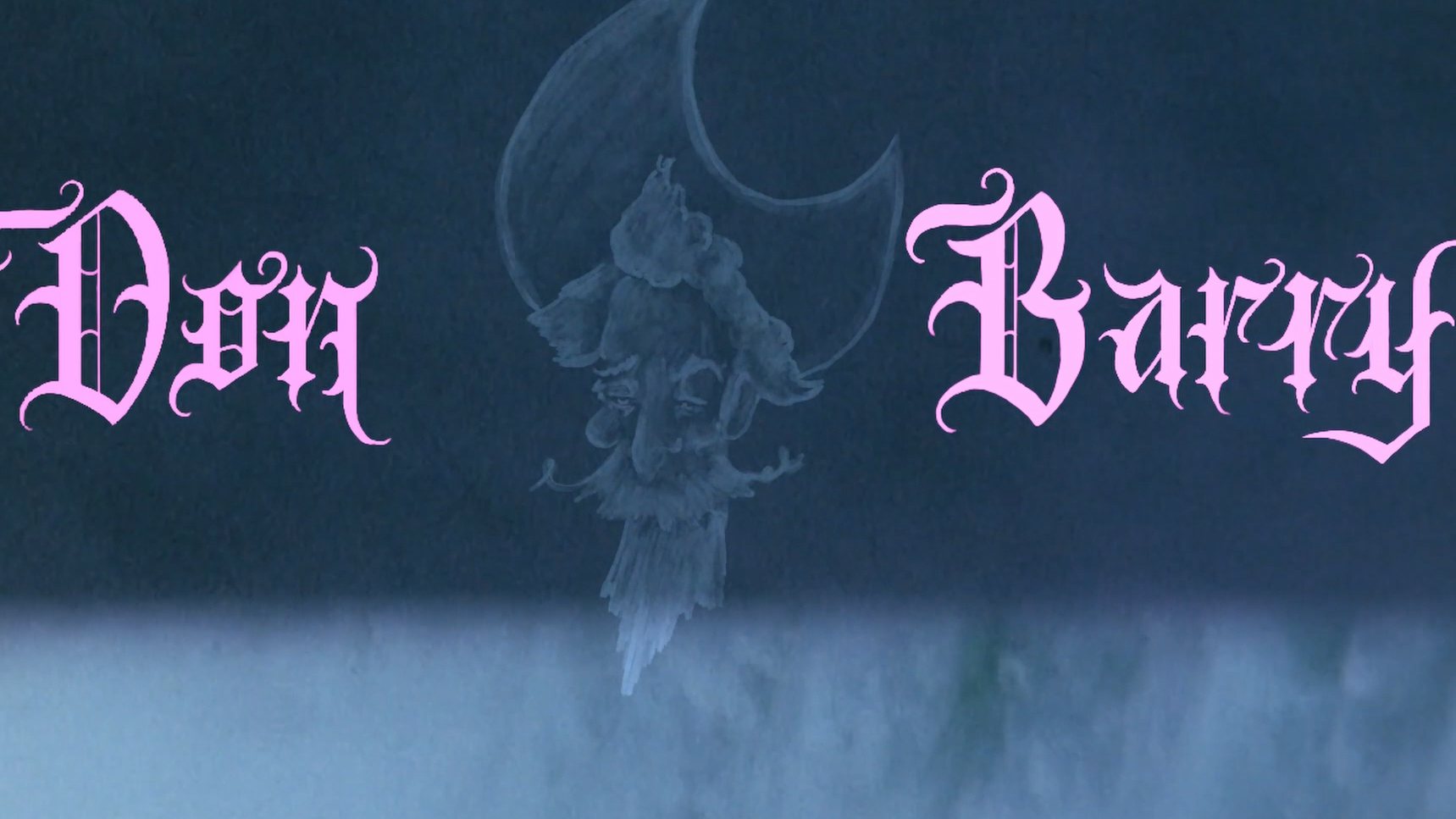
Docufiction, Experimental, by Paul Smart, Mexico, 2026.
Don Barry: A Quixotic Exploration is a debut feature that places the biography of an eighty-year-old experimental filmmaker and artist, Barry Gerson, within the metanarrative of Miguel de Cervantes’ Don Quixote. Don Barry was filmed in the city of Guanajuato during the 51st edition of the Cervantino Festival, as well as during the vibrant Day of the Dead celebrations held in the city’s UNESCO-listed tunnels. The film honors the director’s long friendship with artist Barry Gerson, drawing inspiration from Cervantes’ Don Quixote. Paul Smart’s directorial choices create something new that celebrates life and goes beyond conventional storytelling. A search for magic in our real lives. A moving film about the meaning of life, art, and death. Not to be missed.
Paul Smart is a proud outsider filmmaker with a long history of film screenings. In the 1980s, he emerged in New York’s vibrant youth art scene, working in theater production and later filmmaking, before retreating to rural upstate New York, in the Catskill Mountains, where he made a living writing and screening independent films in old parish halls for rural audiences, many of whom had never seen a film.
LANGUAGE: English
SUBTITLES: Spanish, French, German, Portuguese
The Violence That Made the Sacred
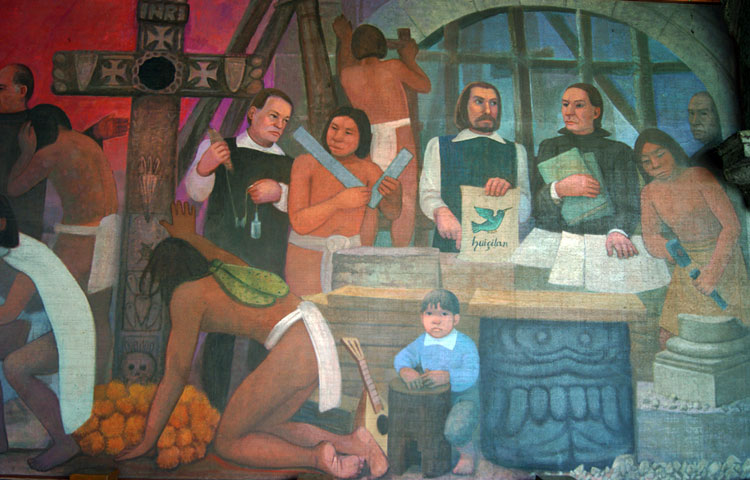
There is a moment, somewhere in the rubble of Tenochtitlan in the years just after 1521, that demands you sit with its full weight before moving on. The Spanish did not simply arrive and govern. They demolished. Systematically, methodically, with the particular zeal of people who believe they are doing God’s work, they tore down an estimated six hundred temples in the former Aztec capital alone — not to clear land for practical construction, but to erase a cosmos. Every stone removed was a theological statement. Every foundation exposed was a declaration that the sacred geography of an entire civilization had been nullified by decree.
And then, on top of those foundations, they built churches.
This is not metaphor. This is engineering. The Cathedral Metropolitana in Mexico City stands directly over the ceremonial center of Tenochtitlan. The stones of the Templo Mayor were not carted away — they were repurposed, pressed into new walls, new altars, new arches. The sacred was not destroyed so much as buried alive, forced to support the weight of what replaced it. Tzvetan Todorov, in his 1982 study of the conquest, argued that what the Spanish pursued was not merely military domination but a semiotic war — the systematic dismantling of indigenous sign systems, the violent substitution of one symbolic order for another. The goal was not conversion in any spiritually generous sense. It was the annihilation of meaning itself, followed by the installation of a replacement meaning that bore the conqueror’s signature.
Forced baptisms proceeded at a pace that should disturb anyone who still uses the word “evangelization” without flinching. Franciscan missionaries recorded baptizing thousands in a single day — numbers that make any claim of genuine spiritual instruction absurd on their face. Pedro de Gante, one of the earliest Franciscan missionaries, reported baptizing over fourteen thousand people in a single day in 1524. The ritual was performed on bodies, not souls. It was a marking, a reclassification, a bureaucratic act dressed in holy water. What the indigenous populations understood about what was being done to them, and what they chose to do with that understanding, is where the real history begins.
Syncretism, seen clearly, is not the warm meeting of two traditions over a shared table. It is what happens when one tradition has a sword at its throat. It is the cognitive technology of survival — the capacity to say yes with the mouth while the interior life continues to organize itself around older loyalties, older cosmologies, older dead. Todorov’s central insight was that the conquered are never simply passive recipients of the conqueror’s worldview. They translate, they deflect, they submerge. The image of the Virgin placed where a goddess once stood is not evidence of successful conversion. It is evidence of an underground negotiation, conducted invisibly, in which the outward form of compliance conceals an inward act of preservation.
You see this in the calendar, in the persistence of ritual timing that aligned Christian feast days with agricultural and astronomical cycles that predate Christianity by centuries. You see it in the iconography — the colors that don’t quite match Roman tradition, the flowers that belong to another symbolic vocabulary entirely, the darkness of the Virgin’s skin that carries a meaning Rome never intended. None of this was accidental. It was precise. It was, in its way, an act of intellectual resistance carried out by people who had no army left, no temples left, and who understood that the only remaining territory that could not be fully colonized was the interior one — the place where meaning is made, and where it can be hidden in plain sight.

The Goddess Beneath the Virgin
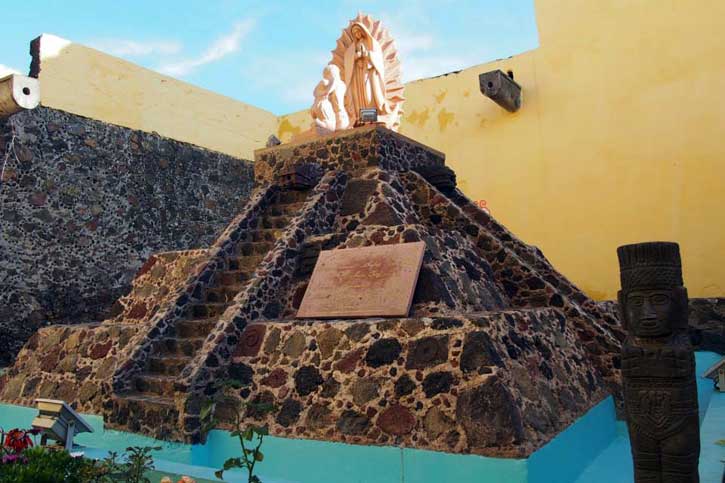
There is a hill north of Mexico City where the ground itself remembers two names. You can stand at its base today, surrounded by pilgrims and candle smoke and the particular exhausted devotion of people who have walked for days to arrive here, and feel something in the air that organized religion alone cannot explain. Tepeyac is not simply a sacred site. It is a palimpsest, a place where one act of worship was laid directly over another with such precision that the gesture cannot be accidental.
In 1531, ten years after the Spanish military destruction of Tenochtitlán, a Nahua man named Juan Diego reported that a brown-skinned woman appeared to him on this hill, spoke to him in Nahuatl, and identified herself as the mother of the Christian God. The Spanish bishop demanded proof. The woman told Juan Diego to gather roses from the hilltop in December, wrap them in his tilma, and carry them to the bishop. When he opened his cloak, the roses fell and an image had been imprinted on the fabric. That image — dark-complexioned, standing on a crescent moon, crowned by the sun, her feet on the earth — was immediately recognized by both populations, though each recognized something different. The Spanish saw a miracle conforming to Catholic Marian apparitions. The indigenous people saw Tonantzin, Our Sacred Mother, the Nahua earth goddess whose shrine had stood on that same hill for centuries before the conquest leveled it.
This was not coincidence or convenient overlap. Octavio Paz, writing in 1950, understood that the Virgin of Guadalupe occupied a structural position in the Mexican psyche that went far beyond religious devotion. For Paz, she represented the only maternal figure in a culture defined by violent patriarchal rupture — the conquest being experienced psychologically as a collective abandonment, a betrayal by the father, a wound that never fully closed. The Virgin, he argued, was the one relationship that offered belonging without submission, tenderness without the threat of violation. She was the mother who did not abandon. What Paz saw clearly was that this figure served a psychological function no purely Spanish Catholic Virgin could have served, because she carried within her image the memory of something older, something that predated the catastrophe.
Gloria Anzaldúa pushed this further, understanding Guadalupe not as resolution but as permanent tension. Her concept of the borderlands — that psychic and cultural space where two worlds meet without merging, where contradiction is not resolved but inhabited — describes exactly what the Virgin of Guadalupe performs. She is not a synthesis. She is a border. Inside her image, Tonantzin and Mary exist simultaneously, neither canceling the other, holding irreconcilable cosmologies in suspension. The Spanish colonial project demanded conversion, demanded that indigenous spiritual life be erased and replaced. What happened at Tepeyac was something else entirely: an appropriation that moved in the opposite direction. The colonized took the symbol offered to them and filled it with meaning the colonizers could not read, could not control, and could not remove without destroying their own religious project.
There is a man in a scene that stays with you — kneeling on stone, moving forward on his knees for what seems like an impossible distance, his face carrying something that is not quite pain and not quite peace. The people around him do not look at him with pity. They look at him with recognition. Whatever he is doing with his body in that moment, it is not what the Catholic Church formally teaches. It is older. It rises from a layer of devotion that survived by learning to wear the face of something else, the way water finds the shape of whatever contains it while remaining entirely itself.
Living Inside a Contradiction
You light the candle before the image and you are not sure, in that precise moment, whether you are addressing a saint or something far older than sainthood. The flame moves. You say words that were given to you by a church that arrived on ships carrying soldiers. And yet the gesture feels yours, entirely yours, carved into you by something that precedes memory. This is not confusion. This is what it feels like to live inside a form of knowledge that the dominant culture has never had a word for, because it was never meant to survive long enough to require one.
Victor Turner, writing in The Ritual Process in 1969, described liminality as the threshold state in which a person or community exists between two defined identities — neither what they were nor yet what they will become, suspended in a space that is structurally ambiguous and therefore, paradoxically, generative. Turner was thinking primarily of initiation rites in Central African societies, but the concept lands with unexpected precision on the Mexican syncretic experience, because that experience has never fully resolved its threshold state. It has inhabited liminality not as a temporary passage but as a permanent address.
Consider the altar built in a kitchen in October, the photographs of the dead arranged alongside marigolds whose smell is supposed to guide the returning souls, the glass of water left for a journey no one can quite describe, the bread shaped into bones. A priest might bless the house that week. The same hands that lit copal will receive communion. No one in that family experiences this as contradiction, and that itself is the thing worth pausing over, because the absence of felt contradiction is not naivety. It is the residue of centuries of practiced doubling, a cognitive and spiritual flexibility that was developed under conditions of existential threat.
When a colonial regime demands that you abandon everything you are, you face a specific kind of violence that is not only physical. It is ontological. It reaches for the architecture of your inner life. The response that emerged across Mesoamerica was not simple resistance, which would have been visible and therefore punishable, but something more intricate — a replication of the imposed form with a hidden interior. The saint who stands on the church altar occupies the same spatial position, the same ritual address, the same calendar feast as the deity whose name was never spoken aloud. The Catholic shell held something older inside it the way a vessel holds water, and the vessel was never the point.
What this produces, generations later, is a person who carries two cosmologies in the same body without experiencing them as warfare. This is not spiritual ambiguity born of ignorance. It is a highly specific form of doubled consciousness, not unlike what W.E.B. Du Bois described in 1903 as the twoness of Black American identity — always looking at oneself through the eyes of a world that measures you by a standard designed to find you lacking. The Mexican syncretic self knows what it means to perform one identity while inhabiting another, to give the colonizer the symbol he demands and preserve something beneath it that he cannot reach.
There is a moment in a ceremony where an old woman in a village near Oaxaca stands before an image covered in flowers and speaks in a voice that modulates between Spanish prayer and something else, something that the younger people around her cannot fully parse but feel in the body before they understand it in the mind. She is not confused about what she believes. She is translating across a wound that never fully closed, and the translation itself has become the belief. What you call contradiction from outside is, from inside, a specific and hard-won fluency.
What Gets Lost When We Call It Beautiful
There is a sugar skull on a shelf in a home goods store in Stockholm, next to a scented candle and a small ceramic cactus. It costs twelve dollars. It was manufactured in a factory outside Guangzhou. Nobody who walks past it thinks about the eighteen million people who died in the century after 1519, or about the priests who learned Nahuatl not to honor it but to dismantle it from the inside, or about the women who kept burying their dead with marigolds in secret because the flowers were the only language left that the colonizers had not yet confiscated. The skull is pretty. That is what it is now. Pretty, and twelve dollars, and entirely emptied of the pressure that made it.
Walter Benjamin wrote in his Theses on the Philosophy of History, completed in 1940 in the last months before his death at the Spanish border, that every document of civilization is simultaneously a document of barbarism. He meant it literally, not as a metaphor for nuance. The object you admire carries inside it the crushed body of whoever was forced to produce the conditions that made that object possible. The syncretic symbol — the Virgin of Guadalupe fused with Tonantzin, the skull that is simultaneously an Aztec offering vessel and a Catholic memento mori — is not a happy marriage of two traditions. It is a scar that learned to look like an ornament. And the scar only looks like an ornament to those who did not sustain the wound.
Benjamin’s concept of the dialectical image is precise about this. An image becomes dialectical when the past and the present collide inside it with enough force to produce a flash of recognition, a moment where history stops being chronology and becomes accusation. The marigold path laid out for the dead on November second is a dialectical image. So is the dark-skinned Virgin appearing to an indigenous man on a hill where a goddess temple had recently been demolished. These images do not celebrate hybridity. They record, in the only code that survived, the magnitude of what was destroyed. To see only the beauty is to perform, one more time, the same erasure that created the beauty in the first place.
The Frida Kahlo tote bag is not a trivial problem. It is a precise symptom. Kahlo painted her unibrow and her Tehuana dresses as an explicit political act, a reclamation of indigenous aesthetics against the European gaze that had spent four centuries teaching Mexican women that their faces were wrong. By 1954, the year of her death, she had turned her own suffering body into an argument. The tote bag keeps the face and removes the argument, which is exactly the operation that colonialism has always performed: extract the form, discard the content, sell the form back as cultural richness.
This is what gets lost when we call it beautiful and stop there. Not the aesthetic. The aesthetic survives, obviously, it is what we are busy purchasing. What gets lost is the necessity. These forms were not created because someone had a creative vision on a calm afternoon. They were created because people needed to keep something alive under conditions designed to kill it. When you remove that necessity from the form, you do not have a simplified version of the thing. You have its opposite: a monument to the forgetting that the thing was built to resist.
Benjamin believed that the dead make a claim on the living, that every generation inherits not just the victories of those who came before but their unfinished business, their interrupted gestures, their suppressed screams. The ease with which a culture consumes the aesthetic residue of another people’s historical trauma is not innocent appreciation. It is the sound of that scream being swallowed one more time, in a different century, by different hands, for a different price.
A vision curated by a filmmaker, not an algorithm
In this video I explain our vision
🌺 Faith, Myth, and Sacred Memory in Mexico
Mexican religious syncretism is a living tapestry woven from indigenous cosmologies, colonial Catholicism, and centuries of cultural negotiation. To fully grasp its depth, one must explore the mythologies, artistic traditions, and literary voices that have shaped the Mexican spiritual imagination. These related articles open pathways into that rich and layered world.
Day of the Dead: History and Meaning
The Day of the Dead is perhaps the most iconic expression of Mexican religious syncretism, blending pre-Columbian ancestor veneration with Catholic commemorations of All Saints and All Souls. Its rituals, altars, and offerings reveal how indigenous communities absorbed and transformed colonial religion into something entirely their own. Understanding this celebration is essential to grasping the living heart of Mexican syncretism.
GO TO THE SELECTION: Day of the Dead: History and Meaning
Aztec Culture: History Religion and Art
Aztec culture provides the indigenous foundation upon which Mexican religious syncretism was built, offering a complex pantheon, cosmological vision, and ritual system that never truly disappeared after the Spanish conquest. The gods of rain, sun, death, and fertility were not erased but reinterpreted, hidden within saints and sacred images. Exploring Aztec religion and art is indispensable for understanding what survived and what was transformed.
GO TO THE SELECTION: Aztec Culture: History Religion and Art
Octavio Paz: Life and Thought
Octavio Paz devoted much of his philosophical and poetic thought to the question of Mexican identity, including the spiritual ambivalence born from conquest and cultural mixing. In works like The Labyrinth of Solitude, he examined how the Mexican soul carries within it both the wound and the inheritance of syncretism. His reflections remain among the most penetrating analyses of what it means to live between two spiritual worlds.
GO TO THE SELECTION: Octavio Paz: Life and Thought
Frida Kahlo: Life and Works
Frida Kahlo’s paintings are saturated with the imagery of Mexican religious syncretism, seamlessly merging Catholic iconography with pre-Columbian symbols, indigenous mythology, and personal suffering. Her self-portraits function as sacred icons that speak to both the colonial and the ancestral, embodying the dual spiritual heritage of Mexico. Through her art, syncretism becomes not an abstract concept but a visceral and intimate experience.
GO TO THE SELECTION: Frida Kahlo: Life and Works
Discover Independent Cinema on Indiecinema
If these explorations of sacred culture, myth, and identity have stirred your curiosity, Indiecinema streaming is the place to continue the journey. Our curated catalog of independent and world cinema brings you films that dare to explore spirituality, cultural memory, and the human search for meaning. Come discover stories that go beyond the mainstream — and see the world through new eyes.
👉 EXPLORE THE CATALOG: Watch Indie Films in Streaming
A vision curated by a filmmaker, not an algorithm
In this video I explain our vision

