
The Sun That Demanded Blood
You wake before the sun and you already owe something. Not to a landlord, not to an employer, not to the slow administrative machinery of a modern state. You owe the universe itself the price of its continuation. This is not metaphor. This is the operating logic of a city of two hundred thousand people built on a lake in the middle of a valley at an altitude of seven thousand feet, a city with aqueducts, causeways, botanical gardens, a zoo, a judicial system, compulsory education for all children regardless of social class — centuries before Europe would consider any of those things normal. When the Spanish arrived in 1519 and first saw Tenochtitlan from the surrounding mountains, several of them wrote home saying they believed they were hallucinating. Bernal Díaz del Castillo, a soldier in Cortés’s army who later wrote his own account of the conquest, described the city as something out of a dream, a place so ordered and vast and strange that no words in his language seemed adequate. London at that same moment held perhaps fifty thousand people. Tenochtitlan held four times that number, and it functioned.

What functioned inside it, though, was not simply a city in the way you understand the word. It was a machine for keeping the cosmos alive. The Aztec philosophical framework — and it deserves that word, framework, with all the rigor the term implies — rested on a cosmological premise that strikes the modern mind as extreme precisely because we have forgotten what it feels like to take existence seriously. The universe had been created and destroyed four times before this one. The current world, the fifth sun, had been bought into being through the self-sacrifice of the gods at Teotihuacan, where two divine figures threw themselves into a fire so that the sun and moon would move. Movement cost something. Everything cost something. The debt was not symbolic. It was structural.
León-Portilla, the Mexican philosopher and historian whose 1956 work La filosofía náhuatl reconstructed Aztec thought from surviving codices and early colonial transcriptions, argued that the Nahua thinkers — the tlamatinime, literally those who know something — developed a genuine philosophical tradition concerned with precisely the questions that would occupy Heidegger or Wittgenstein: what is real, what endures, what is the nature of a self in time. The answer they arrived at was not comforting. The Nahuatl concept of the world as Tlaltícpac, the surface of the earth, carried within it the assumption of instability. Things on the surface slide. The image they returned to obsessively in their poetry was the flower: beautiful, brief, and already dying at the moment of its fullest bloom.
Into this cosmological vertigo, ritual sacrifice was not barbarism inserted from outside. It was the logical consequence of the premise. If the sun moved because it was fed, then letting it go hungry was not piety or restraint — it was negligence of the highest order, a failure of cosmic citizenship. You were not watching a spectacle at the top of the Templo Mayor. You were participating in the maintenance of physics. The blood was fuel. The heart was the offering that kept the engine running for one more day, one more cycle of fifty-two years, one more improbable rotation of a universe that had no obligation to continue.
This is the thing that gets lost in every sanitized museum caption and every breathless documentary narration that frames the Aztecs as either monsters or noble savages. They were neither. They were people who had thought very hard about contingency and had arrived, with terrible consistency, at a theology of radical responsibility. The sun does not rise because it must. It rises because someone paid for it. And the question that their entire civilization was organized around answering was simply this: are you willing to pay.
Don Barry: A Quixotic Exploration
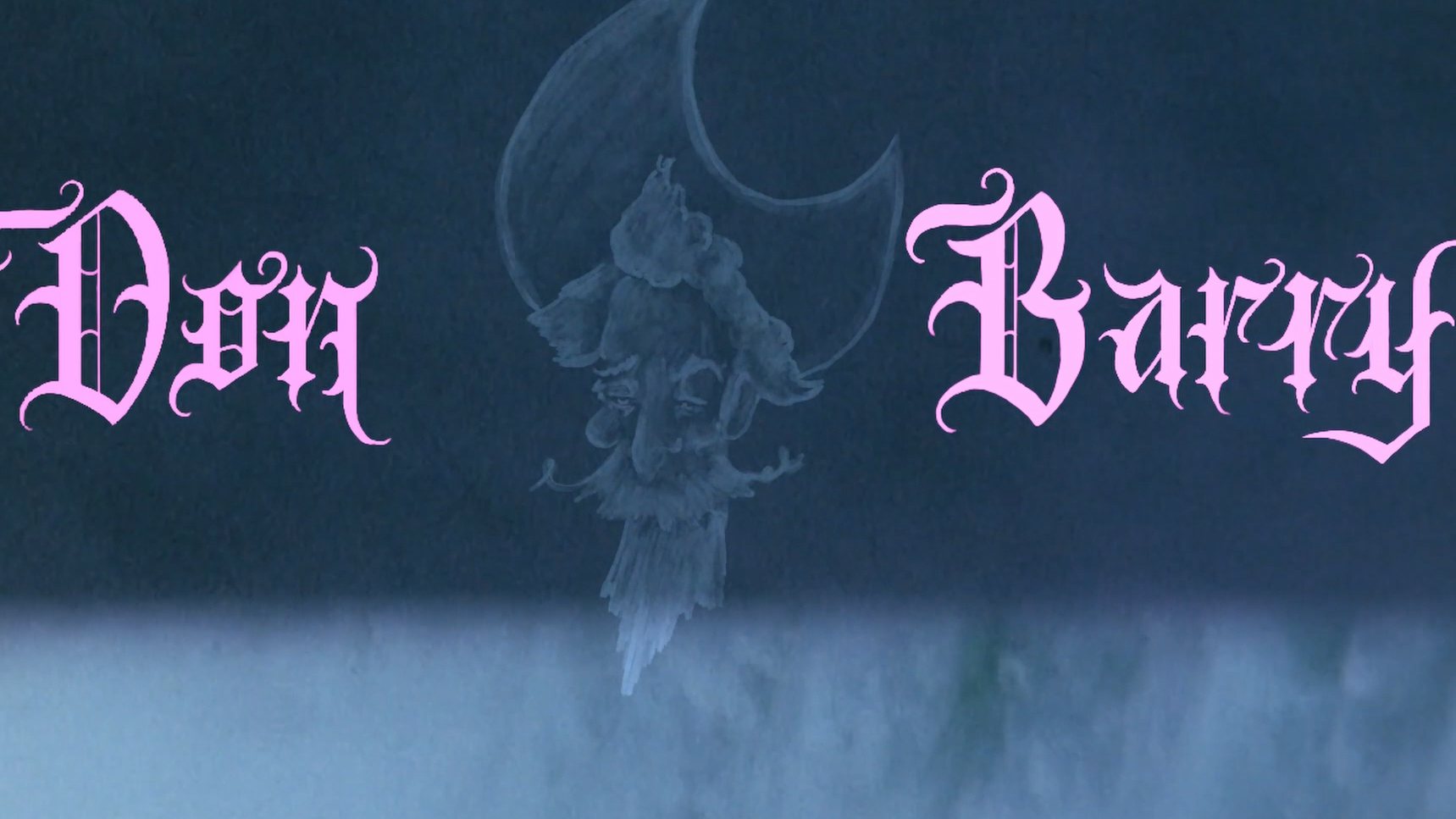
Docufiction, Experimental, by Paul Smart, Mexico, 2026.
Don Barry: A Quixotic Exploration is a debut feature that places the biography of an eighty-year-old experimental filmmaker and artist, Barry Gerson, within the metanarrative of Miguel de Cervantes’ Don Quixote. Don Barry was filmed in the city of Guanajuato during the 51st edition of the Cervantino Festival, as well as during the vibrant Day of the Dead celebrations held in the city’s UNESCO-listed tunnels. The film honors the director’s long friendship with artist Barry Gerson, drawing inspiration from Cervantes’ Don Quixote. Paul Smart’s directorial choices create something new that celebrates life and goes beyond conventional storytelling. A search for magic in our real lives. A moving film about the meaning of life, art, and death. Not to be missed.
Paul Smart is a proud outsider filmmaker with a long history of film screenings. In the 1980s, he emerged in New York’s vibrant youth art scene, working in theater production and later filmmaking, before retreating to rural upstate New York, in the Catskill Mountains, where he made a living writing and screening independent films in old parish halls for rural audiences, many of whom had never seen a film.
LANGUAGE: English
SUBTITLES: Spanish, French, German, Portuguese
Five Suns and the Architecture of Impermanence
There is a moment in certain lives when you understand, with sudden clarity, that the world you inhabit did not have to exist. Not as philosophy, not as late-night abstraction, but as a physical certainty that settles in the chest like cold water. The Aztecs lived inside that certainty every day, and they built an entire civilization on top of it.
Before this sun, there were four others. Each one rose, sustained life, and was annihilated. The first world perished when jaguars devoured the sky. The second was destroyed by wind so absolute it unmade everything that breathed. The third collapsed into a rain of fire. The fourth drowned under water that had no shore and no memory of the shore. These were not metaphors. They were cosmological records, as serious and precise as any geological survey, documenting the fragility of existence as a structural condition rather than an exception. The current age, the fifth sun, was purchased at Teotihuacan when two gods threw themselves into a divine fire to become the sun and moon, and even then the celestial bodies refused to move until the remaining gods bled themselves for the energy needed to set creation in motion.
What the Aztecs understood, and what we have systematically refused to absorb, is that continuity is not the default state of the universe. Destruction is not an interruption of order. It is order’s other face.
Mircea Eliade, in his 1949 work The Myth of the Eternal Return, argued that archaic societies did not experience time as the linear progression modernity takes for granted. They experienced it as a series of returns to an original sacred moment, each cycle renewing the world through ritual re-enactment of its creation. What Eliade called the “terror of history” was precisely the anxiety of linear time, the irreversible accumulation of events without cosmic meaning. But the Aztec five-sun cosmology goes further than Eliade’s framework can comfortably contain. It is not simply a return to origins. It is a return to the edge of annihilation, and survival each time is never guaranteed.
Somewhere in the memory of a man who lived in Tenochtitlan in the early fifteenth century, there was the knowledge that the sun might simply fail to rise. Not as metaphor. As the actual dark. He stood on the roof of his house in the hours before dawn and waited, and the waiting was not theatrical. The ritual specialists had calculated. The ceremonies had been performed. The blood had been offered. And still, in those final minutes before sunrise, existence held its breath. When light came, it was not relief. It was reprieve. The distinction matters enormously.
This is precisely what modern secular consciousness cannot metabolize about Aztec religious life. We interpret the sacrificial rituals as evidence of cruelty or political coercion, and those dimensions certainly existed within the institutional structures of the empire. But the cosmological sincerity underneath is something else entirely. The philosopher William James, in The Varieties of Religious Experience published in 1902, described certain states of religious consciousness as characterized by an acute sense of the contingency of the self, the feeling that one’s existence is borrowed and conditional. The Aztec relationship to the fifth sun was exactly this, scaled to the level of civilization.
The world was not given. It was maintained. And maintaining it required not passive devotion but active, costly, irreversible participation. You were not a spectator of creation. You were its ongoing condition.
There is something vertiginous in this that our language of gratitude and stewardship only partially captures. We speak of caring for the earth as an ethical choice. For a civilization built on the memory of four destroyed worlds, it was something closer to a debt so vast it reorganized every waking hour around the single question of whether you had done enough to keep the sky intact.

Huitzilopochtli and the Politics of Sacred Violence
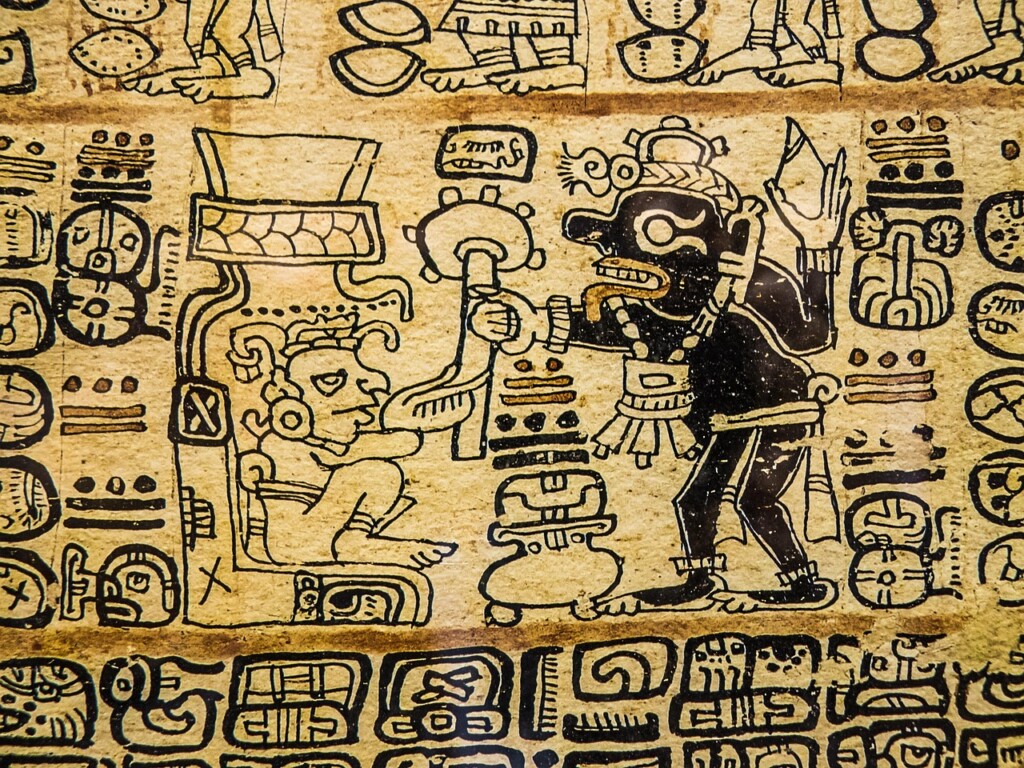
You are standing in a city of two hundred thousand people, canals threading between white buildings, markets humming with cacao and obsidian and quetzal feathers, everything ordered, everything precisely where it belongs. A man climbs stone steps in the early light. He is not afraid. He has prepared for this moment across years of warfare, of capture, of ritual fasting. He knows what the universe requires of him, and he gives it willingly, because in his cosmology the sun does not rise on its own. Someone has to feed it.
This is where the comfortable distance collapses. The moment you understand that the warrior climbing those steps believes he is holding the world together, the word barbarism loses its footing.
Huitzilopochtli, the hummingbird of the south, the solar war deity of the Mexica, was not merely a god of battle. He was the cosmological argument for why society must remain militarized, why the calendar must be obeyed, why the flower wars were not aggression but liturgy. The Mexica believed the fifth sun — their sun, our sun, the one that makes crops grow and children breathe — had survived its birth only through divine sacrifice. The gods had bled at Teotihuacan so that light could move. Human blood was not an offering to power. It was a debt payment to existence itself.
René Girard, in his 1972 work La Violence et le Sacré, argued something that most modern readers still resist: that sacrifice is not the pathology of primitive cultures but the original mechanism through which communities regulate their own internal violence. The sacrificial victim absorbs collective tension, externalizes it, and through ritual destruction, restores temporary peace to the group. Girard called this the surrogate victim mechanism, and he was not describing Mesoamerica in particular. He was describing the architecture underneath every civilization that has ever called itself ordered.
The Mexica state understood this with an almost surgical clarity. The Templo Mayor in Tenochtitlan, excavated beginning in 1978 under archaeologist Eduardo Matos Moctezuma, was not simply a religious site. It was the axis of an imperial system that needed, structurally, to keep producing sacred violence in order to justify its own military expansion, its tributary economy, its social hierarchy. The sacrifices were real. The numbers debated by historians range from hundreds to tens of thousands annually, and the truth probably sits somewhere in the contested middle. But the function was never hidden. It was announced. It was performed in public, at the center of the city, in front of everyone, because the performance was the point.
Here is where Girard’s framework becomes genuinely uncomfortable for modern readers. Because if you follow the logic even briefly, you notice that the mechanism he describes has never actually disappeared. It has been laundered, bureaucratized, sent offshore. The Mexica performed their sacrificial violence openly and called it sacred. You perform yours through drone strikes, through prison systems, through economic sanctions that starve civilian populations, and you call it policy. The ritual has not ended. The priests have changed their clothing.
The warrior at the top of those steps was not a victim of superstition. He was a participant in a theology of reciprocity that made, on its own terms, complete internal sense. The sun had died and been reborn through sacrifice at the moment of creation. The world was not a stable gift. It was a continuously negotiated contract between humans and forces that could, at any moment, withdraw. This is not a metaphor. For the Mexica, it was cosmological physics. The obligation was real because the universe was fragile.
Civilization, as a word, tends to organize itself around the question of who is doing the killing and whether they have written down a justification for it first.
The Codices They Burned
Imagine you wake up one morning and every book you have ever read has been replaced by a summary written by someone who hated the author. Not a hostile critic — someone who believed the very act of reading those books was a form of spiritual contamination. That is not a metaphor for what happened in 1529. It is the literal administrative reality of what Bishop Juan de Zumárraga oversaw in the Valley of Mexico, when piles of screenfold manuscripts, painted bark-paper codices encoding centuries of astronomical observation, ritual calendars, genealogical memory and cosmological reasoning, were gathered and burned. The fire did not last long. The loss was permanent.
The numbers are almost obscene in their smallness. Of all the pre-Columbian Mesoamerican codices that once existed — and scholars estimate there were thousands, held in temples, in the calmecac schools, in the households of the priestly and noble classes — between fifteen and twenty survive with any claim to pre-contact origin. Fifteen to twenty. The rest were consumed by deliberate policy, by the theological conviction that indigenous writing was diabolical inscription rather than human knowledge. Zumárraga alone is credited with destroying hundreds in a single campaign. What burned was not primitive superstition. What burned was an entire epistemological universe.
Walter Mignolo, in his sustained work on the colonial difference and what he calls the coloniality of knowledge, makes a distinction that cuts directly into this wound. Colonial power, he argues, does not merely conquer territory. It reorganizes the very criteria by which knowledge is recognized as knowledge. The Spanish missionaries did not believe they were destroying a library. They believed they were clearing away noise so that truth could finally be heard. This is not ignorance. It is a more sophisticated violence — the violence of redefining what counts as thought, as record, as meaning. When you burn a book, you can at least mourn the book. When you declare that the object in question was never a book at all, the mourning itself becomes impossible.
And yet what we call Aztec religion today is reconstructed almost entirely through the eyes of people who held precisely that conviction. The major surviving accounts — Bernardino de Sahagún’s Florentine Codex, Diego Durán’s Historia de las Indias, the writings of Toribio de Benavente — were produced by Franciscan and Dominican friars whose intellectual project was conversion, not preservation. Sahagún, often praised as a proto-anthropologist for his methodical interviews with indigenous informants in the 1560s and 1570s, was genuinely curious. He was also genuinely certain that what he was documenting was the work of the devil. His curiosity and his contempt coexisted without contradiction, because the framework that organized both was colonial difference: the premise that indigenous knowledge was an object of study, never a subject of inquiry.
There is a scene that stays with you. A man carefully transcribing the words of elders, writing down the names of gods, the sequences of festivals, the meanings of calendar signs — and doing so in order to better equip other priests to dismantle the very practices he is recording. The archive as weapon. Documentation as a form of controlled demolition. What emerges from that process is not Aztec religion. It is the colonial representation of Aztec religion, shaped at every point by the categories that the recorders brought with them: sin, idolatry, sacrifice, superstition. Categories that did not exist in Nahuatl. Categories that had to be imposed before the description could begin.
This means that when you read about Huitzilopochtli or Tlaloc or the cyclical destruction of worlds in the Aztec cosmological imagination, you are reading something real filtered through a lens designed to make it appear monstrous. The question is not whether anything survives the filter. Something always does. The question is what we cannot see because we do not know what shape it had before the burning.
Tlaloc, Quetzalcoatl and the Gods Who Were Also Ideas
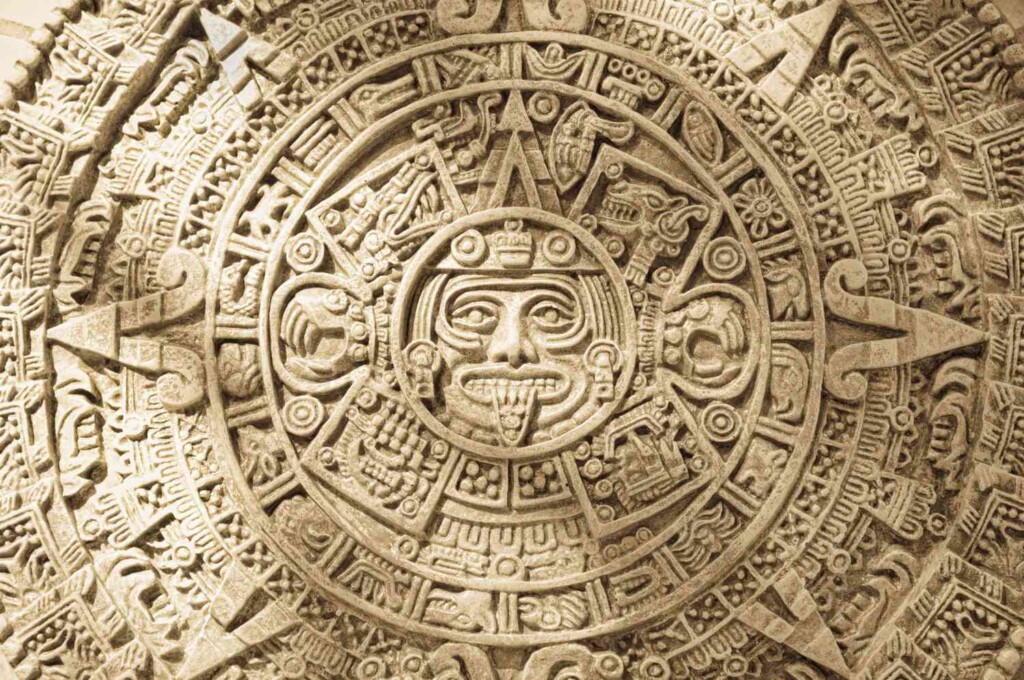
You have seen rain do both things in the same afternoon — coax green from cracked earth and then drown what it fed. That contradiction does not resolve. It sits inside the same cloud, the same season, the same outstretched hand of sky. The Aztecs did not resolve it either, and this was not a failure of their theology but its most precise achievement.
Tlaloc is ancient beyond the Aztec world itself, his goggled eyes and fanged mouth appearing in Teotihuacan murals centuries before the Mexico people built Tenochtitlan, which means his persistence across cultures and centuries tells you something essential: he was not invented to explain rain. He was invented because rain itself is inexplicable in the way that matters, not scientifically but existentially. He gives the maize its life and he fills the lungs of children with water until they drown. In the dual pyramid of the Templo Mayor, his shrine stood side by side with Huitzilopochtli’s, the rain beside the war, the fertile beside the violent, and the symmetry was not decorative. It was cosmological argument made in stone.
Paul Ricoeur, writing in his 1969 work The Conflict of Interpretations, drew a distinction that cuts directly to what is at stake here: myths are not primitive explanations competing with science. They are what he called a second naivete, a mode of inhabiting reality that operates at a register entirely different from empirical description. When you treat a myth as a failed hypothesis, you have already misunderstood it categorically. The Aztec gods were not believed in the way you believe that water boils at one hundred degrees. They were inhabited the way you inhabit a language — not consciously, not as a choice, but as the medium through which experience becomes thinkable at all.
Quetzalcoatl makes this legible in the most visceral way. The feathered serpent: a creature of the earth given the capacity for sky, scales dressed in the iridescent green of the quetzal bird, which itself was so sacred its feathers could not be bought but only received. Here is a figure that refuses the most basic categorical division human thought imposes — the division between matter and spirit, between what crawls and what ascends. He is not a metaphor for that union. He is its form. The Nahuatl word coatl means both serpent and twin, a doubling that the scholars Alfonso López Austin and Leonardo López Luján have examined at length in their analyses of Mesoamerican religious thought, noting that Quetzalcoatl carries within his very name the logic of creative opposition, the idea that the highest things contain their apparent opposite rather than transcending it.
There is a moment that encapsulates this perfectly: a man, stripped of everything he thought defined him, stands at the edge of an enormous chasm and understands suddenly that the two sides of his nature he has spent his entire life trying to reconcile were never enemies. That the wound and the gift were the same aperture. You recognize that moment because you have stood there too, even if the chasm was smaller, even if no one was watching.
The Aztec pantheon numbered in the hundreds, but the logic threading through it is neither chaotic nor arbitrary. Léon-Portilla, in his landmark 1963 study Aztec Thought and Culture, demonstrated that Nahuatl philosophical tradition — toltecayotl, the way of wisdom — understood divinity not as personality but as force, as the named shape that a particular tension in reality takes when consciousness tries to hold it. The gods were ideas the way mathematics is ideas: abstract, yes, but more real than any single instance of them, not less.
What the modern secular mind calls superstition was, in this framework, something closer to phenomenology — the rigorous attempt to describe experience as it is actually lived, before the explanatory machinery arrives to flatten it into cause and effect.
A vision curated by a filmmaker, not an algorithm
In this video I explain our vision
Stone That Speaks: The Art of a World Under Pressure
You stand in front of it and something happens before you can name it. Not awe exactly, not the pleasant elevation of museum-going, but something closer to alarm — a recognition that this object was not made to be looked at from a safe distance. The enormous basalt disc, more than three and a half meters in diameter and carved sometime around 1479 during the reign of Axayacatl, fills the room not with beauty but with pressure. At its center, a face that may be the sun deity Tonatiuh or the earth itself, surrounded by concentric rings of glyphs encoding the five cosmic eras, the days, the cardinal directions, the claws of time gripping human hearts. Scholars spent a century calling it a calendar. It is not a calendar. It is a statement of emergency.
Aby Warburg, the German art historian who died in 1929 having mapped the survival of ancient emotional formulas across centuries of European painting, called these concentrated gestures Pathosformeln — pathos formulas. What he meant was that certain images carry an affective charge so dense, so biologically rooted in collective human experience, that they bypass intellectual interpretation entirely. The body reads them first. Fear, grief, ecstasy, sacrifice — these are inscribed in posture, in line, in the specific curvature of a mouth or the angle of a raised arm, and they migrate across cultures and millennia without losing their voltage. What Warburg traced through the nymphs of Botticelli and the serpent rituals of the Pueblo peoples, the Aztecs encoded in stone with a ferocity that makes European Renaissance painting look like a polite conversation.
Consider the Coatlicue, excavated in Mexico City in 1790 and so disturbing to colonial authorities that it was reburied almost immediately. The statue stands nearly two and a half meters tall. Where her head should be, two serpents face each other, their profiles forming a single monstrous face. Her skirt is braided snakes. Her necklace is made of severed hands, excised hearts, and a skull pendant. She is earth mother, death goddess, the one who devours and generates simultaneously. When Octavio Paz wrote about the Aztec imagination, he noted that it refused the consoling separation between creation and destruction that Western monotheism had institutionalized. Coatlicue does not symbolize this refusal. She embodies it with such physical completeness that the visitor who encounters her in the National Museum of Anthropology in Mexico City often steps backward involuntarily. That step is the Pathosformel working. The body understood something the mind is still translating.
Then there are the obsidian blades — not the ceremonial ones mounted in exhibitions, but the ordinary ones, the ones that passed through thousands of hands in the markets of Tenochtitlan. Obsidian fractures to an edge sharper than surgical steel, and the Aztecs mastered its working with a precision that still confounds materials scientists. These objects are both tool and theology, because in the Aztec cosmology there is no clean boundary between the practical and the sacred. Tezcatlipoca, one of the supreme deities, carries an obsidian smoking mirror in which he sees everything — the hidden desires, the inevitable deaths, the turning of fate. The blade that cuts a sacrificial cord and the mirror that reflects the truth of the soul are made of the same volcanic glass. The material is the message.
What Warburg understood, working obsessively through his library of sixty thousand volumes in Hamburg before his mind broke and then reassembled itself, was that art under pressure speaks differently from art made in comfort. Aztec artists were not decorating a stable world. They were holding one together through the act of making, inscribing into stone and obsidian and featherwork the emotional formulas that kept a civilization conscious of its own fragility, and therefore alive to the full weight of being alive at all.
Moctezuma’s Paradox and the Gravity of Contact
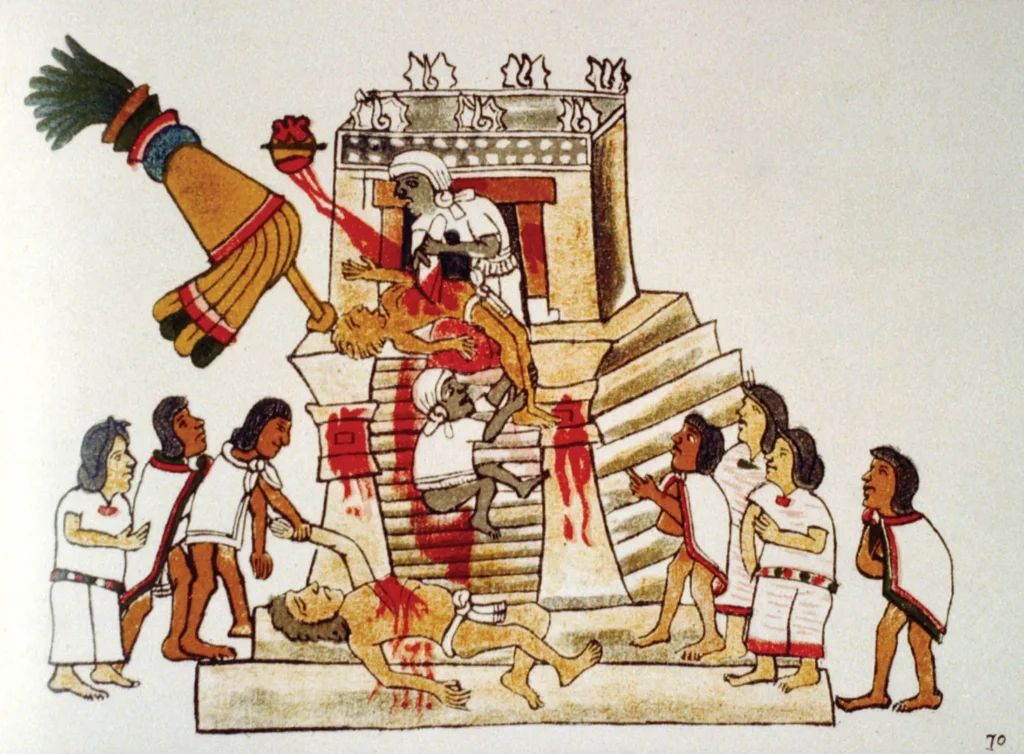
Imagine standing at the edge of your own capital, watching something arrive that has no name in any language you possess. Not a monster, not a god, not quite an enemy yet — something that moves through your territory leaving behind a trail of alliances broken and reformed, of cities that resisted and then submitted, of omens your priests have been arguing about for years without resolution. This is November 1519. The causeways into Tenochtitlan are crowded with people who have come to witness what no one knows how to describe. And you, Moctezuma II, huey tlatoani, speaker of the world, walk forward in your feathered sandals that must not touch the ground, carried by attendants, dressed in the full ceremonial weight of an empire’s symbolic vocabulary, to meet a man named Hernán Cortés.
The received story — the one repeated in textbooks and popular films for five centuries — is that Moctezuma believed Cortés to be the returning deity Quetzalcoatl, was paralyzed by this conviction, and surrendered his civilization out of theological confusion. It is a story that requires the Aztec sovereign to be, above all, stupid. Camilla Townsend, in her 2003 article published in the American Historical Review, traced this narrative back to its source and found not indigenous testimony but a retrospective construction assembled from post-conquest documents, many produced under colonial pressure or by Nahua informants working within a framework the Spanish had already imposed. Matthew Restall, in his 2003 study Seven Myths of the Spanish Conquest, was equally precise: the Quetzalcoatl identification appears nowhere in the earliest sources and becomes increasingly elaborate the further one moves from the event itself. What we have, in other words, is a colonial myth grafted onto a historical moment to make the outcome feel inevitable, natural, even deserved.
What Moctezuma was actually doing in that November encounter was something far more demanding than capitulation. He was negotiating. The Mexica political tradition included a sophisticated practice of incorporating powerful outsiders through ceremony, of absorbing threat by ritually acknowledging it, of buying time with the grammar of hospitality while calculating military and diplomatic options. Receiving Cortés with honor was not submission. It was statecraft performed at the highest register. You extend the hand of protocol precisely because you do not yet know how hard you will need to hit, and because hitting too early, without information, without allies, without understanding what this force actually is, would be the error of a lesser ruler.
There is something almost unbearable about this reading, because it restores to the man his full intelligence and then makes his situation worse. A fool stumbling into catastrophe is a tragedy of ignorance. A sovereign reading his position correctly, making the most rational moves available, and still losing — that is something the political philosophy of the twentieth century had to rebuild language to describe. Hannah Arendt, writing about the collapse of political worlds, understood that the most devastating losses are not those caused by stupidity but by the structural impossibility of the situation, by the moment when no action available within the existing framework of meaning can alter the outcome.
And yet Moctezuma performs the rituals. He speaks the ceremonial formulas. He wears the jade, the gold, the quetzal feathers, the entire cosmological grammar of Mexica sovereignty. Not because he is deluded. Because to stop performing them would be to concede, before any battle, that the world they encode is already over. There is a kind of radical dignity in this — the insistence on meaning at the precise moment when meaning is under the most violent pressure. A man inside a ceremony that is also, already, a eulogy, who has not yet permitted himself to know which one it is.
What We Inherit Without Knowing
There is a word you use without thinking. You say it in a market, or over the phone, or to a child reaching for something dangerous. The word is chocolate. Or tomato. Or avocado. Or chile. These are not borrowings from some distant and exotic tongue — they are Nahuatl, the language of a civilization that official history insists was extinguished by 1521, the year Tenochtitlan fell to Hernán Cortés and the world was supposedly reorganized along European lines. Yet the language did not die. It migrated into the mouth of the conqueror, into the daily speech of a continent, into your kitchen and your afternoon and the particular way you describe hunger.
This is what colonization cannot fully accomplish, no matter how thorough its violence. It can burn codices — and the Spanish did, systematically, reducing centuries of astronomical knowledge, ritual practice and historical memory to ash in bonfires that Inga Clendinnen, in her 1991 study of Aztec civilization, described as an epistemicide more total than almost any other in recorded history. It can rename cities and build cathedrals directly on top of pyramids, as was done at Tlatelolco and at Cholula, where the church of Nuestra Señora de los Remedios sits on the largest pyramid by volume ever constructed by human hands. It can forbid languages, mandate baptisms, rewrite genealogies. But it cannot reach the thing that lives below language, below ritual, below the conscious mind — the inherited structure of how a people understands time, death, the relationship between the living and the ground they walk on.
Consider what happens every year on the first and second of November across Mexico and in Mexican communities scattered through the United States and beyond. Families build altars. They place photographs of the dead alongside marigolds — cempasúchil, the flower the Mexica associated with the sun and with the passage between worlds — alongside food the deceased loved, alongside candles that are meant not to illuminate the living room but to guide a wandering soul home. The Catholic Church assigned All Saints‘ Day and All Souls’ Day to those dates, and official culture calls what happens a Christian commemoration. But the structure of belief underneath it is older than Christianity by a thousand years. The Aztec calendar contained dedicated periods for honoring the dead in August, and when the Spanish shifted the timing, the practice did not disappear — it simply moved, the way a river rerouted by engineering eventually finds its old bed again.
Claude Lévi-Strauss argued that myth is not a story people tell but a structure people think with, often without knowing they are thinking at all. What persists in the Day of the Dead is not nostalgia or ethnic performance. It is a cognitive architecture — the dead are not gone, time is cyclical rather than linear, the border between worlds is permeable on specific days and must be tended with specific care. These are not metaphors. They are operational beliefs that organize how millions of people actually move through grief, through memory, through the annual rhythm of the year.
A man lights a candle at an altar his grandmother built before him and her grandmother before her, and he does not think: I am preserving pre-Columbian cosmology in the face of five centuries of colonial erasure. He thinks: my father liked carnitas, so I brought carnitas. And yet both things are true simultaneously, and the second one is only possible because of the first.
The question this raises is not really about Mexico or about the Aztecs. It is about you, wherever you are reading this — what you have received without a bill of sale, what structures your thinking without announcing itself, what you would find if you pulled back the layer of your most ordinary assumptions and asked, honestly, where they came from and whether you ever agreed to carry them.
🌞 Myths, Rituals and Art of Ancient Mesoamerica
Aztec culture is a gateway into a world where religion, art, and daily life were inseparably intertwined. Exploring the civilizations and traditions that surrounded and followed the Aztec legacy reveals the deep roots of Mexican identity. These related articles illuminate the cultural landscape from which Aztec history emerges.
Day of the Dead: History and Meaning
The Day of the Dead is one of the most direct living inheritances of pre-Columbian Aztec beliefs about death and the afterlife. The Aztecs celebrated elaborate rituals honoring the dead, and this tradition merged with Catholic influences after the Spanish conquest to create a uniquely Mexican festival. Understanding its history reveals how deeply Aztec cosmology still shapes contemporary Mexican culture.
GO TO THE SELECTION: Day of the Dead: History and Meaning
Mexican Muralism: History and Protagonists
Mexican Muralism was a twentieth-century artistic movement that consciously drew on Aztec imagery, mythology, and history to forge a post-revolutionary national identity. Artists like Rivera, Orozco, and Siqueiros depicted indigenous gods, warriors, and symbols on public walls, reclaiming pre-Columbian heritage as a source of pride. The movement is inseparable from the rediscovery and revaluation of Aztec cultural legacy.
GO TO THE SELECTION: Mexican Muralism: History and Protagonists
Diego Rivera: Life and Works
Diego Rivera was one of the most passionate artistic interpreters of Aztec and Mesoamerican civilization, weaving ancient glyphs, deities, and market scenes into monumental public murals. His work at the National Palace in Mexico City reconstructs entire epochs of Aztec life with encyclopedic detail and political passion. Rivera’s art remains one of the most vivid visual portrayals of Aztec culture available to a modern audience.
GO TO THE SELECTION: Diego Rivera: Life and Works
Octavio Paz: Life and Thought
Octavio Paz, Mexico’s Nobel Prize-winning poet and essayist, devoted much of his intellectual life to understanding the Aztec roots of Mexican identity and the psychological wounds left by the conquest. In works like ‘The Labyrinth of Solitude,’ he analyzes how pre-Columbian worldviews continue to haunt and shape the Mexican psyche. His thought offers an indispensable philosophical lens through which to interpret Aztec culture and its enduring resonance.
GO TO THE SELECTION: Octavio Paz: Life and Thought
Discover the World Through Independent Cinema on Indiecinema
If the myths, visions, and cultural depths of the Aztec world have sparked your curiosity, independent cinema offers another extraordinary path into the mysteries of human civilization. On Indiecinema streaming you will find avant-garde, documentary, and visionary films that explore history, spirituality, and identity from unexpected angles. Let independent cinema take you further into the labyrinth.
👉 EXPLORE THE CATALOG: Watch Indie Films in Streaming
A vision curated by a filmmaker, not an algorithm
In this video I explain our vision

