
The Desert as a Decision
The heat hits you before you understand it. Not warmth — heat, the kind that reorganizes your thinking, that makes the body’s usual negotiations with the world suddenly irrelevant. You are standing somewhere between Abiquiú and Ghost Ranch, in a landscape so indifferent to your presence that the word “landscape” feels wrong, too decorative, too much like something framed for viewing. This is not scenery. It is condition. The red and ochre cliffs do not rise dramatically — they simply exist, massive and pre-human, and the sky above them is not blue so much as it is an argument for the color blue, a blue so saturated it seems to press downward with physical weight. The instinct, for most people, is immediate and biological: find shade, find water, find the road back to somewhere with walls.

And yet someone stayed.
Not because the hardship was secretly comfortable, not because the solitude was a romantic pose struck for admirers, but because something in the confrontation with this particular harshness told the truth in a way that softer places did not. Georgia O’Keeffe arrived in New Mexico for the first time in 1929, already forty-one years old, already a painter of recognized force, already trapped inside a life that had been largely constructed around her by other people’s needs and other people’s interpretations. She had been living as Alfred Stieglitz’s wife, his muse, his most famous exhibit, the woman whose flowers the entire critical establishment had decided were something other than flowers, projecting onto her canvases a sexual symbolism she consistently and pointedly refused to claim. New York had made her visible and invisible simultaneously — seen constantly, understood almost never.
The desert offered something stranger and more necessary than escape. It offered opacity. In the Chihuahuan Desert, in the silence of those mesas and arroyos, there is no social grammar, no conversational scaffold to climb. The French philosopher Gaston Bachelard, writing in 1958 in The Poetics of Space, described certain landscapes as spaces that “possess us” rather than the reverse — environments that do not yield to the human desire for domestication but instead demand a kind of ontological surrender. O’Keeffe did not romanticize this. She painted bones. She painted the skull of a horse against that impossible blue sky with the same directness one might use to paint a vase of flowers on a kitchen table, as if the fact of death in the landscape was simply another fact, neither morbid nor transcendent, just present.
This is where the philosophical tension lives, and it is worth sitting with it rather than resolving it too quickly. Most of us organize our lives around the avoidance of exactly what O’Keeffe sought. We build familiarity like insulation — familiar streets, familiar faces, familiar mirrors that reflect back a version of ourselves we have pre-approved. The psychologist Abraham Maslow spent decades mapping what he called the hierarchy of human needs, but what his framework struggled to account for was the person who deliberately descends back through the hierarchy, who trades safety for something that cannot be named in the language of safety. Not masochism. Not eccentricity. Something closer to what Nietzsche meant when he wrote of the courage required to see without consolation.
She drove herself through those landscapes in a Model A Ford, alone, stopping to collect bones and stones and pieces of wood bleached by decades of sun. She brought them back to a house she had bought with her own money in 1945, a crumbling adobe in Abiquiú that took her four years to acquire from the Catholic Church that owned it, a negotiation she conducted with the same patient ferocity she brought to everything. The house had a door in the courtyard that she painted again and again, as if the question of threshold — what you enter, what you leave, what you stand before without crossing — never exhausted itself.
Don Barry: A Quixotic Exploration
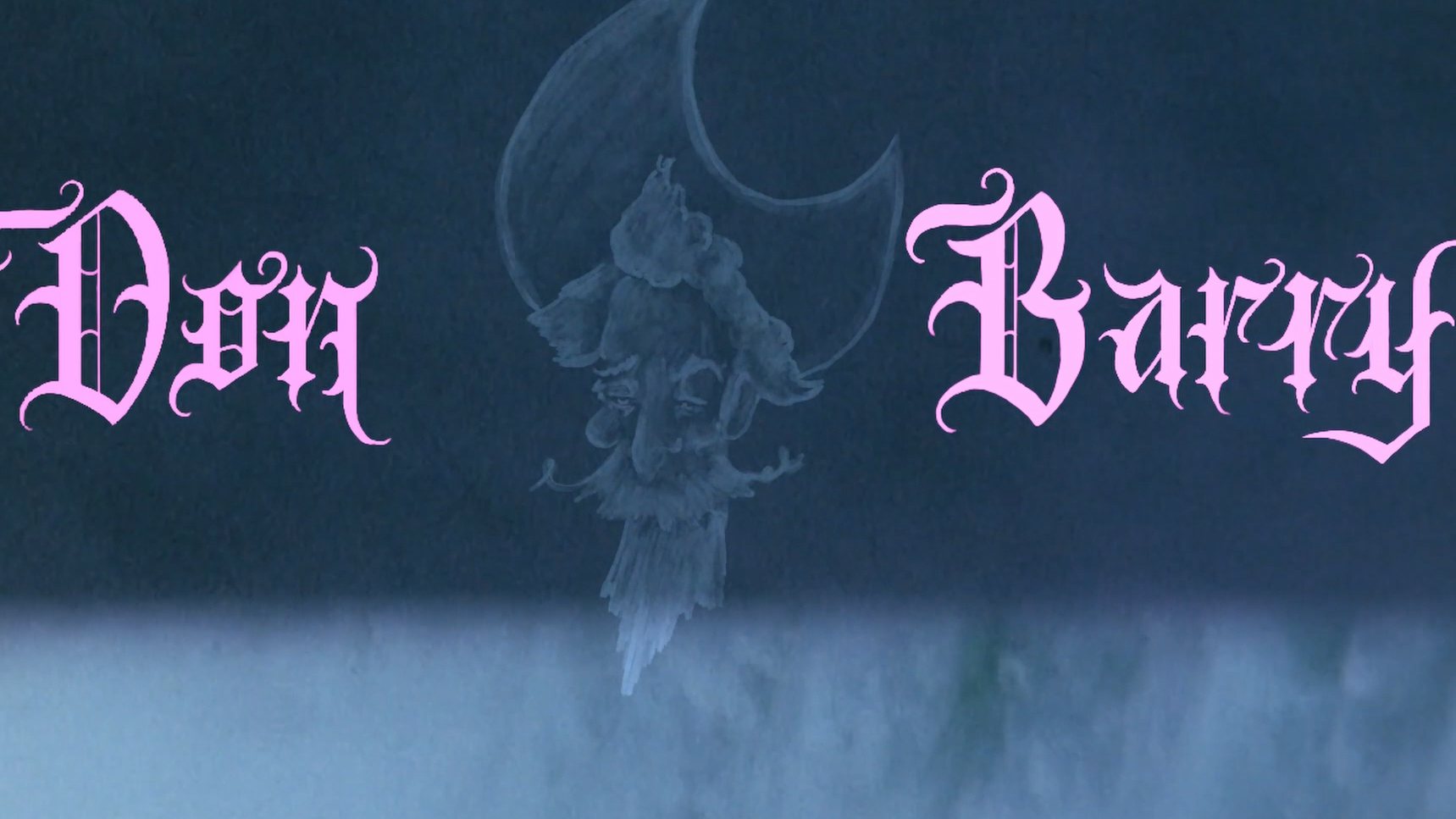
Docufiction, Experimental, by Paul Smart, Mexico, 2026.
Don Barry: A Quixotic Exploration is a debut feature that places the biography of an eighty-year-old experimental filmmaker and artist, Barry Gerson, within the metanarrative of Miguel de Cervantes’ Don Quixote. Don Barry was filmed in the city of Guanajuato during the 51st edition of the Cervantino Festival, as well as during the vibrant Day of the Dead celebrations held in the city’s UNESCO-listed tunnels. The film honors the director’s long friendship with artist Barry Gerson, drawing inspiration from Cervantes’ Don Quixote. Paul Smart’s directorial choices create something new that celebrates life and goes beyond conventional storytelling. A search for magic in our real lives. A moving film about the meaning of life, art, and death. Not to be missed.
Paul Smart is a proud outsider filmmaker with a long history of film screenings. In the 1980s, he emerged in New York’s vibrant youth art scene, working in theater production and later filmmaking, before retreating to rural upstate New York, in the Catskill Mountains, where he made a living writing and screening independent films in old parish halls for rural audiences, many of whom had never seen a film.
LANGUAGE: English
SUBTITLES: Spanish, French, German, Portuguese
What They Called Madness
There is a moment in a young woman’s life when she discovers that her clearest thinking makes the people around her uncomfortable. Not because she is wrong. Because she is legible only to herself, and that self-sufficiency reads, to others, as a kind of social malfunction. Georgia O’Keeffe knew this sensation before she had language for it. Born in the flat, frost-hard country of Wisconsin in November 1887, she grew up in a landscape that offered no ornament, only fact — sky, field, the geometry of distance. It was not a childhood that taught prettiness. It was one that taught looking.
She studied at the School of the Art Institute of Chicago, then at the Art Students League in New York, absorbing the conventions of academic realism with enough discipline to master them and enough intelligence to distrust them. The turning point arrived not as revelation but as correction — quiet, almost methodical. Arthur Wesley Dow, the educator whose 1899 treatise “Composition” restructured how a generation of American artists understood form, taught her that line and color were not vehicles for depicting the world but for expressing something prior to depiction: feeling itself, compressed into shape. Under Dow’s influence, abstraction ceased to be a stylistic option and became an emotional grammar. O’Keeffe began making marks that had no referent outside her own interior life, charcoal drawings that curved and compressed and opened like held breath finally released.
She sent them to a friend in New York with an instruction: show no one. The friend showed Alfred Stieglitz. He exhibited them in 1916 at his gallery at 291 Fifth Avenue without asking her permission, and when she arrived at his door to demand he take them down, he told her that the work was too important to be controlled by its maker. This is the story as it is usually told — the great man recognizing the great woman, liberation arriving in the form of male sanction. But Simone de Beauvoir, writing in “The Second Sex” in 1949, described precisely this structure: the moment when a woman’s interiority becomes visible to the world is also the moment it begins to be administered by it. Discovery and possession are not opposites. They are the same gesture performed with different expressions.
What surrounded O’Keeffe in those early years was a cultural machinery with a very specific function: to reclassify female ambition as pathology. The early twentieth century had inherited from the nineteenth a rich vocabulary for this operation — hysteria, eccentricity, unwomanliness, the various clinical-sounding terms that meant, in practice, she wants too much and conceals it poorly. De Beauvoir’s analysis holds that female selfhood is not merely discouraged but actively framed as deviance, as a departure from the natural order in which woman exists in relation to man, not in relation to her own becoming. O’Keeffe’s becoming was visible in her body, in the way she moved through rooms, in the fact that she dressed without decoration and spoke without apology. These were not character traits. They were, to the cultural logic of her moment, symptoms.
And yet the charcoal abstractions Stieglitz held up to the light were undeniable. Not provocative in the manner of deliberate transgression, but stranger than that — genuine, which is always more unsettling than rebellion. They did not argue with convention. They simply proceeded as if convention had nothing to do with the matter. This is the quality that makes certain kinds of work unbearable to the institutions that encounter it: not defiance, but indifference. O’Keeffe was not painting against anything. She was painting from somewhere so interior that the question of outside permission had not yet occurred to her, and when it did, when Stieglitz raised it by answering it on her behalf, something in the dynamic between them was already decided.

Alfred Stieglitz and the Gaze That Owns
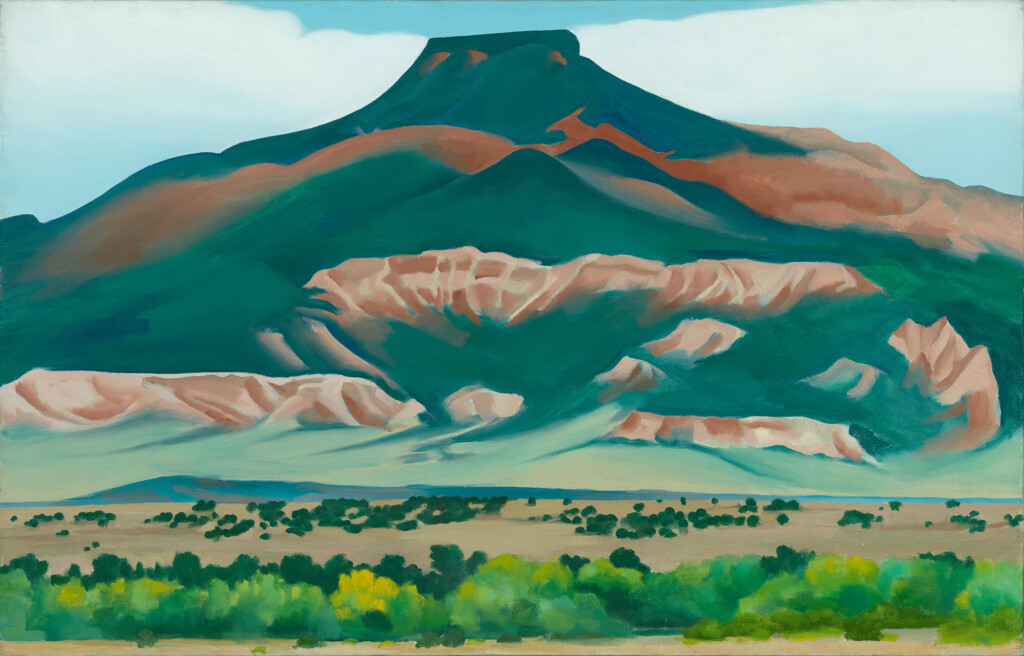
There is a particular kind of attention that feels like love until you understand it is possession. You have known it, perhaps, in the way someone looked at you across a table and you felt simultaneously seen and pinned, the way an insect is pinned, wings spread, into felt. The look that says: I understand you. The look that means: stay still.
Between 1917 and 1937, Alfred Stieglitz made more than three hundred photographs of Georgia O’Keeffe. He photographed her hands, her neck, her feet, her breasts, her face in every available light. He called it a portrait. He called it love. He exhibited the images at 291 and later at the Anderson Galleries without fully consulting her, and the art world received them as revelation — here was a woman, raw and essential, given to the world by the man who truly saw her. The vocabulary of gift. The grammar of ownership.
John Berger wrote in 1972 that men act and women appear, and that women watch themselves being looked at. This determines not only most relations between men and women but also the relation of women to themselves. Berger was describing a structure, not an exception. The surveyor and the surveyed living inside the same body, the woman learning to see herself through the eyes that observe her before she can locate her own. It is not a psychological defect. It is a cultural installation, running silently beneath everything.
Watch what happens in that room with the camera. A woman stands in front of a man who loves her, or believes he does, and he raises the lens and says nothing but his silence says: like this, a little to the left, yes, hold that. She adjusts. She is twenty-nine, thirty, thirty-three. She adjusts because the adjustment feels like intimacy, because being seen by someone who desires you carries a warmth that is difficult to distinguish from being known. And the photographs are beautiful. That is precisely the problem. The beauty makes the architecture invisible.
Berger’s distinction between the naked and the nude is surgical here. To be naked is to be oneself. To be nude is to be seen naked by others without being oneself — it is nakedness as display, as object constituted by an external gaze. In the more than three hundred images Stieglitz made, O’Keeffe is nude in this precise sense: she is constructed by his vision into a symbol, a primordial femininity, an embodiment of what he already believed about women and art and the erotic. She did not enter those photographs as herself. She entered them as his thesis.
She understood this, slowly, the way you understand something your body has known for years before your mind catches up. She began spending longer and longer periods in New Mexico, away from him, away from New York, away from the galleries where her image preceded her like a label. When she painted the desert, nobody was behind her deciding what it meant. When she stood at the edge of that landscape, the red earth and the wide irreversible sky, there was no lens adjusting her into symbol. She was simply standing there, unobserved, which is another way of saying: finally existing.
The photographer in that room believed, genuinely, that his camera was tenderness. That to document obsessively was to honor. Stieglitz wrote about O’Keeffe in letters that trembled with something real — but what is real in feeling is not therefore innocent in structure. The most complete appropriations in history have been performed by people who were entirely sincere. Sincerity is not a defense against the architecture you are building. The woman in front of the lens smiles, or doesn’t, and either way the shutter closes, and what is captured is never quite her.
Flowers That Were Never Just Flowers
There is a particular embarrassment that happens in front of certain paintings. You stand there, strangers beside you, and you feel the room notice that you are all pretending not to see what everyone has decided is there. The petals open. The pistil rises at the center. The velvet folds of a dark iris descend into shadow, and someone behind you murmurs something knowing, and suddenly the painting has been reduced to a wink, to a secret that isn’t particularly secret, to a Rorschach test in which only one answer is acceptable. You leave feeling vaguely cheated, as though you came to see something and were handed a punchline instead.
The Freudian reading arrived almost before the paint was dry. By 1926, when the black iris first appeared in its enormous and radical scale, the interpretive machinery was already turning. The psychoanalytic frame was fashionable, it was sophisticated, it gave critics the pleasure of feeling they had seen through something. Alfred Stieglitz himself, her partner and promoter, helped circulate the erotic mythology with a kind of proprietary satisfaction. And O’Keeffe spent decades objecting, precisely and furiously, insisting that she was painting flowers, that she was painting what she actually saw when she looked closely enough and long enough, that she was painting the experience of seeing rather than a symbol of anything else. Nobody particularly listened. The erotic reading was too convenient, too titillating, too flattering to the people doing the reading.
What they missed, in their eagerness to decode, was the epistemological violence she was committing against ordinary perception. Maurice Merleau-Ponty, in his Phenomenology of Perception published in 1945, argued that the body is not a passive receiver of visual information but an active participant in the construction of what we experience as real. To perceive is not to photograph. It is to inhabit. The scale of O’Keeffe’s flower paintings is not aesthetic choice or decorative ambition — it is a forcible restructuring of how a body encounters an object. A red poppy filling a canvas four feet wide does not allow you to glance. It refuses the skim. It pulls you into a relationship with something you have walked past ten thousand times and never once actually met.
This is the real subversion, and it has nothing to do with sex. When you blow a jimsonweed blossom to the size of a doorway, you are not making an innuendo — you are making an argument about what it means to pay attention. You are suggesting that the world as ordinarily perceived is not the world as it actually exists, but only the world as processed by a mind trained to extract information quickly and move on. The flower you didn’t see on the way to work this morning. The calla lily you passed in a funeral parlor without registering anything except category — flower, white, appropriate. O’Keeffe was painting the moment before that categorization arrives, the moment of pure presence before the mind files and forgets.
Merleau-Ponty would say that she was recovering what he called the “primacy of perception,” the layer of experience that precedes concept and language. But there is something he perhaps underweighted, which is how frightening that recovery actually is. To be made to see something you have always dismissed requires a mild surrender of the self that moves fast and knows things. The scale of those paintings is not comfortable. It is demanding. It asks you to be someone who has time, who has willingness, who is capable of being absorbed rather than absorbing.
That is what the erotic reading was really fleeing. Not the suggestiveness of petals, but the demand that you stop. The flower was never a metaphor for the body. It was a demand made on the mind — which is, in the end, a far more intimate intrusion.
New York, Speed, and the Architecture of Belonging
There is a particular kind of loneliness that only becomes visible from above. You are standing at a window twenty floors up, and the city below you is doing what cities do at night — burning, pulsing, rearranging its geometry in light — and you realize with a start that the spectacle was never meant for you. It was meant to overwhelm you into compliance. The lights are not an invitation. They are an argument.
Georgia O’Keeffe understood this before she had the language for it, which is perhaps why she reached for paint instead. Her New York canvases from the mid-1920s — the Radiator Building slicing the dark sky in 1927, the vertical corridors of City Night from the year before — are routinely claimed by the history of American modernism as celebrations of industrial ascent, as visual hymns to the machine age and its gorgeous ambitions. This reading is not wrong exactly. It is incomplete in the way that most triumphant readings are incomplete: it mistakes the surface temperature for the emotional truth.
Look at those paintings again without the inherited narrative. The buildings do not soar. They loom. The lights do not invite. They isolate. There is something in the geometry of those canvases that belongs less to enthusiasm than to witness — the particular composure of someone recording a world they inhabit but do not fully trust, standing at the edge of belonging without ever quite stepping inside it.
Marshall Berman, writing in All That Is Solid Melts Into Air in 1982, described modernity as a mode of experience defined by its own perpetual self-destruction, a condition in which everything stable dissolves the moment it crystallizes, where the thrill of transformation and the grief of loss are not sequential emotions but simultaneous ones, folded into each other so tightly that you cannot celebrate without already mourning. Berman was reading Marx and Baudelaire and Goethe, but he was also describing something O’Keeffe had already placed on canvas half a century earlier: the ambivalence of someone who has arrived at the center of the modern world and found there a beauty that is also a kind of wound.
She had come to New York through Alfred Stieglitz, which meant she had come through one of the period’s most powerful advocates for modernist aesthetics and also through a relationship that was, from its earliest days, a negotiation between her vision and his. Stieglitz exhibited her work at 291, then at the Intimate Gallery, framing her paintings in ways that frequently collapsed the personal and the erotic into the formal, reading flower studies and desert forms through the lens of female sexuality in ways O’Keeffe spent decades pushing back against. The city she painted was also, in some sense, his city — the city of the Stieglitz circle, of Camera Notes and Photo-Secession, of the Manhattan intellectual avant-garde that moved between galleries and rooftop studios with the comfortable authority of people who had decided where history was going.
She was never entirely of that world, and the paintings know it. In one of those night scenes, a man stands at the window of a high building while the city burns quietly below him, and there is nothing in his posture that resembles pride. He is watching, not claiming. He is present in the spectacle the way a witness is present at something they did not cause and cannot stop. That quality — alert, grieving, formally precise — is exactly what O’Keeffe brought to the Manhattan skyline. Not the boosters’ confidence that the American century was arriving on schedule, but the quieter, more durable recognition that beauty assembled from steel and electricity is still beauty that will not hold.
Berman called it the tragedy of development: to build what you know will be destroyed, to love what you already know you are losing.
A vision curated by a filmmaker, not an algorithm
In this video I explain our vision
Ghost Ranch and the Theology of Bones
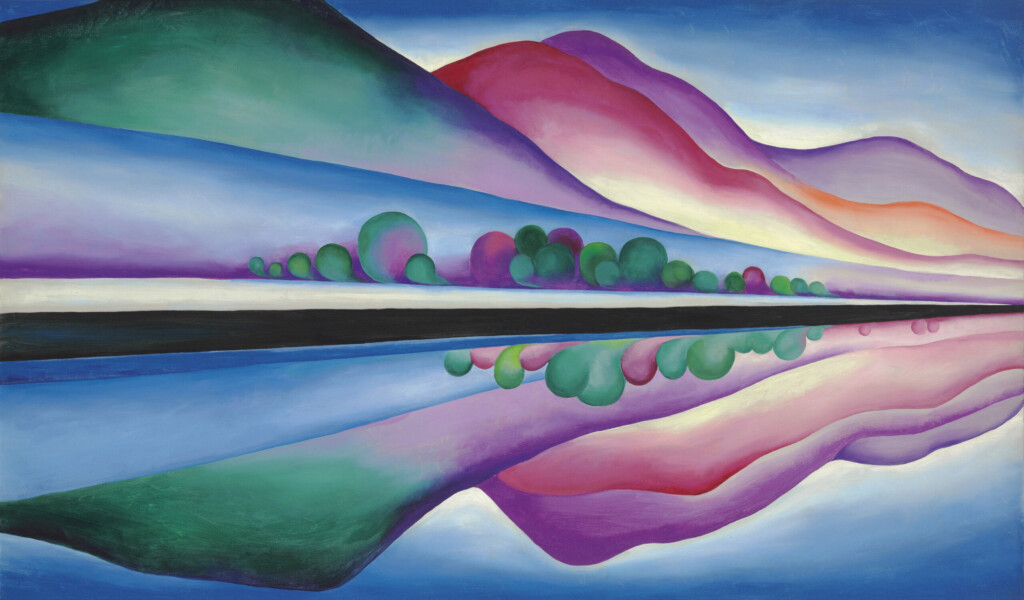
There is a moment — late afternoon light, the kind that turns everything amber and accusatory — when an old woman crouches in a field of cracked earth and lifts an animal skull with both hands. Not dramatically. With the same unhurried attention she might give a piece of bread. From a distance, someone watching might call it grief. They would be wrong. What she is doing is something older and less comfortable than grief. She is recognizing something. Confirming a fact about herself that the rest of the week, the rest of the social world, requires her to forget.
O’Keeffe found the bones by accident, which is to say she found them the way all serious discoveries are made — by being somewhere that most people refused to linger. New Mexico in 1929 hit her like a diagnosis. She had driven out to Taos at Mabel Dodge Luhan’s invitation, and the desert received her the way a desert receives anything: without adjustment, without softening, without the ambient noise of approval that New York had trained her to expect and resist simultaneously. She went back every summer for nearly two decades, and when Stieglitz died in 1946 and the city finally released its claim on her, she moved permanently to Abiquiú, to Ghost Ranch, to a landscape that had been waiting with geological patience.
The skulls began appearing in her canvases in the early 1930s. Cow skulls, horse skulls, ram skulls, bleached to a whiteness that had nothing to do with innocence and everything to do with duration. She arranged them against skies of impossible blue, floated them above flowers, suspended them in spatial relationships that defied gravity and narrative both. American critics wanted to call it morbid, then quickly retreated and called it mystical instead, which is the culturally sanctioned way of avoiding what is actually in front of you.
Georges Bataille argued — in his 1957 study of eroticism and transgression — that the sacred and the repulsive occupy the same territory, that the experience of the sacred is inseparable from the encounter with what social organization most violently excludes. Decomposition, death, the body reduced to its mineral fact: these are not opposite to beauty in Bataille’s framework, they are its deepest occasion. The transgression does not destroy the prohibition; it needs the prohibition to mean anything at all. O’Keeffe’s skulls work exactly this way. They do not abolish the flowers. They require them. The proximity is the entire argument.
American culture has a structural allergy to decomposition. Not to death as concept, which it commodifies readily enough, but to death as material process — the slow undoing of form, the body’s patient return to something impersonal. O’Keeffe held that process up to the light and found it beautiful not in spite of what it was but because of the specific quality of its truth. The skull in “Ram’s Head with Hollyhock” from 1935 floats in a blue so saturated it reads as metaphysical, and the dried flower beside it has the same weightlessness, and together they refuse every consolation the viewer arrives with. There is no narrative of loss here. There is only form, and the honest acknowledgment that form ends.
The old woman in the field lifts the skull and turns it slightly, reading it the way you read a face. Something in the orbital structure, the particular curve of bone, holds her attention not because it reminds her of death but because it reminds her of what persists past the performance of being alive. The tenderness in her hands is not mourning. It is the tenderness of recognition between equals — the living form acknowledging the form that has completed itself, that no longer has to negotiate with time.
O’Keeffe was not romanticizing solitude at Ghost Ranch. She was doing something the culture had no adequate language for: she was paying attention to what remains.
The Institution Catches Up With the Rebel
There is a moment in the life of every genuinely dangerous artist when the institution extends its hand, and the gesture looks so much like recognition that it is almost impossible to see it for what it also is: a closing of the file. The hand that receives the medal and the hand that once painted a flower so large it forced an entire culture to look at something it had been carefully not seeing — these two hands belong to the same body, but the ceremony has already decided which one it intends to remember.
Georgia O’Keeffe received the Presidential Medal of Freedom in 1977. She was eighty-nine years old. The National Medal of Arts followed in 1985, when she was ninety-seven. These were not recognitions arriving late by accident. Lateness is structural. The Museum of Modern Art had mounted her retrospective in 1946, making her the first woman to receive that honor from the institution, a fact that sounds triumphant until you notice how the framing of that triumph required her to be singular, exceptional, an anomaly rather than evidence of a systemic exclusion. The medal and the retrospective do not contradict each other. They complete the same sentence.
Pierre Bourdieu, writing in The Rules of Art, describes how the literary and artistic field operates through a process of consecration — a slow metabolic absorption by which the field converts radical gestures into cultural capital, stripping them of their capacity to disturb and reinvesting them as heritage. The dangerous work does not disappear. It is displayed. But display is a form of containment. A painting behind glass in a permanent collection is no longer an interruption; it is part of the furniture of civilized life. Bourdieu understood that the most effective way to neutralize a challenge is not to refuse it but to celebrate it so completely that its edges dissolve into the applause.
There is a scene — it belongs to no fiction, only to the recurring grammar of human ceremony — in which a woman sits at a formal table, wearing the correct clothes, receiving the correct praise, while somewhere at the edge of the room, in a photograph on a wall or a memory that moves like a shadow behind the speeches, there is a younger version of her. The one who worked alone in the desert without permission from anyone. The one who pressed her face close to a jimsonweed in full bloom and decided the painting would be enormous, aggressive, impossible to ignore. That younger woman is not present at the ceremony because she cannot be. She would have asked the wrong questions. She would have noticed the wrong things. The applause is loudest precisely at the moment she is being most thoroughly covered over.
This is not cynicism about honor. It is something more precise. O’Keeffe’s work had always operated by insisting on presence — the skull against blue sky demanding that you sit with mortality rather than decorate it, the pelvic bones framing light in a way that made transcendence and decomposition identical. That insistence is not what the medals were honoring. What they were honoring was survival, perseverance, the long arc of a career that could now be narrated as individual triumph rather than structural indictment. The story of one exceptional woman is far less costly to tell than the story of what the institution had been doing to all the others.
Bourdieu called this the “autonomization of the field” — the art world’s capacity to appear self-governing, meritocratic, above the mechanisms of power, precisely while reproducing them. O’Keeffe became, in her consecrated form, the proof that the system works. For the system, that is by far the more useful O’Keeffe. The one painting in Abiquiu at four in the morning, before the light changed and the world caught up with her, serves a different purpose entirely — one the institution has never quite known what to do with.
What Remains When the Eye Goes
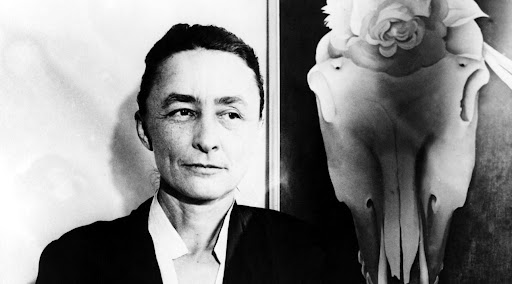
There is a particular cruelty in what the body chooses to take last. Not the hands. Not the mind that had spent eight decades building a vocabulary of form so precise it could reduce a mountain range to three brushstrokes. What went was the eyes.
By the early 1970s, the macular degeneration had progressed far enough that the desert she had painted for forty years became a blur of approximate color, the edges of things dissolving into one another the way watercolors bleed when the paper is too wet. She was in her eighties. She had been looking at that landscape with an attention so sustained it amounted to a kind of prayer, and now the instrument of that attention was failing in the most specific, most surgical way possible — not darkness, but the destruction of the center of the visual field, the precise zone where detail lives, where a painter reads the world.
William James, in the Principles of Psychology published in 1890, argued that the self is not a fixed entity but a continuous stream, a process of perception threading through time. The sense of who we are, he wrote, is inseparable from the habits of attention we cultivate, the particular way we have learned to take the world in. What this means, followed to its honest conclusion, is that a painter does not merely use vision as a tool. Vision is the architecture of her selfhood. It is not what she does. It is what she is.
This is not a metaphor. It is a structural claim about identity, and it makes O’Keeffe’s condition not a peripheral biographical detail but a philosophical event. When the center of the visual field degrades, the painter does not simply lose a capacity. She loses the organ through which her particular form of being in the world was organized. The question this opens is not inspirational. It is genuinely frightening: what remains?
What remained, first, was her hands. She turned to pottery for several years, working with clay in a way that relocated knowledge from the eye to the fingertip, trading the distance of looking for the immediacy of touch. There is something almost too neat about this transition, and it would be dishonest to romanticize it as a serene acceptance. The pots she made are works of discipline, but they are not paintings. She knew the difference.
Then Juan Hamilton arrived, a young sculptor who became her assistant, her companion, her practical connection to a world she could no longer fully see. Under his guidance, working with photographs enlarged to near-abstraction and with his physical help orienting her materials, she returned to painting in the late 1970s. The canvases from this period are not diminished versions of her earlier work. They are something stranger than that — images made by a woman navigating through perception largely destroyed, trusting what her memory of form had built into her muscles over sixty years of practice.
There is a man in a film who spends years building something in silence, in a room no one else enters, not because he expects anyone to understand it, but because the act of building is the only form of coherence left to him after everything external has been stripped away. You watch him and feel not admiration exactly, but a kind of vertigo, because the activity makes no sense by any social measure and yet it is absolutely serious. O’Keeffe painting with near-total blindness belongs to that same register of human behavior — the kind that resists being made useful by interpretation.
James also wrote that habit is the flywheel of society, the mechanism that keeps us functioning when conscious will is insufficient. Sixty years of looking at the world in a specific way had deposited something in her that did not require the eyes to access. The hand knew. The body knew. Whether that constitutes consolation or simply continuation is a question she never answered for us, and the marks she made on those final canvases do not answer it either.
🌸 Between Art, Spirit, and the American Desert
Georgia O’Keeffe’s life and works exist at the intersection of modernist painting, nature mysticism, and fierce artistic independence. The articles below explore the broader worlds of artists, thinkers, and movements that resonate most deeply with her vision — from the radical creativity of her contemporaries to the philosophical search for inner meaning that shaped her solitary New Mexico years.
Frida Kahlo: Life and Works
Frida Kahlo and Georgia O’Keeffe stand as two of the most iconic female artists of the twentieth century, both forging intensely personal visual languages rooted in their own bodies, landscapes, and inner lives. Kahlo’s Mexican surrealism and O’Keeffe’s American modernism share a refusal to subordinate personal truth to prevailing artistic movements. Reading their parallel journeys reveals how two women on different continents each transformed pain and place into enduring myth.
GO TO THE SELECTION: Frida Kahlo: Life and Works
Mexican Muralism: History and Protagonists
The Mexican Muralism movement, led by Rivera, Orozco, and Siqueiros, was reshaping the definition of art as a public and political force at the same moment O’Keeffe was developing her intimate, large-scale flower and desert paintings in New York and New Mexico. Both movements grappled with questions of national identity, landscape, and the role of the artist in modern society. Understanding Muralism deepens our appreciation of the broader cultural ferment in which O’Keeffe’s singular modernism emerged.
GO TO THE SELECTION: Mexican Muralism: History and Protagonists
Titian: Life and Works
Titian’s late career, like O’Keeffe’s, is a study in the radical freedom that comes when a great artist sheds the need for external approval and follows only the inner logic of their vision. His luminous surfaces and dissolution of form into color anticipate, across centuries, the way O’Keeffe used color to evoke something beyond the visible. Exploring Titian’s life and works offers a rich comparative lens for understanding how masters of different eras pursue the essential over the merely beautiful.
GO TO THE SELECTION: Titian: Life and Works
Art Brut: History and Meaning
Art Brut, the tradition of raw, unmediated artistic creation outside academic convention, shares with O’Keeffe’s work a deep suspicion of institutional taste and a commitment to authentic self-expression. Though O’Keeffe worked within the modernist gallery world, her insistence on painting what she truly saw — and felt — rather than what critics expected gives her work a similarly untamed quality. This article traces the history of a movement that, like O’Keeffe herself, refused to be domesticated by the art establishment.
GO TO THE SELECTION: Art Brut: History and Meaning
Discover Independent Cinema on Indiecinema
If Georgia O’Keeffe’s lifelong search for beauty, solitude, and authentic vision speaks to you, Indiecinema streaming is your next destination. Our curated catalog gathers the finest independent and art-house films — works that, like O’Keeffe’s paintings, dare to see the world differently and invite you to do the same.
👉 EXPLORE THE CATALOG: Watch Indie Films in Streaming
A vision curated by a filmmaker, not an algorithm
In this video I explain our vision

