
The Wall Before the Word
You walk into the building and the wall hits you before your eyes have adjusted to the light. Not metaphorically — there is something genuinely physical in the encounter, a pressure at the sternum, a slight disorientation of scale that makes you grip the railing without meaning to. The figures are enormous. They are not decorating the space; they are occupying it, claiming it, refusing to let the architecture be merely architecture. Faces contorted in labor, in rage, in something that sits uncomfortably between ecstasy and suffering. Bodies piled against bodies, brown and ochre and scorched red, limbs that seem to reach past the plaster surface toward you specifically. You do not know where to look because every corner of your vision is being addressed simultaneously, and the cumulative effect is not wonder. It is something closer to accusation.

This is not what public art is supposed to feel like. Public art is supposed to harmonize with its surroundings, soothe the anxiety of civic space, remind citizens that they inhabit something dignified and continuous. What you are standing before does none of that. It refuses decoration as a category. It insists, with the stubbornness of someone who has survived something you have not, that you see what happened here.
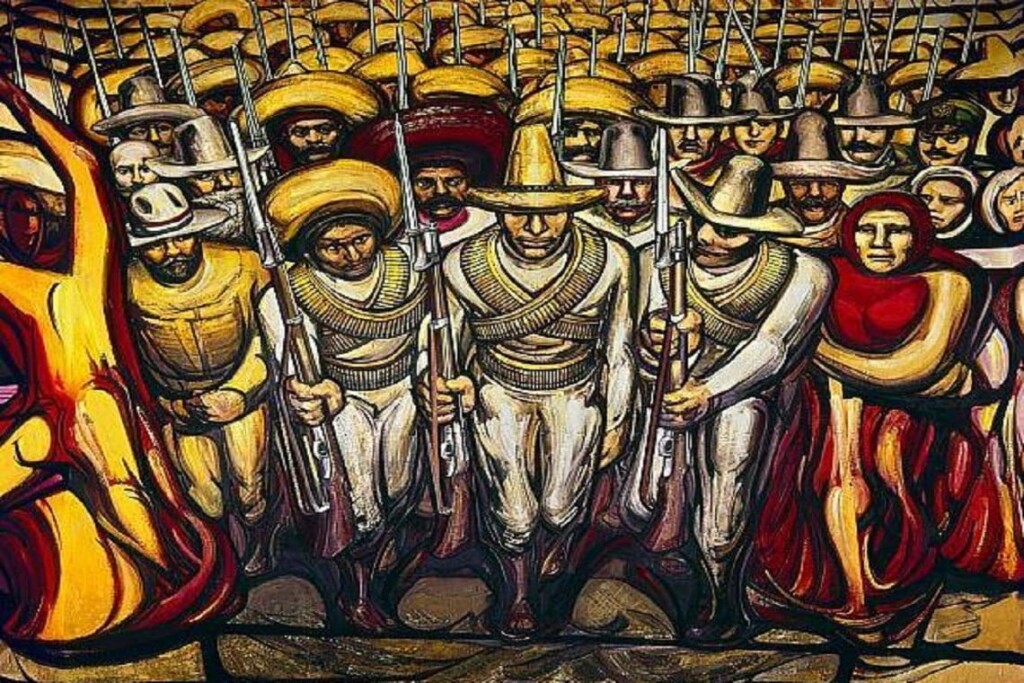
What happened was the Mexican Revolution, which began in 1910 and did not truly end until 1920, and which left approximately two million people dead in a country of fifteen million. That is a number that reads cleanly on a page and means almost nothing until you try to hold it against the actual texture of a decade — the burning of villages, the displacement of entire populations, the execution of men in village squares, the typhus and starvation that killed as many as the bullets did. Francisco Madero, Emiliano Zapata, Pancho Villa, Venustiano Carranza — each represented not merely a faction but an entire philosophy of what Mexico was supposed to become, and each of those philosophies was eventually answered with an assassination. The revolution consumed its own logic repeatedly, producing not a single liberating rupture but a series of catastrophes that left the country standing, barely, on the rubble of everything it thought it was.
Into this silence — the silence that follows not resolution but exhaustion — the muralists arrived. Diego Rivera returned from Europe in 1921, having spent fourteen years absorbing Cubism and Renaissance fresco technique in equal measure, carrying both like weapons he had not yet decided how to use. José Clemente Orozco had lived through the revolution inside Mexico, had watched the violence from within rather than from the cafes of Paris and Madrid, and what he brought to the wall was not ideology but visceral horror, the knowledge that every political program eventually produces its pile of bodies. David Alfaro Siqueiros, the youngest of the three, had fought as a soldier in the Constitutionalist Army before turning to paint, and he never entirely stopped being a soldier; his murals feel like tactical maneuvers, attempts to seize and hold territory through sheer visual force.
What bound them was not style — their styles were in fact radically incompatible — but a shared understanding of what the wall could do that no canvas could. Walter Benjamin, writing in 1936 in his essay on the work of art in the age of mechanical reproduction, argued that the authority of an original artwork resides in part in its location, its embeddedness in a specific place and time. The mural takes this principle to its extreme. It cannot be moved, cannot be sold to a private collector, cannot be hung in a drawing room above a fireplace. It belongs to the building and the building belongs to the public, and the public must pass through it to conduct the ordinary business of civic life. You cannot choose not to see it. This is not incidental to what the muralists were doing. It is precisely the point.
The wound that two million deaths open in a national body does not close because someone declares the fighting finished. It requires a different kind of witness.
Don Barry: A Quixotic Exploration

Docufiction, Experimental, by Paul Smart, Mexico, 2026.
Don Barry: A Quixotic Exploration is a debut feature that places the biography of an eighty-year-old experimental filmmaker and artist, Barry Gerson, within the metanarrative of Miguel de Cervantes’ Don Quixote. Don Barry was filmed in the city of Guanajuato during the 51st edition of the Cervantino Festival, as well as during the vibrant Day of the Dead celebrations held in the city’s UNESCO-listed tunnels. The film honors the director’s long friendship with artist Barry Gerson, drawing inspiration from Cervantes’ Don Quixote. Paul Smart’s directorial choices create something new that celebrates life and goes beyond conventional storytelling. A search for magic in our real lives. A moving film about the meaning of life, art, and death. Not to be missed.
Paul Smart is a proud outsider filmmaker with a long history of film screenings. In the 1980s, he emerged in New York’s vibrant youth art scene, working in theater production and later filmmaking, before retreating to rural upstate New York, in the Catskill Mountains, where he made a living writing and screening independent films in old parish halls for rural audiences, many of whom had never seen a film.
LANGUAGE: English
SUBTITLES: Spanish, French, German, Portuguese
The State That Commissioned Its Own Indictment
There is a moment when you stand in front of a government building and look up, and what looks back at you is an accusation. Not a slogan, not a portrait of a founding father with his jaw set at the correct angle of nobility, but something rawer — bodies in chains, priests blessing conquistadors while villagers burn, the machinery of capital grinding human figures into abstraction. You were not supposed to feel what you feel standing there. This is the lobby. This is where you come to pay a tax, to file a form, to be processed by the state. And yet the walls are telling you the state is a crime.
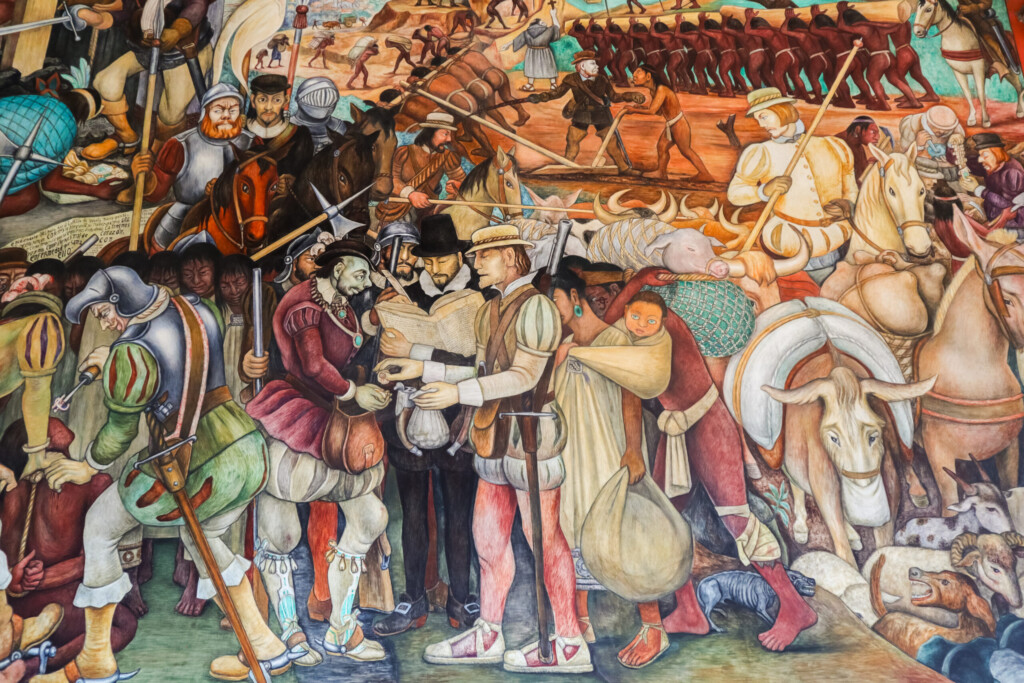
This is not a metaphor. This is what José Vasconcelos did between 1921 and 1924, when as Minister of Public Education under President Álvaro Obregón he authorized and funded one of the most structurally paradoxical cultural projects in modern history. He invited Diego Rivera, José Clemente Orozco, David Alfaro Siqueiros and others to cover the walls of the Secretaría de Educación Pública, the Escuela Nacional Preparatoria, and various government buildings with images that systematically questioned the legitimacy of every institution that had commissioned them. The budget was real, the scaffolding was real, the contracts were signed by officials in rooms with marble floors. And on those same marble floors, over the following years, visitors walked beneath paintings that depicted the Spanish conquest as organized massacre, the Church as instrument of subjugation, and the ruling class as a grotesque carnival of parasites.
Think of the man who watches war footage he was never meant to see — reel after reel projected in a public square, the kind of images that were supposed to remain classified, too honest, too direct, too damaging to the official story. He stands there in the open air, and he watches, and the strange part is not the horror of what is shown but the fact that someone put the projector there. Someone threaded the film. Someone opened the square and let the crowd in. The sanction and the indictment arrived from the same hand, and this is not an accident or a lapse of judgment. It is the structure of something more interesting and more dangerous than simple censorship.
Hannah Arendt, writing in “On Revolution” in 1963, distinguished between power as the collective capacity to act in concert and violence as its ersatz replacement when that capacity collapses. What the post-revolutionary Mexican state attempted, however briefly, was something she identified as exceptionally rare: the institutionalization of revolutionary energy before it calcified into mere authority. Vasconcelos understood, with the particular clarity of someone who had lived through the Díaz dictatorship and the chaos of a decade of civil war, that legitimacy in 1921 could not be restored through monuments to continuity. The old visual grammar was discredited. The new government needed a different kind of wall.
Walter Benjamin, in his “Theses on the Philosophy of History” written in 1940 and published posthumously, argued that the historian’s task is to brush history against the grain — to rescue the tradition of the oppressed from the triumphal procession of the victors, who drag their conquered along as spoils. What Rivera and Orozco painted was precisely this counter-history, made monumental, made inescapable, made public. But the paradox Benjamin could not have fully anticipated is that the brushing against the grain was being commissioned, funded, and publicly endorsed by the inheritors of the very triumphal procession the paintings condemned. The state handed the muralists a megaphone and pointed it at the state. The institution became the stage for its own dismantling.
Whether this represents the revolution eating itself, or whether it represents something more cunning — a power structure sophisticated enough to absorb its own critique and thereby neutralize it — is a question that does not resolve cleanly. Vasconcelos himself would later move toward nationalism and a politics of racial hierarchy that complicated his early idealism enormously. Rivera’s relationship with successive governments oscillated between mutual use and mutual suspicion. The walls remained. The contracts had been signed.

Diego Rivera and the Theology of the Visible
There is a moment, if you have ever worked with your hands long enough, when you stop recognizing them. You are performing a gesture you have performed ten thousand times — folding, pressing, turning, fastening — and suddenly the hands doing this thing feel like they belong to someone else entirely. You watch them move with a strange, removed curiosity, and for one disorienting second you see yourself from the outside, a body inside a system, a motion inside a machine. It passes almost immediately. The familiarity rushes back and swallows the vision whole. But for that instant, something true was visible.
Rivera understood that instant as the political problem of modernity. Not oppression in the abstract, not capital as a theoretical construct, but the specific phenomenological condition of a human being who can no longer see themselves clearly because the rhythm of production has colonized their perception. When he stood inside the Ford River Rouge Complex in 1932, studying the assembly lines that would become the Detroit Industry Murals, he was not documenting industry. He was mapping the precise coordinates of what Marx had called entfremdung — alienated labor, the worker severed from the product of their work, from the process, from their fellow workers, and finally from themselves. The manuscripts of 1844 gave the concept its philosophical architecture, but Rivera gave it a face, a posture, a pair of hands that are recognizably your hands.
The murals he produced for the Detroit Institute of Arts between 1932 and 1933 are twenty-seven frescoes covering all four walls of an interior courtyard, and they operate not as decoration but as environment. You do not look at them. You stand inside them. The workers depicted are not rendered as victims of the system — they are enormous, almost geological in their solidity, their bodies interlocking with machinery in a visual grammar that refuses the simple binary of exploitation. This was the Gramscian move, executed in pigment and lime plaster. Antonio Gramsci, writing from his Fascist prison cell in the early 1930s, developed the concept of the organic intellectual — not the detached academic, but the thinker who emerges from within a class and articulates its experience in forms that class can recognize and use. Rivera was precisely this, except his medium was not the pamphlet or the lecture but the wall of a public building, inescapable, free to enter, impossible to own privately.
The National Palace cycle, begun in 1929 and never fully completed even by Rivera’s death in 1957, performs a different but related operation. Across the main staircase in Mexico City, Rivera compressed roughly seven centuries of Mexican history into a single visual argument — and the argument is that the past is not past. The Aztec market at Tlatelolco, the Spanish conquest, the Inquisition, the Reform Wars, the Revolution, all coexist in a continuous present tense that refuses the consolation of historical progress. This is not nostalgia and it is not revolutionary optimism. It is something closer to what Walter Benjamin, writing in his Theses on the Philosophy of History in 1940, called the tiger’s leap — the idea that every moment of the present is charged with the compressed energy of all the moments that produced it, that history is not a line but a pressure.
Then came Rockefeller Center in 1933, and the fresco that could not be permitted to exist. Rivera had included a portrait of Lenin in Man at the Crossroads, and when Nelson Rockefeller requested its removal, Rivera refused. The mural was covered in May 1933 and destroyed in February 1934. What is interesting is not the censorship itself, which was predictable, but what the censorship confirmed: that a painted wall can be genuinely threatening, that visibility itself — the act of making certain things impossible to look away from — is a form of power that institutions recognize and fear before most individuals do.
That woman watching her own hands perform their ten-thousandth gesture — the mural’s true function is to extend that moment of outside-seeing rather than let it collapse back into habit.
Orozco’s Fire: When the Image Refuses to Comfort

There is a specific kind of discomfort that arrives when a story refuses to end the way you need it to. You are sitting in the dark, and the hero — the one the entire structure of the preceding two hours has trained you to follow, to invest in, to half-become — does not survive. And worse: the ending offers no explanation. No camera lingers meaningfully on a symbolic object. No secondary character speaks the lesson aloud. The screen simply moves on, and then it stops, and you are left holding the full weight of what happened with no ideological container to put it in. You do not feel catharsis. You feel exposed.
This is the precise emotional register in which José Clemente Orozco worked.
Among the three great muralists of the Mexican movement, Orozco is the one history tends to approach with a kind of nervous admiration — acknowledging his power while quietly preferring Rivera’s legibility or Siqueiros’s militant clarity. Because Orozco gave you nothing to hold onto. His figures do not march toward liberation. They burn. They collapse. They contort under forces that are never fully named, because he understood, with the philosophical honesty that most artists fear, that naming a force domesticates it. Between 1932 and 1934, working at Dartmouth College on what would become the Epic of American Civilization, he painted a sequence that moves from ancient Mesoamerican cosmology through conquest and into industrial modernity — and the arrival of the modern is not presented as progress. It is presented as a different species of catastrophe. The ancient gods and the new machines share the same grammar of destruction. The only thing that changes is the vocabulary of the justification.
Nietzsche, in the second of his Untimely Meditations, published in 1874, warned against what he called monumental history — the tendency to narrate the past as a procession of peaks, each one justifying the suffering required to reach it. This, he argued, was not history at all. It was mythology wearing the costume of scholarship, and its true function was to anesthetize the present by making its violence appear necessary. Orozco had read nothing of Nietzsche, almost certainly, but he had read something deeper: he had read the ruins of Guadalajara, the corpses of the Revolution, the particular way a country learns to celebrate the deaths that made it what it is. His Dartmouth murals are the visual equivalent of Nietzsche’s warning made flesh — a refusal to allow historical suffering to be laundered into meaning.
Then, between 1938 and 1939, he worked inside the Hospicio Cabañas in Guadalajara, and he painted what may be the most terrifying image in the entire canon of twentieth-century mural art: Man of Fire, a human figure consumed entirely by flame at the apex of the dome, ascending or disintegrating — and the architecture refuses to tell you which. Simone Weil, writing in the early 1940s in her essays collected posthumously as Waiting for God, developed the concept of affliction — malheur in her French — as something categorically distinct from ordinary suffering. Affliction, she argued, is suffering that does not ennoble, that does not teach, that strips the self of the social and psychological scaffolding through which human beings normally construct meaning. It does not build character. It destroys the machinery through which character is built. The figure at the top of Orozco’s dome is not a martyr. It is not a revolutionary. It is a human being in a condition that ideology cannot reach.
Rivera painted history as a mural of causes and effects, arrows pointing forward. Siqueiros painted history as a call to action. Orozco painted history as a furnace, and the furnace does not promise anything on the other side of the heat. What you see in the Hospicio Cabañas is not pessimism — pessimism is still a position, still a stance from which one addresses the future. What you see is something prior to that, something that refuses the consolation of even a negative conclusion. The fire does not mean anything. It is simply fire, and it is enormous, and you are standing inside the building where it lives.
Siqueiros and the Weapon Disguised as Art
There is a wall you pass every morning, and for weeks it has been white. Not clean — white in the way of absence, the way a silence becomes aggressive when it lasts too long. One night someone is there with a can, no sketch, no plan, pressing pigment into the surface before any thought arrives to justify it. The act is not symbolic. It is physical, almost metabolic — the body responding to an intolerable blankness the way the throat responds to smoke.
This is where Siqueiros begins. Not in ideology, though ideology came, vast and disciplined and sometimes catastrophic. Not in theory, though theory followed, baroque and precise. He begins in the conviction that a surface left untouched by force is a surface already occupied by the enemy. The blank wall is never neutral. It belongs to someone, and that someone is not you.
David Alfaro Siqueiros fought in the Constitutionalist Army before he was twenty, organized miners in Jalisco, commanded an anti-fascist battalion in Spain, and in May 1940 led an armed assault on Leon Trotsky’s house in Coyoacán — disguised as a police officer, firing over two hundred rounds into the bedroom, failing to kill him by margins that still seem improbable. He was not a man who used art as a metaphor for struggle. He used art the way he used everything else: as a weapon whose caliber needed to be continually upgraded. Frantz Fanon, writing in The Wretched of the Earth in 1961, argued that decolonial violence is not a symptom of oppression but its structural negation — that the colonized subject does not express suffering through violence but reconstitutes their humanity through it. Siqueiros did not need to read Fanon to inhabit this logic entirely. He was already living its most extreme formal consequence.
What he built between 1939 and 1940 in Mexico City — on the walls of the Mexican Electricians’ Union — is not a mural in any decorative sense. It is a machine designed to produce ideological disorientation in the viewer standing inside it. The composition annihilates the frame. Figures of capital — helmeted, insectoid, bureaucratic — emerge from multiple angles simultaneously, without a stable vanishing point, without the reassurance of perspective that tells you where to stand and therefore who you are. The technique was deliberate: Siqueiros had been experimenting since the 1930s with industrial lacquers, spray guns borrowed from automobile manufacturing, surfaces that could receive pigment at velocities no brush could match. The result is paint that does not describe violence — it enacts it spatially. You cannot look at it. You are inside it.
Guy Debord, in The Society of the Spectacle published in 1967, diagnosed modern capitalism’s most sophisticated weapon as the transformation of all lived experience into image — the replacement of being with appearance, of action with representation. The spectacle does not suppress revolt; it absorbs it, reframes it, sells it back. Siqueiros understood this problem before Debord named it, which is why he refused the frame, refused the gallery, refused any surface that could be cleanly photographed and distributed as cultural product. The Polyforum Cultural Siqueiros, completed the year before his death in 1974, takes this refusal to its architectural conclusion: a twelve-sided building whose interior is a single continuous painting of over four thousand square meters, designed so that no single viewpoint can contain it. It cannot be reproduced. It resists the postcard. It exists only as an environment you physically enter and cannot intellectually master, because mastery requires distance, and Siqueiros has eliminated distance as a structural option.
This is the distinction that separates him from Rivera’s didactic grandeur and Orozco’s tragic expressionism. Rivera teaches. Orozco mourns. Siqueiros constructs a device. The mural is not about revolution — it is engineered to produce in the body of the viewer something that precedes the word revolution, something closer to what that man felt in the dark with the spray can, before any argument arrived to explain why the blank wall had become, finally, unbearable.
A vision curated by a filmmaker, not an algorithm
In this video I explain our vision
What the Wall Knows That the Museum Forgets
There is a man with a roller. That is all. A man with a roller and a bucket of beige paint, moving across a wall the way weather moves across a field — without ceremony, without announcement, without the slightest acknowledgment that what is disappearing beneath each stroke took months to make and decades to mean something. The municipal order came on a Tuesday. By Thursday afternoon, the faces were gone.
This is how it ends, almost always. Not with outrage, not with debate, not with the dignity of a public argument. With beige. With a man doing his job, which is to say, with the most banal expression of power imaginable: the administrative erasure, the bureaucratic palette, the city reclaiming its surfaces as if surfaces had never belonged to anyone but the city.
What the muralists understood, and what their critics and their champions alike have often failed to articulate with sufficient precision, is that the wall was never simply a medium. It was an address. Diego Rivera did not paint the Detroit Industry Murals or the frescoes at the Secretaría de Educación Pública for collectors. He painted them for people who would never have walked into a gallery, who had never been invited to walk into a gallery, who had been systematically excluded from the category of people to whom art was permitted to speak. Pierre Bourdieu spent much of his career documenting this exclusion — in Distinction, published in 1979, he demonstrated with sociological rigor what most people already felt in their bodies: that the art world is not a neutral space of aesthetic appreciation but a field of power, structured precisely to reproduce the social hierarchies it pretends to transcend. The museum entrance is not an open door. It is a threshold that most people learn, very early, is not meant for them.
The muralists blew the threshold apart. Not by making art more accessible in the condescending sense — not by simplifying, not by dumbing down — but by relocating the encounter entirely. They put the work where the people already were. On the walls of ministries, markets, hospitals, schools. On the surfaces that the unlettered and the landless were forced to pass every morning on their way to work. Jacques Rancière would call this a redistribution of the sensible — a reorganization of who gets to perceive, who gets to be perceived, who counts as a subject worthy of representation and who remains invisible in the dominant aesthetic order. The true transgression of Siqueiros, of Orozco, of Rivera was not their communist iconography or their indigenous faces or their scenes of colonial violence. It was their audience. They chose people who had never been chosen.
A mural cannot be owned the way a canvas can be owned. It cannot be moved to a private collection, cannot be purchased and removed from public sight, cannot appreciate in value on an art market while the neighborhood around it deteriorates. This is its radicality, and this is precisely why it must be erased rather than simply ignored. You can ignore a painting in a gallery by never buying a ticket. You cannot ignore a wall you walk past every morning. The image finds you whether you consent to it or not, which means the image has power that the market cannot fully domesticate, and power that cannot be fully domesticated must eventually be painted over.
The man with the roller reaches the upper left corner of what was once a face — a woman’s face, broad-boned, dark-eyed, looking outward with an expression that was never quite defiance and never quite grief but something that held both without resolving either. The beige covers her forehead. Then her eyes. The roller moves with the efficient indifference of a system that does not need to hate what it erases, only to regard it as a problem of surface management. And the people who walked past her every morning on their way to work will walk past bare wall tomorrow, and the question that remains — the one the beige cannot answer — is whether they will remember what it felt like to be looked at by their own history, or whether the forgetting is also something that gets administered, quietly, one coat at a time.
🎨 Art, Revolution, and the Power of the Image
Mexican Muralism was not merely a painterly movement — it was a total vision of history, identity, and social transformation projected onto the walls of public life. Like other great currents of thought and art, it drew from deep cultural roots and spoke in symbols that transcended the merely aesthetic. The articles below explore related worlds where image, myth, and human consciousness intersect in unexpected ways.
Masterpieces of Rebellion and Counterculture Cinema
Revolutionary art and rebellious cinema share a common ambition: to shake the viewer out of passive acceptance and ignite a critical, transformative gaze. Just as the Mexican muralists used monumental imagery to challenge power and rewrite history from below, counterculture cinema has long sought to dismantle dominant narratives through raw visual force. This article maps the films that carry that spirit of defiant creativity into the moving image.
GO TO THE SELECTION: Masterpieces of Rebellion and Counterculture Cinema
Mass Social Homologation Today
The Mexican muralists painted precisely against the grain of mass social conformity, insisting that collective memory and indigenous identity could not be erased by modernization or cultural imperialism. Understanding how homologation works in contemporary societies helps illuminate why movements like Muralism emerged as such fierce acts of cultural resistance. This article examines the mechanisms by which societies flatten difference and silence dissenting visions.
GO TO THE SELECTION: Mass Social Homologation Today
The Unconscious and its Relationship With Cinema
Diego Rivera, Orozco, and Siqueiros painted figures that seem to rise from the depths of collective unconscious — archetypes of struggle, death, rebirth, and transcendence rendered in monumental scale. The relationship between the unconscious and visual art is one that cinema has explored with particular intensity, translating interior worlds into exterior spectacle. This article delves into how the unconscious shapes cinematic language in ways that echo the symbolic power of the great murals.
GO TO THE SELECTION: The Unconscious and its Relationship With Cinema
The Avant-Garde Cinema: Movies to Watch
The avant-garde in cinema shares with Mexican Muralism a refusal of decorative beauty in favor of art as a weapon of consciousness and transformation. Both movements pushed the boundaries of form to force audiences into new ways of seeing the world and their place within it. This curated guide to avant-garde cinema offers a journey through the films that, like the great murals, demand active, questioning spectatorship.
GO TO THE SELECTION: The Avant-Garde Cinema: Movies to Watch
Discover Independent Cinema on Indiecinema
If these intersections between art, history, and the moving image have sparked your curiosity, Indiecinema streaming is the place to go deeper. Our platform gathers the most visionary independent and documentary films from around the world, including works that explore political art, cultural identity, and the revolutionary power of the image. Join us and let independent cinema expand the walls of your world.
👉 EXPLORE THE CATALOG: Watch Indie Films in Streaming
A vision curated by a filmmaker, not an algorithm
In this video I explain our vision

